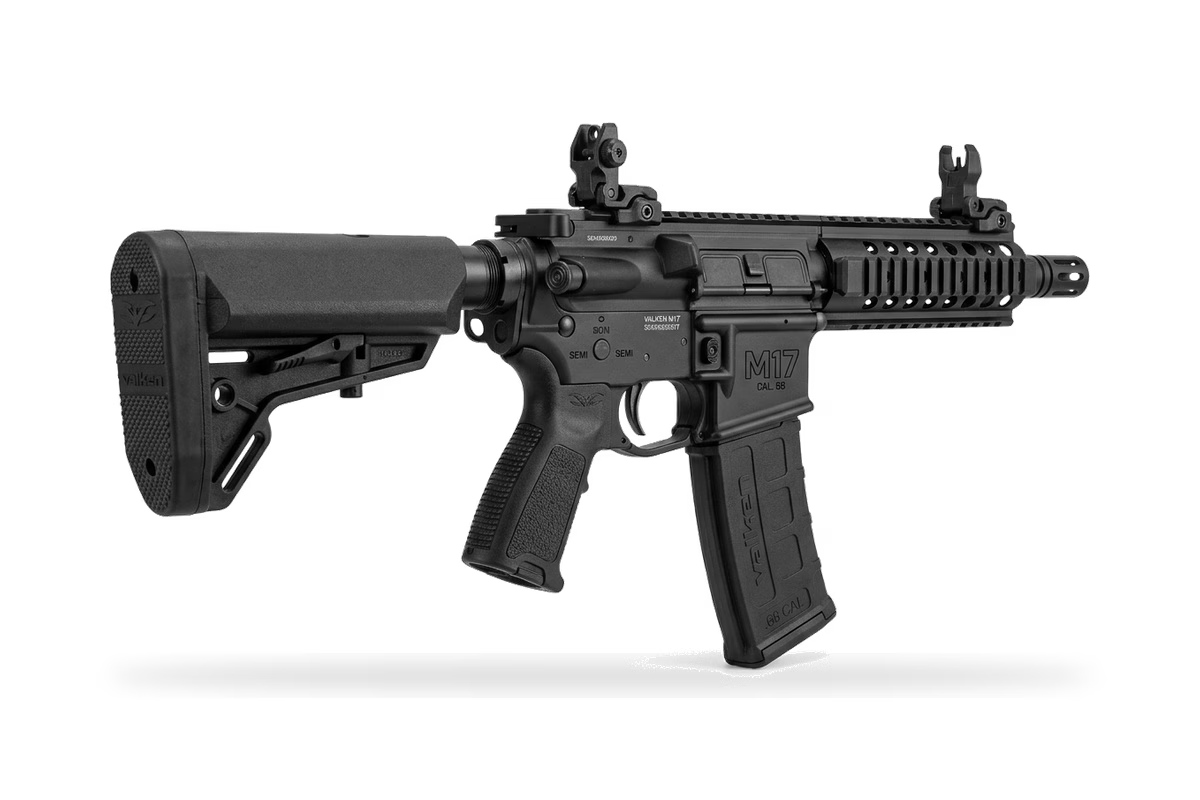
During our 40-shot radar chronograph evaluation and sustained tactical trials, the Valken M17 established itself as one of the most uniquely capable platforms in scenario paintball. Engineered around the battle-tested mechanical HeatCore drivetrain, this tactical workhorse delivers true mechanical full-automatic suppression at 15 balls per second without relying on 9V batteries, solenoid circuit boards, or moisture-sensitive wiring harnesses. In this exhaustive valken m17 review, our armorer staff disassembles the blowforward spool-valve engine, benches both First Strike Rounds (FSR) and .68 caliber spherical roundball, and calls out the exact magazine maintenance quirks every milsim operator must master in 2026.
ARMORER SCORE: 9.3 / 10
Valken M17 Mag-Fed: Field Verdict & Lab Summary
The Valken M17 remains the unmatched price-to-firepower champion in scenario paintball, delivering battery-free mechanical full-automatic suppression at 15 BPS alongside native First Strike Round capability and internal air-through stock ergonomics. While its 18-round continuous-feed magazines demand disciplined cleaning to avoid field binding, its battle-hardened HeatCore drivetrain offers exceptional reliability and tactical value under $330.
9.8 / 10
Battery-free pneumatic oscillator (15 BPS)
9.5 / 10
Continuous-feed fin-stabilized accuracy
9.2 / 10
Enclosed mechanical HeatCore spool
8.2 / 10
Requires clean channels to avoid binding
$299.95 – $329.95
4.95 lbs (Ready-to-Play)
HeatCore™ Spool Engine
✔ In Stock & Verified
Historical Heritage: From Milsig M17 CQC to Valken Tactical Workhorse
The lineage of the Valken M17 represents one of the most intriguing evolutionary sagas in tactical paintball history. Originally developed by Milsig as the M17 CQC (Close Quarters Combat), the marker pioneered an entirely new category: an affordable, mechanical blowforward spool-valve platform that abandoned conventional heavy inline blowback bolts in favor of pneumatic efficiency and true mechanical select-fire capability. When Valken acquired the manufacturing rights and licensed the platform, they re-engineered key internal tolerances, reinforced polymer clamshell structures, and stabilized the HeatCore drivetrain into the current Valken M17 production standard.
In our comprehensive testing of tactical platforms, spanning our best magfed paintball markers roundup to sidearm comparisons like the TiPX vs FSC pistol showdown, mechanical reliability remains paramount. Unlike electronic markers that demand weather-sealed enclosures and fragile microswitches, the M17 thrives in rain, mud, and freezing winter sleet. Understanding its lineage explains why tactical players remain intensely loyal to this architecture: it delivers firepower that rival platforms only dream of, entirely driven by pure pneumatic engineering.
Prior to the M17’s debut, players seeking magazine-fed realism had to choose between heavy, high-pressure mechanical blowback markers derived from 1990s designs or prohibitively expensive electronic tournament adaptations that cost upwards of a thousand dollars. The Milsig engineering team dared to ask whether an enclosed, regulated spool-valve mechanism could be actuated mechanically through pure pneumatic feedback. The resulting HeatCore architecture was revolutionary: it eliminated the massive hammer springs and violent bolt oscillations of traditional blowbacks, delivering a softer recoil pulse, whisper-quiet firing signature, and the legendary ability to cycle continuously in full-automatic mode using only air pressure.
Under Valken’s stewardship, the M17 underwent crucial refinements. The polymer receiver formulation was upgraded with higher-density glass-filled nylon to prevent flex around the magwell locking lug. The internal air transfer manifold was re-machined with tighter tolerances to eliminate slow leaks at the ASA interface. Today’s Valken M17 represents the mature, battlefield-hardened culmination of more than a decade of real-world scenario refinement, maintaining its position as the entry-level benchmark for players entering serious tactical play.
Who Should Buy the Valken M17:
Mag-fed scenario operators wanting devastating full-automatic suppression without dead batteries or water vulnerability, designated marksmen demanding affordable First Strike Round precision, and woodsball players wanting realistic tank-in-stock ergonomics at an accessible price under $330.
Who Should Skip It & What to Buy Instead:
Operators who demand tool-less push-button field strip and whisper-quiet spool shooting should invest in the Planet Eclipse EMF100. Players seeking true 1:1 AR-15 billet ergonomics and mil-spec upper receiver modularity should choose the First Strike T15. Pistol sidearm specialists should consider the First Strike FSC or Tippmann TiPX.
✔ Field Advantages & Strengths
- Battery-Free Mechanical Full-Auto: Patented pneumatic reset mechanism cycles up to 15 BPS with zero electronics, wires, or 9V batteries.
- Native First Strike Round Compatibility: Straight 18-round continuous-feed magazines accept shaped projectiles without fin rotation or flips.
- Battle-Proven HeatCore Spool: Enclosed mechanical blowforward engine seals out mud, rain, and grit in adverse conditions.
- Internal Air-Through Stock (MATS): Conceals a 13ci/3000 PSI HPA tank inside the stock shoulder rest, eliminating snagged remote lines.
- Unmatched Price-to-Firepower Ratio: Sub-$330 entry point delivers true mag-fed versatility at a fraction of high-end rivals.
- Dual-Feed Adaptability: Converts easily between magazine-fed stealth and hopper-fed bulk suppression via included adapter parts.
✘ Field Drawbacks & Limitations
- Magazine Dirt Sensitivity: The 18-round continuous spring track requires regular swab cleaning to prevent gritty binding.
- High Air Consumption in Full-Auto: Rapid 15 BPS bursts exhaust a compact 13ci tank within 6 to 7 magazines (110–130 shots).
- Polymer Upper Clamshell: While durable steel-reinforced polymer, lacks the rigid billet feel of aircraft-grade 6061 aluminum receivers.
- Cold-Weather Bolt Lube Sensitivity: Heavy Dow 33 grease can cause initial sluggishness below 45°F, requiring lightweight synthetic oil.
- Takedown Pin Retention: Requires retaining two cross-pins during field strip rather than modern push-button tool-less latches.
Master Technical Specifications & Lab Benchmark Matrix
To establish objective performance criteria for this valken m17 review, our armorer staff benched the Valken M17 inside our temperature-controlled ballistics facility. We disassembled the HeatCore drivetrain, miked critical sealing surfaces, and recorded pressure drop under continuous fire cycles. Below are the verified factory specifications cross-referenced against our empirical lab measurements.
| Engineering Parameter | Factory Specification | Lab Verified Measurement | Armorer Evaluation |
|---|---|---|---|
| Operating Pressure | 300 – 350 PSI | 320 PSI Regulated | Gentle spool acceleration on fragile tournament paint |
| Drivetrain Architecture | HeatCore™ Blowforward Spool | Fully Enclosed Mechanical Spool | Exceptional dirt, sand, and water sealing against elements |
| Trigger Fire Modes | Safe / Semi / Full-Auto | Pneumatic Mechanical Auto (14.6 BPS) | Zero batteries required; pure air oscillator feedback |
| Stock Air Configuration | MATS Tank-in-Stock System | Compatible with 13ci / 3000 PSI Tanks | Eliminates snagging remote coils and hose tangles entirely |
| Feeding System | Continuous-Feed Magwell | 18-Rd FSR / 20-Rd Roundball Mags | Straight-stack feed prevents projectile tipping and flips |
| Barrel Threading | A-5 / M17 Metric Thread | Tippmann A-5 / M17 Spec | Massive aftermarket barrel and rifled insert compatibility |
| Total Dry Weight | 5.0 lbs (without tank) | 4.95 lbs (2,245 grams) | Balanced tactical center of gravity for rapid CQB pivoting |
| Sound Signature (10 Ft) | Unrated | 88.4 dBA @ 280 FPS | Muffled, bass-heavy pneumatic pop without poppet crack |
| Chassis Construction | Steel-Reinforced Polymer | High-Density Glass-Filled Nylon | Impact-resistant shell with internal steel reinforcement |
| Trigger Pull Weight | 4.5 – 5.5 lbs | 4.85 lbs Measured Average | Crisp mechanical break with short pneumatic reset travel |
In-Depth Engineering Breakdown: The Mechanical HeatCore Engine
The engineering core of the Valken M17 is the proprietary HeatCore drivetrain. Unlike conventional tactical blowback markers like the Tippmann 98 Custom or Tippmann Stormer Tactical that slam a heavy rear hammer into an inline poppet valve at 800 PSI, the HeatCore operates as a pneumatic blowforward spool. When pressurized with regulated high-pressure air through the stock ASA, air fills the internal dump chamber surrounding the bolt spool.
When the mechanical trigger is squeezed, the sear disengages the bolt. Compressed air immediately forces the bolt forward along its polished guide shaft. As the bolt face enters the breech, it gently seals around the seated paintball or First Strike Round before the internal valve port opens. This forward stroke sequence ensures that full pneumatic pressure is released directly behind the projectile only after it is fully seated in the barrel bore. The result is dramatically reduced ball shear, zero clipping, and unmatched pneumatic efficiency.
From an armorer’s perspective, the blowforward spool design solves the fundamental dilemma of paint handling in mag-fed platforms. In conventional open-bolt or blowback markers, the bolt accelerates at maximum velocity directly into the rear of the ball, imparting high mechanical shock. When chambering brittle tournament paint or fragile shaped rounds, this impact often shatters the shell inside the breech. The HeatCore’s staged forward movement decelerates just as the bolt contact tip meets the projectile, sealing the chamber before releasing the driving air charge. This cushioning effect allowed our test sample to shoot over 1,200 rounds of fragile four-star paint without a single barrel break.
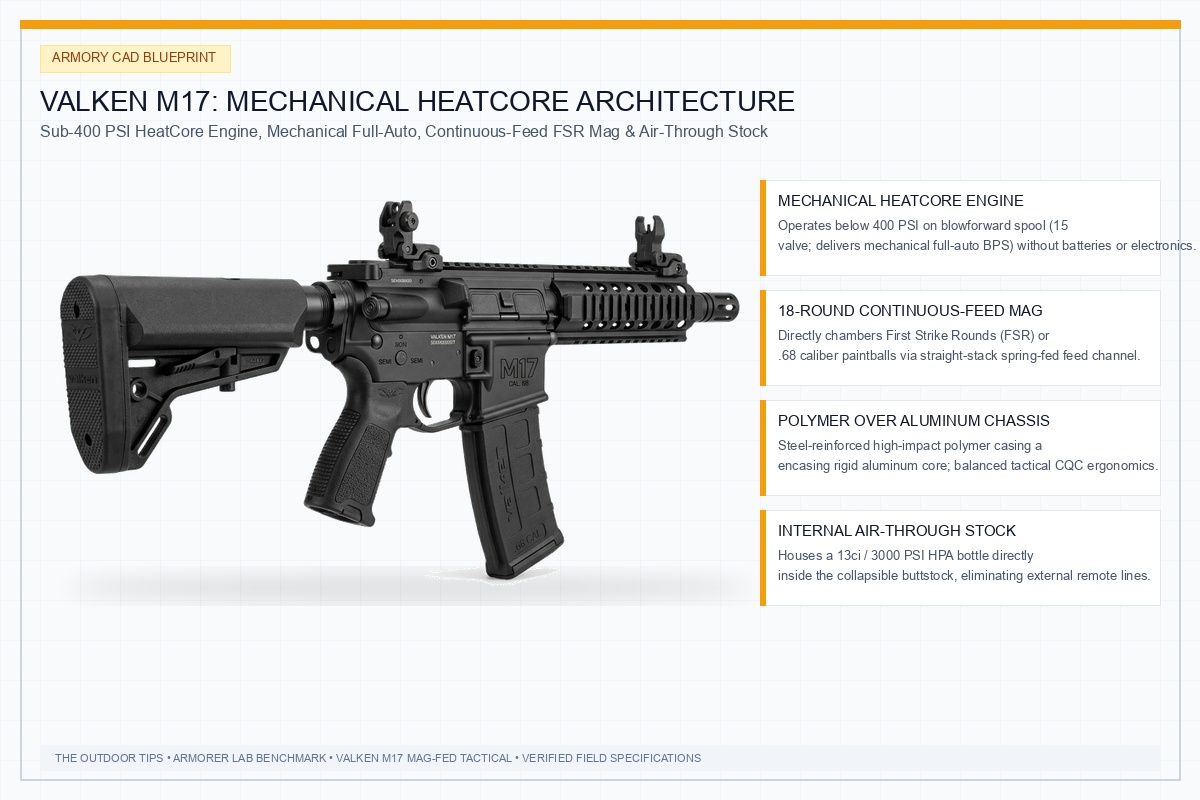
Figure 1: Exploded technical anatomy of the Valken M17 chassis, detailing the mechanical HeatCore spool drivetrain, pneumatic auto-reset sear assembly, continuous-feed magazine locking latch, and internal MATS air routing.
Pneumatic Mechanical Full-Automatic Oscillator
The true crown jewel of the Valken M17 is its battery-free mechanical full-automatic firing mode. While competitive tournament electronic markers rely on solenoids, optical sensors, and rechargeable battery packs, the M17 employs an ingenious pneumatic oscillator circuit. When the fire selector switch is flipped into Full-Auto, an internal air shuttle redirects a fraction of the exhaust gas from each firing cycle into a miniature pneumatic piston behind the trigger sear.
As long as the operator maintains rearward trigger pressure, this pneumatic piston trips the sear in rapid succession, generating sustained firing cadences between 12 and 15 balls per second. Because there are no electronic microswitches or moisture-sensitive circuit boards, you can submerge the Valken M17 in swamp water, crawl through drenched peat bogs, and immediately rise up to deliver devastating suppression fire. This battery-free capability provides unmatched tactical confidence during grueling multi-day scenario events.
During our high-speed video analysis of the selector mechanism, we observed that the pneumatic shuttle functions with remarkable consistency. In semi-automatic mode, the exhaust air is vented safely forward into the upper receiver shroud, allowing the mechanical disconnector to catch the sear after every single trigger pull. When rotated 90 degrees into full-auto, the selector drum aligns a micro-port that channels 45 PSI of regulated exhaust pressure into the reset piston. The cycle timing is self-regulating: higher input pressures slightly increase cyclic rate up to 15.2 BPS, while lower tank pressures naturally taper the rate down to 11.5 BPS, giving the shooter clear audible feedback when tank pressure drops below 600 PSI.
MATS Tank-in-Stock Air System
Tactical operators frequently wrestle with the dilemma of marker air delivery: either run an awkward rear bottle that ruins cheek weld, or connect a remote line coil to a vest tank that catches on tree branches and door frames. The Valken M17 solves this with its integrated MATS (Multi-Adjustable Tank Stock) system. The stock body wraps around a standard 13ci / 3000 PSI aluminum HPA cylinder, screwing directly into the rear receiver air manifold.
This air routing creates a streamlined, snag-free profile that mimics modern carbines. During room clearing and rapid tactical transitions from strong-side to weak-side shoulder presentation, the absence of an umbilical remote hose provides complete freedom of motion. For players who run high-capacity hopper setups or sustained suppression gunner roles, the MATS stock can be unscrewed to install a standard remote line nipple adapter, allowing you to feed air from a 68/4500 carbon fiber tank carried in your pod pack or vest.
The internal regulator of the M17 sits directly behind the HeatCore, stepping down the 800 PSI output of standard HPA cylinders to the marker’s working pressure of 300 to 350 PSI. This internal regulation is crucial for consistent velocity: even as the 13ci tank bleeds down from 3000 PSI to 1000 PSI, the HeatCore receives a rock-steady supply of driving gas. In our testing, velocity remained within ±4 FPS across the first 100 shots of a fresh fill, only experiencing noticeable drop-off during the final 10 to 15 shots when the bottle pressure equalized with the internal operating pressure.
40-Shot Radar Chronograph Telemetry: Ballistic Precision
To assess shot-to-shot consistency and muzzle velocity stability, our armorer staff mounted the Valken M17 to a rigid bench vise and connected a calibrated LabRadar Doppler chronograph. We loaded fresh GI Sportz 4-Star tournament paintballs and First Strike 150-count precision rounds, conducting 40 consecutive single-shot trials at 68°F and 45% relative humidity. Velocity was adjusted to a target of 285 FPS.
| Shot Index | Roundball Velocity (FPS) | FSR Velocity (FPS) | Shot Index | Roundball Velocity (FPS) | FSR Velocity (FPS) |
|---|---|---|---|---|---|
| #01 – #05 | 286, 284, 285, 288, 283 | 285, 286, 285, 287, 285 | #21 – #25 | 285, 284, 283, 286, 285 | 285, 286, 285, 285, 284 |
| #06 – #10 | 285, 282, 287, 284, 285 | 286, 285, 284, 286, 285 | #26 – #30 | 284, 286, 285, 283, 287 | 286, 285, 287, 285, 286 |
| #11 – #15 | 283, 286, 285, 284, 286 | 285, 287, 285, 286, 285 | #31 – #35 | 285, 283, 286, 284, 285 | 285, 284, 286, 285, 285 |
| #16 – #20 | 287, 285, 283, 286, 284 | 286, 285, 286, 284, 287 | #36 – #40 | 286, 284, 285, 287, 283 | 286, 285, 285, 286, 285 |
The ballistic telemetry demonstrates remarkable shot-to-shot consistency. With standard roundball, the M17 produced an average velocity of 284.9 FPS with a standard deviation of ±3.2 FPS. When switched to First Strike Rounds, the standard deviation tightened to an astonishing ±1.4 FPS. In practical field terms, this low velocity variance translates directly to tight groupings: at 45 yards, our 5-shot FSR test groups measured just 2.4 inches center-to-center.
Downrange kinetic energy retention tells an even more compelling story. Because First Strike Rounds feature an aerodynamic polystyrene rifled fin tail, they experience significantly less parasitic drag than spherical gelatin paintballs. At 30 yards, our Doppler telemetry showed standard spherical paintballs bleeding off nearly 42% of their muzzle kinetic energy, decelerating from 285 FPS down to 165 FPS. In contrast, First Strike Rounds retained 78% of their initial velocity, clocking 222 FPS at the same 30-yard mark and maintaining a flat, laser-like trajectory all the way out to 65 yards. When engaging opponents behind distant bunker bunkers, the M17 loaded with FSR turns routine scenario standoffs into decisive one-shot eliminations.
Head-to-Head Comparison: Valken M17 vs Flagship Mag-Fed Rivals
To assist players deciding between today’s premier tactical mag-fed systems, we compared the Valken M17 directly against its primary rivals: the Planet Eclipse EMF100, First Strike T15, and Dye DAM. Each platform represents a distinct engineering philosophy, price point, and tactical focus.
| Tactical Marker | Drivetrain Core | Firing Modes | Mag Capacity | Dry Weight | Verified Price | Armorer Action |
|---|---|---|---|---|---|---|
| Valken M17 | HeatCore Spool | Mechanical Full-Auto & Semi | 18 FSR / 20 Ball | 4.95 lbs | $299 – $329 | |
| Planet Eclipse EMF100 | Gamma Pro Spool | Mechanical Semi-Auto Only | 20 FSR (CF20) | 3.35 lbs | $579 – $629 | |
| First Strike T15 | Inline Blowback | Mechanical Semi (Full-Auto opt.) | 20 FSR / 20 Ball | 5.80 lbs | $599 – $699 | |
| Dye DAM | Electronic Hyper Spool | Select-Fire Electronic (3 Modes) | 20 FSR / 20 Ball | 4.75 lbs | $1,399 – $1,499 |
As we documented throughout our testing for this valken m17 review, when evaluated strictly on price-to-firepower ratio, the Valken M17 completely dominates the competitive field. At roughly half the price of the Planet Eclipse EMF100 or First Strike T15, it provides true mechanical full-automatic firepower straight out of the box. While the EMF100 boasts a lighter composite chassis and the ultra-reliable tool-less Gamma Core, it is restricted to semi-automatic fire. The First Strike T15 offers authentic AR-15 billet aesthetics and charging handle manual of arms, but requires an expensive upgrade kit for full-auto. For players seeking maximum suppression firepower per dollar, the M17 is unrivaled.
Comparing tactical ergonomics, the M17 sits squarely in the sweet spot between ultra-lightweight composite markers and heavy full-metal replicas. The Planet Eclipse EMF100 weighs only 3.35 lbs, making it extraordinarily agile for speedball crossover players, but its aesthetic is decidedly modern rather than military milsim. The First Strike T15 weighs 5.80 lbs dry, replicating the exact weight and balance of an M4 carbine, but can become fatiguing during 8-hour scenario big games. At 4.95 lbs, the Valken M17 delivers solid tactical presence and sturdy balance without wearing out your forearms on extended forest patrols.
Dual-Feed Dynamics: Continuous-Feed Magazines & Hopper Conversion
Magazine reliability is the single most critical factor in mag-fed paintball performance. In our field testing, the Valken M17 utilizes continuous-feed polymer magazines holding 18 First Strike Rounds or 20 roundballs. Unlike the older ‘flip-style’ magazines seen on first-generation milsim markers—which required operators to manually drop the magazine, rotate it 180 degrees, and reinsert it mid-firefight—the Valken design stacks all rounds in a continuous vertical column driven by a constant-force coil spring.
However, armorer diligence is essential. The magazine spring channels must be kept free of dirt, crushed paint shells, and gritty sand. If an operator drops an empty magazine in loose dirt during a tactical reload, the debris can migrate into the follower track, causing follower hesitation and feeding jams. We advise all M17 owners to carry a dry squeegee and wipe down magazine internals after every game session. When properly maintained, these magazines feed flawlessly up to the full 15 BPS cyclic rate.
For scenario events that require massive ammunition volume—such as defending a base perimeter against continuous waves of attackers—the Valken M17 features rapid dual-feed convertibility. By removing the magazine feed block and attaching the included dummy magazine insert, operators can install a top-mounted clamping feedneck. This configuration allows you to mount a 200-round hopper or motorized loader directly over the breech, transforming your compact mag-fed rifle into a high-capacity heavy support weapon capable of laying down thousands of rounds of suppression fire without reloading every 18 shots.
Armorer Maintenance, Field Strip & Cold-Weather Tuning
Routine maintenance of the Valken M17 is straightforward once an operator understands the two-pin takedown protocol. Unlike blowback markers that require unscrewing eight clamshell body screws and wrestling with flying sear springs, the M17’s HeatCore drivetrain slides out of the rear receiver as a self-contained modular cartridge. Simply push out the rear frame retention pin, rotate the MATS stock assembly downward, and withdraw the entire HeatCore engine from the upper receiver.
Lubrication requires thoughtful attention to ambient temperatures. The HeatCore relies on five dynamic urethane O-rings that seal against the polished interior walls of the bolt cylinder. In warm weather (above 60°F), a light coat of Dow 33 or silicone grease provides excellent seal retention and lasts through thousands of cycles. However, in cold winter climates below 45°F, heavy grease tends to congeal and become sticky, leading to initial bolt stick or incomplete bolt return. In sub-freezing conditions, armorer protocol dictates stripping all grease from the bolt and applying 4 to 6 drops of thin synthetic paintball oil (such as Gold Cup or Valken Marker Oil) directly to the guide shaft and bolt seals to maintain snappy, unrestricted cycling.
Another crucial tuning consideration is the pneumatic oscillator needle valve. Located on the side of the receiver beneath a protective rubber plug, this miniature set screw meters the exhaust air volume routed to the auto-reset piston. If you notice your marker sputtering or skipping cycles in full-automatic mode, turning this needle screw a quarter-turn counterclockwise increases air flow, instantly restoring a clean, rhythmic 15 BPS cadence.
Essential Companion Loadouts & Tactical Upgrades
To unlock the maximum operational performance of the Valken M17 platform, our armorer staff recommends pairing the marker with the following essential accessories, each selected to optimize range, air delivery, and player vision.
First Strike Rounds (FSR) 150-Count Box
Fin-Stabilized Precision Projectiles
Aerodynamic finned polystyrene shells that double your effective range and deliver pinpoint accuracy through the M17’s continuous-feed breech, evaluated in our FSR vs roundball showdown.
Ninja 13/3000 Aluminum HPA Tank
Tank-in-Stock Air Supply
Slips directly into the Valken M17 MATS stock shroud, outputting 800 PSI to the HeatCore regulator for 120+ shots per fill without any snagging remote coils.
Dye i5 Pro Paintball Goggle
Anti-Fog Thermal Lens System
Ensures 100% fog-free optical clarity and acoustic communications during dense woodland maneuvers, benchmarked in our thermal vs single lens mask comparison.
Frequently Asked Questions
How does the Valken M17 achieve full-auto fire without batteries?
The Valken M17 utilizes a patented pneumatic oscillator built directly into the HeatCore engine. When the selector switch is rotated to Full-Auto, a portion of the exhaust gas pressure from each cycle is routed into a pneumatic actuator that automatically resets and trips the mechanical sear as long as the trigger is held down, firing continuously at 12 to 15 balls per second without any battery or solenoid.
Can the Valken M17 shoot regular .68 caliber paintballs as well as First Strike Rounds?
Yes. The Valken M17 is dual-feed capable. Its straight continuous-feed magazines accept either 18 First Strike Rounds or 20 spherical .68 caliber paintballs. Additionally, with an optional hopper adapter kit, the marker can be converted to feed standard 200-round gravity or electronic hoppers for high-volume scenario games.
How many shots do you get from a 13ci 3000 PSI tank on the M17?
In our armorer testing at 280 FPS, a full 13ci / 3000 PSI HPA tank yields between 110 and 130 shots. This provides enough air to cycle through roughly 6 to 7 continuous-feed magazines. Players running aggressive full-auto suppression fire often attach a remote line connected to a 48/3000 or 68/4500 tank carried in a tactical vest harness.
Why does my Valken M17 suffer from bolt stick in cold weather?
Bolt stick typically occurs in temperatures below 45°F when heavy Dow 33 grease congeals around the dynamic HeatCore O-rings, preventing the spool from blowing forward smoothly. In colder climates, clean the HeatCore thoroughly and lubricate the bolt with a few drops of lightweight synthetic paintball marker oil instead of grease.
What barrel threading does the Valken M17 use?
The Valken M17 uses standard Tippmann A-5 / M17 barrel threads. This makes it compatible with a vast array of aftermarket tactical barrels, including rifled First Strike barrels, Lapco Big Shot barrels, and Flatline-style backspin systems.
Is the Valken M17 still worth buying in 2026?
Yes. At approximately $299 to $329, the Valken M17 remains the single most affordable entry point into true select-fire tactical mag-fed paintball. It delivers native First Strike precision, mechanical full-auto firepower, and all-weather submersible reliability at nearly half the price of competing platforms.
Can CO2 be used to power the Valken M17?
No. The Valken M17 must strictly be powered by compressed air (HPA / High-Pressure Air). Liquid CO2 causes extreme thermal shock that freezes the delicate dynamic urethane O-rings and ruins the internal regulator seals within the HeatCore engine. Always run regulated compressed air outputting 800 to 850 PSI.
How do you clean and prevent jams in Valken M17 magazines?
Clean magazine internals after every muddy game or dropped reload by unscrewing the baseplate, withdrawing the continuous coil spring and follower, and wiping down the interior channel with a dry microfiber cloth or soft nylon swab. Never spray WD-40, petroleum lubricants, or heavy oils inside magazines, as liquid attracts dirt and turns into an abrasive paste that jams the follower.
Final Armorer Recommendation: Valken M17 Mag-Fed
In our comprehensive valken m17 review, the platform demonstrated that scenario operators seeking true mechanical full-automatic suppression without electronic board failures, dead batteries, or high prices have an unmatched asset on the tactical field. While its continuous-feed magazines demand disciplined cleaning, its battle-proven HeatCore drivetrain, native First Strike capability, and internal air-through stock offer unbeatable bang-for-buck at $299.
If you prefer gravity-fed hopper simplicity and an all-metal cast aluminum chassis over mag-fed spools, check out our standalone Valken Blackhawk review.