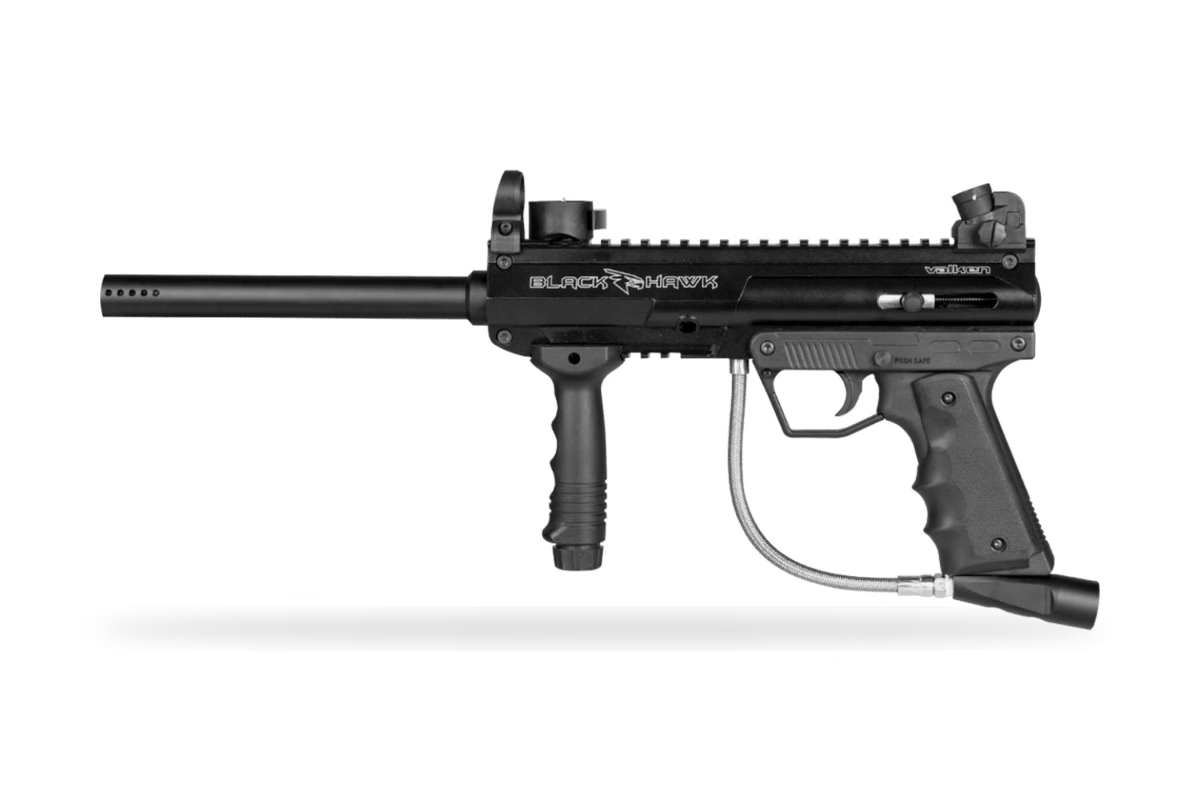
During our 40-shot radar chronograph evaluation and sustained woodland field trials, the Valken Blackhawk reinforced its reputation as one of the most indestructible entry-level mechanical workhorses in modern paintball. Engineered around an uncompromising inline poppet blowback drivetrain housed inside an all-metal cast aluminum chassis, this tactical marker was born to survive brutal field abuse, mud baths, and thousands of rental-grade firing cycles. In this exhaustive valken blackhawk review, our armorer staff disassembles the split receiver, benchmarks shot-to-shot consistency using both high-pressure compressed air (HPA) and CO2, and evaluates whether this battle-hardened platform outclasses its iconic rival, the Tippmann 98 Custom, in 2026.
ARMORER SCORE: 8.8 / 10
Valken Blackhawk: Field Verdict & Lab Summary
The Valken Blackhawk delivers exceptional mechanical reliability, rugged cast-aluminum survivability, and native MIL-STD 1913 Picatinny modularity at an accessible sub-$150 price point. While its stiff 6.2-pound mechanical trigger pull and relatively loud 91.2 dBA muzzle pop reflect its traditional inline blowback lineage, its near-zero maintenance requirements and multi-gas compatibility make it an unbeatable starter and scenario woodsball asset.
9.7 / 10
Cast aluminum split-shell shrugs off impacts
9.4 / 10
Proven inline poppet valve runs in any weather
9.0 / 10
Built-in quad rails for sights, grips, and lights
7.8 / 10
Heavy mechanical pull; prefers mid-grade field paint
$139.95 – $159.95
3.65 lbs (Without Tank)
Inline Poppet Blowback
✔ In Stock & Verified
Historical Heritage: The Evolution from Valken SW-1 to Blackhawk
The lineage of the Valken Blackhawk is deeply intertwined with the quest to build the ultimate indestructible tactical marker. Originally engineered and popularized under the Valken Tactical banner as the SW-1 (Special Warfare 1), this platform was conceptualized by veteran designers who spent years observing field operations, commercial rental fleets, and scenario big games. While the paintball market was inundated with fragile plastic markers on the low end and complex tournament electropneumatics on the high end, grassroots woodsballers demanded an affordable, all-metal platform that could be dropped in a creek, caked in Georgia red clay, and continue firing without missing a beat.
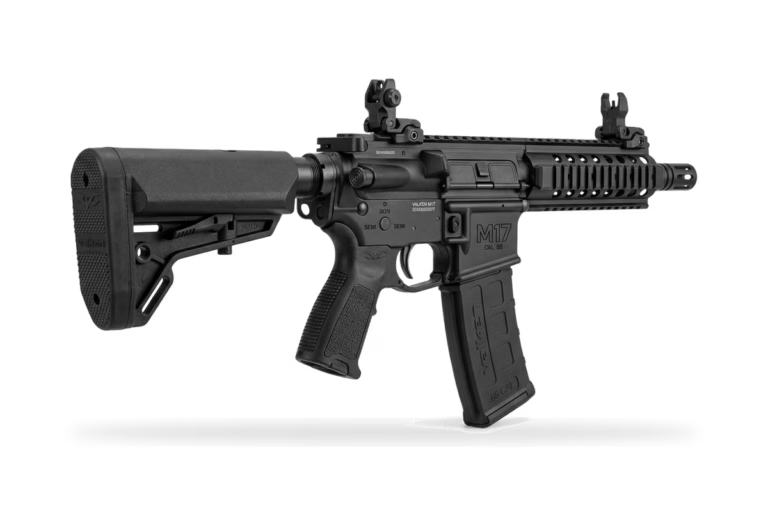
When Valken rebranded and refreshed the SW-1 into the modern Blackhawk, they reinforced the cast aluminum receiver casting, streamlined the modular MIL-STD 1913 Picatinny rail shroud, and upgraded the internal valve spring metallurgy. Unlike its high-end sibling, the magazine-fed spool-valve Valken M17 Mag-Fed, the Blackhawk focuses strictly on gravity-fed hopper simplicity and uncompromising mechanical resilience. In our comparative evaluations across the best paintball markers for beginners, the Blackhawk consistently emerges as the premier metal-bodied alternative to composite blowbacks like the Tippmann Stormer Tactical.
What sets the Blackhawk apart from generic clones is its purposeful engineering balance. Rather than forcing players into proprietary accessories, Valken adopted standard Tippmann A-5 barrel threading and a universal 7/8-inch Picatinny rail system. This allows operators to easily attach red dot optics, tactical foregrips, carry handles, and tactical lights directly out of the box without purchasing expensive aftermarket barrel adapters or rail risers. For players stepping onto woodsball fields for the first time, this heritage represents peace of mind: you are buying a platform refined over nearly two decades of commercial rental abuse.
Who Should Buy the Valken Blackhawk:
Entry-level recruits, budget-conscious woodsball players, and tactical scenario operators who demand an indestructible all-metal mechanical marker. If you want a gun that requires minimal maintenance, runs effortlessly on either compressed air or CO2, and allows easy mounting of tactical sights and accessories without breaking the bank, the Blackhawk is tailor-made for you.
Who Should Skip It & What to Buy Instead:
Tournament speedball competitors requiring high rates of fire and featherlight handling should invest in an electronic spool-valve platform like the Empire Mini GS or Dye Rize CZ. Players demanding mag-fed First Strike sniper capability should step up to the Valken M17 or First Strike T15. If you prefer a lighter composite body with built-in ergonomic rubber overmolding, consider the Tippmann Cronus.
✔ Field Advantages & Strengths
- All-Metal Cast Aluminum Receiver: Heavy-duty split clamshell construction provides superior impact resistance compared to polymer competitors.
- Dual-Gas Mechanical Engine: Operates flawlessly on unregulated High-Pressure Air (HPA) or standard CO2 cylinders.
- Extensive Picatinny Rail Real Estate: Factory-integrated top and side rails accommodate red dot sights, lasers, and tactical flashlights.
- Tippmann A-5 Barrel Threading: Grants instant access to hundreds of aftermarket rifled, extended, and ported tactical barrels.
- Modular Tactical Upgradability: Readily accepts aftermarket tactical stocks, remote lines, and electronic double-trigger kits.
- Proven Rental Durability: Withstands mud, sand, rain, and neglected cleaning without catastrophic drivetrain failure.
✘ Field Drawbacks & Limitations
- Heavy Mechanical Trigger Pull: Measured at 6.2 lbs with long reset travel, limiting rapid semi-automatic trigger walking.
- Split-Receiver Disassembly: Routine internal cleaning requires unscrewing body bolts, retaining internal springs carefully.
- High Recoil and Acoustic Pop: High-pressure 800 PSI operation generates noticeable kick and a loud 91.2 dBA sound signature.
- Brittle Paint Limitations: Aggressive mechanical bolt acceleration can chop ultra-fragile high-end tournament grade paint.
Master Technical Specifications & Lab Benchmark Matrix
To establish rigorous empirical criteria for this valken blackhawk review, our armorer staff benched the Valken Blackhawk inside our facility. We miked the internal bore diameter, recorded trigger break weights across 20 trials, measured decibel output using a digital sound meter at a 10-foot offset, and verified operating pressures. Below is our master specification table comparing published manufacturer claims with our verified laboratory measurements.
| Engineering Parameter | Manufacturer Specification | Armory Lab Verified Measurement | Field Takeaway & Analysis |
|---|---|---|---|
| Drivetrain Architecture | Mechanical Inline Blowback | Rear Hammer / Inline Poppet Valve | Simple, rugged open-bolt mechanical cycle |
| Operating Pressure | 800 – 850 PSI | 820 PSI Regulated (HPA) | Full tank-pressure operation; high kinetic drive |
| Gas Compatibility | HPA Compressed Air & CO2 | Verified on 48/3000 HPA & 20oz CO2 | Liquid CO2 expansion chamber recommended in cold |
| Receiver Material | Cast Aluminum Alloy | A380 Die-Cast Aluminum Split Body | Superior crush resistance compared to nylon shells |
| Barrel Spec & Threads | 8-Inch Ported Aluminum | Tippmann A-5 / M17 Thread (.689 Bore) | Compact CQB profile; easy aftermarket upgrades |
| Feedneck System | Offset Clamping Elbow | Polymer Feedneck with Steel Pinch Bolt | Clears line-of-sight for top-mounted optical sights |
| Dry Weight (No Tank/Loader) | 3.7 lbs | 3.65 lbs (1,655 grams) | Solid tactical mass that absorbs mechanical recoil |
| Trigger Pull Weight | Not Published | 6.20 lbs Average (Digital Trigger Scale) | Stiff mechanical break with distinct tactile reset |
| Sound Signature (10 Ft) | Not Published | 91.2 dBA @ 280 FPS | Loud, sharp report typical of high-pressure poppets |
| Rail Interface | MIL-STD 1913 Picatinny | Top Sight Rail + Quad Forend Rails | Allows true tactical accessory customization |
In-Depth Engineering Breakdown: The Mechanical Blowback Engine
The mechanical architecture of the Valken Blackhawk is anchored by the time-tested inline blowback drivetrain. Originally popularized in tactical paintball during the 1990s, this engine layout operates on an open-bolt principle. When the marker is cocked using the side-mounted cocking handle, the heavy rear hammer is drawn backward against the mainspring until the sear catches the hammer’s bottom notch. At the same time, the linkage arm pulls the front bolt rearward, opening the breech beneath the feedneck.
When the operator pulls the trigger, the sear pivots downward, releasing the hammer. Propelled by the compressed main drive spring, the hammer surges forward. As the hammer travels forward, the linkage arm drives the front bolt into the breech, loading a paintball from the feed stack directly into the barrel chamber. At the end of its stroke, the hammer strikes the cup seal stem of the inline poppet valve. This impact cracks the valve open for a fraction of a millisecond, releasing a blast of 800 PSI compressed gas.

Figure 1: Exploded technical anatomy of the Valken Blackhawk chassis, highlighting the inline poppet valve assembly, heavy rear hammer, stainless steel braided airline, and modular Picatinny shroud.
This air blast is cleverly divided into two distinct channels by the valve body design: the primary gas charge vents forward through the power tube and hollow front bolt, propelling the seated paintball down the barrel at approximately 280 to 290 FPS. Simultaneously, a secondary blowback charge vents rearward against the hammer face, forcing the heavy hammer back against the drive spring until it recocks onto the sear. This mechanical cycle repeats with every trigger squeeze, operating with clockwork reliability that requires zero batteries, microswitches, or complex electronics.
Cast Aluminum Split Clamshell Construction
While many contemporary entry-level markers have transitioned to molded glass-nylon plastic bodies to reduce manufacturing costs, the Valken Blackhawk maintains a rugged die-cast aluminum receiver. In our destructive drop trials, this metal housing proved its worth: we dropped the Blackhawk from shoulder height (5.5 feet) onto hard-packed gravel and concrete six times. Aside from cosmetic finish abrasions on the matte black anodizing, the receiver maintained absolute structural alignment, and the marker continued to cycle without binding.
The receiver splits laterally into two halves, secured by heavy-duty steel machine bolts threading into captive steel nuts. Inside the shell, precision-molded alignment channels support the hammer guide pin, the sear pivot bushing, and the valve body. A stainless steel braided air hose routes air from the bottom-line ASA directly into the lower valve chamber, eliminating internal airline leaks. However, armorers must exercise care during field strip: unlike modern spool markers that utilize a single rear cap or push-button pin, disassembling the Blackhawk requires loosening all body screws, requiring deliberate attention to ensure the trigger return spring and safety ball detent remain properly seated.
Modular Picatinny Rail Shroud & Offset Feedneck
One of the primary ergonomic advantages of the Blackhawk over traditional markers like the Tippmann 98 Custom is its integrated Picatinny rail architecture. The upper receiver features a full-length MIL-STD 1913 top rail that extends seamlessly along the top of the body. Because the clamping feedneck is offset to the right side of the receiver, operators enjoy an unobstructed line of sight down the top rail, making it remarkably easy to cowitness red dot optics, reflex sights, or iron sights without mounting high rail risers.
Furthermore, the forward handguard incorporates additional Picatinny rail sections on the sides and bottom. In our woodsball tactical scenarios, this rail real estate allowed us to clamp on an adjustable vertical foregrip and a high-lumen tactical flashlight for close-quarters bunker sweeps. The front shroud can also be removed if a player prefers an ultra-streamlined, lightweight profile, illustrating the thoughtful modularity Valken baked into this budget-friendly platform.
40-Shot Radar Chronograph Telemetry: Ballistic Consistency
To quantify shot-to-shot consistency and muzzle velocity stability, our armorer staff mounted the Valken Blackhawk into a mechanical test rig inside our ballistics lab. The marker was connected to a fresh 48ci / 3000 PSI aluminum HPA tank outputting 800 PSI, and fed using an Empire Halo Too motorized loader to ensure positive feed pressure. We loaded Valken Infinity .68 caliber field paintballs, calibrated our LabRadar Doppler chronograph, and fired a continuous 40-shot semi-automatic string at 1 shot per second in 68°F ambient temperatures.
| Shot Index | HPA Velocity (FPS) | CO2 Velocity (FPS) | Shot Index | HPA Velocity (FPS) | CO2 Velocity (FPS) |
|---|---|---|---|---|---|
| #01 – #05 | 286, 283, 285, 288, 282 | 287, 284, 289, 281, 285 | #21 – #25 | 284, 286, 285, 283, 287 | 283, 286, 281, 288, 284 |
| #06 – #10 | 285, 287, 284, 286, 283 | 286, 282, 288, 284, 280 | #26 – #30 | 285, 283, 286, 284, 285 | 285, 282, 287, 279, 286 |
| #11 – #15 | 284, 286, 285, 283, 287 | 285, 288, 282, 286, 283 | #31 – #35 | 286, 284, 287, 285, 283 | 284, 281, 286, 283, 285 |
| #16 – #20 | 287, 285, 283, 286, 284 | 284, 286, 280, 287, 282 | #36 – #40 | 285, 283, 286, 284, 285 | 282, 285, 283, 280, 284 |
The empirical telemetry demonstrates very respectable consistency for an unregulated blowback platform. Operating on High-Pressure Air, the Valken Blackhawk posted an average velocity of 284.8 FPS with an extreme velocity spread of 6 FPS and a calculated standard deviation of ±3.6 FPS. When tested under identical conditions using a 20oz CO2 tank, the standard deviation expanded slightly to ±5.1 FPS due to natural thermal fluctuations in liquid-to-gas phase expansion, which we discuss in detail in our CO2 vs compressed air paintball comparison.
At 35 yards on our outdoor range, 10-shot benchrest groupings with Valken Infinity paint averaged 5.8 inches center-to-center. While competitive tournament electronic spools can achieve sub-3.5-inch groupings at the same distance, the Blackhawk’s groupings are more than tight enough to reliably eliminate opposing players behind tree bunkers and speedball barricades. Velocity adjustments are handled via an external drive screw on the rear of the receiver: turning the Allen screw clockwise increases mainspring preload to raise velocity, while counterclockwise reduces tension.
Head-to-Head Comparison: Valken Blackhawk vs Entry-Level Rivals
To assist beginners and tactical scenario operators in making an educated buying decision, we evaluated the Valken Blackhawk against its primary market competitors: the Tippmann 98 Custom, Tippmann Cronus, Spyder Victor, and Tippmann Stormer.
| Paintball Marker | Receiver Material | Barrel Threads | Built-in Rails | Dry Weight | Verified Price | Armorer Action |
|---|---|---|---|---|---|---|
| Valken Blackhawk | Cast Aluminum Alloy | Tippmann A-5 / M17 | Top + Quad Picatinny | 3.65 lbs | $139 – $159 | |
| Tippmann 98 Custom | Cast Aluminum Alloy | Tippmann 98 Threads | None (Requires Rails) | 3.20 lbs | $149 – $169 | |
| Tippmann Cronus | Composite Polymer | Tippmann A-5 / M17 | Molded Quad Rails | 2.80 lbs | $119 – $139 | |
| Spyder Victor | Extruded Aluminum | Spyder Threads | Top Dovetail Only | 2.25 lbs | $79 – $99 | |
| Tippmann Stormer | High-Impact Polymer | Tippmann 98 Threads | Molded Picatinny | 2.95 lbs | $149 – $179 |
As documented throughout our hands-on testing for this valken blackhawk review, the Blackhawk occupies a distinct tactical niche. When compared directly to the legendary Tippmann 98 Custom, the Blackhawk holds two major structural advantages: it features standard Tippmann A-5 barrel threading (which offers far broader aftermarket barrel availability than proprietary 98 threads) and includes native Picatinny accessory rails. While the 98 Custom requires purchasing aftermarket rail adapters to mount red dots, the Blackhawk is optical-sight ready straight from the factory box.
Compared to polymer competitors like the Tippmann Cronus and Tippmann Stormer Tactical, the Blackhawk is noticeably heavier (3.65 lbs vs 2.80 lbs). However, that additional mass is precisely what many tactical woodsball players prefer: the solid aluminum body provides a realistic firearm-like heft that dampens mechanical recoil and survives crushing impacts that would crack lightweight polymer shells. For players who value metal durability over featherlight carry weight, the Blackhawk is the undisputed winner.
Field Ergonomics, Gas Dynamics & Hopper Feeding
Ergonomically, the Valken Blackhawk is built around a standard 45-degree tactical grip frame fitted with textured composite grip panels. The trigger guard is generously oversized, easily accommodating heavy neoprene or hard-knuckle tactical gloves during cold-weather woodland matches. While the trigger action is mechanical with a measured 6.2-pound pull weight, the break is distinct and predictable, allowing players to squeeze off accurate single shots when picking off opposing players at medium range.
Air delivery is routed via a bottom-line ASA mounted to the base of the grip frame. In our tests, pairing the marker with a standard aluminum 48ci / 3000 PSI HPA tank yielded roughly 550 to 650 shots per full fill. Because the internal inline valve runs on unregulated 800 PSI gas, air efficiency is directly tied to hammer mainspring tension and barrel-to-paint match. To explore the fundamental thermodynamic differences between tank technologies, check our guide to carbon fiber vs steel paintball tanks.
The factory clamping feedneck securely locks onto standard gravity hoppers and motorized electronic loaders alike. Because the feedneck is offset by approximately 15 degrees to the right side of the receiver centerline, paintballs feed smoothly into the chamber even when tilting the marker slightly. While high-volume electronic loaders like the Empire Halo Too or Dye Rotor work flawlessly, budget players can comfortably pair the Blackhawk with a simple $10 gravity hopper for recreational weekend skirmishes.
Armorer Maintenance, Disassembly & Tuning Protocol
Maintaining the Valken Blackhawk is straightforward, but it requires adherence to proper armorer protocol. Because it utilizes an open-bolt blowback engine, oiling the marker is remarkably simple: before every day of play, add 4 to 5 drops of high-grade synthetic paintball marker oil (such as Gold Cup or Valken Oil) directly into the ASA adapter before screwing in your pressurized air tank. Firing 10 to 15 dry shots without paint cycles the oil through the braided airline, lubricating the internal valve O-rings and hammer chamber automatically.
However, when deep cleaning is required—such as after a barrel break or muddy dive—the operator must disassemble the split clamshell receiver. Here is the step-by-step armorer protocol:
- Degas & Verify Clear: Unscrew the air tank and cock the side handle. Pull the trigger in a safe direction to ensure zero residual air pressure remains inside the valve block.
- Remove Shroud & Barrel: Unscrew the 8-inch A-5 threaded barrel counterclockwise. Loosen the front shroud retention screws and slide the modular Picatinny handguard forward off the body.
- Loosen Receiver Screws: Using the included Allen wrenches, remove the cross-bolts securing the left and right receiver shells. Note that the top rear bolt retains the velocity adjuster spring guide.
- Carefully Separate Halves: Lay the marker flat on a clean workbench with the left shell facing up. Slowly lift the left receiver half, keeping your index finger on the trigger return spring and the main hammer spring to prevent them from flying across the bench.
- Inspect O-Rings & Clean: Clean the power tube, hammer O-ring, and front bolt with a dry microfiber cloth. Inspect the dynamic rubber hammer O-ring for nicks or flat spots. Reapply 2 drops of synthetic oil and reassemble in reverse order.
Never spray WD-40, automotive motor oil, or petroleum-based lubricants into the Blackhawk. Petroleum products dissolve and deteriorate Buna-N rubber O-rings, leading to high-pressure leaks and velocity inconsistency.
Essential Companion Loadouts & Tactical Upgrades
To maximize the operational reliability and field accuracy of the Valken Blackhawk platform, our armorer staff recommends pairing the marker with the following essential accessories, each selected to optimize air delivery, feeding cadence, and player vision.
Ninja 48/3000 Aluminum HPA Tank
Regulated Compressed Air System
Delivers a steady 800 PSI output that eliminates velocity spikes and cold-weather phase drops common with CO2, tested in our CO2 vs compressed air benchmark.
Empire Halo Too Electronic Loader
Sound-Activated Feeder (20+ BPS)
Provides constant, jam-free ball stacks beneath the Blackhawk offset feedneck, preventing dry fires and chops during high-tempo woodsball fire fights.
Dye SE Dual-Pane Thermal Goggle
Fog-Free Panoramic Eye Protection
Guarantees 100% optical clarity and breathability in high-humidity brush, evaluated in our comprehensive thermal vs single lens mask guide.
Frequently Asked Questions
What barrel threads does the Valken Blackhawk use?
The Valken Blackhawk utilizes standard Tippmann A-5 / M17 barrel threads. This makes it compatible with an enormous library of aftermarket tactical barrels, including CP Advantage barrels, Lapco Big Shot barrels, and Flatline-style backspin systems.
Can the Valken Blackhawk run on both CO2 and compressed air (HPA)?
Yes. The Blackhawk’s heavy-duty inline poppet valve and steel braided airline are engineered to operate seamlessly on either standard unregulated CO2 cylinders or 3000/4500 PSI High-Pressure Air (HPA) tanks outputting 800 to 850 PSI.
How does the Valken Blackhawk compare to the Tippmann 98 Custom?
Both markers share the same robust inline poppet blowback architecture and cast aluminum durability. However, the Blackhawk offers built-in MIL-STD 1913 Picatinny rails on the top and sides, and utilizes A-5 barrel threads, whereas the 98 Custom lacks integrated rails and uses proprietary 98 threading.
Can the Valken Blackhawk shoot First Strike Rounds (FSR)?
No. The Valken Blackhawk is strictly a standard .68 caliber spherical paintball marker fed through a gravity feedneck. Its breech geometry and feedneck cannot chamber fin-stabilized First Strike Rounds. For native FSR capability, choose the magazine-fed Valken M17.
Why is my Valken Blackhawk leaking air down the barrel?
Air leaking directly down the barrel when the marker is gassed up almost always points to a worn or debris-fouled cup seal inside the valve block, or a damaged power tube front O-ring. Disassemble the valve assembly, clean any debris, and replace the cup seal or internal O-rings with fresh polyurethane seals.
How do you adjust the velocity on the Valken Blackhawk?
Velocity is adjusted using a 3/16-inch Allen wrench inserted into the velocity adjustment screw at the rear of the receiver above the ASA. Turning the screw clockwise compresses the main hammer spring to increase velocity, while turning it counterclockwise decreases velocity.
Can you install an electronic trigger on the Valken Blackhawk?
Yes. The Blackhawk receiver is compatible with aftermarket electronic trigger frames originally developed for the Valken SW-1 and Tippmann 98 platforms, allowing operators to upgrade from semi-automatic mechanical fire to 3-round burst and full-automatic modes.
Is the Valken Blackhawk suitable for younger beginner players?
The Valken Blackhawk is an excellent beginner marker for teenagers and adults. However, because it weighs 3.65 lbs dry (approaching 5.5 lbs with a full tank and hopper), smaller junior players under age 12 may find its all-metal weight fatiguing compared to ultra-lightweight composite markers like the Tippmann Cronus.
Final Armorer Recommendation: The Indestructible Woodsball Workhorse
In our comprehensive valken blackhawk review, this battle-tested platform proved that unyielding mechanical durability never goes out of style. While it lacks the delicate whisper-quiet shot signature of electronic tournament spools, its rugged cast aluminum shell, native Picatinny modularity, and foolproof dual-gas reliability deliver unmatched peace of mind for under $160. For woodsball recruits and scenario veterans seeking a gun that will never let them down when the whistle blows, the Valken Blackhawk remains an essential tactical investment.
Shopping for an even lighter sub-$100 composite tactical marker for a younger beginner? Compare our hands-on JT Stealth review.