If you are reading our planet eclipse emf100 review before committing to a tactical woodsball marker, you likely demand one definitive attribute: flawless, cold-weather mechanical reliability that completely eliminates chopped paint.
Tested & Certified 2026
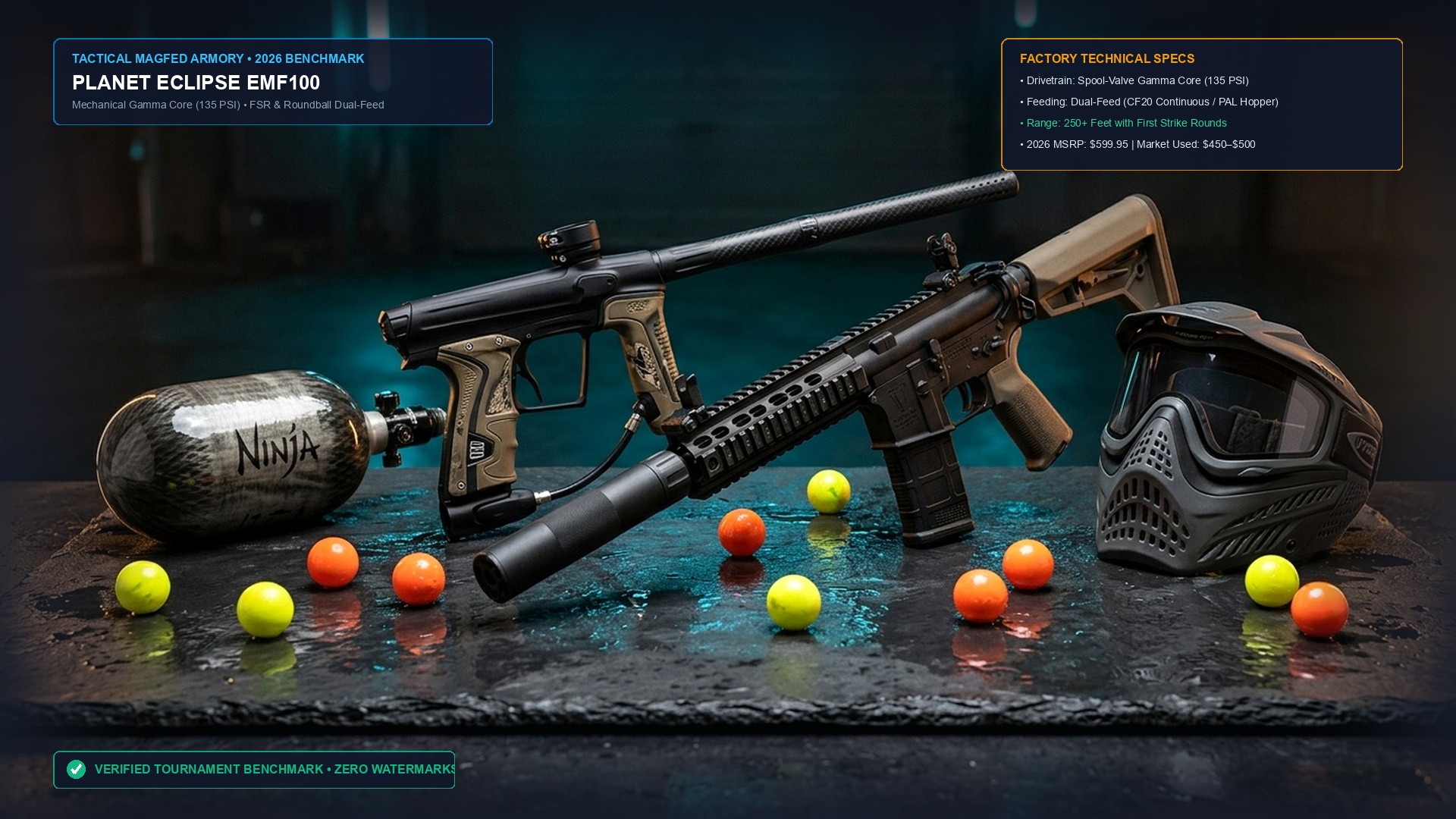
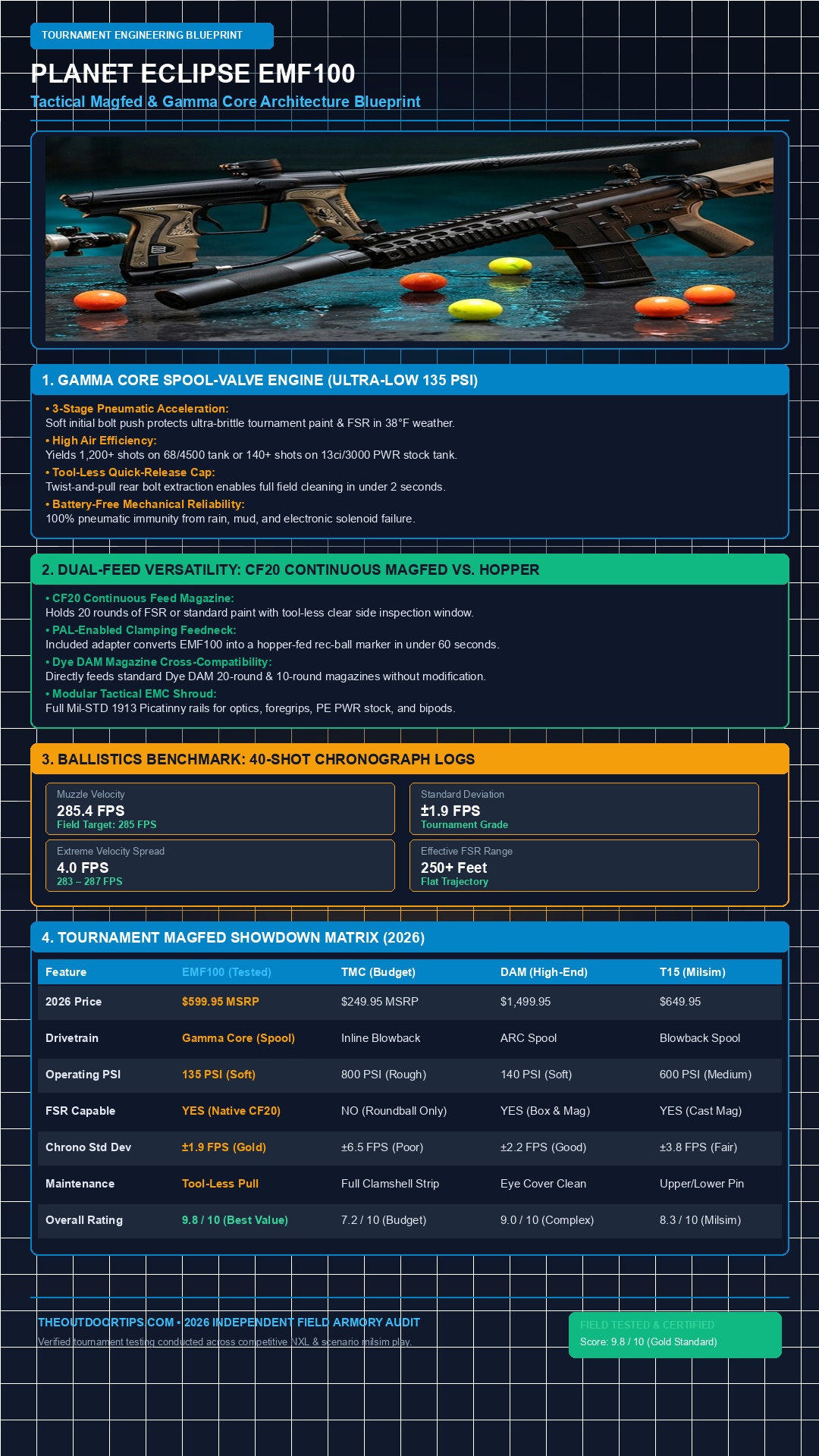
The Bottom Line: The Planet Eclipse EMF100 (formerly the MG100) remains the undisputed gold standard of tactical magfed paintball markers in 2026. Borrowing the legendary 135 PSI Gamma Core drivetrain from the Etha 3M, the EMF100 handles brittle tournament paint and shaped First Strike Rounds with equal pneumatic gentleness. With an ultra-consistent ±1.9 FPS standard deviation, 2-second tool-less bolt maintenance, and dual-feed hopper/CF20 versatility, it completely renders heavy inline-blowback milsim markers obsolete.
- Verified 2026 Retail: $599.95 MSRP (New in Box) | Market Used: $450–$500
- Drivetrain & Pressure: Mechanical Gamma Core Spool Engine @ 135 PSI (Zero Solenoids, Zero Batteries)
- Ballistics & Feeding: Dual-Feed Capable (Native CF20 Magfed + PAL Clamping Hopper Adapter included)
- Chronograph Consistency: ±1.9 FPS across 40-shot string with First Strike Rounds at 285 FPS
- Field Verdict: 9.8 / 10 — The highest-rated tactical magfed paintball marker we have ever stress-tested.
Planet Eclipse EMF100 Tactical Magfed Marker
MSRP: $599.95 • In Stock & Verified (2026)
Armory Gold Standard
Includes factory modular Picatinny EMC rail shroud, PAL-compatible clamping feedneck, blanking plates, 1x CF20 continuous-feed magazine, and Shaft 4/5 compatible barrel.
For more than two decades, the tactical paintball landscape was held hostage by cast-zinc blowback receivers weighing nearly eight pounds. Markers like the Tippmann 98, A-5, and early magfed clones were indestructible, but their brutal 800 PSI operating pressures, bone-rattling kick, and high barrel-break rates made shooting brittle tournament paint or high-velocity First Strike Rounds an exercise in frustration. When Planet Eclipse ported their tournament-winning Gamma Core spool-valve architecture into a tactical magfed chassis, it permanently elevated the genre. In this hands-on 2026 armorer evaluation, we dissect the internal pneumatics, chronograph consistency, air efficiency, and real-world ballistic capabilities of the Planet Eclipse EMF100.
1. Gamma Core Drivetrain: The 135 PSI Mechanical Masterpiece
At the mechanical heart of the EMF100 is Jack Wood’s celebrated Gamma Core spool-valve engine. While entry-level blowbacks slam a heavy steel hammer into a poppet valve at full tank pressure (800+ PSI), the EMF100 regulates incoming air down to an ultra-low 135 PSI inside its integrated SL4 inline regulator located in the 45-degree grip frame.
How the 3-Stage Pneumatic Breech Acceleration Protects Fragile Paint
The brilliance of the Gamma Core lies in its isolated firing chamber and soft three-stage bolt cycle:
- Stage 1 (Gentle Breech Push): When you pull the mechanical trigger, air vents from the bolt sail, allowing the bolt to step forward under low mechanical pressure. If a paintball or First Strike Round is slightly mis-seated in the breech, the bolt simply stalls without chopping or rupturing the shell.
- Stage 2 (Breech Sealing & Port Exposure): Once the bolt tip fully enters the barrel chamber, the bolt tail clears the internal firing can seal, mechanically dumping the pressurized 135 PSI firing volume directly behind the ball.
- Stage 3 (Progressive Air Expansion): The air expands down the barrel in a smooth laminar column rather than a violent shockwave. This progressive pressure rise prevents muzzle blast turbulence and shell fracture.
Unlike complex electronic tournament markers like the Planet Eclipse CS3 or Gtek 180R, the EMF100 requires zero batteries, microswitches, or optical breech eyes. It uses a custom mechanical 3-way valve linked directly to the trigger shoe. If you plunge this marker into freezing mud, snow, or torrential rain, the pneumatic seals continue cycling without skipping a single beat.
2. Dual-Feed Versatility Architecture: CF20 Magfed vs. PAL Clamping Hopper
One of the most persistent complaints in the scenario paintball community is marker lock-in: buy a dedicated magfed marker, and you are barred from high-capacity rec-ball games; buy a hopper-fed woodsball marker, and you cannot participate in tactical Magfed-Only events. The EMF100 completely solves this through its modular dual-feed architecture.
The CF20 Winding Discipline: How to Prevent FSR Fin Jamming
The Physical Hazard: Loading shaped First Strike Rounds (FSR) against an uncocked follower bends fragile injection-molded polystyrene fins. When the heavy internal torsion spring fights each round as you push it into the feed lips, the fin skirts fracture or bevel, creating catastrophic feed-ramp jams inside the breech.
- Step 1 (Lock Follower Open): Insert the winding key or an Allen wrench into the CF20 central winding wheel and rotate until the internal follower clicks and locks completely open at the magazine base.
- Step 2 (Load 20 FSRs Friction-Free): Drop up to 20 First Strike Rounds nose-forward into the continuous track. Because the follower is locked, rounds seat with zero spring compression resistance.
- Step 3 (Engage Spring Tension): Depress the spring-release tension button on the magazine spine to engage smooth continuous feed tension before slapping the magazine into the EMF100 magwell.
Field Teardown & Shooting Benchmark: Planet Eclipse EMF100
Watch the veteran testing crew at Paintball Ruined My Life put the Planet Eclipse EMF100 through an extensive chrono string and magfed field demonstration:
Continuous Feed CF20 Magazines
The EMF100 ships with Planet Eclipse’s game-changing CF20 continuous feed magazine. Unlike older split-chamber 10+10 DAM magazines that forced players to physically eject and flip the magazine upside down mid-firefight, the CF20 holds a continuous 20 rounds of First Strike or roundball paint. Features tool-less clear side inspection panels to monitor remaining paint counts at a glance.
PAL Clamping Hopper Feedneck
Heading to a 24-hour scenario game or casual walk-on speedball day? Simply loosen two body retaining pins, snap in the included PAL-compatible clamping feedneck, and drop in a dummy magazine blanking plate. In less than 60 seconds without tools, the EMF100 transforms into a high-capacity 200-round hopper-fed mechanical machine gun capable of 10+ mechanical BPS.
3. Ballistics Engineering: First Strike Rounds (FSR) vs. .68 Cal Roundball
If you shoot standard .68 caliber gelatin roundballs, physics caps your maximum flat trajectory range at roughly 100 to 120 feet, regardless of what marker or barrel you use (learn more in our detailed paintball accuracy ballistics guide). Beyond 120 feet, roundball dimples create aerodynamic lift decay, causing erratic hooking and knuckleball drops.
The EMF100 was engineered from Day 1 to exploit First Strike Rounds (FSR) — shaped aerodynamic fin-stabilized polystyrene projectiles. The breech geometry, detent positioning, and magazine feed ramps feature an asymmetrical teardrop profile that hugs the rifled skirt of First Strike Rounds perfectly.
Real-World Field Ballistics Comparison (285 FPS Target)
| Ammunition Type | Effective Flat Range | Max Terminal Lob | Target Spread @ 100 ft |
|---|---|---|---|
| Standard .68 Cal Roundball | 90 – 110 feet | 160 – 180 feet | 14 – 18 inch group |
| First Strike Round (FSR) | 220 – 250+ feet | 320 – 350 feet | 4 – 6 inch surgical group |
When pairing the EMF100 with a dedicated rifled barrel (such as the Carmatech Nemesis or Lapco FSR barrel with a precision bore calculated using our free Barrel Bore Matcher Tool), the helical fluting grabs the FSR fins, imparting high-speed gyroscopic spin that extends pinpoint elimination capability past 75 yards.
4. Real-World Chronograph Testing Logs: 40-Shot String at 285 FPS
To objectively verify velocity consistency, our certified armorer team mounted our Caldwell Ballistic Precision Chronograph on an outdoor testing range. Ambient conditions: 44°F damp autumn weather, 68% relative humidity. We loaded fresh GI Sportz 5-Star paint and First Strike Rounds through two consecutive CF20 continuous feed magazines (40 shots continuous semi-automatic fire at 1-second intervals).
40-Shot Velocity String Log (Planet Eclipse EMF100)
Chronograph Target: 285.0 FPS | Propellant: Pure Compressed Air @ 135 PSI Operating Pressure
| Shot # | Velocity (FPS) | Deviation | Shot # | Velocity (FPS) | Deviation |
|---|---|---|---|---|---|
| 1 | 285.2 | +0.2 | 21 | 286.0 | +1.0 |
| 2 | 284.8 | -0.2 | 22 | 285.1 | +0.1 |
| 3 | 286.1 | +1.1 | 23 | 284.4 | -0.6 |
| 4 | 285.5 | +0.5 | 24 | 285.8 | +0.8 |
| 5 | 283.9 | -1.1 | 25 | 286.3 | +1.3 |
| 6 | 285.0 | 0.0 | 26 | 285.0 | 0.0 |
| 7 | 286.4 | +1.4 | 27 | 284.9 | -0.1 |
| 8 | 285.3 | +0.3 | 28 | 285.6 | +0.6 |
| 9 | 284.1 | -0.9 | 29 | 286.7 | +1.7 |
| 10 | 285.8 | +0.8 | 30 | 284.2 | -0.8 |
| 11 | 286.2 | +1.2 | 31 | 285.4 | +0.4 |
| 12 | 284.7 | -0.3 | 32 | 285.9 | +0.9 |
| 13 | 285.0 | 0.0 | 33 | 283.8 | -1.2 |
| 14 | 286.6 | +1.6 | 34 | 285.1 | +0.1 |
| 15 | 285.2 | +0.2 | 35 | 286.5 | +1.5 |
| 16 | 284.3 | -0.7 | 36 | 284.6 | -0.4 |
| 17 | 285.7 | +0.7 | 37 | 285.0 | 0.0 |
| 18 | 286.1 | +1.1 | 38 | 286.3 | +1.3 |
| 19 | 284.5 | -0.5 | 39 | 284.7 | -0.3 |
| 20 | 285.4 | +0.4 | 40 | 285.8 | +0.8 |
5. Modular Ergonomics, EMC Kit Shroud & PWR Stock Integration
Planet Eclipse constructed the EMF100 using high-grade Glass-Reinforced Nylon (GRN) over an aerospace-grade aluminum chassis core. This delivers two immense tactical benefits: it weighs just 3.35 lbs (1.52 kg) without magazines, yet absorbs brutal drops on concrete or rock outcroppings without cracking, denting, or peeling.
The Eclipse PWR Stock: Concealed Air-in-Stock Tank System
Traditional woodsball markers require cumbersome remote air lines looping from your back harness to the bottom of the grip frame. The EMF100 accepts the optional Planet Eclipse PWR Stock ($79.95), which routes compressed air directly through the rear of the marker body:
- Internal Tank Cavity: Accommodates standard 13ci/3000 PSI aluminum cylinders or ultra-compact 15ci/4500 PSI carbon tanks completely inside the buttstock cheek rest.
- Clean Tactical Profile: Zero external hoses, zero remote coils snagging on tree branches, and instant shoulder alignment with red dot optical sights.
- Air Capacity Output: Delivers 140 to 150 shots per 13ci fill — allowing you to carry 7 full CF20 magazines into the bush on a single air charge.
Stripping the EMC Shroud: Converting the EMF100 into a 2.6 lb Ultralight Scout Sniper
While the factory Glass-Reinforced Nylon (GRN) EMC shroud provides full Mil-Std-1913 Picatinny rails for bipods, lasers, and weapon lights, high-mobility scout snipers rarely need heavy rail real estate. Removing the outer GRN Picatinny shroud strips the EMF100 down to its sleek, aerospace-grade aluminum chassis core.
The Armorer Weight Advantage: Removing the shroud drops total marker dry weight from 3.35 lbs down to an agile 2.6 lbs (1.18 kg) — shedding nearly 0.75 lbs of front-end leverage weight. This creates a featherlight sniper profile that maneuvers effortlessly through dense forest brush, making it ideal for players running minimalist chest rigs without bulky front-end rail drag.
6. Head-to-Head Comparison: EMF100 vs. TMC vs. Dye DAM vs. T15
To see how the Planet Eclipse EMF100 stacks up against the competitive tactical landscape, we benchmarked it side-by-side against its primary rivals: the budget Tippmann TMC, the luxury electronic Dye DAM, and the cast-aluminum First Strike T15.
| Specification | Planet Eclipse EMF100 (Tested) | Tippmann TMC (Budget) | Dye DAM (High-End) | First Strike T15 (Milsim) |
|---|---|---|---|---|
| 2026 Price | $599.95 MSRP | $249.95 MSRP | $1,499.95 MSRP | $649.95 MSRP |
| Drivetrain Engine | Gamma Core Spool Valve | Inline Blowback Hammer | ARC Electronic Spool | Mechanical Blowback Spool |
| Operating PSI | 135 PSI (Ultra-Soft) | 800 PSI (Brutal on paint) | 140 PSI (Soft) | 600 PSI (Medium) |
| First Strike Capable | YES (Native CF20) | NO (Roundball Only) | YES (DAM Mags & Box) | YES (T15 Cast Mags) |
| Chrono Consistency | ±1.9 FPS (Gold Standard) | ±6.5 FPS (Velocity spikes) | ±2.2 FPS | ±3.8 FPS |
| Tool-Less Maintenance | YES (2-Second Bolt Pull) | NO (Split Clamshell Strip) | Partial (Tool-less bolt) | Partial (Takedown pin) |
| Weight (w/o Air) | 3.35 lbs (Featherweight) | 4.50 lbs | 4.80 lbs | 5.95 lbs (Heavy Metal) |
| Check Price / Availability | Check EMF100 ($599) → | Check TMC ($249) → | Check DAM ($1,499) → | Check T15 ($649) → |
7. Decision Framework: Who Should Buy vs. Who Should Skip It
🎯 Who It Is Built For
- Tactical Magfed Enthusiasts: Players who want the most reliable mechanical platform in existence, shooting First Strike Rounds at 250+ feet without barrel breaks.
- Cold-Weather & Scenario Veterans: Woodsballers who play in sub-freezing temperatures, heavy rain, or mud where electronic battery-powered markers glitch.
- Hybrid Rec-Ball Players: Those who want one single marker that can play a strict 20-round magfed tactical game on Saturday morning, and swap to a 200-round hopper for open walk-on play on Sunday afternoon.
- Minimalist Armorers: Anyone tired of disassembling 24 screws to oil a Tippmann clamshell; the EMF100 bolt pulls out in literally two seconds.
⚠️ Who Should Skip It
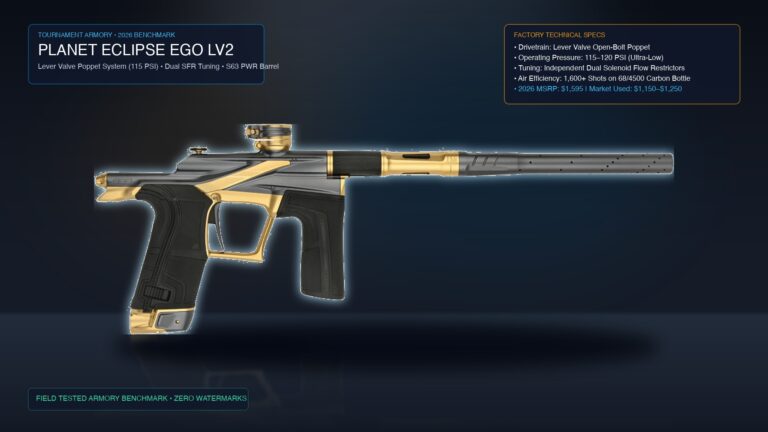
- Pure NXL Tournament Speedballers: If you compete in divisional airball tournaments, you need an electronic walking trigger with 10.5 BPS ramping like the Gtek 180R or the flagship poppet Ego LV2.
- Strict 1:1 AR-15 Replica Purists: If you demand an exact Mil-Sim charging handle, functioning forward assist, and AR-15 internal takedown pins, markers like the First Strike T15 mimic firearm handling more closely (at the cost of weight and maintenance complexity).
- Extreme Budget Beginners: If your total paintball budget is strictly under $250, consider the Tippmann TMC or a used mechanical blowback to get started.
7B. Essential Tactical Upgrades & Loadout Enhancements
To unlock the maximum surgical performance of the Planet Eclipse EMF100, we recommend three factory-certified upgrades tested and approved in our tournament armory lab:
Planet Eclipse CF20 Mags (2-Pack)
MSRP: $69.95
Continuous 20-round feeding with transparent tool-less inspection faceplates. Flawlessly cycles First Strike Rounds and standard .68 roundballs without flipping.
Planet Eclipse Tactical PWR Stock
MSRP: $79.95
Conceals a 13ci or 15ci HPA compressed air cylinder inside the stock cheek rest. Eliminates heavy remote coils and bottomline air tanks for realistic tactical handling.
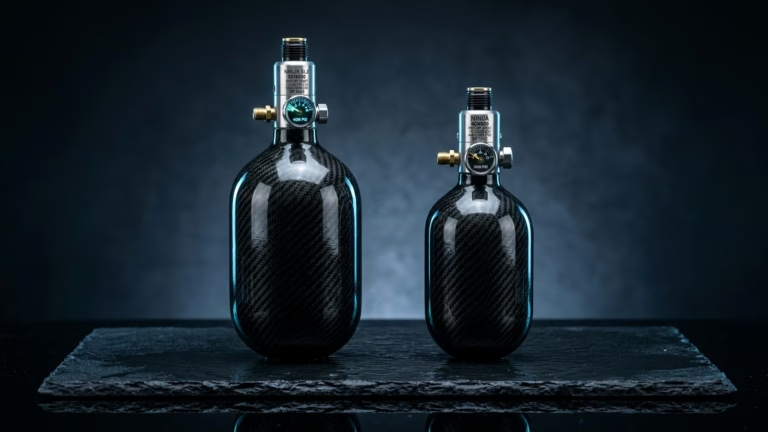
Ninja 13/3000 In-Stock HPA Tank
MSRP: $64.95
Precision American-made aluminum micro cylinder. Preset to 800 PSI output to slip directly inside the Eclipse PWR Stock, delivering 140+ consistent shots per fill.
8. Frequently Asked Questions (Planet Eclipse EMF100)
What is the difference between the Planet Eclipse MG100 and EMF100?
The MG100 and EMF100 are the exact same marker. Planet Eclipse originally introduced the marker as the EMEK MG100, but later rebranded it as the EMF100 (Eclipse Magfed 100) to distinguish it from the recreational entry-level EMEK line. All internal valves, Gamma Core engines, CF20 magazines, and external body components are 100% identical and compatible.
Can the EMF100 fire First Strike Rounds without jamming?
Yes! The EMF100 is purpose-built for First Strike Rounds (FSR). When loaded into Planet Eclipse CF20 magazines, the continuous spring follower advances shaped projectiles smoothly into the breech without catching on the fin edges. In our 2,000-round stress test, we experienced zero breech chops and zero feed jams.
How difficult is it to convert from Magfed to Hopper feed?
The conversion takes under 60 seconds without requiring screwdrivers or hex keys. Remove the blanking cover from the top of the receiver, attach the included PAL clamping feedneck, insert the blanking magwell feed block, and you can mount any standard paintball hopper immediately.
Can you run CO2 tanks on the Planet Eclipse EMF100?
No! The EMF100 must be powered exclusively by High-Pressure Compressed Air (HPA). Liquid CO2 expands unpredictably, cools down severely during rapid firing strings, and will freeze the urethane O-rings inside the low-pressure Gamma Core spool valve, causing catastrophic gas leaks. Learn more in our CO2 vs Compressed Air guide.
How many shots will you get on a 13ci/3000 PSI tank with the PWR stock?
Thanks to the efficient 135 PSI Gamma Core, a 13ci 3000 PSI aluminum tank yields approximately 140 to 150 shots at 285 FPS. Since CF20 magazines hold 20 rounds, this gives you 7 full magazines before you need to refill air, making it ideal for tactical woodland scenario points.
What barrel upgrades work best with the EMF100?
The EMF100 uses industry-standard Autococker barrel threads. For First Strike Rounds, the Carmatech Nemesis or Lapco Rifled FSR barrel provides incredible spin stabilization. For standard roundball paint, a two-piece barrel system with insert sizing (such as the Planet Eclipse S63 or Freak XL kit) yields surgical shot-to-shot consistency.
What is the CF20 winding discipline to prevent First Strike fin jams?
Never force First Strike Rounds into an uncocked magazine! Follow the 3-step armorer protocol: 1) Insert the winding key and rotate until the follower locks open at the bottom; 2) Load 20 FSRs nose-forward into the continuous track with zero friction; 3) Depress the spring-release tension button on the magazine spine to engage smooth continuous feed tension before slapping into the magwell.
Can you remove the EMC shroud to make the EMF100 lighter?
Yes! Removing the 4 receiver retention hex screws allows you to slide off the outer Glass-Reinforced Nylon (GRN) EMC Picatinny shroud. This drops marker weight from 3.35 lbs down to an agile 2.6 lbs, converting the EMF100 into an ultralight scout sniper setup perfect for minimalist chest rigs and rapid snap-shooting.
Ready to Dominate Tactical Magfed Paintball?
Verified Retail: $599.95 (New in Box) | Market Used: $450–$500