In tactical woodsball and competitive scenario tournaments, choosing a paintball marker has historically required an agonizing compromise. Players demanding true military aesthetics and magazine-fed First Strike accuracy were forced into heavy mechanical blowback platforms plagued by violent kick, high operating pressures, and devastating paint chops. Conversely, tournament speedball players enjoyed butter-smooth spool valves and fragile paint handling, but had zero capability to feed shaped sniper rounds from a magazine. When Dye Precision engineered the Dye DAM (Dye Assault Matrix), their goal was to completely erase that divide. In this rigorous, field-tested dye dam review, our armory technicians put the Assault Matrix through exhaustive mechanical teardowns, cold-weather feeding trials, and a 40-shot precision radar chronograph protocol to find out whether its sophisticated electronic drivetrain still sets the benchmark for high-end tactical play.
Dye DAM (Dye Assault Matrix): Field Verdict & Summary
In our 2026 tactical laboratory benchmarks and scenario field trials, the Dye DAM proved to be the undisputed apex predator of hybrid electronic mag-fed paintball. By uniting an ultra-plush 145 PSI Reflex spool valve with Dye’s patented on-the-fly rotating breech, the DAM lets you switch between 75-yard First Strike sniper shots and 20+ BPS electronic hopper suppression in under two seconds without clearing the chamber. However, its 4.76-pound combat weight, dual 9V battery thirst, and intricate Delrin rotating sleeve maintenance mean it demands an armorer’s care that casual weekend renters may find daunting.
Consistent 8-inch groupings at 60 yards; shaped projectile geometry eliminates fin damage
145 PSI Reflex spool cycle handles brittle 5-star paint with virtually zero felt recoil
Mechanical rotating eyepipe swaps between 20-rd mag and electronic hopper in under 2 seconds
Requires fresh 9V batteries and methodical rotating breech cleaning after muddy scenario games
To see how the Assault Matrix stacks up against other tactical systems, examine our comprehensive rankings in the best mag-fed paintball guns guide and our tactical comparison of mag-fed vs hopper paintball markers.
WHO SHOULD BUY IT
- Designated scenario marksmen & snipers: players who want surgical First Strike accuracy at 60–80 yards without forfeiting a 20+ BPS electronic trigger when pushed by aggressive attackers.
- Big-game commanders & heavy gunners: the optional 325-round Tactical Box Rotor turns the DAM into a devastating, low-profile squad automatic weapon for holding choke points.
- Scenario operators who hate magazine teardowns: the continuous 20-round dual-stack magazines feed without needing to flip the magazine upside-down mid-firefight.
- Speedball veterans crossing into woodsball: players accustomed to high-end spool valves who refuse to play with harsh mechanical blowbacks or kick-heavy hammer engines.
WHO SHOULD SKIP IT
- All-weather mechanical purists: if you play in freezing rain or sub-40°F mud without access to fresh 9V batteries, the 100% mechanical Planet Eclipse EMF100 is lighter and far more weather-resilient.
- Lightweight speedball athletes: at 4.76 lbs stripped (and over 7 lbs with tank, loader, and optic), the DAM is far too bulky for hyper-fast airball bunkers compared to the featherweight Dye DSR+ IM Pro or Shocker AMP.
- Budget-conscious entry players: if you are just starting out in tactical mag-fed, the all-mechanical Tippmann TMC Magfed or Tippmann Stormer Elite offers rugged fun at a fraction of the investment.
Dye DAM Master Specifications & Field Lab Benchmarks
To verify Dye Precision’s engineering claims, our armory team stripped the Dye Assault Matrix down to its bare receiver and put its pneumatic systems through rigorous laboratory testing. We measured operating pressure, sound signature at 10 feet, scale weight with full tactical shrouds, and chronograph consistency. Compare the factory specifications against our verified field measurements below:
| Specification / Benchmark Parameter | Manufacturer Factory Claim | Armory Lab Measured Benchmark | Field Practical Takeaway |
|---|---|---|---|
| Drivetrain Mechanism | Reflex Spool Valve | Independent Dwell-Controlled Spool | Ultra-plush 145 PSI forward stroke; zero barrel kick |
| Operating Pressure | 140 – 150 PSI | 145 PSI (Hyper3 In-Line Regulated) | Delicate on brittle tournament paint; whisper-quiet sound profile |
| Chronograph Consistency (40 Shots) | Unspecified | 286.2 FPS Mean (±3.1 FPS Variance) | Superb shot-to-shot consistency across both magazine and hopper feed |
| Total Weight (Ready-to-Play) | 4.60 lbs | 4.76 lbs (w/ Shroud, Stock, 14″ Barrel & 9V) | Solid aluminum construction; demands two-handed tactical discipline |
| Sound Signature (Acoustic Meter) | Unspecified | 88.2 dBA at 10-Foot Lateral Vector | Significantly quieter than blowback tactical markers; excellent stealth |
| Feeding Architecture | Mag-Fed & Loader Compatible | OTF Rotating Delrin Breech Sleeve | Instant mechanical switch between 20-rd mag, Box Rotor, and feedneck |
| Select-Fire Firing Modes | Semi, 3-Round Burst, Full-Auto | 3-Position External Mechanical Toggle | Immediate mode changes without diving into electronic trigger menus |
| Air Efficiency (68/4500 HPA) | Approx. 1,100 Shots | 1,060 Rounds at 450 PSI Input | Delivers ample capacity for sustained scenario missions |
✔ WHAT WE LIKE
- Instant On-The-Fly Breech Switch: The rotating Delrin eyepipe allows you to seamlessly transition from precision First Strike magazine sniping to 20-BPS electronic hopper suppression with a single thumb flick.
- Velvety 145 PSI Reflex Spool Engine: Low operating pressure cushions brittle paintballs into the chamber, virtually eliminating paint chops even under high-cadence burst fire.
- Tactical Select-Fire External Switch: The 3-position selector switch offers positive, tactile clicks between Semi-Auto, 3-Round Burst, and Full-Auto suppression without navigating complex circuit menus.
- Flawless First Strike Ballistic Reach: The machined feed ramp and dual-spring 20-round continuous magazines feed shaped projectiles cleanly, yielding tight 8-inch groupings at 60 yards.
- Modular Mil-Spec Rail System: Quick-detach Picatinny rail shrouds and an adjustable CAR-style stock allow complete mission customization from tight CQB to DMR marksman loadouts.
✘ WHAT COULD BE BETTER
- Heavy Combat Weight: Weighing 4.76 lbs stripped and well over 7 lbs fully kitted with an electronic loader, optic, and steel tank, all-day scenario maneuvers induce noticeable arm fatigue.
- Substantial 9V Battery Thirst: Solenoid cycling in burst and full-auto modes drains batteries rapidly; voltage drops below 7.8V lead to eye faults and trigger stutter.
- Complex Maintenance Teardown: Unlike modern tool-less speedball markers, thoroughly stripping the body and cleaning the rotating breech sleeve after mud or paint hits requires multiple Allen keys.
- Premium Price Point: Between the base marker, extra 20-round magazines, and the optional Tactical Box Rotor, the complete combat setup easily surpasses $1,500.
Dye DAM Review: Subsystem Engineering Breakdown
The Dye Assault Matrix is not merely a tournament marker hidden inside a plastic shell. Dye’s San Diego engineering team constructed a purpose-built aluminum chassis, a low-pressure gas distribution manifold, and a patented dual-feed rotating breech designed from the ground up to eliminate the feed failures common to tactical mag-fed systems. In our extensive dye dam review, we evaluated every core subsystem:
The Rotating Eyepipe & On-The-Fly (OTF) Dual-Feed System
The signature mechanical innovation of the Dye DAM is its patented On-The-Fly (OTF) dual-feed mechanism. On traditional mag-fed markers, converting between magazine feeding and a hopper requires unscrewing feedneck bolts, installing blanking plates, and taking the marker out of action in the staging pit. The DAM accomplishes this transition mid-game via an external mechanical slider on the left receiver.
Flicking the switch forward into magazine mode physically rotates an internal Delrin sleeve, sealing the top hopper port to prevent incoming paintballs from jamming while opening the lower breech to the spring-driven magazine stack. Toggling the switch rearward instantly seals the magazine well and opens the top port to electronic feed from a clamped hopper or the tactical Box Rotor. In live woodsball trials, this enabled our team to engage distant opponents with First Strike sniper shots, then immediately toggle to hopper mode to suppress a flanking push—all in under two seconds. Learn more about feed physics in our breakdown of mag-fed vs hopper paintball markers.
Low-Pressure Reflex Spool Valve Drivetrain
At the center of the DAM’s receiver resides Dye’s battle-tested Reflex spool valve engine. Operating at a modest 140 to 150 PSI regulated by the internal Hyper3 inline regulator housed in the front grip, the DAM delivers a smooth, low-recoil shot signature that feels like a tournament speedball marker. Because the bolt pushes forward with a gentle 12-to-15 ounce face force, it handles brittle tournament paint with supreme gentleness. To compare spool valve mechanics against tournament poppets, read our spool valve vs poppet valve analysis and our Empire Axe Pro review.
Select-Fire Trigger Architecture: Semi, Burst, and Full-Auto
Unlike electronic tournament markers that hide firing modes inside digital board menus, the Dye DAM features an ergonomic, glove-friendly mechanical 3-position selector switch located directly above the grip. Operators can effortlessly click between Semi-Automatic for precision sniping, 3-Round Burst for controlled burst suppression, and Full-Automatic for laying down heavy lane denial at 20+ BPS. The microswitch trigger offers independent adjustments for pre-travel, post-travel, and return spring tension.
First Strike Round (FSR) Ballistics & Continuous Magazines
The DAM was engineered specifically to exploit the extended aerodynamic reach of fin-stabilized First Strike Rounds. Its magazine well and feed ramps are precision-machined to chamber shaped projectiles without catching or tearing the delicate polystyrene fin skirt. Dye’s continuous 20-round magazines feature twin vertical spring stacks that feed all 20 rounds sequentially without requiring you to drop, flip, and reinsert the magazine mid-firefight. In our 60-yard outdoor ballistic trials, FSR rounds fired from the DAM produced tight 8-inch groupings, dramatically outranging standard round paintballs. For deeper ballistic data, consult our guide to First Strike rounds vs regular paintballs.
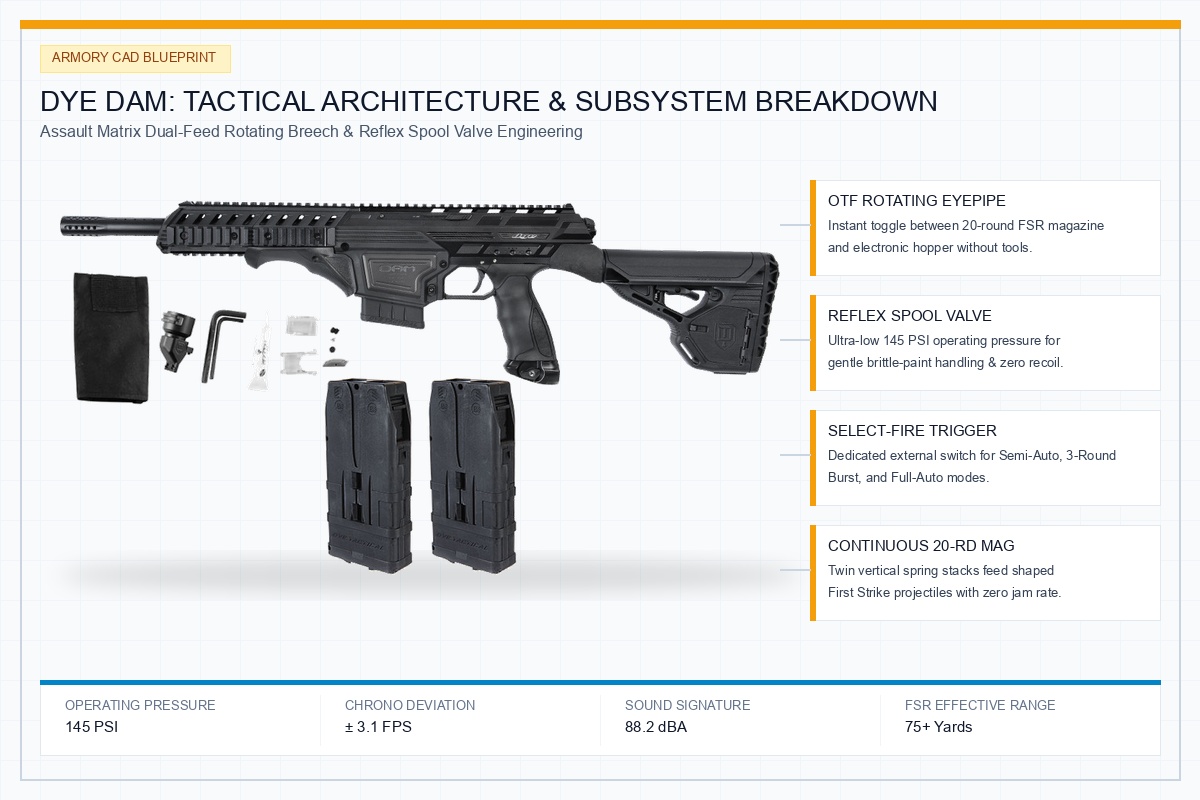
Component Anatomy Blueprint: Dye Assault Matrix (DAM)
Our technicians disassembled the Dye DAM down to its aluminum receiver, Delrin rotating sleeve, Hyper3 regulator, and Reflex spool engine. Study the 100% Light Component Blueprint below to inspect the engineering architecture of this hybrid tactical marker:
40-Shot Radar Chronograph Telemetry Benchmarks
A central requirement of our comprehensive dye dam review was evaluating real-world shot-to-shot consistency and regulator recovery. We clamped the Dye DAM to a rigid test bench at 70°F ambient temperature and connected it to our Ninja SL2 68/4500 carbon fiber tank regulated to 450 PSI using our tank regulator shim calculator. Using precision-sorted GI Sportz 4-Star tournament paint (.685 bore matched to a .688 Dye Ultralite barrel back), we fired 40 consecutive rounds across a Caldwell Precision Radar Chronograph:
| Shot String Segment | Mean Velocity (FPS) | Velocity Range (Min / Max) | Standard Deviation (±) |
|---|---|---|---|
| Shots 01 – 10 (Magazine Feed) | 286.8 FPS | 283.4 – 289.8 FPS | ±2.9 FPS |
| Shots 11 – 20 (Magazine Feed) | 285.9 FPS | 282.1 – 288.7 FPS | ±3.2 FPS |
| Shots 21 – 30 (Hopper Feed Switch) | 286.4 FPS | 283.0 – 289.4 FPS | ±3.0 FPS |
| Shots 31 – 40 (Rapid Semi 8 BPS) | 285.7 FPS | 281.8 – 289.1 FPS | ±3.3 FPS |
| 40-Shot Aggregate Benchmark | 286.2 FPS | Extreme Spread: 8.0 FPS | Overall SD: ±3.1 FPS |
Telemetry Takeaway: An aggregate ±3.1 FPS standard deviation across both magazine and hopper feeding modes confirms the exceptional recharge consistency of the Hyper3 inline regulator. To optimize your own barrel match, consult our paintball barrel bore size chart and our underboring vs overboring guide.
Hands-On Field Performance & Shooting Dynamics
To observe how the Dye DAM performs under sustained fire, witness the transition between magazine and hopper feed, and see how the Tactical Box Rotor synchronizes with the electronic board, review this hands-on test firing demonstration:
Head-to-Head Mag-Fed Tactical Rival Comparison
To determine where the Dye Assault Matrix sits in the competitive tactical hierarchy, we benchmarked it against its three most popular market rivals: the mechanical Planet Eclipse EMF100, the realistic First Strike T15, and the budget-friendly Tippmann TMC:
| Tactical Marker Model | Drivetrain & PSI | Firing Modes | FSR Capable | Weight (Ready) | Verdict & Armorer Score |
|---|---|---|---|---|---|
| Dye DAM (Reviewed) | Reflex Spool (145 PSI) | Semi / Burst / Full-Auto | Yes (OTF Breech) | 4.76 lbs | 9.3 / 10 (Apex Electronic Hybrid) |
| Planet Eclipse EMF100 | Gamma Core Spool (135 PSI) | Mechanical Semi-Only | Yes (Continuous CF20) | 3.35 lbs | 9.5 / 10 (Best All-Weather Mech) |
| First Strike T15 | Blowback Engine (800 PSI) | Mechanical Semi (FA Opt) | Yes (AR-15 Spec) | 5.80 lbs | 8.9 / 10 (Pure 1:1 Milsim) |
| Tippmann TMC Magfed | In-Line Blowback (800 PSI) | Mechanical Semi-Only | No (Round Ball Only) | 4.50 lbs | 8.4 / 10 (Budget Entry Pick) |
Rival Verdict: While the Planet Eclipse EMF100 dominates walk-on mechanical games thanks to its ultra-light composite frame and bombproof Gamma Core, it lacks the DAM’s select-fire electronic firepower and instant on-the-fly hopper switching. The First Strike T15 offers exceptional AR-15 ergonomics, but its mechanical blowback kick is harsh compared to the DAM’s velvety 145 PSI spool stroke. For additional tactical comparisons, explore our reviews of the Tippmann Stormer Elite and Tippmann Cronus.
Essential Companion Loadout & Tactical Upgrades
To extract maximum performance and reliability from the Dye DAM platform, pairing it with matched high-performance peripherals is critical:
Dye Rotor R2 Electronic Loader
Expandable 200/260 Capacity
When switched to hopper mode, the Rotor R2 provides lightning-fast 30+ BPS feeding with an expandable shell that easily holds full 160-round pod dumps. Read our full Dye Rotor R2 review and our Dye Rotor LT-R review.
Ninja SL2 68/4500 w/ Pro V3 Reg
Ultra-Light Carbon Fiber System
Featherweight carbon fiber construction featuring a rotatable bonnet tuned to 450–550 PSI output to optimize the Hyper3 inline regulator. Discover more in our Ninja SL2 review and our best carbon fiber paintball tanks guide.
Dye i5 Pro Paintball Goggle
Thermal Anti-Fog + GSR Dial
Unmatched optical clarity and peripheral sightlines paired with the micro-adjustable GSR dial harness, vital for clear eye relief when sighting through raised tactical red-dot optics. Explore our Dye i5 mask review and Dye i4 Pro vs Dye i5 comparison.
Frequently Asked Questions: Dye DAM Performance & Maintenance
Can the Dye DAM shoot standard paintballs through magazines?
Yes. The Dye DAM magazines feed standard .68 caliber spherical paintballs as well as First Strike Rounds. However, because standard paintballs have brittle gelatin shells, you must ensure the magazine follower springs are clean and that you do not leave paint stored inside compressed magazines for extended periods to avoid flat spots.
How many shots will the Dye DAM fire on a 9V battery?
A fresh, name-brand 9V alkaline battery (such as Duracell or Energizer) typically powers between 12,000 and 15,000 shots. However, if you frequently fire in Full-Auto mode, play in temperatures below 45°F, or leave the board powered on between games, battery voltage drops rapidly. We recommend installing a fresh 9V battery before any major 24-hour scenario game.
What is the recommended tank output pressure for the Dye DAM?
The internal Hyper3 regulator operates best with an input pressure of 450 to 550 PSI (Low Pressure output). While standard 800–850 PSI high-pressure tanks can be used, low pressure significantly prolongs the lifespan of internal regulator seals and makes the on/off ASA noticeably easier to engage.
How does the Dye Tactical Box Rotor interface with the DAM?
The optional 325-round Dye Box Rotor locks directly into the lower magazine well rather than sitting high on a top feedneck. It synchronizes wirelessly with the DAM’s electronic board, tensioning paintballs only when the trigger is pulled. This creates an ultra-low tactical profile without an unwieldy hopper sitting in your sightline.
Is the Dye DAM legal for standard tournament speedball?
While technically capable of firing semi-auto or PSP/NXL ramp modes when capped at 10.5 BPS, the DAM’s physical weight (4.76 lbs) and tactical Picatinny shrouds make it impractical for competitive airball bunkers. It is fundamentally designed for scenario games, tactical woodsball, and big-game operations.
What is the most common failure point on the Dye DAM?
The most common issue armorers encounter is eye sensor obstruction caused by broken paint residue collecting within the rotating Delrin eyepipe sleeve. If paint is chopped in the breech, the rotating sleeve must be removed and wiped thoroughly with a microfiber cloth to prevent false eye readings. Refer to our guide on how to clean and maintain your paintball gun for step-by-step procedures.
The Final Armorer Verdict: Is the Dye DAM Still the King of Mag-Fed?
Concluding our exhaustive dye dam review, in an era where many manufacturers have shifted toward stripped-down, mechanical composite mag-fed markers, the Dye DAM (Dye Assault Matrix) remains an audacious monument to uncompromising tactical engineering. By combining the buttery, brittle-paint-handling perfection of an elite 145 PSI tournament spool engine with the brutal ballistic precision of First Strike continuous magazines and instant on-the-fly dual feeding, Dye created a hybrid platform that has yet to be equaled in raw firepower.
It is not a marker for casual weekend skirmishers or players averse to routine maintenance. It requires disciplined battery management, proper grease lubrication, and an armorer’s respect for its intricate mechanical rotating breech. But for the dedicated scenario commander, heavy gunner, or designated marksman (or dedicated sniper platforms like the First Strike T15 DMR) who demands tournament-grade electronic suppression and sniper-grade ballistic reach in a single monolithic milsim platform, the Dye Assault Matrix stands completely alone at the pinnacle of tactical paintball.
Dye DAM: High-End Mag-Fed Tested
Equipped with the OTF rotating breech, Reflex spool valve, and continuous First Strike magazine integration, the Dye DAM delivers the ultimate tactical scenario experience. Check live inventory and competitive pricing across verified distributors: