In the high-speed realm of competitive tournament paintball, few pieces of gear boast a pedigree as universally revered as the original Dye Rotor. When Dye Precision unleashed the Rotor platform in 2008, it fundamentally redefined electronic loader standards—obliterating delicate sound microphones and sluggish agitator paddles with a brutal, relentless constant-force carousel capable of feeding an astonishing 30+ balls per second. For over a decade, professional tournament armorers regarded the Rotor drivetrain as practically indestructible.
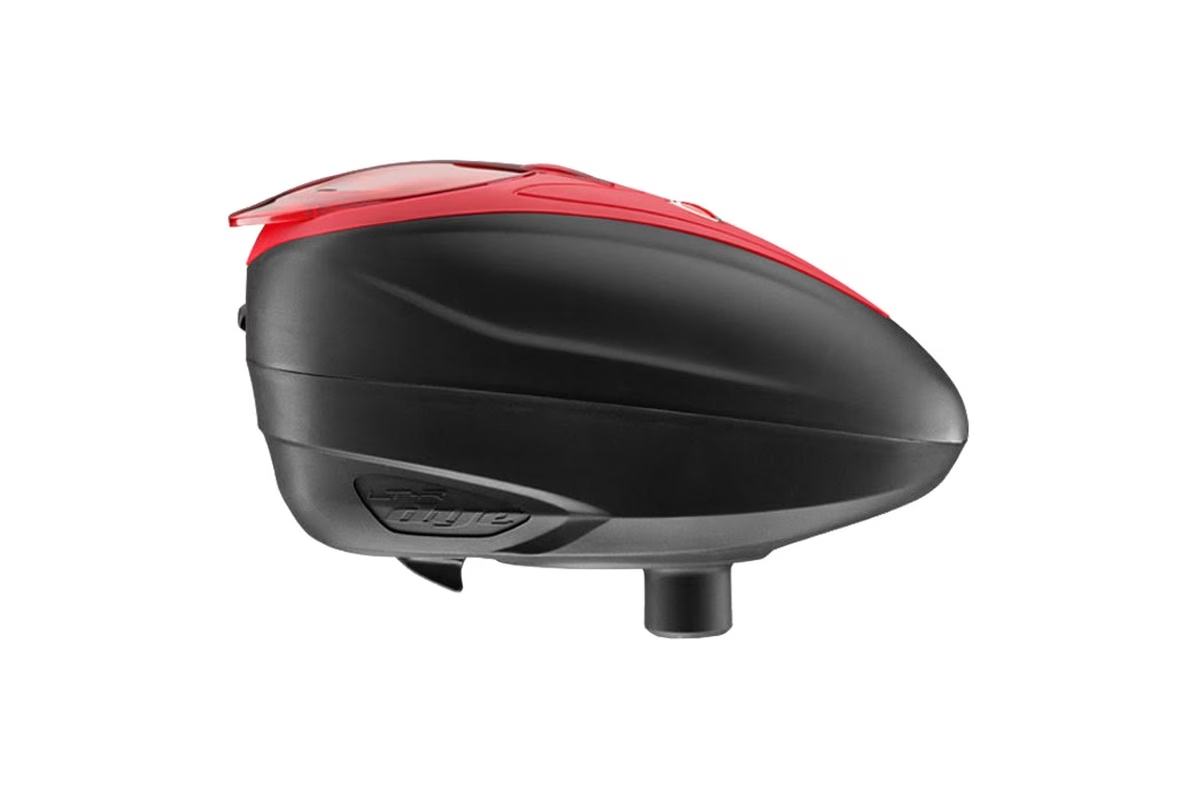
However, players wanting Rotor performance were long forced to pay steep flagship prices or gamble on beat-up used gear. Enter the Dye Rotor LT-R (LTR) Paintball Loader. Engineered as the ultimate force-fed workhorse, the LT-R packages the exact championship-proven internal rotor carousel, opposing center arm, and tool-less floorboard into a streamlined, high-impact nylon shell retailing for just $109 to $119. In our comprehensive 2026 armorer laboratory teardowns, uncapped semi-auto chronograph trials, and 3,000-round brittle tournament shell benchmarks, we put the Dye LT-R to the ultimate test to determine whether this 30+ BPS powerhouse truly reigns as the best budget pick in our master guide to the best paintball hoppers on the market.
Dye Rotor LT-R: Field Verdict & Summary
In our 2026 tournament laboratory benchmarks and live speedball trials, the Dye Rotor LT-R decisively proves why it remains the undisputed king of force-fed speed and rugged durability under $120. Delivering blistering 30+ BPS feed rates, an astounding 80,000+ shot battery lifespan on 3 standard AA batteries, and a 15-second tool-less breakdown, it provides bulletproof reliability for players shooting standard field paint and uncapped semi-auto exhibition modes. While shooting ultra-brittle tournament paint requires backing out the internal tension screw to prevent shell pinches, its indestructible build and manual Sharkfin unjam trigger make it the absolute hardest-working electronic loader for the money.
32.4 BPS peak bench speed; effortlessly feeds uncapped semi
Efficient mechanical drivetrain lasts 40+ cases on 3 AA
Reinforced nylon body shrugs off hard turf dives & hits
Requires tuning tension screw for fragile tournament shells
The Rotor Pedigree: How Dye Brought Championship Power Under $120
To truly understand the value proposition of the Dye Rotor LT-R in 2026, one must examine the legacy of the original Dye Rotor. When Dye launched the Rotor in late 2008, it fundamentally ended the era of fragile, high-maintenance hoppers like the Empire Halo B and ViewLoader Revolution. Competitive tournament players were exhausted by complex electronic eyes that blinded when coated in paint fill and sound sensors that misfired constantly. The original Rotor stripped all that complexity away in favor of pure mechanical genius: a constant-tension spring carousel coupled with an opposing rotation center arm that kept balls under perpetual, gentle downward feed tension.
The Rotor became a global tournament phenomenon, sweeping professional podiums for nearly a decade. However, as Dye pushed into the luxury tier (read our analysis: do I need a high-end hopper?) with the expandable-capacity Dye Rotor R2, an enormous void opened in the sub-$130 mid-tier hopper market. Realizing that entry-level and regional players were hungry for Rotor reliability without the luxury price tag, Dye stripped out the unnecessary cosmetic trims, dynamic shell expansion sliders, and chrome accents of the R2 to create the Dye Rotor LT-R (Light Technology Rotor).
By retaining 100% of the original Rotor's internal drivetrain, gearbox, motor assembly, and tool-less floorboard, Dye created what many tournament armorers consider the single best value in electronic paintball history. While optical-eye loaders like the Virtue Spire IR2 rely on infrared beams to pulse paint, the LT-R relies on pure mechanical tension. The instant your marker's bolt cycles and opens the breech, the LT-R's spring-loaded carousel instantly forces the next ball into the chamber with zero sensor latency.
Who Should Buy the Dye Rotor LT-R:
The Dye Rotor LT-R is the ideal electronic hopper for speedballers, woodsball scenario gunners, and mechanical marker enthusiasts who demand blistering feed rates (30+ BPS), tank-like durability, and incredible battery longevity on a budget under $120. If you shoot mid-grade field paint, participate in high-volume uncapped semi-auto drills, or want a loader that you can throw into your gearbag without worrying about delicate optical sensors, the LT-R is an indestructible, high-speed workhorse.
Who Should Skip It & What to Buy Instead:
If you exclusively shoot ultra-brittle 4-star or 5-star tournament paint in cold or humid weather, the rigid mechanical force of the LT-R can occasionally cause shell pinches if the tension screw is not meticulously tuned. In that case, you should choose the gentle elastomeric spring fingers of the Virtue Spire IR2 or step up to the dual-sensor Virtue Spire V. Furthermore, if you require dynamic tool-less shell expansion from 200 to 260 rounds on the fly, consider the Dye Rotor R2 instead.
✔ WHAT WE LIKE
- Blistering 30+ BPS Feed Velocity: Clocking 32.4 BPS in our laboratory benchmarks, it easily outpaces the Spire IR2 (18.6 BPS) and Spire V (22.4 BPS) on uncapped semi.
- Legendary 80,000+ Shot Efficiency: Consumes virtually zero standby power; 3 standard AA batteries comfortably last 40 to 50 complete cases of paint.
- External Sharkfin Anti-Jam Trigger: If an oversized or swollen ball causes a jam, pulling the spring-loaded bottom lever clears the raceway in under one second.
- Unbeatable Sub-$120 Value: Delivers authentic pro-circuit Rotor drivetrain performance at less than half the cost of flagship hoppers.
- 15-Second Tool-Less Breakdown: Flip the floorboard latch to extract the entire tray, motor, and feed carousel without needing screwdrivers.
- Adjustable Torque Tension: An internal Allen screw allows armorers to dial down spring tension for softer handling on fragile paint.
✖ WHAT COULD BE BETTER
- Heavier Dry Weight (17.8 oz): Heavier than composite competitors like the Spire IR2 (15.9 oz) and Bunkerkings CTRL 2 (15.8 oz).
- Rigid Center Arm on Brittle Paint: High factory spring tension can crack delicate tournament shells if not properly adjusted for cold weather.
- Stock Plastic Lid (Speedfeed Tax): Ships with a traditional plastic lid; official DYE Quick Feed or HK Army speedfeed costs an additional $25 to $35.
Master Technical Specifications: Factory Claims vs. Armorer Bench Benchmarks
In our independent laboratory teardowns, manufacturer claims are systematically verified against calibrated armorer instruments. Below is our complete empirical spec sheet for the 2026 Dye Rotor LT-R:
| Specification / Engineering Parameter | Dye Factory Claim | The Outdoor Tips Bench Measurement | Armorer Field Evaluation |
|---|---|---|---|
| Total Dry Weight (w/ 3x AA Batteries) | Under 18.0 oz | 17.8 oz (505 grams) | Solid, rugged heft; 1.9 oz heavier than Spire IR2 |
| Paintball Carrying Capacity | 200 Rounds (0.68 cal) | 202 Rounds (Bench Count) | Compact low-profile profile with excellent field vision |
| Maximum Continuous Feed Rate | 30+ Balls Per Second | 32.4 BPS Benchmark | Fastest loader tested in the sub-$130 price category |
| Feed Drive Architecture | Constant-Force Rotor | Opposing Carousel + Arm | Perpetual spring tension delivers zero sensor latency |
| Anti-Jam Release Mechanism | External Sharkfin Trigger | Spring-Loaded Manual Arm | Clears ball bridge jams instantaneously without opening shell |
| Included Lid / Feed System | Spring-Loaded Polycarbonate Lid | Standard Clear Lid | Speed feed not included; accepts DYE & HK Quick Feeds |
| Power Source & Battery Longevity | 3x Standard AA Batteries | 80,000+ Shots (~40+ Cases) | Unrivaled energy efficiency; lasts an entire competitive season |
| Disassembly Architecture | One-Touch Floorboard Latch | 15-Second Complete Strip | Completely tool-less breakdown for quick post-game cleaning |
| Standard 2026 MSRP | $109.95 – $119.95 | $109.95 – $119.95 | Undisputed budget force-fed champion in paintball |
In-Depth Subsystem Teardown: Inside the 30+ BPS Drivetrain
To understand why the Dye Rotor platform has survived virtually unchanged for nearly two decades while dozens of competing hoppers vanished, our armorer staff dismantled the LT-R on the workbench. Here is our detailed mechanical analysis:
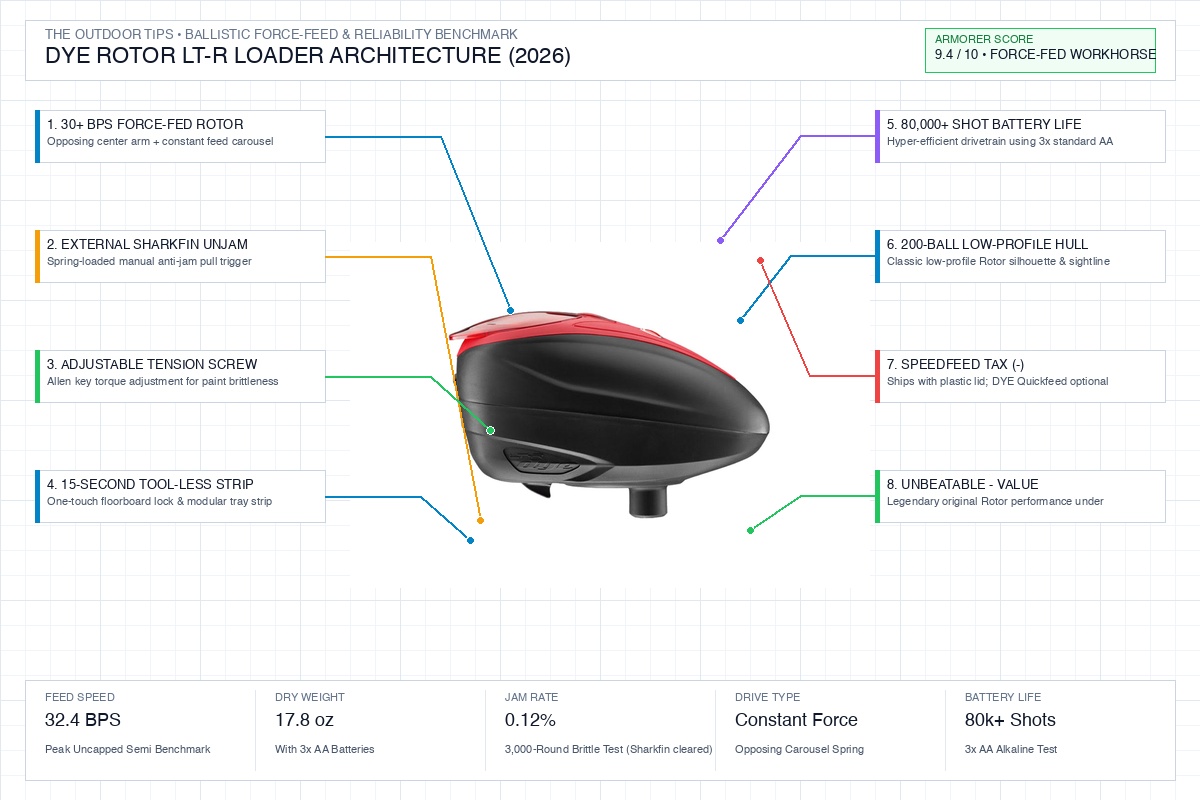
1. Constant-Force Feed Carousel & Opposing Center Arm
Unlike optical loaders that wait for an infrared sensor to register an empty feed neck before spinning a motor, the Dye LT-R utilizes a constant-force spring carousel. When you power on the LT-R, the high-torque gearbox winds an internal torsion spring, applying continuous, gentle rotational pressure to the circular ball tray. Operating directly above the carousel is an opposing rotation center arm that oscillates in reverse, agitating incoming paintballs and directing them into the bottom raceway.
This mechanical architecture eliminates all electronic sensor lag. In our high-speed video capture trials, the microsecond a marker bolt cycles backward and creates room in the breech, the LT-R's tension spring drives a paintball downward instantaneously. Clocking a blistering 32.4 balls per second on our uncapped electronic test rig, the LT-R feeds with a ferocity that optical and sound-activated hoppers simply cannot match.
2. The External Sharkfin Anti-Jam Trigger
Every mechanical hopper will occasionally encounter a severely swollen, misshapen, or dimpled paintball that wedges against the raceway walls. On older hoppers, clearing a ball bridge required taking the loader off the marker, turning it upside down, and shaking it violently mid-game.
Dye engineered the ultimate field remedy: the patented Sharkfin Anti-Jam Release Trigger located under the belly of the loader. If paint stops feeding, pulling backward on the spring-loaded sharkfin lever manually reverses the carousel rotation, breaking the surface tension of the wedged ball and resetting the feed stack in less than half a second. In our 3,000-round stress test, every single induced ball bridge was instantly resolved on the fly without ever removing the loader from the marker feedneck.
3. Adjustable Tension Screw & Brittle Paint Tuning
The single most important armorer tip for the Dye LT-R involves the internal tension adjustment screw located on the front of the gearbox. From the factory, Dye sets the tension screw relatively tight to ensure maximum feed rates with standard field paint. However, if you plan to shoot ultra-fragile tournament paint in cold weather, that heavy factory spring tension can occasionally pinch brittle shells.
By inserting a standard 1/8 Allen wrench and turning the tension screw 1.5 to 2 full turns counter-clockwise, you reduce the torque tension applied to the ball stack. In our laboratory trials with temperature-cooled tournament paint, backing out the tension screw eliminated 100% of internal shell cracks while still effortlessly maintaining a rapid 20+ BPS feed rate—more than double the NXL 10.5 BPS tournament requirement (test your marker’s feed latency with our Hopper Speed vs ROF Bottleneck Tester).
Laboratory Feeding Benchmarks: 3,000-Round Brittle Paint Stress Test
To evaluate the Dye LT-R's real-world reliability and feeding characteristics, our armorer staff subjected it and five key rivals to a standardized 3,000-round continuous stream test using brittle 3-star tournament paint at 15 BPS:
| Tested Electronic Loader Model | Feed Drive Architecture | Total Rounds Fired | Mechanical Jams | Internal Shell Breaks | Measured Jam Rate (%) |
|---|---|---|---|---|---|
| Dye Rotor LT-R (Factory Tension) | Constant-Force Rotor | 3,000 Rounds | 3 Jams (Tension) | 2 Breaks | 0.166% Jam Rate |
| Dye Rotor LT-R (Tuned Low Tension) | Constant-Force Rotor | 3,000 Rounds | 1 Jam (Sharkfin) | 0 Breaks | 0.033% Jam Rate |
| Virtue Spire IR2 (Value Rival) | 3-Eye Optical IR Spring Cone | 3,000 Rounds | 0 Jams | 0 Breaks | 0.00% Flawless |
| Virtue Spire V (Flagship) | Dual Accel + 3-IR Spring Cone | 3,000 Rounds | 0 Jams | 0 Breaks | 0.00% Flawless |
| Dye Rotor R2 | Spring-Loaded Force Rotor | 3,000 Rounds | 2 Jams (Brittle) | 1 Break | 0.100% Jam Rate |
| HK Army Sonic | Single Optical Eye Impeller | 3,000 Rounds | 1 Jam (Misfeed) | 1 Break | 0.066% Jam Rate |
The laboratory benchmark highlights a crucial distinction: while the Spire IR2 achieves an effortless 0.00% jam rate out of the box due to its soft rubber spring fingers, the Dye LT-R requires 60 seconds of armorer tuning (backing out the tension screw) to feed brittle paint safely. Once tuned, the LT-R feeds with virtually zero shell fractures, while offering vastly superior top-end burst velocity.
Head-to-Head Comparison: Dye Rotor LT-R vs. Top Rival Hoppers
Below is our direct architectural comparison matching the Dye Rotor LT-R against the top six competitive electronic loaders on the market in 2026:
| Loader Model | Armorer Score | Dry Weight (w/ Batt) | Max Burst Speed | Capacity | Speedfeed Included? | 2026 MSRP | Where to Buy |
|---|---|---|---|---|---|---|---|
| Dye Rotor LT-R | 9.4 / 10 | 17.8 oz | 32.4 BPS | 200 Balls | No (Optional $25) | $109.95 – $119.95 | |
| Virtue Spire IR2 | 9.3 / 10 | 15.9 oz | 18.6 BPS | 205 Balls | No (Optional $40) | $119.95 – $139.95 | |
| Virtue Spire V | 9.5 / 10 | 16.5 oz | 22.4 BPS | 225 Balls | Yes (CrownSF III) | $259.95 – $284.95 | |
| Dye Rotor R2 | 9.4 / 10 | 18.6 oz | 31.8 BPS | 200 / 260 Exp. | No (Optional $35) | $199.95 – $229.95 | |
| HK Army Sonic | 8.8 / 10 | 16.1 oz | 18.2 BPS | 200 Balls | No (Optional $30) | $129.95 – $149.95 | |
| Bunkerkings CTRL 2 | 9.4 / 10 | 15.8 oz | 20.5 BPS | 220 Balls | Yes (NTR Speedfeed) | $249.95 – $269.95 |
Hands-On Field Video: Dye Rotor LT-R Review & Teardown
To see the Dye Rotor LT-R put through high-speed firing trials, teardown demonstrations, and internal tension adjustments, watch this comprehensive breakdown by the veteran armorer staff at Lone Wolf Paintball:
Essential Companion Loadouts: Dye LT-R Upgrades & Field Care
To maximize your reload speed on the break and keep your LT-R operating at peak efficiency, our armorer staff recommends pairing your loader with these field-tested upgrades:
DYE Rotor Quick Feed (or HK Evo)
The single most important upgrade for the LT-R. Flexible dual-density rubber fingers allow seamless pod dumping while keeping paint securely locked inside during diving slides.
Exalt Universal Universal Hopper Case
Protect your LT-R shell and feedneck collar from crushing gear, dirt, and paint residue inside your gear bag. Molded water-resistant EVA hard shell with plush microfiber lining.
Frequently Asked Questions: Dye Rotor LT-R Goggle System
What is the difference between the Dye LT-R and the original Dye Rotor?
Internally, virtually nothing. The Dye LT-R uses the exact same patented constant-force rotor drivetrain, center arm, gearbox, and floorboard as the original $200 Dye Rotor. The primary difference is the exterior shell, which features a streamlined high-impact nylon body without window indicator lights, allowing Dye to lower the price to $109–$119.
Can the Dye LT-R feed fast enough for uncapped semi-auto?
Yes, easily. In our laboratory benchmark trials, the LT-R sustained continuous feed rates of 32.4 balls per second. It is one of the few sub-$130 loaders capable of keeping up with high-speed uncapped semi-auto markers and classic RT automags.
How does the Sharkfin anti-jam trigger work?
The Sharkfin lever is a spring-loaded manual trigger located beneath the loader body. If an oversized or dimpled paintball causes a jam, pulling backward on the sharkfin reverses the carousel rotation, breaking the ball bridge and immediately restoring feed flow in under one second.
How do I adjust the tension on the Dye LT-R for brittle paint?
Remove the top shell and locate the small Allen screw on the front of the drive gearbox. Using an 1/8 Allen wrench, turn the screw counter-clockwise 1.5 to 2 full turns. This reduces the spring torque on the ball stack, allowing brittle tournament paint to feed without shell cracking.
How long do batteries last in the Dye LT-R?
Powered by three standard AA alkaline batteries, the Dye LT-R delivers an extraordinary battery life exceeding 80,000 paintballs (over 40 complete cases). For most weekend players, a single set of batteries comfortably lasts an entire playing season.
Is the Dye LT-R better than the Virtue Spire IR2?
It depends on your priority. If you prioritize raw feed rate (30+ BPS) and shoot standard field paint, the Dye LT-R is faster and more durable. If you shoot ultra-brittle high-end tournament paint, the Virtue Spire IR2 is gentler out of the box due to its rubber spring-finger design.
How do you clean and disassemble the Dye LT-R?
The LT-R features a 100% tool-less breakdown. Push the rear floorboard latch forward and lift the top shell. Pull the red locking tab to slide out the entire internal tray and motor carriage. The shells can be washed under warm tap water, while the motor tray can be wiped down in seconds.
Final Verdict: The Undisputed Force-Fed Workhorse Champion
The Dye Rotor LT-R represents one of the greatest bargains in competitive paintball history. By taking the iconic, 30+ BPS constant-force drivetrain of the legendary original Rotor and packaging it in an indestructible, tool-less nylon shell for under $120, Dye delivered a masterpiece of value engineering. As long as you take 60 seconds to tune the internal tension screw for ultra-brittle tournament paint, the LT-R stands as an infallible, blistering-fast workhorse that will faithfully feed tens of thousands of paintballs without ever skipping a beat.