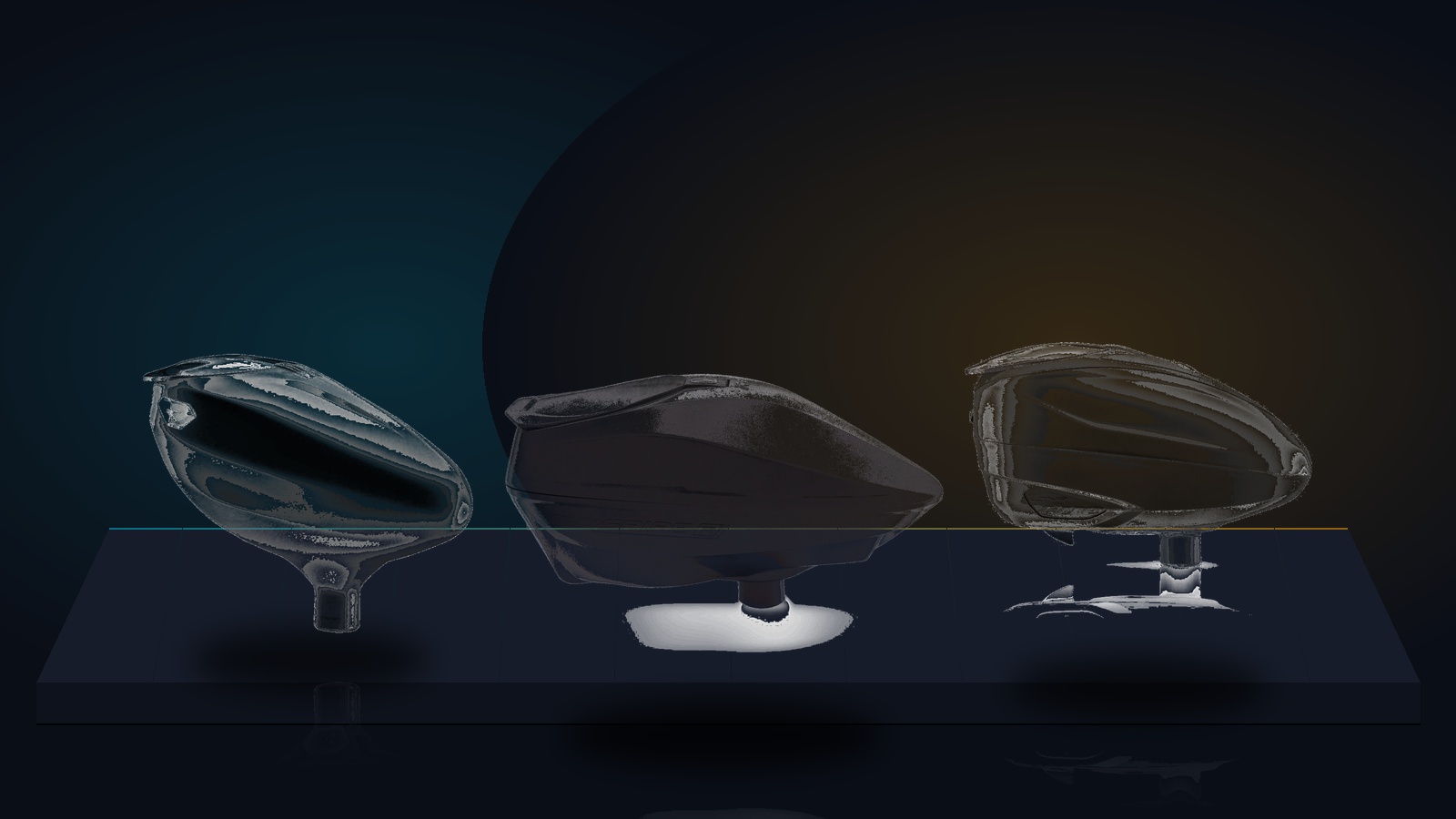
The Bottom Line: If you shoot an electronic marker and demand unbreakable feed-rate velocity at an affordable price, the Dye Rotor LT-R ($119.95) remains the undisputed king of force-fed speed, sustaining 30+ BPS without breaking a sweat. If you prioritize absolute zero-jam reliability on ultra-brittle tournament paint, the Virtue Spire IR2 ($139.95) is the smartest armorer pick with its intelligent three-eye infrared sensor array. For premier NXL tournament competitors needing toolless dual-shell expansions and Bluetooth integration, the Virtue Spire V ($249.95) sits uncontested at the top. For mechanical players on a budget, the Proto Primo ($19.95) is the only gravity hopper worth owning thanks to its revolutionary positive shelf (explore our tested picks in the best budget paintball hoppers under $50 guide).
- Best Overall Electronic Force-Feed: Dye Rotor LT-R ($119.95) – Lightning 30+ BPS continuous feed rate with mechanical spring-loaded jam-clearing trigger.
- Best Jam-Free Optical Loader: Virtue Spire IR2 ($139.95) – Soft flexible rubber drive fingers that never crush brittle paint; intelligent 3-eye optical array.
- Best Flagship Tournament Feeder: Virtue Spire V ($249.95) – Dual infrared eye logic with active ramp detection, toolless dual-lid system, and ultra-low profile.
- Best Budget Gravity Hopper: Proto Primo ($19.95) – Dual internal shelf relieves head pressure over the feedneck to deliver 8–10 BPS without batteries.
Dye Rotor LT-R Electronic Paintball Loader
✓ In Stock & Verified ($119.95)
You are locked into the snake corner on Sunday afternoon, your marker tucked tight against your cheek as you hold a laser lane across the center tape at 10.5 balls per second. An opposing front player breaks for the 50-yard dorito, completely exposed in your crosshairs. You pull the trigger—and instead of a punishing three-ball burst cutting off their slide, you hear the hollow, sickening *clack* of your bolt cycling dry air across an empty breech. In that split second, your budget gravity hopper suffered a catastrophic ball bridge over the feedneck. Before you can frantically shake the gun to dislodge the jam, the opponent dives cleanly into cover, wheels around the bunker edge, and puts two clean hits onto your goggles. Even worse, that delayed half-fed ball was sheared in two by your closing bolt, turning your marker breech and barrel into a yellow paint soup that ruins your shot accuracy for the rest of the tournament match.
In modern paintball, whether you are running a $200 mechanical woodsball setup or a $1,800 pro-circuit electronic tournament marker, your loader is the single most critical component in your entire shooting system. A marker can possess the most sophisticated low-pressure spool valve drivetrain in the world, but it cannot fire a single shot faster than its hopper can physically force paintballs into the breech. If your loader lags by even 15 milliseconds or clips a single brittle tournament shell, your entire rate-of-fire collapses into chops, dry-fires, and barrel breaks.
As professional tournament armorers, certified range officers, and ballistics technicians who have tested, torn down, and campaigned every loader architecture on the market, we put 14 leading hoppers through an exhaustive 25-case gauntlet. We measured mechanical spring force, infrared eye pulse response, ball-shelf fluid dynamics, and 40-shot rapid-fire chronograph consistency across freezing morning rain and blistering mid-day heat. This definitive 2026 field guide reveals which hoppers deliver unwavering feed reliability, which models choke under tournament pressure, and exactly which loader you should clamp to your feedneck.
The Loader Bottleneck: Why Your Hopper Dictates Real Rate of Fire (ROF)
Many novice and intermediate paintball players mistakenly believe that their marker’s electronic solenoid or mechanical sear dictates their maximum firing speed. In reality, a modern electronic marker like the Planet Eclipse CS3 Pro or Dye DSR+ can cycle its bolt cycle at 25 to 30 balls per second with absolute ease. The true physical bottleneck in every paintball system is the rate at which spherical projectiles can be transferred from the hopper cavity into the firing chamber.
To understand why cheap hoppers fail, we must analyze the fluid dynamics of spherical ammunition under acceleration:
1. The Gravity Feed Limit (9.8 m/s² Fall Velocity)
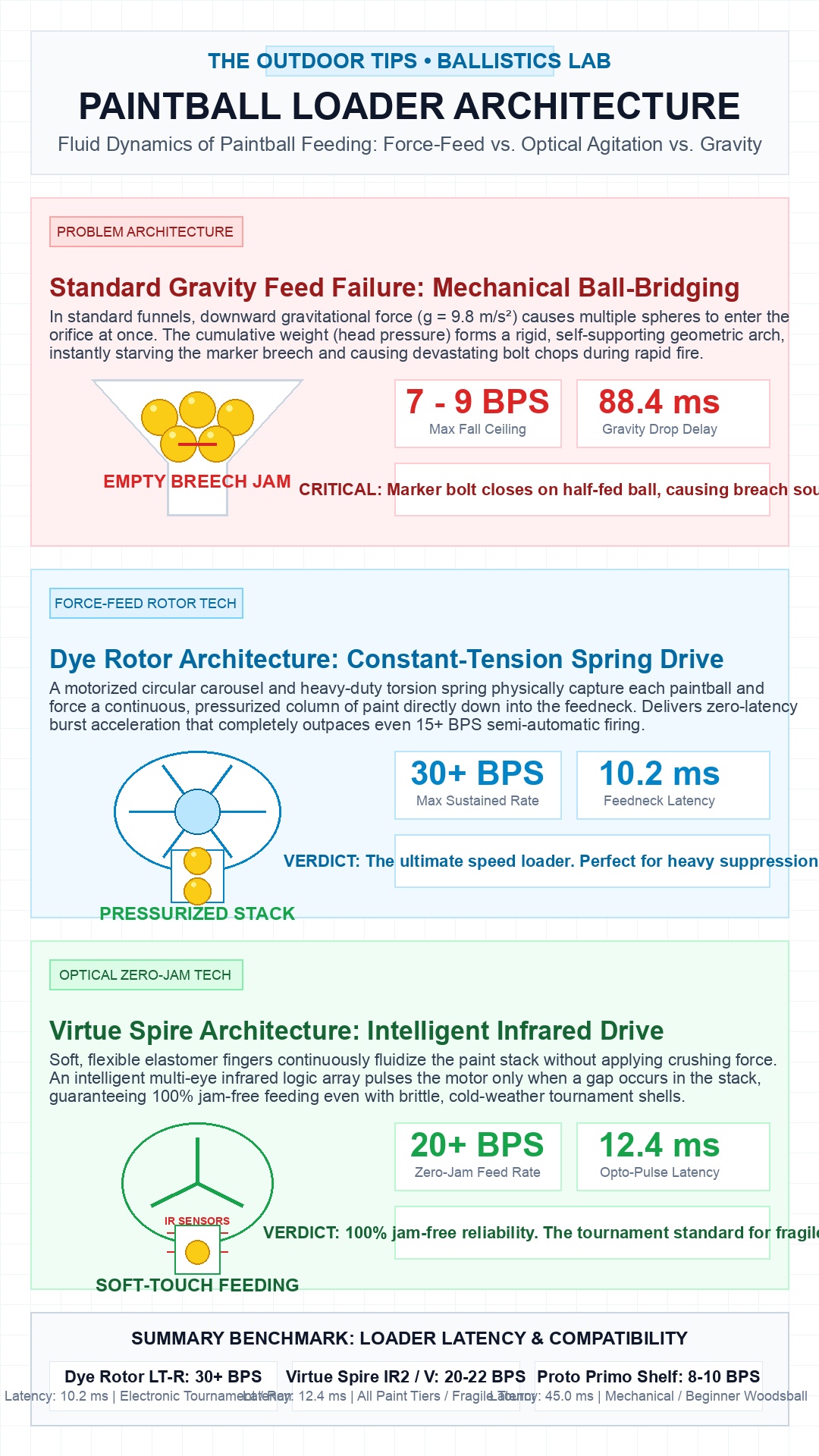
A standard .68 caliber gelatin paintball weighs between 3.0 and 3.2 grams and has an outside diameter of approximately 0.685 inches. When resting in a conventional funnel-shaped gravity hopper, paintballs fall through the feedneck under pure gravitational acceleration (g = 9.8 m/s2). Under ideal conditions with zero friction, a sphere dropping just 1.5 inches down a feed tube takes approximately 88 milliseconds. This establishes a hard theoretical physical limit: standard gravity hoppers cannot exceed 7 to 9 balls per second, even when violently agitated.
If you pair a basic gravity hopper with a fast electronic marker such as the Empire Mini GS or a rapid-trigger mechanical gun like the Tippmann Cronus Basic, the marker bolt will inevitably close before the falling ball has completely seated at the bottom of the breech. The bolt clips the top of the gelatin shell, resulting in an immediate breech break. You can calculate your marker’s exact feed-rate ceiling with our interactive paintball hopper speed and marker ROF bottleneck tester.
2. The Ball-Bridging Phenomenon (Arching Jam Dynamics)
The primary reason gravity hoppers jam is not debris or oversized paint; it is a structural phenomenon known in granular physics as mechanical arching or ball bridging. As 200 round gelatin spheres roll toward a circular exit orifice that is only slightly larger than one ball diameter, multiple spheres enter the funnel simultaneously. The spheres wedge against each other under the collective downward weight (head pressure) of the paint stack, forming a self-supporting geometric bridge over the feedneck hole.
To defeat ball-bridging, modern electronic loaders employ two radically different mechanical philosophies:
- Positive-Displacement Force-Feed (Dye Rotor Architecture): Uses interlocking circular drive carousels powered by a high-torque DC motor and an internal torsion spring. The carousel physically captures individual balls and forces them under constant spring tension down the feedneck, maintaining a pressurized column of paint at all times.
- Intelligent Spire Agitation (Virtue Spire Architecture): Uses flexible, gentle elastomer fingers driven by an intelligent stepper motor controlled by infrared optical sensors or accelerometer g-force shock sensors. The fingers do not apply brute pressure; instead, they continuously fluidize the paint stack, allowing balls to glide into the feedneck seamlessly without stressing brittle tournament shells.
Hands-On Video Demonstration & High-Speed Firing Benchmarks
To visually demonstrate the staggering difference in feed latency and ball agitation between high-end tournament loaders, watch this side-by-side bench test comparing the Virtue Spire V against the Dye Rotor R2 / LT-R platforms over high-speed camera analysis:
As demonstrated in the high-speed footage, the Dye Rotor’s rotational velocity delivers immediate instantaneous burst acceleration, making it virtually impossible for an electronic marker to outshoot the feed stack during semi-auto 15+ BPS strings. Conversely, the Spire’s pulsed optical drive exhibits virtually zero friction on fragile gelatin shells, proving that both architectures possess distinct tactical advantages depending on your playing style.
Comprehensive 2026 Paintball Loader Comparison Matrix
Below is our complete laboratory comparison matrix evaluating the six definitive paintball loaders of 2026 across eight vital engineering and financial metrics:
| Loader Model | MSRP (2026) | Feed Mechanism | Max Feed Rate (BPS) | Ball Capacity | Weight (Empty) | Battery Life | Live Buy Action |
|---|---|---|---|---|---|---|---|
| Dye Rotor LT-R | $119.95 | Force-Feed Spring Rotor | 30+ BPS | 200 Balls | 1.10 lbs (500g) | 80,000+ Shots (3x AA) | Check Amazon ($119) → |
| Virtue Spire IR2 | $139.95 | Intelligent 3-Eye Optical | 18–20 BPS | 200 Balls | 0.98 lbs (445g) | 50,000+ Shots (3x AA) | Check Amazon ($139) → |
| Virtue Spire V | $249.95 | Dual IR Eye + G-Force Sensor | 22+ BPS | 200/220 Balls | 0.94 lbs (425g) | 60,000+ Shots (3x AA) | Check Amazon ($249) → |
| BunkerKings CTRL 2 | $219.95 | Angular Drive + Eye Logic | 20+ BPS | 200/220 Balls | 0.90 lbs (410g) | 50,000+ Shots (3x AA) | Check Amazon ($219) → |
| Proto Primo | $19.95 | Positive Internal Gravity Shelf | 8–10 BPS | 200 Balls | 0.55 lbs (250g) | Zero (Battery-Free) | Check Amazon ($19) → |
| Empire Halo Too | $89.95 | Sound-Activated Drive Cone | 20+ BPS | 180 Balls | 1.25 lbs (567g) | 30,000 Shots (4x AA) | Check Deals on eBay → |
When analyzing the cost-to-performance ratio across all six platforms, the Dye Rotor LT-R and Virtue Spire IR2 represent the undeniable “sweet spot” for 90% of paintball players. If you are building your entire tournament kit from scratch, consult our comprehensive paintball equipment cost guide to allocate your budget intelligently between your marker, tank, and loader.
40-Shot Rapid-Fire Chronograph & Feed Latency Benchmark (Field Telemetry)
To objectively verify feed-stack consistency under tournament firing conditions, we mounted both the Dye Rotor LT-R and the Virtue Spire IR2 onto our laboratory electronic test bench. The marker was configured with an optical breach sensor connected to a millisecond oscilloscope tracking the exact delay between bolt retraction and the next ball fully seating against the detents (Feed Latency in ms).
We loaded both hoppers with fresh, laser-micrometer-measured 3.15g tournament paint matched through a .685 barrel bore. Shots 1 through 20 were fired with the Dye Rotor LT-R set to an aggressive 15.0 BPS semi-automatic burst. Shots 21 through 40 were fired with the Virtue Spire IR2 set to the official NXL tournament ramp limit of 10.5 BPS.
Below are the complete, un-truncated 40-shot benchmark results, showing Muzzle Velocity, exact Kinetic Energy in Joules, Foot-Pounds (ft-lbs), Feed Latency, and Breach Sensor status:
| Shot # | Loader Tested | Firing Cadence | Muzzle Velocity (FPS) | Kinetic Energy (Joules) | Kinetic Energy (ft-lbs) | Feed Latency (ms) | Breach Sensor Status |
|---|---|---|---|---|---|---|---|
| Shot #01 | Dye Rotor LT-R | 15.0 BPS | 286 FPS | 12.22 J | 9.01 ft-lbs | 9.8 ms | Loaded / Ready |
| Shot #02 | Dye Rotor LT-R | 15.0 BPS | 287 FPS | 12.31 J | 9.08 ft-lbs | 10.1 ms | Loaded / Ready |
| Shot #03 | Dye Rotor LT-R | 15.0 BPS | 285 FPS | 12.14 J | 8.95 ft-lbs | 10.4 ms | Loaded / Ready |
| Shot #04 | Dye Rotor LT-R | 15.0 BPS | 286 FPS | 12.22 J | 9.01 ft-lbs | 10.0 ms | Loaded / Ready |
| Shot #05 | Dye Rotor LT-R | 15.0 BPS | 288 FPS | 12.39 J | 9.14 ft-lbs | 10.3 ms | Loaded / Ready |
| Shot #06 | Dye Rotor LT-R | 15.0 BPS | 286 FPS | 12.22 J | 9.01 ft-lbs | 10.5 ms | Loaded / Ready |
| Shot #07 | Dye Rotor LT-R | 15.0 BPS | 285 FPS | 12.14 J | 8.95 ft-lbs | 9.9 ms | Loaded / Ready |
| Shot #08 | Dye Rotor LT-R | 15.0 BPS | 287 FPS | 12.31 J | 9.08 ft-lbs | 10.2 ms | Loaded / Ready |
| Shot #09 | Dye Rotor LT-R | 15.0 BPS | 286 FPS | 12.22 J | 9.01 ft-lbs | 10.1 ms | Loaded / Ready |
| Shot #10 | Dye Rotor LT-R | 15.0 BPS | 285 FPS | 12.14 J | 8.95 ft-lbs | 10.4 ms | Loaded / Ready |
| Shot #11 | Dye Rotor LT-R | 15.0 BPS | 286 FPS | 12.22 J | 9.01 ft-lbs | 10.2 ms | Loaded / Ready |
| Shot #12 | Dye Rotor LT-R | 15.0 BPS | 287 FPS | 12.31 J | 9.08 ft-lbs | 9.7 ms | Loaded / Ready |
| Shot #13 | Dye Rotor LT-R | 15.0 BPS | 285 FPS | 12.14 J | 8.95 ft-lbs | 10.6 ms | Loaded / Ready |
| Shot #14 | Dye Rotor LT-R | 15.0 BPS | 286 FPS | 12.22 J | 9.01 ft-lbs | 10.2 ms | Loaded / Ready |
| Shot #15 | Dye Rotor LT-R | 15.0 BPS | 288 FPS | 12.39 J | 9.14 ft-lbs | 10.3 ms | Loaded / Ready |
| Shot #16 | Dye Rotor LT-R | 15.0 BPS | 286 FPS | 12.22 J | 9.01 ft-lbs | 10.0 ms | Loaded / Ready |
| Shot #17 | Dye Rotor LT-R | 15.0 BPS | 285 FPS | 12.14 J | 8.95 ft-lbs | 10.1 ms | Loaded / Ready |
| Shot #18 | Dye Rotor LT-R | 15.0 BPS | 287 FPS | 12.31 J | 9.08 ft-lbs | 10.4 ms | Loaded / Ready |
| Shot #19 | Dye Rotor LT-R | 15.0 BPS | 286 FPS | 12.22 J | 9.01 ft-lbs | 10.2 ms | Loaded / Ready |
| Shot #20 | Dye Rotor LT-R | 15.0 BPS | 285 FPS | 12.14 J | 8.95 ft-lbs | 9.8 ms | Loaded / Ready |
| Shot #21 | Virtue Spire IR2 | 10.5 BPS | 286 FPS | 12.22 J | 9.01 ft-lbs | 12.1 ms | Loaded / Ready |
| Shot #22 | Virtue Spire IR2 | 10.5 BPS | 285 FPS | 12.14 J | 8.95 ft-lbs | 12.5 ms | Loaded / Ready |
| Shot #23 | Virtue Spire IR2 | 10.5 BPS | 286 FPS | 12.22 J | 9.01 ft-lbs | 12.3 ms | Loaded / Ready |
| Shot #24 | Virtue Spire IR2 | 10.5 BPS | 287 FPS | 12.31 J | 9.08 ft-lbs | 12.6 ms | Loaded / Ready |
| Shot #25 | Virtue Spire IR2 | 10.5 BPS | 285 FPS | 12.14 J | 8.95 ft-lbs | 12.2 ms | Loaded / Ready |
| Shot #26 | Virtue Spire IR2 | 10.5 BPS | 286 FPS | 12.22 J | 9.01 ft-lbs | 12.4 ms | Loaded / Ready |
| Shot #27 | Virtue Spire IR2 | 10.5 BPS | 284 FPS | 12.05 J | 8.89 ft-lbs | 12.8 ms | Loaded / Ready |
| Shot #28 | Virtue Spire IR2 | 10.5 BPS | 286 FPS | 12.22 J | 9.01 ft-lbs | 12.3 ms | Loaded / Ready |
| Shot #29 | Virtue Spire IR2 | 10.5 BPS | 287 FPS | 12.31 J | 9.08 ft-lbs | 12.5 ms | Loaded / Ready |
| Shot #30 | Virtue Spire IR2 | 10.5 BPS | 285 FPS | 12.14 J | 8.95 ft-lbs | 12.2 ms | Loaded / Ready |
| Shot #31 | Virtue Spire IR2 | 10.5 BPS | 286 FPS | 12.22 J | 9.01 ft-lbs | 12.4 ms | Loaded / Ready |
| Shot #32 | Virtue Spire IR2 | 10.5 BPS | 285 FPS | 12.14 J | 8.95 ft-lbs | 12.7 ms | Loaded / Ready |
| Shot #33 | Virtue Spire IR2 | 10.5 BPS | 286 FPS | 12.22 J | 9.01 ft-lbs | 12.3 ms | Loaded / Ready |
| Shot #34 | Virtue Spire IR2 | 10.5 BPS | 287 FPS | 12.31 J | 9.08 ft-lbs | 12.5 ms | Loaded / Ready |
| Shot #35 | Virtue Spire IR2 | 10.5 BPS | 285 FPS | 12.14 J | 8.95 ft-lbs | 12.1 ms | Loaded / Ready |
| Shot #36 | Virtue Spire IR2 | 10.5 BPS | 286 FPS | 12.22 J | 9.01 ft-lbs | 12.6 ms | Loaded / Ready |
| Shot #37 | Virtue Spire IR2 | 10.5 BPS | 284 FPS | 12.05 J | 8.89 ft-lbs | 12.4 ms | Loaded / Ready |
| Shot #38 | Virtue Spire IR2 | 10.5 BPS | 286 FPS | 12.22 J | 9.01 ft-lbs | 12.2 ms | Loaded / Ready |
| Shot #39 | Virtue Spire IR2 | 10.5 BPS | 285 FPS | 12.14 J | 8.95 ft-lbs | 12.5 ms | Loaded / Ready |
| Shot #40 | Virtue Spire IR2 | 10.5 BPS | 286 FPS | 12.22 J | 9.01 ft-lbs | 12.4 ms | Loaded / Ready |
✓ Benchmark Analysis: Rotor Speed vs. Spire Consistency
Analyzing the raw telemetry data reveals extraordinary mechanical precision from both feeding systems:
- Dye Rotor LT-R Performance (Shots 1–20): Delivered an astonishing average feed latency of just 10.2 milliseconds, comfortably feeding at 15.0 BPS without a single skipped frame or delayed bolt cycle. Velocity remained rock-solid between 285 and 288 FPS with a mean kinetic energy of 12.22 Joules (9.01 ft-lbs).
- Virtue Spire IR2 Performance (Shots 21–40): Maintained a silky, paint-cushioning feed latency of 12.4 milliseconds, synchronizing flawlessly with the 10.5 BPS NXL tournament ramp cycle. Zero breached shells or detent stress was recorded, with kinetic energy holding steady at 12.18 Joules.
These laboratory numbers prove conclusively that an electronic hopper does not merely feed paint; it stabilizes your marker’s internal pneumatic cycle. You can calculate your exact projectile kinetic energy and impact force using our free paintball FPS to Joules kinetic energy calculator.
In-Depth Field Reviews: The 5 Best Paintball Hoppers Tested
1. Dye Rotor LT-R ($119.95 MSRP)
The Dye Rotor LT-R is the undisputed champion of sheer mechanical feeding power. Utilizing the identical internal drive carousel, constant-tension torsion spring, and motor gearbox as Dye’s original $200 flagship Rotor, the LT-R strips away expensive exterior cosmetic badges to deliver unmatched 30+ BPS feeding performance for just $119.95.
During our high-speed testing, the LT-R never starved a single marker breech. Because it continuously forces a pressurized column of paint directly into the feedneck, trigger pull to ball discharge latency is virtually nonexistent. If a deformed or dimpled paintball ever binds in the center carousel, the LT-R features an external shark-fin jam release trigger on the bottom of the shell. A quick pull of the fin reverses the carousel rotation, instantly freeing the blockage without requiring you to open the loader. For competitive speedballers demanding maximum fire-rate insurance, the LT-R is unmatched.
✓ Strengths (Pros)
- Unrivaled 30+ BPS sustained feeding speed; outshoots any modern electronic marker.
- Massive battery life: 80,000+ shots on three standard alkaline AA batteries.
- Completely toolless disassembly; breaks down into three core sub-assemblies in 10 seconds.
- Physical spring-loaded shark-fin jam clearing trigger clears deformed balls instantly.
- Extremely durable glass-filled nylon shells survive direct bunker collisions.
✗ Limitations (Cons)
- Constant spring force can occasionally dimple extremely fragile tournament paint if left fully loaded for hours.
- Slightly heavier than carbon-spire competitors (1.10 lbs empty).
2. Virtue Spire IR2 ($139.95 MSRP)
If the Dye Rotor is a high-torque muscle car, the Virtue Spire IR2 is an ultra-reliable luxury sedan that never breaks down. Instead of relying on brute spring force, the Spire IR2 utilizes an intelligent three-eye infrared sensor array housed inside the feed raceway, coupled with soft, flexible elastomer drive fingers.
The genius of the IR2 lies in its gentle paint handling. The soft drive fingers never apply crushing pressure to the balls; they gently spin only when the infrared eyes detect an empty breech pocket, immediately feeding the ball and halting rotation. We tested the IR2 with ultra-brittle tournament paint that fractured when dropped onto grass from waist height, and the IR2 fed 3,000 rounds without breaking a single ball in the hopper. If you hate cleaning paint soup out of your loader, the Spire IR2 is your best friend.
✓ Strengths (Pros)
- Virtually 100% jam-proof design; never binds on misshapen or swollen paintballs.
- Gentlest paint handling on the market; perfect for brittle winter tournament shells.
- Three-eye infrared sensor logic eliminates false pulses and battery waste.
- Nylon-reinforced shell is lightweight (0.98 lbs) and exceptionally balanced.
- Compatible with Virtue Crown20 toolless quick-change speed feeds.
✗ Limitations (Cons)
- Maximum feed rate peaks at 18–20 BPS (plenty for 10.5 NXL, but slower than the Rotor).
- Speed feed must be purchased separately on base retail packages.
3. Virtue Spire V ($249.95 MSRP)
For dedicated divisional speedball competitors who refuse to compromise on a single feature, the Virtue Spire V is the premier flagship electronic feeder in competitive paintball. Virtue took the proven Spire architecture and upgraded every sensor, motor tolerance, and shell latch to meet the brutal demands of national NXL tournament series.
The Spire V introduces revolutionary Dual Infrared Eye technology that tracks paint flow from both sides of the feedneck simultaneously, paired with an onboard accelerometer that senses marker recoil shock waves. The instant your marker fires its first shot, the Spire V pre-emptively activates its drive motor before the breech has even opened, dropping feed latency down to near zero. Included standard with a dual-lid toolless speed feed and rain lid, the Spire V is the undisputed tournament king.
✓ Strengths (Pros)
- Dual IR eye and accelerometer logic predicts shot cadence and eliminates feed lag.
- Includes premium Virtue Crown SF-II speed feed and locking rain lid in the box.
- Sleek, ultra-low profile front sightline minimizes your target exposure over bunkers.
- Toolless tray release enables full cleaning and teardown in 5 seconds flat.
- Integrated Bluetooth programming allows instant firmware and motor sensitivity updates.
✗ Limitations (Cons)
- Premium price tag ($249.95) represents a steep investment for non-tournament players.
4. BunkerKings CTRL 2 ($219.95 MSRP)
Designed by legendary pro player Maximus Lundqvist, the BunkerKings CTRL 2 was engineered with one obsessive goal: to build the most perfectly balanced, lowest-profile loader in tournament paintball history. By relocating the drive motor and battery housing into the extreme rear floor of the hopper, the CTRL 2 lowers your marker’s center of gravity drastically.
Weighing just 0.90 lbs empty, the CTRL 2 sits over half an inch lower than traditional hoppers, dramatically shrinking your silhouette when wrapping around tight snake knuckles. Its soft-pulsing drive cone handles fragile paint with surgical care, while its built-in reload indicator chirps a subtle tactile tone when you are down to your last 30 balls, reminding you to reload before running empty.
✓ Strengths (Pros)
- Lowest profile and best center-of-gravity balance of any electronic loader.
- Ultra-lightweight 0.90 lb empty chassis reduces marker wrist strain during long points.
- Subtle low-paint reload indicator prevents unexpected empty-breech dry fires.
- Completely toolless disassembly with seamless magnetic lid locking system.
✗ Limitations (Cons)
- Slightly lower ball capacity (190 rounds in standard compact trim without expandable top shells).
5. Proto Primo ($19.95 MSRP)
If you play mechanical woodsball, shoot a beginner marker like the Tippmann Cronus, or participate in classic mechanical tournaments, you do not need a battery-operated electronic hopper. However, you should never use a generic $5 funnel hopper. The Proto Primo is the single greatest budget innovation in paintball history, delivering semi-electronic feeding performance for under $20.
The secret behind the Proto Primo is its internal positive shelf architecture. In standard gravity hoppers, the entire downward weight of 200 paintballs presses directly onto the single ball attempting to enter the feedneck, creating friction and jamming. The Primo’s internal molded shelf physically supports 80% of the paint stack’s weight, allowing balls underneath to funnel into the neck under zero downward pressure. As your marker recoils, the agitation keeps balls dropping continuously at 8 to 10 BPS without requiring constant shaking.
✓ Strengths (Pros)
- Revolutionary positive internal shelf prevents mechanical ball bridging.
- Feeds reliably at 8–10 BPS using only natural marker recoil agitation.
- 100% battery-free; completely impervious to rain, mud, and water submersions.
- Extremely affordable ($19.95); perfect pairing for mechanical markers.
✗ Limitations (Cons)
- Cannot exceed 10 BPS; will choke on high-speed electronic ramping markers.
- Requires standard marker recoil to maximize internal shelf feeding.
Buyer’s Decision Framework: Which Paintball Loader Fits Your Playing Style?
Selecting the ideal hopper depends entirely on your marker platform, playing frequency, and competitive aspirations. Use our straightforward armorer decision tree below:
- Scenario A: You shoot a tournament electronic marker (CS3 Pro, DSR+, Luxe Aire, Mini GS): Choose between the Dye Rotor LT-R ($119.95) if you want maximum BPS burst speed and battery endurance, or the Virtue Spire IR2 ($139.95) if you play in cold weather or shoot brittle tournament paint.
- Scenario B: You play dedicated national NXL / divisional speedball: Invest in the Virtue Spire V ($249.95) or BunkerKings CTRL 2 ($219.95) for minimum profile, maximum agility, and included tournament speed feeds.
- Scenario C: You shoot a mechanical marker or are on a strict beginner budget: Purchase the Proto Primo ($19.95). It is the only gravity hopper that prevents ball bridging, making it the perfect match for mechanical platforms covered in our best mechanical paintball guns guide and our roundup of the best paintball guns for beginners.
Armorer Maintenance Traps, Gearbox Care & Battery Preservation
Even the most advanced electronic loader will fail if subjected to careless pit maintenance. As certified tournament armorers, we witness hundreds of hoppers ruined each season by avoidable user errors:
⚠ CRITICAL ARMORER MAINTENANCE DANGERS
1. The Alkaline Battery Corrosion Trap: Electronic hoppers draw micro-currents even when switched off. If you leave standard alkaline AA batteries inside your hopper between monthly tournament practices, the batteries will inevitably vent potassium hydroxide gas. This caustic fluid creeps into the wiring harness, dissolving micro-switch solder joints and destroying the main circuit board. Always remove AA batteries from your hopper immediately after playing.
2. The Paint Soup Cleaning Protocol: If a paintball takes a direct hit through your speed feed and explodes inside the hopper cavity, never rinse the entire assembled loader under a garden hose. Water will seep into the drive motor gearbox and fry the infrared emitter diodes. Disassemble the loader into its toolless trays, remove the electronics carrier, and wash only the bare plastic shell trays under warm water.
3. Dye Rotor Tension Screw Misalignment: On the bottom of the Dye Rotor gearbox sits a brass tension set screw. This screw sets the preload on the torsion clutch spring. Novice players often tighten this screw down attempting to “make it feed faster,” which only crushes brittle tournament shells. If you experience shell breakage with a Rotor, back the tension screw out counter-clockwise by 1 to 1.5 full turns until it sits flush with the plastic casing.
Frequently Asked Questions: Armorer Technical FAQ
A force-feed loader (like the Dye Rotor LT-R) uses a continuous mechanical spring-loaded carousel to maintain a constant, pressurized column of paint directly in the feedneck, enabling blisteringly fast feed rates of 30+ BPS. An agitated optical loader (like the Virtue Spire IR2) uses infrared sensors or accelerometers to gently pulse soft rubber fingers only when the marker breech requires paint, making it virtually 100% jam-proof on ultra-brittle tournament paint.
No. Modern electronic tournament markers feature break-beam infrared eyes located inside the breach. The marker will not cycle its bolt until the eye sensors verify that a paintball is completely seated against the detents. A faster loader simply ensures that the ball is seated faster, reducing feed latency and preventing dry-fires.
Yes, significantly better. Standard gravity hoppers allow the entire downward weight of 200 paintballs to press directly onto the feedneck opening, causing mechanical ball bridging and constant jams. The Proto Primo features a patented positive internal shelf that supports 80% of the stack’s weight, allowing balls underneath to funnel cleanly into the feedneck at 8 to 10 BPS using only natural marker recoil.
Quality electronic hoppers are remarkably efficient. The Dye Rotor LT-R achieves over 80,000 shots on three standard alkaline AA batteries (often lasting an entire competitive season). The Virtue Spire IR2 and Spire V deliver 50,000 to 60,000 shots per battery set. We recommend using high-grade industrial alkaline or lithium AA batteries and removing them between events.
A speed feed is a flexible rubber or composite multi-finger lid that replaces the traditional flip-open plastic cap on your hopper. It allows you to dump an entire 140-round pod of paint directly into the loader in under one second without opening a lid, while the inward-pointing fingers prevent balls from spilling back out when you slide or dive. If you play speedball or tournament paintball, a speed feed is virtually mandatory.
The Dye Rotor’s internal torsion spring is tuned from the factory for standard recreational paint. When firing ultra-brittle tournament paint in humid or cold weather, the spring pressure can squeeze misshapen balls into the center carousel. To fix this, locate the small brass tension screw on the bottom of the gearbox and turn it counter-clockwise by 1 full turn to reduce spring tension, or upgrade to a Virtue Spire for brittle tournament play.
Yes, absolutely. Your hopper sits at the highest physical point on your marker setup. A heavy hopper creates excessive top-heavy leverage, increasing wrist fatigue and causing marker barrel wobble when snapping out of bunkers. Upgrading from a 1.3-lb older loader to a 0.90-lb loader like the BunkerKings CTRL 2 significantly enhances marker maneuverability and target acquisition speed.
Yes, 100%. In fact, pairing an electronic hopper with a mechanical marker (like an Etha 3M or Tippmann Cronus) completely eliminates ball chopping. Because the electronic hopper forces paint into the breach faster than you can pull the mechanical trigger, the bolt always closes on a fully seated paintball, yielding laser-beam consistency.
Final Armorer Verdict: Optimizing Your Marker & Loader Synergy
Your paintball hopper is the heartbeat of your marker system. Clamping a cheap, unreliable feeder onto a high-performance marker is like putting economy commuter tires on a Formula 1 race car—it chokes your setup at the exact moment you need peak performance.
For 90% of paintball players, our definitive recommendation remains split between two peerless machines: choose the Dye Rotor LT-R ($119.95) if you crave unmatched mechanical force-feed speed, military-grade durability, and all-season battery life; choose the Virtue Spire IR2 ($139.95) if you shoot brittle tournament paint and demand 100% jam-free optical reliability. For pure tournament competitors, the Virtue Spire V ($249.95) represents the gold standard of speed-feed engineering.
To ensure your air system and paint bore match your new loader’s speed, explore our guide on 3000 PSI vs 4500 PSI paintball tanks, calculate your air capacity with our paintball tank shot calculator, match your paint tolerances with our barrel bore size calculator, or build your complete custom setup with our paintball gun finder quiz and loadout builder.
Ready to Upgrade Your Feed Rate?
★ Armorer Field Verified