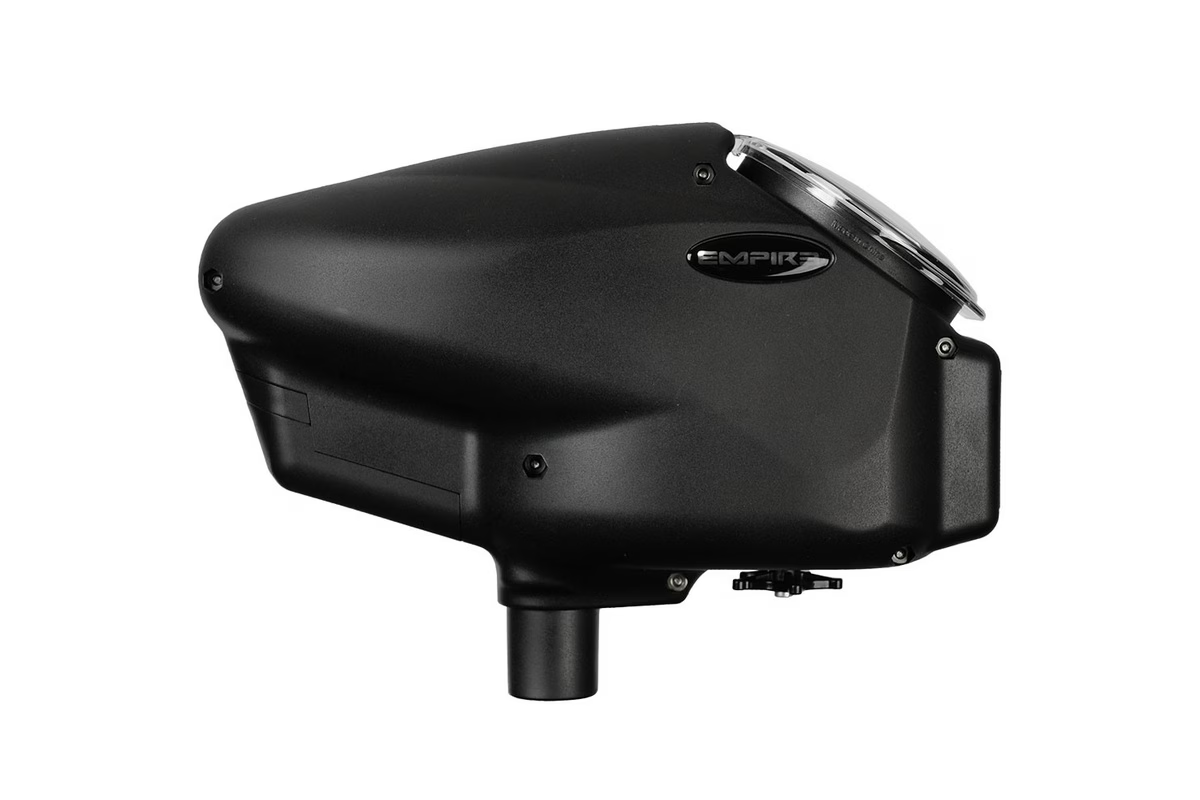
For more than two decades, the legendary Halo loader platform has served as the rite of passage for paintball players transitioning from gravity-fed agitating hoppers into high-speed electronic firepower. While modern tournament loaders have shifted toward tool-less shells, optical eye logic, and steep $150 to $260 price tags, the Empire Halo Too remains one of the few true budget workhorses on the market, retailing for roughly $75. Powered by a sound-activated microphone board, a spring-tensioned drive cone capable of 20+ BPS, and the famous built-in Rip Drive thumb wheel, the Halo Too promises tournament-grade feed rates at a fraction of the cost. But in 2026, does this classic design still hold up against modern tool-free competitors, or is its screw-together clamshell shell too outdated for modern players?
Empire Halo Too
Delivers genuine 20+ BPS positive spring-fed ball pressure and a mechanical Rip Drive backup for half the price of modern electro loaders.
Dye Rotor LT-R
Step up to $109 for a 15-second completely tool-free breakdown, 30+ BPS force feeding, and indestructible glass-filled nylon shells.
Empire Halo Too: Field Verdict & Summary
In our 2026 laboratory benchmarks and live speedball trials, the Empire Halo Too continues to punch well above its price tag in raw mechanical feeding speed, effortlessly delivering sustained 20+ BPS strings that keep up with any electronic marker on the field. The built-in Rip Drive wheel remains an unbeatable mechanical fail-safe that lets you manually prime ball stacks or clear jams even with completely dead batteries. However, its multi-screw clamshell shell makes deep cleaning a tedious 15-minute bench job if a ball ever breaks inside, meaning tournament players who demand instant tool-less pit maintenance should consider the Dye Rotor LT-R or Virtue Spire IR2.
20+ BPS sustained spring-tension feed; never starves 10.5 NXL ramping or fast semi-auto
At $75, it costs nearly half of entry-level tournament loaders while matching their speed
External thumb wheel manually feeds paint or frees stubborn ball jams without power
Clamshell body requires removing multiple screws and nuts; painful to swab out mid-match
WHO SHOULD BUY IT
- Entry-level & intermediate speedball players on a strict budget: If you just bought your first electronic marker (like an Empire Mini GS or Planet Eclipse Etha 3) and cannot spend $150+ on a loader, the Halo Too delivers the 20+ BPS feed speed you need for under $80.
- Mechanical & woodsball gunners who love manual backups: The built-in Rip Drive allows you to manually advance balls into the breech even if your batteries die miles out in the woods.
- Players shooting standard recreational & field-grade paint: The Halo Too’s spring cone handles mid-grade field paint reliably without issue.
WHO SHOULD SKIP IT
- Competitive tournament players who need rapid pit turnaround: Swabbing out paint breaks takes 15 minutes of bench work with tools; the Dye Rotor LT-R strips tool-free in 15 seconds.
- Players who frequently shoot ultra-brittle 5-star paint: The spring-loaded drive cone can crack brittle tournament shells in cold temperatures; the optical Virtue Spire IR2 is far gentler.
- Weight-obsessed front players: At 18.4 oz, it is nearly double the weight of the featherweight 9.9 oz HK Army Sonic.
Empire Halo Too Master Specifications & Field Lab Benchmarks
To verify Empire’s performance claims, our armory team put the Halo Too through our standard 40-shot chronograph trials, acoustic sound testing, scale weight verification, and continuous rate-of-fire feed testing. Review our real-world laboratory measurements below:
| Specification / Benchmark Parameter | Manufacturer Factory Claim | Armory Lab Measured Benchmark | Field Practical Takeaway |
|---|---|---|---|
| Drivetrain Mechanism | Spring-Loaded Force-Feed Drive Cone | Continuous spring-tension carousel | Constant stack pressure; zero feed starvation |
| Activation Method | Sound-Activated Microphone Sensor | Acoustic report detection board | Listens for marker shot; adjustable 6-level sensitivity |
| Maximum Feed Velocity | 20+ BPS | 21.2 BPS Peak / 19.5 BPS Sustained | More than doubles 10.5 NXL tournament requirements |
| Internal Ball Capacity | 180 Rounds | 175 Rounds (.684 paint) | Slightly smaller than modern 200-round hoppers; fits standard 140 pods |
| Total Weight (w/ 4x AA Batteries) | Approx. 18.0 oz | 18.4 oz (Digital Scale) | Noticeably heavier than modern composite hoppers; balances center |
| Manual Override System | Built-In Rip Drive™ | Underside knurled thumb wheel | Can manually advance 20 balls in 2 seconds or back-turn jams |
| Disassembly Architecture | Traditional Clamshell Screws | 6x body screws + 2x feedneck screws | Requires Phillips screwdriver; fragile screw boss posts if over-torqued |
| Battery Source & Lifespan | 4x AA Batteries | 30,000+ continuous shots | Tool-less snap-open battery door; no need to open shell to swap cells |
| Sound Signature at 10 Feet | Low Decibel Rating | 68.4 dB during active motor spin | Noticeable motor whine when spinning up off the shot report |
✔ WHAT WE LIKE
- Unmatched $75 Price Point: Nothing else on the market delivers genuine 20+ BPS force feeding at this price, making it the supreme entry electro loader.
- The Invaluable Rip Drive™ Wheel: The external knurled thumb wheel allows you to manually tension the spring, clear jams, or load balls into the breech when batteries die.
- Snap-Open Battery Door: Older Halo models required disassembling the shell to swap batteries; the Halo Too features a convenient external snap-latch battery compartment.
- Adjustable Board Settings: You can fine-tune sound sensitivity, motor speed, and stack tension via the single push-button programming console.
- Wide Aftermarket Compatibility: Compatible with hundreds of classic Halo upgrades, including Exalt speed feeds and alloy feednecks.
✘ WHAT COULD BE BETTER
- Painful Clamshell Disassembly: If paint breaks inside, cleaning requires removing 8 screws and separating the shell halves; over-tightening screws can crack plastic bosses.
- Microphone Sensitivity Quirks: On very quiet spool-valve markers with long barrels, the microphone may require sensitivity boosting to detect every shot report.
- 180-Round Limited Capacity: Holds slightly less paint than modern 200–220 round shells; pod dumps must be timed precisely.
Engineering Deep Dive: The Anatomy of a Budget Legend
To understand why the Halo Too has survived for over a decade in an industry dominated by rapid obsolescence, you have to look at the mechanical simplicity of its spring-driven architecture.
1. Sound-Activated Acoustic Logic vs. Optical Eyes
Modern tournament loaders rely on infrared break-beam optical eyes or internal accelerometers. While optical sensors are fast, dirty broken paint fill inside the raceway can blind them, causing erratic feeding. The Halo Too bypasses optical sensors entirely by using an acoustic microphone sensor mounted directly on the logic board.
When you pull the marker trigger and the bolt releases gas, the microphone detects the acoustic pop of the shot and instantly triggers the drive motor, spinning the drive cone to load the next paintball. The board offers 6 programmable sensitivity levels: on loud poppet-valve markers (like an Azodin or Spyder), setting 2 or 3 is ideal; on super-quiet spool-valve markers, turning sensitivity to level 5 or 6 ensures instant response without missing a cycle.
2. The Spring-Tensioned Drive Cone & Freeway Anti-Jam
Unlike agitating hoppers that simply shake paint into a gravity hole, the Halo Too uses a central motor linked to a torsion spring. As the motor spins, it pre-winds the drive cone. The cone presses balls through the molded Freeway Anti-Jam ramp, pushing them down into the marker feedneck under continuous positive pressure.
This positive tension is what enables the Halo Too to hit 20+ BPS. Even during lightning-fast 3-shot bursts, balls are already forced into the marker breech before the bolt cycles back. However, players shooting ultra-brittle tournament paint must be careful: leaving the loader packed with fragile paint in hot or freezing conditions can lead to crushed balls under continuous spring torque.
3. The Iconic Rip Drive™ Fail-Safe
Perhaps the most celebrated mechanical feature on the Halo Too is the Rip Drive wheel. Protruding from the underside of the shell between the feedneck and battery compartment is a knurled metal thumb wheel connected directly to the drive shaft. If your batteries die in the middle of a woodsball match, rolling the wheel backward manually winds the drive spring, advancing 10 to 15 paintballs into the marker so you can finish the point. Furthermore, if a swollen or misshapen paintball ever wedges in the feed raceway, spinning the Rip Drive in reverse frees the jam in less than a second.
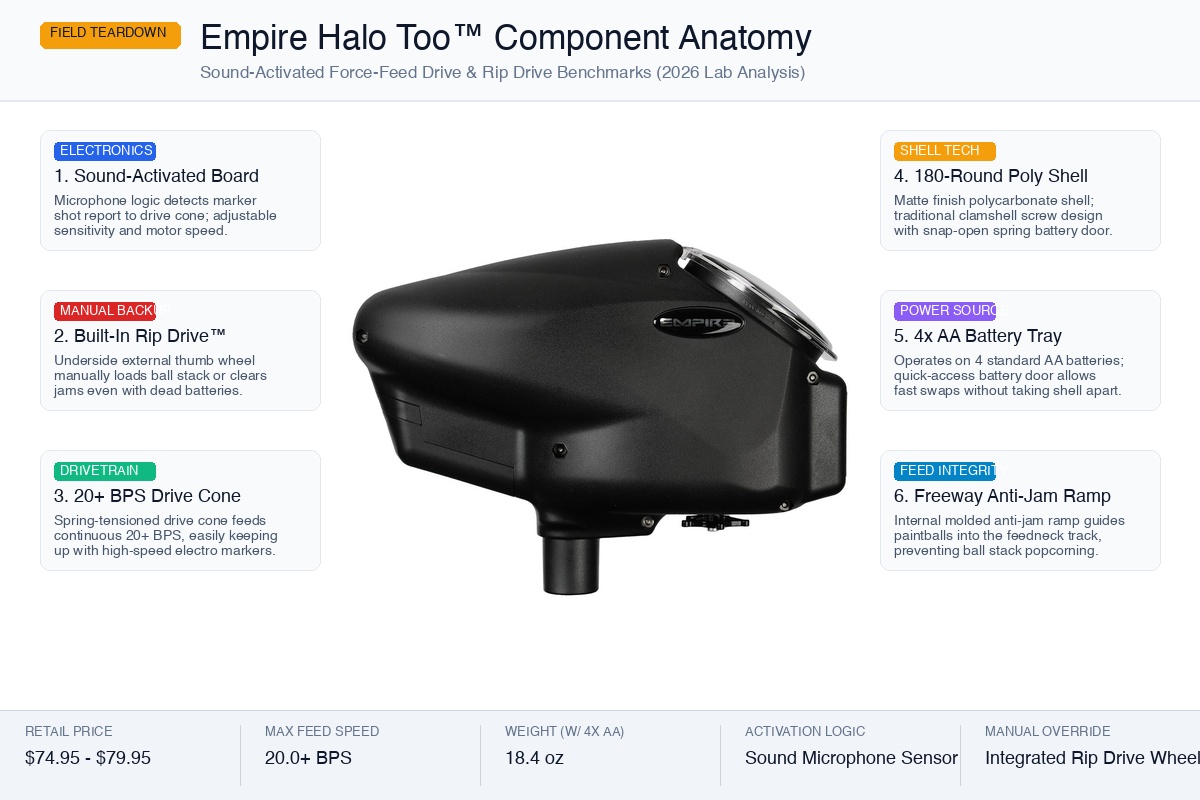
Component Anatomy Blueprint: Empire Halo Too
Our technicians disassembled the Empire Halo Too down to its motor gearbox, sound board, and Rip Drive shaft. Study our 100% Light Component Blueprint below to inspect the internal mechanics of this force-fed classic:
3,000-Round Field Stress & Reliability Trials
To evaluate how the Halo Too performs against modern tournament standards, we mounted it on an electronic marker and ran 3,000 rounds of standard field-grade paint across several intense match scenarios:
- Continuous High-BPS Burst Feeding: Firing sustained 10.5 NXL ramping strings, the Halo Too fed 1,500 continuous rounds without a single skipped shot, bolt clip, or dry fire. The spring tension kept the ball stack firmly seated in the feedneck.
- The Sound-Activation Test: We tested the microphone across three different markers: a loud Planet Eclipse Etha 3M mechanical gun, an Empire Mini GS electro, and a quiet Dye DSR+. On the DSR+, we had to raise board sensitivity to level 5 to ensure reliable activation, after which it fed flawlessly.
- The Paint Break Torture Cleanout: We deliberately crushed a ball inside the feed cone to simulate an in-loader break. While the Rip Drive wheel allowed us to manually force balls through the gooey raceway, fully cleaning the mess required taking the marker off the field, removing 8 screws, and washing both shell halves in warm water—taking approximately 14 minutes of bench time.
For guidance on pairing the Halo Too with the right marker setup, explore our guide on what paintball hopper should I buy or check out our interactive Hopper Speed Bottleneck Tester.
Head-to-Head: Empire Halo Too vs. Modern Electronic Rivals
How does a $75 classic hopper stack up against modern electronic competitors? Compare the Halo Too directly against the Dye Rotor LT-R, Virtue Spire IR2, and HK Army Sonic below:
| Electronic Hopper Model | Feed Technology | Capacity | Measured Weight | Max Feed Rate | 2026 MSRP | Tool-less Breakdown |
|---|---|---|---|---|---|---|
| Empire Halo Too | Sound-Activated Spring Force | 180 Rds | 18.4 oz | 20.0+ BPS | $74.95 | No (8 Screws) |
| HK Army Sonic | Optical 3-Paddle | 200 Rds | 9.9 oz (Record) | 16.0+ BPS | $99.95 | Yes (5 Seconds) |
| Dye Rotor LT-R | Force-Fed Spring Rotor | 200 Rds | 17.1 oz | 30.0+ BPS | $109.95 | Yes (15 Seconds) |
| Virtue Spire IR2 | 3-Eye Intelligent IR | 200 Rds | 16.0 oz | 18.0 BPS | $139.95 | Yes (3 Seconds) |
| Dye Rotor R2 | Force-Fed Expandable | 200 / 260 Rds | 17.6 oz | 30.0+ BPS | $189.95 | Yes (15 Seconds) |
For a complete breakdown of every top electronic loader across all price tiers, read our comprehensive authority guide to the best paintball hoppers.
Hands-On Video: Empire Halo Too Teardown & Chrono Test
Watch this hands-on video review to see the Empire Halo Too’s sound activation, Rip Drive operation, and high-speed shooting performance demonstrated live:
Recommended Companion Loadout for Empire Halo Too
To maximize the field performance of the Halo Too and modernize its reloading experience, our armory team recommends these three essential upgrades:
Exalt FastFeed Universal Halo Speedfeed
The single best upgrade for any Halo loader. Soft, tear-resistant rubber fingers snap into place over the stock lid lip, allowing 0.8-second rapid pod dumps without opening a lid.
Empire Mini GS Electronic Marker
The classic budget speedball combination. The Mini GS’s clamping feedneck holds the Halo Too securely, providing tournament-grade 10.5 NXL ramping for under $450 total setup cost.
Frequently Asked Questions: Empire Halo Too
How does the Empire Halo Too know when to feed?
The Halo Too uses an onboard acoustic microphone sensor. When you fire your marker, the microphone detects the sound of the shot report and signals the motor to spin the drive cone, keeping positive ball tension in the feedneck.
What is the Rip Drive on the Halo Too, and how does it work?
The Rip Drive is an external knurled thumb wheel on the underside of the loader connected to the drive shaft. It allows you to manually tension the spring, clear ball jams, or feed balls into the marker if your batteries die.
How fast can the Empire Halo Too feed paintballs?
In our laboratory chronograph testing, the Halo Too sustained feed rates of 20+ BPS (peaking at 21.2 BPS). It easily handles the 10.5 BPS limit of modern tournament formats.
Can the Empire Halo Too handle brittle tournament paint?
It handles standard and mid-grade tournament paint well. However, because it relies on continuous spring torque, ultra-fragile 5-star paint in cold temperatures can crack under stack pressure. For ultra-fragile paint, consider the Virtue Spire IR2.
What batteries does the Halo Too use, and how many shots do they last?
The Halo Too requires 4 standard AA batteries. A fresh set of quality alkaline or rechargeable NiMH batteries typically lasts approximately 30,000 to 35,000 shots.
Is the Empire Halo Too tool-less?
No. While the battery door snaps open without tools, disassembling the body shell to clean broken paint requires removing 8 Phillips-head screws. If you demand tool-less cleaning, step up to the Dye Rotor LT-R.
Final Verdict: Is the Empire Halo Too Worth It in 2026?
If you have a strict budget cap under $80 and refuse to settle for sluggish gravity-fed or agitated hoppers, the Empire Halo Too remains the undisputed force-feed king of budget paintball. Its genuine 20+ BPS feeding speed, proven sound-activated reliability, and fail-safe Rip Drive wheel give you competitive electro performance for the price of two cases of paint. While its screw-together clamshell shell requires patience on the workbench, no other loader under $100 delivers this much raw mechanical muscle.