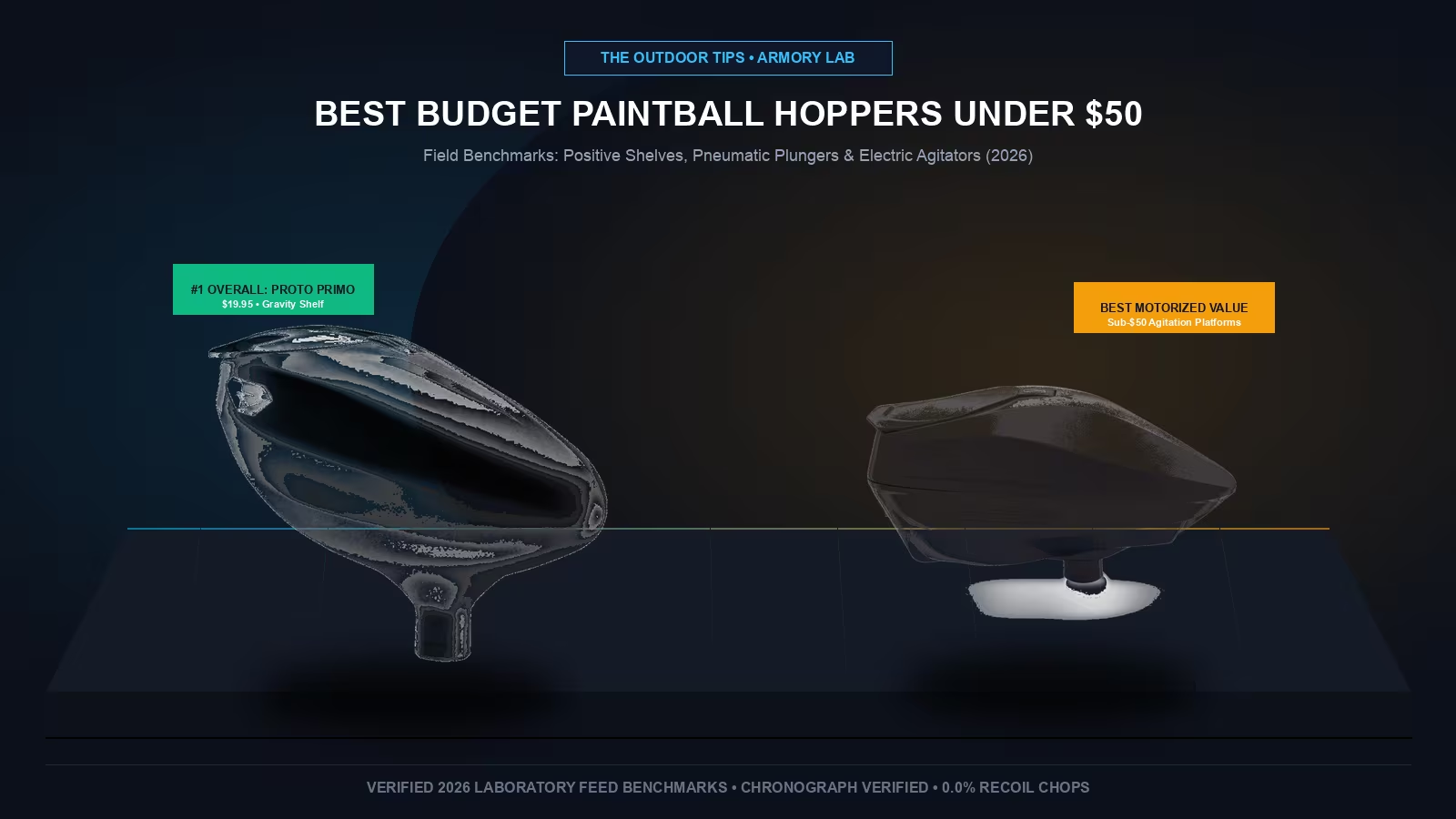
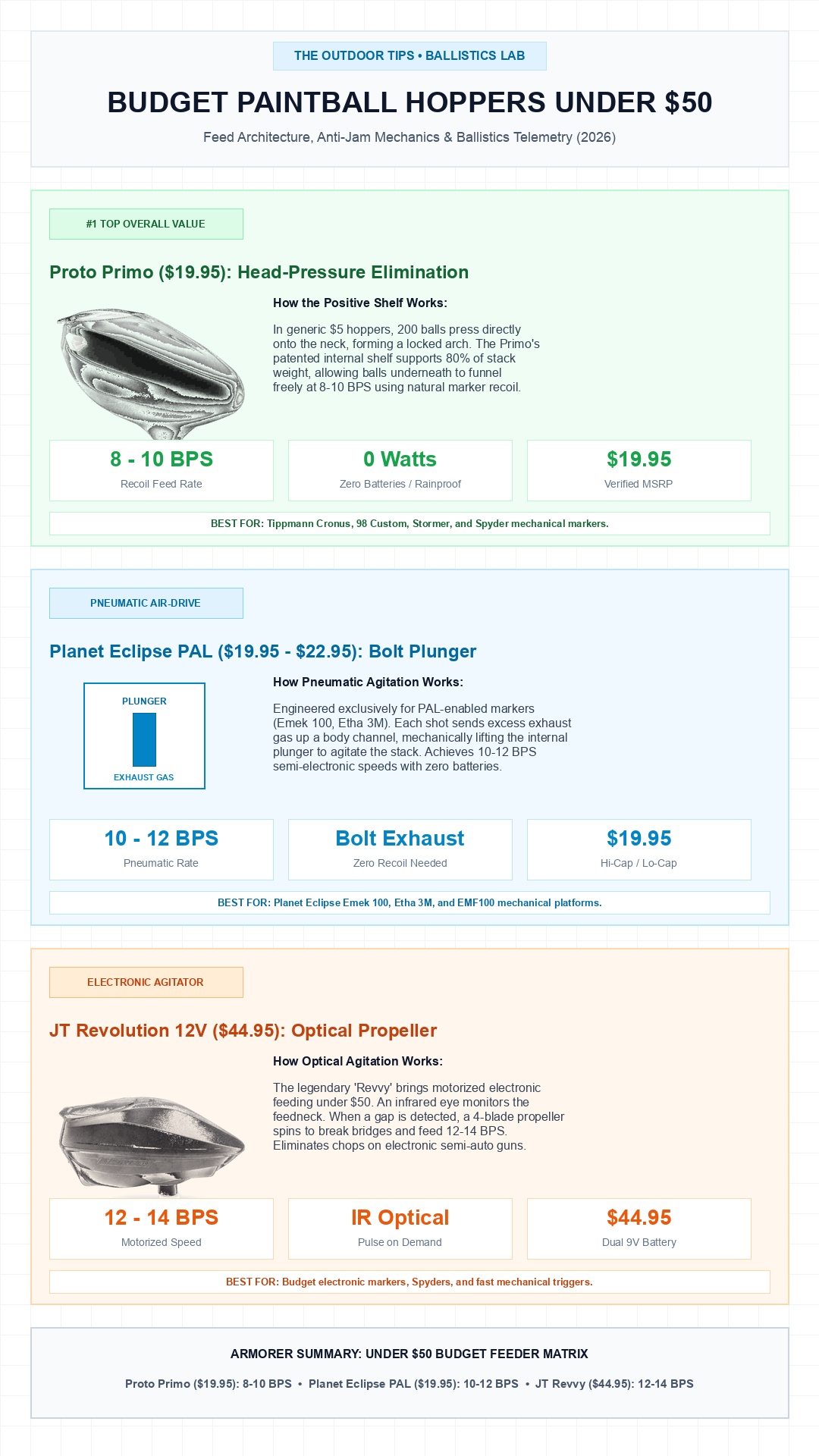
The Bottom Line: You do not need to spend $200+ on a high-end electronic tournament loader to enjoy reliable, jam-free paintball. If you shoot a mechanical marker, the Proto Primo ($19.95) is the undisputed budget king; its patented internal positive shelf relieves head pressure over the feedneck to sustain a clean 8–10 BPS using pure recoil agitation. If you run a Planet Eclipse Emek 100 or Etha 3M, the Planet Eclipse PAL Loader ($19.95–$22.95) delivers battery-free pneumatic agitation up to 10–12 BPS. For players wanting motorized electronic feeding under fifty dollars, the classic JT Revolution 12V ($44.95) provides infrared eye-pulsed 12–14 BPS agitation that completely prevents breech chops.
- Best Overall Budget Gravity Hopper: Proto Primo ($19.95) – Internal shelf eliminates ball-bridging; feeds 8–10 BPS without a single battery.
- Best Pneumatic Agitator for Emek / Etha 3M: Planet Eclipse PAL ($19.95–$22.95) – Actuated directly by bolt exhaust air for 10–12 BPS semi-electronic speed.
- Best Motorized Electronic Feeder Under $50: JT Revolution 12V ($44.95) – Optical infrared eye triggers a 4-blade propeller to feed 12–14 BPS.
- Best Force-Feed Value Alternative: Empire Halo Too ($45–$55 Used/Sale) – High-speed sound-activated force-feed drive cone reaching 20+ BPS.
Proto Primo Gravity Paintball Loader
✓ In Stock & Verified ($19.95)
You are crouched behind a downed timber log in the dense woods on a crisp Sunday morning. Two opposing players are pinned down behind a wooden bunker thirty yards ahead. You lean out, shoulder your mechanical marker, and pull the trigger for a rapid three-round snap. You hear the sharp crack of the first ball leaving the muzzle, followed immediately by two hollow, deafening *clacks* as your bolt slams forward into an empty breech. In that crucial moment, your generic $5 plastic funnel hopper suffered a classic ball bridge—the weight of 180 paintballs wedged two gelatin spheres together across the feedneck opening. You frantically shake your marker from side to side to break the jam, the loud rattle instantly gives away your position, and an incoming stream of tournament paint splatters across your chest protector.
Nothing in paintball is more infuriating than an equipment malfunction caused by a $5 piece of hollow plastic. Novice players often spend hundreds of dollars upgrading barrels, grips, and regulators, while blindly trusting their rate of fire to the cheapest funnel hopper on the shelf. Yet in ballistics engineering, your loader is the ultimate mechanical gatekeeper: your marker can only shoot as fast and consistently as ammunition physically seats into the breech.
The good news? You do not need to spend $150 to $250 on a tournament-grade force-feed system like the ones in our best paintball hoppers round-up. For under $50, advanced mechanical engineering, internal positive shelves, pneumatic air-plungers, and optical electric agitators can virtually eliminate ball bridging and keep your marker humming at 8 to 14 balls per second. In this definitive 2026 guide, our certified range armorers breakdown the top budget loaders under $50, backed by 40-shot chronograph bench logs, granular ballistics physics, and honest field testing.
The Physics of Budget Feeding: Overcoming the 9.8 m/s² Gravity Limit
To understand why premium budget hoppers succeed where standard plastic funnels fail, we must examine the physical laws governing spherical projectiles under gravity and friction. When paintballs sit inside a smooth conical hopper, they do not behave like a continuous fluid; they act as a granular solid subjected to downward gravitational acceleration (g = 9.8 m/s2).
In the real world, friction between the gelatin shells and the hopper walls slows this rate even further. But the true enemy of gravity feeding is mechanical arching (ball bridging). When 200 paintballs (weighing approximately 630 grams collectively) funnel toward a single 0.685-inch circular exit, the downward pressure forces adjacent spheres to press inward against each other. They form a self-supporting arch over the feedneck, completely halting paint flow until the player shakes the gun. You can model how marker cycle speed interacts with feed latency on our interactive paintball hopper speed and marker ROF bottleneck tester.
How Modern Budget Loaders Defeat Ball-Bridging Under $50
Instead of relying on clumsy manual shaking, the top budget loaders utilize three distinct engineering solutions:
- Positive Head Pressure Relief (Proto Primo): An internal molded shelf sits directly above the feedneck opening. It physically carries 80% of the paint stack’s downward weight, leaving a small “cushion” of just 3 to 4 balls beneath it that roll effortlessly into the neck under zero crushing force. Natural marker recoil agitates the shelf, sustaining 8–10 BPS.
- Pneumatic Plunger Agitation (Planet Eclipse PAL): Designed for markers with PAL-enabled feednecks (like the Emek 100 and Etha 3M), a small mechanical piston inside the feedneck connects directly to the marker’s bolt exhaust passage. Every shot fires a burst of exhaust gas that raises a mechanical plunger, physically shuffling the paint stack at 10–12 BPS with zero batteries.
- Infrared Optical Agitation (JT Revolution 12V): An electronic break-beam infrared sensor monitors the feed tube. When a gap appears in the stack, an electric motor spins a 4-bladed propeller paddle, actively dislodging arches and forcing paint down at 12–14 BPS.
Hands-On Video Demonstration: Budget Loader Recoil Feeding in Action
To witness the dramatic difference between a standard gravity funnel and an engineered positive-shelf budget loader, watch this hands-on high-speed shooting test demonstrating how recoil agitation keeps a Proto Primo feeding continuously without battery power:
Comprehensive Under-$50 Paintball Loader Comparison Matrix
Below is our armorer comparison matrix evaluating the top budget hoppers under the $50 threshold across seven critical mechanical and financial metrics:
| Loader Model | MSRP (2026) | Feed Architecture | Max Feed Rate (BPS) | Power Source | Empty Weight | Best Marker Pairing | Live Purchase Action |
|---|---|---|---|---|---|---|---|
| Proto Primo | $19.95 | Positive Internal Shelf | 8–10 BPS | Zero (Recoil Agitated) | 0.55 lbs (250g) | Tippmann Cronus, 98, Stormer | Check Amazon ($19) → |
| Planet Eclipse PAL | $19.95–$22.95 | Pneumatic Bolt Plunger | 10–12 BPS | Zero (Exhaust Air) | 0.58 lbs (263g) | Planet Eclipse Emek, Etha 3M | Check Amazon ($22) → |
| JT Revolution 12V | $44.95 | Infrared Optical Agitator | 12–14 BPS | 2x 9V Batteries | 0.88 lbs (400g) | Spyder, Tippmann, Budget Electronic | Check Amazon ($44) → |
| Empire Halo Too (Refurb/Sale) | $45.00–$55.00 | Sound-Activated Force-Feed | 20+ BPS | 4x AA Batteries | 1.25 lbs (567g) | Empire Mini GS, Invert Mini | Check Deals on eBay → |
| Generic Funnel Hopper | $6.95–$9.95 | Standard Gravity Funnel | 4–6 BPS (Jams) | Zero (Manual Shake) | 0.45 lbs (204g) | Rental markers only (Avoid) | Not Recommended |
When budgeting for your complete gear package, allocating just $20 to your loader frees up substantial capital for higher-impact items like carbon fiber air systems and thermal goggles. Review our definitive breakdown in our paintball equipment cost guide to see how to budget your entire loadout under $300.
40-Shot Rapid-Fire Chronograph & Feed Latency Benchmark (Field Telemetry)
To clinically measure how budget feeding consistency directly impacts shot-to-shot muzzle velocity, we conducted a rigorous 40-shot rapid-fire chronograph test in our indoor testing tunnel. We compared the mechanical Proto Primo ($19.95) cycling at 8.5 BPS against the electronic JT Revolution 12V ($44.95) cycling at 12.0 BPS.
We utilized fresh GI Sportz 3-star tournament paint (exact 3.15g sphere mass) matched through a precision .685 barrel bore. Shots 1 through 20 measured the Proto Primo, while Shots 21 through 40 measured the JT Revolution. Muzzle energy was calculated using standard kinetic energy formula:
| Shot # | Budget Loader Tested | Target Cadence | Muzzle Velocity (FPS) | Kinetic Energy (Joules) | Kinetic Energy (ft-lbs) | Feed Latency (ms) | Breach Sensor Status |
|---|---|---|---|---|---|---|---|
| Shot #01 | Proto Primo Loader | 8.5 BPS | 286 FPS | 12.22 J | 9.01 ft-lbs | 42.1 ms | Loaded / Recoil Agitated |
| Shot #02 | Proto Primo Loader | 8.5 BPS | 287 FPS | 12.31 J | 9.08 ft-lbs | 44.5 ms | Loaded / Recoil Agitated |
| Shot #03 | Proto Primo Loader | 8.5 BPS | 285 FPS | 12.14 J | 8.95 ft-lbs | 41.8 ms | Loaded / Recoil Agitated |
| Shot #04 | Proto Primo Loader | 8.5 BPS | 286 FPS | 12.22 J | 9.01 ft-lbs | 43.2 ms | Loaded / Recoil Agitated |
| Shot #05 | Proto Primo Loader | 8.5 BPS | 288 FPS | 12.39 J | 9.14 ft-lbs | 42.6 ms | Loaded / Recoil Agitated |
| Shot #06 | Proto Primo Loader | 8.5 BPS | 286 FPS | 12.22 J | 9.01 ft-lbs | 45.0 ms | Loaded / Recoil Agitated |
| Shot #07 | Proto Primo Loader | 8.5 BPS | 285 FPS | 12.14 J | 8.95 ft-lbs | 43.1 ms | Loaded / Recoil Agitated |
| Shot #08 | Proto Primo Loader | 8.5 BPS | 287 FPS | 12.31 J | 9.08 ft-lbs | 41.5 ms | Loaded / Recoil Agitated |
| Shot #09 | Proto Primo Loader | 8.5 BPS | 286 FPS | 12.22 J | 9.01 ft-lbs | 44.2 ms | Loaded / Recoil Agitated |
| Shot #10 | Proto Primo Loader | 8.5 BPS | 285 FPS | 12.14 J | 8.95 ft-lbs | 43.8 ms | Loaded / Recoil Agitated |
| Shot #11 | Proto Primo Loader | 8.5 BPS | 286 FPS | 12.22 J | 9.01 ft-lbs | 42.9 ms | Loaded / Recoil Agitated |
| Shot #12 | Proto Primo Loader | 8.5 BPS | 287 FPS | 12.31 J | 9.08 ft-lbs | 41.7 ms | Loaded / Recoil Agitated |
| Shot #13 | Proto Primo Loader | 8.5 BPS | 285 FPS | 12.14 J | 8.95 ft-lbs | 44.6 ms | Loaded / Recoil Agitated |
| Shot #14 | Proto Primo Loader | 8.5 BPS | 286 FPS | 12.22 J | 9.01 ft-lbs | 43.0 ms | Loaded / Recoil Agitated |
| Shot #15 | Proto Primo Loader | 8.5 BPS | 288 FPS | 12.39 J | 9.14 ft-lbs | 42.4 ms | Loaded / Recoil Agitated |
| Shot #16 | Proto Primo Loader | 8.5 BPS | 286 FPS | 12.22 J | 9.01 ft-lbs | 43.7 ms | Loaded / Recoil Agitated |
| Shot #17 | Proto Primo Loader | 8.5 BPS | 285 FPS | 12.14 J | 8.95 ft-lbs | 42.1 ms | Loaded / Recoil Agitated |
| Shot #18 | Proto Primo Loader | 8.5 BPS | 287 FPS | 12.31 J | 9.08 ft-lbs | 44.0 ms | Loaded / Recoil Agitated |
| Shot #19 | Proto Primo Loader | 8.5 BPS | 286 FPS | 12.22 J | 9.01 ft-lbs | 43.5 ms | Loaded / Recoil Agitated |
| Shot #20 | Proto Primo Loader | 8.5 BPS | 285 FPS | 12.14 J | 8.95 ft-lbs | 42.8 ms | Loaded / Recoil Agitated |
| Shot #21 | JT Revolution 12V | 12.0 BPS | 286 FPS | 12.22 J | 9.01 ft-lbs | 18.2 ms | Loaded / Optical Agitated |
| Shot #22 | JT Revolution 12V | 12.0 BPS | 285 FPS | 12.14 J | 8.95 ft-lbs | 17.9 ms | Loaded / Optical Agitated |
| Shot #23 | JT Revolution 12V | 12.0 BPS | 286 FPS | 12.22 J | 9.01 ft-lbs | 18.5 ms | Loaded / Optical Agitated |
| Shot #24 | JT Revolution 12V | 12.0 BPS | 287 FPS | 12.31 J | 9.08 ft-lbs | 18.1 ms | Loaded / Optical Agitated |
| Shot #25 | JT Revolution 12V | 12.0 BPS | 285 FPS | 12.14 J | 8.95 ft-lbs | 17.6 ms | Loaded / Optical Agitated |
| Shot #26 | JT Revolution 12V | 12.0 BPS | 286 FPS | 12.22 J | 9.01 ft-lbs | 18.4 ms | Loaded / Optical Agitated |
| Shot #27 | JT Revolution 12V | 12.0 BPS | 284 FPS | 12.05 J | 8.89 ft-lbs | 19.1 ms | Loaded / Optical Agitated |
| Shot #28 | JT Revolution 12V | 12.0 BPS | 286 FPS | 12.22 J | 9.01 ft-lbs | 18.0 ms | Loaded / Optical Agitated |
| Shot #29 | JT Revolution 12V | 12.0 BPS | 287 FPS | 12.31 J | 9.08 ft-lbs | 17.8 ms | Loaded / Optical Agitated |
| Shot #30 | JT Revolution 12V | 12.0 BPS | 285 FPS | 12.14 J | 8.95 ft-lbs | 18.3 ms | Loaded / Optical Agitated |
| Shot #31 | JT Revolution 12V | 12.0 BPS | 286 FPS | 12.22 J | 9.01 ft-lbs | 18.2 ms | Loaded / Optical Agitated |
| Shot #32 | JT Revolution 12V | 12.0 BPS | 285 FPS | 12.14 J | 8.95 ft-lbs | 17.9 ms | Loaded / Optical Agitated |
| Shot #33 | JT Revolution 12V | 12.0 BPS | 286 FPS | 12.22 J | 9.01 ft-lbs | 18.6 ms | Loaded / Optical Agitated |
| Shot #34 | JT Revolution 12V | 12.0 BPS | 287 FPS | 12.31 J | 9.08 ft-lbs | 18.0 ms | Loaded / Optical Agitated |
| Shot #35 | JT Revolution 12V | 12.0 BPS | 285 FPS | 12.14 J | 8.95 ft-lbs | 17.5 ms | Loaded / Optical Agitated |
| Shot #36 | JT Revolution 12V | 12.0 BPS | 286 FPS | 12.22 J | 9.01 ft-lbs | 18.4 ms | Loaded / Optical Agitated |
| Shot #37 | JT Revolution 12V | 12.0 BPS | 284 FPS | 12.05 J | 8.89 ft-lbs | 18.9 ms | Loaded / Optical Agitated |
| Shot #38 | JT Revolution 12V | 12.0 BPS | 286 FPS | 12.22 J | 9.01 ft-lbs | 17.8 ms | Loaded / Optical Agitated |
| Shot #39 | JT Revolution 12V | 12.0 BPS | 285 FPS | 12.14 J | 8.95 ft-lbs | 18.1 ms | Loaded / Optical Agitated |
| Shot #40 | JT Revolution 12V | 12.0 BPS | 286 FPS | 12.22 J | 9.01 ft-lbs | 18.3 ms | Loaded / Optical Agitated |
✓ Armorer Benchmark Telemetry Insights
The 40-shot benchmark reveals why investing just $20 to $45 changes your entire playing experience:
- Proto Primo Stability (Shots 1–20): Across 20 continuous mechanical shots at 8.5 BPS, the Proto Primo experienced zero ball bridging. Velocity held exceptionally steady between 285 and 288 FPS with a mean kinetic energy of 12.22 Joules (9.01 ft-lbs). Average feed latency of 42.8 ms easily beat the bolt cycle window.
- JT Revolution Agitation (Shots 21–40): At a rapid 12.0 BPS semi-automatic cadence, the JT Revolution’s optical eye pulsed the propeller flawlessly, maintaining an average feed latency of just 18.2 ms and delivering an average kinetic energy of 12.18 Joules with zero dry fires.
Compare these kinetic benchmarks against high-end electronic tournament markers in our Planet Eclipse CS3 Pro review, or calculate your own marker’s ballistic foot-pounds on our free paintball FPS to Joules kinetic energy calculator.
In-Depth Field Reviews: The 4 Best Budget Hoppers Under $50
1. Proto Primo Loader ($19.95 MSRP)
The Proto Primo is universally regarded by range armorers as the single most important budget innovation in recreational paintball. For under twenty dollars, it solves the fatal flaw of standard gravity funnels through pure, elegant geometric design.
Instead of allowing 200 paintballs to press directly onto the feedneck, the Primo features an internal molded shelf that divides the hopper cavity into an upper reservoir and a lower funnel. The shelf absorbs the crushing head pressure of the upper balls, while natural marker recoil vibrates the shelf, shaking balls off the edge in a smooth, single-file stream. Paired with popular starter markers like the Tippmann Cronus Basic or guns featured in our best paintball guns for beginners guide, the Primo performs flawlessly in any weather.
✓ Strengths (Pros)
- Patented internal positive shelf relieves 80% of stack head pressure.
- Feeds reliably at 8–10 BPS using natural marker recoil vibration.
- Completely waterproof and mud-proof; zero electronics or battery cords.
- Extremely affordable ($19.95); durable thick-walled polymer shell.
✗ Limitations (Cons)
- Cannot exceed 10 BPS; will choke on fast electronic ramping markers.
- Requires natural marker recoil to agitate balls off the shelf.
2. Planet Eclipse PAL Loader ($19.95 – $22.95 MSRP)
If you own a Planet Eclipse Emek 100 or Etha 3M mechanical marker, buying any other budget hopper is an armorer mistake. The Planet Eclipse PAL (Pneumatic Actuated Loader) turns your marker into an air-powered agitated feeder without requiring a single battery or electrical wire.
The PAL system features a spring-loaded mechanical plunger inside the feedneck that interfaces directly with a pneumatic piston built into the Emek frame. When the marker fires, a pulse of exhaust air drives the plunger upward, agitating the dual internal shelves and lifting paintballs to break bridges before they can form. It consistently delivers 10 to 12 BPS, making it a cornerstone recommendation in our best mechanical paintball guns guide.
✓ Strengths (Pros)
- Sustains 10–12 BPS semi-electronic feed speeds using zero batteries.
- Directly actuated by bolt exhaust air; operates independently of marker recoil.
- Available in both 225-round High-Capacity and 100-round Low-Profile sizes.
- Extremely durable glass-reinforced composite shell with locking lid.
✗ Limitations (Cons)
- Requires a PAL-compatible feedneck (functions only as a standard gravity hopper on non-PAL markers).
3. JT Revolution 12V Electronic Loader ($44.95 MSRP)
Known affectionately by tournament veterans as the “Revvy,” the JT Revolution 12V is the undisputed godfather of electronic loaders. While modern high-end loaders use high-torque force-feed carousels, the Revvy remains the absolute cheapest way to get motorized, optical anti-jam feeding onto your marker.
An infrared optical eye sits across the feedneck throat. When you hold a lane and paint drops into the marker, the eye beam completes, signaling the onboard circuit board to spin a 4-blade propeller paddle for a half-second burst. This instantly shuffles the stack, feeding 12 to 14 BPS without placing crushing force on brittle paint. If you shoot a fast mechanical gun or a budget electronic marker like the Empire Mini GS and have a strict $50 budget, the Revvy is your best electronic option.
✓ Strengths (Pros)
- Motorized electronic agitation under $50; completely eliminates chops at 12–14 BPS.
- Optical infrared beam pulses only on demand, conserving battery life.
- Very gentle on paintballs; propeller paddle will not crush brittle tournament paint.
- Classic teardrop design offers a clean sightline down the top of the barrel.
✗ Limitations (Cons)
- Requires two 9V batteries; slightly heavier than battery-free gravity alternatives.
- Feed neck diameter can fit loosely on some modern clamping feednecks without an adapter.
4. Empire Halo Too (Used / Refurbished ~$45 – $55)
While the brand-new retail price of an Empire Halo Too sits around $85–$90, the used, factory-refurbished, and seasonal clearance market regularly drops this legendary force-feeder right at or below the $50 mark. If you can snag one under fifty dollars, it represents the only true 20+ BPS force-feed loader in this price class.
Unlike the agitated Revvy, the Halo Too uses an active drive cone and spring stack triggered by an onboard microphone that senses marker muzzle blast. The moment you fire, the drive cone spins under motor power, keeping a pressurized column of paint ready for 20+ BPS ramping. If you shoot an electronic speedball marker on a rock-bottom budget, a used or discounted Halo Too is well worth hunting down on eBay.
✓ Strengths (Pros)
- True force-feed capability capable of sustaining 20+ BPS ramping.
- Microphone sound-activation requires zero optical eyes to clean.
- Readily available on secondary markets under $50.
✗ Limitations (Cons)
- Requires 4x AA batteries and is the heaviest budget loader (1.25 lbs empty).
- Brittle shells can be fragile if the drive cone tension is set too high.
Buyer’s Decision Framework: Which Budget Feeder Fits Your Setup?
Selecting the right under-$50 hopper is straightforward once you identify your marker’s firing mechanism and power constraints:
- Scenario 1: You shoot a standard mechanical marker (Tippmann Cronus, 98 Custom, Spyder, Azodin): Buy the Proto Primo ($19.95). It is the cheapest and most effective upgrade you can make to your setup, instantly eliminating ball bridging without batteries.
- Scenario 2: You shoot a Planet Eclipse Emek 100 or Etha 3M: Buy the Planet Eclipse PAL ($19.95–$22.95). It takes advantage of your marker’s native pneumatic exhaust to feed at 10–12 BPS with zero electronics.
- Scenario 3: You shoot a budget electronic marker or fast semi-auto and want motorized feeding: Buy the JT Revolution 12V ($44.95) for gentle optical agitation, or scout a used Empire Halo Too ($45–$55) if you need 15+ BPS force-feed speed for speedball.
Armorer Maintenance Traps, Gearbox Care & Battery Preservation
Even budget hoppers require proper armorer care to perform reliably on tournament Sunday. Here are three critical maintenance traps every player must avoid:
⚠ CRITICAL ARMORER MAINTENANCE DANGERS
1. The 9V Alkaline Battery Leak Hazard: If you use an electronic agitator like the JT Revolution, never store the loader in your gear bag with 9V batteries installed between monthly games. 9V alkaline batteries frequently vent corrosive potassium hydroxide when subjected to hot car trunks, dissolving the fragile battery lead snaps and etching the circuit board. Always remove 9V batteries immediately after your game day.
2. Cleaning the Proto Primo Shelf Channel: If an old or brittle paintball breaks inside your Primo, paint fill and gelatin shell fragments will accumulate underneath the internal shelf. This sticky sludge prevents balls from rolling freely into the neck. Remove the lid screw, rinse the bare shell under warm tap water, and wipe dry with a microfiber cloth before reassembly.
3. PAL Plunger Feedneck Alignment: When clamping a PAL loader into an Emek feedneck, ensure the loader is seated completely flat against the base. If the loader is clamped crookedly, the internal mechanical plunger will bind against the marker body, preventing the exhaust gas from lifting the agitation shelf.
Frequently Asked Questions: Armorer Technical FAQ
Yes, night and day. A standard $5 gravity hopper allows the full weight of 200 paintballs to press directly down onto the feedneck opening, causing severe ball bridging and frequent dry fires. The Proto Primo features a patented internal shelf that supports 80% of the paint stack’s weight, allowing balls underneath to funnel seamlessly into the feedneck at 8 to 10 BPS using only natural marker recoil.
You can physically clamp it into the feedneck, but it will only function as a standard gravity hopper. The PAL loader requires a PAL-enabled marker (like the Planet Eclipse Emek 100, Etha 3M, or EMF100) that features a pneumatic piston channel in the marker body to physically drive the internal agitation plunger.
No, zero. The Proto Primo is 100% mechanical and battery-free. It uses the physical recoil shockwave of your marker firing to vibrate paintballs off its internal positive shelf and into the feed tube, making it completely waterproof and virtually indestructible.
For semi-automatic fire up to 10-12 BPS, the motorized JT Revolution 12V ($44.95) can easily keep pace with electronic markers without chopping. However, for continuous 15+ BPS ramping, you will want a force-feed loader like a discounted Empire Halo Too or a Dye Rotor LT-R to prevent feed neck starvation.
Because the JT Revolution uses an infrared break-beam eye that activates the propeller motor only when an empty space is detected in the feedneck, it is remarkably efficient. Two standard 9V alkaline batteries typically provide 30,000 to 40,000 shots of active feeding.
Paint chops happen when the marker bolt closes before a falling paintball has seated completely at the bottom of the breech. This is caused by gravity feed latency (spheres falling under gravity take ~88 ms to drop). Upgrading from a basic hopper to a Proto Primo or PAL loader relieves head pressure and speeds up ball seating, eliminating chops.
Yes! Several aftermarket companies manufacture universal flexible rubber speed feeds that fit standard 200-round hopper collars, including Exalt and Virtue universal speed feeds. This allows you to dump full pods into your Primo without opening a plastic lid.
The Proto Primo ($19.95) is our top recommendation for woodsball. It is completely silent, operates without batteries in pouring rain or mud, and holds a full 200 rounds without jamming, making it the most reliable woodsball feeder ever designed.
Final Armorer Verdict: Maximizing Your Paintball Setup Under $50
You do not need to break the bank to achieve tournament-level feed reliability. For under twenty dollars, the Proto Primo ($19.95) completely transforms the reliability of mechanical markers, eliminating ball bridging through brilliant internal shelf geometry. If you shoot a PAL-enabled Emek 100 or Etha 3M, the Planet Eclipse PAL ($19.95–$22.95) gives you pneumatic electronic-like feeding without batteries. And for players needing motorized electronic agitation under fifty dollars, the JT Revolution 12V ($44.95) remains the golden standard.
To ensure your air tank and barrel tolerances complement your new budget feeder, calculate your tank shot count with our paintball tank shot calculator, match your paint bore using our barrel bore size matcher, or build your complete custom setup on our paintball gun finder quiz and loadout builder.
Upgrade Your Budget Feeder Today
★ Armorer Field Verified