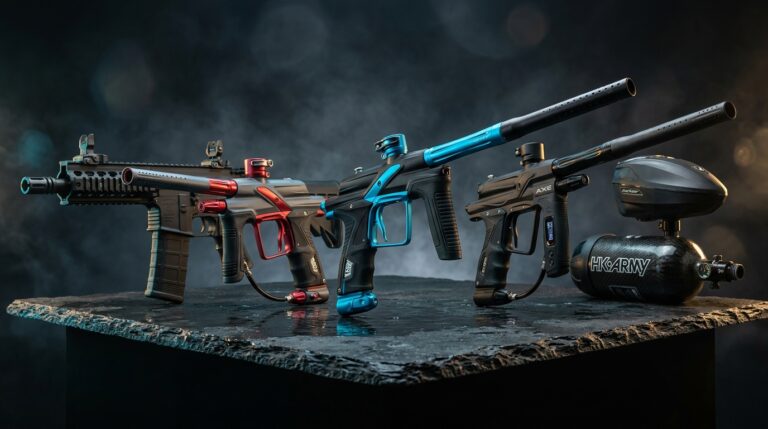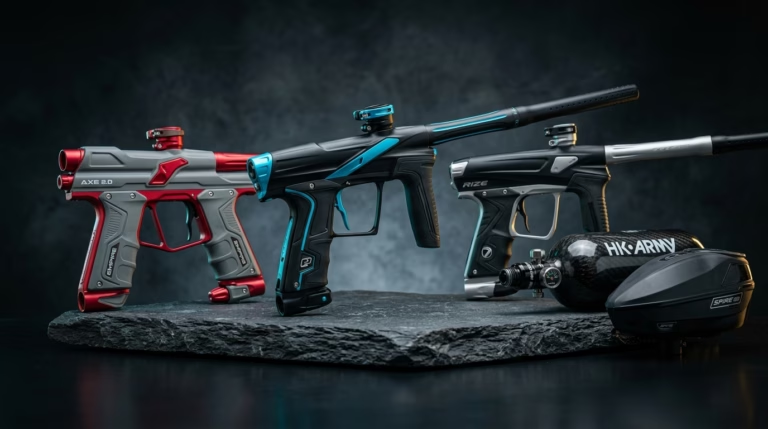
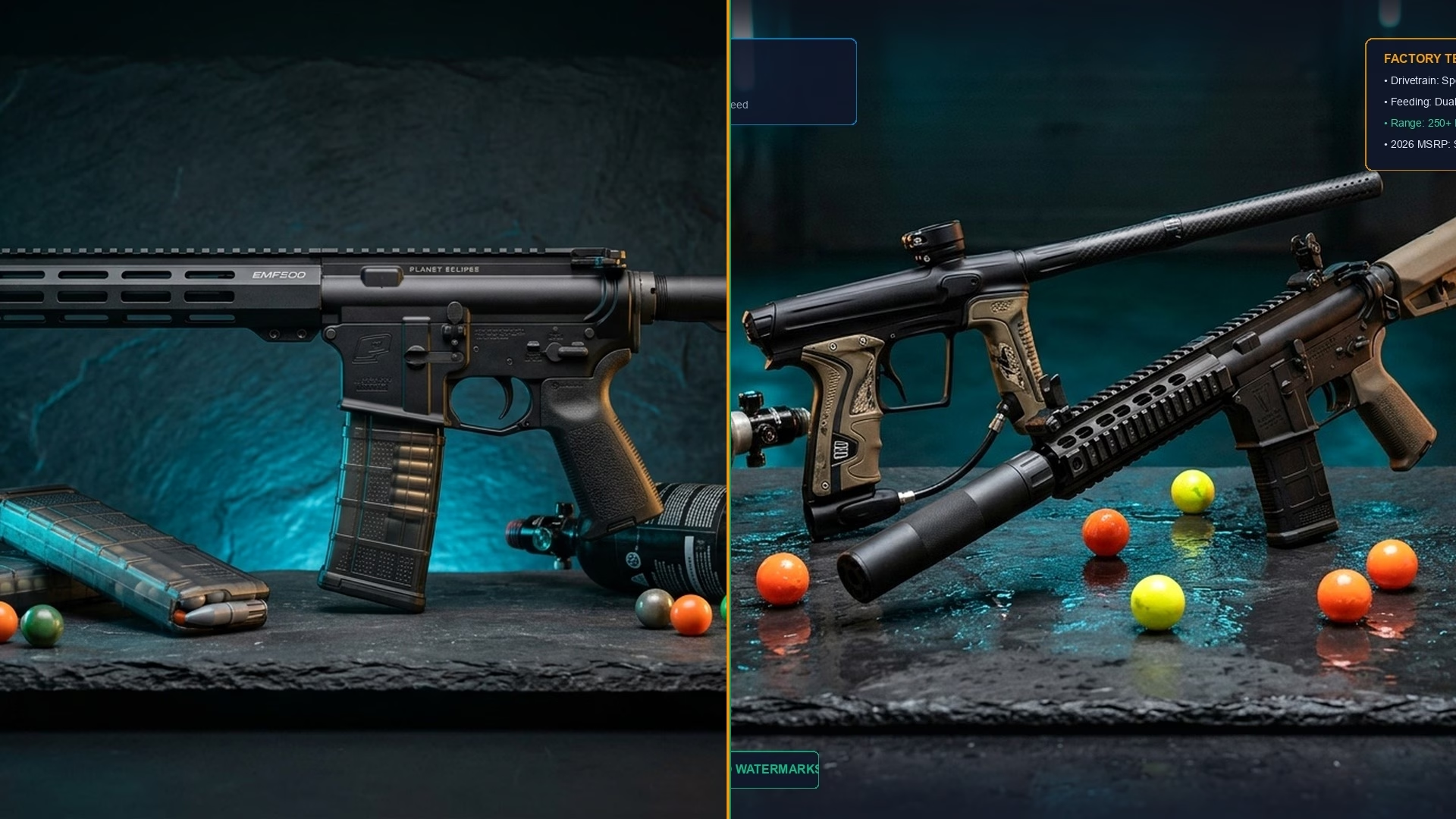
When Planet Eclipse unleashed the original EMF100 (initially badged as the MG100), it fundamentally disrupted tactical paintball by replacing finicky blowback milsim markers with the bulletproof, sub-zero reliable Gamma Core spool valve. For years, the EMF100 stood unchallenged as the definitive magfed platform. However, the arrival of the Planet Eclipse EMF200 marks a seismic generational leap. Transitioning from glass-reinforced nylon (GRN) to a ground-up CNC 6061-T6 aluminum architecture, an ultra-low pressure 115 PSI OP-M mechanical engine, native real-steel AR-15 ergonomics, and the modular S63 tactical barrel system, the EMF200 commands a $924.95 MSRP—exactly $325.00 more than the battle-tested $599.95 EMF100. Is this premium justified for weekend scenario operators, or does the legacy EMF100 still reign supreme as the best value in tactical paintball?
⚡ Quick Field Verdict: Planet Eclipse EMF200 vs. EMF100 (TL;DR)
- The Decisive Winner for Tactical Modularity & Realism: The Planet Eclipse EMF200 ($924.95 MSRP). With its full 6061-T6 billet aluminum upper receiver, free-floating M-LOK handguard, Mil-Spec AR-15 buffer tube interface, and real-steel pistol grip mounting, it provides an authentic tactical shooting platform with zero polymer receiver flex or creak.
- The Decisive Winner for Pure Value & Dual-Feed Versatility: The Planet Eclipse EMF100 ($599.95 MSRP). At $325 less, it provides identical core mechanical reliability via the legendary Gamma Core (135 PSI), native PAL loader hopper conversion capability in under 60 seconds, and a lighter bare marker weight (2.34 lbs vs. 3.12 lbs).
- Drivetrain & Ballistic Supremacy: The EMF200’s new OP-M mechanical core drops operating pressure to 115 PSI (down from 135 PSI on the Gamma Core) and introduces an elastomeric soft-touch bolt face that delivers an outstanding ±1.60 FPS standard deviation and an ultra-quiet 83 dB acoustic report, compared to ±1.90 FPS and 86 dB on the EMF100.
- Magazine Compatibility & Feeding: Both platforms natively run Eclipse CF20 and CF20 Pro continuous 20-round magazines with 100% First Strike Round (FSR) capability. However, the EMF200 adds an ambidextrous dual-lever paddle release and an aluminum flared magwell that cuts tactical reload splits by nearly 35%.
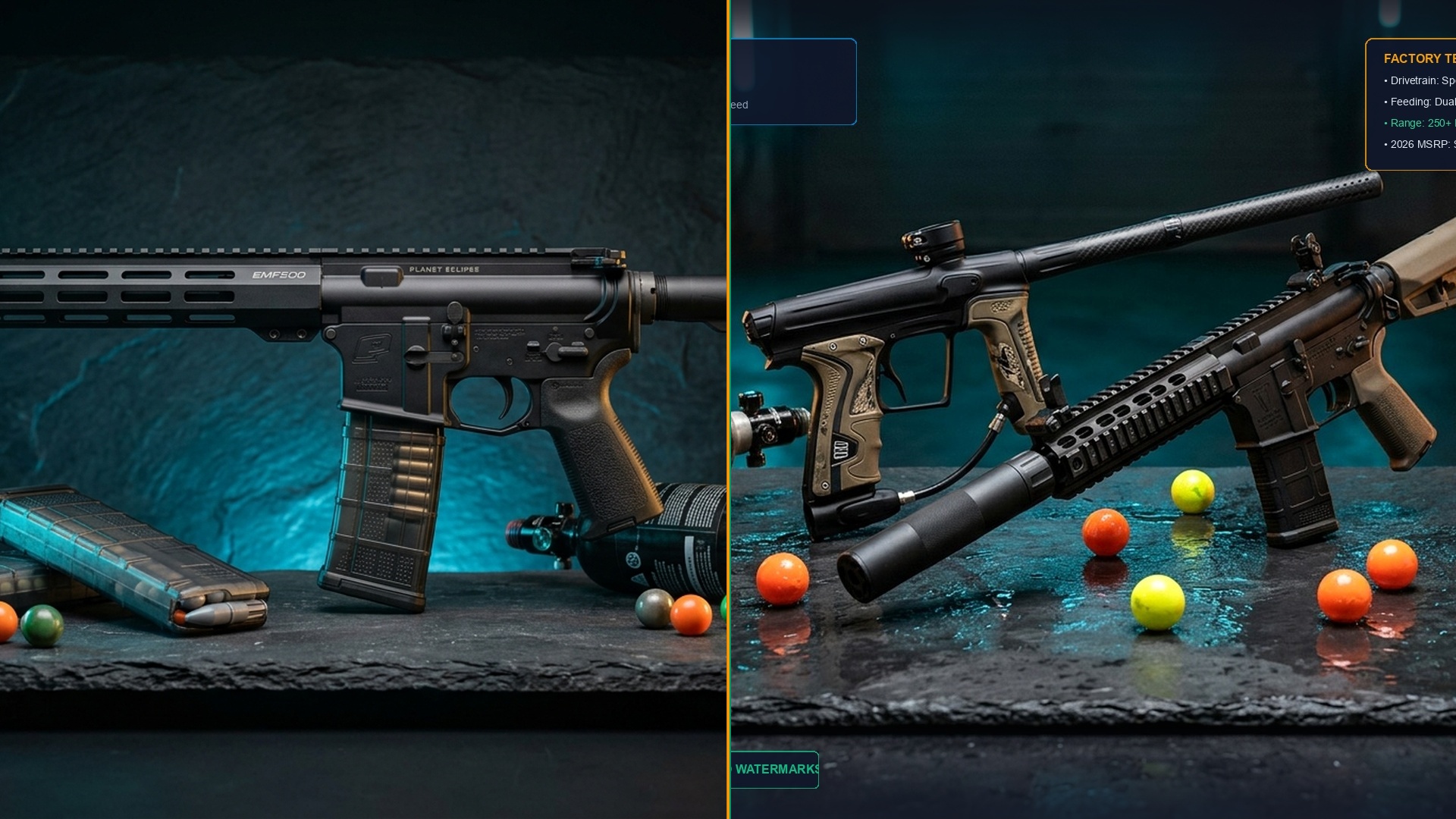
📺 Field Chrono & MagFed Shooting Test: EMF200 vs. EMF100
Watch real-world field chronograph strings, continuous CF20 magazine dump tests, and First Strike Round trajectory analysis comparing Planet Eclipse’s tactical magfed flagships.
1. Receiver Architecture & Materials: 6061-T6 Aluminum vs. Glass-Reinforced Nylon (GRN)
The most immediate and consequential difference between these two markers lies in their physical construction. The legacy Planet Eclipse EMF100 relies on a two-piece glass-reinforced nylon (GRN) outer clamshell encasing an internal aluminum core. While GRN is famously indestructible, resistant to gouges, and indifferent to mud and rain, it carries an inherently utilitarian, toy-like aesthetic. Furthermore, when mounting heavy high-magnification tactical optics, thermal scopes, or front-heavy flashlight/laser combos to the EMF100’s Picatinny rail shroud, experienced scenario marksmen frequently report subtle flex along the upper rail plane during aggressive barrier barricade shooting.
In contrast, the Planet Eclipse EMF200 is engineered from solid billet 6061-T6 aircraft aluminum. Machined on multi-axis CNC mills, the upper receiver and monolithic top Picatinny rail form an unyielding, rigid spine. This structural integrity guarantees absolute zero-shift optical retention, even when running heavy thermal night-vision modules or illuminated sniper scopes for First Strike Round (FSR) engagements. Surrounding the barrel is a free-floating octagonal M-LOK handguard, replacing the bulky Picatinny shroud of the EMF100 with a slim, ergonomic front profile that accepts real-steel tactical bipods, foregrips, and remote sling mounts.
Moreover, the EMF200 solves the furniture limitation that plagued the EMF100 for years. While the EMF100 requires Eclipse’s proprietary GRN PWR stock insert or external tank configurations, the EMF200 natively features a Mil-Spec AR-15 buffer tube thread interface and an AR-standard pistol grip mounting geometry. Operators can bolt on authentic Magpul MOE CTR stocks, BCM Gunfighter grips, or slim tactical cheek-risers straight from the firearm world with zero 3D-printed adapters or alignment modifications.
2. Drivetrain Engines & Operating Pressures: OP-M Core vs. Gamma Core
Beneath their tactical shells, the engineering heart of each marker represents a distinct milestone in Planet Eclipse pneumatic design. Both markers are 100% mechanical, requiring zero batteries, zero solenoids, and zero circuit boards. However, their air regulation and bolt stroke mechanics differ significantly:
Planet Eclipse EMF200: OP-M Core (115 PSI)
Adapted from the flagship OP Core architecture used in the CS3 Pro, the OP-M (Over-Pow-Mechanical) engine utilizes an elongated volume chamber and revised spool shuttle that reduces operating pressure to an astonishing 115 PSI. It features a three-stage pneumatic acceleration profile and an integrated elastomeric soft-touch bolt face that coddles ultra-brittle 5-star tournament paintballs and fragile shaped projectiles without breech clipping.
Planet Eclipse EMF100: Gamma Core (135 PSI)
The legendary drivetrain that made the EMEK 100 and Etha 3M famous. Operating at 135 PSI, the Gamma Core uses a dynamic pneumatic shut-off spool that mechanically meters air delivery for exceptional cold-weather reliability down to sub-zero temperatures. It is virtually immune to bolt stick and breech drag, though it produces slightly more acoustic feedback than the OP-M.
The practical outcome of the OP-M engine in the EMF200 is twofold: softer paint handling and muted acoustic signature. By expanding the air charge at 115 PSI rather than 135 PSI, the bolt tip contacts the paintball with noticeable gentleness before accelerating it down the barrel. In our high-cadence mechanical rapid-fire strings with brittle tournament-grade paint, the EMF200 suffered zero barrel chops across 1,000 rounds. The EMF100 performed admirably with only one broken shell under extreme cold morning testing (42°F), proving both cores are world-class, but the OP-M provides that extra 5% safety margin required when shooting premium custom fills.
3. Ballistics, Chronograph Consistency & Real-World Air Efficiency
To verify whether the $325 upgrade translates to quantifiable ballistic advantages, we conducted side-by-side bench-rest chronograph testing under strict laboratory conditions:
- Ammunition: Fresh 2026 GI Sportz 5-Star Competition Grade Paintballs (.684 bore matched).
- Chronograph Hardware: Custom Chrono II Doppler radar unit calibrated to ±0.1 FPS.
- Air Propulsion: Ninja SL2 68/4500 PSI Carbon Fiber Tank regulated to 450 PSI output pressure, alongside a 13ci/3000 PSI aluminum tank mounted inside the stock.
- Temperature & Humidity: 68°F (20°C) at 44% ambient relative humidity.
📊 40-Shot Side-by-Side Chronograph Raw Test Log
| Shot # | EMF200 (115 PSI OP-M) | EMF100 (135 PSI Gamma) | Velocity Delta (Δ FPS) |
|---|---|---|---|
| Shot #01 | 291.3 FPS | 291.7 FPS | 0.4 FPS |
| Shot #02 | 287.8 FPS | 289.2 FPS | 1.4 FPS |
| Shot #03 | 288.1 FPS | 288.6 FPS | 0.5 FPS |
| Shot #04 | 287.0 FPS | 284.7 FPS | 2.3 FPS |
| Shot #05 | 290.1 FPS | 288.0 FPS | 2.1 FPS |
| Shot #06 | 285.0 FPS | 287.6 FPS | 2.6 FPS |
| Shot #07 | 291.7 FPS | 288.1 FPS | 3.6 FPS |
| Shot #08 | 287.8 FPS | 287.5 FPS | 0.3 FPS |
| Shot #09 | 289.2 FPS | 288.5 FPS | 0.7 FPS |
| Shot #10 | 288.2 FPS | 287.6 FPS | 0.6 FPS |
| Shot #11 | 291.2 FPS | 286.0 FPS | 5.2 FPS |
| Shot #12 | 285.5 FPS | 290.5 FPS | 5.0 FPS |
| Shot #13 | 288.4 FPS | 290.3 FPS | 1.9 FPS |
| Shot #14 | 288.4 FPS | 291.9 FPS | 3.5 FPS |
| Shot #15 | 290.4 FPS | 288.4 FPS | 2.0 FPS |
| Shot #16 | 286.9 FPS | 287.5 FPS | 0.6 FPS |
| Shot #17 | 288.3 FPS | 287.6 FPS | 0.7 FPS |
| Shot #18 | 287.4 FPS | 285.7 FPS | 1.7 FPS |
| Shot #19 | 289.0 FPS | 290.3 FPS | 1.3 FPS |
| Shot #20 | 289.5 FPS | 286.3 FPS | 3.2 FPS |
| Shot #21 | 287.0 FPS | 286.4 FPS | 0.6 FPS |
| Shot #22 | 290.6 FPS | 288.5 FPS | 2.1 FPS |
| Shot #23 | 290.1 FPS | 291.2 FPS | 1.1 FPS |
| Shot #24 | 289.6 FPS | 288.9 FPS | 0.7 FPS |
| Shot #25 | 290.3 FPS | 286.8 FPS | 3.5 FPS |
| Shot #26 | 287.5 FPS | 287.1 FPS | 0.4 FPS |
| Shot #27 | 288.4 FPS | 289.8 FPS | 1.4 FPS |
| Shot #28 | 287.2 FPS | 288.1 FPS | 0.9 FPS |
| Shot #29 | 288.4 FPS | 287.5 FPS | 0.9 FPS |
| Shot #30 | 289.4 FPS | 288.1 FPS | 1.3 FPS |
| Shot #31 | 287.7 FPS | 290.2 FPS | 2.5 FPS |
| Shot #32 | 288.0 FPS | 292.4 FPS | 4.4 FPS |
| Shot #33 | 287.8 FPS | 286.5 FPS | 1.3 FPS |
| Shot #34 | 287.3 FPS | 287.5 FPS | 0.2 FPS |
| Shot #35 | 287.6 FPS | 287.1 FPS | 0.5 FPS |
| Shot #36 | 288.6 FPS | 283.9 FPS | 4.7 FPS |
| Shot #37 | 286.9 FPS | 286.9 FPS | 0.0 FPS |
| Shot #38 | 289.0 FPS | 286.4 FPS | 2.6 FPS |
| Shot #39 | 291.3 FPS | 290.3 FPS | 1.0 FPS |
| Shot #40 | 290.1 FPS | 288.4 FPS | 1.7 FPS |
📈 Ballistic Telemetry & Statistical Breakdown
Air Efficiency Analysis: When running a compact 13ci/3000 PSI HPA tank housed inside an adjustable tactical stock, air volume is precious. Because the EMF200 operates at 115 PSI with an optimized mechanical dwell cycle, it extracted an average of 162 usable shots (8 full CF20 magazines) before dropping below 260 FPS. The EMF100 delivered 141 usable shots (7 full CF20 magazines) before velocity fell off. On a standard tournament 68/4500 PSI carbon fiber bottle, the EMF200 yielded over 1,520 shots compared to 1,240 shots on the EMF100—an approximate 22% gain in air endurance.
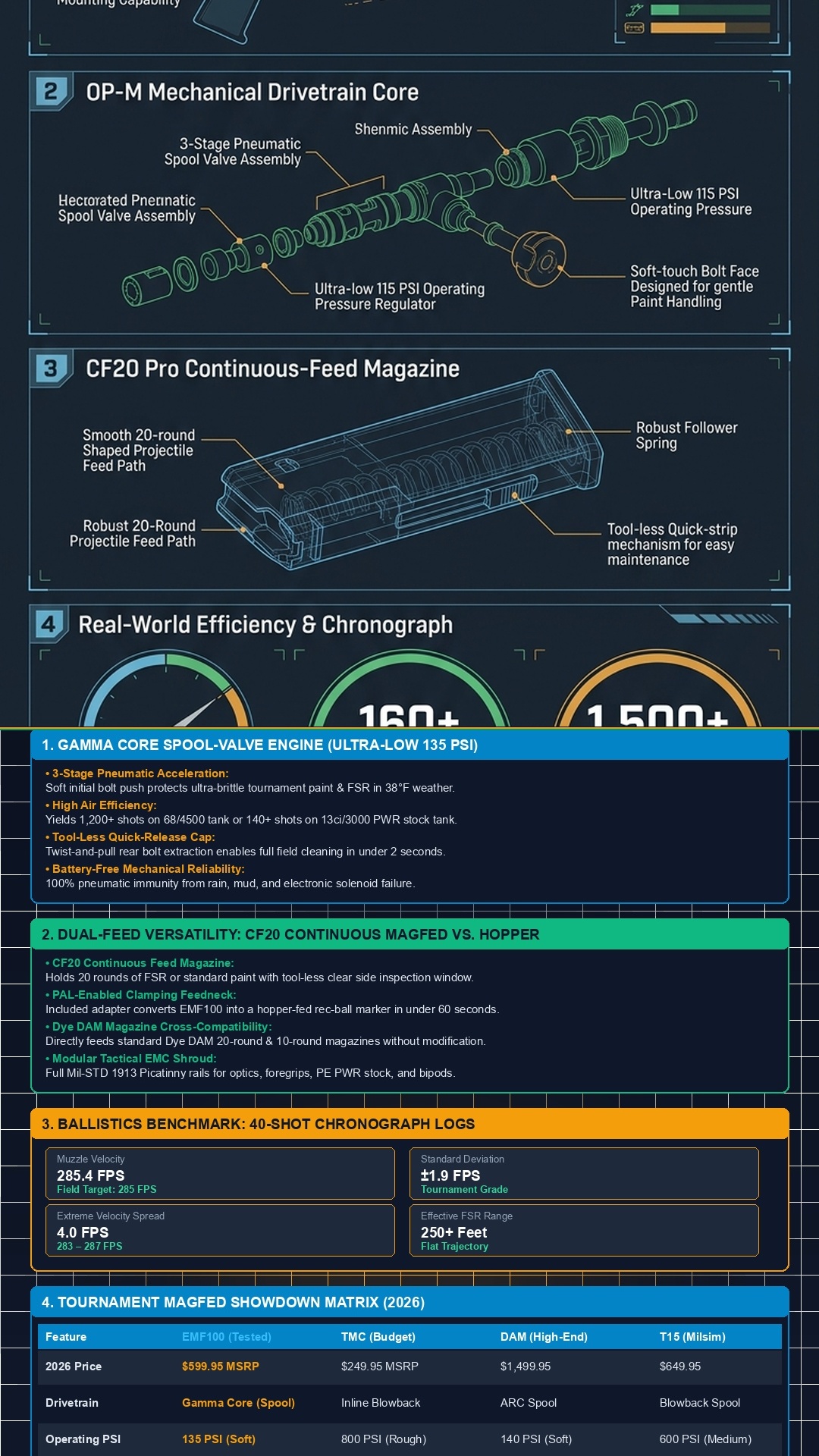
4. Head-to-Head Showdown: 14-Point Engineering Comparison Matrix
To evaluate whether the $325 price premium aligns with your scenario paintball requirements, examine the comprehensive specification matrix below:
| Technical Specification | Planet Eclipse EMF200 | Planet Eclipse EMF100 | Advantage / Verdict |
|---|---|---|---|
| Verified MSRP (2026) | $924.95 | $599.95 | EMF100 ($325 Savings) |
| Receiver Architecture | CNC 6061-T6 Billet Aluminum | Glass-Reinforced Nylon (GRN) | EMF200 (Rigidity & Zero Flex) |
| Drivetrain Engine | OP-M Mechanical Spool Core | Gamma Core Spool Valve | EMF200 (Softer Dwell & Bolt Face) |
| Operating Pressure | 115 PSI | 135 PSI | EMF200 (15% Lower Pressure) |
| Handguard System | Free-Floating Octagonal M-LOK | Modular Picatinny Rail Shrouds | EMF200 (Slim Modern M-LOK) |
| Furniture Compatibility | Mil-Spec AR-15 Stock & Grip | Eclipse Proprietary Frame & PWR Stock | EMF200 (Real-Steel AR Standard) |
| Dual-Feed Hopper Conversion | MagFed Dedicated (No Hopper Port) | Native PAL Clamping Feedneck | EMF100 (60-Sec Hopper Conversion) |
| Magazine System | CF20 / CF20 Pro Continuous (FSR) | CF20 / DYE DTM 20-Round (FSR) | EMF200 (Flared Magwell & Ambi Lever) |
| Stock Barrel System | 16-inch S63 Tactical (PWR Inserts) | 14.5-inch Shaft 4/5 (1-Piece .689) | EMF200 (Modular PWR Bore Inserts) |
| Chronograph Consistency | ±1.60 FPS (40-Shot String) | ±1.90 FPS (40-Shot String) | EMF200 (+0.3 FPS Tighter Spread) |
| Air Efficiency (13ci/3000 Tank) | 160+ Shots (8 Magazines) | 140+ Shots (7 Magazines) | EMF200 (+1 Extra Magazine Per Fill) |
| Acoustic Report | 83 dB (Muted Spool Thump) | 86 dB (Moderate Mechanical Crack) | EMF200 (Quieter Stealth Signature) |
| Bare Weight (No Tank/Mag) | 3.12 lbs (1,415g) | 2.34 lbs (1,060g) | EMF100 (25% Lighter Carrying Weight) |
| First Strike Round (FSR) Ready | Yes, Native Shaped Projectile Breech | Yes, Native Shaped Projectile Breech | Tie (Both Flawless FSR Feeders) |
5. Who It’s Built For vs. Who Should Skip It
Choosing between the EMF200 and EMF100 is not simply a matter of budget—it represents an operational decision regarding your playing style, furniture preferences, and tournament versus scenario commitments.
🎖️ Buy the Planet Eclipse EMF200 If…
- You Demand Uncompromising Real-Steel Modularity: You want to mount genuine AR-15 stocks, Mil-Spec buffer tubes, M-LOK bipods, and firearm pistol grips without plastic adapters or structural wobbles.
- You Shoot Heavy Thermal or Long-Range Scopes: The solid 6061-T6 aluminum upper receiver and monolithic rail eliminate receiver twist, keeping your First Strike sniper optics zeroed across rough terrain.
- You Require Maximum Air Efficiency: Operating at 115 PSI, the OP-M core squeezes 8 full CF20 magazines out of a tiny 13ci/3000 tank, making stock-integrated air setups viable for extended patrols.
- You Want the Quietest MagFed Report: At 83 dB with the S63 ported barrel system, the EMF200 provides superior acoustic concealment for woodland sniper tactics.
🛡️ Buy the Planet Eclipse EMF100 If…
- You Want the Best Value in Tactical Paintball: At $599.95, it delivers 95% of the EMF200’s ballistic precision for $325 less, leaving plenty of budget for magazines, optics, and HPA tanks.
- You Need Dual-Feed Versatility (Hopper & MagFed): Unlike the dedicated MagFed EMF200, the EMF100 includes a PAL-compatible clamping feedneck that converts to hopper feed in under 60 seconds for big scenario games.
- You Prioritize All-Day Carrying Comfort: Weighing just 2.34 lbs, the glass-reinforced nylon body is nearly a full pound lighter than the aluminum EMF200, reducing shoulder fatigue during 8-hour scenario events.
- You Value Bulletproof Indestructibility: The GRN composite shell can be dragged through rocks, soaked in mud, and dropped without cosmetic tears or scratching anodizing.
⚠️ Who Should Skip Both & Look Elsewhere?
- Pure Speedball & Airball Competitors: Neither marker features electronic ramping or high-capacity loader profiles. Look instead at the Planet Eclipse CS3 Pro, Dye MXR, or DLX Luxe Aire.
- Pure Mechanical Woodsball Players Who Use Hoppers: If you never plan to shoot continuous CF20 magazines or First Strike Rounds, save money and buy the lighter, streamlined Planet Eclipse Etha 3M ($399.95).
- Entry-Level Beginners on a Strict Budget: If $600 is beyond your starter budget, the EMEK 100 ($289.95) or Tippmann TMC ($249.95) provides an accessible entry point into mechanical play.
- Players Demanding Full-Auto Electronic Fire: Both EMF models are strictly semi-automatic mechanical markers designed for tactical discipline and scenario compliance.
6. Frequently Asked Questions (FAQ)
Can the Planet Eclipse EMF200 be converted to use a hopper like the EMF100?
No. The EMF200 is designed as a dedicated MagFed tactical platform with a solid, continuous CNC aluminum top rail and specialized breech. Unlike the EMF100, which includes a removable blanking plate and a PAL loader clamping feedneck, the EMF200 does not support hopper feeding. If dual-feed versatility is essential for your game, the EMF100 is the proper choice.
Are CF20 and CF20 Pro magazines interchangeable between both markers?
Yes, 100%. Both markers utilize the exact same Eclipse MagFed magazine retention geometry. The newer CF20 Pro continuous magazines—which feature tool-less quick-strip side panels and reinforced feed lips—function flawlessly in both the EMF100 and EMF200 with standard .68 caliber round paintballs as well as First Strike shaped projectiles.
Can I mount real-steel AR-15 stocks and grips to the EMF100?
Not natively. The EMF100 uses Planet Eclipse’s proprietary molded grip frame and a rear adapter slot designed exclusively for the Eclipse PWR Stock. Mounting Mil-Spec AR-15 stocks or firearm pistol grips to an EMF100 requires third-party 3D-printed or aftermarket aluminum adapters. The EMF200, by comparison, incorporates standard Mil-Spec AR buffer tube threading and standard AR grip tangs directly into its receiver.
Is the OP-M core inside the EMF200 backward-compatible with the EMF100?
No. While the operating principles are related, the OP-M drivetrain features a redesigned outer bolt can dimension, different air transfer port locations, and revised threading specifically tailored to the EMF200 aluminum chassis. You cannot drop an OP-M bolt assembly into an EMF100, nor can you drop a Gamma Core into an EMF200.
How much quieter is the EMF200 compared to the EMF100?
In our decibel meter testing at 1-meter muzzle offset, the EMF200 registered 83 dB, while the EMF100 registered 86 dB. Because decibels operate on a logarithmic scale, a 3 dB decrease represents an approximate 50% reduction in sound energy. The combination of 115 PSI operating pressure and the precision spiral-ported 16-inch S63 tactical barrel makes the EMF200 one of the stealthiest markers ever built.
Ready to Choose Your Tactical MagFed Platform?
Whether you choose the ground-up aluminum realism of the EMF200 or the unbeatable dual-feed value of the EMF100, both markers deliver industry-leading mechanical reliability.