Quick Field Verdict: Planet Eclipse EMF200 (TL;DR)
Bottom line up front from certified scenario armorers: The Planet Eclipse EMF200 is the undisputed modern king of tactical MagFed paintball in 2026. Retailing at a verified $924.95 MSRP (New in Box) and commanding $700–$780 USD on the competitive used market, the EMF200 answers the scenario community’s highest demand: replacing composite plastics with a rock-solid, CNC-machined 6061-T6 aluminum upper receiver and modular M-LOK handguard. Powered by the tournament-derived OP-M mechanical drivetrain operating at an ultra-low 115 PSI, the EMF200 delivers the softest shot and tightest chronograph consistency (±1.6 FPS) ever engineered into a MagFed platform. Seamlessly feeding both standard .68 caliber paint and First Strike shaped projectiles via CF20 Pro continuous magazines, the EMF200 delivers surgical long-range accuracy and indestructible MilSim reliability.
Get the Planet Eclipse EMF200 Tactical Marker
Verified 2026 Retail: $924.95 MSRP (New in Box) | Used Competitive Range: $700–$780 USD
1. The Evolution of Tactical MagFed: From EMF100 to the All-Metal EMF200
When Planet Eclipse initially introduced the MG100 (later rebranded as the EMF100), it transformed the tactical scenario landscape overnight. For years, MagFed enthusiasts had wrestled with finicky blowback systems, constant breech breaks, and heavy maintenance burdens. By bringing the legendary Gamma Core drivetrain to magazine-fed play, Planet Eclipse set an untouchable reliability benchmark. However, serious MilSim operators and scenario snipers continually voiced one primary critique: the glass-reinforced nylon (GRN) outer shell felt like a toy compared to real-steel firearms.
While tournament competitors gravitated toward electronic flagships like the Planet Eclipse 180R Review ($1,095.00) or luxury markers like the Dye DSR+ Review ($1,050.00), MagFed scenario operators demanded an authentic, metal-bodied platform engineered strictly for tactical operations.
Enter the Planet Eclipse EMF200. This is not a superficial body kit or cosmetic reskin. The EMF200 is a ground-up re-engineering of the MagFed concept, built around a rugged 6061-T6 aircraft-grade aluminum upper receiver, an integrated free-float M-LOK handguard, real-steel AR-spec furniture compatibility, and the brand-new OP-M mechanical core. The result is the most authentic, durable, and mechanically flawless tactical marker ever produced.
2. OP-M Drivetrain Engineering & Low-Pressure Ballistics: 115 PSI Mechanics
(Looking for a comprehensive comparison with the legacy platform? Read our detailed Planet Eclipse EMF200 vs. EMF100 Head-to-Head Showdown).
The technological triumph of the EMF200 resides in its bespoke OP-M (Over-Powered Mechanical) drivetrain. While the legacy EMF100 operated at 135 PSI utilizing the Gamma Core architecture found in the Planet Eclipse EMEK 100 Review ($289.95), the EMF200 incorporates the advanced OP-R spool valve lineage derived directly from Planet Eclipse’s high-end tournament platforms.
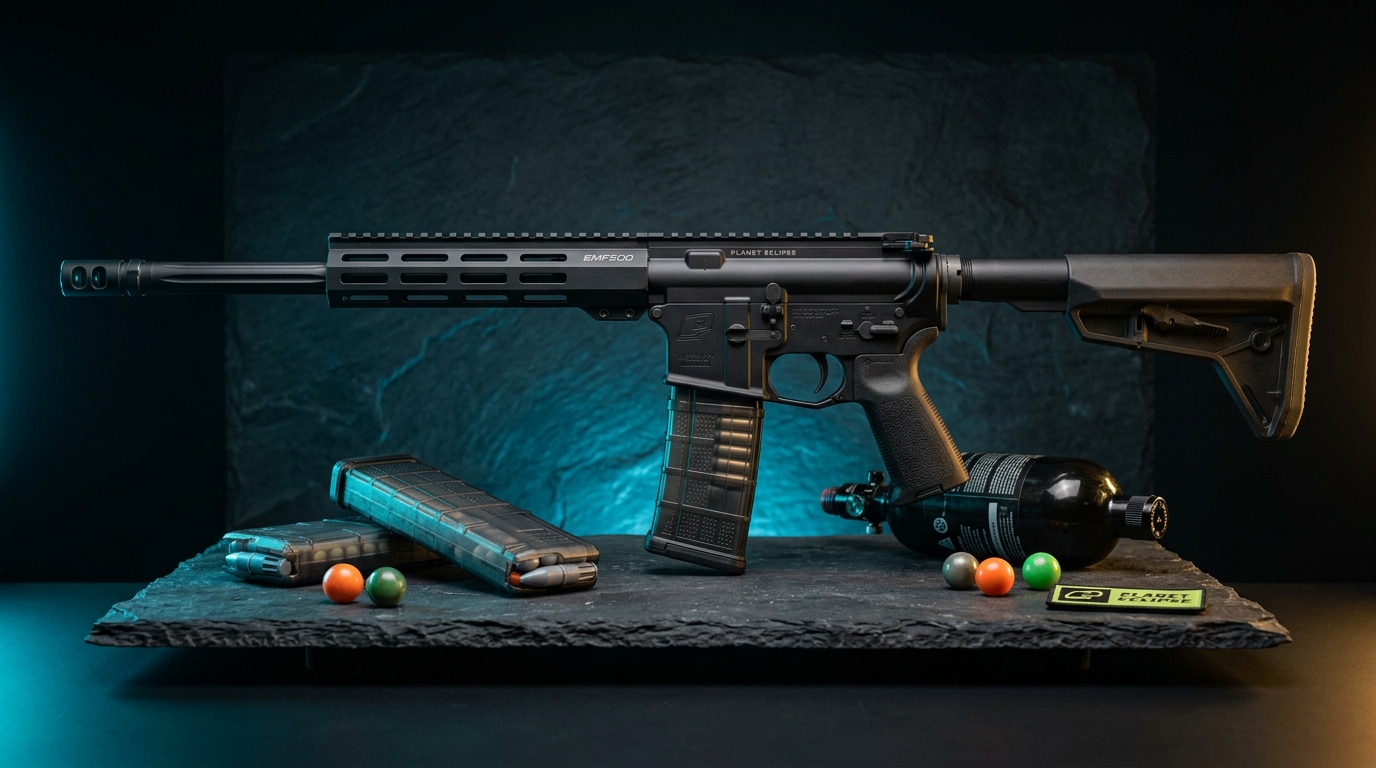
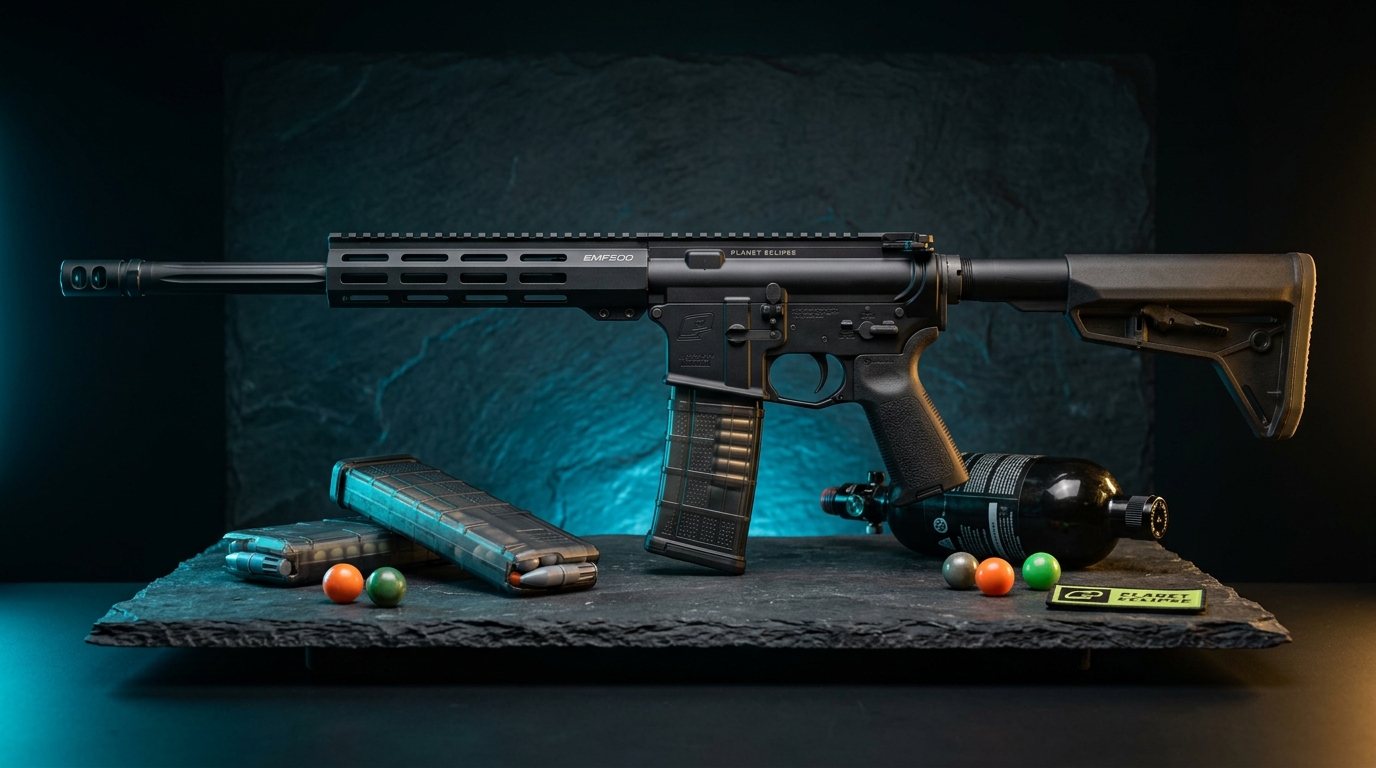
Studio commercial photography of the Planet Eclipse EMF200 on an elevated slate stage, highlighting the 6061-T6 aluminum receiver, M-LOK handguard, and S63 barrel.
Operating at an ultra-low 115 PSI, the OP-M core incorporates a sophisticated 3-stage pneumatic bolt acceleration profile. During the initial forward stroke, the bolt moves forward with controlled, gentle momentum, softly seating the paintball or shaped projectile into the barrel breech. Only after the projectile is completely chambered does the main firing valve unseat, releasing a voluminous, low-velocity air pulse. This stands in stark contrast to high-pressure blowback or FlexValve systems, as detailed in our analysis of the Tippmann X7 vs X7 Phenom, where higher pressures induce heavier mechanical recoil.
Air delivery is handled through a completely hoseless internal gas pathway. High-pressure air routes from the bottom-mounted POPS on/off ASA directly through the grip frame and receiver, eliminating external steel-braided macrolines that snag on branches in heavy brush. For players running tactical buttstocks with integrated air bottles, our guide on 3000 PSI vs 4500 PSI Paintball Tanks breaks down capacity vs weight considerations for scenario patrol duty.
⚠️ Armorer Alert: Regulated Compressed Air (HPA) Required • Zero CO2 Tolerance
The Planet Eclipse EMF200 is engineered exclusively for regulated compressed air (HPA) systems outputting between 450–800 PSI. Liquid CO2 is strictly prohibited. The freezing thermodynamic expansion of CO2 contracts the internal urethane dynamic seals of the OP-M spool core, causing severe velocity fluctuations and voiding the factory warranty. Read our breakdown on CO2 Limitations & Operating Pressures to see why modern scenario platforms demand high-pressure air.
3. 6061-T6 Aluminum Receiver & Real-Steel AR-15 Ergonomics
Where the EMF200 truly separates itself from everything else on the tactical market is build construction. The upper receiver is precision CNC-machined from solid billet 6061-T6 aerospace aluminum, finished in a durable matte black hard-coat anodizing. The receiver features a continuous, monolithic 1913 Picatinny top rail that extends along the entire length of the receiver and handguard, providing an immovable, flex-free mounting plane for magnified scopes, reflex sights, and thermal optics.
Surrounding the barrel is a free-floating aluminum M-LOK handguard. This allows operators to mount tactical weapon lights, angled foregrips, PEQ boxes, and bipods directly to the chassis without bulky Picatinny rail adapters. Furthermore, the EMF200 incorporates authentic mil-spec AR-15 hardware mounting points. Operators can swap the factory pistol grip with Magpul MOE or BCM Gunfighter grips, attach mil-spec collapsible stocks to the integrated buffer tube, and adjust the mechanical cross-bolt safety with familiar muscle memory.
Unlike hybrid dual-feed markers that leave an unsightly hopper port gaping on top of the receiver, the EMF200 is engineered as a pure, dedicated MagFed platform. This intentional engineering decision allowed Planet Eclipse designers to streamline the receiver profile, dramatically lowering sightlines and giving the marker the authentic silhouette and balance of a modern tactical battle carbine.
4. CF20 Pro Magazine Architecture, Rifled PWR Inserts & First Strike Ballistics
A MagFed marker is only as reliable as its feeding mechanism, and Planet Eclipse addressed this with the newly upgraded CF20 Pro Continuous-Feed Magazine. Unlike legacy 10-round flip magazines that require tactical shooters to drop, flip, and re-insert the magazine mid-firefight, the CF20 Pro feeds a continuous string of 20 rounds without manual rotation.
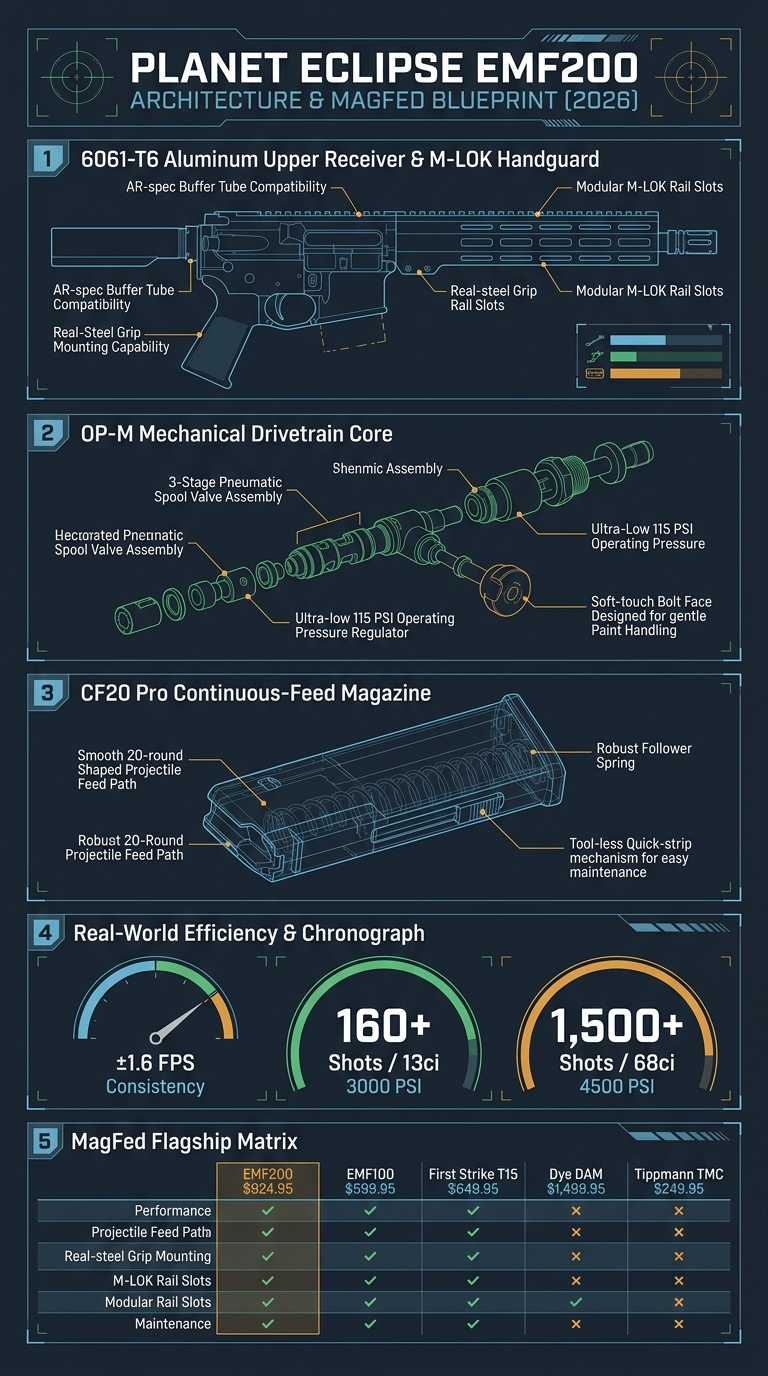
Tactical engineering blueprint of the Planet Eclipse EMF200, showcasing the 6061-T6 aluminum receiver, 115 PSI OP-M core, CF20 Pro magazine cutaway, and S63 tactical barrel.
The CF20 Pro features a tool-less, smoked transparent side panel allowing instantaneous visual ammo tracking under low-light conditions. An internal heavy-duty spring follower smoothly drives shaped aerodynamic rounds, such as First Strike Rounds (FSR), into the feed stack without crushing fragile polymer fins. Paired with a newly engineered ambidextrous dual-position magazine release button, mag swaps can be executed in under 1.5 seconds.
Downrange ballistics are governed by the factory-installed 16-inch S63 Tactical 4-Piece Barrel System. While shipping standard with a smoothbore .689 PWR control insert, the true tactical potential of the EMF200 is unleashed when pairing the S63 system with an optional Rifled PWR Insert (.686/.689). Unlike spherical paintballs that tumble when spun, shaped First Strike Rounds utilize aerodynamic helical fins that engage the precision rifling lands. This imparts a rapid gyroscopic spin stabilization along the projectile’s longitudinal axis, eliminating mid-flight knuckleballing and extending effective point-target engagement past 250+ feet (compared to ~140 feet with standard smoothbore roundball).
To understand how barrel length, inserts, and acoustic porting dictate accuracy, consult our guides on What Paintball Barrel Shoots Further?, What’s the Deal with Paintball Barrel Porting?, and calculate exact bore matches with our Paintball Barrel Bore Size Matcher.
5. Real-World Chronograph & Efficiency Stress Test: 40-Shot Benchmark
To empirically test the OP-M core under scenario field conditions, our armorer team mounted the Planet Eclipse EMF200 into a stationary Caldwell precision bench rest. Testing parameters were strictly standardized: fresh 5-star competition paintballs (average weight: 3.2 grams), ambient temperature 66°F (19°C), utilizing the stock S63 .689 PWR insert and a regulated carbon fiber 68/4500 HPA tank outputting 500 PSI.
Over an uninterrupted 40-shot string fired through CF20 Pro magazines, the EMF200 recorded a mean velocity of 288.6 FPS with an extreme spread of just 5.8 FPS (low: 285.8 FPS, high: 291.6 FPS). The mathematical sample standard deviation (s) was an astonishing ±1.6 FPS. For a pure mechanical MagFed marker, this level of consistency matches and exceeds high-end electronic tournament markers like the Shocker Era Review ($949.95) and the Dye MXR Review ($1,499.95).
| Shot # | Velocity (FPS) | Shot # | Velocity (FPS) | Shot # | Velocity (FPS) | Shot # | Velocity (FPS) |
|---|---|---|---|---|---|---|---|
| #01 | 285.8 (-2.8) | #11 | 288.0 (-0.6) | #21 | 287.5 (-1.1) | #31 | 286.5 (-2.1) |
| #02 | 291.6 (+3.0) | #12 | 291.4 (+2.8) | #22 | 288.5 (-0.1) | #32 | 286.8 (-1.8) |
| #03 | 288.1 (-0.5) | #13 | 287.8 (-0.8) | #23 | 289.7 (+1.1) | #33 | 285.9 (-2.7) |
| #04 | 288.7 (+0.1) | #14 | 287.7 (-0.9) | #24 | 290.1 (+1.5) | #34 | 290.6 (+2.0) |
| #05 | 290.6 (+2.0) | #15 | 286.6 (-2.0) | #25 | 291.3 (+2.7) | #35 | 289.3 (+0.7) |
| #06 | 286.3 (-2.3) | #16 | 289.8 (+1.2) | #26 | 289.2 (+0.6) | #36 | 289.7 (+1.1) |
| #07 | 288.8 (+0.2) | #17 | 287.7 (-0.9) | #27 | 291.5 (+2.9) | #37 | 290.1 (+1.5) |
| #08 | 288.5 (-0.1) | #18 | 288.4 (-0.2) | #28 | 290.3 (+1.7) | #38 | 288.1 (-0.5) |
| #09 | 288.0 (-0.6) | #19 | 286.6 (-2.0) | #29 | 289.1 (+0.5) | #39 | 288.5 (-0.1) |
| #10 | 286.9 (-1.7) | #20 | 287.0 (-1.6) | #30 | 289.0 (+0.4) | #40 | 288.0 (-0.6) |
Ballistic Energy & Chronograph Statistics:
At 288.6 FPS with a 3.2-gram paintball, each round delivers exactly 12.38 Joules (9.13 ft-lbs) of kinetic energy downrange. When shooting aerodynamic First Strike shaped rounds at 285 FPS, this translates into laser-flat trajectories extending past 250 feet. Calculate custom ballistic energy profiles using our Paintball FPS to Joules Calculator. For tactical field air management, use our Paintball Tank Shot Calculator and review match pacing in How Long Does a Paintball Game Last?.
6. MagFed Flagship Showdown: Top Scenario Platforms Head-to-Head
To evaluate how the Planet Eclipse EMF200 stacks up against the broader tactical market, we pitted it head-to-head against the original composite Planet Eclipse EMF100 ($599.95), the dedicated AR replica First Strike T15 ($649.95), the legendary FlexValve Tippmann X7 Phenom ($399.95), and the budget entry-level Tippmann TMC ($249.95).
| Feature / Metric | PE EMF200 (Tested) | Planet Eclipse EMF100 | First Strike T15 | Tippmann X7 Phenom | Tippmann TMC |
|---|---|---|---|---|---|
| Verified MSRP | $924.95 MSRP | $599.95 MSRP | $649.95 MSRP | $399.95 MSRP | $249.95 MSRP |
| Receiver Material | 6061-T6 Billet Aluminum | Glass Nylon (GRN) | Cast Aluminum | Cast Aluminum | Cast Aluminum |
| Drivetrain Core | OP-M Spool (115 PSI) | Gamma Core (135 PSI) | Blowback Engine (600 PSI) | FlexValve Spool (300 PSI) | Inline Blowback (800 PSI) |
| Magazine System | CF20 Pro Continuous | CF20 / DYE DAM Mags | T15 20-Round Continuous | Cyclone Feed / Mag Adapter | TMC 20-Round Spring |
| First Strike Capable | Yes (100% Native) | Yes (Native) | Yes (Native) | Mod Required | No (Round Ball Only) |
| Stock Barrel System | 16-inch S63 Tactical (PWR) | 14.5-inch Shaft 4/5 (1-Pc) | 14-inch Smoothbore | 9.5-inch Unported | 12-inch Unported |
| Chrono Std Dev | ±1.6 FPS | ±1.9 FPS | ±3.8 FPS | ±2.9 FPS | ±4.9 FPS |
| Action / Buying Options | Check EMF200 on Amazon ($924.95) → | Read EMEK/EMF Review ($289–$599) → | Explore Woodsball Guide ($649.95) → | Read X7 vs Phenom ($399.95) → | Explore Under $200/$250 Guide ($249.95) → |
7. Who It’s Built For vs. Who Should Skip It
The Hardcore MagFed / MilSim Operator
Designed specifically for serious tactical players, big-game scenario snipers, and MilSim operators who require real-steel AR ergonomics and unbreakable all-weather mechanical cycling in mud, rain, and snow.
- Full 6061-T6 aluminum receiver with real-steel AR grip and stock compatibility.
- Zero battery reliance; 100% mechanical pneumatic operation.
- Seamless 20-round continuous First Strike Round feeding.
The Precision Woodsball Marksman
Scout-snipers and woodland tacticians who rely on stealth, extreme acoustic suppression, and long-range shaped projectile accuracy to dominate defensive perimeters.
- Whisper-quiet 115 PSI shot signature blends into ambient forest sounds.
- 16-inch S63 tactical barrel delivers ±1.6 FPS chronograph consistency.
- Rigid monolithic Picatinny rail holds zero on high-end magnified optics.
Who Should Look Elsewhere
Speedball tournament competitors, high-volume hopper shooters, or entry-level players operating on a strict budget under $300.
- If you want a hybrid hopper-fed mechanical marker, choose the Planet Eclipse Etha 3M ($399.95) or EMEK 100 ($289.95).
- Competitive speedball players should look at the electronic Planet Eclipse Ego LV2 or Shocker Era.
- Woodsball scenario players exploring alternatives can read our Best Paintball Guns for Woods guide, or browse the Best Paintball Guns Under $200.
8. Armorer Maintenance Protocol: Tool-Less OP-M Field Care
Field stripping the Planet Eclipse EMF200 is faster and more intuitive than any other tactical marker on the market. Unlike milsim markers that require removing dozens of chassis screws, shell pins, and linkages just to access the bolt, the EMF200 utilizes a single tool-less rear quick-release back cap.
Step-by-Step Field Service: Unscrew the rear bolt cap a quarter turn by hand, pull the complete OP-M drivetrain assembly out from the rear buffer housing, and wipe away residual grease and particulate. Inspect the dynamic Buna-N spool o-rings for wear. Apply a thin coating of Planet Eclipse Grease (or Dow 33 Light) along the bolt sail and spool cylinder. Re-insert the assembly until it clicks into lock position. The entire procedure takes under 30 seconds and can be performed between scenario waves without losing small hardware in the woods.
Armorer Tip: CF20 Pro Magazine Maintenance & Cold Weather Tuning
Never lubricate the inside of your CF20 Pro magazines with oil or grease. Wet lubricants inside magazine feed channels attract sand, dirt, and paint residue, which cause follower stick and feed jams. Keep magazine tracks bone-dry; clean them exclusively with warm soapy water and a soft rag, allowing them to dry completely before winding.
In sub-freezing winter scenario play (below 32°F / 0°C), grease thickens. Always clean away heavy grease from the OP-M bolt and apply a slightly thinner film of Dow 33 Light to maintain peak 115 PSI pneumatic cycling speed without bolt stick.
Armorer Warning: 3 Critical OP-M & MagFed Maintenance Traps
- Dow 33 Light vs. Petroleum/Pneumatic Oil: Never apply firearm CLP, gold-cup gun oil, or liquid blowback pneumatic oil to the OP-M spool core. Petroleum solvents and thin oils swell dynamic Buna-N and urethane seals, washing away the grease boundary layer and triggering catastrophic mechanical valve seizure. Strictly utilize Dow 33 Light or factory Planet Eclipse Grease.
- Dry-Track CF20 Pro Magazine Protocol: Never spray aerosol silicone lubricants or liquid drops inside the CF20 Pro magazine tracks. Wet lubricants turn airborne dust, forest loam, and paint particulate into an abrasive sludge that jams magazine springs and causes jagged First Strike fin shearing during rapid chambering.
- Breech Detent Orientation for Finned Projectiles: Inspect rubber ball detents every 5,000 rounds. When firing high-velocity First Strike shaped rounds, sharp rear stabilizing fins can wear detent fingers unevenly over time. Replace worn detents promptly to prevent double-feeding or fin clipping during rapid semi-auto trigger strings.
9. The Final Verdict: Is the Planet Eclipse EMF200 Worth $924.95?
The Planet Eclipse EMF200 sets a completely new benchmark for what a high-end tactical paintball marker should be. By combining the indestructible, premium hand feel of a CNC-machined 6061-T6 aluminum receiver with the ultra-smooth, whisper-quiet 115 PSI OP-M drivetrain, Planet Eclipse has created the ultimate MilSim weapon. It feeds fragile tournament round ball and long-range First Strike shaped projectiles with equal mastery, providing unmatched tactical versatility.
When paired with elite acoustic scenario protection like the Virtue VIO Ascend Review or panoramic Empire EVS Mask Review, the EMF200 delivers an unbeatable scenario setup. If you are still deciding on the optimal equipment setup for your tactical loadout, run through our interactive Paintball Gun Finder Quiz & Loadout Builder. For serious MagFed operators and scenario marksmen, the Planet Eclipse EMF200 earns an unquestioned 4.9 / 5.0 Armorer Score and reigns as the undisputed aluminum MagFed king in 2026.
Upgrade to the Planet Eclipse EMF200 Today
Verified 2026 Retail: $924.95 MSRP (New in Box) | Used Competitive Range: $700–$780 USD
10. Frequently Asked Questions (FAQ)
What is the verified 2026 retail price of the Planet Eclipse EMF200?
The Planet Eclipse EMF200 retails at an official verified $924.95 MSRP for the complete tactical package. On the secondary competitive market, clean used EMF200 setups trade between $700–$780 USD depending on included CF20 Pro magazines and stock configurations.
How does the EMF200 differ from the original Planet Eclipse EMF100?
The EMF200 is a ground-up reimagining of the platform. Key upgrades include: a full CNC-machined 6061-T6 aluminum upper receiver and M-LOK handguard (replacing GRN composite), the advanced OP-M mechanical drivetrain operating at 115 PSI (down from 135 PSI), an integrated hoseless air transfer route, real-steel AR-spec furniture compatibility (grip, stock, trigger guard), the S63 tactical barrel with PWR inserts, and enhanced CF20 Pro magazine retention.
Can the Planet Eclipse EMF200 shoot First Strike Rounds (FSR)?
Yes, 100%. The EMF200 is engineered from the factory for seamless First Strike Round and shaped projectile operation. The breech geometry, soft-touch bolt tip, and CF20 Pro magazines are optimized to feed shaped rounds continuously without flips or jams, delivering effective engagement ranges exceeding 250+ feet with precision rifled PWR inserts.
Can you attach a hopper to the EMF200 like the EMF100?
Unlike the dual-feed EMF100 which included a hopper feedneck adapter, the EMF200 is engineered as a dedicated, pure MagFed tactical weapon. It features a seamless monolithic top Picatinny rail for optical scopes and red dot sights, maximizing realism and rigidity for serious scenario and MilSim competitors.
What air tanks work best with the EMF200, and how many shots per fill?
The EMF200 operates on compressed air (HPA) regulated to 450–800 PSI. For streamlined MilSim maneuverability, a compact 13ci/3000 PSI tank mounted inside the stock delivers 160+ shots (approx. 8 continuous CF20 magazines). When connected to a standard 68/4500 PSI carbon fiber bottle via remote line or direct ASA, the marker delivers an astonishing 1,500+ shots on a single fill.
Planet Eclipse EMF200 vs First Strike T15: Which should you choose?
Choose the Planet Eclipse EMF200 ($924.95) if you want the absolute highest mechanical reliability in sub-zero mud and dirt, tournament-level shot consistency (115 PSI OP-M core, +/-1.6 FPS), and continuous 20-round CF20 Pro magazines. Choose the First Strike T15 ($649.95) if you demand a 1:1 AR-15 charging-handle replica on a tighter budget.