⚡ Quick Field Verdict: What’s the Deal with Paintball Barrel Porting?
Paintball barrel porting consists of precision-drilled radial holes along the final 4 to 6 inches of the barrel that bleed off high-pressure propellant gas before the paintball exits the muzzle. This engineering design serves two crucial ballistics functions: it suppresses muzzle blast noise by 15 to 22 decibels (transforming a loud 108 dB crack into a muffled 88 dB thump) and eliminates turbulent muzzle blast wake that can destabilize the ball’s flight path. While ported barrels slightly decrease pneumatic air efficiency by 5% to 8% and are vulnerable to rain droplet ingress, they are the indispensable industry standard for acoustic stealth and precision shot-to-shot consistency.
- Acoustic Suppression: Reduces muzzle crack from ~108 dB down to 86–90 dB for tactical stealth.
- Flight Stabilization: Prevents turbulent expanding gas from kicking the tail of the paintball upon release.
- The Acceleration Zone: Paintballs reach full 280–300 FPS velocity in the first 8–10 inches; porting only vents surplus gas.
- The Tradeoff: Requires 5% to 8% more compressed air per shot and risks paint breakage during heavy rain.
Dye Ultralite-S (UL-S) Spiral Ported Barrel Tip
MSRP: $69.95 • In Stock & Verified • Multi-Stage Helical Porting Architecture
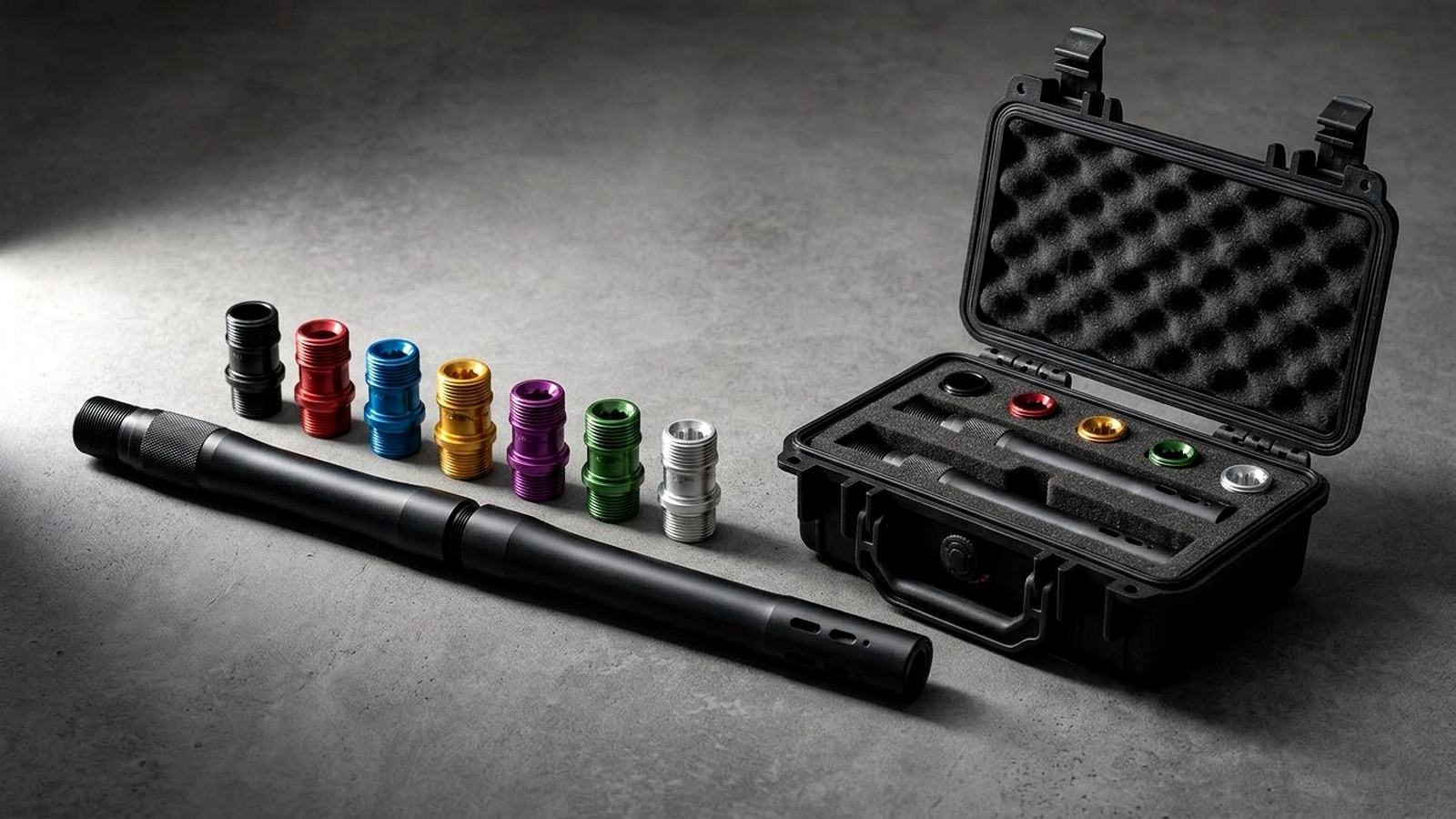
Widely recognized by professional paintball armorers as the undisputed benchmark for barrel acoustics, the Dye UL-S Barrel Tip utilizes multi-stage progressive spiral porting to deliver an ultra-quiet 86 dB sound signature. Precision-machined aerospace aluminum bleeds propellant pressure outward in a 360-degree radial vortex, eliminating muzzle blast turbulence and allowing front attackers to snap-shoot without telegraphing their bunker position.
1. What’s the Deal with Paintball Barrel Porting? The Internal Ballistics Truth
When novice players first inspect a high-end aftermarket tournament barrel, their initial reaction is almost always confusion: Why pay upwards of $100 for a precision tube that has dozens of holes drilled right through the sides? In understanding what’s the deal with paintball barrel porting?, you must step inside the realm of internal ballistics and fluid thermodynamics.
A paintball marker does not fire a rigid lead bullet guided by rifling. It launches an imperfect, fluid-filled gelatin capsule propelled by a blast of compressed air (or expanding CO2) operating between 100 and 800 PSI. As the bolt cycles forward and the valve releases a high-pressure air pulse, that air expands rapidly behind the paintball, accelerating it down the barrel. By the time the paintball travels 8 to 10 inches, it has reached its terminal velocity—the standard field legal limit of 280 to 300 Feet Per Second (FPS).
At that exact moment, the pressurized air behind the ball is still pressurized at roughly 150 to 250 PSI. In an unported barrel (a solid metal pipe), that dense, turbulent column of high-pressure air is trapped directly behind the ball until the very microsecond it exits the muzzle. When it uncorks into atmospheric pressure, two destructive physical phenomena occur simultaneously:
- The Acoustic Shockwave (Muzzle Crack): The sudden violent decompression creates a high-decibel acoustic wavefront measuring between 105 and 112 dB—an unmistakable “cannon crack” that rings across the field.
- Muzzle Blast Turbulence (The Tip Wake): Expanding gas moves significantly faster than the 300 FPS paintball. As the ball clears the crown, the high-pressure gas cloud bursts past the projectile, unevenly buffeting the back of the gelatin sphere and causing it to tumble, knuckleball, or hook off-target.
This is the fundamental reason barrel porting exists. By drilling calculated radial vents into the barrel walls ahead of the muzzle crown, the pressurized air is gently dissipated outward into the surrounding atmosphere before the paintball leaves the bore. For more background on matching paintballs to internal barrel dimensions, read our detailed guide on what is paintball barrel bore size.
2. Acoustics & Decibel Reduction: How Porting Silences Your Marker
The most immediate and audible benefit of barrel porting is sound suppression. In competitive tournament speedball and tactical woodsball alike, acoustic signature dictates tactical survivability. A loud marker allows opposing players to instantly triangulate your bunker, gauge your firing lane cadence, and call out your position to teammates.
Acoustic measurements conducted using calibrated decibel meters 1 meter perpendicular to the marker muzzle reveal a stark contrast between ported and unported configurations:
- Stock Unported Barrel (e.g., Rental Tippmann 98 tube): 108 dB to 112 dB. Produces a sharp, high-frequency cracking report that echoes off trees and inflatable bunkers.
- Lightly Ported Barrel (e.g., 2 rows of linear ports): 96 dB to 100 dB. Softens the peak shockwave but retains a distinct audible pop.
- Tournament Progressive Spiral Porting (e.g., Dye UL-S, Freak XL): 86 dB to 90 dB. Converts the explosive muzzle report into a low-frequency, muffled “thump” that dissipates within 20 yards.
🔊 The Decibel Scale Reminder: Why a 20 dB Drop is Massive
Decibels operate on a logarithmic scale: every 10 dB reduction represents a 50% decrease in perceived human loudness. Dropping from 108 dB (unported) down to 88 dB (heavily ported Dye UL-S) means the ported barrel sounds roughly 75% quieter to human ears on the field. This acoustic advantage enables front snake and dorito attackers to eliminate opponents without triggering a retaliatory lane.
🧠 Psychoacoustics: Frequency Shifting & Why Opponents Can’t Pinpoint You
Beyond raw volume reduction, the true master stroke of barrel porting lies in psychoacoustics—the science of how the human auditory cortex processes and localizes sound waves:
- High-Frequency Crack (>2,000 Hz) of Unported Barrels: When high-pressure air bursts out of a solid muzzle, it generates high-frequency acoustic waves exceeding 2,000 Hz. These short sound waves have wavelengths shorter than the human head, allowing opposing players’ ears to calculate minute Interaural Time Differences (ITD) and Interaural Level Differences (ILD). In practical terms, an opponent can close their eyes and instantly point a finger within 2 degrees of your bunker location.
- Low-Frequency Muffled Thump (<500 Hz) of Progressive Micro-Ports: Precision spiral porting releases pressure incrementally across dozens of tiny vents, stretching the acoustic discharge duration. This shifts the dominant harmonic frequencies downward below 500 Hz. Long sound waves diffract seamlessly around bunkers, netting, and trees rather than reflecting sharp echoes.
- Omnidirectional Sound Dissipation: Because low-frequency acoustic energy radiates in a spherical, omnidirectional pattern, opposing players hear only a diffuse, ambient rumble. They cannot echolocate whether the shot originated from the snake wire, the center dorito, or the back corner, buying you critical seconds to dominate the lane.
Watch: Paintball Barrel Sound Signatures & Decibel Testing in the Field
Field laboratory sound analysis demonstrating the measurable decibel drop across unported and multi-stage ported barrel designs.
For more strategies on dampening your marker’s overall operational signature, see our armorer guide on how to make your paintball gun quieter.
3. The Aerodynamic Truth: Does Barrel Porting Improve Accuracy?
There is an enduring paintball myth that barrel porting creates a “cushion of air” that magically straightens a flying paintball. While that specific explanation is aerodynamically flawed, porting does measurably improve shot-to-shot consistency and grouping tightens by removing destabilizing air pressure at the muzzle crown.
High-speed ballistic photography reveals that when a paintball leaves an unported barrel, the escaping compressed air rushes out around the perimeter of the ball in an uneven, chaotic pattern known as tip wake turbulence. Because paintballs have imperfect seams and slightly non-spherical shapes (due to gravity sagging during the gelatin drying process), the high-pressure gas escaping behind the ball acts like an uneven jet thruster. A microsecond of uneven gas pressure against the ball’s seam kicks the tail off-axis, initiating an erratic wobble that grows into a 6-to-12-inch point-of-impact shift at 40 yards.
When barrel porting is introduced, the physical outcome changes entirely:
- Gradual Pressure Equalization: By the time the paintball reaches the final inch of the barrel tip, the air pressure inside the bore has already equalized with ambient atmospheric pressure (roughly 14.7 PSI).
- Laminar Projectile Release: The paintball glides past the muzzle crown into calm, undisturbed air without experiencing an explosive gas shove from behind.
- Reduced Muzzle Rise: Radial venting releases gas symmetrically in all directions, counteracting muzzle flip and stabilizing marker aim during sustained 10.5 BPS ramping.
To explore how barrel length and backspin devices interact with this aerodynamic release, consult our field test on what paintball barrel shoots further and our definitive analysis of the best paintball barrel length.
4. Dual-Zone Barrel Anatomy: The 8-Inch Acceleration Rule
To truly understand what’s the deal with paintball barrel porting?, players must recognize that modern two-piece tournament barrels are engineered into two completely distinct functional zones:
This anatomical division explains why a 14-inch barrel does not shoot balls any faster or further than an 8-inch barrel. Because all pneumatic acceleration ceases the moment the ball passes the very first row of porting holes, the remaining 4 to 6 inches of ported barrel front contribute zero kinetic energy to the shot. The ported front acts solely as a directional guide, an acoustic silencer, and a tool for manipulating paintball flight dynamics.
Technical Blueprint: Fluid Dynamics & Barrel Porting Architecture
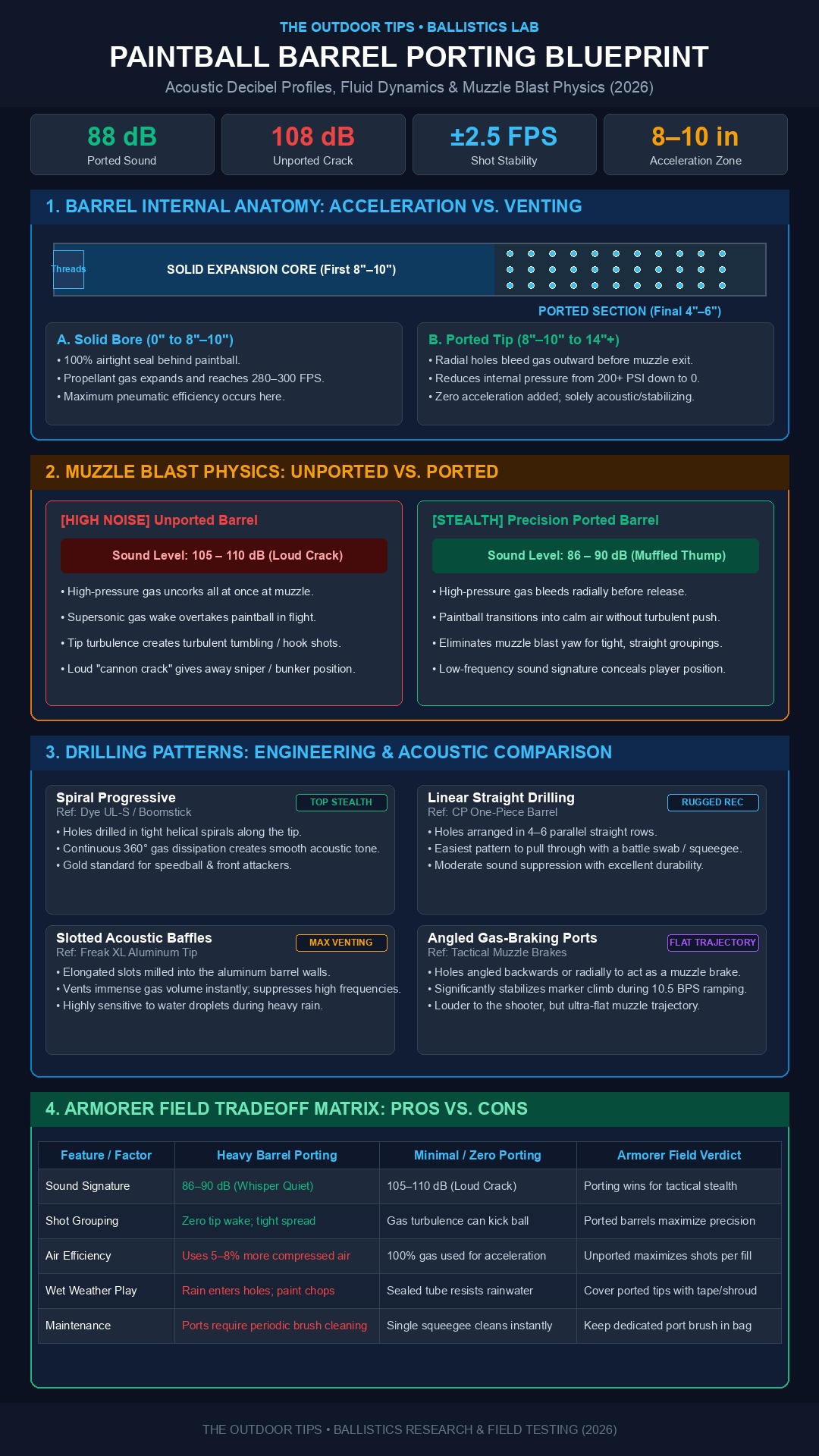
Figure 1.0: Full fluid dynamics schematic comparing unported vs. ported acoustic profiles, porting hole patterns, and armorer field tradeoffs.
6. Drilling Patterns: Spiral vs. Linear vs. Slotted Baffles
Not all barrel porting is engineered equally. Different manufacturers employ distinct hole geometries, hole diameters, and drilling angles to achieve specific ballistics and acoustic targets:
1. Spiral Progressive Porting (e.g., Dye UL-S, Planet Eclipse S63)
In spiral porting, micro-machined holes are arranged in continuous helical spirals wrapping 360 degrees around the outer barrel diameter. Because each successive hole engages the expanding air column at a slightly staggered millisecond interval, the acoustic energy is broken into a smooth, broad-spectrum whisper rather than a sharp pop. Armorers rate spiral porting as the quietest configuration available, making it the top choice for tournament speedball platforms like the Planet Eclipse CS3 Pro.
2. Linear Straight Drilled Porting (e.g., Custom Products One-Piece)
Linear porting features 4 to 8 parallel, straight rows of round holes running longitudinally down the barrel tip. While slightly louder than progressive spirals (averaging 94 to 98 dB), linear drilled barrels are exceptionally durable, cheaper to manufacture, and remarkably easy to swab clean on the field. If a paintball chops inside the barrel, pulling a standard folding squeegee down a linear ported tube pushes paint out cleanly without packing paste into complex spiral channels.
3. Slotted Acoustic Baffles (e.g., Freak XL All-American Tip)
Instead of small round holes, slotted porting uses elongated milled vents cut diagonally or longitudinally through the barrel wall. Slotted baffles evacuate massive volumes of pressurized gas virtually instantaneously. They excel at dampening the harsh, concussive “crack” of high-pressure mechanical blowback markers. However, slotted tips have thinner structural bridges and are more susceptible to bending if slammed against bunker turf.
4. Angled Gas-Braking Ports (Tactical Muzzle Brakes)
Found primarily on milsim and tactical woodsball barrels (such as Lapco and Hammerhead barrels), angled ports are drilled at a 45-degree reverse angle. As high-pressure air exhausts, the gas pushes forward against the rear walls of the holes, acting as an active muzzle brake. This dramatically dampens felt marker recoil during rapid firing strings. The tradeoff: angled ports direct sound backwards toward the shooter, making the marker noticeably louder to the player holding it.
Dye UL-S 14″ Spiral Ported Barrel Tip
86 dB Acoustic Profile • Helical Venting • Autococker Compatible
The pinnacle of sound dampening engineering. Pairs with Dye UL backs to deliver whisper-quiet sound signatures and laser-flat muzzle release for tournament speedball players.
Freak XL 14″ Aluminum Slotted Barrel Tip
88 dB Sound Rating • Linear Acoustic Slots • Freak XL Core Compatible
Features precision slotted acoustic baffles that rapidly vent immense gas volumes. The universal tournament standard for players running the 8.5-inch Freak XL insert system.
8. The Hidden Tradeoffs: Air Efficiency, Rain Ingress & Field Maintenance
While barrel porting provides unmatched acoustic stealth and flight stability, an objective armorer evaluation must address its mechanical drawbacks. Nothing in paintball physics comes without an engineering compromise:
1. The 5% to 8% Air Efficiency Tax
Because porting intentionally bleeds compressed air out of the barrel before the paintball exits the muzzle, none of that vented air can contribute to terminal velocity. In an unported barrel, 100% of the air pulse stays behind the ball until exit, allowing the regulator to run at slightly lower dwell or pressure settings. On a standard 68/4500 PSI carbon fiber HPA tank, shooting an aggressively ported barrel will yield roughly 75 to 100 fewer shots per tank fill compared to an unported pipe. For players running smaller 48/3000 aluminum tanks or CO2 tanks, this efficiency tax is a genuine factor to consider.
2. Rain Ingress and Water Droplet Paint Chops
The single greatest operational hazard for ported barrels is wet weather play. When playing woodsball in steady rain or diving into waterlogged grass, rain droplets enter the porting holes and cling to the internal bore walls. When a brittle paintball traveling at 300 FPS strikes a standing drop of water inside the barrel tip, hydrostatic shock causes the ball to rupture instantly inside the ported tip. Once one ball breaks inside the porting, paint fills the tiny holes, completely ruining accuracy until thoroughly cleaned.
🌧️ Armorer Pro-Tip for Wet Weather Play:
If forced to play in heavy rain, wrap a single layer of electrical tape or athletic grip tape around the top half of your barrel porting holes, leaving only the bottom row open. This prevents rain from dropping into the bore while still allowing water and gas to drain downward during shooting.
🔍 The Hidden Manufacturing Flaw: How Internal Port Burrs Shred Paintballs
One of the most insidious yet overlooked causes of barrel breaks on budget or cloned aftermarket barrels is the internal port burr defect. When barrel ports are CNC drilled into an aluminum tube from the outside without proper secondary internal honing, the drill bit pushes a microscopic lip of displaced metal—a razor-sharp aluminum burr—inward into the internal bore path.
When a fragile, high-grade tournament paintball traveling at 300 FPS (approx. 200 mph) grazes these microscopic teeth, the sharp metal burrs act like micro-razor blades, slicing open the 0.008-inch gelatin shell and causing an instantaneous catastrophic barrel break.
🧪 The Armorer’s Cotton Swab Test:
Take a standard dry cotton ball or cosmetic cotton pad, lightly expand the fibers, and gently pull it through the barrel tip from breech to muzzle using a pull-through cable. If the cotton glides effortlessly, your ports are clean. If the cotton snags, tears, or leaves wisps of white fiber clinging to the holes, your barrel has interior manufacturing burrs.
How to Eliminate Burrs: Minor burrs can be polished out by wrapping ultra-fine 1,000-grit silicon carbide automotive wet sandpaper or jewelers rouge around an expanding wooden dowel and rotating gently by hand. However, top-tier tournament barrels like the Dye UL-S and Freak XL prevent this defect at the factory by diamond micro-honing and electrochemical deburring the internal bore after the porting is drilled, guaranteeing an ultra-smooth 6-micron mirror finish that will never rupture brittle tournament shells.
3. Port Maintenance & Cleaning Discipline
Standard barrel swabs wipe the smooth internal bore, but they do not clear dried paint, shell fragments, and mud packed into the radial porting holes. Over time, clogged ports disrupt the symmetrical venting pattern, reintroducing muzzle turbulence. Professional armorers carry a dedicated soft-bristle nylon toothbrush or ultrasonic cleaner to soak and clear barrel tip ports between tournament weekends.
Exalt Barrel Maid / BattleRope All-Weather Swab
MSRP: $14.95 • In Stock & Verified • Dual-Action Rocket Disk & Buffer
Every ported barrel owner must carry an Exalt Barrel Maid in their harness pocket. When paint breaks in a ported barrel, traditional push squeegees force liquid paint outward into the radial port holes, permanently packing the vents. The Barrel Maid solves this through two distinct mechanical ends: a flexible Rocket Disk rubber squeegee that glides past paint on insertion and expands on retraction to scoop the bore spotless, followed by a fluff buffer that dries radial porting holes on the pull stroke without leaving lint.
9. Who It’s Built For vs. Who Should Skip It
✅ Who Needs Heavy Barrel Porting
- Tournament Speedball Players: In high-cadence 10.5 BPS airball points, acoustic stealth and tight muzzle control allow players to lane bunkers without telegraphing their position.
- Front Attackers & Snap-Shooters: Sneaking into the 50-yard snake or dorito wire requires a quiet marker that doesn’t draw immediate cross-field suppression.
- Players Using Brittle Tournament Paint: Minimizing muzzle blast tip wake prevents delicate paintballs from fracturing or fluttering off-axis.
- Shooters Sensitive to Recoil: Symmetrical radial venting counteracts muzzle jump, allowing rapid single-shot sight realignment.
❌ Who Can Skip Heavy Porting
- Casual Rental & Plinking Players: If you only play once or twice a year, the stock unported barrel on a rental Tippmann or Spyder is durable, cheap, and indestructible.
- Extreme Wet Weather Woodsballers: Playing in pouring rain or muddy swamps makes heavily ported tips a liability for water droplet barrel breaks.
- Small-Tank Players Seeking Max Shots: If you rely on a 48/3000 aluminum tank or small CO2 bottle, unported barrels squeeze out every last ounce of gas efficiency.
10. Head-to-Head Comparison: All 5 Barrel Porting Designs
For players considering lightweight composite materials, see our deep-dive on carbon fiber vs aluminum paintball barrels.
11. Frequently Asked Questions: What’s the Deal with Paintball Barrel Porting?
Does barrel porting decrease paintball velocity?
No, porting does not decrease terminal muzzle velocity when designed properly. A paintball reaches its maximum velocity (280–300 FPS) in the first 8 to 10 inches of unported solid barrel bore. Porting is located exclusively in the final 4 to 6 inches, where it vents residual gas that would otherwise be wasted upon exit.
Why do ported barrels sound quieter than unported barrels?
An unported barrel uncorks high-pressure gas abruptly at the muzzle, producing an explosive, high-frequency sound wave (108–112 dB). Ported barrels bleed the gas off gradually through dozens of radial vents over a longer duration, reducing the sudden shockwave into a low-frequency, muffled thump (86–90 dB).
What is the cotton swab test for barrel porting?
The cotton swab test is an armorer inspection method to detect razor-sharp internal burrs left from drilling ports. Pulling a dry cotton ball through the barrel will snag on microscopic burrs. If fibers catch, those same burrs will slice fragile .68 caliber paintballs at 300 FPS, causing barrel breaks that require diamond micro-honing or wet sanding to resolve.
How does barrel porting use psychoacoustics to hide player positions?
Unported barrels produce high-frequency sounds (>2,000 Hz) that human ears easily localize via interaural time and level differences. Multi-stage barrel porting shifts sound frequencies down to low frequencies (<500 Hz), whose long acoustic waves disperse omnidirectionally and diffract around bunkers, preventing opponents from pinpointing your exact firing location.
Does barrel porting make your paintball marker less air efficient?
Yes, slightly. Because ported barrels allow air to escape before the projectile clears the muzzle, markers require roughly 5% to 8% more compressed air or CO2 per shot to achieve the same 300 FPS velocity compared to a solid unported barrel. On a standard 68/4500 tank, this equals roughly 75 to 100 fewer shots per fill.
Can you play in the rain with a ported paintball barrel?
You can, but you must take precautions. Rain droplets can enter the porting holes and pool on the internal bore walls, causing high-speed paintballs to break upon contact. To prevent this, armorers tape over the top rows of ports with electrical tape or use a rain shroud to protect the vents while leaving bottom ports open to drain.
How do you clean paint out of barrel porting holes?
Standard battle swabs clean the bore but leave paint packed inside the holes. The best method is using an Exalt Barrel Maid with an expanding rocket disk, or removing the barrel tip, soaking it in warm water with mild dish soap, and gently scrubbing the ports with a soft-bristle nylon brush. Never use metal picks, which can scratch the internal precision finish.
Are spiral ported barrels better than straight drilled barrels?
Spiral progressive porting is superior for acoustic stealth and 360-degree radial gas dispersion, producing the quietest shot signature possible. Straight linear porting is slightly louder (by 4–6 dB) but is easier to squeegee on the field and more resistant to fouling during heavy rec-ball use.
Want to eliminate muzzle turbulence and ball wobble? Check out our complete protocol on How to Make Your Paintball Gun More Accurate.
Want to see acoustic porting in action on a tournament insert kit? Check out our certified decibel trials in the HK Army Barrel Kit Review to see how linear spiral porting reduces muzzle pop.