⚡ Quick Field Verdict: How Long Does a Paintball Game Last?
An individual recreational paintball game lasts between 5 and 15 minutes (averaging 7 to 10 minutes for standard elimination matches). However, match length is heavily dictated by game format: competitive tournament speedball points end in a blazing 2 to 3 minutes, tactical woodsball and Capture the Flag games run 15 to 30 minutes, and massive scenario big games can span 2 to 8 continuous hours. A full recreational paintball session at a commercial field typically lasts 3 to 5 hours, giving players 8 to 14 separate games interspersed with air refills, pod reloading, and tactical staging breaks.
- Standard Rec-Ball Elimination: 5–10 minutes per round; ~200 paintballs expended per player.
- Tournament Speedball (NXL): 2–3 minute rapid points inside a 15–20 minute regulation match clock.
- Woodsball & CTF Scenarios: 15–30 minutes per objective skirmish across large outdoor timber terrain.
- Full Field Day Outing: 3–5 total hours (combining 8–12 active matches with 10–15 minute staging intervals).
Empire Mega Lite 68/4500 Carbon Fiber HPA Tank
MSRP: $159.95 • In Stock & Verified • 1,200–1,400 Shot Match Capacity
The primary mechanical reason players get eliminated or forced off the field during extended matches is running out of air pressure. While entry-level 48/3000 aluminum tanks run dry after just 450 to 500 shots, the ultralight Empire Mega Lite 68/4500 stores 4,500 PSI of high-pressure air, delivering 1,200+ consistent shots per fill. This ensures you comfortably outlast full multi-game rotations and 30-minute woodsball battles without sprinting to the refill compressor between points.
1. The Short Answer: How Long Does a Single Paintball Match Last?
When newcomers ask how long does a paintball game last?, they are usually surprised to learn that an individual round is remarkably short. At most commercial open-play facilities across North America and Europe, a single game of recreational paintball lasts between 5 and 15 minutes, with 7 to 10 minutes representing the true median duration.
Unlike video games or tactical airsoft battles that can stretch into multi-hour stalemates, paintball is governed by high-velocity projectile ballistics, intense kinetic suppression, and strict physical limitations:
- Single-Hit Elimination Rules: A paintball travels at 280 to 300 FPS (roughly 200 mph). A single nickel-sized paint break anywhere on a player’s body, mask, or marker results in immediate elimination. In a standard 10v10 rec-ball skirmish, players begin dropping within the first 60 seconds as crossfire lanes develop.
- Ammunition & Hopper Limitations: A standard gravity or electronic loader holds 180 to 200 rounds. In the heat of an adrenaline-fueled firefight, a player pulling the trigger 4 to 8 times per second can empty an entire hopper in under 45 seconds of sustained firing. Once ammunition runs low, aggressive tactical pushes accelerate game resolution.
- Pneumatic Gas Depletion: High-pressure air (HPA) and CO2 tanks have finite shot counts. If a player shoots aggressively on a smaller cylinder, pressure dropoff forces tactical retreats. For details on tank stamina, see our comprehensive guide on what is the best CO2 tank size for your paintball marker and our thermodynamic analysis of CO2 vs HPA for paintball.
- Referee Time Caps: To maintain strict field schedules and prevent passive “camping” in bunkers, commercial referees enforce strict 10-to-15-minute game clocks. If opposing players remain bunkered down when the horn sounds, the match is declared a stalemate.
⚠️ The Rookie Mistake: How to Avoid Getting Eliminated in the First 60 Seconds
The single most frustrating experience for first-time paintball players is the First 60-Second Trap. Because paintball is single-elimination, sprinting blindly into open terrain off the break horn frequently results in taking a 280 FPS hit across the chest or mask within 45 seconds. The player is forced to raise their marker, walk off the field, and sit in the staging area for 10 minutes while their friends continue the game.
🛡️ The Armorer’s “3-Bunker Rule” for Survival:
When the break horn sounds, sprint directly to your team’s closest primary home bunker—never advance beyond the first 1/3 of the field. Stay locked behind solid cover for the first 60 seconds. Listen to opposing marker fire, observe where the primary crossfire lanes intersect, and let over-aggressive opposing players eliminate themselves. Once the field thins out and crossfire angles are identified, use cover-to-cover bounding to advance safely into attacking lanes.
Following this simple discipline instantly extends your active playtime, ensuring you stay in the match for the full 10 minutes rather than watching from the sidelines.
2. Duration Breakdown by Game Format: From 2-Minute Sprints to 24-Hour Wars
The single greatest variable determining how long does a paintball game last? is the specific game format being played. The paintball spectrum stretches from lightning-fast tournament speedball to multi-day military simulation scenario battles. To understand which marker drivetrain fits each format, explore our deep-dive on speedball vs woodsball paintball guns and our complete taxonomy of paintball game types.
1. Tournament Speedball (NXL / PSP): 2 to 3 Minutes per Point
Played on a manicured turf grid measuring exactly 120 by 150 feet filled with symmetrical inflatable Sup’Air bunkers, tournament speedball represents the ultimate adrenaline sprint. Two 5-player teams break from the back gate at the sound of the horn, firing ramped electronic markers capped at 10.5 balls per second (BPS). Because sightlines are immediate and players slide into primary snake and dorito bunkers within 3 seconds, points are decided in 90 to 180 seconds. A full NXL regulation match operates on a 15-minute countdown clock using a “Race-to-5” or “Race-to-7” point structure, lasting roughly 30 to 45 minutes of total real-world time.
2. Recreational Woodsball Elimination: 5 to 12 Minutes
Recreational woodsball is the most common format encountered by birthday parties, rental players, and weekend walk-ons. Set in natural timber or themed obstacle courses, two teams start at opposite boundary flags and eliminate opponents until one side remains. The dense brush and natural tree cover slow player movement compared to speedball, resulting in an average duration of 7 to 10 minutes before one team achieves numerical supremacy.
3. Capture The Flag (CTF) & Objective Formats: 15 to 30 Minutes
Introducing an objective dramatically changes tactical pacing. In two-flag CTF or Center-Flag Push, players cannot simply hide behind barricades—they must coordinate offensive flanking maneuvers while maintaining a defensive base perimeter. Because players must physically retrieve the opposing flag and carry it back across enemy firing lanes, matches typically run 15 to 25 minutes. Referees typically enforce a hard 20-minute time cap to keep tournament brackets moving.
4. Tactical MagFed Paintball: 20 to 40 Minutes
MagFed replaces top-mounted 200-round hoppers with authentic spring-fed magazines holding 18 to 20 rounds each. Because players carry a finite ammunition loadout (often 100 to 140 rounds total in tactical vests), the spray-and-pray dynamic disappears completely. MagFed players utilize real-world tactical movement, bounding overwatch, and selective semi-automatic fire. Firefights consist of intense, surgical bursts separated by long reconnaissance maneuvers, stretching game durations to 20 to 40 minutes.
5. 24-Hour Scenario Big Games (Oklahoma D-Day, Supergame, Skirmish ION)
At the absolute extreme of the sport are annual scenario mega-events drawing 1,000 to 4,000 players to battle across hundreds of acres. Featuring tanks, rocket launchers, and role-playing command trees, these games operate on continuous 2 to 8 hour mission cycles or unbroken 24-hour schedules. Rather than single-elimination, big games utilize designated respawn insertion points every 15 to 30 minutes, allowing eliminated players to reload, clean goggles, and return immediately to the frontline.
Watch: What to Expect During Your First Paintball Field Experience
Veteran armorer breakdown of field safety, game timing, staging pacing, and tactical survival on commercial paintball fields.
3. How Long Does a Full Day of Paintball Last? (The 3-to-5 Hour Experience)
When planning a weekend trip to a commercial paintball park, you are not paying for a single 10-minute game. Rental packages and walk-on field passes grant access for a multi-hour session. A standard open-play paintball session lasts between 3 and 5 hours, during which your group will play between 8 and 14 individual matches across various themed fields.
Understanding the flow of a paintball day helps players pace their energy, hydration, and paint consumption. Here is a real-world chronograph of a typical commercial field session:
⏱️ The 40/60 Active Time Reality
During a 4-hour visit, you will spend roughly 1.5 hours in active combat and 2.5 hours in staging, refilling, and strategizing. Paintball is an intense anaerobic sport requiring explosive sprinting, squatting behind low bunkers, and constant core stabilization. The 10-to-15-minute inter-game rest intervals are essential for preventing heat exhaustion and muscle cramping.
4. Paintball & Air Consumption: What Really Cuts Games Short?
In ballistics engineering, game length is directly governed by consumable capacity. A player cannot remain in a firefight once their propellant gas reaches zero gauge pressure or their hopper runs dry. Let’s examine the mathematical reality of paint and air consumption across common game formats:
🎯 How Long Does a 500-Round Bag of Paintballs Last on the Field?
One of the most frequently asked questions by beginner walk-on players is: “Will a single 500-count bag of paintballs last me the entire day?” The answer depends entirely on your marker mechanics and trigger discipline:
- Mechanical Rental Player: Standard rental markers (such as the Tippmann 98 or Cronus) fire in mechanical semi-automatic. A disciplined player fires roughly 150 to 200 shots per 10-minute game. Therefore, a 500-round bag will last exactly 2 to 3 games (roughly 1 to 1.5 hours of field time).
- Electronic Tournament Player (Ramping): On an electronic speedball marker firing 10.5 BPS, an aggressive player shoots an entire 200-round hopper plus two 150-round pods in a single point! 500 paintballs can be incinerated in 180 seconds flat.
- Field Session Budget Rule: For a standard 4-hour open-play session (8 to 12 games), an individual player requires a minimum of 1,000 to 1,500 paintballs (half a case to 3/4 case). Purchasing a full 2,000-round case ($55–$65) and splitting it between two players is the most cost-effective armorer strategy.
1. Air Tank Stamina: The Cubic-Inch Formula
How long your compressed air tank lasts depends on cylinder volume, fill pressure, and marker engine operating pressure. The industry standard rule of thumb for modern spool and poppet valve markers is:
• 3,000 PSI Aluminum Tanks: Volume (CI) × 10 = Approximate Total Shots (e.g., 48ci × 10 = ~480 shots)
• 4,500 PSI Carbon Fiber Tanks: Volume (CI) × 15–18 = Approximate Total Shots (e.g., 68ci × 18 = ~1,220 shots)
Because an entry-level 48/3000 aluminum tank yields only 450 to 500 shots, an aggressive player will exhaust their gas supply in a single 15-minute game. Upgrading to a 68ci/4500 PSI carbon tank provides the pneumatic stamina required to play 3 to 4 consecutive rounds without leaving the field for fills. For more on ballistics range limits that affect engagement length, read our guide on what paintball barrel shoots further.
🔋 Battery Life & Electronic Runtime Telemetry
Electronic markers and force-feed loaders rely on internal DC battery power. When voltage drops below threshold, solenoids fail to cycle and eyes register false paint chops:
- Electronic Marker (9V Alkaline): A fresh industrial 9V battery delivers 15,000 to 20,000 firing cycles (roughly 8 to 10 cases of paint). However, cold weather below 50°F (10°C) accelerates internal impedance, reducing runtime by 30% to 40%.
- Motorized Hopper (3x AA or 2x 9V): Loaders like the Virtue Spire IR2 and Dye Rotor LTR process 20,000+ balls on a single set of AA batteries.
- Armorer Rule: Always keep a 4-pack of fresh brand-name industrial alkaline batteries (e.g., Duracell Procell) in your gear bag. Never use cheap heavy-duty or rechargeable 9V batteries, which suffer from rapid voltage drop under high-cadence solenoid cycling.
Technical Blueprint: Paintball Game Durations & Resource Consumption
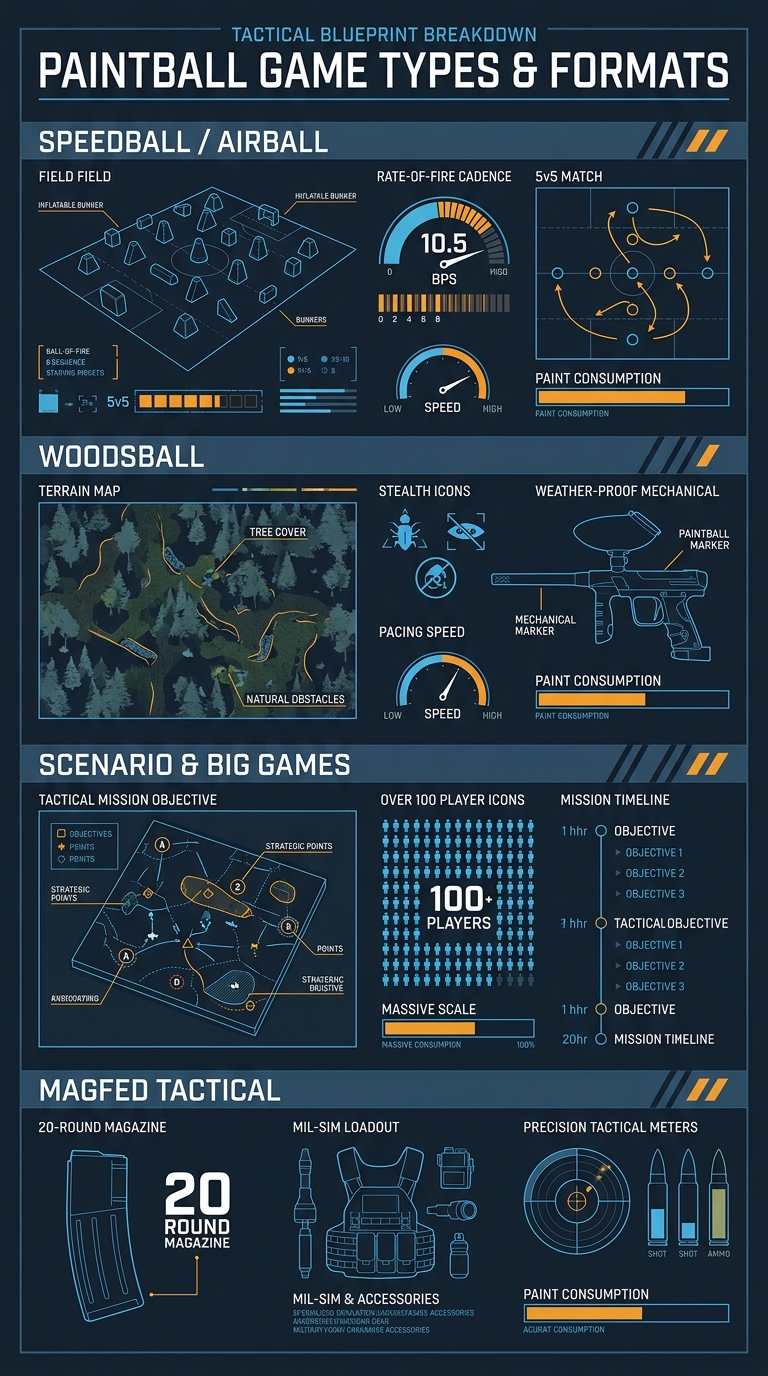
Figure 1.0: Ballistics timeline matrix comparing individual game formats, player pacing speedometers, air exhaustion curves, and full-day session schedules.
Bunkerkings ESC 4+7 Paintball Pod Pack
Carries 500–900 Extra Rounds • Strapless Fast Ejection • Lumbar Support
Running out of paintballs mid-match leaves you completely defenseless. The Bunkerkings ESC harness holds 4 primary and 7 expansion pods, ensuring you stay armed throughout intense 25-minute Capture the Flag battles.
Virtue Spire IR2 Electronic Paintball Loader
Intelligent 3-Eye Infrared Sensors • Jam-Proof Drivetrain • Toolless Shell
Cheap gravity hoppers jam during aggressive sprints, halting your game. The Virtue Spire IR2 feeds 200 paintballs seamlessly at up to 18 BPS, giving you unbroken firepower during rapid 2-minute tournament points.
Valken Graffiti .68 Caliber Tournament Paintballs (2,000-Round Case)
MSRP: $59.95 • In Stock & Verified • 4 Sealed 500-Round Bags
To power through an entire 4-hour open-play day (8 to 12 games), bringing a full 2,000-round case is the single most economical decision a player can make. Valken Graffiti is the gold standard for all-weather recreational and scenario play: engineered with a consistent, brittle gelatin shell that breaks reliably on targets at 40 yards without rupturing inside your barrel or hopper.
7. Key Factors That Alter Game Duration on the Field
Even within the same game format, match lengths can fluctuate significantly based on environmental, tactical, and organizational dynamics:
1. Field Dimensions and Obstacle Density
A compact 100×100 foot CQB (Close Quarters Battle) arena forces immediate engagements within 5 seconds of the break horn, causing games to resolve in under 4 minutes. Conversely, a 5-acre rolling hillside course with thick foliage and ravines allows players to maneuver undetected for 10 minutes before the first paintballs are even exchanged.
2. Team Size & Player Headcount
Player density dictates tactical pace. In a 3v3 skirmish, losing a single player represents a crippling 33% loss of team firepower, leading to rapid mop-up finishes in under 5 minutes. In a massive 30v30 woodsball clash, defensive crossfire traps and wide perimeters create protracted multi-stage stalemates that last 20 to 30 minutes. To determine optimal roster sizes, consult our guide on how many players do you need for paintball.
3. Skill Disparity & Aggression Level
Novice and rental players tend to play conservatively, staying hunkered down behind their initial spawn bunkers and waiting for opponents to expose themselves. These matches frequently run the full 15-minute clock. Experienced tournament players, by contrast, practice aggressive snap-shooting and rapid lane suppression, collapsing on opposing flanks and eliminating entire teams in under 3 minutes.
4. Weather & Temperature Extremes
In mid-summer heat above 90°F (32°C), physical exhaustion and goggle lens sweating accelerate player fatigue, prompting referees to shorten game clocks to 7 minutes to protect player safety. In cold winter conditions below 45°F (7°C), CO2 expansion issues and brittle gelatin shells can cause marker malfunctions that alter game pacing.
8. Who It’s Built For: Matching Game Formats to Your Time & Budget
⚡ Choose Short-Format Paintball (Speedball / Rec-Ball) If:
- You Want Maximum Adrenaline: 2-to-5-minute rounds deliver intense heart-pounding action without dead downtime.
- You Have a Half-Day Window: A 3-hour session lets you play 10+ games and head home before afternoon fatigue sets in.
- You Love Athletic Movement: Sliding into turf bunkers, snap-shooting, and rapid communication appeal to competitive athletes.
- You’re Hosting a Birthday or Bachelor Party: Short rounds keep eliminated guests from waiting long in staging before playing again.
🌲 Choose Long-Format Paintball (Woodsball / Scenario) If:
- You Prefer Tactical Strategy: 20-to-40-minute missions reward patient reconnaissance, squad flanking, and objective coordination.
- You Want Full-Day Immersion: 5-to-8-hour scenario events simulate military skirmishes across vast wooded landscapes.
- You’re on an Ammunition Budget: Slower pacing means you expend 500 to 1,000 paintballs across an entire day, keeping costs low.
- You Enjoy Rolling Respawns: Scenario big games allow you to re-enter combat immediately rather than sitting out upon elimination.
9. Master Breakdown: Paintball Game Lengths & Equipment Matrix
10. Frequently Asked Questions: How Long Does a Paintball Game Last?
How long does a standard game of paintball last?
An individual recreational elimination game lasts between 5 and 15 minutes, with the average match concluding around the 7-to-10-minute mark. Because a single paint hit eliminates a player, games resolve quickly once defensive bunker positions are compromised.
How long does a 500-round bag of paintballs last?
For a recreational walk-on player using a mechanical semi-automatic rental marker, a 500-round bag lasts exactly 2 to 3 games (roughly 1 to 1.5 hours of field play). For electronic speedball markers firing 10.5 BPS ramping, 500 balls can be completely shot in a single 3-minute point.
How can beginners avoid getting eliminated in the first 60 seconds?
Follow the “3-Bunker Rule”: off the break horn, sprint to your team’s closest home bunker and stay behind solid cover for the first 60 seconds. Observe opposing crossfire lanes and wait for aggressive opponents to expose themselves before advancing cover-to-cover.
How long do electronic paintball marker and hopper batteries last?
A fresh industrial 9V alkaline battery in an electronic marker lasts roughly 15,000 to 20,000 shots (8 to 10 cases of paint). Motorized loaders (like the Spire IR2 with 3x AA batteries) deliver 20,000+ balls. Always carry spare Duracell Procell batteries in your gear bag to prevent mid-game brownouts.
How long do you stay at a paintball field for an open play session?
A typical open-play visit to a commercial paintball field lasts between 3 and 5 hours. This session includes a 30-minute safety orientation and equipment fitting, followed by 8 to 14 separate games with 10-to-15-minute staging intervals between rounds to refill air and reload pods.
How many paintballs do you shoot in a 10-minute game?
A recreational player shooting a semi-automatic rental marker expends roughly 150 to 250 paintballs in a 10-minute round (approximately one standard hopper). In competitive speedball with electronic ramping, a player can shoot 500 to 1,000+ paintballs across a single 3-minute point.
Why do professional speedball points end in under 3 minutes?
Speedball is played on a compact 120×150 foot field with zero visual blind spots. High-rate-of-fire electronic markers firing 10.5 BPS suppress primary lanes instantly. When an attacker is eliminated off the break, numerical superiority enables the opposing team to rapidly flank and clear remaining bunkers in under 180 seconds.
How long does a 48ci/3000 PSI or 68ci/4500 PSI air tank last?
A standard 48ci 3,000 PSI aluminum tank provides approximately 450 to 500 shots, which is enough for 1 to 2 recreational games before requiring a refill. A high-capacity 68ci 4,500 PSI carbon fiber tank yields 1,200 to 1,400 shots, enabling players to participate in 4 to 6 consecutive games without refilling.
Can you respawn during a paintball game to make it last longer?
In standard elimination games, there are no respawns—once tagged, you must exit to staging. However, fields frequently host objective modes like “Attack and Defend,” “Medic,” and large-scale 24-hour scenario events where eliminated players touch their home base or wait at designated respawn zones every 15 minutes to re-enter battle.
How much downtime is there between paintball rounds?
Commercial fields typically provide 10 to 15 minutes of downtime between games. This break gives players necessary time to walk back to the staging area, clean their goggle lenses, refill high-pressure air tanks at the compressor stations, reload pods with paintballs, and hydrate.
What happens if the game clock runs out before all players are eliminated?
If the referee’s timer expires (typically set at 10 to 15 minutes) and opposing players remain alive in bunkers, the match is officially ruled a draw or stalemate. In tournament play, team points are calculated based on remaining surviving players and objective flag touches.