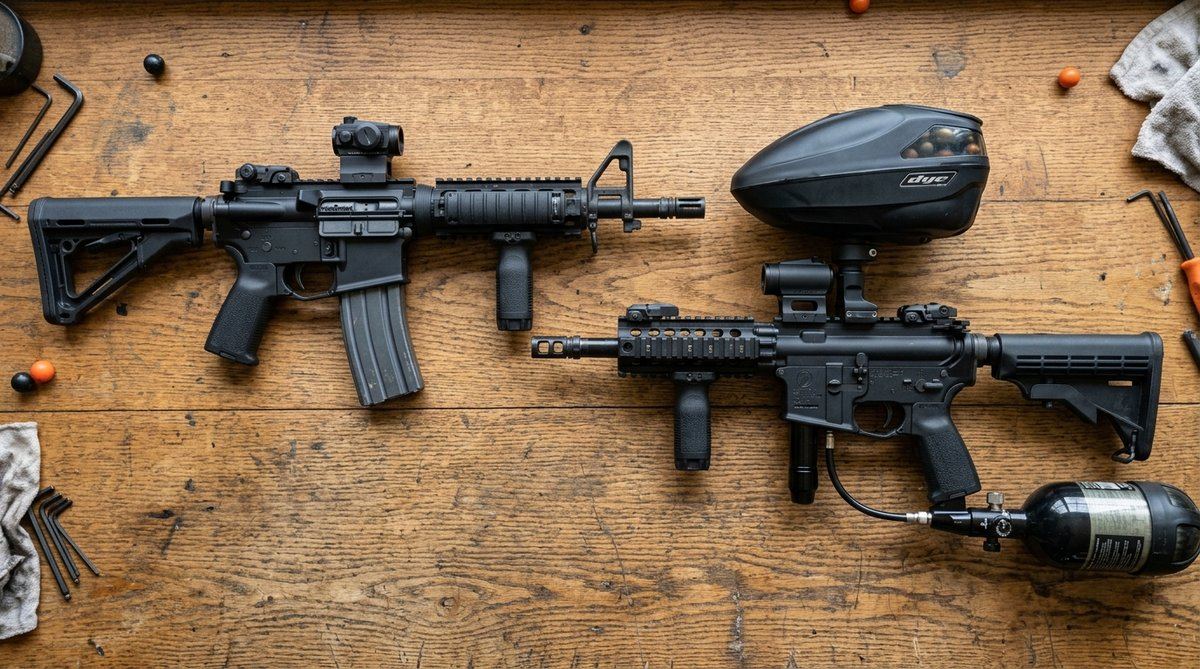
Quick take: the Tippmann X7 and X7 Phenom may share an aggressive milsim shell and the pneumatic Cyclone Feed System, but internally they are completely different marker platforms. The original classic X7 is a traditional high-pressure inline blowback marker (~800 PSI) with an external steel braided gasline and noticeable recoil. The X7 Phenom is a low-pressure spool-valve marker powered by Tippmann’s proprietary FlexValve system (~300 PSI), featuring internal air routing, virtually zero recoil, nearly double the air efficiency, and an electronic firing system with true mechanical failover. For serious scenario and woodsball players, the Phenom is a monumental leap in performance.
Quick Comparison
| Feature | Classic Tippmann X7 | Tippmann X7 Phenom |
|---|---|---|
| Operating System | Inline blowback (mechanical hammer & sear) | Low-pressure spool valve (FlexValve technology) |
| Operating Pressure | ~800 PSI (High Pressure) | ~300 PSI (Low Pressure) |
| Air Line Design | External steel braided hose with tombstone | Internal gasline routed through grip frame |
| Air Efficiency (68/4500 Tank) | ~700–800 shots per fill | ~1,400+ shots per fill |
| Recoil & Shot Signature | Noticeable forward hammer kick; louder pop | Smooth, gentle puff; virtually zero muzzle rise |
| Electronic & Mechanical Modes | Mechanical semi-auto (E-Grip sold separately) | Select-fire electronic with instant mechanical failover |
| Paint Handling | Stiffer on brittle tournament paint | Very gentle on fragile, high-grade paintballs |
| Feed System | Cyclone Feed System (pneumatic, up to 15 BPS) | Cyclone Feed System (pneumatic, up to 15–20 BPS) |
| Routine Maintenance | Paintball oil in ASA / hammer lubrication | Dow 33 synthetic grease on spool valve O-rings |
The Core Mechanical Leap: Inline Blowback vs. FlexValve Spool
To understand why these two markers feel so radically different on the field, you have to look inside the receiver. The original classic Tippmann X7 was engineered as the tactical evolution of the legendary Tippmann A-5 (see our full Tippmann A-5 vs. Tippmann X7 comparison) and 98 Custom. It relies on a heavy rear bolt (hammer), a sear catch, a main drive spring, and an inline poppet valve. When you pull the trigger, the heavy hammer drives forward under full tank pressure (~800 PSI) to strike the valve pin, release gas to propel the paintball, and blow the hammer back to re-cock the sear. While practically indestructible, that reciprocating metal mass creates heavy mechanical vibration and requires substantial air volume per cycle.
The X7 Phenom completely replaced that blowback mechanism with Tippmann’s patented FlexValve spool-valve engine. Developed in collaboration with legendary paintball engineers, the FlexValve operates at an ultra-low 300 PSI. Instead of slamming a heavy hammer into a valve pin, the Phenom uses pneumatic pressure differentials to cycle a lightweight internal spool. The result is a marker with fewer moving parts, vastly smoother operation, reduced wear and tear on internal components, and the ability to shoot brittle tournament paint without chopping in the breech.
Air Efficiency & Shot Count Reality
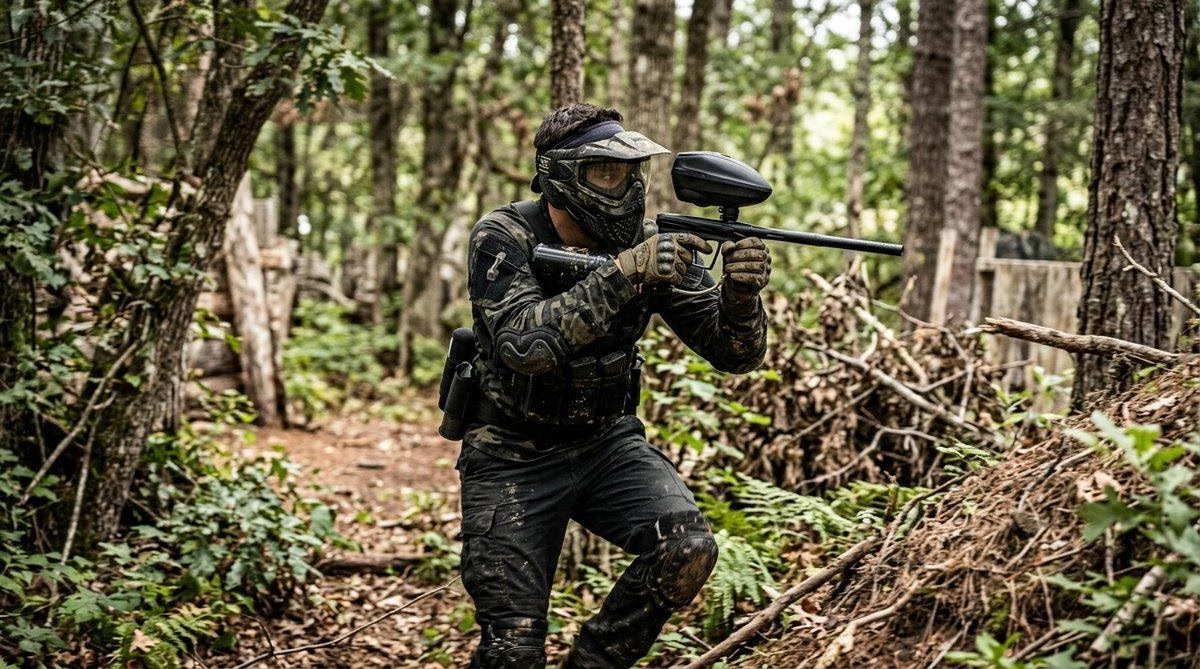
Air efficiency is where the FlexValve delivers its biggest real-world advantage. Because the classic X7 operates at full tank pressure with an open-bolt blowback cycle, a significant volume of gas is vented out the rear to re-cock the heavy hammer. On a standard 68ci 4500 PSI HPA tank, a classic X7 typically delivers between 700 and 800 shots before dropping below operating pressure.
The X7 Phenom’s low-pressure spool valve uses air with surgical precision. It only vents the exact volume needed to propel the ball to 280–300 FPS and advance the Cyclone ratchet. In field testing, an X7 Phenom on the same 68ci 4500 PSI tank consistently delivers 1,400 shots or more — nearly doubling your effective shot count per fill. During 24-hour scenario games or deep woodsball patrols where air refill stations are far behind the front line, that efficiency gap is massive.
Upgrade Your Tactical Setup
As an Amazon Associate, we earn from qualifying purchases at no extra cost to you.
Recoil, Shot Smoothness, and Optics Stability
If you run tactical optics — such as red dot sights, reflex scopes, or mock magnifiers — the difference in muzzle stability between these two markers is immediately apparent:
- Classic X7: The forward slam of the heavy hammer produces noticeable kick and muzzle jump. While it provides satisfying mechanical feedback, it can knock your sight picture off target during rapid strings of fire and loosen delicate rail accessories over time.
- X7 Phenom: The forward-venting spool valve generates virtually no reciprocating mass recoil. The marker produces a soft, muted “puff” rather than a loud mechanical clatter, keeping your crosshairs steady on target for fast follow-up shots.
Ergonomics: External Steel Hose vs. Internal Gas Routing
Ergonomically, the Phenom solved one of the biggest complaints players had about the original X7: the external gasline. The classic X7 uses a rigid, stainless-steel braided hose extending from the bottom ASA adapter up into the right-side tombstone connection on the receiver. While rugged, that steel hose can snag on tree branches, rub uncomfortably against your wrist when wrapping around bunkers, and make left-to-right hand transitions awkward.
The X7 Phenom eliminated the external hose entirely by integrating an internal gasline directly through the magnesium grip frame into the inline regulator. This creates a clean, streamlined profile identical to high-end tournament speedball markers, dramatically improving handling in dense brush.
Electronic Firing with Instant Mechanical Failover
The electronic version of the X7 Phenom features one of the most brilliant electronic trigger boards ever put into a tactical marker. The magnetic selector switch offers five firing modes:
- Safe
- Semi-Automatic (Electronic)
- Auto-Response
- 3-Shot Burst
- Full Automatic (up to 15 BPS)
The Killer Feature — Mechanical Failover: If your 9-volt battery dies in the middle of a heated firefight, you do not need to call a timeout or fumble for a screwdriver behind a bunker. Simply flip the selector switch to semi-automatic, and the Phenom’s FlexValve seamlessly transitions to 100% mechanical operation without missing a beat. The classic X7 with an aftermarket E-Grip cannot do this — if the battery dies on an electronic classic X7, the marker goes completely dead until the battery is replaced.
Cyclone Feed System & Body Kit Compatibility
Both markers come equipped with Tippmann’s air-powered Cyclone Feed System, which utilizes excess exhaust gas to spin a paddle wheel and index paintballs into the breech at up to 15–20 balls per second without requiring batteries. However, modular compatibility between the two models has a few specific rules:
- Fully Interchangeable: Barrels (both use standard A-5 / X7 Autococker-threaded or Tippmann A-5 threaded adapters), barrel kits (see our HK Army LAZR review), tactical stocks (M16, collapsible, folding), mock magazines, and Picatinny rail accessories.
- Not Interchangeable: Internal bolt assemblies, valves, power tubes, trigger frames, and certain body shrouds designed specifically around the classic X7’s tombstone port.
Enhance Your Cyclone Feed
As an Amazon Associate, we earn from qualifying purchases at no extra cost to you.
Maintenance & Care Differences
Because their internal valve designs are totally different, maintaining these two markers requires different protocols:
- Classic X7 Maintenance: Standard inline blowback maintenance is simple. Adding 3–4 drops of synthetic paintball oil into the ASA before gassing up lubricates the hammer and front bolt O-rings. Field stripping requires pulling the rear pushpins to clean the hammer and drive spring.
- X7 Phenom Maintenance: The Phenom uses a delicate spool assembly with multiple dynamic O-rings. Do not flood the Phenom ASA with liquid oil. Instead, unscrew the rear cap, pull out the FlexValve spool assembly, wipe it clean, and apply a light coat of Dow 33 synthetic grease to the O-rings before reinstalling.
Mistakes to Avoid
- Assuming the classic X7 has FlexValve technology. Older listings and misinformed forum posts frequently mix these up. Only the Phenom features the low-pressure FlexValve spool engine.
- Using heavy liquid oil in the Phenom spool valve. Liquid oil can cause bolt stick (FSDO — first shot drop-off) in spool valves. Always use high-grade Dow 33 or silicone grease on Phenom internals.
- Running unregulated CO2 in freezing temperatures. While both can shoot CO2, the Phenom performs vastly better on compressed air (HPA), which prevents liquid CO2 from freezing the spool O-rings.
- Buying classic X7 internal upgrade kits for a Phenom. Response triggers, power tubes, and hammers built for the classic 98/A-5/X7 blowback drivetrain will not fit inside a Phenom receiver.
Frequently Asked Questions
Is the Tippmann X7 Phenom better than the classic X7?
Yes, significantly. The X7 Phenom operates at 300 PSI (versus 800 PSI), delivers nearly double the air efficiency (~1,400 shots per 68/4500 tank), eliminates the external steel hose, shoots much smoother with virtually no recoil, and includes electronic select-fire with a mechanical failover mode.
Can the Tippmann X7 Phenom fire without a battery?
Yes. Even on the electronic Phenom model, the marker features mechanical semi-automatic failover. If the 9V battery dies during a game, the marker continues to fire mechanically on semi-auto without interruption.
What barrel threads do the Tippmann X7 and X7 Phenom use?
Both the classic X7 and the X7 Phenom use standard Tippmann A-5 barrel threads, allowing you to share high-performance barrel kits and mock suppressors across both platforms.
Can the Tippmann X7 Phenom run on CO2?
Yes, the Phenom is designed to operate on both CO2 and compressed air (HPA). However, because it is a precision spool-valve marker, running High-Pressure Air (HPA) delivers superior consistency, avoids liquid freeze-ups in cold weather, and protects the internal spool seals.
Are body kits and stocks interchangeable between the X7 and X7 Phenom?
Most external stocks, mock magazines, top rails, and barrels are fully cross-compatible. However, some front shrouds designed around the classic X7’s external tombstone connection may require minor modification to fit the Phenom’s streamlined receiver.
Verdict
The classic Tippmann X7 remains a rugged, dependable piece of paintball history for players who love the raw, mechanical simplicity of blowback markers and want an ultra-cheap platform to build custom milsim replicas. But for anyone prioritizing on-field performance, air efficiency, shot-to-shot consistency, and modern ergonomics, the Tippmann X7 Phenom is the clear, definitive winner. Its low-pressure FlexValve spool engine, internal air routing, and electronic select-fire with mechanical backup make it one of the finest tactical scenario markers ever manufactured.
Related reading: Tippmann A-5 Lineup Guide · Tippmann A-5 Upgrades Guide · CO2 vs. Compressed Air (HPA) · 3000 PSI vs. 4500 PSI Paintball Tanks · Best .68 Caliber Paintball Guns
Affiliate Disclosure: theoutdoortips.com is a participant in the Amazon Services LLC Associates Program. As an Amazon Associate we earn from qualifying purchases at no extra cost to you.