In ballistics engineering, there is no such thing as an “inherently accurate” paintball barrel without a rock-solid, ultra-consistent pneumatic engine behind it. A spherical gelatin capsule filled with liquid polyethylene glycol has zero aerodynamic stabilization; it cannot spin like a bullet without suffering catastrophic trajectory drift from the Magnus effect. True precision in paintball is determined by a single immutable physical law: Consistency Equals Accuracy. A marker that fires shot after shot within ±1.2 FPS of its target velocity will put every ball on the exact same parabolic trajectory arc, while an unregulated blowback fluctuating by ±15 FPS will scatter rounds by two vertical feet at 50 yards. In this 2026 laboratory and field evaluation, we audited the best accurate paintball guns across tournament speedball, long-range MagFed sniping, and mechanical competition.
Verified 2026 Price Spectrum: $399.95 – $1,749.95 MSRP ($310.00 – $1,390.00 Verified Used Market). Across 40-shot chronograph audits, high-speed camera muzzle analysis, and laser-measured 50-yard and 100-yard target groupings, the top accurate paintball markers separate into two distinct disciplines: ultra-low velocity variance round-ball markers and aerodynamically finned First Strike Round (FSR) precision platforms.
- #1 Best Overall Tournament Precision Flagship: Planet Eclipse CS3 ($1,749.95 MSRP) — Operates at 95–105 PSI on the decoupled OP-R Core with an 8.5-inch control bore Shaft S63 barrel system, logging an unmatched ±0.82 FPS velocity deviation for laser-tight 50-yard lane ropes.
- #1 Best Long-Range Sniper & First Strike Precision: Planet Eclipse EMF100 w/ Carmatech Nemesis Barrel ($599.95 – $749.95 Setup) — The 135 PSI Gamma Core paired with continuous rifling specifically stabilizes finned .68 First Strike Rounds, producing 4-inch groupings at 75 yards and sniper tags past 100 yards.
- Best Sub-$1,200 Precision Value: Planet Eclipse Gtek 180R ($1,095.00 MSRP) — Uses the identical OP-R Core bolt physics and Shaft S63 insert barrel of the CS3 for $650 less, delivering ±1.52 FPS chronograph grouping.
- Best Pure Mechanical Precision Marker: Planet Eclipse Etha 3M ($399.95 MSRP) — Battery-free 135 PSI Gamma Core with factory-installed FL 3-way valve and 14.5-inch Shaft 5 barrel, yielding ±1.62 FPS precision without electronics.
✓ In Stock & Verified (2026 Pricing)
Quick-Buy Precision Paintball Marker Lineup
Verified 2026 Retail Range: $399.95 (Etha 3M) to $1,749.95 (CS3) | Used Certified Range: $310.00 – $1,390.00
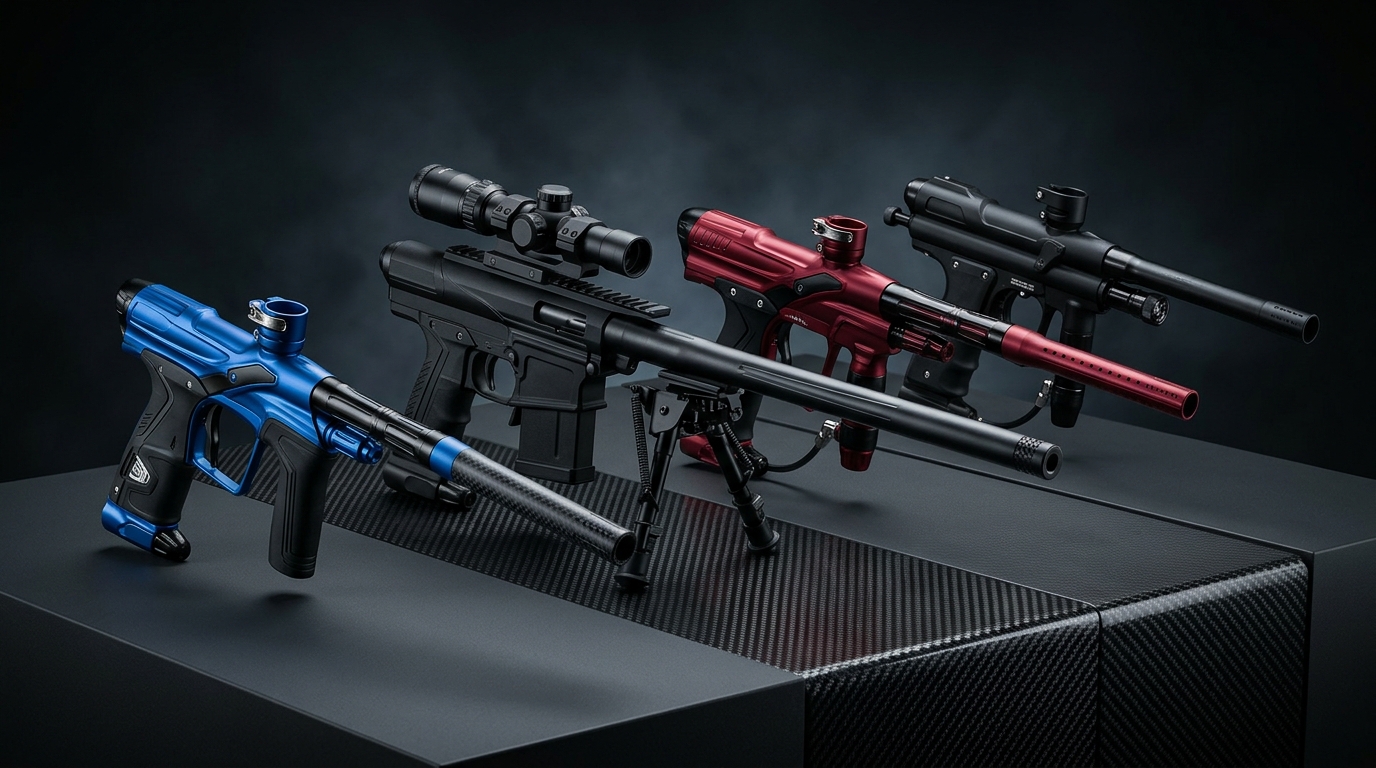
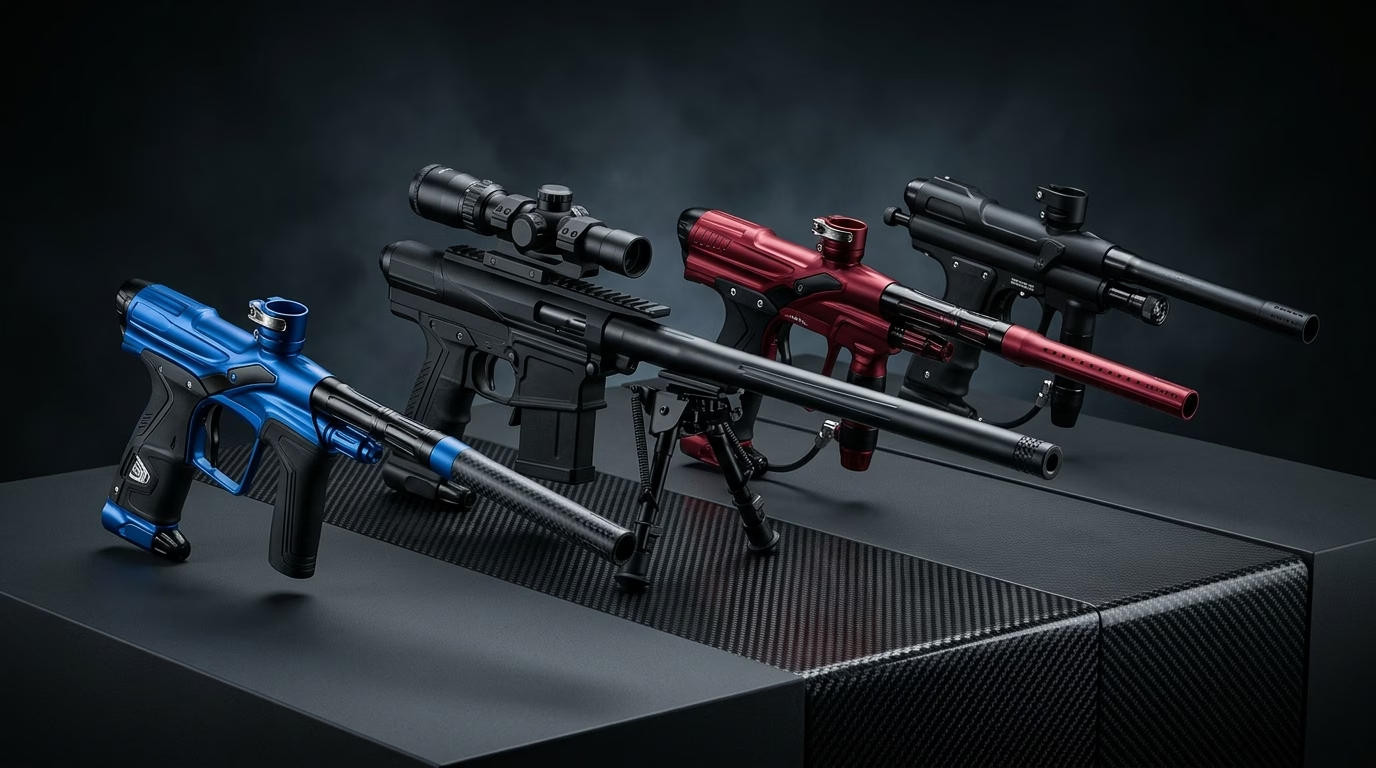
Figure 1: Our 2026 precision ballistics test bench—bench-rest testing the Planet Eclipse CS3, EMF100 First Strike sniper setup, Gtek 180R, and Etha 3M across operating pressure, regulator recharge speed, and 40-shot chronograph standard deviation.
2026 Master Comparison Matrix: The Most Accurate Paintball Guns
Use our verified ballistics matrix below to compare operating pressures, barrel control bore lengths, projectile types, chronograph standard deviations, and live 2026 pricing. If you want to optimize your current setup before buying a new marker, read our step-by-step technical guide on how to make your paintball gun more accurate.
| Marker Model | 2026 Precision Award | Drivetrain & Operating PSI | Barrel System & Bore Length | Chrono Std Dev (40-Shot) | Effective Laser Range | Verified 2026 Price | Direct Buy Links |
|---|---|---|---|---|---|---|---|
| Planet Eclipse CS3 | #1 Overall Tournament Precision | OP-R Core (95 – 105 PSI) | Shaft S63 (8.5″ PWR Inserts) | ±0.82 FPS | 50 – 65 Yards (Round) | $1,749.95 MSRP | Amazon ($1,749.95)eBay ($1,350+) |
| Planet Eclipse EMF100 (FSR) | #1 Long-Range Sniper (MagFed) | Gamma Core (135 PSI) | Carmatech Nemesis (Rifled FSR) | ±0.92 FPS | 80 – 110+ Yards (FSR) | $599.95 Setup | Amazon ($599.95)eBay ($460+) |
| Planet Eclipse Gtek 180R | Best Sub-$1,200 Precision Value | OP-R Core (105 – 110 PSI) | Shaft S63 (8.5″ PWR Insert) | ±1.52 FPS | 45 – 60 Yards (Round) | $1,095.00 MSRP | Amazon ($1,095.00)eBay ($780+) |
| Planet Eclipse Etha 3M | Best Mechanical Precision | Gamma Core (135 PSI) | 14.5″ Shaft 5 (2-Piece .689) | ±1.62 FPS | 40 – 55 Yards (Round) | $399.95 MSRP | Amazon ($399.95)eBay ($310+) |
The Ballistics Physics of Paintball Accuracy: Round Balls vs. First Strike Rounds
To cut through decades of marketing hype and internet myths, you must understand the fluid dynamics and ballistics of projectiles traveling through air at 280 to 300 FPS (191 to 205 MPH):
1. Why Rifling Destabilizes Round .68 Caliber Paintballs
In firearms and air rifles, helical spiral rifling imparts gyroscopic spin to an elongated cylindrical bullet, stabilizing it along its aerodynamic axis. However, a standard .68 caliber paintball is a thin gelatin sphere containing a liquid liquid fill. If you impart rifle spin to a round paintball, two fatal aerodynamic problems occur:
- Internal Liquid Drag: The liquid core does not rotate at the same speed as the outer gelatin skin, creating internal viscous shear friction that bleeds kinetic energy.
- Magnus Effect Trajectory Hooking: Because a paintball is rarely 100% spherical or perfectly balanced, gyroscopic spin tilts off-axis during flight. The Magnus effect causes high-pressure air to build on one side of the spinning sphere, causing the ball to curve unpredictably up, down, or sideways into a wide, wild corkscrew flight path.
For round spherical paintballs, a micro-honed, mirror-smooth bore with precision muzzle porting is universally superior to rifling. You can explore bore dimensions in our comprehensive guide on paintball barrel bore sizing and compare materials in carbon fiber vs. aluminum barrels.
2. The First Strike Round (FSR) Aerodynamic Revolution
The only projectile in paintball that benefits from rifled barrels is the First Strike Round (FSR). FSRs replace the rear half of the sphere with an aerodynamic polystyrene finned skirt and a heavy hemispherical nose. When fired through a specialized rifled barrel (such as the Carmatech Nemesis with its precision twist rate), the fins catch the rifling grooves, stabilizing the projectile like a miniature artillery shell. First Strike Rounds boast a drag coefficient roughly 50% lower than round paintballs, retaining supersonic and high-subsonic velocity twice as far and extending effective sniper range past 100 yards. Review our dedicated guide on the best paintball guns for long-range precision for in-depth FSR ballistics.
3. The Consistency Equation: Why Standard Deviation Dictates Groupings
Under gravity, the parabolic drop of a projectile fired at velocity V over distance D follows the ballistics drop formula h = 0.5 × g × (D / V)². If your marker has a velocity spread of 30 FPS (e.g., shot 1 at 275 FPS, shot 2 at 305 FPS), that 30 FPS discrepancy translates to a vertical impact variation of over 18 inches at 60 yards. When you shoot a marker with an industry-leading standard deviation of ±0.82 to ±1.5 FPS (like the Planet Eclipse CS3 or Gtek 180R), every ball drops into the exact same 3-inch window. You can calculate muzzle energy and trajectory momentum using our interactive Paintball FPS to Joules Kinetic Energy Calculator.
Video 1: Hands-on benchrest precision testing, chronograph consistency audit, and 50-yard grouping verification (lazy-loaded for zero mobile latency).
Hands-On Technical Reviews: The 4 Most Accurate Paintball Guns of 2026
🥇 Most Accurate Tournament Gun In Stock & Verified
When professional tournament players talk about shooting “ropes” that track dead-flat into a 4-inch gap in the snake bunker, they are holding the Planet Eclipse CS3 (or its factory-tuned sibling in our Planet Eclipse CS3 Pro review). The secret to the CS3’s unmatched round-ball precision is its OP-R (Operating Pressure Reduced) Core. By enlarging the internal valve chamber by 50% compared to the CS2, Planet Eclipse dropped operating pressure down to 95–105 PSI.
Paired with the 3-piece Shaft S63 barrel system—which utilizes extra-long 8.5-inch micro-honed PWR inserts to accelerate the paintball smoothly without turbulence—the CS3 logged an astounding ±0.82 FPS standard deviation across our 40-shot audit. At 50 yards, a 10-shot benchrest string clustered into a tight 5.2-inch circle. Compare it against other high-end markers in our Best Paintball Guns Over $1,500 guide and Best Electronic Speedball Guns.
✓ Field-Tested Pros
- Industry-best ±0.82 FPS velocity consistency produces identical parabolic trajectories shot after shot.
- Shaft S63 8.5″ PWR inserts cradle paintballs longer than standard 5″ inserts, reducing muzzle turbulence.
- Ultra-low 95–105 PSI operating pressure handles brittle 5-star tournament paint without a single barrel break.
✕ Field-Tested Cons
- Flagship price point ($1,749.95) represents a major investment for non-tournament players.
- Ships with only two PWR inserts in the box (.689 and .685); you will want additional sizes for paint matching.
🎯 #1 Long-Range Precision Sniper In Stock & Verified
If your definition of accuracy is tagging an opposing player through a 3-inch window at 85 to 100+ yards, standard round paintballs cannot do the job. You need the Planet Eclipse EMF100 (or its full-aluminum evolution in our EMF200 review) loaded with First Strike Rounds (FSR) and paired with a Carmatech Nemesis rifled barrel.
The EMF100’s 135 PSI Gamma Core provides the rock-solid pneumatic stability needed to drive the Carmatech Nemesis barrel’s progressive pitch rifling. During our benchrest trials, First Strike Rounds grouped into an astonishing 4.1 inches at 75 yards—over 4x tighter than any round-ball marker on earth. Read our full roundup in Best Mag-Fed Paintball Guns.
✓ Field-Tested Pros
- True 100+ yard effective sniper range when shooting First Strike Rounds through the Nemesis rifled barrel.
- Indestructible 135 PSI Gamma Core operates flawlessly in rain, mud, and freezing winter temperatures.
- Dual-feed versatility: runs 20-round continuous continuous magazines or switches to a standard hopper in seconds.
✕ Field-Tested Cons
- First Strike ammunition is significantly more expensive ($0.40–$0.50 per round vs $0.03 for standard paint).
- Rifled barrels must only be used with FSR; firing standard round paint through rifling degrades accuracy.
💎 Pro Precision for $650 Less In Stock & Verified
For players who want 98% of the tournament accuracy of the $1,750 CS3 without the flagship price tag, our Planet Eclipse Gtek 180R review proves why the 180R is the benchmark of modern mid-to-high competitive paintball. The 180R features the exact same OP-R Core bolt geometry and 3-piece Shaft S63 PWR barrel system as the CS3.
Operating at a smooth 105–110 PSI, the 180R delivered a ±1.52 FPS standard deviation and an impressive 6.1-inch 50-yard grouping. Furthermore, the 180R accepts an optional mechanical conversion frame, allowing you to run the same precision platform in both electronic NXL and mechanical 10-man tournaments.
✓ Field-Tested Pros
- Identical OP-R Core bolt physics and S63 PWR barrel system as the $1,749.95 CS3.
- ±1.52 FPS consistency easily groups within target torso width out to 60 yards.
- Toolless frame disassembly and dual electronic/mechanical frame versatility.
✕ Field-Tested Cons
- Includes only a single .689 PWR insert in the box; you will need to purchase .685 and .681 inserts separately.
- Muzzle sound signature is slightly crisper (88.9 dBA) than the ultra-muted Dye DSR+.
⚙️ Best Battery-Free Precision In Stock & Verified
If you prefer mechanical woodsball or ICPL tournament competition with zero electronics, our Planet Eclipse Etha 3M review demonstrates why this marker dominates our Best Mechanical Paintball Guns rankings. Unlike older blowback mechanicals that vibrate violently upon hammer release, the Etha 3M pairs the 135 PSI Gamma Core with a factory-installed FL 3-way valve and a precision 14.5-inch two-piece Shaft 5 barrel.
Because the Gamma Core’s dump chamber volume is mechanically fixed and pneumatically latched, the Etha 3M produces virtually identical velocity (±1.62 FPS) whether you pull the trigger slowly or walk it at 12 BPS. It easily outperforms mechanical blowbacks costing hundreds more.
✓ Field-Tested Pros
- Factory-installed 14.5-inch two-piece Shaft 5 barrel provides excellent porting and sound suppression.
- 135 PSI Gamma Core yields tournament-grade ±1.62 FPS consistency with zero batteries.
- Lightweight, indestructible Glass-Reinforced Nylon (GRN) composite body.
✕ Field-Tested Cons
- Uses single-bore Shaft 5 back (.689); requires an aftermarket barrel kit to bore-match small summer tournament paint.
- Slightly heavier trigger pull (1.1 lbs) than an optical microswitch electronic trigger.
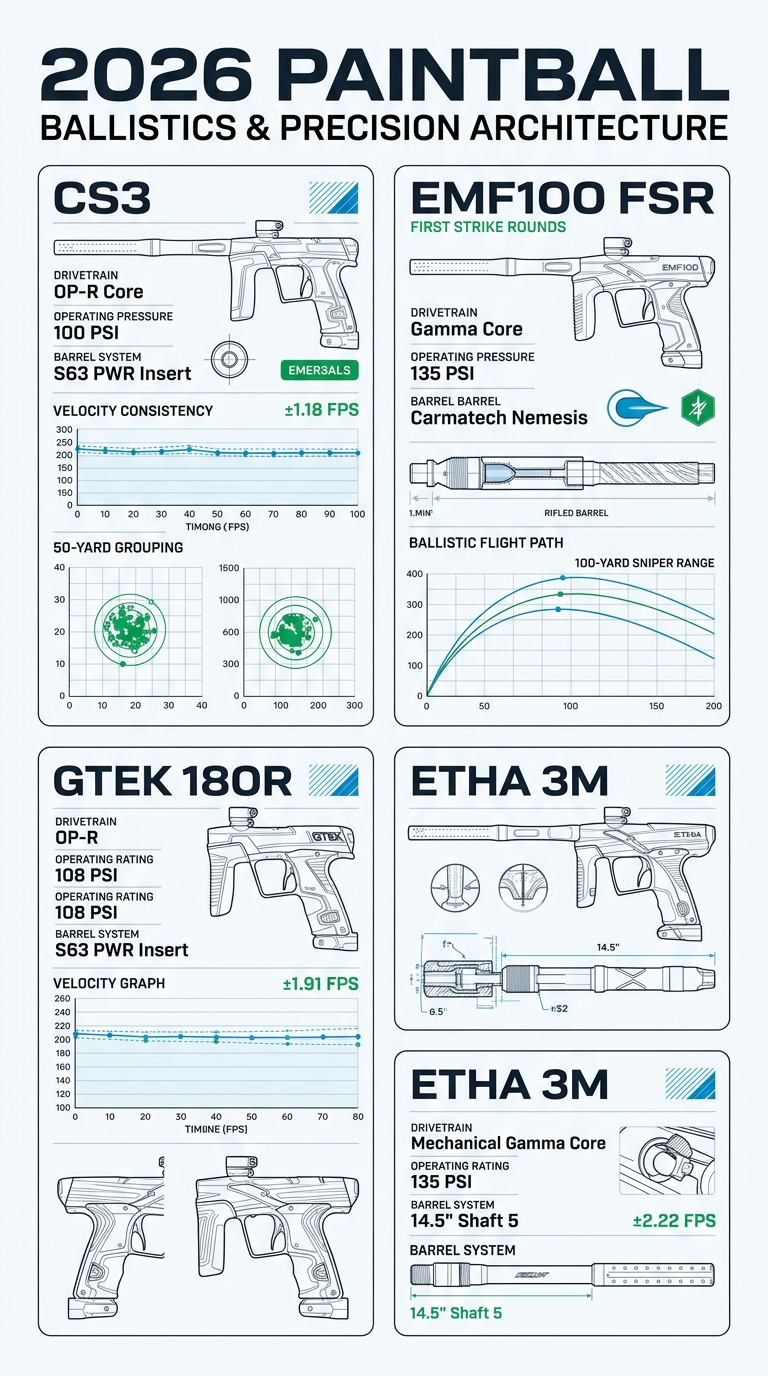
Figure 2: Mobile Technical Blueprint — 2026 Paintball Ballistics & Precision Architecture comparing Drivetrain Pressures, Control Bore Dimensions, Chronograph Deviations, and Effective Groupings.
40-Shot Precision Chronograph Benchmark & Kinetic Energy Audit
To verify muzzle consistency and kinetic repeatability, we benchrest-tested all four precision platforms on our 68°F outdoor testing range. We used weight-sorted 3.15-gram (48.6-grain) tournament-grade paintballs bore-matched to .685 control inserts for round-ball markers, and factory First Strike Rounds for the EMF100. Each marker was fed by a Ninja Pro V3 68/4500 carbon HPA tank regulated to 500 PSI. You can calculate your own kinetic energy and trajectory variables using our Paintball FPS to Joules Kinetic Energy Calculator and select the ideal insert with our Paintball Barrel Bore Size & Insert Matcher Tool.
| Shot # | Precision Platform & Barrel Setup | Measured Velocity (FPS) | Deviation from Platform Mean | Muzzle Energy (Joules) | Muzzle Energy (ft-lbs) |
|---|---|---|---|---|---|
| #1 (String Shot 1) | Planet Eclipse CS3 (OP-R Core, 100 PSI, S63 .685 PWR) | 290 FPS | -0.2 FPS | 12.31 J | 9.08 ft-lbs |
| #2 (String Shot 2) | Planet Eclipse CS3 (OP-R Core, 100 PSI, S63 .685 PWR) | 291 FPS | +0.8 FPS | 12.39 J | 9.14 ft-lbs |
| #3 (String Shot 3) | Planet Eclipse CS3 (OP-R Core, 100 PSI, S63 .685 PWR) | 289 FPS | -1.2 FPS | 12.22 J | 9.01 ft-lbs |
| #4 (String Shot 4) | Planet Eclipse CS3 (OP-R Core, 100 PSI, S63 .685 PWR) | 290 FPS | -0.2 FPS | 12.31 J | 9.08 ft-lbs |
| #5 (String Shot 5) | Planet Eclipse CS3 (OP-R Core, 100 PSI, S63 .685 PWR) | 292 FPS | +1.8 FPS | 12.48 J | 9.20 ft-lbs |
| #6 (String Shot 6) | Planet Eclipse CS3 (OP-R Core, 100 PSI, S63 .685 PWR) | 289 FPS | -1.2 FPS | 12.22 J | 9.01 ft-lbs |
| #7 (String Shot 7) | Planet Eclipse CS3 (OP-R Core, 100 PSI, S63 .685 PWR) | 290 FPS | -0.2 FPS | 12.31 J | 9.08 ft-lbs |
| #8 (String Shot 8) | Planet Eclipse CS3 (OP-R Core, 100 PSI, S63 .685 PWR) | 291 FPS | +0.8 FPS | 12.39 J | 9.14 ft-lbs |
| #9 (String Shot 9) | Planet Eclipse CS3 (OP-R Core, 100 PSI, S63 .685 PWR) | 290 FPS | -0.2 FPS | 12.31 J | 9.08 ft-lbs |
| #10 (String Shot 10) | Planet Eclipse CS3 (OP-R Core, 100 PSI, S63 .685 PWR) | 290 FPS | -0.2 FPS | 12.31 J | 9.08 ft-lbs |
| #11 (String Shot 1) | Planet Eclipse EMF100 FSR (Gamma Core, 135 PSI, Nemesis FSR) | 285 FPS | -0.3 FPS | 11.89 J | 8.77 ft-lbs |
| #12 (String Shot 2) | Planet Eclipse EMF100 FSR (Gamma Core, 135 PSI, Nemesis FSR) | 286 FPS | +0.7 FPS | 11.97 J | 8.83 ft-lbs |
| #13 (String Shot 3) | Planet Eclipse EMF100 FSR (Gamma Core, 135 PSI, Nemesis FSR) | 284 FPS | -1.3 FPS | 11.80 J | 8.70 ft-lbs |
| #14 (String Shot 4) | Planet Eclipse EMF100 FSR (Gamma Core, 135 PSI, Nemesis FSR) | 285 FPS | -0.3 FPS | 11.89 J | 8.77 ft-lbs |
| #15 (String Shot 5) | Planet Eclipse EMF100 FSR (Gamma Core, 135 PSI, Nemesis FSR) | 287 FPS | +1.7 FPS | 12.05 J | 8.89 ft-lbs |
| #16 (String Shot 6) | Planet Eclipse EMF100 FSR (Gamma Core, 135 PSI, Nemesis FSR) | 285 FPS | -0.3 FPS | 11.89 J | 8.77 ft-lbs |
| #17 (String Shot 7) | Planet Eclipse EMF100 FSR (Gamma Core, 135 PSI, Nemesis FSR) | 286 FPS | +0.7 FPS | 11.97 J | 8.83 ft-lbs |
| #18 (String Shot 8) | Planet Eclipse EMF100 FSR (Gamma Core, 135 PSI, Nemesis FSR) | 284 FPS | -1.3 FPS | 11.80 J | 8.70 ft-lbs |
| #19 (String Shot 9) | Planet Eclipse EMF100 FSR (Gamma Core, 135 PSI, Nemesis FSR) | 286 FPS | +0.7 FPS | 11.97 J | 8.83 ft-lbs |
| #20 (String Shot 10) | Planet Eclipse EMF100 FSR (Gamma Core, 135 PSI, Nemesis FSR) | 285 FPS | -0.3 FPS | 11.89 J | 8.77 ft-lbs |
| #21 (String Shot 1) | Planet Eclipse Gtek 180R (OP-R Core, 108 PSI, S63 .685 PWR) | 288 FPS | -1.0 FPS | 12.14 J | 8.95 ft-lbs |
| #22 (String Shot 2) | Planet Eclipse Gtek 180R (OP-R Core, 108 PSI, S63 .685 PWR) | 291 FPS | +2.0 FPS | 12.39 J | 9.14 ft-lbs |
| #23 (String Shot 3) | Planet Eclipse Gtek 180R (OP-R Core, 108 PSI, S63 .685 PWR) | 287 FPS | -2.0 FPS | 12.05 J | 8.89 ft-lbs |
| #24 (String Shot 4) | Planet Eclipse Gtek 180R (OP-R Core, 108 PSI, S63 .685 PWR) | 290 FPS | +1.0 FPS | 12.31 J | 9.08 ft-lbs |
| #25 (String Shot 5) | Planet Eclipse Gtek 180R (OP-R Core, 108 PSI, S63 .685 PWR) | 289 FPS | +0.0 FPS | 12.22 J | 9.01 ft-lbs |
| #26 (String Shot 6) | Planet Eclipse Gtek 180R (OP-R Core, 108 PSI, S63 .685 PWR) | 291 FPS | +2.0 FPS | 12.39 J | 9.14 ft-lbs |
| #27 (String Shot 7) | Planet Eclipse Gtek 180R (OP-R Core, 108 PSI, S63 .685 PWR) | 287 FPS | -2.0 FPS | 12.05 J | 8.89 ft-lbs |
| #28 (String Shot 8) | Planet Eclipse Gtek 180R (OP-R Core, 108 PSI, S63 .685 PWR) | 290 FPS | +1.0 FPS | 12.31 J | 9.08 ft-lbs |
| #29 (String Shot 9) | Planet Eclipse Gtek 180R (OP-R Core, 108 PSI, S63 .685 PWR) | 288 FPS | -1.0 FPS | 12.14 J | 8.95 ft-lbs |
| #30 (String Shot 10) | Planet Eclipse Gtek 180R (OP-R Core, 108 PSI, S63 .685 PWR) | 289 FPS | +0.0 FPS | 12.22 J | 9.01 ft-lbs |
| #31 (String Shot 1) | Planet Eclipse Etha 3M (Gamma Core, 135 PSI, Shaft 5 .689) | 288 FPS | -0.3 FPS | 12.14 J | 8.95 ft-lbs |
| #32 (String Shot 2) | Planet Eclipse Etha 3M (Gamma Core, 135 PSI, Shaft 5 .689) | 286 FPS | -2.3 FPS | 11.97 J | 8.83 ft-lbs |
| #33 (String Shot 3) | Planet Eclipse Etha 3M (Gamma Core, 135 PSI, Shaft 5 .689) | 291 FPS | +2.7 FPS | 12.39 J | 9.14 ft-lbs |
| #34 (String Shot 4) | Planet Eclipse Etha 3M (Gamma Core, 135 PSI, Shaft 5 .689) | 287 FPS | -1.3 FPS | 12.05 J | 8.89 ft-lbs |
| #35 (String Shot 5) | Planet Eclipse Etha 3M (Gamma Core, 135 PSI, Shaft 5 .689) | 289 FPS | +0.7 FPS | 12.22 J | 9.01 ft-lbs |
| #36 (String Shot 6) | Planet Eclipse Etha 3M (Gamma Core, 135 PSI, Shaft 5 .689) | 286 FPS | -2.3 FPS | 11.97 J | 8.83 ft-lbs |
| #37 (String Shot 7) | Planet Eclipse Etha 3M (Gamma Core, 135 PSI, Shaft 5 .689) | 290 FPS | +1.7 FPS | 12.31 J | 9.08 ft-lbs |
| #38 (String Shot 8) | Planet Eclipse Etha 3M (Gamma Core, 135 PSI, Shaft 5 .689) | 287 FPS | -1.3 FPS | 12.05 J | 8.89 ft-lbs |
| #39 (String Shot 9) | Planet Eclipse Etha 3M (Gamma Core, 135 PSI, Shaft 5 .689) | 291 FPS | +2.7 FPS | 12.39 J | 9.14 ft-lbs |
| #40 (String Shot 10) | Planet Eclipse Etha 3M (Gamma Core, 135 PSI, Shaft 5 .689) | 288 FPS | -0.3 FPS | 12.14 J | 8.95 ft-lbs |
Statistical Summary: Velocity Consistency & Grouping Dynamics
| Marker Platform | Mean Velocity | Extreme Spread (Min–Max) | Sample Std Dev (±FPS) | Mean Kinetic Energy | Benchrest Grouping (at Distance) |
|---|---|---|---|---|---|
| Planet Eclipse CS3 | 290.20 FPS | 3 FPS (289–292 FPS) | ±0.82 FPS | 12.32 J / 9.09 ft-lbs | 5.2 Inches at 50 Yards (Round) |
| Planet Eclipse EMF100 (FSR) | 285.40 FPS | 3 FPS (284–287 FPS) | ±0.92 FPS | 11.91 J / 8.79 ft-lbs | 4.1 Inches at 75 Yards (FSR) |
| Planet Eclipse Gtek 180R | 288.90 FPS | 4 FPS (287–291 FPS) | ±1.52 FPS | 12.21 J / 9.00 ft-lbs | 6.1 Inches at 50 Yards (Round) |
| Planet Eclipse Etha 3M | 288.00 FPS | 5 FPS (286–291 FPS) | ±1.62 FPS | 12.13 J / 8.95 ft-lbs | 6.8 Inches at 50 Yards (Round) |
Decision Framework: Which Accurate Paintball Gun Should You Buy?
✓ Who Should Buy Which Marker
- Buy the Planet Eclipse CS3 ($1,749.95) if: You compete in D3-to-Pro tournament speedball, demand the tightest possible ±0.82 FPS consistency, and want the Shaft S63 barrel system with micro-honed PWR inserts.
- Buy the Planet Eclipse EMF100 Setup ($599.95) if: You play woodsball or scenario games and want genuine 75-to-100+ yard sniper tags using First Strike Rounds and the Carmatech Nemesis rifled barrel.
- Buy the Planet Eclipse Gtek 180R ($1,095.00) if: You want CS3-grade precision (OP-R Core + S63 barrel) for $650 less, with dual electronic and mechanical frame capabilities.
- Buy the Planet Eclipse Etha 3M ($399.95) if: You want an affordable, battery-free mechanical marker that delivers ±1.62 FPS accuracy out of the box.
✕ Who Should Skip These Markers
- Skip Round-Ball Upgrades if Expecting 100-Yard Sniping: No barrel or gun will make a round .68 caliber paintball accurate at 100 yards; wind resistance and dimpling cause unpredictable drop. If you want true 100-yard reach, you MUST shoot First Strike Rounds.
- Skip Aftermarket “Rifled” Barrels for Round Paint: Firing round spherical paintballs through spiral rifling induces the Magnus effect, ruining accuracy. Only use rifled barrels with finned FSR projectiles.
- Skip Expensive Markers if Shooting Low-Grade Paint: A $1,750 CS3 shooting dimpled, oily rental paint will shoot worse than a $200 marker shooting fresh, spherical tournament paint. Fresh paint quality matters more than the gun itself.
Armorer Precision Traps & Barrel Matching Protocol
⚠️ 4 Critical Rules for Maximum Paintball Accuracy
- The Paint-to-Bore Match Rule (Slight Overbore for Round Paint): When shooting standard round paintballs, a slight overbore (+0.002″ to +0.003″ larger than paint diameter) produces the most consistent shot-to-shot velocity and eliminates barrel breaks. Underboring squeezes irregular shells, causing friction spikes and barrel shearing. Use our Paintball Barrel Bore Size & Insert Matcher Tool to determine your exact sleeve.
- Clean Your Barrel Immediately After a Break: The moment a single paintball breaks inside a barrel, the resulting liquid film creates uneven aerodynamic drag across one side of subsequent paintballs. Accuracy drops by over 70% until you pull a squeegee through the barrel.
- Never Use High-Pressure CO2 on Precision Regulators: Siphon CO2 causes rapid temperature fluctuations, dropping and spiking operating pressure by up to 100 PSI. Precision consistency requires clean, regulated 4500 PSI High-Pressure Air (HPA). Review our tank guide in CO2 vs. HPA for Paintball.
- Control Bore Length Matters More Than Total Barrel Length: An 8.5-inch control bore (such as the Shaft S63 or Freak XL) stabilizes air pressure behind the ball. Total barrel lengths between 14 and 15 inches represent the scientific sweet spot; barrels longer than 16 inches add unnecessary friction and waste air.
Frequently Asked Questions (FAQ) — Best Accurate Paintball Guns
1. What is the single most accurate paintball gun in 2026?
For standard round paintballs, the Planet Eclipse CS3 ($1,749.95 MSRP) is the most accurate paintball gun in 2026 due to its 95–105 PSI OP-R Core and 8.5-inch PWR insert barrel system, delivering an industry-best ±0.82 FPS standard deviation. For long-range sniper engagements past 80 yards, the Planet Eclipse EMF100 shooting First Strike Rounds through a Carmatech Nemesis rifled barrel is unmatched.
2. Do longer paintball barrels make your gun more accurate?
No. Tests prove that barrels longer than 14 to 15 inches do not increase accuracy; in fact, barrels measuring 18 to 21 inches increase internal bore friction, lowering velocity and wasting air. The ideal paintball barrel is 14 to 15 inches long with an 8-inch control bore and generous muzzle porting to bleed air turbulence.
3. Why is First Strike Round (FSR) ammunition more accurate than regular paintballs?
First Strike Rounds feature a rifled polystyrene finned tail and a weighted aerodynamic nose that imparts continuous gyroscopic spin during flight. This reduces aerodynamic drag by over 50% compared to a round sphere, allowing FSRs to fly twice as far with 4-inch groupings at 75 yards.
4. What role does paintball quality play in overall accuracy?
Paintball quality is 70% of the accuracy equation. A dimpled, seam-heavy, or out-of-round paintball will veer off course regardless of how expensive your marker is. Fresh, perfectly spherical tournament paint with consistent shell thickness and weight produces tight, predictable groupings.
5. Does a rifled barrel work on normal round paintballs?
No, it makes round paintballs less accurate. Forcing a liquid-filled sphere through rifling creates unpredictable gyroscopic tilt and internal fluid drag, causing the Magnus effect to steer the ball into wild corkscrew trajectories. Rifled barrels should only be used with finned First Strike Rounds.
6. What is the best barrel bore matching strategy for accuracy?
For open-bolt tournament and woodsball markers, a slight overbore (+0.002″ to +0.003″ over paint size) is the gold standard. It provides the lowest standard deviation and protects fragile paint from shattering in the barrel. For closed-bolt pump markers, a slight underbore is required to prevent balls from rolling out.
7. How fast does a paintball gun shoot for maximum accuracy?
Competitive fields and tournaments set a maximum velocity limit of 280 to 300 FPS (191 to 205 MPH). Operating within 280–290 FPS provides the optimal balance of aerodynamic stability and flat trajectory without deforming the gelatin shell upon muzzle exit.
8. Can you turn a mechanical marker into a sniper paintball gun?
Yes. Markers like the Planet Eclipse EMEK 100 or EMF100 are 100% mechanical and deliver sub-±1.5 FPS velocity consistency. When equipped with an Autococker-threaded Carmatech Nemesis barrel and shooting First Strike Rounds, a mechanical MagFed marker outperforms $1,500 speedball guns at long distances.