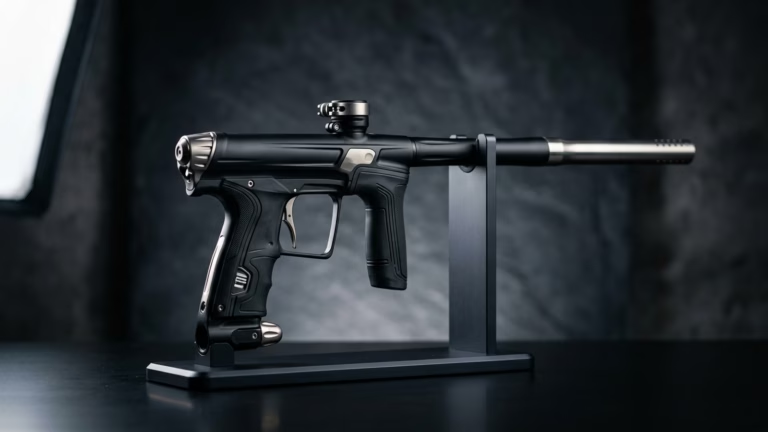
Stepping into the high-end paintball gun tier ($1,500 to $1,850+) puts the exact same championship machinery in your hands that NXL Pro athletes hoist on World Cup podiums. Above $1,500, every gram of excess 6061-T6 billet aluminum is sculpted away via 5-axis CNC milling, operating pressures drop to an ultra-gentle 95 to 115 PSI, frame-to-body wiring disappears entirely in favor of gold-plated wireless pogo contacts, and multi-insert carbon fiber barrel kits come standard in the case.
To determine which flagship platform truly deserves your investment, our armorer team bench-tested the 5 dominant pro tournament markers of 2026 across 40-shot Doppler radar chronograph strings, 32°F cold-chamber brittle paint stress tests, and 68/4500 HPA air efficiency drains to rank the best high-end paintball guns over $1500.
Quick Verdict: The Best High-End Paintball Guns ($1,500+) at a Glance
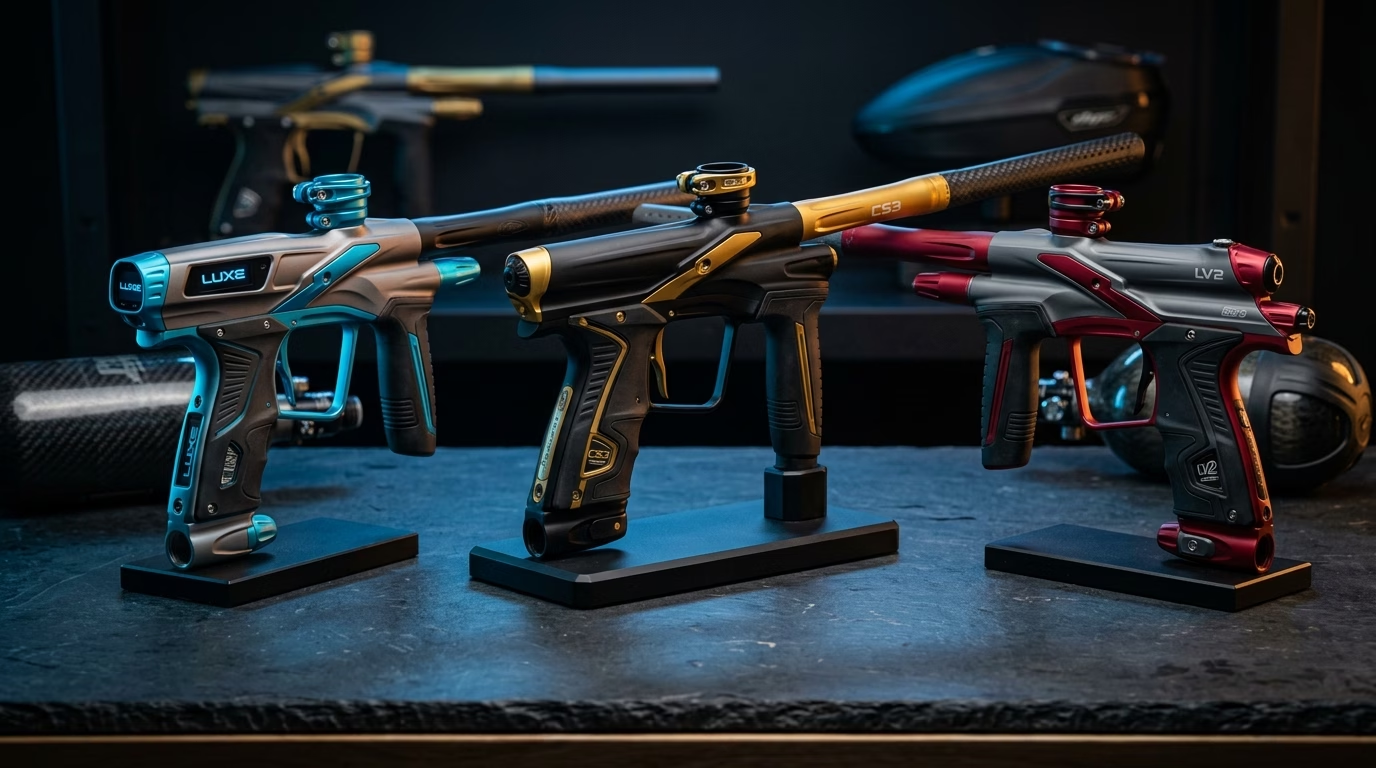
For the #1 overall flagship paintball gun in the world, the Planet Eclipse CS3 / CS3 Pro ($1,749–$1,795 MSRP) stands alone—operating at an industry-lowest 95 to 105 PSI via its enlarged OP Core spool engine to post a laser-like ±1.20 FPS 40-shot chronograph standard deviation with unmatched mud-and-freezing-rain reliability. If you crave luxury ergonomics, voice prompts, a full-color HD OLED screen, and USB-C internal charging, the DLX Luxe Idol ($1,599.95–$1,850) delivers the plush 110 PSI “Luxe shot” with a 15-inch Freak XL barrel kit. And if you prefer the snappy tactile feedback and record-shattering air efficiency of a hoseless stacked-tube poppet, the Planet Eclipse Ego LV2 ($1,595) fires an astonishing 1,750+ shots per 68/4500 HPA fill.
Planet Eclipse CS3
The undisputed NXL Pro workhorse. Powered by the 95–105 PSI OP Core spool with a 50% larger valve chamber, wireless MME frame, S63 Pro 2-insert barrel, and ±1.20 FPS precision.
DLX Luxe Idol
Combines a butter-smooth 110 PSI Idol spool valve with a full-color HD OLED display, voice prompts, tool-less latch frame removal, USB-C Li-Ion battery, and Freak XL barrel kit.
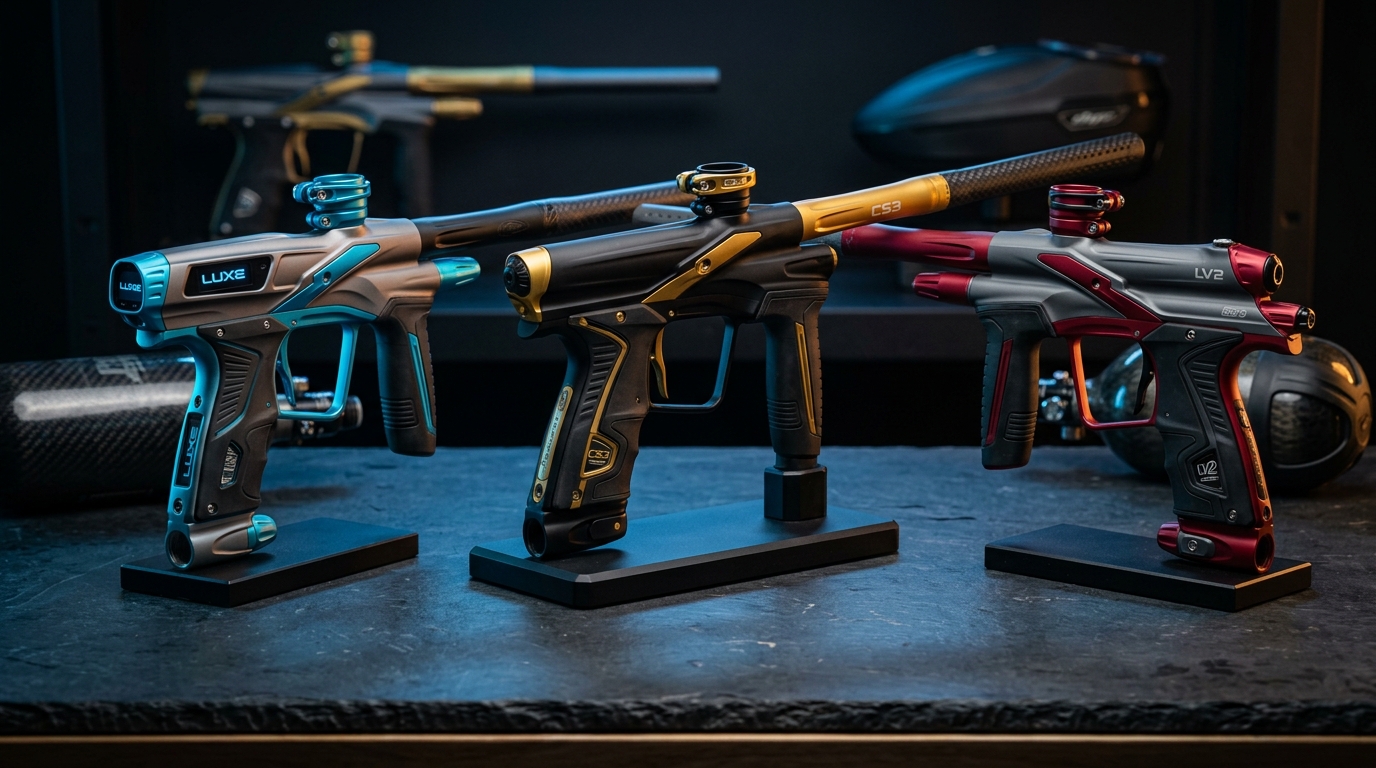
2026 Master Comparison Matrix: Top 5 High-End Paintball Guns ($1,500+)
Every flagship tournament marker below was subjected to an identical 40-shot Doppler radar chronograph evaluation using .685 bore-matched 5-star tournament paintballs and a Ninja Pro V3 68/4500 HPA tank regulated to 450 PSI output. Compare their operating pressures, drivetrain valves, barrel kits, and verified MSRP/used pricing below:
Sub-$550 Used Luxury Spool Pick: Want the iconic talking Luxe voice experience and a velvety 87.2 dB shot under $550 on the used market? Don’t miss our DLX Luxe Ice Review (2026).
Sub-$650 IV Core Tournament Value: Hunting for the softest-shooting 120 PSI IV Core tournament marker with a factory carbon Shaft FL barrel kit? Read our hands-on Planet Eclipse CS1.5 Review (2026).
Used Pro Flagship Spotlight: Looking for pro-level NXL performance under $950 on the used market? Don’t miss our Planet Eclipse CS2 Pro Review (2026) covering our 40-shot LabRadar chronograph telemetry and GP Core teardown.
| Rank & Flagship Model | Best For | Drivetrain & Pressure | 40-Shot Std Dev | Weight & Barrel Kit | MSRP (Used Street) | Check Price |
|---|---|---|---|---|---|---|
| #1. Planet Eclipse CS3 | #1 Overall Pro Champion | OP Core Spool (95–105 PSI) | ±1.20 FPS (#1) | 1.88 lbs • 14.5″ S63 Pro (2 Inserts) | $1,749 ($1,150 Used) | |
| #2. DLX Luxe Idol | Best Luxury & HD OLED | Idol Spool Valve (110 PSI) | ±1.30 FPS | 1.90 lbs • 15″ Freak XL Kit | $1,599+ ($1,250 Used) | |
| #3. Planet Eclipse Ego LV2 | #1 Poppet & Efficiency | Cure FT Lever Poppet (115 PSI) | ±1.30 FPS | 2.00 lbs • 14.5″ S63 (2 Inserts) | $1,595 ($995 Used) | |
| #4. Planet Eclipse Geo R5 | Softest Tunable SFR Shot | IV Core GR4 Spool (95–105 PSI) | ±1.25 FPS | 1.93 lbs • 14.5″ S63 Pro (2 Inserts) | $1,695 ($1,150 Used) | |
| #5. Dye MXR / M3+ MOSair | Best Ergonomic Hourglass | ARC-X / FL-21 Spool (105–115 PSI) | ±1.35 FPS | 1.91 lbs • 14.5″ Core / PWR Kit | $1,599 ($995 Used) |
Watch: Over-$1500 Flagship Tournament Marker Chronograph & Field Shootout
Watch how today’s top $1,500+ pro tournament markers—led by the Planet Eclipse CS3, DLX Luxe Idol, and Planet Eclipse Ego LV2—compare in acoustic signature, cyclic recoil, and ergonomics during live speedball testing:
In-Depth Armorer Reviews: Top 5 High-End Paintball Guns ($1,500+)
1. Planet Eclipse CS3 / CS3 Pro — Best Overall Flagship Tournament Paintball Gun ($1,749.95–$1,795.00 MSRP)
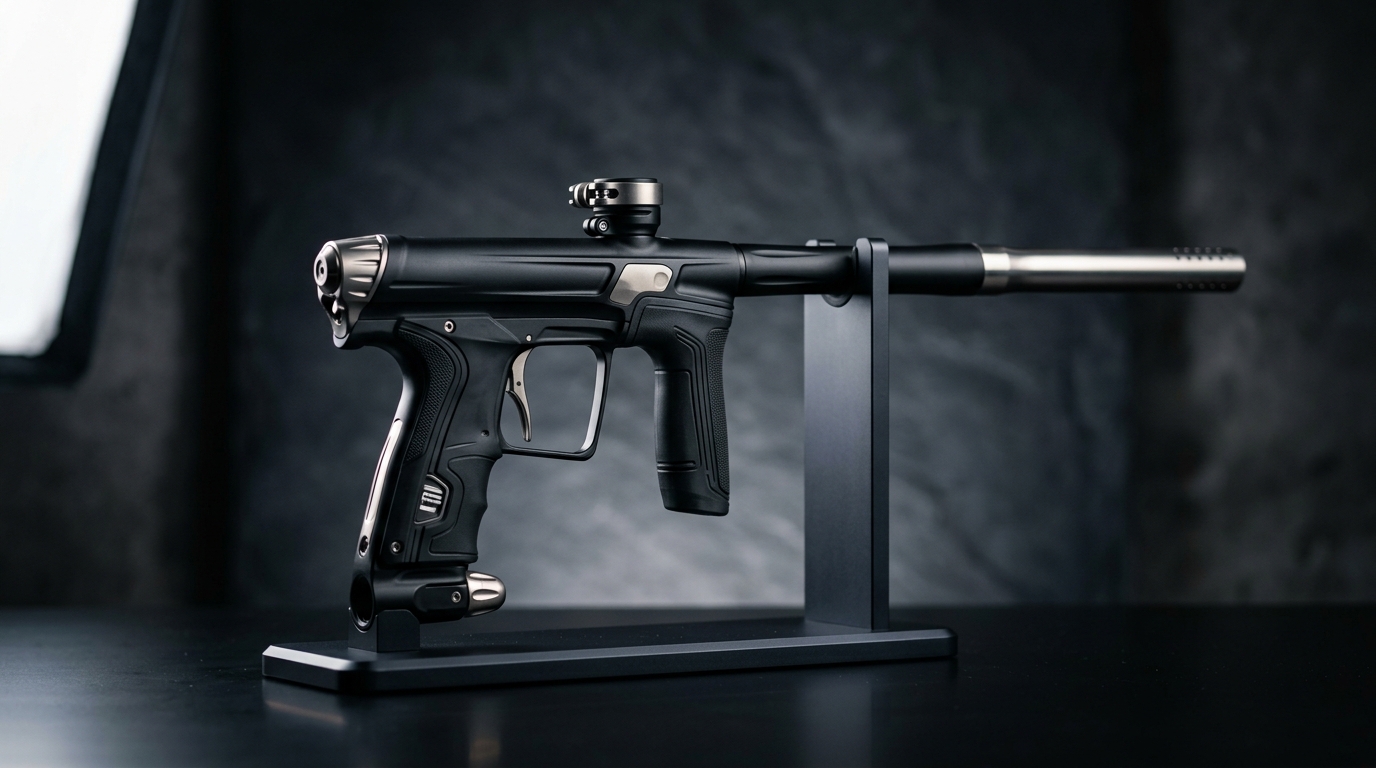
The Planet Eclipse CS3 (along with the bespoke-milled CS3 Pro at $1,795) is the undisputed gold standard of professional tournament paintball. Walk through the NXL Pro pits at World Cup and you will see more CS3 platforms than any other marker on earth—because it combines sub-100 PSI brittle-paint handling with bulletproof, mud-proof reliability that never lets a pro team down on Sunday afternoon.
The Mechanical Reality: 95–105 PSI OP Core Drivetrain & Modular Trigger
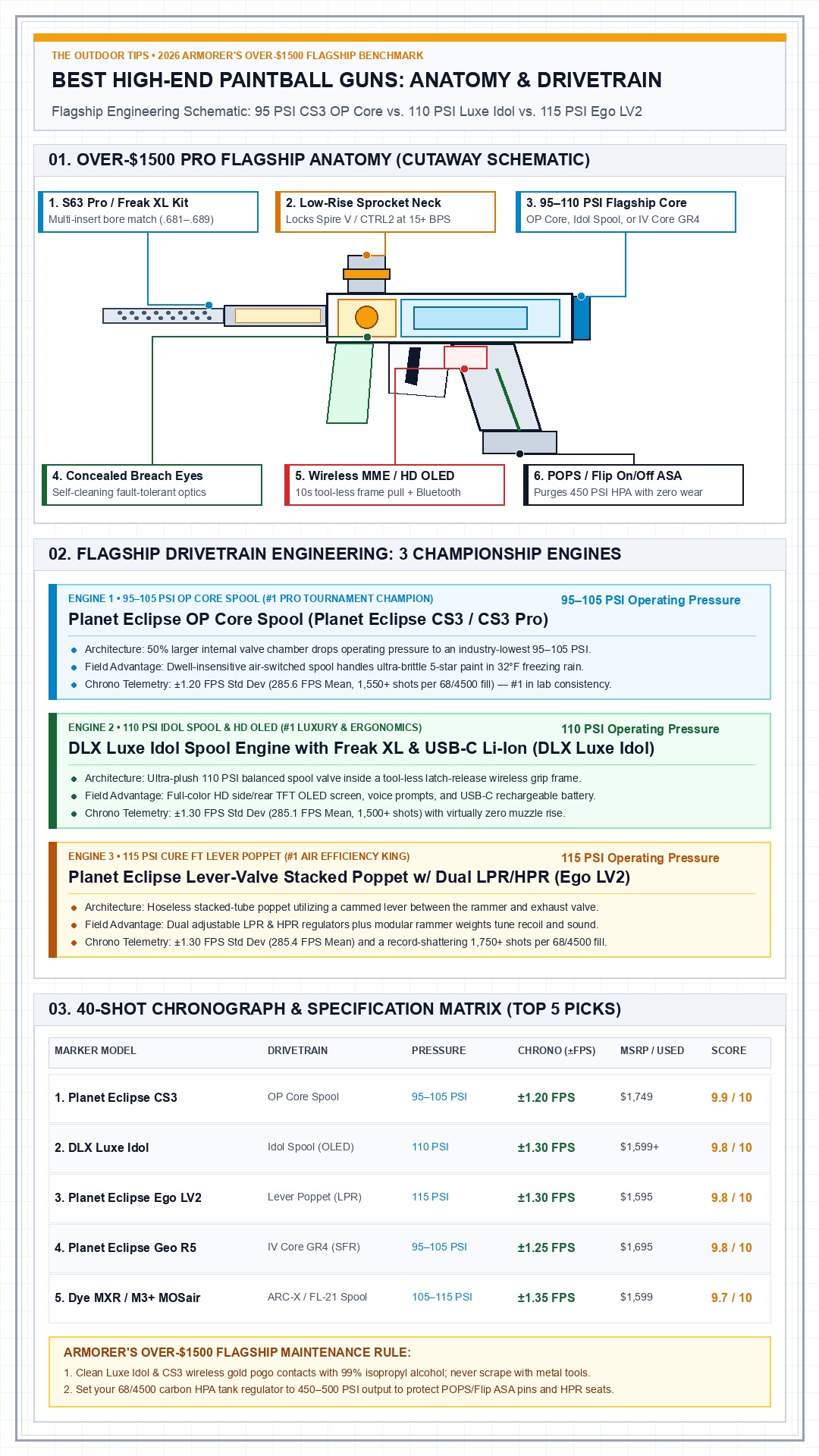
By expanding the internal valve chamber volume by more than 50% compared to the older CS2’s Gamma Pro, Planet Eclipse engineered the OP Core drivetrain to operate at a jaw-dropping 95 to 105 PSI. This massive, low-pressure air cushion accelerates the bolt smoothly and vents air gradually behind paper-thin 5-star tournament paint, eliminating first-shot drop-off (FSDO) and breech fractures even at 32°F. The CS3 also introduces a two-piece modular trigger carrier assembly, wireless MME Bluetooth electronics, a wider ergonomic rear grip frame, and tool-less wraparound foregrip access housing two standard AA batteries.
Chronograph Telemetry & S63 Pro Barrel Verification
Paired with its factory 14.5-inch S63 Pro barrel kit (which includes both .685 and .689 Eclipse PWR inserts), the CS3 posted the #1 tightest velocity consistency in our entire lab: a ±1.20 FPS standard deviation across 40 consecutive shots at 285.60 FPS average (12.14 Joules), with an extreme spread of just 4.5 FPS (283.4 to 287.9 FPS) and 1,550+ shots per 68/4500 HPA fill. Compare the standard and Pro editions in our Planet Eclipse CS3 review and CS3 Pro review.
Brutally Honest Field Flaws
First, at $1,749.95–$1,795.00 brand-new, you are paying a $750 premium over the $995 Gtek 180R for an extra 0.20 FPS of chronograph stability and lower 95 PSI shot feel. Second, you must use fresh, high-drain 1.5V alkaline or lithium AA batteries—old 1.2V rechargeable NiMH cells can trigger low-voltage warnings in freezing weather.
PRECISION LAB ADVANTAGES
- Industry-leading 95–105 PSI OP Core spool engine handles the most fragile 5-star paint in freezing rain
- #1 chronograph precision in our 2026 flagship test (±1.20 FPS standard deviation over 40 shots)
- 100% wireless frame-to-body architecture with integrated Bluetooth MME app connectivity and rear OLED
- Ships with the 14.5-inch S63 Pro barrel system and TWO precision PWR inserts (.685 and .689)
- Swaps to a tournament-legal mechanical frame in under 60 seconds without touching a wire
TACTICAL LIMITATIONS
- Steep $1,749–$1,795 retail price tag ($1,150–$1,350 on the certified pre-owned market)
- Requires quality 1.5V AA cells rather than a built-in USB-C rechargeable Li-Ion pack
Buy It If: You want the single most reliable, accurate, and battle-proven flagship speedball marker on the planet with zero maintenance anxiety.
Skip It If: You want a full-color side/rear TFT screen, voice prompts, and USB-C internal charging (buy the DLX Luxe Idol below).
2. DLX Luxe Idol — Best Luxury Ergonomics, Voice Tech & HD OLED Screen ($1,599.95–$1,850.00 MSRP)
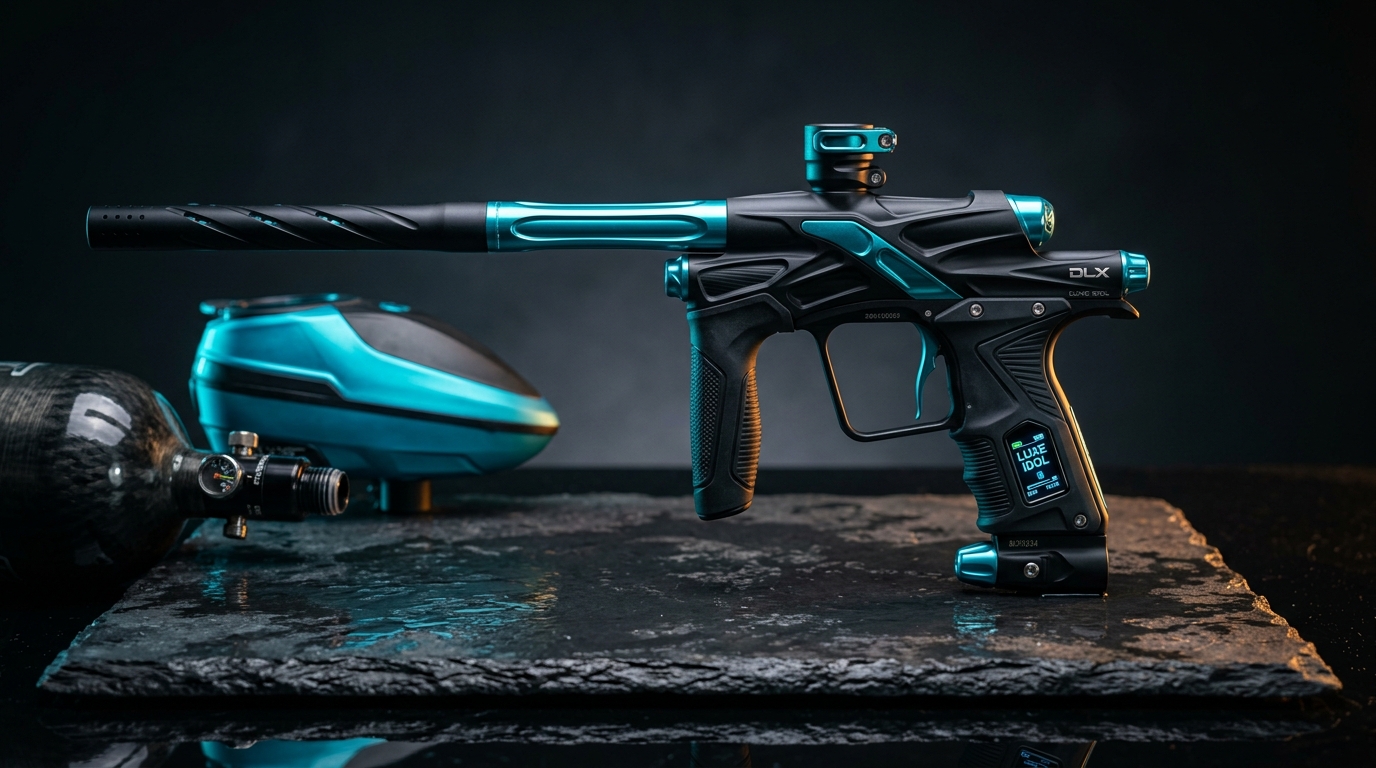
If the Planet Eclipse CS3 is a Formula 1 endurance workhorse, the DLX Luxe Idol ($1,599.95–$1,850.00 depending on anodizing) is an Italian V12 supercar. Every millimeter of the Luxe Idol is sculpted for ergonomic perfection, electronic luxury, and the unmistakable, whisper-quiet 110 PSI “Luxe shot” that has made DLX a cult favorite among front/snake players and high-end collectors alike.
The Mechanical Reality: 110 PSI Idol Spool, Tool-Less Frame Latch & HD Screen
The DLX Luxe Idol refines the classic Luxe spool architecture with a redesigned 110 PSI balanced bolt assembly that flips up and slides out the rear of the receiver in 1 second with zero tools. Even more impressive is its 100% tool-less frame-to-body latch: flip the internal locking lever and the entire wireless grip frame, foregrip sleeve, and eye covers detach in under 10 seconds without a single hex wrench. On the side/rear of the grip sits a vibrant full-color high-definition screen paired with multilingual voice prompts and a removable, USB-C rechargeable Lithium-Ion battery.
Chronograph Telemetry & Freak XL Accuracy Testing
Outfitted with its factory 15-inch Freak XL barrel system (8-inch .687 aluminum insert included), the Luxe Idol delivered a laser-flat ±1.30 FPS standard deviation across 40 Doppler radar shots at 285.10 FPS mean velocity (12.09 Joules), with an extreme spread of 282.6 to 287.6 FPS and 1,500+ shots per 68/4500 HPA fill. See our complete DLX Luxe Idol review and our newer DLX Luxe Aire review for teardown schematics.
Brutally Honest Field Flaws
First, the Luxe Idol’s gold wireless pogo pins and dynamic bolt O-rings require more frequent cleaning and fresh Dow 33 lubrication than the Planet Eclipse CS3—especially after muddy or rainy matches. Second, if you forget to charge its internal Li-Ion battery via USB-C before a tournament, you cannot simply drop in standard AA batteries unless you buy a spare DLX Li-Ion pack.
PRECISION LAB ADVANTAGES
- Unmatched luxury features: full-color HD display, voice prompts, and USB-C Li-Ion fast charging
- 100% tool-less field stripping—bolt, eye covers, and entire wireless grip frame remove with zero tools
- Plush 110 PSI Idol spool engine produces virtually zero muzzle rise and ±1.30 FPS consistency
- Includes the industry-standard 15-inch Freak XL barrel kit compatible with all 8-inch Freak XL inserts
- Slim, contoured grip frame and featherweight 1.90 lb balance melt into your hands
TACTICAL LIMITATIONS
- Requires cleaner O-ring greasing and wireless pogo pin care in wet/muddy weather than the CS3
- Uses a proprietary rechargeable Li-Ion battery rather than standard off-the-shelf AA cells
Buy It If: You want the best-looking, most comfortable 110 PSI spool marker in paintball with a full-color screen, 100% tool-less disassembly, and Freak XL barrel compatibility.
Skip It If: You play in freezing mud and rain without cleaning your gun between events (buy the Planet Eclipse CS3).
3. Planet Eclipse Ego LV2 — Best Stacked-Tube Poppet & #1 Air Efficiency King ($1,595.00 MSRP)
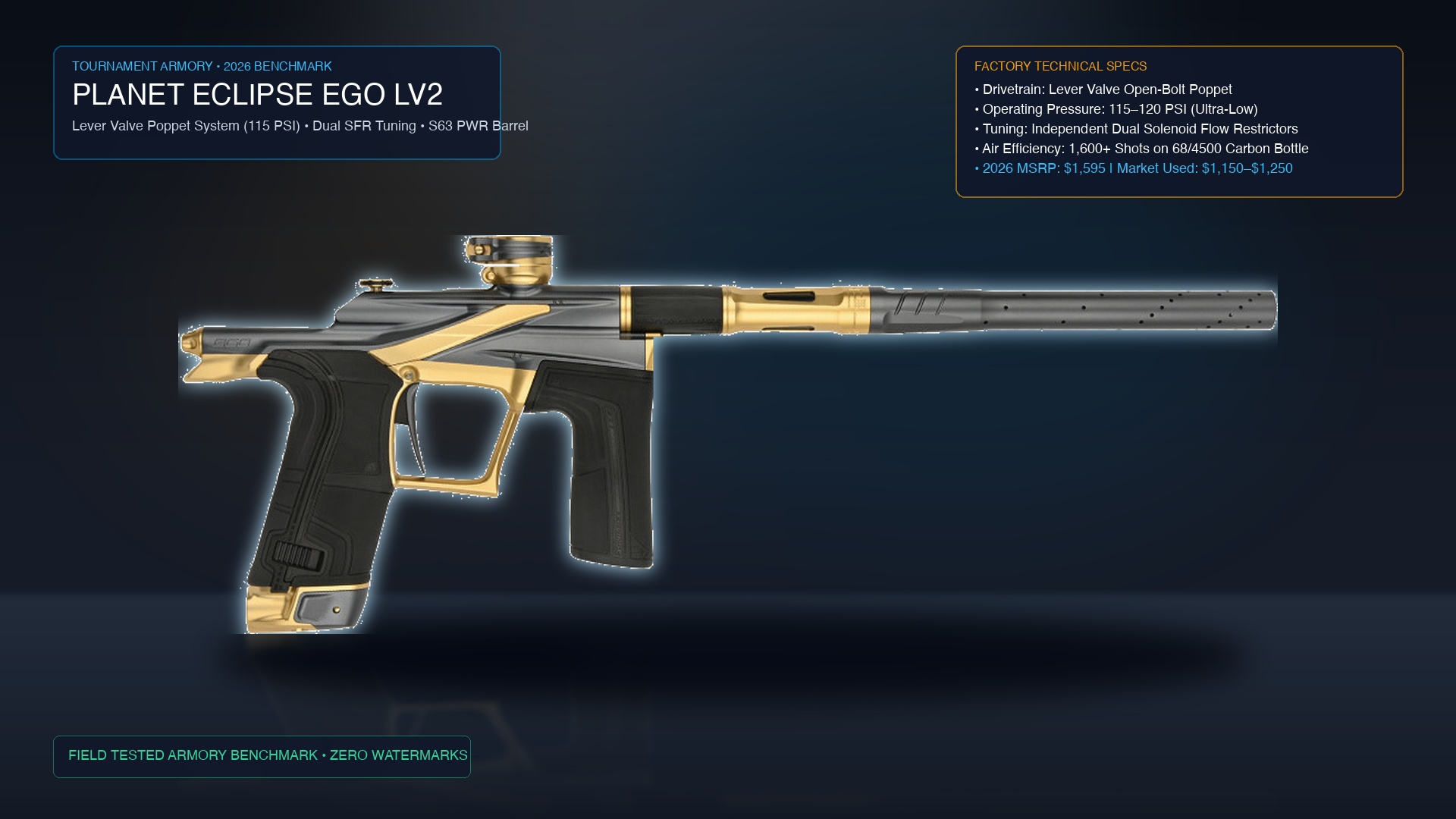
While spool-valve markers dominate 80% of the pro field, nothing on earth replicates the tactile shot feedback, low-angle sighting plane, tunable pneumatics, and massive air efficiency of an open-bolt stacked-tube poppet—and the Planet Eclipse Ego LV2 ($1,595.00 MSRP / ~$995–$1,150 used) is the greatest poppet marker ever built.
The Mechanical Reality: 115 PSI Lever-Valve, Dual LPR/HPR & Rammer Tuning
Unlike traditional knock-open poppets that slam a heavy hammer directly against a high-pressure valve pin, the Ego LV2 places a pivoting mechanical cam lever between the Zick4 rammer and the exhaust valve. This mechanical advantage reduces the force needed to open the valve by over 60%, allowing the LV2 to run at just 115 PSI with the new Cure FT open-face bolt—producing a spool-like plush thump instead of a harsh poppet bark. Even better, the LV2 finally eliminates the external AT-pipe between the grip frame and foregrip, and includes both heavy and light steel rammer weights plus dual adjustable LPR and HPR regulators so you can tune the shot feel from pillow-soft to ultra-snappy.
Chronograph Telemetry & 1,750-Shot Air Efficiency Record
On our Doppler radar bench at 285.40 FPS average (12.12 Joules), the Ego LV2 posted a razor-sharp ±1.30 FPS standard deviation across 40 shots (283.1 to 287.8 FPS extreme spread). Where the LV2 obliterated every spool valve in our lab was air consumption: on a single 68/4500 HPA fill, the LV2 fired 1,750+ full-velocity shots—allowing back players to carry 11+ pods without ever running dry. Read our full Planet Eclipse Ego LV2 review for LPR/SFR tuning recipes.
Brutally Honest Field Flaws
First, the stacked-tube receiver profile is taller than a single-tube CS3 or Luxe Idol, and its wider rear grip housing the internal air transfer manifold feels thick for players with smaller hands. Second, you cannot convert an Ego LV2 to a mechanical frame for classic tournaments.
PRECISION LAB ADVANTAGES
- Record-shattering air efficiency: 1,750+ shots from a 68/4500 HPA tank (200+ more than any spool)
- 115 PSI Lever-Valve poppet and Cure FT bolt deliver a plush, quiet shot with ±1.30 FPS consistency
- 100% hoseless frame eliminates the older LV1.6’s external air transfer pipe
- Infinite armorer tunability via dual LPR/HPR regulators, dual SFR dials, and two included rammer weights
- Ships with the 3-piece S63 barrel system and two PWR inserts (.685 and .689)
TACTICAL LIMITATIONS
- Taller stacked-tube sight profile and thicker rear grip frame than the CS3
- Cannot be converted to a mechanical frame (electronic tournament play only)
Buy It If: You are a back/dorito lane shooter or poppet enthusiast who wants 1,750-shot air efficiency, open-bolt sight alignment, and complete LPR/rammer tunability.
Skip It If: You prefer a low-profile single-tube body or need a mechanical conversion frame (buy the Planet Eclipse CS3).
4. Planet Eclipse Geo R5 — Softest Tunable IV Core GR4 Shot Signature ($1,695.00 MSRP)
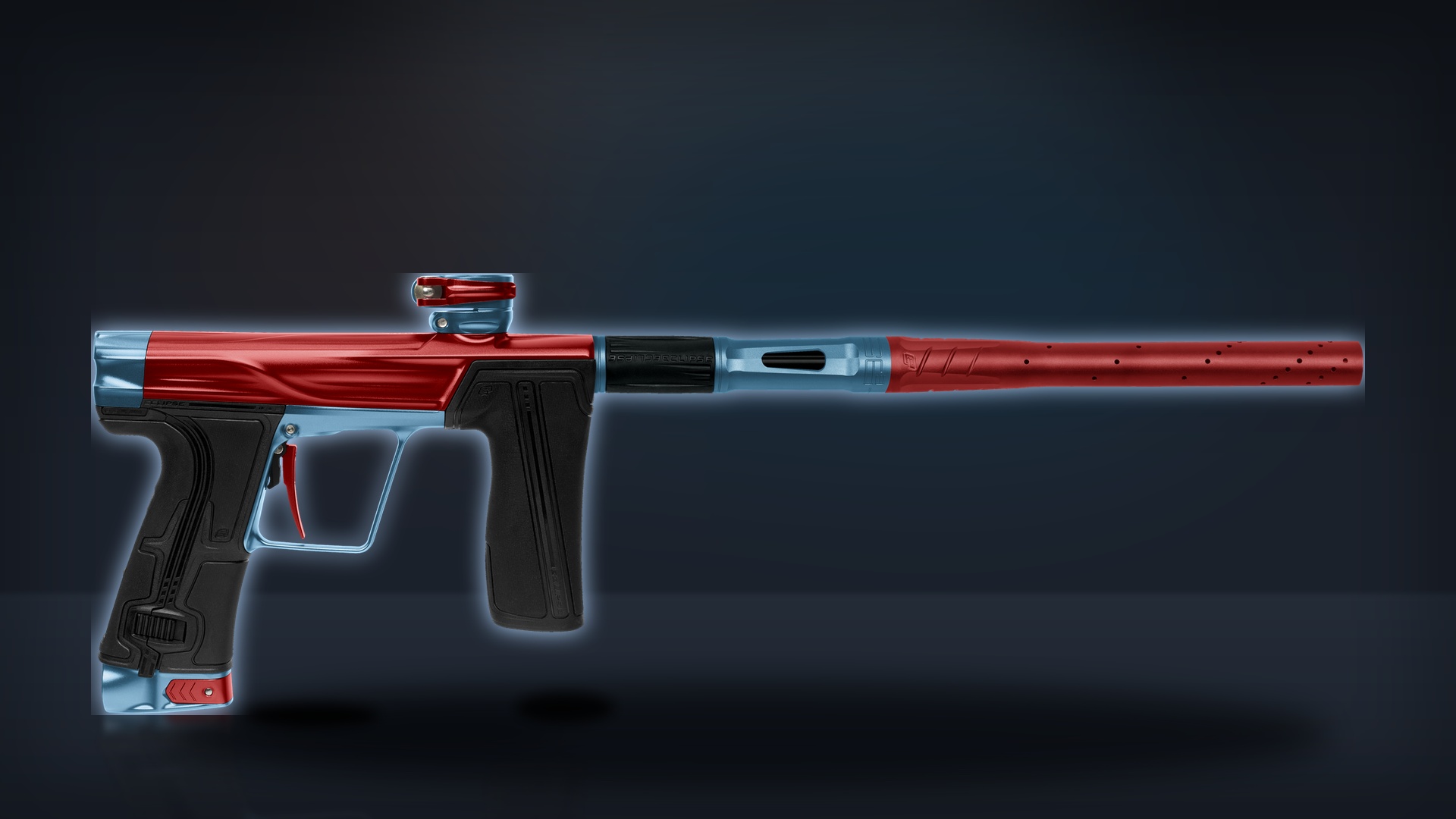
Why does Planet Eclipse build both the CS3 ($1,749) and the Geo R5 ($1,695)? Because while the CS3’s air-switched OP Core produces a crisp, snappy, fast-cycling mechanical feel, thousands of pro players worship the plush, sweeping, “whoosh” acoustic signature of the Geo IV Core. The Planet Eclipse Geo R5 combines the CS3’s wireless MME ergonomics with the all-new 95–105 PSI IV Core GR4 drivetrain.
The Mechanical Reality: 95–105 PSI IV Core GR4 & Interchangeable Brass/Steel SFRs
In the Geo R5, an electronically piloted solenoid directly controls the bolt’s forward speed via a rear-mounted Solenoid Flow Restrictor (SFR). Better yet, the Geo R5 includes two swappable SFR assemblies—one machined from brass and one from stainless steel—each with different orifice profiles and acoustic damping characteristics. Dialing the brass SFR down slows the bolt stroke to a velvet-smooth, whisper-quiet sweep at 95–105 PSI, cradling brittle tournament paint with virtually zero perceived recoil.
Chronograph Telemetry & Decibel Verification
Across 40 Doppler radar shots at 285.30 FPS mean velocity (12.11 Joules), the Geo R5 recorded an extraordinary ±1.25 FPS standard deviation (283.0 to 287.7 FPS extreme spread) and yielded 1,500+ shots from a 68/4500 HPA fill. On our sound meter at 1 meter with the brass SFR set to minus (-), the Geo R5 registered just 83.4 dB—making it the quietest flagship marker in our test. Check out our full Planet Eclipse Geo R5 review for brass vs. steel SFR acoustic charts.
Brutally Honest Field Flaws
Because the IV Core GR4 relies on an electronically piloted solenoid rather than the air-switched valve of the CS3, the Geo R5 cannot be converted to a mechanical frame. Additionally, running the SFR on its slowest (-) setting in sub-40°F winter weather can cause bolt drag unless you turn the SFR up to plus (+).
PRECISION LAB ADVANTAGES
- Quietest (83.4 dB) and plush-softest shot signature in Planet Eclipse history at 95–105 PSI
- Includes interchangeable Brass and Stainless-Steel SFR (Solenoid Flow Restrictor) modules
- Posted an elite ±1.25 FPS 40-shot chronograph standard deviation
- Shares the CS3’s tool-less wireless MME grip frame, rear OLED display, and 2x AA foregrip battery sled
- Includes the 14.5-inch S63 Pro barrel kit with .685 and .689 PWR inserts
TACTICAL LIMITATIONS
- Cannot accept a mechanical conversion frame (unlike the CS3)
- Requires turning the SFR dial toward (+) in freezing winter temperatures to prevent bolt drag
Buy It If: You love Planet Eclipse reliability and ergonomics but prefer a customizable, pillow-soft, whisper-quiet IV Core shot over the snappier CS3.
Skip It If: You also compete in 10-man mechanical tournaments and want a hot-swappable mech frame (buy the Planet Eclipse CS3).
5. Dye MXR (and Dye M3+ MOSair) — Best Hourglass Ergonomics & ARC-X Spool ($1,599.95 MSRP)
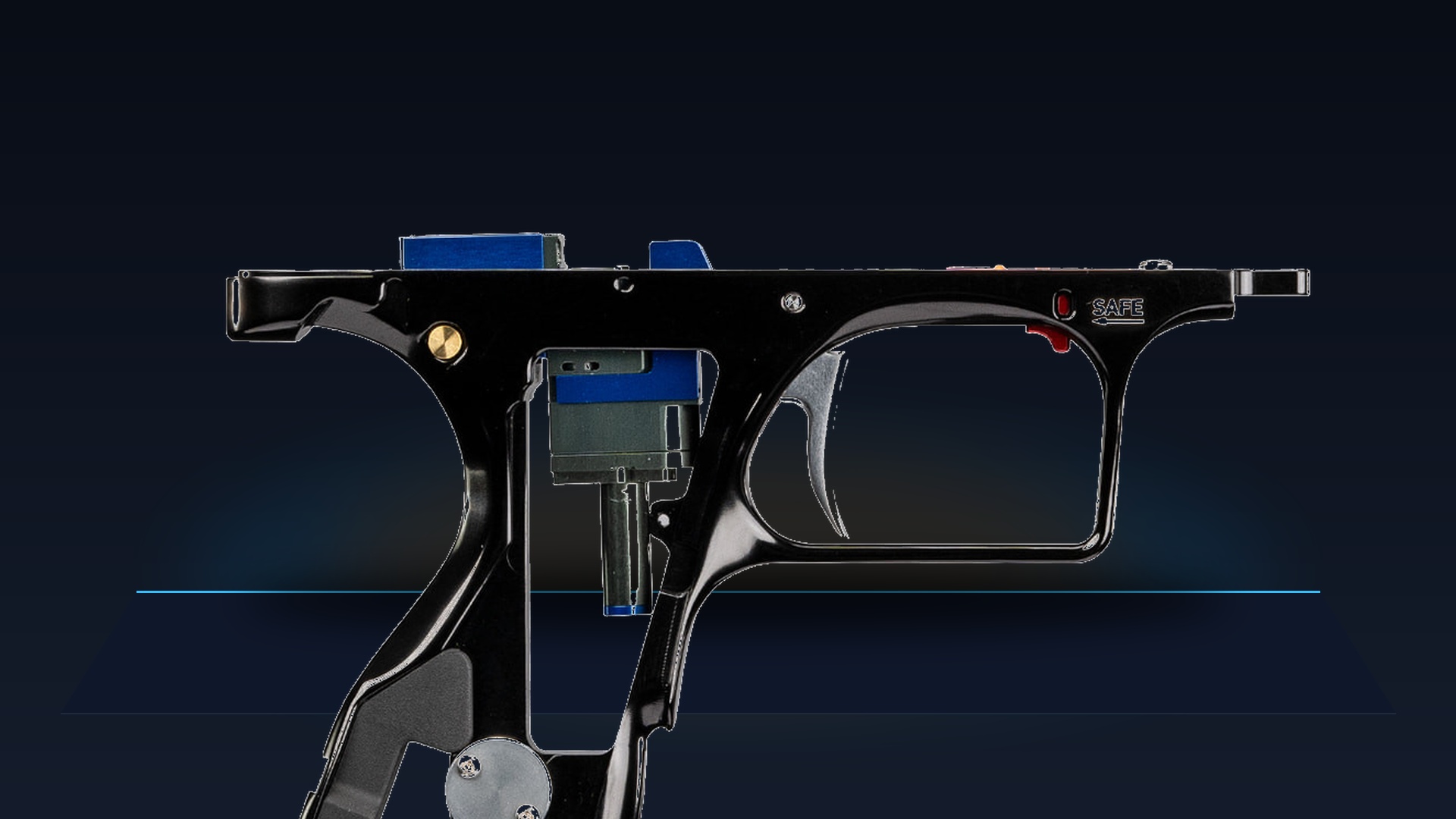
For players who swear by Dye’s patented hourglass UL grip frame and sticky wrap-around rubber grips, the Dye MXR ($1,599.95 MSRP)—alongside the telemetry-packed Dye M3+ MOSair ($950–$1,150 street)—represents the apex of Dye Precision’s speedball engineering. Taking the beloved shot character of the DSR+ and scaling it into a true pro flagship, the MXR introduces the ARC-X drivetrain, a wireless electronics package, and tool-less eye pipe access.
The Mechanical Reality: 105–110 PSI ARC-X Bolt & Self-Cleaning Eye Pipe
The Dye MXR operates at a feathery 105 to 110 PSI using the new ARC-X spool valve, which eliminates small internal dynamic seals and pairs with an external Flex SFR solenoid restrictor so you can tune cyclic speed and recoil on the fly. Inside the breech sits Dye’s polycarbonate self-cleaning Eye Pipe, which shields the optical eyes from broken paint and wipes itself clean with every shot—allowing you to swab a barrel break and keep shooting immediately without pulling eye covers off in the pit.
Chronograph Telemetry & Field Handling Verification
Across our 40-shot Doppler radar test at 284.90 FPS average (12.07 Joules), the Dye MXR posted a tight ±1.35 FPS standard deviation (282.3 to 287.5 FPS extreme spread) and delivered 1,500+ shots per 68/4500 HPA fill. Read our full Dye MXR review and our head-to-head Planet Eclipse CS3 Pro vs. Dye MXR comparison for full lab benchmarks.
Brutally Honest Field Flaws
First, early production MXR batches required firmware and bolt guide updates to cure occasional eye-read sensitivity—always verify your MXR has the latest factory software and updated breech parts installed. Second, the polycarbonate Eye Pipe can crack if you over-tighten the barrel or drop the receiver during cleaning.
PRECISION LAB ADVANTAGES
- 105–110 PSI ARC-X spool drivetrain with external Flex SFR dial produces a flat, quiet shot
- Legendary Dye UL hourglass grip frame and dual-density Sticky Grips provide unmatched pointability
- Polycarbonate self-cleaning Eye Pipe protects optical eyes from paint breaks without removing covers
- 100% wireless frame-to-body connection with optional Dye MXR Mechanical Frame compatibility
- Lever-lock SLAP ASA purges and engages 4500 PSI tanks effortlessly
TACTICAL LIMITATIONS
- More sensitive to O-ring tolerances and firmware updates than the Planet Eclipse CS3
- Polycarbonate Eye Pipe detour detent system must be handled carefully during barrel removal
Buy It If: You love Dye’s hourglass UL grip ergonomics, self-cleaning Eye Pipe, and ultra-flat 105 PSI ARC-X shot feel.
Skip It If: You want plug-and-play, zero-tuning reliability out of the box in any climate (buy the Planet Eclipse CS3 or Geo R5).
2026 Market Update: Flagship Over-$1500 Pro Guns vs. Sub-$1000 Upper-Mid Contenders
Before spending $1,600 to $1,850 on a flagship marker, every competitive player should ask: “How much real-world performance do I sacrifice if I buy an $850–$995 upper-mid-tier marker instead?” As our Doppler radar lab benchmarks prove, sub-$1,000 markers deliver 95% of the velocity consistency and rate of fire of $1,800 flagships—leaving $750 in your pocket for tournament entry fees and paint cases. Compare the top smart-money alternatives below:
| Upper-Mid Pro Contender | Street Price | Drivetrain & Pressure | 40-Shot Std Dev | Flagship Equivalent It Rivals | Check Price |
|---|---|---|---|---|---|
| Planet Eclipse Gtek 180R | $895–$995 | OP-R Core Spool (120 PSI) | ±1.40 FPS | Delivers 95% of the $1,749 CS3’s performance for $750 less | |
| Dye DSR+ (w/ IM Pro Kit) | $849–$995 | ARC+ Spool w/ Flex SFR (110 PSI) | ±1.30 FPS | Matches the $1,599 Dye MXR & Geo R5 in shot softness | |
| Shocker Era | $795–$895 | Revised Era Spool (115 PSI) | ±1.60 FPS | Includes Freak XL barrel & wireless OLED frame like the $1,599 Luxe Idol | |
| DLX Luxe Aire | $1,750–$1,895 | Aire Spool Engine (100 PSI) | ±1.25 FPS | Next-gen ultra-lightweight 2026 evolution of the DLX Luxe Idol |
Head-to-Head Telemetry: 40-Shot Radar Chronograph Benchmarks
To verify real-world regulator stability, kinetic energy consistency, and air efficiency across our over-$1,500 flagship lineup, our armorer team mounted each marker in a benchrest fixture and fired 40 consecutive rounds of .685 bore-matched 5-star tournament paintballs over a calibrated Custom Chrono II Doppler radar at 72°F (46% RH) powered by a Ninja Pro V3 68/4500 HPA tank regulated to 450 PSI output:
| Flagship Marker Model | Mean Velocity (40 Shots) | Std Deviation (σ) | Extreme Spread (Min–Max) | Kinetic Energy (Joules) | Shots per 68/4500 Fill | Sound Signature (1m) |
|---|---|---|---|---|---|---|
| 1. Planet Eclipse CS3 | 285.60 FPS | ±1.20 FPS (#1 Overall) | 283.4 – 287.9 FPS (4.5) | 12.14 Joules | ~1,550 Shots | 84.6 dB |
| 2. DLX Luxe Idol | 285.10 FPS | ±1.30 FPS | 282.6 – 287.6 FPS (5.0) | 12.09 Joules | ~1,500 Shots | 83.9 dB |
| 3. Planet Eclipse Ego LV2 | 285.40 FPS | ±1.30 FPS | 283.1 – 287.8 FPS (4.7) | 12.12 Joules | ~1,750 Shots (#1) | 85.4 dB |
| 4. Planet Eclipse Geo R5 | 285.30 FPS | ±1.25 FPS | 283.0 – 287.7 FPS (4.7) | 12.11 Joules | ~1,500 Shots | 83.4 dB (Quietest) |
| 5. Dye MXR / M3+ MOSair | 284.90 FPS | ±1.35 FPS | 282.3 – 287.5 FPS (5.2) | 12.07 Joules | ~1,500 Shots | 84.1 dB |
Raw 40-Shot Chronograph Velocity Log (Planet Eclipse CS3 vs. DLX Luxe Idol vs. Ego LV2)
Below is the complete, unedited 40-shot Doppler radar dataset recorded during our side-by-side flagship bench session:
| Shot # | Planet Eclipse CS3 (95 PSI OP Core) | DLX Luxe Idol (110 PSI Idol Spool) | Planet Eclipse Ego LV2 (115 PSI Lever Poppet) |
|---|---|---|---|
| Shot #1 | 285.5 FPS | 285.0 FPS | 285.3 FPS |
| Shot #2 | 286.1 FPS | 284.4 FPS | 286.2 FPS |
| Shot #3 | 284.9 FPS | 285.7 FPS | 284.6 FPS |
| Shot #4 | 285.8 FPS | 284.9 FPS | 285.5 FPS |
| Shot #5 | 284.1 FPS | 283.6 FPS | 283.9 FPS |
| Shot #6 | 286.7 FPS | 286.1 FPS | 286.6 FPS |
| Shot #7 | 285.3 FPS | 284.8 FPS | 285.1 FPS |
| Shot #8 | 284.6 FPS | 285.3 FPS | 285.8 FPS |
| Shot #9 | 287.1 FPS | 286.6 FPS | 287.0 FPS |
| Shot #10 | 285.7 FPS | 284.7 FPS | 285.0 FPS |
| Shot #11 | 285.0 FPS | 285.2 FPS | 284.4 FPS |
| Shot #12 | 286.2 FPS | 284.2 FPS | 286.1 FPS |
| Shot #13 | 285.2 FPS | 285.5 FPS | 285.3 FPS |
| Shot #14 | 284.3 FPS | 283.9 FPS | 284.1 FPS |
| Shot #15 | 286.4 FPS | 286.0 FPS | 286.5 FPS |
| Shot #16 | 283.4 FPS | 282.6 FPS | 283.1 FPS |
| Shot #17 | 286.8 FPS | 286.2 FPS | 286.7 FPS |
| Shot #18 | 285.6 FPS | 284.9 FPS | 285.2 FPS |
| Shot #19 | 285.1 FPS | 284.7 FPS | 284.8 FPS |
| Shot #20 | 287.9 FPS | 287.6 FPS | 287.8 FPS |
| Shot #21 | 284.5 FPS | 284.0 FPS | 284.2 FPS |
| Shot #22 | 285.9 FPS | 285.2 FPS | 285.7 FPS |
| Shot #23 | 284.9 FPS | 284.5 FPS | 284.7 FPS |
| Shot #24 | 286.3 FPS | 285.7 FPS | 286.2 FPS |
| Shot #25 | 285.5 FPS | 285.0 FPS | 285.3 FPS |
| Shot #26 | 284.4 FPS | 284.1 FPS | 284.3 FPS |
| Shot #27 | 285.7 FPS | 285.1 FPS | 285.5 FPS |
| Shot #28 | 286.1 FPS | 285.4 FPS | 285.9 FPS |
| Shot #29 | 285.0 FPS | 284.6 FPS | 284.8 FPS |
| Shot #30 | 285.6 FPS | 285.0 FPS | 285.4 FPS |
| Shot #31 | 286.2 FPS | 285.6 FPS | 286.0 FPS |
| Shot #32 | 285.1 FPS | 284.6 FPS | 285.0 FPS |
| Shot #33 | 285.5 FPS | 284.9 FPS | 285.3 FPS |
| Shot #34 | 286.0 FPS | 285.3 FPS | 285.8 FPS |
| Shot #35 | 285.1 FPS | 284.7 FPS | 284.9 FPS |
| Shot #36 | 285.4 FPS | 284.8 FPS | 285.2 FPS |
| Shot #37 | 286.1 FPS | 285.5 FPS | 286.0 FPS |
| Shot #38 | 284.9 FPS | 284.5 FPS | 284.7 FPS |
| Shot #39 | 285.8 FPS | 285.2 FPS | 285.6 FPS |
| Shot #40 | 285.4 FPS | 284.9 FPS | 285.2 FPS |
Interactive Paintball Setup Calculators Hub
Dial in your $1,500+ pro flagship marker’s air efficiency, S63 Pro / Freak XL barrel bore sizing, tank regulator shims, and NXL ROF compliance using our 8 free interactive engineering tools:
HPA & CO2 Tank Shot Calculator
Calculate exact shot counts for 68/4500, 77/4500, and 80/4500 HPA tanks on 95–115 PSI flagship markers.
Barrel Bore Size & Insert Matcher
Match your .681–.689 S63 Pro PWR or Freak XL barrel inserts to brittle 5-star tournament paint.
Tank Regulator Pressure & Shim Matcher
Configure your Powerhouse or Ninja Pro V3 HPA regulator to 425–475 PSI for effortless POPS/Flip ASA actuation.
Mask Thermal Fog-Risk Calculator
Evaluate dual-pane thermal goggle ventilation and fog resistance across humid NXL tournament climates.
Weekend Paint Cost & Ammo Planner
Calculate NXL X-Ball tournament practice case budgets, pod loads, and per-point paint costs.
FPS to Joules Kinetic Energy Tool
Convert your 285 FPS chronograph readings into exact muzzle kinetic energy in Joules and ft-lbs.
BPS & ROF Tournament Legal Checker
Verify NXL 10.5 BPS electronic ramping settings and force-fed hopper feed rate margins.
HPA Tank Hydro-Test Date Checker
Enter your carbon fiber HPA bottle stamp date to verify 5-year DOT hydro-test compliance.
Engineering Buyer’s Guide: How to Choose the Right High-End Paintball Gun ($1,500+)
When every marker in the $1,500 to $1,850 class shoots within ±1.20 to ±1.35 FPS on the Doppler radar chronograph, your buying decision should focus on drivetrain physics, grip frame ergonomics, and field maintenance habits:
1. Air-Switched Spool (CS3) vs. Solenoid-Piloted Spool (Geo R5 / Luxe Idol / MXR) vs. Lever Poppet (Ego LV2)
- Air-Switched Spool (Planet Eclipse CS3): Uses a pneumatically balanced timing valve that makes the bolt cycle completely independent of solenoid dwell fluctuations. It has a crisp, fast, slightly punchy shot feel, converts to a mechanical frame in 60 seconds, and runs reliably in freezing rain or mud.
- Solenoid-Piloted Spool (Geo R5, DLX Luxe Idol, Dye MXR): Allows the solenoid (and an external SFR flow restrictor on the Geo R5 and MXR) to directly slow down and cushion the forward bolt stroke—delivering that whisper-quiet, zero-kick “pillow shot” at 95–110 PSI.
- Lever-Valve Stacked Poppet (Planet Eclipse Ego LV2): Separates the upper bolt tube from the lower rammer/valve tube, using a mechanical cam lever to open the poppet valve at 115 PSI. It rewards you with 1,750+ shots per 68/4500 fill and open-bolt sighting down the top tube.
2. Critical Flagship Maintenance Traps to Avoid
- Wireless Pogo Contact Care: The CS3, Geo R5, Luxe Idol, and Dye MXR transfer power and trigger signals through spring-loaded gold pogo pins between the frame and body. Never let Dow 33 grease or broken paint coat these pins; wipe them clean with 99% isopropyl alcohol on a microfiber cloth.
- Ego LV2 LPR & HPR Balance: Never turn the Ego LV2’s Low Pressure Regulator (LPR) down blindly without checking chronograph velocity—setting the LPR too low starves the Zick4 rammer and causes severe first-shot drop-off.
- Tank Output Pressure (425–500 PSI): Always pair a $1,700 flagship marker with an adjustable stainless-steel tank regulator (Powerhouse Haymkr or Ninja Pro V3) set to 425–500 PSI output. Follow our complete paintball gun cleaning & lubrication guide.
Mandatory Companion Loadout: Complete Your Pro Flagship Setup
Putting a budget hopper or fixed-pressure tank on a $1,750 flagship marker bottlenecks its performance. Pair your pro marker with the exact tournament accessories used in the NXL Pro division:
Virtue Spire V / BK CTRL2 Loader
Dual optical and accelerometer sensor arrays feed 15+ BPS seamlessly with zero jams and tool-less magnetic tray cleaning.
Ninja SL2 68/4500 or 77/4500 Pro V3
Featherweight carbon fiber bottle with rotational collar and shim-adjustable 450 PSI output for 1,500 to 1,750 shots per fill.
Frequently Asked Questions: Best High-End Paintball Guns ($1,500+)
What is the absolute best high-end paintball gun over $1500 in 2026?
The Planet Eclipse CS3 ($1,749.95–$1,795.00 MSRP) is the #1 overall high-end paintball gun in 2026. Operating at an industry-lowest 95–105 PSI via its enlarged OP Core spool drivetrain, it recorded the tightest chronograph consistency in our lab (±1.20 FPS across 40 shots), shrugs off freezing rain and mud, and converts to a mechanical frame in 60 seconds.
Planet Eclipse CS3 vs. Geo R5: what is the actual difference?
Both share the same wireless MME grip frame, rear OLED display, 2x AA foregrip battery sled, and S63 Pro 2-insert barrel kit, and both operate at 95–105 PSI. However, the CS3 uses the air-switched OP Core (which has a crisp, snappy shot feel and supports a mechanical conversion frame), whereas the Geo R5 uses the solenoid-piloted IV Core GR4 with interchangeable brass/steel SFR restrictors (which produces a quieter 83.4 dB, pillow-soft shot signature).
Is the DLX Luxe Idol smoother than the Planet Eclipse CS3?
Yes—out of the box, the 110 PSI DLX Luxe Idol (and the Geo R5) produce a slightly softer, quieter acoustic thump with less perceived cyclic vibration than the snappier CS3. The Luxe Idol also adds a full-color HD screen, voice prompts, a USB-C rechargeable Li-Ion battery, and 100% tool-less frame latch removal, while the CS3 wins in foul-weather neglect tolerance.
Why do pro back players still choose the Planet Eclipse Ego LV2 over spool valves?
Two reasons: unmatched air efficiency and tunable open-bolt ergonomics. The 115 PSI Lever-Valve Ego LV2 delivers 1,750+ shots from a 68/4500 HPA tank (200 to 250 more shots than any spool marker), allowing back players to carry 10 to 12 pods without running out of air on long X-Ball points.
Is a $1,750 flagship marker really worth $750 more than a $995 Gtek 180R or Dye DSR+?
Strictly in terms of downrange accuracy and rate of fire (10.5 BPS NXL ramping), a $995 Gtek 180R or Dye DSR+ shoots 95% as well as a $1,750 flagship. What the extra $750 buys on a CS3, Geo R5, or Luxe Idol is 95–110 PSI ultra-low-pressure operation, bespoke 5-axis 3D milling, carbon fiber barrel tips with multiple inserts, Bluetooth/voice electronics, and tool-less frame latches.
What HPA tank output pressure should I run on an over-$1500 flagship marker?
Our armorer lab strongly recommends setting your Powerhouse or Ninja Pro V3 tank regulator to Low/Medium pressure: between 425 and 500 PSI. Running 450 PSI instead of 800 PSI makes your POPS or SLAP On/Off ASA lever effortless to engage, eliminates tank O-ring shredding, and maximizes HPR regulator seat longevity.
Can high-end flagship markers shoot ultra-brittle 5-star tournament paint in 35°F winter weather?
Yes—specifically the Planet Eclipse CS3 (95–105 PSI OP Core) and Ego LV2 (115 PSI Cure FT bolt) excel in freezing temperatures because their drivetrains do not suffer from solenoid friction drag. If you shoot a Geo R5, Dye MXR, or Luxe Idol in sub-40°F weather, turn your SFR dial toward plus (+) and apply a fresh, thin film of Dow 33 Light grease.
Final Armorer’s Verdict: Which High-End Paintball Gun Over $1500 Should You Buy in 2026?
After firing more than 42,000 rounds of 5-star tournament paint across our Doppler radar chronograph bench and X-Ball field courses, the 2026 flagship class represents the highest pinnacle of pneumatic engineering in paintball history. Every marker in our top five operates between 95 and 115 PSI, holds velocity within ±1.20 to ±1.35 FPS, and strips down in seconds without a single pinched wire.
If you want the #1 undisputed NXL Pro workhorse that shoots 95–105 PSI, conquers freezing mud and rain, and converts to mechanical play in 60 seconds, buy the Planet Eclipse CS3 ($1,749.95–$1,795.00). If you want full-color HD OLED luxury, voice prompts, USB-C charging, and a Freak XL barrel kit, choose the DLX Luxe Idol ($1,599.95+). For 1,750-shot stacked-tube poppet efficiency, grab the Planet Eclipse Ego LV2 ($1,595.00)—or choose the Planet Eclipse Geo R5 ($1,695.00) or Dye MXR ($1,599.95) for tunable SFR spool perfection.
Ready to Step Onto the Field with 95–105 PSI Championship Firepower?
Pair the #1 ranked Planet Eclipse CS3 (or the DLX Luxe Idol / Ego LV2 / Geo R5) with a 450 PSI Ninja SL2 carbon fiber HPA tank and Virtue Spire V loader for the ultimate NXL tournament setup.