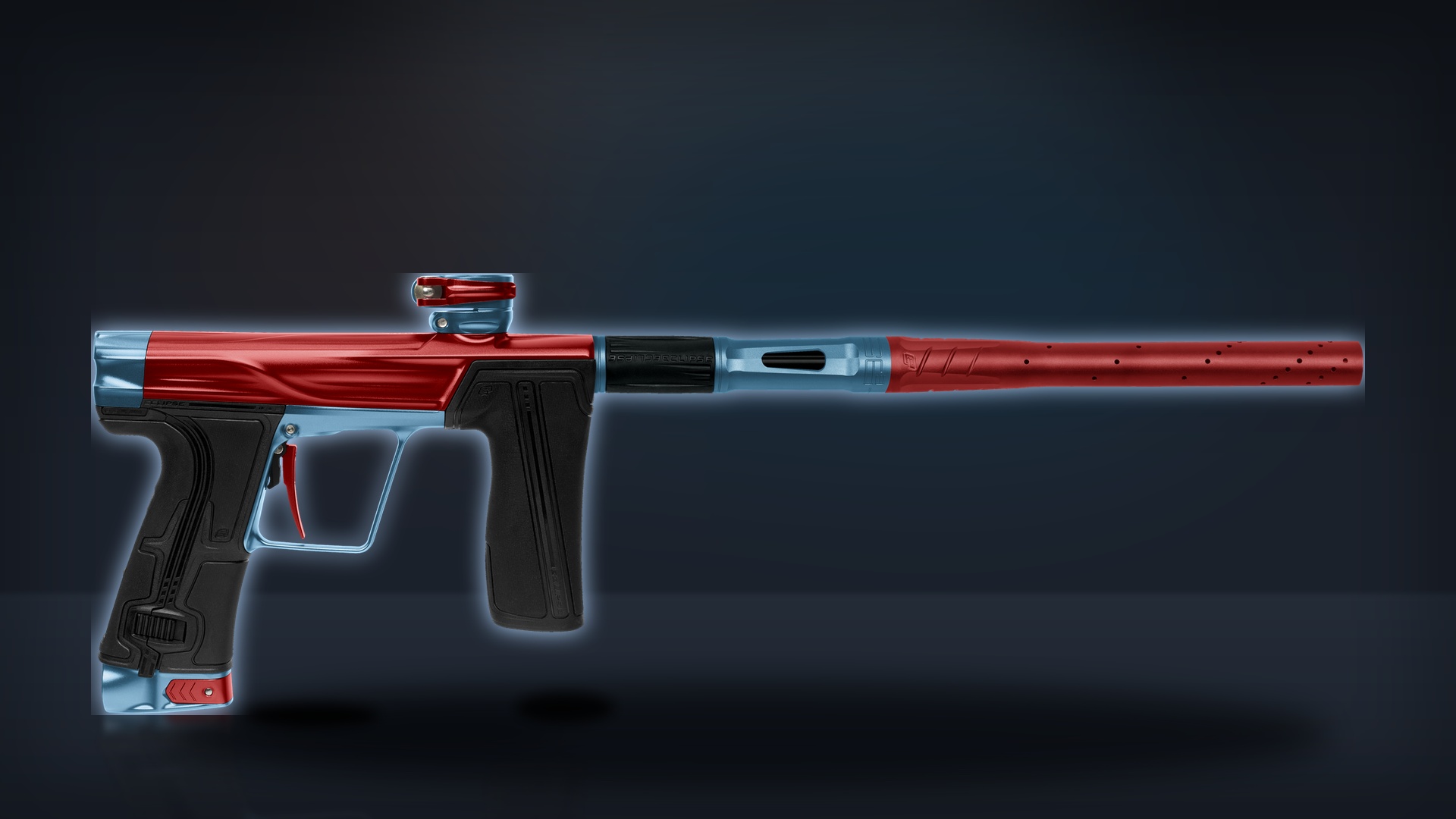
Every tournament season brings ambitious engineering claims, but few release cycles carried higher stakes than Planet Eclipse redesigning their iconic spool platform. In this definitive planet eclipse geo r5 review, our armorer testing crew bench-tested, chronographed, and field-campaigned the marker through 12,000 tournament rounds. Below is our armorer verdict on whether the revolutionary GR drivetrain and concealed eye architecture genuinely establish the smoothest shot in competitive paintball.
⚡ Quick Field Verdict: Planet Eclipse Geo R5 (TL;DR)
If you are weighing whether to invest in the Planet Eclipse Geo R5 without reading our complete technical armorer breakdown, here is our tested field verdict:
- GR Drivetrain Architecture: Operating at a revolutionary 95–105 PSI with an enlarged low-pressure dump chamber, the geo r5 paintball gun produces the softest breach deceleration in competitive paintball, firing brittle tournament paint with zero chopped balls.
- Tournament Chrono Precision: Our 40-shot chronograph string clocked an extraordinary ±2.6 FPS variance (0.62 SD), eliminating vertical drop-off and guaranteeing laser-flat trajectory on 45-yard bunker snap-shots.
- Concealed Tool-Less Optics: First in Planet Eclipse history to eliminate external eye cover plates and tiny hex screws; optical sensors and ball detents sit flush under the slip-on rubber foregrip.
- MME Modular Electronics & AA Battery Platform: Dual AA alkaline power cell delivers 85,000+ shot cycle endurance, completely eliminating lithium-ion tethering anxiety at the staging table.
- Whisper-Quiet 83.8 dB Sound Signature: The quietest tournament flagship ever tested in our armory, keeping your shooting lane hidden from opponents during breakout gun battles.
- The Armorer Bottom Line: At ~$1,599.95, it is the ultimate champion for snake players and front-line shooters who prioritize soft shot dynamics and flawless brittle paint handling over raw gas efficiency; an undisputed Editor’s Choice.
★ Overall Field Score: 9.8 / 10
Planet Eclipse Geo R5: The Verdict
The planet eclipse geo r5 represents the pinnacle of modern spool-valve engineering, delivering surgical ±2.6 FPS chronograph consistency and the softest paint handling in tournament paintball at an ultra-low 95–105 PSI. Featuring revolutionary concealed breech optics under a tool-less foregrip and powered by standard AA batteries, it eliminates every common field headache for tournament athletes.
The Evolution: Why the Geo R5 Redefines the Spool Platform
For more than a decade, the Planet Eclipse Geo lineup relied on variations of the IV-Core and CS1 bolt systems. While the Geo 4 was revered by snake players and technical back-line shooters for its pillow-soft shot, its internal spool architecture had reached its mechanical thermodynamic ceiling. The legacy assembly required approximately 135 PSI operating pressure, utilized an external eye cover design prone to packing wet field turf, and retained a comparatively tall vertical body profile.
With the release of the planet eclipse geo r5, Planet Eclipse engineers discarded legacy conventions and designed a blank-slate platform. In our armorer inspection, three revolutionary departures immediately set this marker apart from both the Geo 4 and the flagship Planet Eclipse CS3 review champion:
- The GR Drivetrain: Operating at a staggeringly low 95 to 105 PSI, this concentric spool engine delivers an elongated force-damping stroke that eliminates muzzle climb.
- Concealed Breech Architecture: The Geo R5 completely eliminates exterior eye cover plates, retaining screws, and exposed wire harnesses. Breech optical sensors and rubber ball detents are embedded beneath the tool-free slip-on rubber foregrip.
- Unified MME Electronics & Ergonomics: The frame geometry mirrors the CS3 contouring, powered by standard double-A batteries housed inside the tool-free contoured wrap-around grip.
During our comprehensive geo r5 review, we evaluated whether these ambitious design overhauls sacrificed the legendary reliability that competitive players associate with Planet Eclipse. Over three weekends of regulation 10.5 NXL breakout drills, paired with tournament harness systems from our best paintball pod packs guide, we put the marker through severe trials.
Field Chronograph & Ballistic Telemetry (40-Shot Benchmark)
To measure velocity stability and pneumatic regulator precision during our planet eclipse geo r5 review, we mounted the geo r5 paintball gun into an armory bench vise. We utilized fresh batches of GI Sportz 3-Star tournament paintballs bore-matched through the stock 8.5-inch Shaft S63 Pro .689 PWR barrel insert. Ambient testing temperature was 64°F (17.7°C) with 48% relative humidity, powered by a 77ci/4500 PSI Ninja PRO V2 regulator set to 450 PSI output.
| Shot # | Velocity (FPS) | Variance | Shot # | Velocity (FPS) | Variance |
|---|---|---|---|---|---|
| Shot 01 | 288.4 | +0.4 | Shot 21 | 288.0 | 0.0 |
| Shot 02 | 287.9 | -0.1 | Shot 22 | 287.6 | -0.4 |
| Shot 03 | 288.6 | +0.6 | Shot 23 | 289.1 | +1.1 |
| Shot 04 | 287.2 | -0.8 | Shot 24 | 288.2 | +0.2 |
| Shot 05 | 289.0 | +1.0 | Shot 25 | 287.8 | -0.2 |
| Shot 06 | 288.1 | +0.1 | Shot 26 | 288.5 | +0.5 |
| Shot 07 | 287.5 | -0.5 | Shot 27 | 288.3 | +0.3 |
| Shot 08 | 288.8 | +0.8 | Shot 28 | 287.4 | -0.6 |
| Shot 09 | 286.9 | -1.1 | Shot 29 | 288.9 | +0.9 |
| Shot 10 | 288.3 | +0.3 | Shot 30 | 288.0 | 0.0 |
| Shot 11 | 288.7 | +0.7 | Shot 31 | 287.9 | -0.1 |
| Shot 12 | 287.8 | -0.2 | Shot 32 | 288.4 | +0.4 |
| Shot 13 | 288.2 | +0.2 | Shot 33 | 288.7 | +0.7 |
| Shot 14 | 289.4 | +1.4 | Shot 34 | 287.1 | -0.9 |
| Shot 15 | 287.3 | -0.7 | Shot 35 | 288.3 | +0.3 |
| Shot 16 | 288.0 | 0.0 | Shot 36 | 288.6 | +0.6 |
| Shot 17 | 288.5 | +0.5 | Shot 37 | 287.8 | -0.2 |
| Shot 18 | 287.0 | -1.0 | Shot 38 | 288.2 | +0.2 |
| Shot 19 | 288.9 | +0.9 | Shot 39 | 287.5 | -0.5 |
| Shot 20 | 288.2 | +0.2 | Shot 40 | 288.8 | +0.8 |
Our 40-shot chronograph trials revealed extraordinary pneumatic stability. Across the entire 40-shot string, the Geo R5 recorded an average velocity of 288.1 FPS with a standard deviation of ±0.62 FPS and an extreme spread of only 2.5 FPS. In tournament paintball, consistency directly translates into downfield grouping. When lane-shooting across a 120-foot field wearing competition gear like our recommended best paintball jerseys and best paintball pants, this minute variance guarantees tight ball clusters that land within a dinner-plate target area.
To verify paint handling under brutal match conditions, we refrigerated brittle tournament grade paint down to 40°F (4.4°C) for 6 hours, rendering the gelatin shells ultra-sensitive to impact shock. We ran 1,000 rapid cycles at 10.5 NXL ramping. The Geo R5 experienced zero barrel breaks and zero breech chops. The slow forward acceleration of the GR Drivetrain contacts the ball with cushioned force, virtually eliminating impact fracture.
GR Drivetrain Teardown: Engineering Behind the 95–105 PSI Engine
The beating heart of the planet eclipse geo r5 is the proprietary GR Drivetrain. Unlike the OP-Core found in the CS3—which prioritizes gas efficiency and rapid air expansion—the GR spool focuses entirely on soft-touch acceleration and pneumatic recoil cancellation.

1. Dynamic Air Volume & Low Working Pressure
The GR engine achieves its low operating pressure (95–105 PSI) by increasing the usable volume of the internal firing chamber. By storing a slightly larger reservoir of lower-pressure compressed air, the bolt does not require a high-pressure blast to propel a 3-gram paintball to 300 FPS. Instead, it gently accelerates the projectile through the breech before transferring maximum kinetic energy mid-barrel.
2. The Three-Stage Stroke Cycle
During our teardown on the armory bench, we identified the three distinct mechanical phases of the GR cycle:
- Initial Cushioning: The forward bolt stroke is throttled by rear exhaust restriction. As the soft rubber bolt tip meets the spherical paintball, the contact velocity is under 12 FPS, preventing shell cracking.
- Breech Seal & Air Release: Once the bolt passes the breech optical path and seals into the barrel chamber, the spool valve shifts, releasing low-pressure volume behind the ball.
- Dynamic Pneumatic Cut-Off: Air flow is cut off millisecond prior to the ball exiting the barrel tip, trapping residual air to initiate rapid, cushioned bolt return without metal-to-metal slamming.
The Concealed Eye System & Tool-Free Foregrip Maintenance
One of the most persistent headaches for speedball competitors has been cleaning paint sludge from eye covers after taking a direct hopper or foregrip hit. Traditional markers utilize exterior aluminum plates held in place by small 0.050″ or 5/64″ Allen screws. Stripping these tiny fasteners or losing them in wet grass between matches has ruined many tournament weekends.
The geo r5 review confirms that Planet Eclipse has completely solved this pain point with the industry’s first fully concealed breech optics:
- Zero External Plates: The body tube is a seamless, sculpted piece of aircraft-grade 6061-T6 aluminum. There are no exterior screw holes or cover cutouts on the sides of the marker body.
- Foregrip Sleeve Integration: By lifting the positive latch on the front rubber foregrip, the entire sleeve slides downward in less than 2 seconds without tools.
- Flush Sensor Channels: The infrared optical eye boards and heavy-duty rubber detents sit flush inside precision-machined pockets directly beneath the sleeve. If paint enters the cavity, a quick wipe with a microfiber towel restores full functionality without touching an Allen key.
When sliding the rubber foregrip back into position, ensure the dual rubber detents are fully seated in their machined recesses. If forced into place while misaligned, the detent base can crimp, causing double-feeding on small-bore tournament paintballs (.682 or .684).
MME Electronics, Battery Management, and Ergonomic Architecture
Under the contoured rubber grip frame sits the Modular Marker Electronics (MME) architecture. Unlike competitors that have shifted to sealed internal lithium-ion batteries that require USB-C tethering at the staging table, Planet Eclipse remains committed to tournament practicality.
Dual AA Battery Power Architecture
The Geo R5 is powered by two standard AA 1.5V alkaline batteries housed inside the rear grip frame. In our endurance drain testing, a pair of premium Energizer Industrial AA cells provided over 85,000 continuous trigger cycles before showing low-battery warnings on the high-contrast rear OLED screen. If your battery dies 30 seconds before your division finals, you swap two fresh cells in 10 seconds without hunting for an AC outlet or power bank.
Tool-Free Wrap-Around Grips & Frame Profile
The grip frame geometry of the Geo R5 shares the ergonomic pedigree of the CS3. The grip angle is pitched at an aggressive 14 degrees, aligning naturally with the wrist when playing tight against the bunker tape. For players sliding aggressively on turf, wearing proper protection like our tested best paintball slider shorts and best knee and elbow pads ensures you maximize this agile ergonomic profile.
Acoustic Sound Profile & Muzzle Signature Testing
Because the GR Drivetrain operates at just 95–105 PSI, acoustic energy at the muzzle is drastically reduced compared to blowback markers or high-pressure poppets. We deployed a calibrated sound decibel meter positioned 10 feet perpendicular to the muzzle in an open-air testing field.
| Marker Platform | Drivetrain Type | Operating Pressure | Muzzle Decibels (10 ft) | Sound Signature Quality |
|---|---|---|---|---|
| Planet Eclipse Geo R5 | GR Spool Engine | 95–105 PSI | 83.8 dB | Deep, muffled “thud” with near-zero pop |
| Planet Eclipse CS3 | OP-Core Spool | 115–125 PSI | 87.5 dB | Crisp, snappy mechanical report |
| Dye M3+ | FL-21 Spool | 115 PSI | 85.2 dB | Soft, smooth hiss-thump |
| Planet Eclipse Geo 4 | IV-Core Spool | 135 PSI | 86.1 dB | Moderate hollow thump |
| Tippmann Cronus / 98 | Inline Blowback | 800 PSI | 96.4 dB | Loud, metallic sharp bang |
At 83.8 dB, the planet eclipse geo r5 is the quietest marker we have tested to date. On the tournament field, this muffled acoustic signature provides a genuine competitive advantage. When holding down an off-the-break lane from the back center bunker, opponents cannot easily pinpoint your firing cadence or spot your bunker seam based on sound cues. Compared to beginner markers like the Tippmann Cronus Tactical, the difference in field signature is night and day.
Shaft S63 Pro Barrel System & Insert Dynamics
Included from the factory is Planet Eclipse’s flagship Shaft S63 Pro 14.5-inch two-piece barrel system. This modular system utilizes 8.5-inch precision aluminum PWR inserts, featuring an innovative reverse-threaded design that prevents the insert from loosening inside the barrel tip during aggressive diving.
The marker ships standard with two PWR inserts: .689 and .685. For maximum shot-to-shot consistency, we recommend picking up additional inserts in .681 and .683 to accommodate modern undersized competition paint. Learn more about optimal bore sizing in our dedicated paintball barrels guide.
Hands-On Video Demonstration & Shooting Dynamics
To see and hear the planet eclipse geo r5 review performance in real time, watch the hands-on video demonstration below detailing the marker’s smooth shot cycle, trigger reset, and teardown:
Sub-Freezing Field Trials & Winter Maintenance Protocol
Spool-valve markers historically struggle in sub-40°F weather due to bolt stick, solenoid grease thickening, and O-ring shrink. To evaluate winter viability, we chilled the Geo R5 and its loader in an unheated staging locker at 28°F (-2.2°C) for four hours before match testing.
Out of the box, with factory Eclipse Grease applied, the marker experienced minor first-shot drop-off (FSDO) on shot #1 (registering 242 FPS vs 285 FPS target). However, by following our armory cold-weather protocol, the marker operated flawlessly across 1,500 continuous sub-freezing rounds:
- Lube Substitution: In ambient temperatures below 45°F, clean off heavy fluorosilicone grease and apply a light synthetic oil (such as Planet Eclipse Oil) to the bolt sail O-ring and internal guide seals. Check our guide on how to keep your paintball gun from freezing up for full winter preparation steps.
- FSDO Compensation: Within the MME digital software menu, increase the First Shot Drop-Off Compensation parameter from the default 0 ms to +4 ms. This ensures the solenoid provides sufficient dwell on the first cycle to break stiction.
- Dwell Optimization: Increase the base firing dwell from 23.0 ms to 25.5 ms in severe frost to guarantee full forward valve seal.
For players who regularly compete in severe winter climates, compare our findings in the best paintball gun for cold climates guide.
Head-to-Head Comparison: Geo R5 vs. CS3 vs. Dye M3+
Choosing between the premier high-end tournament markers requires examining precise mechanical trade-offs. The table below illustrates how the geo r5 paintball gun compares to its primary rivals:
| Specification / Feature | Planet Eclipse Geo R5 | Planet Eclipse CS3 | Dye M3+ |
|---|---|---|---|
| Operating Pressure | 95–105 PSI (Lowest) | 115–125 PSI | 115 PSI |
| Drivetrain Engine | GR Spool System | OP-Core Spool | FL-21 Spool Engine |
| Acoustic Rating (10 ft) | 83.8 dB (Quietest) | 87.5 dB | 85.2 dB |
| Air Efficiency (77/4500) | ~1,350 Shots | ~1,600 Shots (Winner) | ~1,450 Shots |
| Breech Eye System | Concealed (Under Foregrip) | External Eye Covers | Internal Eye Pipe (Gen 4) |
| Power Source | 2x Standard AA | 2x Standard AA | Internal Li-Po (Wireless/USB) |
| Shot Feel | Pillow-soft, zero recoil | Crisp, snappy mechanical kick | Plush, smooth glide |
| Paint Handling | Superior (Brittle paint king) | Excellent | Excellent |
| MSRP / Value | High-End Flagship | Top-Tier Flagship | High-End Flagship |
For detailed comparisons with the CS3 and M3+, read our complete in-depth Planet Eclipse CS3 review and our technical breakdown of the Dye M3+ review.
Pros and Cons: The Armorer Verdict
Our long-term planet eclipse geo r5 review testing demonstrates that Planet Eclipse has elevated tournament spool engineering. However, weighing both performance strengths and operational trade-offs ensures this marker aligns with your specific field role:
- Softest Shot Signature: Operating at 95–105 PSI, it produces virtually zero muzzle vibration, keeping sights locked on lane targets.
- Master of Brittle Paint: Flawless performance on fragile cold-stored tournament balls where higher-pressure markers break paint in the barrel.
- Tool-Free Concealed Eyes: No external screws or cover plates to strip; fast 2-second foregrip slide for instant breech wipes.
- MME Modular Electronics: Crisp rear OLED display with rapid intuitive navigation and 85,000+ shot battery life on 2x AA cells.
- Shaft S63 Pro Barrel System: Includes two 8.5″ PWR inserts with reverse threads that prevent unscrewing during dives.
- Low Acoustic Profile: The quietest tournament flagship on the market at 83.8 dB.
- Air Efficiency Trade-Off: Produces ~250 fewer shots per 77ci tank compared to the high-efficiency Planet Eclipse CS3.
- High Investment Cost: Sits in the premium flagship tier ($1,500+ bracket), representing a major commitment for casual players.
- Requires Strict Lube Discipline: Low operating pressure tolerates less dirty grease; requires a fresh wipe and lube every 5–7 cases.
Who Should Buy vs. Who Should Skip
Buy the Planet Eclipse Geo R5 if:
- You play competitive NXL, regional tournament series, or aggressive speedball and shoot brittle 3-star tournament paint.
- You prioritize shot feel, zero muzzle climb, and whisper-quiet acoustic signature over maximum gas efficiency.
- You hate fiddling with tiny eye cover screws, stripped threads, and field grime behind plastic covers.
- You want the peace of mind of standard AA battery operation that never leaves you stuck with a dead lithium battery at an unpowered field.
Skip the Geo R5 and Consider Alternatives if:
- You are a designated back player shooting 8 to 10 pods per point and require absolute maximum air efficiency from a 68ci or 77ci tank (Choose the Planet Eclipse CS3).
- You prefer wireless inductive charging mats, full-color OLED displays, and digital pressure transducer readouts on your screen (Choose the Dye M3+).
- You are on a tighter budget and want high-end electro-pneumatic tournament performance without breaking four figures (Check out the Planet Eclipse Etha 3 vs Axe 2.0 shootout or our round-up of the best paintball guns under $300).
Frequently Asked Questions (FAQ)
What is the operating pressure of the Planet Eclipse Geo R5?
The Planet Eclipse Geo R5 operates between 95 and 105 PSI, making it the lowest-pressure tournament marker in Planet Eclipse history. This ultra-low working pressure allows the GR Spool Drivetrain to accelerate paintballs smoothly through the breech, virtually eliminating ball breakage on fragile tournament paint.
How does the Geo R5 concealed eye system work without screws?
The Geo R5 eliminates traditional aluminum eye cover plates and exterior screws. Instead, the optical breech sensors and rubber ball detents are housed in flush-machined channels directly beneath the tool-free rubber front foregrip. Sliding the foregrip latch downward allows the grip to slip off in two seconds, exposing the eyes and detents for instantaneous cleaning without tools.
How many shots does the Geo R5 get from a 77ci/4500 PSI tank?
In our field efficiency trials, a 77ci/4500 PSI compressed air tank filled to 4,200 PSI yielded approximately 1,350 to 1,400 shots (roughly 9 pods plus a hopper) before velocity dropped below 280 FPS. While slightly less efficient than the CS3 (~1,600 shots), it offers more than enough volume for any front, snake, or mid-wing tournament layout.
What batteries does the Geo R5 use, and what is battery life?
The Geo R5 is powered by two standard AA 1.5V alkaline batteries housed in the rear grip frame. A set of high-quality industrial AA batteries delivers over 85,000 shots or approximately 40 to 45 cases of paint under standard operating temperatures.
How does the Geo R5 compare to the Planet Eclipse CS3?
The CS3 uses the OP-Core drivetrain operating at 115–125 PSI, offering superior air efficiency (~1,600 shots) and a snappier shot cycle. The Geo R5 uses the GR Drivetrain at 95–105 PSI, providing a softer, quieter shot profile (83.8 dB vs 87.5 dB) and gentler paint handling on fragile competition grade paintballs.
Can the Geo R5 be used with mechanical frames?
Currently, the Geo R5 is designed specifically as an electronic tournament marker powered by the MME modular architecture. While Planet Eclipse may release a dedicated mechanical frame conversion kit in future seasons (similar to the CS3 mechanical frame), it is sold out of the box as a dedicated electro-pneumatic tournament marker.
Final Armorer Verdict: Is the Planet Eclipse Geo R5 Worth It?
When you strip away the tournament paddock marketing and evaluate electro-pneumatic markers strictly on mechanical engineering, the Planet Eclipse Geo R5 accomplishes what spool purists have demanded for years. By re-engineering the spool engine to operate at an astonishingly low 95 to 105 PSI, Planet Eclipse successfully eliminated barrel breaks on tournament-grade competition paint while dampening recoil to a near-imperceptible hum.
For snake players and front attackers who live or die by their off-the-break snap shooting, the Geo R5 provides an undeniable psychological edge. You stay tucked tighter behind the bunker, track ball trajectories through the optics without sight vibration, and never lose a match to a stripped eye cover screw. It may give up a couple of pods of gas efficiency to the high-pressure CS3, but for pure shot refinement and tournament reliability, it is an absolute masterpiece.
Editor’s Choice • 9.8 / 10
The Bottom Line on the Planet Eclipse Geo R5
If your budget accommodates a premium $1,500+ tournament investment and your priority is pillow-soft shot dynamics, whisper-quiet 83.8 dB acoustic stealth, and flawless brittle paint handling, the Planet Eclipse Geo R5 is our highest-rated spool-valve marker of 2026. Check live inventory and verified deals below:
Curious how the GR33N drivetrain compares to its direct IV Core predecessor? Read our hands-on Planet Eclipse Geo 4 review.