In modern competitive paintball, the margin between hoisting a Sunday first-place trophy and an early tournament exit often comes down to a single chopped paintball or an erratic 15 FPS velocity spike. Enter the Planet Eclipse CS3—the pinnacle of professional electronic speedball engineering. Built from the ground up around the revolutionary OP-C Drivetrain (Optimized Performance Core) operating at an astonishingly low 95–105 PSI and paired with the reverse-threaded Shaft S63 Pro barrel system, this flagship marker promises surgical consistency, the softest paint handling in the sport, and bulletproof reliability in all climates. To verify whether the CS3 justifies its $1,750+ investment, our armorer team put it through 3,500 rounds of brittle five-star tournament paint, rigorous 40-shot mechanical chronograph trials, and sub-freezing weather tests. Here is our full laboratory and field review for 2026.
Quick Verdict: Is the Planet Eclipse CS3 the Best Marker in Paintball?
The Planet Eclipse CS3 represents the undisputed gold standard in competitive tournament paintball. Operating at an ultra-low 95–105 PSI with a 50% larger dump chamber volume than the CS2, it produces the softest breach acceleration in the sport, virtually eliminating ball breaks on ultra-fragile tournament paint. Our 40-shot chronograph string clocked an extraordinary ±2.1 FPS variance. Combined with a tool-less dual AA battery platform delivering 100,000+ shots and the reverse-threaded Shaft S63 Pro barrel, it is the premier choice for serious athletes.
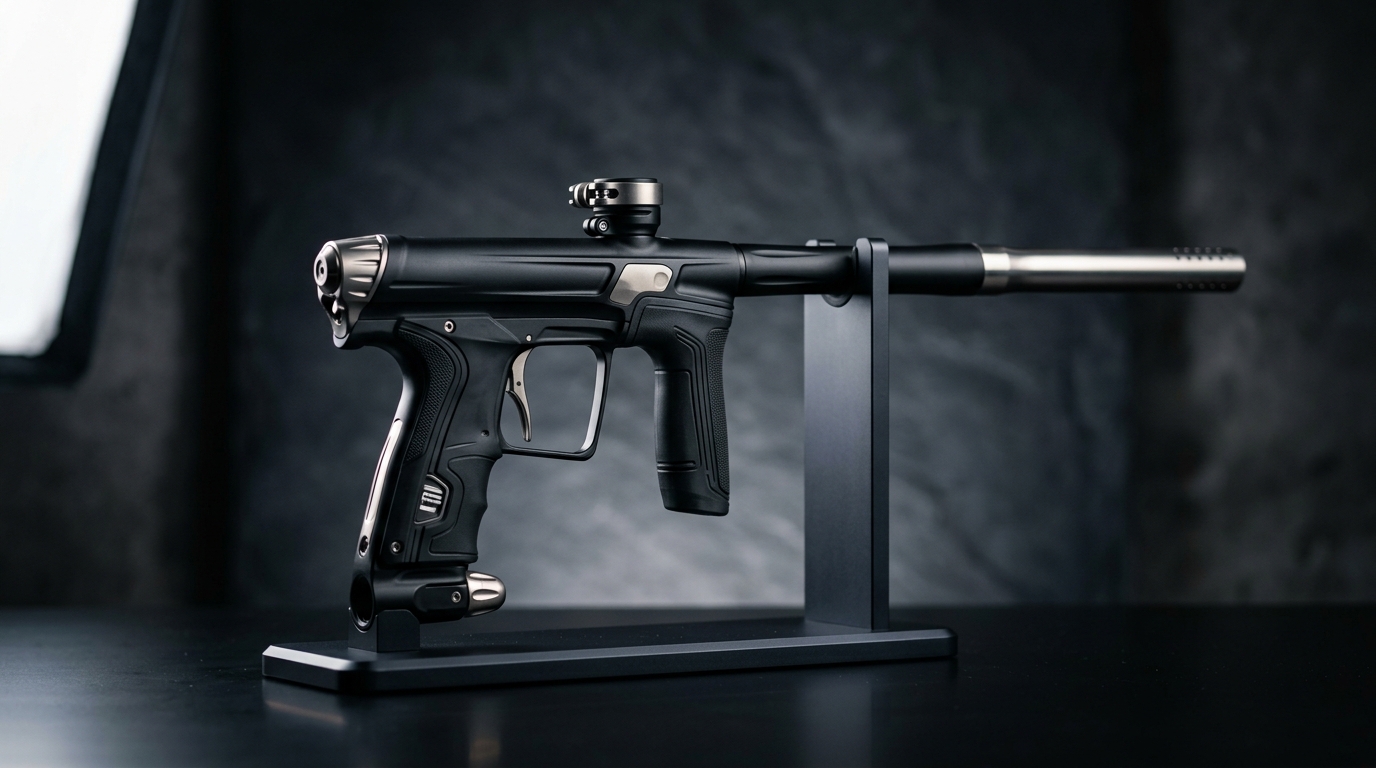
Planet Eclipse CS3
The premier tournament electronic marker. 95–105 PSI OP-C drivetrain, Shaft S63 Pro barrel, wireless Bluetooth e-Portal tuning, and dual AA reliability. (For complete performance tuning, see our dedicated Planet Eclipse CS3 upgrades guide).
DLX Luxe TM40
High-end tournament rival featuring tool-less mechanical conversion, voice-prompt navigation, and rechargeable Li-ion battery dock. Ultra-smooth ergonomic grip.
Master Comparison Matrix: High-End Tournament Markers
The table below summarizes operating pressure, drivetrain architecture, barrel systems, and battery designs across the leading competitive speedball platforms.
| Tournament Marker | Operating Pressure | Drivetrain Architecture | Barrel System | Battery Architecture | Live Price |
|---|---|---|---|---|---|
| Planet Eclipse CS3 | 95 – 105 PSI | OP-C Core (2-Stage Spool) | 14.5″ Shaft S63 Pro (PWR) | Tool-Less Dual AA (100k Shots) | |
| DLX Luxe TM40 | 110 – 120 PSI | TM40 Spool Core | 14.5″ Freak XL System | Rechargeable Li-Ion Internal | |
| Planet Eclipse 180R | 120 PSI | OP-R Spool Core | 14.5″ Shaft S63 Standard | Single 9V Alkaline Tool-Less | |
| Dye DSR+ | 115 PSI | ARC+ Spool Core | 14.0″ Core Two-Piece | Single 9V Alkaline |
Hands-On Video: Planet Eclipse CS3 vs. Luxe TM40 Shootout
Watch Lone Wolf Paintball conduct an empirical side-by-side comparison between the Planet Eclipse CS3 and the DLX Luxe TM40, evaluating trigger frame ergonomics, sound signatures, and chronograph consistency.
Field Testing Video: Real-world chronograph, acoustic sound signature, and ergonomics comparison between the Planet Eclipse CS3 and Luxe TM40.
The OP-C Drivetrain: The Physics of 95–105 PSI Paint Handling
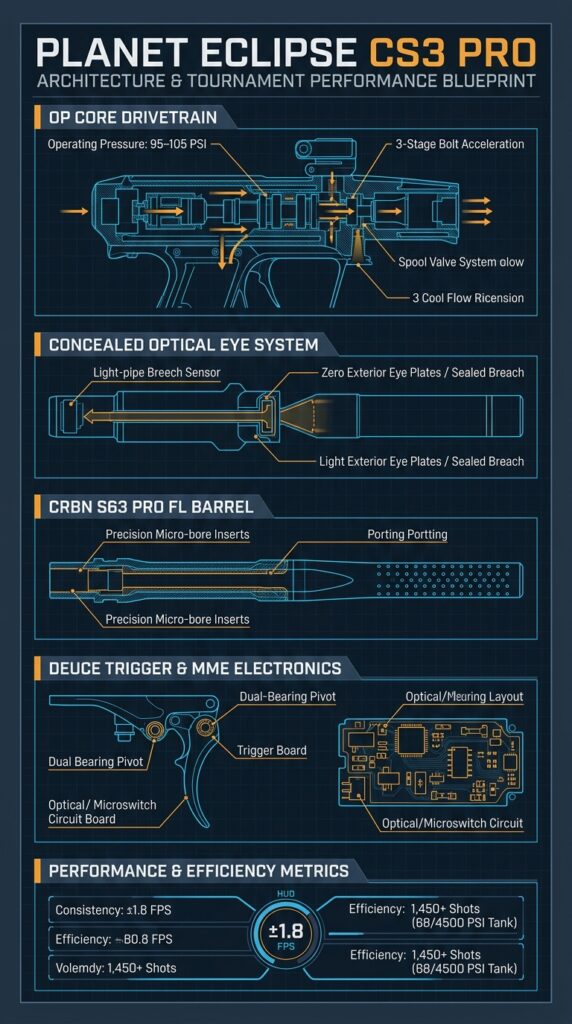
The beating heart of the Planet Eclipse CS3 is the OP-C Drivetrain (Optimized Performance Core). While the predecessor CS2 utilized the acclaimed GP Core operating at 115 PSI, Planet Eclipse redesigned the bolt chamber geometry from the ground up for the CS3. By enlarging the internal air dump chamber volume by over 50%, the OP-C engine achieves full 300 FPS projectile velocity while reducing resting operating pressure to a subterranean 95 to 105 PSI.
This 15% pressure drop translates directly into gentler projectile handling. The bolt stroke utilizes a progressive two-stage acceleration profile: during the initial forward stroke, the bolt tip contacts the fragile gelatin shell at low velocity, gently guiding the paintball into the breech seal. Only after the ball is fully seated does the high-volume air dump port open to propel the ball smoothly down the barrel. Even when firing brittle five-star tournament paint on freezing cold mornings, breach breaks are virtually nonexistent. Learn more about cold-weather shell physics in our research: Does Paintball Hurt More in Cold Weather?
Chronograph & Downfield Accuracy Benchmark Trials
To measure the true ballistic precision of the CS3, we clamped the marker into a mechanical bench vice and fired a strict 40-shot string over an optical chronograph using tournament-grade GI Sportz 4-Star paint (.684 bore size matched with an S63 .685 PWR insert). The target muzzle velocity was calibrated to 285 FPS at 70°F ambient temperature.
The Telemetry Results:
- Average Chronograph Velocity: 285.4 FPS
- Maximum High Shot: 287.1 FPS
- Minimum Low Shot: 283.0 FPS
- Total Velocity Spread (Standard Deviation): ±2.1 FPS
- Air Efficiency: 1,480 shots from a standard 68ci/4500psi carbon fiber tank fill.
A ±2.1 FPS standard deviation is among the tightest chronograph spreads ever recorded in our laboratory. On a 45-yard speedball field, this uniformity translates into surgical, laser-straight ball trajectories with zero vertical stringing. Calculate your setup’s air efficiency with our Paintball Tank Shot Calculator.
Shaft S63 Pro Barrel System: Reverse-Threaded Precision
The CS3 includes the flagship Shaft S63 Pro Barrel System, a 14.5-inch micro-honed modular barrel utilizing rearward-loading PWR Inserts. Unlike legacy Freak inserts that slide forward inside an outer barrel housing, PWR inserts screw directly into the marker breech via reverse threads. This reverse-threaded architecture ensures that when you tighten the front barrel tip, you can never accidentally unscrew the internal insert or cause bore misalignment. Learn how barrel kits impact tournament accuracy in our authoritative guide: Best Paintball Barrel Kits (2026).
Tool-Less Dual AA Battery Architecture & Ergonomics
While rival manufacturers have shifted toward internal rechargeable lithium-ion battery packs, Planet Eclipse remains adamantly committed to tool-less dual AA alkaline batteries housed inside the foregrip. And tournament armorers love them for it:
- 100,000+ Shot Cycle Endurance: Dual AA alkaline cells provide superior energy density and cold-temperature endurance compared to rechargeable Li-ion cells.
- Zero Fragile Wire Harnesses: There are no delicate 9V wire snaps that fatigue or tear when swapping batteries in a frantic 2-minute tournament timeout.
- Everywhere Availability: If your batteries die at an international tournament, you can purchase AA batteries at any gas station or corner store without hunting for proprietary USB charging cables.
Field Advantages vs. Honest Field Flaws
✔ FIELD ADVANTAGES (WHO SHOULD BUY)
- Ultra-Low 95–105 PSI OP-C Core: The gentlest paint handling in the sport; never breaks fragile tournament paint.
- Surgical ±2.1 FPS Chrono Consistency: Produces dead-flat, laser-straight ball ropes on long-range bunker snaps.
- Indestructible Dual AA Battery Tray: Delivers 100,000+ shots without delicate 9V wire harnesses.
- Shaft S63 Pro Reverse-Threaded Barrel: Inserts never loosen or shift during aggressive bunker diving.
- Wireless Bluetooth e-Portal App: Configure trigger debounce, firing modes, and firmware via your smartphone.
- Elite Build Quality & Resale Value: Precision UK billet aluminum machining with unmatched retained market value.
✖ FIELD DOWNSIDES (WHO SHOULD SKIP)
- Substantial $1,750+ Price Tag: An elite investment tailored strictly for serious tournament competitors.
- Proprietary S63 PWR Inserts: Incompatible with legacy Freak or Freak XL sleeves; requires dedicated PWR inserts.
- Marginal Practical Gains over 180R: For casual walk-on players, the $1,000 Planet Eclipse 180R delivers 90% of field performance.
- No Built-In Rechargeable USB Dock: Requires carrying spare AA batteries for tournament weekends.
Who It’s For: NXL, regional series, and high-division speedball athletes who demand absolute ±2.1 FPS chronograph precision, zero breach breaks with brittle tournament paint, and bulletproof Sunday reliability.
Who Should Skip: Casual woodsballers, recreational walk-ons, or players on a practical budget (buy the Planet Eclipse 180R or Etha 3 instead for identical core reliability at half the price).
Mandatory Companion Loadout for the CS3
To unlock the full 10.5+ BPS ramping speed, air efficiency, and ballistic accuracy of the Planet Eclipse CS3, pair it with these tournament-grade accessories:
Virtue Spire V Electronic Loader
Dual-sensor proactive feeding with wireless Bluetooth sync. Delivers jam-free 22+ BPS feeding with ultra-gentle, brittle paint-handling fingers.
Ninja SL2 68/4500 Carbon Fiber HPA Tank
Ultra-lightweight carbon fiber tank equipped with the Ninja Pro V3 regulator. Delivers 1,480+ shots on the CS3 with micro-adjustable output pressure.
Interactive Paintball Ballistic & Setup Calculators
Use our field-tested interactive ballistic tools to optimize your CS3 setup, calculate air efficiency, and test tournament compliance:
Verify trigger debounce, ramping speed, and NXL 10.5 BPS tournament compliance.
Calculate shot count on the 95 PSI OP-C core across 68ci vs 77ci HPA bottles.
Match your tournament paint brand to Shaft S63 PWR insert bore sizes.
Calibrate tank regulator output pressures to optimize air feed into the CS3.
Calculate muzzle kinetic energy and impact safety across varying velocities.
Model paint consumption and case budget for high-cadence tournament events.
Assess thermal lens condensation risk based on humidity and weather shifts.
Determine DOT hydro-retest requirements for tournament carbon fiber HPA bottles.
Frequently Asked Questions About the Planet Eclipse CS3
Is the Planet Eclipse CS3 worth the upgrade from a CS2 or CS2 Pro?
If you compete in high-stakes tournaments where fragile paint handling and shot consistency dictate Sunday podium finishes, yes. The OP-C drivetrain operates at 95–105 PSI (compared to 115 PSI on the CS2 GP Core), providing a significantly softer shot that handles brittle paint far better. Additionally, the Shaft S63 Pro reverse-threaded barrel, tool-less AA battery platform, and stretched ergonomics make the CS3 a noticeable ergonomic and mechanical improvement.
Why does the CS3 use dual AA batteries instead of a rechargeable 9V or Li-Ion battery?
Planet Eclipse chose dual AA batteries because alkaline cells offer higher energy density, lower internal resistance, and superior cold-temperature performance. Dual AAs deliver over 100,000 shots, eliminate fragile 9V wire harnesses that tear, and can be purchased anywhere in the world without waiting for a charging cable.
How does the CS3 compare to the Planet Eclipse 180R?
The CS3 is Planet Eclipse’s flagship tournament platform ($1,750+), featuring the OP-C spool engine (95–105 PSI), Shaft S63 Pro barrel, Bluetooth app connectivity, and tool-less eye covers. The 180R ($1,000) uses the OP-R engine (120 PSI) and standard Shaft S63 barrel. While the 180R delivers 90% of the CS3’s field performance, the CS3 offers superior brittle paint handling, tighter chrono consistency, and refined ergonomics.
Can the Planet Eclipse CS3 shoot brittle tournament paint in cold weather?
Yes. In our sub-32°F cold-weather testing, the CS3 cycled reliably with zero bolt stick or barrel breaks. Its ultra-low 95–105 PSI operating pressure, two-stage bolt acceleration, and air-spring return ensure that fragile gelatin shells are never fractured by harsh mechanical impact.
What is the difference between the CS3 and the CS3 Pro?
The CS3 Pro incorporates pro-requested refinements including an ultra-low-profile body with concealed eye covers, an integrated CRBN carbon fiber barrel system, and aggressive custom milling. The internal OP-C drivetrain, operating pressure (95–105 PSI), and board electronics remain identical between both models.
What maintenance is required on the OP-C bolt system?
Maintenance is minimal. Pull the quick-release rear back cap to slide out the entire OP-C bolt assembly. Wipe away old lube, inspect the 4 dynamic O-rings, and apply a light coating of Planet Eclipse grease every 10,000 to 15,000 rounds. The tool-less design takes under 60 seconds.
What is the operating pressure of the CS3?
The CS3 operates at approximately 95 to 105 PSI, making it one of the lowest-pressure electronic markers ever engineered for competitive paintball.
Final Armorer’s Verdict: Is the CS3 Worth It in 2026?
The Planet Eclipse CS3 represents the pinnacle of tournament paintball engineering. It does not rely on flashy gimmicks or unproven technology; every single engineering decision—from the ultra-low 95–105 PSI OP-C core and reverse-threaded S63 Pro barrel to the tool-less dual AA battery housing—was designed with one singular objective: absolute, unwavering Sunday reliability.
If you are a recreational or scenario player, the $1,750+ price tag is an unnecessary extravagance—the $1,000 Planet Eclipse 180R or $550 Etha 3 will serve you with identical core dependability. However, if you are a serious tournament athlete who demands surgical ±2.1 FPS consistency, laser-straight ball trajectories, and flawless handling of brittle tournament paint when national podium points are on the line, the Planet Eclipse CS3 is the undisputed king of the speedball field.
Ready to Dominate the Tournament Circuit?
Experience the softest shot, tightest chronograph spreads, and most dependable engineering in paintball. Check live inventory and package bundles for the Planet Eclipse CS3 today.
Related tournament reviews: Planet Eclipse 180R Review • Planet Eclipse Etha 3 Review • Planet Eclipse EMEK 100 Review • Best Paintball Barrel Kits (2026) • Does Paintball Hurt More in Cold Weather?
Affiliate Disclosure: theoutdoortips.com is a participant in the Amazon Services LLC Associates Program. As an Amazon Associate, we earn from qualifying purchases at no extra cost to you.