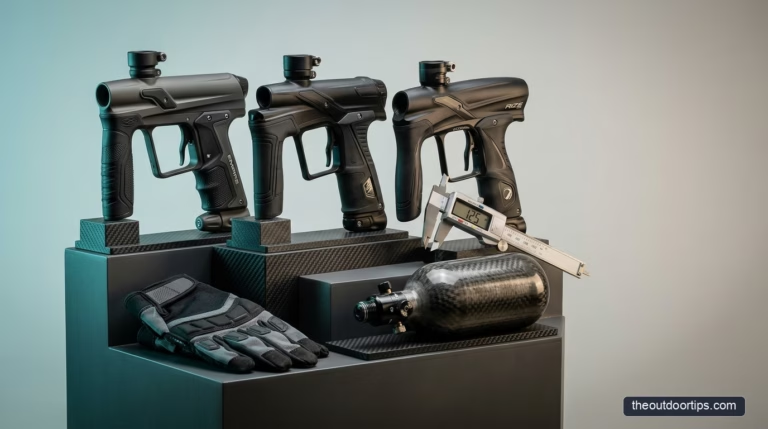
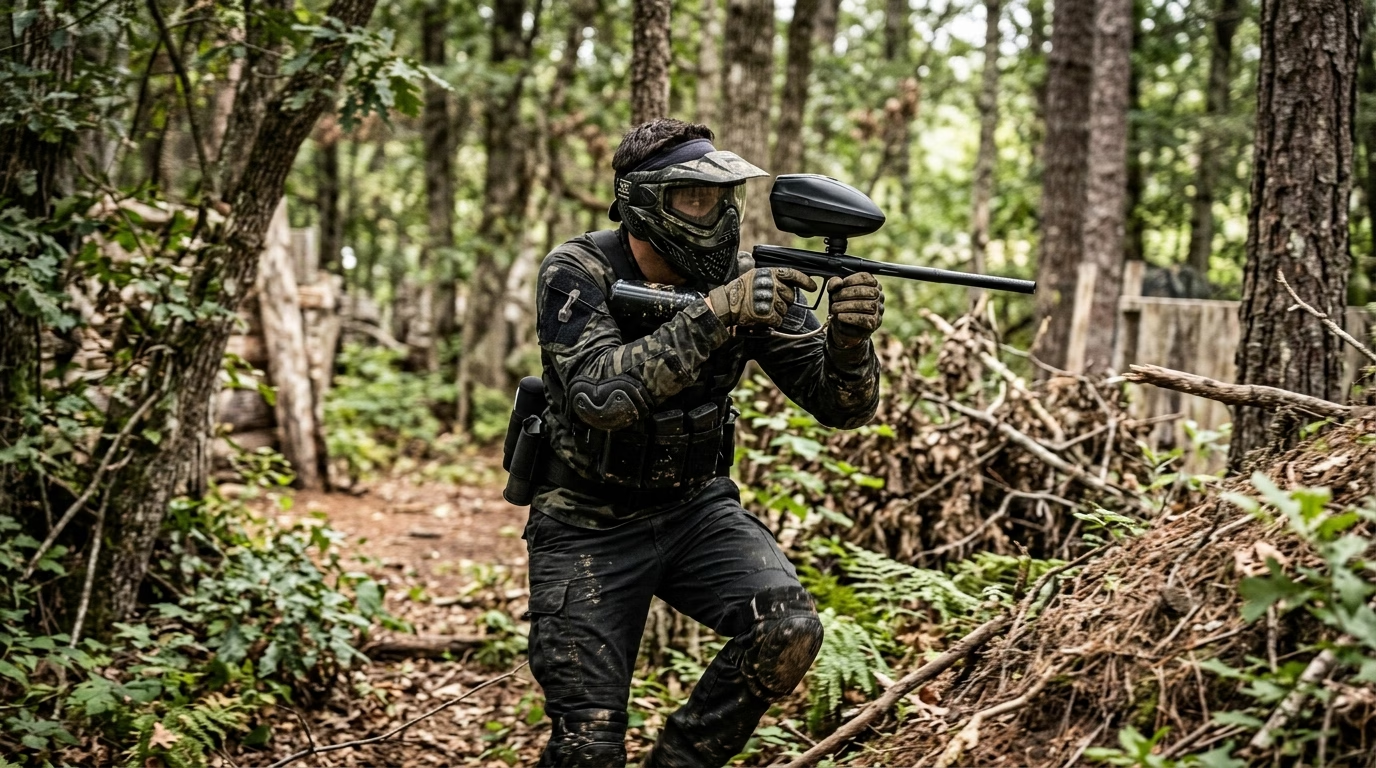
The Direct Answer: Does Paintball Hurt More in the Cold?
Yes, paintball hurts substantially more in cold weather (temperatures below 45°F / 7°C) — but NOT because paintballs “freeze” into solid ice balls. The extra pain is driven by two physical impact factors and one physiological biological reaction:
- The “Bounce” Phenomenon: Gelatin shells stiffen below their glass transition temperature. Instead of bursting and absorbing energy upon impact, cold paintballs bounce off, delivering 100% of their ~13.5 Joules of kinetic energy directly into your body tissue.
- Cold-Induced Vasoconstriction & Hypersensitivity: Cold ambient air constricts peripheral blood vessels and makes epidermal nerve endings (nociceptors) hypersensitive, amplifying stinging sensations by up to 2x.
- Reduced Clothing Compression: Stiff winter outer garments don’t decelerate the ball as effectively as soft, dynamic layers if you aren’t wearing the right moisture-wicking base and loose mid-layers.
Field Tip: Switching to winter-grade paint, using dual-pane thermal goggles, and adding a neoprene neck guard completely neutralizes cold-weather pain.
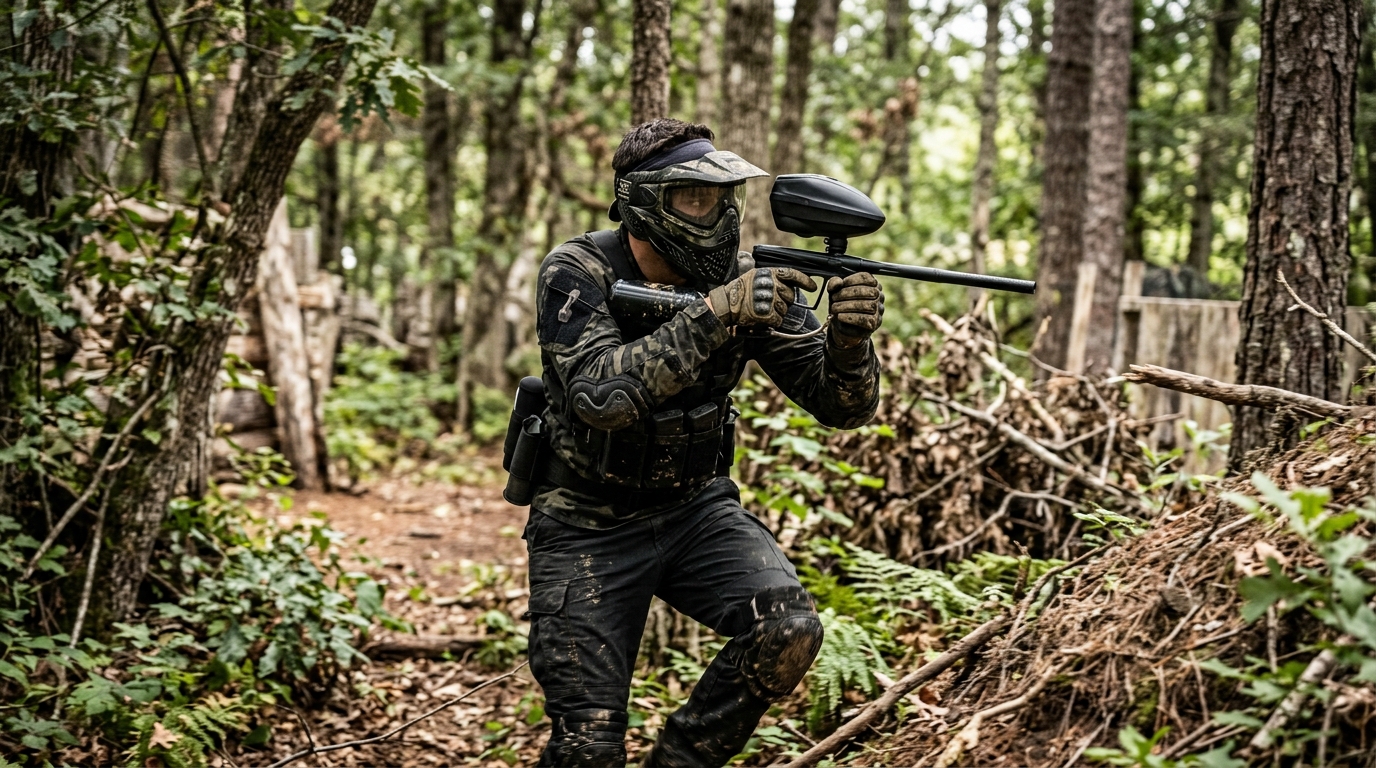
The Myth vs. Reality: Do Paintballs Actually Freeze?
If you have ever been around a staging area in December or January, you have almost certainly heard the urban legend: “Watch out, the paintballs are frozen solid today!”
Let’s clear this up with genuine chemistry: Standard paintballs do not freeze into solid ice spheres under normal winter playing conditions.
A standard paintball consists of two main components:
- The Outer Shell: Made from pharmaceutical-grade gelatin, water, and plasticizers (such as sorbitol or glycerin).
- The Liquid Fill: Made from non-toxic Polyethylene Glycol (PEG), food-grade mineral oils, starch thickeners, and water-soluble coloring dyes.
Polyethylene glycol has an extremely low freezing point—often dipping well below 15°F to -10°F (-9°C to -23°C) depending on the PEG molecular weight (PEG-300 or PEG-400). When exposed to standard winter temperatures (25°F to 40°F), the liquid fill does not freeze into hard ice; it merely thickens into a dense gel or paste.
Furthermore, if you deliberately put paintballs in a household deep freezer at 0°F (-18°C), moisture inside the gelatin shell crystallizes, causing the shell to deform, develop micro-fractures, and shrink unevenly. If you load frozen paintballs into a marker, they shatter inside the hopper or explode violently in the breech the microsecond the bolt strikes them. You end up with a jammed barrel full of slush rather than high-velocity ice bullets.
Key Takeaway: Why Does the Legend Persist?
The myth persists because a cold paintball impact feels exactly like being hit with a hard marble or a solid wooden ball. But the culprit is not ice inside—it is the loss of shell elasticity and the physics of the bounce.
The 4 Scientific Reasons Why Paintball Hurts More in Cold Weather
1. Shell Elasticity Loss & The “Bounce” Kinetic Energy Transfer
The single biggest factor in paintball pain is whether the ball breaks or bounces.
In comfortable weather (65°F to 75°F / 18°C to 24°C), gelatin is soft and pliable. When a 3.0-gram .68 caliber paintball strikes a target at 290 FPS (88.4 m/s), it carries roughly 11.7 Joules of kinetic energy (calculated via the kinetic energy equation Ek = ½mv2).
When the shell breaks upon impact:
- A massive portion of that kinetic energy is consumed to rupture the gelatin wall.
- The liquid paint immediately disperses outward in 360 degrees, distributing the remaining momentum across a wide radial contact zone.
- The deceleration time (Δt) is extended, resulting in a low peak impact force (F = Δp / Δt).
In temperatures below 40°F (4.4°C), gelatin reaches its glass transition state (Tg). The polymer chains lock into place, making the outer casing rigid and leathery.
When a rigid cold paintball hits human flesh, it frequently bounces off without rupturing. Because no energy is expended breaking the shell or splashing the liquid, 100% of the kinetic energy is hammered directly into a dime-sized surface area on your muscle, nerve tissue, or bone. The instantaneous peak force is nearly 3 times higher during a bounce than during a clean break, causing severe contusions and deep paintball bruises.
| Temperature Condition | Gelatin Shell State | Bounce Probability | Energy Absorbed by Body | Relative Pain Index (1-10) |
|---|---|---|---|---|
| Warm (70°F – 80°F) | Soft, flexible, brittle on impact | Low (< 10%) | ~35% (Remainder dissipated in splatter) | 3 / 10 |
| Mild (50°F – 60°F) | Standard elasticity | Moderate (~20-25%) | ~50% | 5 / 10 |
| Chilly (35°F – 45°F) | Rigid, toughened polymer wall | High (50% – 65%) | ~80% – 95% | 7.5 / 10 |
| Freezing (< 32°F / 0°C) | Leathery, hard, non-shattering | Very High (> 75%) | 100% (Direct blunt trauma) | 9 / 10 |
2. Biology & Physiology: Vasoconstriction and Hyperactive Nociceptors
Pain is not merely a mechanical equation; it is a neurological signal. When playing paintball in freezing or windy weather:
- Peripheral Vasoconstriction: To preserve your core body temperature, your cardiovascular system constricts capillary beds near the skin surface. This reduces blood flow to your extremities (fingers, ears, neck, forearms), creating cold, tight skin with minimal subcutaneous tissue pliability.
- Nociceptor Sensitivity: Cold-adapted superficial nerve receptors fire more aggressively upon sudden mechanical blunt trauma. An impact that would register as a dull thud in July feels like a searing whip or hammer strike in January.
- Numb Hands & Exposed Extremities: In cold weather, finger joints and knuckles are stiff. Getting shot on bare or thinly covered cold knuckles is easily one of the sharpest pains in the sport.
3. CO2 Pressure Instability vs. HPA Consistency
Your propellant gas behaves dramatically differently in sub-45°F weather depending on whether you shoot CO2 or compressed air (HPA):
- Liquid CO2 Flaws in Winter: Carbon dioxide is stored as a liquid and requires ambient heat to vaporize into gas. In cold weather, CO2 cannot vaporize efficiently, causing severe pressure drops. However, when liquid CO2 enters the valve during rapid fire, it can cause unpredictable velocity spikes (chronographing at 320+ FPS on sporadic shots), creating dangerous, painful “hot” shots. See our in-depth comparison on CO2 vs. HPA paintball tanks for the thermodynamic breakdown.
- HPA (High-Pressure Air) Superiority: Compressed air is purely gaseous. While pressure in the cylinder decreases slightly according to the ideal gas law (P₁/T₁ = P₂/T₂), marker regulators deliver a razor-consistent operating pressure, keeping your marker safely chronographed at 275–285 FPS.
4. Paintball Quality & Storage Conditions
If you store your paintballs in an unheated garage, car trunk, or outdoor shed during winter, they absorb moisture from fluctuating humidity and turn into rubbery, dimpled balls. Once a paintball shell absorbs ambient cold humidity, its brittleness profile is permanently corrupted.
Proper temperature management before stepping onto the turf is crucial. For storage rules, read our guide on how to store paintballs properly.
How to Prevent Pain and Play Comfortably in Cold Weather
Playing paintball in late autumn and winter is thrilling—there are no bugs, you don’t overheat in heavy gear, and tactical woodsball movement is fast. By taking these 6 field-tested steps, you can completely eliminate the stinging pain of cold-weather impacts:
1. Use Specialized Winter-Formula Paint (Winter Fill)
Standard summer tournament paint is formulated with thick gelatin shells to resist hot humid summer conditions. If you shoot tournament summer paint in 35°F weather, it will bounce endlessly or shatter in your feedneck.
Always purchase Winter Paintballs (such as Valken Winter, GI Sportz Frostbite, or Nelson Cold Weather blends). These use specialized thinner gelatin chemistry formulated to break reliably on impact at 25°F to 45°F while remaining stable inside your barrel.
2. Master the 3-Layer Clothing Rule
Don’t just throw on one giant, bulky winter parka. Heavy parkas restrict your shoulder mobility and make marker shouldering awkward. Follow the 3-layer system:
- Base Layer: Tight, synthetic or merino wool moisture-wicking thermal top and bottom (check our tested picks in the best base layers for winter paintball guide). This prevents sweat from freezing against your skin during staging breaks.
- Middle Layer: A breathable fleece hoodie, padded tactical jersey, or long-sleeve athletic shirt to create an air pocket cushion.
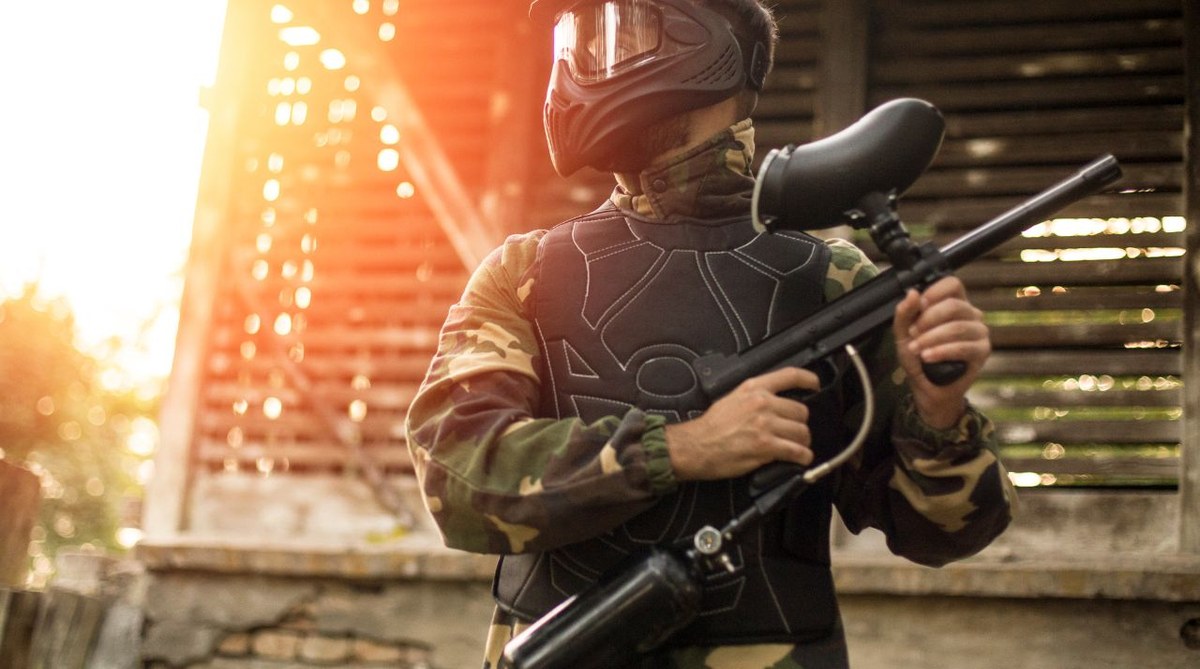
- Outer Layer: Durable, loose-fitting ripstop camo pants and an abrasion-resistant tactical jersey. Loose outer fabric acts as a kinetic shock absorber—when a ball hits loose cloth, the fabric moves with the impact, bleeding off velocity before the shell touches your skin. Check our guide on what clothing to wear for paintball.
3. Essential Protective Accessories (Neck, Hands & Face)
In summer, you might get away without gloves or neck protection. In winter, leaving skin exposed is an invitation to intense stinging.
- Neoprene Neck Protector: A 3mm-5mm padded neoprene collar prevents direct throat and jugular hits.
- Armored / Padded Gloves: Full-finger tactical gloves with reinforced thermoplastic rubber (TPR) knuckles prevent finger swelling. Check our tested picks for the best winter paintball gloves.
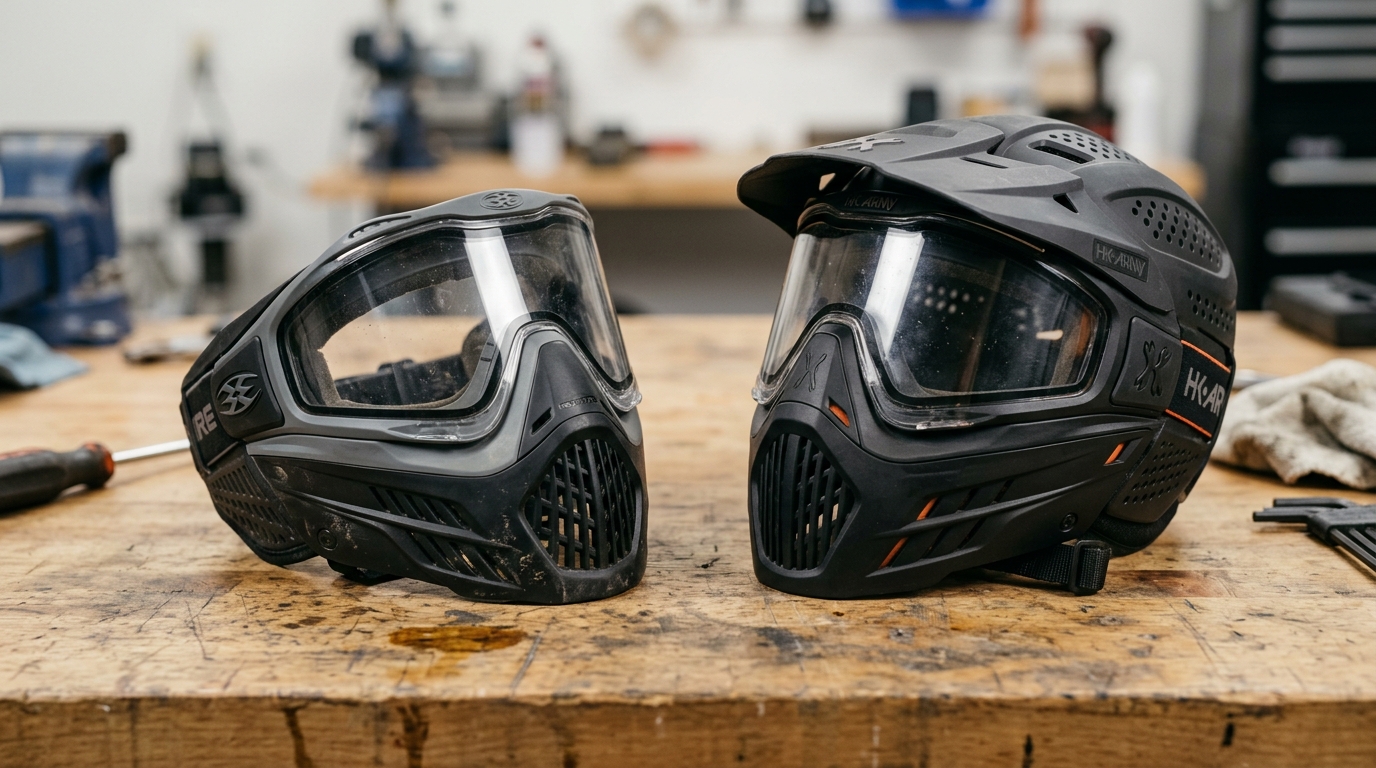
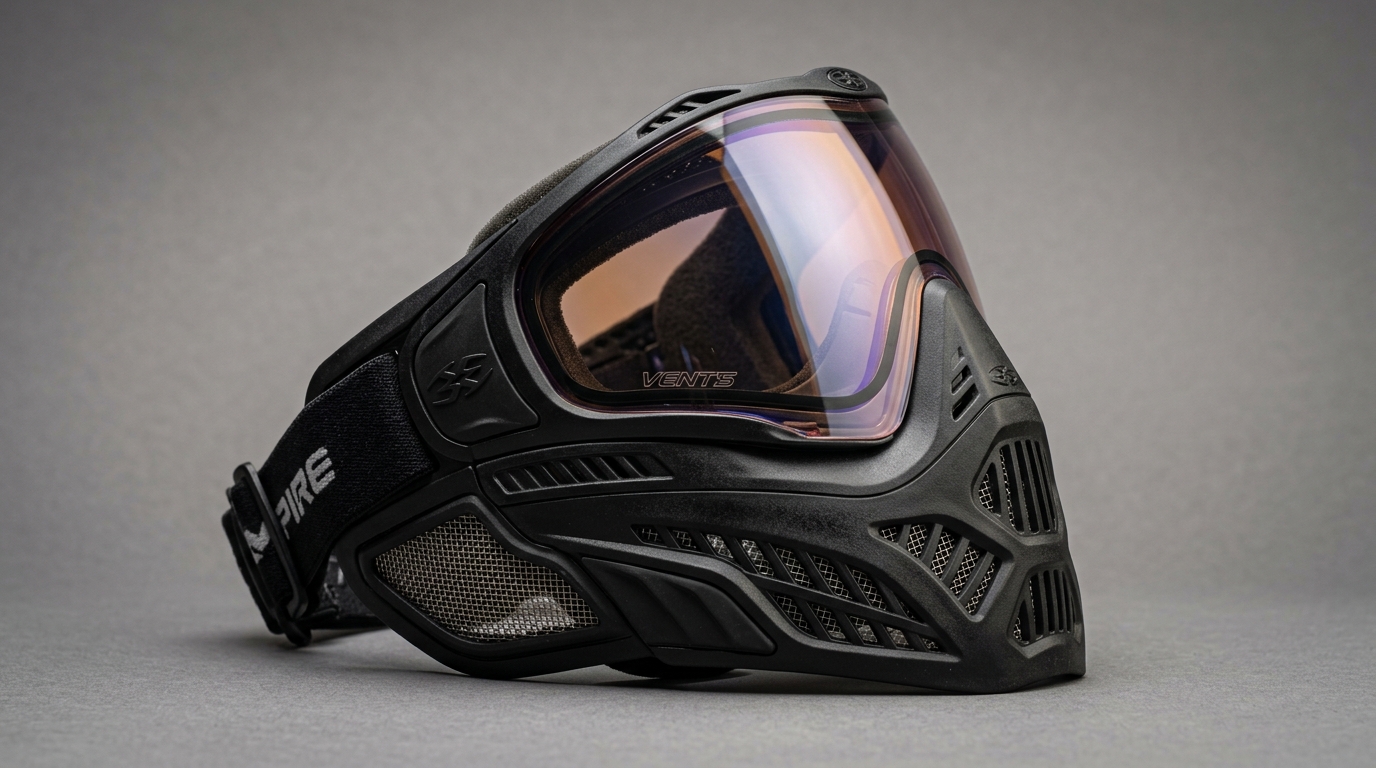
- Dual-Pane Thermal Mask: Cold air makes single-pane lenses fog in 15 seconds flat. A high-end thermal goggle (such as the Virtue VIO Ascend or Dye i5) is mandatory for winter safety. Check our ranked list of the best paintball masks.
4. Keep Your Paint Warm Between Points (The Cooler Trick)
Experienced winter tournament and scenario players never leave paint cases sitting on frozen picnic tables.
Bring an insulated thermal cooler box to the staging area. Place two chemical hand warmers (or a warm water bottle wrapped in a towel) at the bottom, and store your unopened paint bags and loaded pods inside. Keeping paintballs between 55°F and 65°F right up until you dump them into your hopper preserves optimal shell elasticity and guarantees clean breaks on your opponents.
5. Lower Your Chronograph Velocity
Most commercial fields set a summer velocity ceiling of 280 to 300 FPS.
When playing private woodsball games in freezing conditions, dial your marker down to 260 to 275 FPS. Dropping from 290 FPS to 265 FPS reduces impact energy from ~11.7 Joules down to ~9.8 Joules—a noticeable 16% reduction in mechanical trauma that keeps games fun and pain-free. For more physics breakdowns on impact energy, compare our Paintball vs. Airsoft impact physics guide.
Pro Maintenance Tip for Cold Weather Guns
Thick grease (like DOW 33) stiffens in freezing temperatures and causes bolt stick / FSDO (First Shot Drop Off). Clean your spool-valve or poppet bolt and switch to a lighter synthetic paintball oil (like Gold Cup or Triflow) for winter play. Read our complete cold weather paintball gear guide and step-by-step tutorial on how to keep your paintball gun from freezing up for full maintenance steps.
Frequently Asked Questions (FAQ)
Does paintball hurt more than airsoft in winter?
Yes, substantially more. A cold paintball delivers between 10.0 and 13.5 Joules of kinetic energy, whereas an airsoft BB delivers only 1.0 to 1.5 Joules. When a cold paintball bounces, 100% of that massive energy is transferred to cold tissue, making paintball significantly more painful than airsoft in winter.
At what temperature do paintballs begin bouncing?
Standard summer/all-season paintballs begin experiencing noticeable gelatin hardening and bounce rate increases when temperatures drop below 45°F (7°C). Below 32°F (0°C), bounce rates exceed 70% unless using dedicated winter-formula paintballs.
Can you shoot frozen paintballs out of a paintball gun?
No. If you freeze paintballs in a freezer, the gelatin becomes extremely brittle and fragile. The mechanical force of the bolt pushing the ball into the breech will shatter the ball instantly, coating the marker internals in frozen paste.
What is the best way to keep your paintball mask from fogging in the cold?
The only permanent solution is a dual-pane thermal lens (such as in the Virtue VIO, Empire E-Flex, or Dye i5). The thermal barrier creates an insulating dead-air space between the outer and inner lenses that stops humid breath condensation from forming.
Final Takeaway: Play Smarter in the Winter
Paintball definitely stings more in the cold, but it’s completely manageable once you understand the physics of gelatin elasticity, skin vasoconstriction, and energy transfer. Wear a moisture-wicking base layer with loose tactical outer clothing, keep your paint warm in an insulated cooler, wear a dual-pane thermal mask with full-finger padded gloves, and drop your chronograph velocity to ~270 FPS. With these simple adjustments, winter paintball is one of the most exciting tactical experiences of the year.