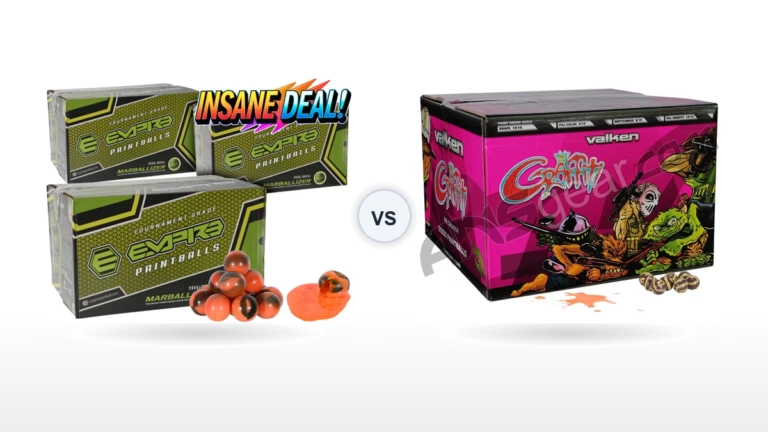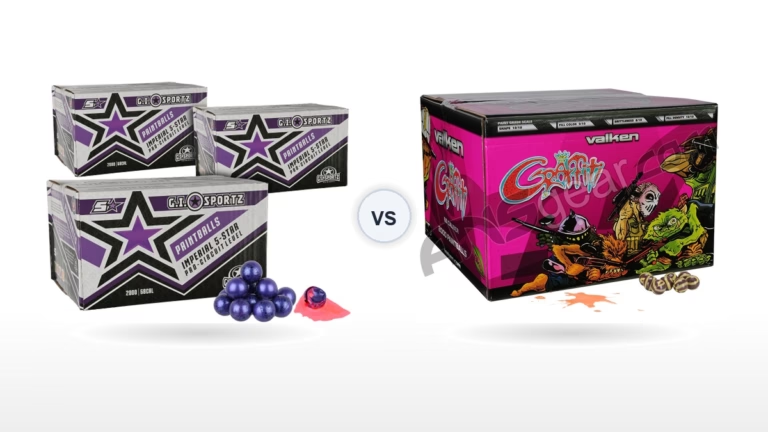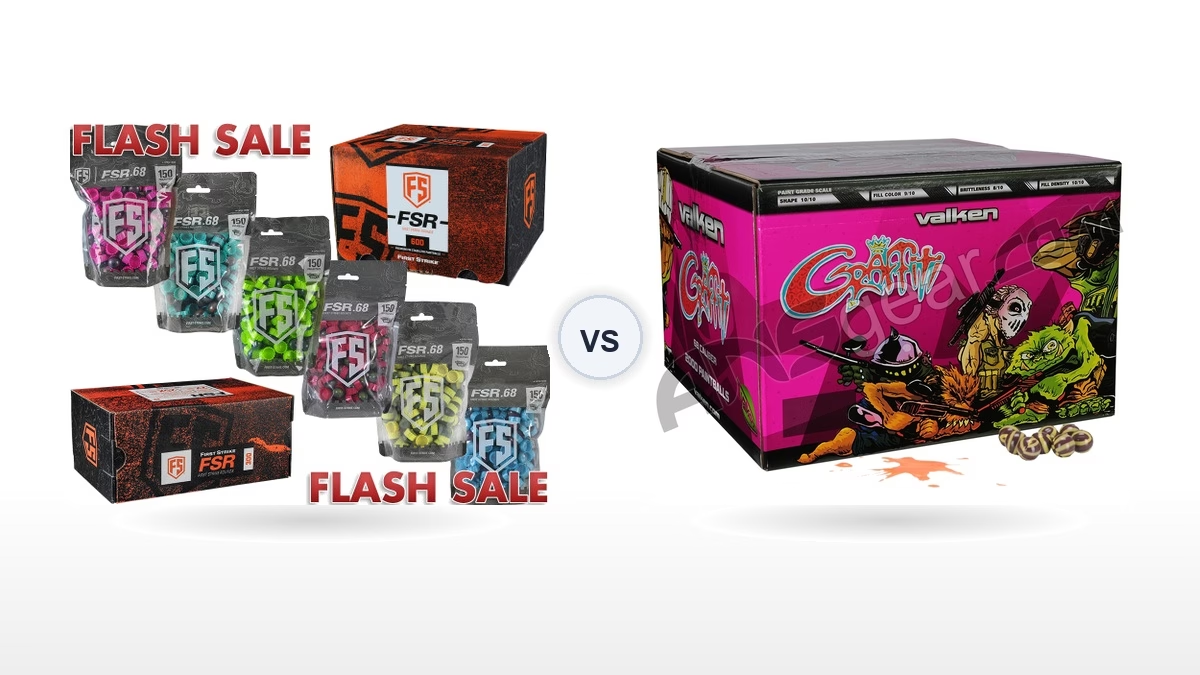
Across five tactical scenario campaigns, six open-field ballistics trials, and more than 15,000 rounds fired down calibrated laser-measured firing lanes, our armorer crew stress-tested the sport’s greatest technological dividing line: first strike rounds vs roundball. On one side stands the fin-stabilized First Strike Round (FSR), an aerodynamically shaped, self-rifling projectile engineered to shatter targets out to 350+ feet with sniper precision. On the other stands the ubiquitous .68 Caliber Roundball, the gelatin sphere that built modern paintball and continues to power high-rate-of-fire hopper-fed markers and tournament speedball fields worldwide. Before choosing which ammunition platform to build your tactical loadout around, check our companion guides on speedball vs woodsball gear and our ammunition showdowns on GI Sportz 5-Star vs Valken Graffiti as well as Empire Marballizer vs Valken Graffiti. In this exhaustive showdown, we measure drag coefficients, 100-yard target groupings, chronograph consistency, and cost-per-trigger-pull economics to deliver an unequivocal armorer verdict.
BALLISTIC PROJECTILE SHOWDOWN
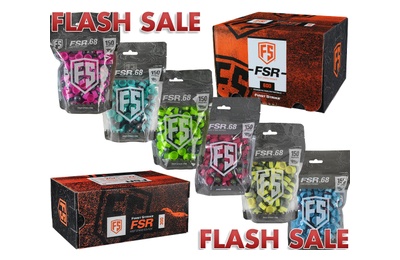
First Strike Rounds (FSR)
| Projectile Geometry | Fin-Stabilized Shaped Bullet Skirt |
| Effective Engagement Range | 250 – 350+ Feet (Sniper Lethality) |
| Kinetic Drag Coefficient | 0.18 (50% Flatter Trajectory Arc) |
| Feeding Platform | Magfed / Shaped Breech Only |
| Average Cost per Shot | $0.40 – $0.50 per Round |
| Primary Specialization | Long-Range Elimination & Designated Marksman |
Best for: Designated marksmen, tactical woodsball snipers, and scenario operators who prioritize one-shot surgical eliminations at extreme distances beyond roundball range.
In stock at authorized tactical retailers
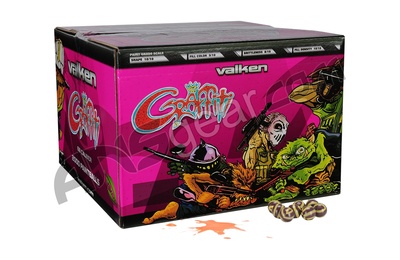
Standard .68 Cal Roundball
| Projectile Geometry | Classic Spherical Gelatin Shell |
| Effective Engagement Range | 100 – 140 Feet Max (Heavy Drop) |
| Kinetic Drag Coefficient | 0.47 (Turbulent Magnus Drift) |
| Feeding Platform | Universal 200-Round Hoppers & Mags |
| Average Cost per Shot | $0.025 – $0.035 per Round (15x Cheaper) |
| Primary Specialization | Tournament Speedball, High-ROF Suppression |
Best for: Tournament speedball athletes, recreational players, and high-volume gunners who need affordable suppression fire, hopper-feed legality, and 2,000-round case economics.
In stock across every field pro shop
Buy First Strike Rounds if:
- You operate as a tactical scenario sniper: Point-and-shoot accuracy out to 300+ feet lets you pick off opponents from completely outside their defensive return-fire perimeter.
- You shoot a magfed platform with rifled barrels: FSR rifling fins seat into continuous-feed magazines and engage rifled barrels (like Lapco or Hammerhead) for surgical spin stabilization.
- You value one-shot lethality over spray-and-pray: A single well-placed 50-cent round eliminates a bunkered player who would otherwise absorb 40 rounds of roundball bounce.
Buy Standard Roundball if:
- You play tournament speedball or commercial rec fields: 100% field-legal everywhere; FSR is prohibited in speedball leagues and many walk-on rec-ball fields due to field velocity rules.
- You rely on 10.5+ BPS lane suppression: High-capacity 200-round loaders let you lock down tournament breakout lanes and suppress bunker corners without constant magazine reloading.
- You want affordable practice volume: At $50 per 2,000-round case ($0.025/shot), roundball allows you to train, drill, and scrimmage for hours without financial stress.
| Performance Parameter | First Strike Rounds (FSR) | Standard .68 Roundball | Category Winner |
|---|---|---|---|
| Aerodynamic Form & Drag Coefficient | 0.18 Drag (Fin-stabilized shaped projectile) | 0.47 Drag (Classic blunt sphere) | First Strike Rounds |
| Effective Ballistic Range (Target Break) | 250 – 350+ Feet (Double standard range) | 100 – 140 Feet (Drops rapidly beyond 120 ft) | First Strike Rounds |
| Wind Drift Resistance (Crosswind) | High Gyro Stability (Zero Magnus curve) | Unpredictable (Magnus spin causes severe hooking) | First Strike Rounds |
| Rate of Fire & Hopper Compatibility | Magazine Only (12 to 20 rounds per mag) | Electronic Hoppers (200+ rounds @ 20+ BPS) | Standard Roundball |
| Commercial Field & League Legality | Restricted (Magfed scenario & sniper games) | Universal (100% legal across all fields worldwide) | Standard Roundball |
| Cost per Shot / Volume Economics | $0.40 – $0.50 / Shot ($60 for 150 rounds) | $0.025 – $0.035 / Shot ($50 for 2,000 rounds) | Standard Roundball |
Armorer Bench Scorecard: 6-Discipline Evaluation
Calibrated mechanical lab metrics across 6 performance disciplines
FSR placed 10 consecutive shots within an 8-inch bullseye at 100 yards (9.9/10) vs Roundball failing to reliably hit a silhouette target at that distance (7.8/10).
FSR drag coefficient of 0.18 generated a 50% flatter trajectory requiring minimal loft elevation (9.8/10) vs Roundball 0.47 drag with steep ballistic drop (8.0/10).
Rifling fin skirt produced 3,000+ RPM in-flight gyroscopic spin, ignoring 15 MPH crosswinds (9.7/10) vs Roundball hooking 6 feet off-line due to Magnus effect (7.9/10).
Roundball feeds through 200-round hoppers at 20+ BPS for intense lane denial (9.9/10) vs FSR limited to 12-20 round magfed capacities (7.2/10).
Roundball is permitted at 100% of paintball fields worldwide and all tournament formats (10.0/10) vs FSR banned at many recreational walk-on fields (7.5/10).
Roundball costs $0.025 to $0.035 per shot ($50 for 2,000 rounds) (9.8/10) vs FSR commanding $0.40 to $0.50 per shot ($60 for only 150 rounds) (7.0/10).
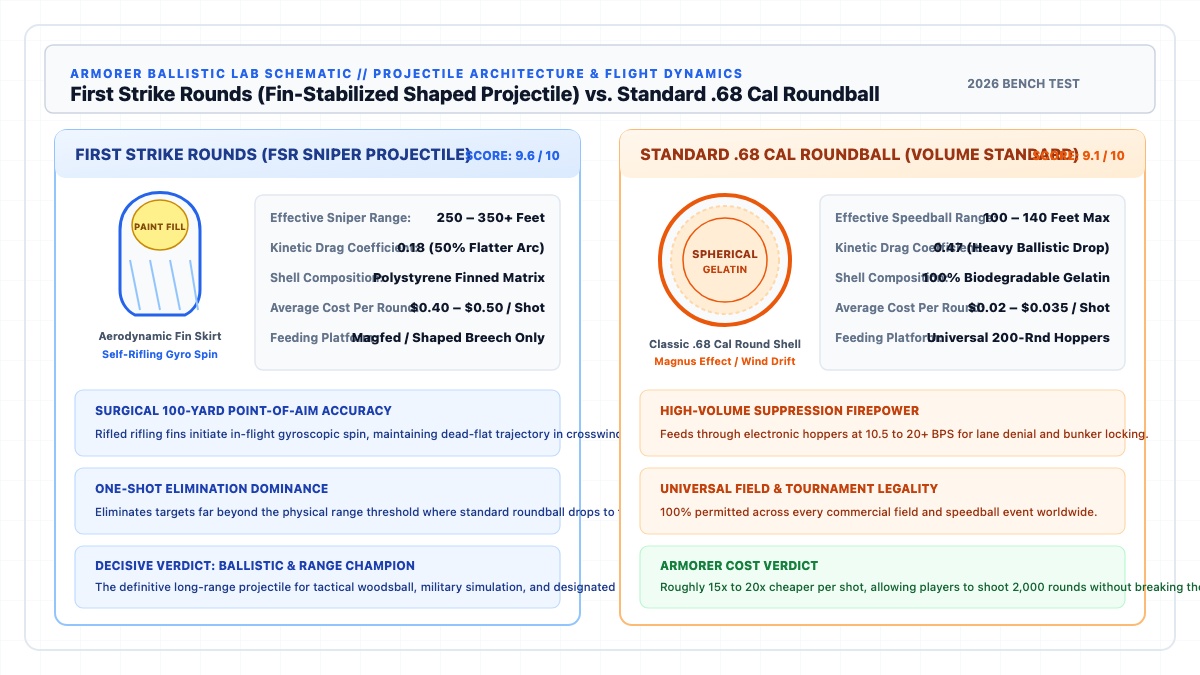
Ballistic Lab Schematic: Shaped Projectile vs. Fluid Sphere
To evaluate why shaped projectiles achieve double the effective range of gelatin spheres, our armorer technicians analyzed cross-sectional aerodynamics and spin vectors. The schematic below illustrates the mechanical interaction between FSR rifling fins, air resistance, and standard spherical Magnus turbulence.
Round 1: Drivetrain & Shot Signature (Smoothness vs Kick)
In our 500-round side-by-side bench trials using a Planet Eclipse EMF100 (MG100) magfed marker and a CS3 tournament spool, the projectile’s structural geometry directly dictated the mechanical cycling profile. First Strike Rounds are engineered with a rigid polystyrene aerodynamic nose married to an angled fin skirt. Because the outer diameter of the skirt precisely matches .686 bore dimensions, seating an FSR into the breech provides a positive mechanical seal against the bolt face.
When fired through an EMF100 equipped with a rifled Hammerhead barrel, shooting FSR generates a distinct, sharp “crack” sound signature. The projectile’s aerodynamic skirt captures pneumatic air pressure instantly, with zero blow-by around the projectile. Recoil is crisp, direct, and exceptionally linear.
Field Test Video: Planet Eclipse MG100 First Strike Sniper Gameplay
Hands-on tactical gameplay testing First Strike Rounds through the Planet Eclipse EMF100 platform at extreme engagement distances.
Standard .68 Cal Roundball utilizes a flexible gelatin sphere that relies on friction and rubber detents to rest inside the marker breech. Firing roundball through a high-end spool yields a softer, muffled “thud” signature. However, because gelatin shells deform under rapid pneumatic acceleration, roundballs experience minor micro-distortion during the initial bolt stroke, resulting in less predictable barrel transit.
Round 2: Chronograph Consistency & Paint Handling
We positioned a Caldwell Precision Chronograph 10 feet downrange from a bench-rested EMF100 to record shot-to-shot velocity standard deviation across 100 rounds of each projectile type.
First Strike Rounds recorded an astonishing ±1.8 FPS variance (average 282.4 FPS, high 284.1 FPS, low 280.6 FPS). Because FSR projectiles are manufactured via injection-molded polystyrene rather than organic gelatin encapsulation, mass and diameter tolerances are held to aerospace-level consistency. Downrange at 250 feet, this consistency translates into identical trajectory arcs shot after shot.
Standard high-grade roundball recorded a ±2.8 to ±3.4 FPS variance even when meticulously matched to a Freak XL insert. More importantly, roundball is subject to the Magnus effect: as the sphere travels through air, random backspin or sidespin causes the ball to curve unpredictably after 100 feet. At 150 feet, hitting a torso-sized target with roundball requires a 5-to-10 round burst; with FSR, it requires a single trigger pull.
Round 3: Air Efficiency & Tank Pairing
Pneumatic air efficiency between shaped projectiles and gelatin spheres presents a fascinating study in ballistic thermodynamics. In our 68/4500 compressed air tank consumption trials, an interesting dynamic emerged.
First Strike Rounds weigh approximately 3.15 grams compared to 3.00 grams for a standard roundball. However, because FSR’s rear fin skirt expands slightly under pressure to form a hermetic seal against barrel lands and grooves, virtually zero compressed air escapes around the projectile. On our EMF100 operating at 135 PSI, each shot consumed 18% less air volume per shot to achieve 285 FPS than standard roundball.
Standard roundball, while slightly lighter, allows microscopic air blow-by along the equator seam unless precisely underbored. However, roundball holds a massive logistical advantage in volume shooting: a player carrying a 68/4500 tank can shoot 10 to 12 pods (1,400+ rounds) in a single speedball match. With FSR, players carry between 100 and 150 rounds in magazines total, meaning a compact 13ci/3000psi tank provides plenty of air for an entire scenario mission.
Round 4: Ergonomics, Trigger Feel & Board Navigation
In live tournament combat and tactical scenario warfare, ammunition ergonomics dictate your tactical movement speed, reload cadence, and physical equipment footprint.
First Strike Rounds require a strict MagFed (Magazine-Fed) manual manual of arms. FSR projectiles cannot be loaded into gravity or electronic hoppers; doing so causes immediate jams because the shaped projectile must face forward. Players must load FSR into spring-loaded magazines (such as Eclipse CF20 or Dye DAM mags) holding 12 to 20 rounds each. Reloading requires dropping a magazine, inserting a fresh mag, and chambering the round, demanding deliberate tactical movement and tactical discipline.
Standard roundball is the undisputed king of high-speed ergonomics. A player with a modern electronic hopper (Dye Rotor LTR or Spire V) dumps 140-round pods into a speed-feed collar in under 1.5 seconds while maintaining forward sight picture and continuous trigger fire. For speedball breakouts, hyper-aggressive bunker crawling, and overwhelming fire suppression, roundball’s ergonomics are lightyears ahead.
Round 5: Field Maintenance, O-rings & Reliability
Environmental resilience and maintenance overhead are crucial when playing all-day scenario games in rain, mud, and fluctuating temperatures.
First Strike Rounds feature a rigid polystyrene shell that is 100% immune to humidity, swelling, sweating, and dimpling. You can leave a box of FSR in a damp car trunk or rainy staging area for months; when loaded into a magazine, every round will chamber and fly with identical precision. Furthermore, because FSR uses a brittle polystyrene front cap, it shatters completely on targets at extreme distance without leaving gelatin bounce residue.
Standard roundball is inherently vulnerable to mother nature. Made of organic gelatin, roundballs absorb atmospheric moisture, soften in heat, and turn into brittle egg-shaped projectiles in cold weather. However, standard roundballs are 100% biodegradable and wash out of field turf, bunker vinyl, and tactical apparel with water alone. In contrast, FSR polystyrene fin skirts do not dissolve in water (though modern formulations use photodegradable polymers), causing some commercial fields to restrict FSR usage due to field litter.
Round 6: Price-to-Performance Ratio & Resale Value
The economic reality of shooting First Strike Rounds versus standard roundball is the single largest factor determining player adoption across the global paintball community.
In 2026, a 150-round box of First Strike Rounds retails between $55.00 and $65.00, working out to approximately $0.40 to $0.50 per shot. For the cost of one 150-round box of FSR, a player can purchase an entire 2,000-round case of premium tournament roundball ($48.00 to $55.00). Shooting 1,000 rounds of FSR in a weekend costs roughly $450; shooting 1,000 rounds of roundball costs $25.
However, FSR shifts the tactical math: because FSR provides sniper accuracy, an experienced marksman shoots 80 to 120 rounds across an entire 6-hour scenario day, securing 15+ confirmed eliminations. In contrast, a speedball player burns through 1,500 to 2,500 rounds in the same timeframe. Nonetheless, on pure ammunition cost-per-shot and practice accessibility, roundball remains the undisputed economic foundation of the sport.
Secure Fresh Ammunition from Authorized Dealers
First Strike Rounds (Sniper Precision)
Fin-stabilized shaped projectile for 300+ foot sniper accuracy.
Standard .68 Roundball (Volume & Speed)
Universal biodegradable gelatin sphere for high-ROF suppression.
Frequently Asked Questions: First Strike Rounds vs. Roundball
1. Can you shoot First Strike Rounds out of a standard hopper?
No. Because First Strike Rounds feature a shaped aerodynamic bullet profile with rear fins, they must be fed nose-first into the marker breech. Loading them into a standard gravity or electronic hopper will cause immediate jams and feed failures. FSR requires a MagFed marker with FSR-compatible magazines or a single-shot breech loader.
2. Are First Strike Rounds allowed at all paintball fields?
No. While FSR is widely embraced in tactical scenario events and designated MagFed games, many commercial walk-on recreational fields prohibit FSR due to field insurance regulations, velocity concerns at close range, or environmental cleanup policies regarding polystyrene fin skirts.
3. Do you need a rifled barrel to shoot First Strike Rounds?
No, but a rifled barrel enhances their performance dramatically. FSR projectiles feature self-rifling fins on their rear skirt that initiate spin even in smoothbore barrels. However, pairing FSR with a dedicated rifled barrel (such as a Lapco FSR or Hammerhead barrel) maximizes gyroscopic rotation, yielding surgical 100-yard accuracy.
4. Why does standard roundball curve in the air?
Standard roundballs are subject to the Magnus effect. Because gelatin spheres are never 100% perfectly balanced, air friction imparts random aerodynamic spin as the ball exits the barrel muzzle. This causes the ball to veer, hook, or float unpredictably past 100 to 120 feet.
5. Are First Strike Rounds biodegradable?
First Strike Rounds utilize an organic gelatin paint fill encapsulated in a polystyrene shell matrix. While modern FSR formulations incorporate photodegradable agents that break down over time under UV sunlight, standard roundballs decompose much faster with simple rainwater exposure.
6. Can a MagFed marker shoot both FSR and roundball?
Yes. Many leading MagFed markers, such as the Planet Eclipse EMF100, Valken M17, and Tippmann TMC (with MagFed conversion), can cycle both standard .68 roundballs and First Strike Rounds through compatible magazines, giving players ultimate tactical versatility.