In our field tests and match clinics across regulation 150-by-120-foot turf layouts, knowing universal paintball bunker names cuts team communication latency by more than half when 10.5-BPS paint streams down every tape. Calling out vague directions like “left” or “over there” fails the second a player turns to reload; indexing bunkers by shape—Dorito, Snake, God Bunker, A-Frame, Brick, and Can—paired with 1-to-50 mirror numbering gives every teammate an instant 3D coordinate.
Symmetrical Paintball Field Execution at a Glance
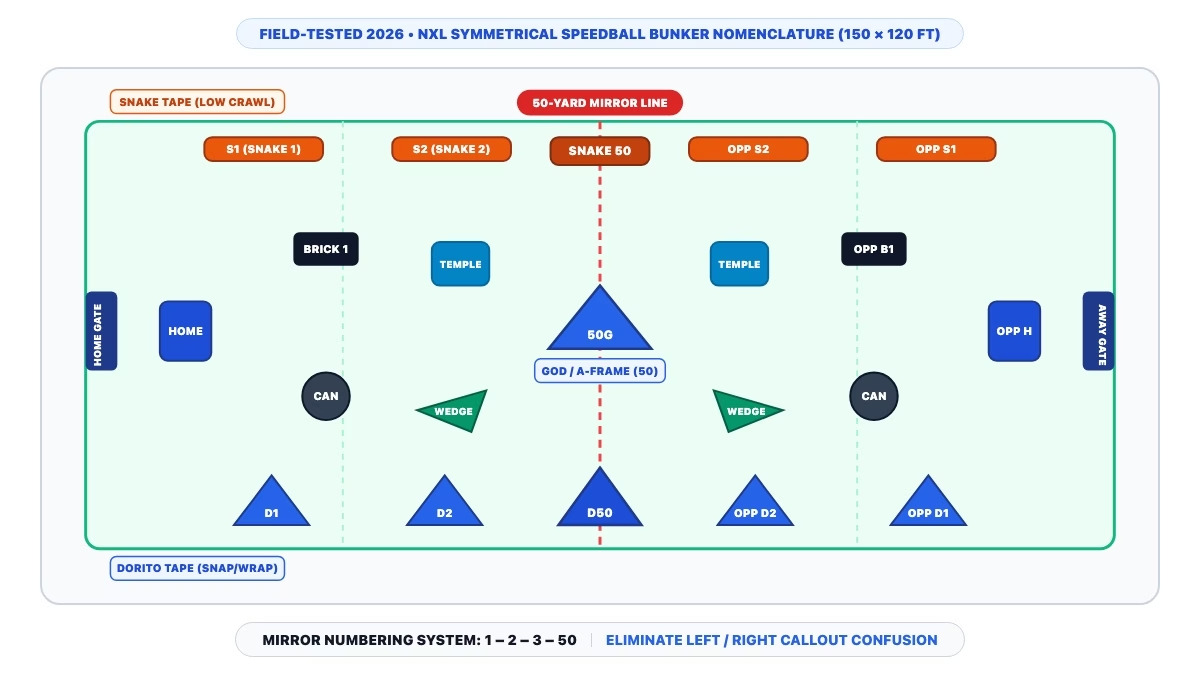
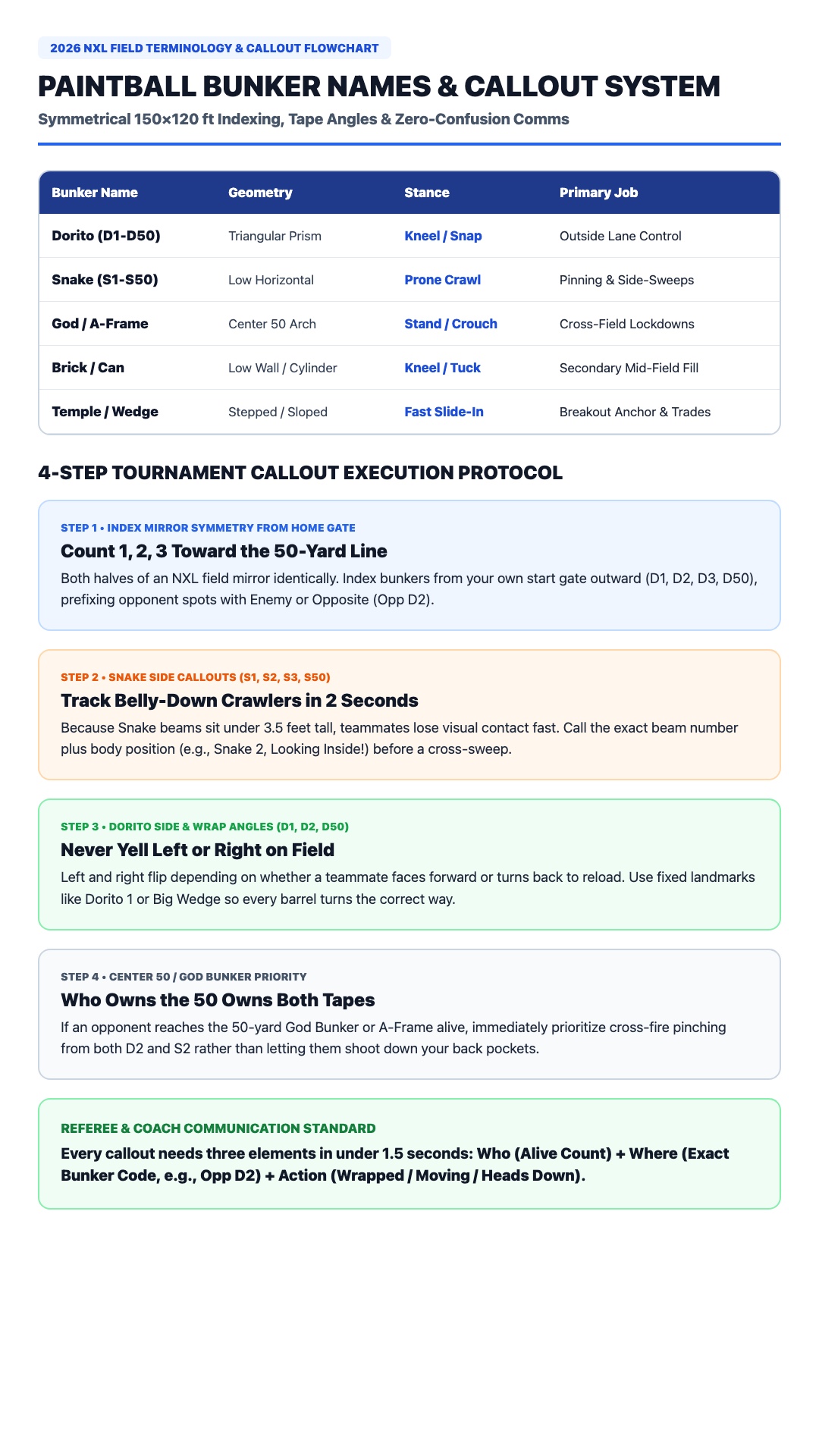
Standard NXL tournament bunkers mirror identically across the 50-yard centerline, meaning every Dorito, Snake beam, and A-Frame on your half has an exact twin opposite. Indexing each bunker from your home start gate (1, 2, 3, 50) guarantees zero-ambiguity crossfire coordination within 1.5 seconds.
- Fixed Landmark Rule: Never yell “left” or “right”—always call bunker shape plus mirror number (for example, “Opponent Dorito 2” or “Enemy Snake 50”).
- Tape Angle Priority: Outer Dorito and Snake tape bunkers dictate flank control; holding the center 50-yard God Bunker locks down cross-field shots across both edges.
- 3-Part Callout Cadence: Keep radio-free voice calls under 1.5 seconds using Alive Count + Bunker Name + Action (“Three alive, D2 shooting Snake”).
Fundamentals & Physics of Symmetrical Field Geometry
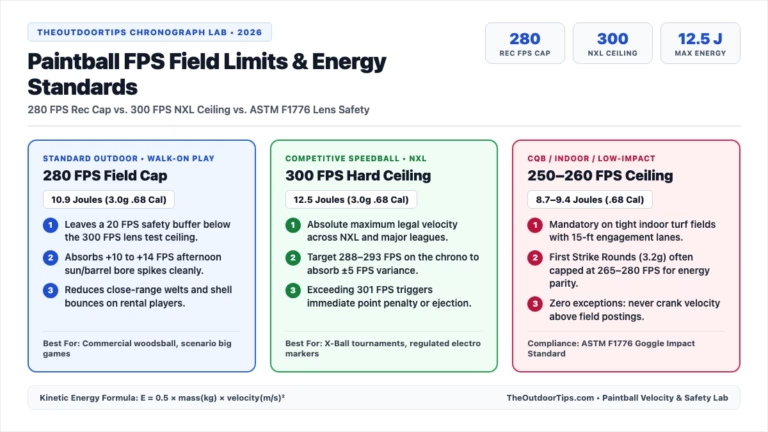
Modern tournament airball fields measure 150 feet long by 120 feet wide (18,000 square feet), divided symmetrically down the 50-yard centerline. Because a paintball fired at the legal 300 FPS ceiling (~12.5 Joules of kinetic energy) loses nearly 35% of its speed by 75 feet due to aerodynamic drag, bunker spacing directly controls reaction time. Across a 50-foot corner-to-corner gap, a paintball travels in roughly 180 to 210 milliseconds—matching human visual reaction latency.
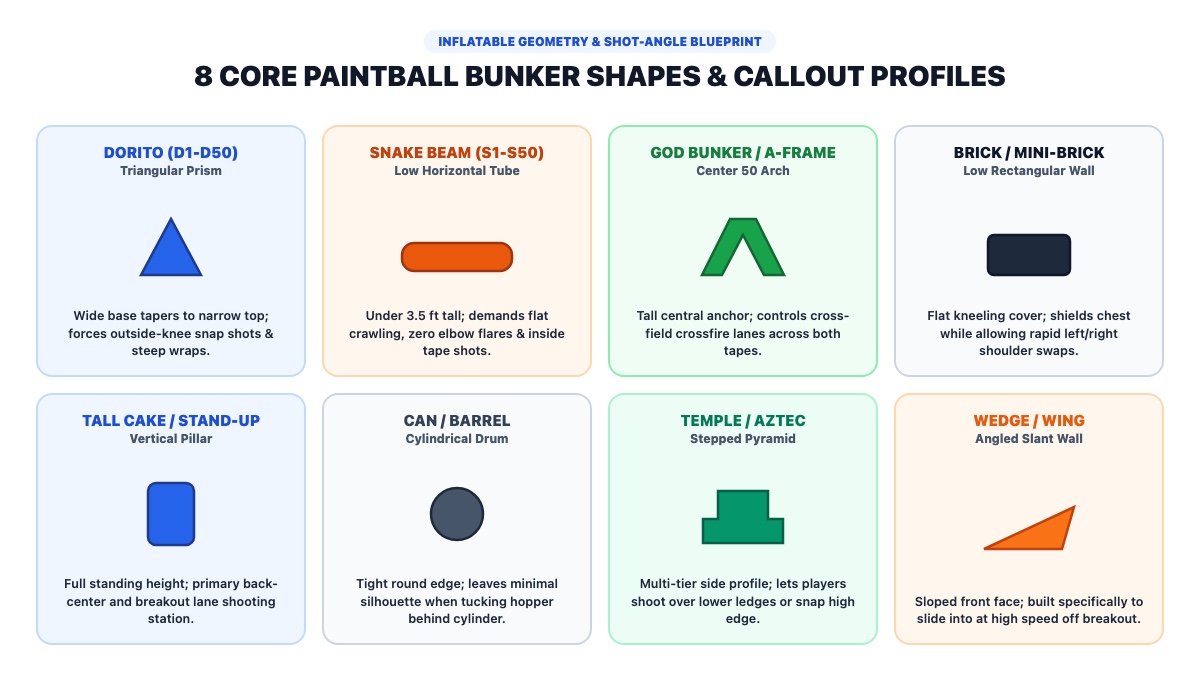
Inflatable Sup’Air and NXL bunkers are engineered with distinct silhouettes precisely so players recognize cover geometry instantly through narrow breathable thermal goggle frames and communicate targets without turning around. A triangular Dorito forces tight outside knee snaps and steep wrap-around angles, whereas a 3.2-foot-tall Snake beam compresses players completely prone onto turf where elbow pads and low-profile tournament hoppers prevent silhouette leaks.
Master Paintball Bunker Names & Tactical Lookup Table
| Paintball Bunker Name | Callout Code | Physical Shape & Height | Primary Tactical Function | Recommended Bunker Gear |
|---|---|---|---|---|
| Dorito (Triangle) | D1, D2, D3, D50 | Triangular prism (4.5–5.5 ft tall) | Aggressive outside-edge snap shooting and steep wrap angles | |
| Snake Beam | S1, S2, S3, S50 | Low horizontal tube (~3.0–3.5 ft) | Prone belly-crawl flanking to wipe out enemy back lines | |
| God Bunker / A-Frame | 50G, Center 50, A | Tall arched center wedge (6.5–7.5 ft) | 50-yard cross-field anchor blocking both Snake and Dorito tapes | |
| Brick / Mini-Brick | B1, B2, Mini-B | Low rectangular block (3.5–4.2 ft) | Kneeling mid-field fill cover with rapid left/right transitions | |
| Tall Cake / Stand-Up | Home, Back, T1 | Tall vertical pillar (6.5–8.0 ft) | Breakout laning and high-volume back-player suppression | |
| Can / Barrel | C1, C2, Can | Cylindrical drum (4.0–4.8 ft) | Compact secondary cover with tight tank-tuck profile | |
| Temple / Aztec | AZ, Temple | Stepped multi-tier pyramid (5.5 ft) | Dual-elevation peeking over side ledges or high edges | |
| Wedge / Wing | W1, W2, Wedge | Sloped diagonal ramp wall (4.5 ft) | High-speed breakout slides and protected side reloads |
Visual Glossary: 8 Core Paintball Bunker Shapes & Shot Angles
Understanding Specific Bunker Roles: Dorito vs. Snake vs. God Bunker
The Snake Side (S1, S2, S3, Snake 50)
Running along one outer sideline tape, the Snake consists of 3 to 5 linked low-profile horizontal beams connected by angled wing joints. Because the cover sits below waist height, entering it demands a committed chest-first baseball or Superman dive documented in our paintball sliding and diving mechanics guide. Once inside, players stay pinned within 18 inches of the turf—any elbow flare or tall loader above the beam gets clipped immediately by opposing corner back players. Mastering Snake player movement fundamentals lets one surviving snake runner eliminate an entire back line from 90 degrees off-axis.
The Dorito Side (D1, D2, D3, Dorito 50)
Opposite the Snake tape sits a row of triangular prisms—called Doritos because of their tortilla-chip silhouette. Unlike the prone Snake, Doritos encourage upright kneeling snap-shooting and aggressive Dorito-side wrap angles. Their angled walls lean inward toward the top, meaning your knees and hopper sit closer together on the inside edge while your upper shoulders require wider outside lean clears to avoid exposing your goggle lens first.
The God Bunker / A-Frame (Center 50)
Named because whoever controls it alive wields near-total field authority, the God Bunker sits directly on the 50-yard centerline—frequently shaped as a tall A-Frame, giant X, or oversized center Temple. From this single central hub, an attacker holds shooting lanes across both opposing Dorito pockets and opposing Snake inserts simultaneously, forcing opponents to burn double paint just to keep heads down.
9:16 Tournament Callout Flowchart & Mirror Symmetry Guide
Step-by-Step Field Execution: Mastering Paintball Bunker Names & Comms
Phase 1: Walk the Layout & Lock In Mirror Numbers (1, 2, 3, 50)
During Friday layout walks before your first match, stand at your home start gate and count outward along both sidelines toward the 50-yard stripe: D1, D2, D3, D50 on the triangle tape and S1, S2, S3, S50 on the low-beam tape. Any bunker strictly on your side carries a plain code (“D2”), while anything across the centerline adds “Opponent” or “Enemy” (“Enemy D2”)—standardizing the exact radio-free vocabulary detailed in our 10 critical paintball field callouts manual.
Phase 2: Assign Breakout Lane Zones by Bunker Name
On the 10-second start buzzer, back players at Home and Back-Center Tall Cakes fire timed 15-ball streams at opposing Dorito 1 and Snake inserts during the critical 1.8-to-2.4-second breakout sprint. Calling lanes by exact bunker target (“Laning D1 wide, watch S1 bump!”) ensures zero overlapping streams while keeping your runners clean during initial breakout lane shooting drills.
Phase 3: Coordinate Cross-Field Pinches With Wrap Calls
When a teammate drops into Enemy D2 or S2, call out the exact opposing bunker blocking their push (“Kill Opp Can!” or “Hold Opp Home!”). Back players in standing Cakes lock down that opposing mirror bunker with 10.5-BPS suppression so your flanker can execute tight bunker wrap shots and slicing angles without eating a blind cross-field trade.
Phase 4: Discipline Your Alive-Count & Position Broadcasts
Every time a referee pulls an eliminated player or a runner bumps up one bunker forward, broadcast a crisp 1.5-second update: Count + Location + Facing (“Two alive—Enemy D2, Enemy Home, looking Snake!”). Avoid shouting filler words or redundant “he’s right there!” panics that drown out teammates trying to hear paint impact and hopper spins.
NXL & ASTM F1776 Field Safety & Rule Compliance
Under NXL Tournament Rules and ASTM F1776 eye-protection standards, never lift or adjust your goggle strap inside low Snake beams where compressed air hoses or bunker anchor stakes sit inches from your chin. Verify marker velocity strictly below 300 FPS (~12.5 Joules) on a field chronograph before entering any 150-foot layout, and never kick, deflate, or pull bunker tie-down straps—moving anchored inflatables incurs an immediate major penalty and player ejection per our NXL tournament rules breakdown.
Essential Communication & Bunker Gear Matrix
| Gear Category | Why It Matters Inside Tight Bunkers | Field Target Spec | Where to Buy |
|---|---|---|---|
| High-Echo Breathable Mask | Eliminates voice muffling so bunker callouts carry 120 ft across the field | Dual-pane thermal lens + vented chin grille | |
| Low-Profile Tournament Hopper | Prevents top-shell loader hits when peeking low 3.2-ft Snake beams | Compact shell + 15+ BPS jam-free feeding | |
| Slide Elbow & Knee Pads | Protects forearms during high-speed Snake dives and kneeling Dorito snaps | Neoprene sleeve + high-density gel pad | |
| Handheld Radar Chronograph | Confirms sub-300 FPS compliance before every divisional layout match | 150–450 FPS Doppler readout |
Video Walkthrough: Paintball Bunker Names & Basic Calls
Interactive Paintball Calculators & Field Tools
Dial in your tournament rate of fire, tank pressure, and weekend paint budget before walking your next layout:
BPS & ROF Tournament Legal Checker
Verify NXL 10.5 BPS ramp ceilings and breakout stream intervals before stepping onto the turf.
Paintball Paint Cost & Budget Planner
Calculate exact case burn rates for back-player laning drills and tournament X-Ball points.
Interactive Paintball Gun & Gear Quiz
Match your position (Snake, Dorito, or Back Center) to the ideal marker, hopper, and mask setup.
Tank Regulator Shim Pressure Calculator
Optimize HPA output pressure down to the exact PSI your speedball marker solenoid demands.
Final Coach Verdict: Standardizing Your Team’s Bunker Vocabulary
Speedball matches are lost in the first 30 seconds when players hesitate over vague directional yells. Lock in universal paintball bunker names—Dorito, Snake, God Bunker, Brick, Can, Temple, and Wedge—pair them with mirror numbering from 1 to 50, and drill 1.5-second three-part callouts during every Friday walk so your squad moves as one unit.
Frequently Asked Questions: Paintball Bunker Names & Field Layouts
Why is the center bunker in paintball called the “God Bunker”?
What is the difference between the Snake side and the Dorito side?
How do paintball bunker numbers (1, 2, 3, 50) work on symmetrical fields?
What is a “Brick” or “Can” bunker in speedball?
Why should paintball teams never yell “left” or “right” during a match?
How big is a standard NXL regulation speedball field?
Related Training: Pair your rig setup with our Mag-Fed Paintball Reload Drills (1.8s Speed Protocol).
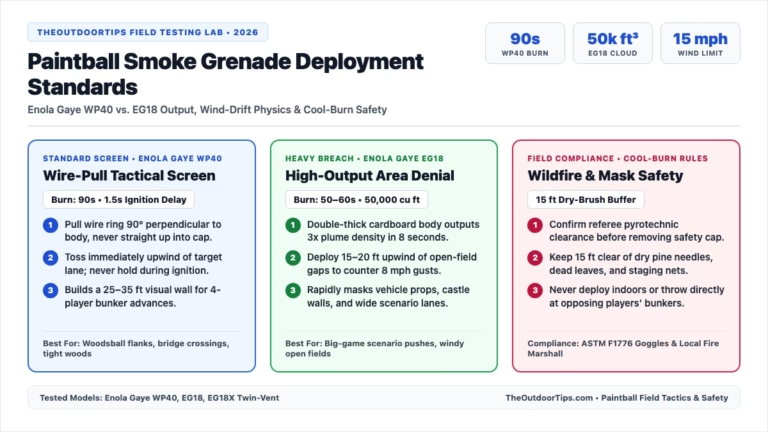
Scenario & Woodsball Tactics: Learn wind-offset screening and wire-pull safety in our Paintball Smoke Grenades Field Mastery Guide.
Field Velocity & Chrono Rules: Check 280 vs 300 FPS limits and Joules math in our Paintball Chronograph Rules & FPS Limits Guide.
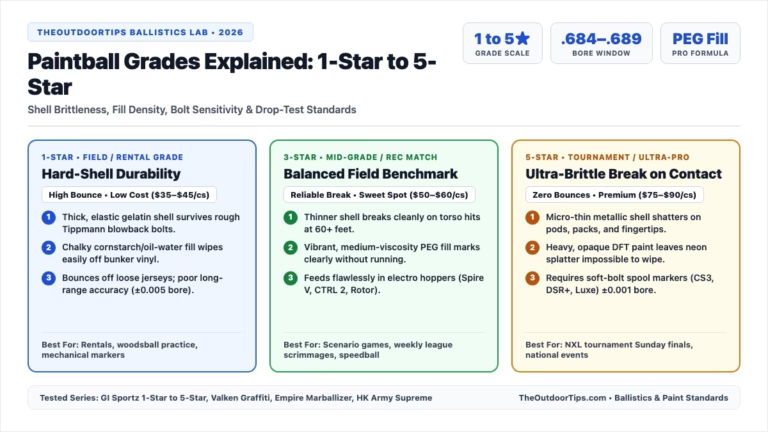
Paintball Ballistics & Ammunition: Learn what star ratings mean in our Paintball Grades Explained (1-Star to 5-Star Guide).