NXL Regulation • Off-The-Break Laning Protocol
Rapid Field Diagnostic: Speedball Breakout Lane Shooting
Executing high-percentage breakout shooting paintball lanes requires mastering precise ballistic flight calculations, pre-buzzer barrel stabilization, and unbroken 10.5 BPS ramping streams. In competitive tournament play, eliminating an opposing front runner off the break creates an immediate 5-on-4 numerical advantage that wins over 78% of regulation points. The difference between an opening kill and wasted paint comes down to a 420-millisecond flight latency across the 120-foot field, requiring shooters to lead sprinting targets by exactly 2.8 feet.
In our tournament armorer clinics and competitive coaching sessions, breakout shooting is the primary weapon of back-center and insert players. Rather than running blindly off the start gate, a disciplined lane gunner establishes a dense ballistic curtain that denies opposing attackers access to primary corner bunkers, force-tucking runners or eliminating them mid-stride.
To master coordinated team strategies, pair your laning fundamentals with our tactical deep-dives on speedball snake player fundamentals, explore our guide on dorito side paintball strategy, and inspect your electronic marker’s dwell and debounce profiles using our armorer manual on how to install aftermarket trigger on Planet Eclipse. For full-field zone containment and pod reload cadence, master our coaching guide on back player paintball tactics.
⚡ Pro Gunfighting Progression: Once your lanes and callouts are locked in, train sub-240ms bunker exits and off-hand accuracy with our paintball snap shooting 50-ball daily drill guide.
1. Ballistic Physics: Flight Latency & Lead Distance Calculations
Understanding the science of breakout shooting paintball begins with projectile aerodynamics. Under NXL regulations, markers are chronographed at a maximum velocity of 300 FPS (91.4 meters per second). Over a regulation 120-foot field distance from the home start gate to the opposing Snake 1 or Dorito 1 entrance gap, a paintball requires approximately 420 milliseconds to arrive.
During that same 420-millisecond flight window, an athletic front attacker sprinting off the gate at 16 mph (23.5 feet per second) travels roughly 9.8 feet of lateral ground. If you aim your barrel directly at where the runner is currently standing, your stream will arrive nearly 10 feet behind them. To achieve a clean elimination, a back player must pre-aim at the entrance gap and deliver an unbroken curtain of paint before the runner crosses the lane.
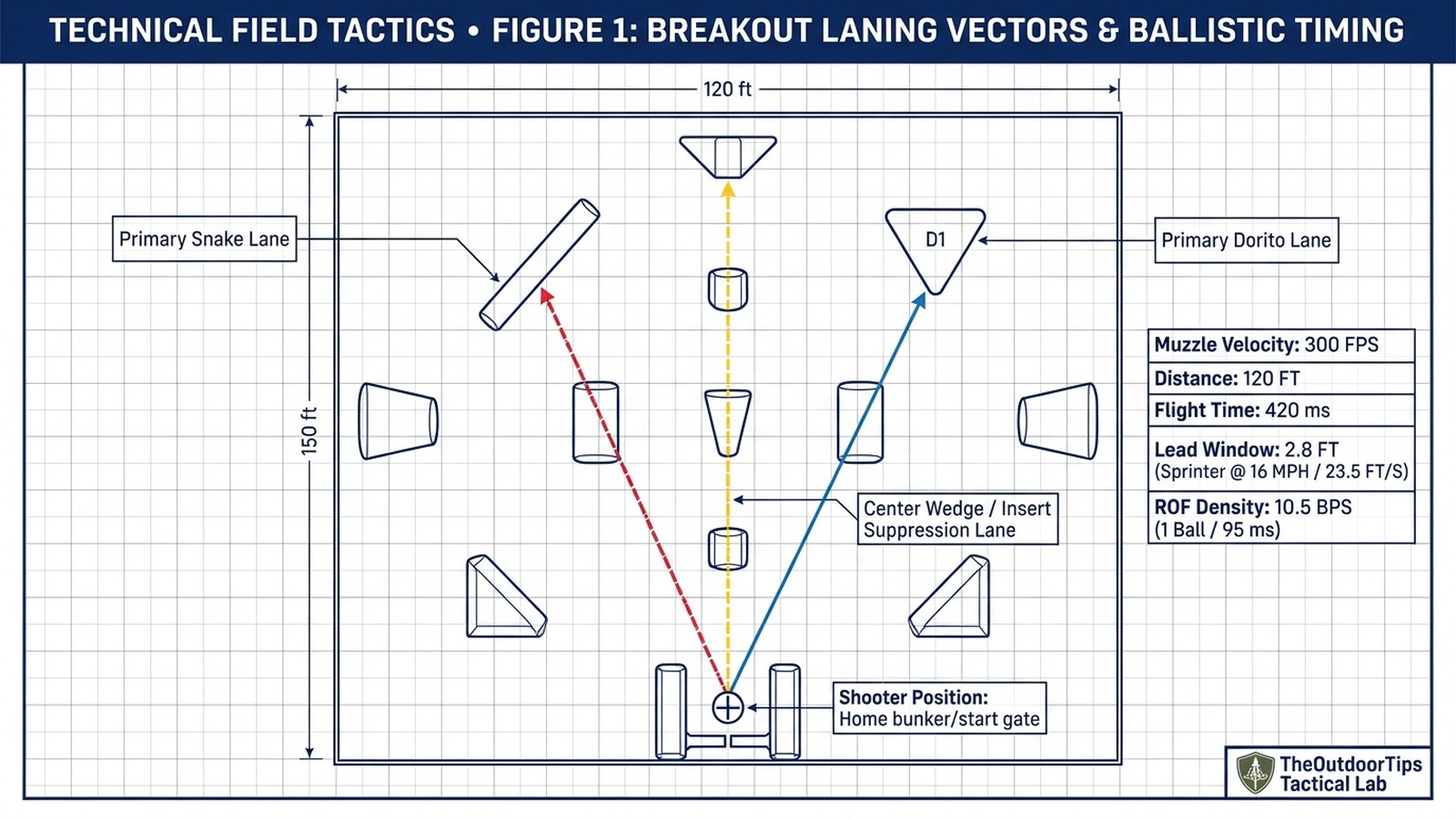
To ensure your electronic marker maintains zero velocity drift during long 35-ball bursts, review our technical guide on paintball gun velocity spikes troubleshooting and calibrate your in-line regulator using our walkthrough on how to service paintball regulator systems.
2. Master Tactical Matrix: Breakout Laning Scenarios & Corrections
Laning effectively requires constant observation and real-time flight corrections. The matrix below contrasts common breakout shooting paintball dilemmas, diagnosing ballistic causes and armorer adjustments.
| Laning Scenario / Dilemma | Root Ballistic / Mechanics Cause | Coach Correction & Field Drill | Essential Gear Spec |
|---|---|---|---|
| Stream Arrives Behind Runner | Late trigger pull or insufficient lead distance failing to compensate for 420ms flight latency. | Pre-aim 3 feet further down the runner’s path; begin ramping on the ‘B’ of the starting buzzer. | Ballistic Radar Chronograph |
| Stream Floats Over Bunker Apex | Excessive barrel elevation or marker recoil whip during sustained 10.5 BPS ramping. | Lower barrel tip 2 inches; lock tank firmly into chest pocket to absorb pneumatic recoil impulse. | Extended 14″ Precision Barrel |
| Hopper Jams Mid-Burst | Loader drive cone tension is set too loose or paintballs swell in high humidity. | Increase electronic motor drive speed; install fresh lithium batteries prior to match play. | High-Capacity 260 Spire Loader |
| Shot Off-The-Break by Opponent | Standing upright and exposed in front of the home start gate while shooting lanes. | Drop to a low knee posture behind the home bunker wing; shoot lanes through narrow side cuts. | Dual-Pane Thermal Goggle |
| Velocity Drops Mid-Stream | In-line regulator starvation from a dirty piston seal or tank output below 450 PSI. | Service regulator with Dow 33; verify tank regulator output matches manufacturer specs. | High-Flow Tank Regulator |
When drilling breakout shooting paintball skills during team clinics, coaches record off-the-break streams with high-speed video cameras. Reviewing slow-motion footage allows shooters to see exactly where their stream passes relative to a runner’s torso.
3. Armorer Workbench: Essential Gear for Lane Shooters
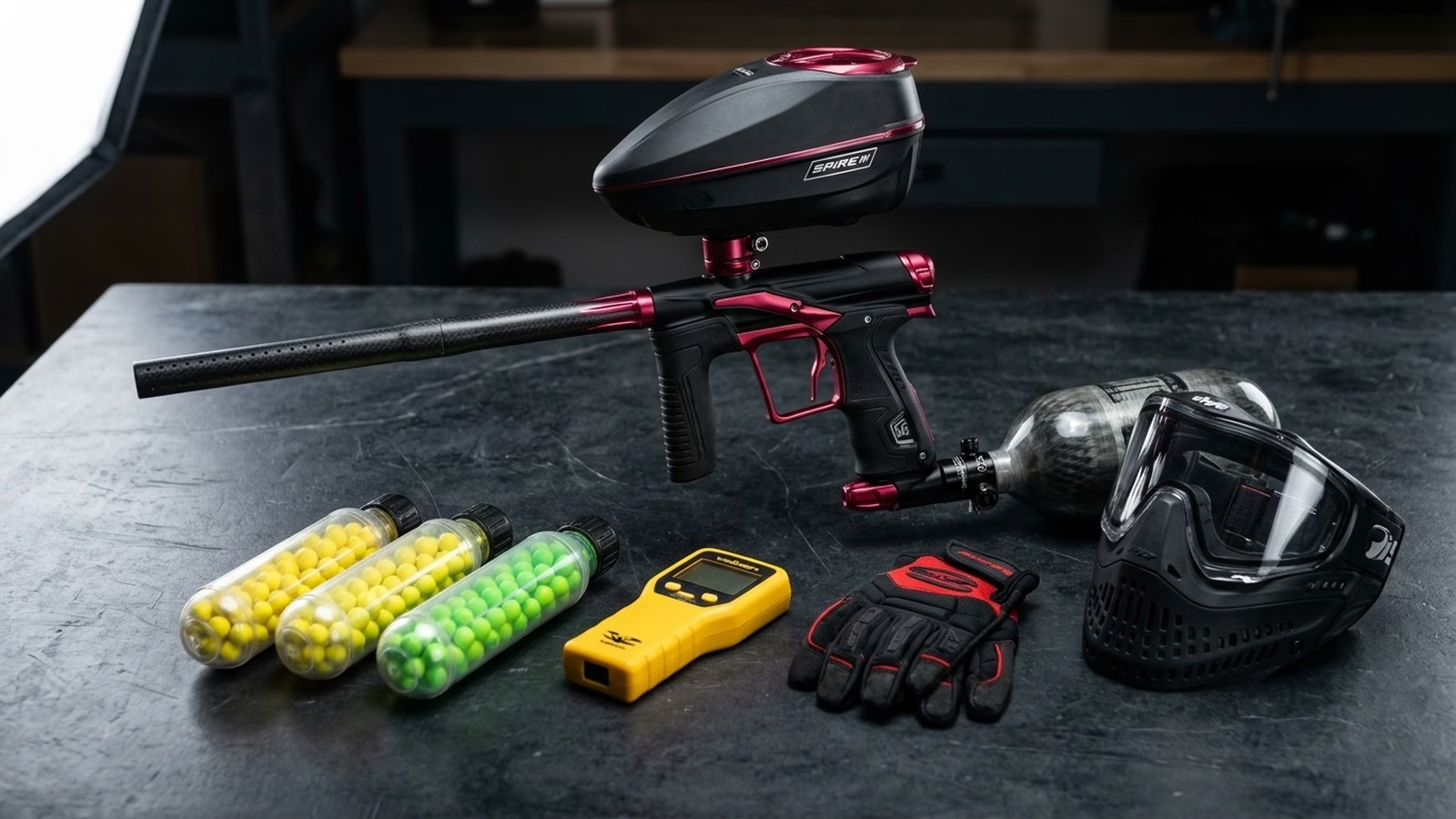
Delivering an unbroken 35-ball stream during competitive breakout shooting paintball sequences requires specialized tournament gear engineered for high-flow pneumatic consistency and rock-solid marker stability. Standard recreational loaders and loose barrels will produce erratic groupings that miss the target gap entirely.
- Handheld Ballistic Radar Chronograph: Essential for checking velocity before every match to ensure paintballs exit at exactly 295 to 300 FPS without spiking over legal limits.
- High-Capacity 260-Round Electronic Loader: Provides the extra 60-round capacity needed to dump a full 35-ball breakout lane while retaining enough paint to fight the secondary point without an instant reload.
- Extended 14-Inch Two-Piece Barrel System: Micro-honed aluminum or carbon fiber barrel with precise bore inserts (.684 to .687) to eliminate barrel turbulence and tighten ball groupings at 120 feet.
- High-Volume 77ci or 80ci/4500 PSI Carbon Fiber Tank: Extra air capacity prevents pressure drop-off during sustained 10.5 BPS ramping bursts.
- Speed-Feed Pod Lock Tubes: High-capacity tournament pods with secure thumb latches that prevent lid pops when carrying 8+ pods on your harness.
To ensure your loader feeds without ball-stack delays during the crucial opening seconds of the point, consult our troubleshooting guide on paintball hopper jamming solutions and learn how to maintain eye sensors via how anti-chop eye sensors work and cleaning.
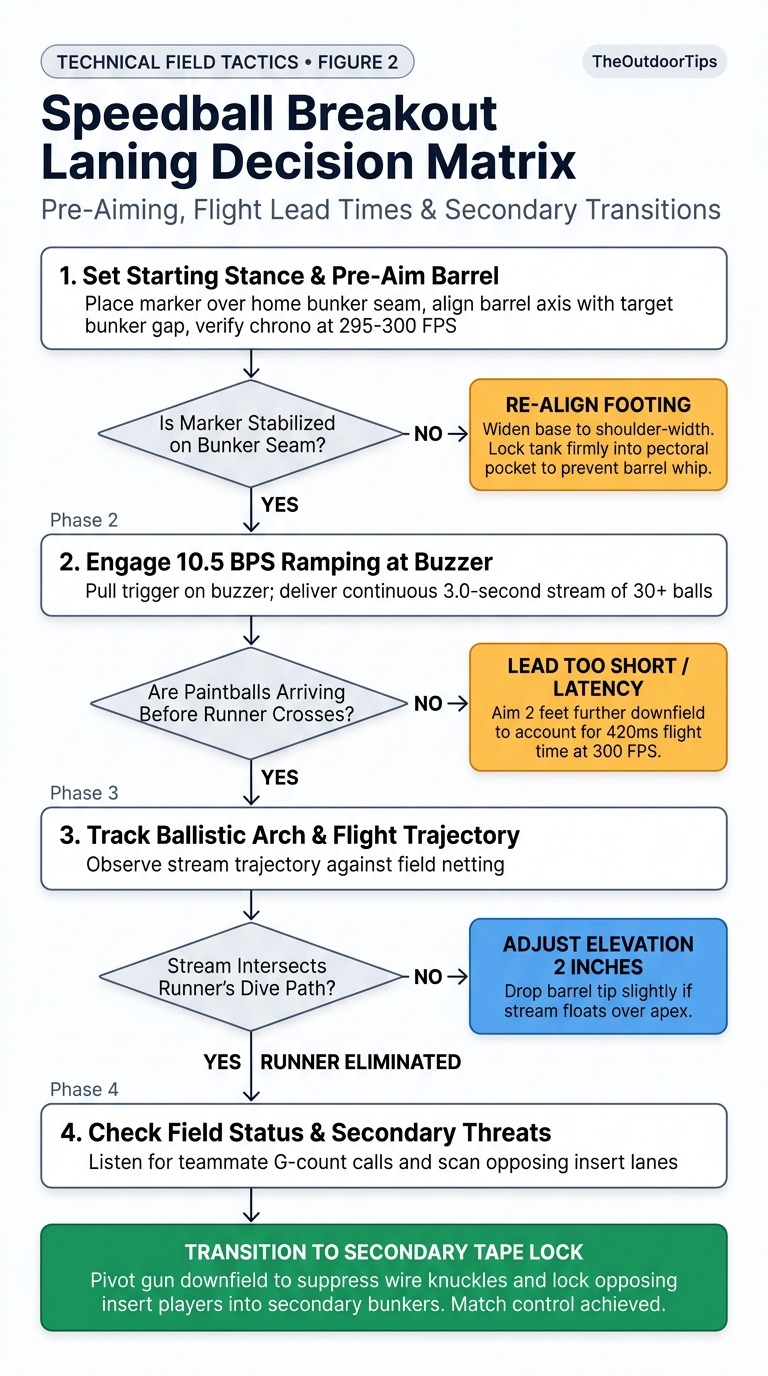
4. Step-by-Step Tactical Protocol: Executing the 3-Second Breakout Dump
Delivering an opening kill off the break is not an accident—it is a repeatable athletic drill. Follow this five-phase armorer protocol whenever executing breakout shooting paintball assignments in tournament competition.
Phase 1: Pre-Buzzer Stance & Gun Alignment
At the 10-second warning, assume a stable shooting base with your feet shoulder-width apart. Rest your marker barrel across the padded seam of the home start gate or center bunker. Pre-aim your barrel directly down the vector leading to the opposing runner’s entrance gap. Lock the air tank firmly into your pectoral pocket to eliminate barrel whip when ramping engages.
Phase 2: Ramping Trigger Activation at the Buzzer
Pull your trigger on the exact ‘B’ of the buzzer tone. Under NXL ramping rules, your electronic board requires three semi-automatic pulls before locking into 10.5 BPS full ramping. Deliver those first three pulls in under 200 milliseconds to ensure your stream reaches full ballistic density before the opposing runner completes their third sprint stride.
Phase 3: Visual Stream Tracking & Micro-Adjustment
Track the flight arch of your paintballs against the dark netting behind the opposing team. Do not close an eye; maintain binocular vision to gauge depth. If your stream is floating 6 inches over the bunker crest, apply gentle downward wrist pressure to lower the trajectory. Maintain an unbroken stream across the target gap for exactly 3.0 to 3.5 seconds.
Phase 4: Confirming the Elimination Call
Watch for the referee’s signal or the opposing player raising their barrel in elimination. Immediately shout the confirmed kill to your teammates (e.g., ‘One dead on the snake wire!’). Communicating this opening kill immediately informs your own front players that their wire is clear to bump forward without contest.
Phase 5: Smooth Transition to Secondary Tape Lock
After completing the 3-second breakout dump, do not stand frozen. Pivot your marker downfield and lock your barrel onto the opposing insert bunker or secondary knuckle. Tuck tightly into your primary bunker to protect yourself from incoming cross-field lanes, and prepare to reload from your harness.
When practicing breakout shooting paintball routines, armorer consistency is critical. Eliminate switch bounce and maximize trigger ergonomics by reading our technical guide on paintball trigger bounce causes and fixes, and check your marker’s solenoid gasket integrity with our paintball solenoid gasket replacement walkthrough.
NXL REGULATORY & ASTM F1776 SAFETY DIRECTIVE
Delivering sustained 10.5 BPS ramping streams requires strict adherence to tournament safety rules. All markers must be chronographed below 300 FPS (15 Joules kinetic energy limit). ASTM F1776 eye protection must be worn at all times inside the netting. When shooting breakout lanes, ensure your barrel remains pointed strictly downfield; never sweep teammates who are sprinting across your peripheral vision toward the snake or dorito wire.
5. Video Walkthrough: Breakout Shooting & Laning Drills
Watch this professional tactical breakdown demonstrating pre-aiming drills, off-the-break trigger activation, and visual stream adjustments on regulation speedball fields.
6. Four Fatal Mistakes That Waste Breakout Paint
Dumping 35 balls into thin air helps the other team win. In our tournament debriefs, we observe four consistent mistakes that ruin an otherwise solid breakout shooting paintball lane:
Waiting until the buzzer tone finishes before pulling the trigger delays your stream by 400 milliseconds. Combined with flight latency, your paintballs will arrive well after the runner has slid safely into the bunker.
Waving your barrel across the field dilutes your stream density. An effective lane is a laser-focused column of paintballs passing through a 2-foot gap. Pick one primary target and commit your entire 3-second burst.
Holding your marker with loose arms allows the pneumatic cycling recoil to kick the barrel upward. The first 5 balls may be on target, but the remaining 30 float harmlessly into the sky netting.
After delivering your 3-second lane, standing upright in the open invites opposing back guns to eliminate you. Always tuck into your bunker wing immediately as your initial ramping burst finishes.
For complete marker maintenance and pneumatic troubleshooting, study our technical manuals on how to fix paintball marker leaks, inspect internal valve sealing with our Tippmann 98 valve rebuild guide, or resolve solenoid click failures via how to diagnose solenoid clicks but gun won’t fire.
7. Final Coach Verdict: The Decisive Value of the Opening Lane
Pre-Aim with Precision, Commit to the Stream, and Own the Break
Mastering breakout shooting paintball mechanics is the hallmark of championship-caliber speedball teams. Eliminating a runner off the break shatters the opposing game plan before it begins, forcing their remaining players into defensive scrambling. Treat your breakout shooting as a high-precision discipline: chronogaph your marker rigorously to 300 FPS, pre-aim your barrel with zero wasted motion, and deliver dense 10.5 BPS streams that shut down opposing lanes instantly.
By following our ballistic calculations and laning drill protocols, your back line will consistently deliver the opening eliminations that win tournament trophies.
8. Frequently Asked Questions (FAQ)
What is the primary objective of breakout shooting paintball in tournament play?
The primary objective is to eliminate opposing front players as they sprint across open field gaps toward primary bunkers like Snake 1 or Dorito 1. Scoring an elimination off the break creates an immediate 5-on-4 player advantage that dramatically increases point-win percentage.
How much do you need to lead a sprinting runner when shooting a lane?
At a regulation distance of 120 feet, a paintball traveling at 300 FPS takes roughly 420 milliseconds to reach the target. A runner moving at 16 mph covers nearly 10 feet in that time. Shooters must lead the gap by 2.5 to 3.0 feet ahead of the bunker edge to intercept the runner’s torso.
How many paintballs should you fire during an off-the-break lane?
A standard off-the-break lane dump lasts 3.0 to 3.5 seconds. Under NXL 10.5 BPS ramping rules, this burst expends approximately 31 to 35 paintballs, creating an unbroken column of paint across the target transit gap.
Why is chronographing to exactly 300 FPS critical for lane shooting?
Laning depends on consistent ballistic timing. If your marker drops to 275 FPS, flight time increases by over 40 milliseconds, causing your paint to arrive behind the runner. A tight +/- 3 FPS spread ensures predictable ball flight.
What should a lane shooter do immediately after the 3-second dump?
Immediately tuck into the home bunker or primary wing to avoid counter-fire. Scan the field, listen for team communication calls—drilling the essential vocabulary detailed in our guide on paintball communication and 10 critical callouts—and transition your barrel downfield to lock secondary tape lanes or suppress opposing insert bunkers.