Few tournament pit-area emergencies are more deceptive than pulling the trigger on an aired-up Planet Eclipse Gtek 180R, Dye DSR+, or Dye Rize CZR, hearing the unmistakable metallic tick inside the grip frame, and watching nothing exit the barrel. Players immediately assume that because they hear a click, the solenoid and battery are healthy. In our field tests and match clinics servicing modern spool-valve and poppet markers, diagnosing why a solenoid clicks but gun wont fire comes down to separating the Stage-1 electronic pilot armature (which creates the sound) from the Stage-2 pneumatic spool and bolt sail (which actually cycles the shot).
Key Technical Takeaways: Solenoid Clicks But Gun Won’t Fire
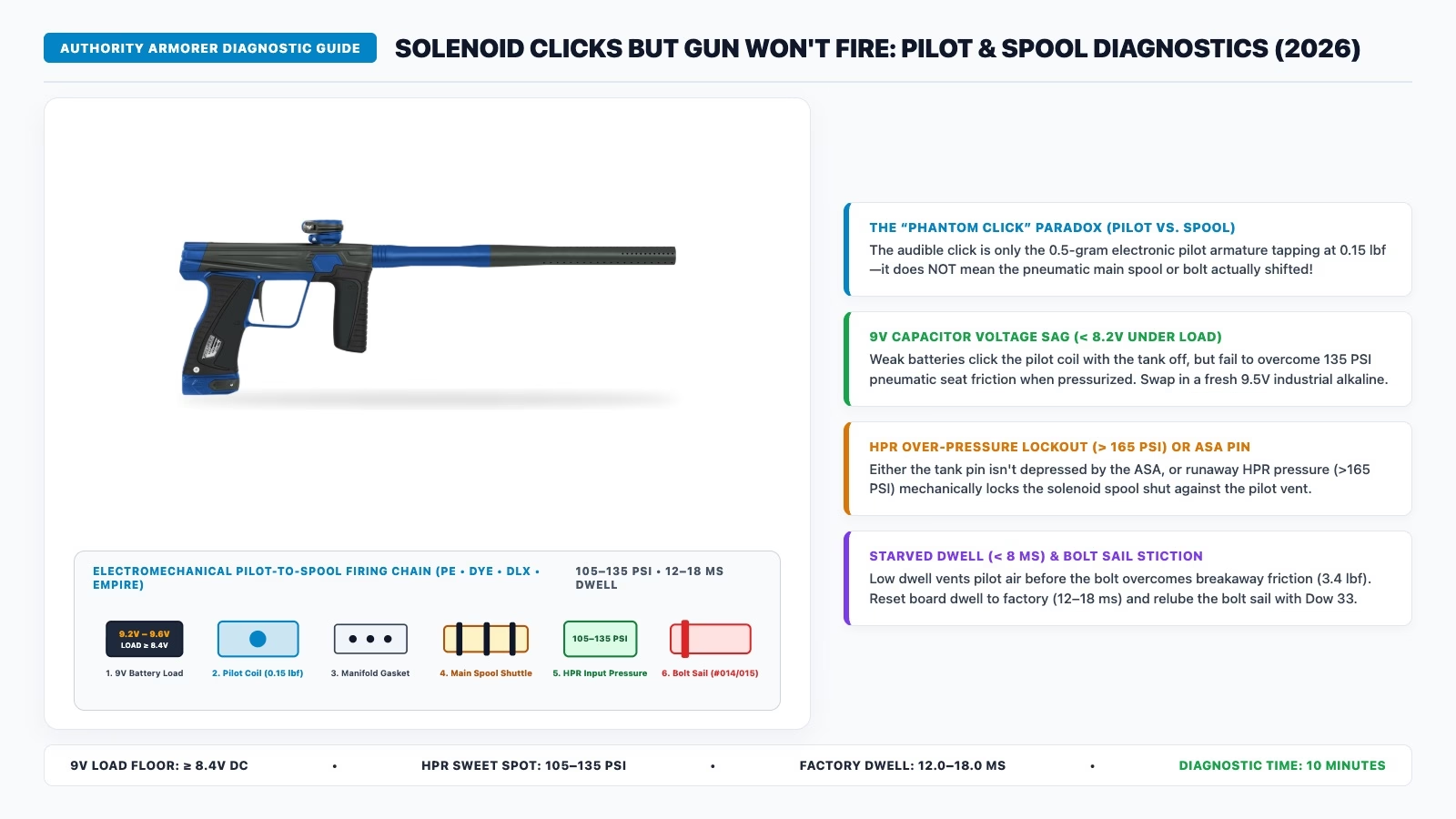
When a paintball solenoid clicks but gun wont fire, the audible tick only proves that the 0.5-gram electronic pilot flapper is moving unloaded—it does NOT confirm that the pilot valve is venting 105–135 PSI air or shifting the main spool shuttle. Over 85% of cases are resolved by installing a fresh 9.5V industrial alkaline battery (≥8.4V under load), verifying the ASA pin is depressing the tank bonnet, resetting board dwell to factory spec (12–18 ms), and relubricating the dynamic bolt sail O-ring (#014/#015) with Dow 33.
≥ 8.4V DC
9.5V Resting Alkaline
105–135 PSI
Locks Out > 165 PSI
12.0–18.0 ms
Spool Fill Duration
≈ 16.2 lbf
19.6 lbf Drive − 3.4 lbf Drag
- The “Phantom Click” Battery Rule: A depleted 9V battery (7.6V–8.1V under load) still has enough voltage to click the unloaded pilot armature when degassed, but lacks the magnetic pull force (0.15 lbf) to lift the pilot poppet against 135 PSI air pressure.
- HPR Over-Pressure Solenoid Lockout: If your inline regulator creeps above 165–180 PSI (or if you bottom out the HPR screw clockwise to 0 PSI), the solenoid spool mechanically locks shut despite an audible pilot click.
- Fatal Solenoid Lubrication Error: Never pack thick Dow 33 grease inside a dry-running SMC or MAC pilot solenoid spool—viscous grease glues the tiny aluminum shuttle stationary while the electronic pilot clicks helplessly.
Electromechanical Physics: Why a Solenoid Clicks Without Firing the Bolt
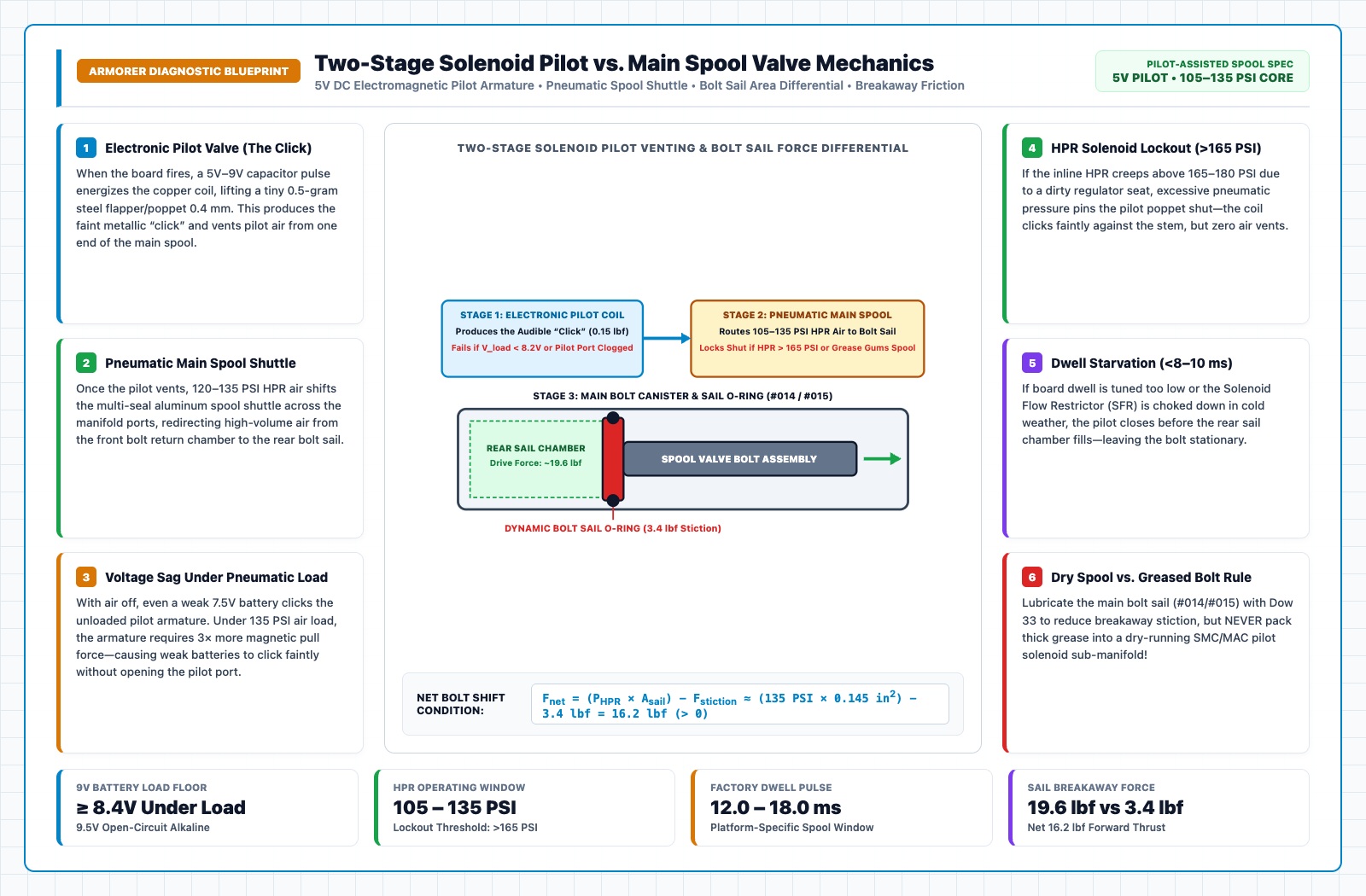
To understand why a solenoid clicks but gun wont fire, you have to look inside a modern two-stage pilot-assisted solenoid valve (such as the SMC/MAC units used in Planet Eclipse, DYE, DLX, and Empire markers). A miniature 9V battery cannot generate the 19+ pounds of mechanical force required to shift a main bolt directly against 105 to 135 PSI operating pressure. Instead, the marker uses a three-stage amplification chain:
- Stage 1 — Electromagnetic Pilot Armature (Produces the Click): When your optical or microswitch trigger fires, the circuit board discharges its capacitor across the copper pilot coil (typically 24–32 Ω resistance at 5V–9V DC). The resulting magnetic pull force (Fmag = (N × I)2 × μ0 × Acore ÷ (2 × g2) ≈ 0.15 lbf) snaps a microscopic 0.5-gram steel flapper or poppet 0.4 mm against its stop. That tiny metal-on-metal tap is the “click” you hear. If coil current drops due to battery voltage sag (<8.2V) or if HPR pressure exceeds 165 PSI, the armature taps weakly without opening the pilot exhaust seal.
- Stage 2 — Pneumatic Main Spool Shuttle Shift: When the pilot port vents cleanly, air pressure on one end of the solenoid’s internal aluminum spool shuttle drops to atmospheric pressure. Incoming HPR air (105–135 PSI) on the opposite end pushes the multi-O-ring spool shuttle 2.5 mm across the sub-manifold ports in under 2.2 milliseconds. If excess Dow 33 grease, swollen spool seals, or a pinched solenoid manifold gasket blocks that shuttle, the pilot clicks and vents a faint puff of air, but the main spool never moves.
- Stage 3 — Dynamic Bolt Sail Differential Thrust: Once the main spool shifts, high-volume HPR gas floods into the rear bolt canister behind the dynamic bolt sail O-ring (#014 or #015, effective area ≈0.145 in2). To launch the bolt forward, pneumatic drive force must exceed static O-ring breakaway friction (bolt stick stiction): Fnet = (PHPR × Asail) − Fstiction ≈ (135 PSI × 0.145 in2) − 3.4 lbf ≈ 16.2 lbf. If a swollen Buna-N sail O-ring or dry canister drives stiction above 19.6 lbf—or if solenoid dwell is starved below 8 ms—the bolt stays frozen in the breech.
Master Diagnostic Matrix: Solenoid Clicks But Gun Won’t Fire Lookup Table
Match your marker’s acoustic and pneumatic symptoms against our field armorer lookup table to isolate the exact failure point in under 60 seconds:
| Acoustic / Pneumatic Scenario | Root Cause / Physics Mechanism | Armorer Diagnostic Fix | Recommended Tool / Gear Link |
|---|---|---|---|
| Clicks Loud Without Air; Weak/Silent When Pressurized #1 cause (55% of field cases) |
9V Battery Load Sag (<8.2V): Depleted battery moves unloaded armature (0.05 lbf) but cannot unseat pilot poppet against 135 PSI air load | Install a fresh 9.5V industrial alkaline battery or full Virtue N-Charge pack; clean battery contacts |
Check Amazon Check eBay |
| Crisp Click, Zero Air in Bolt Core When Unscrewed No gas reaching manifold |
ASA Pin Miss or Zeroed HPR: Recessed tank pin isn’t depressed by On/Off ASA, or inline HPR screw is backed out to 0 PSI | Thread tank in 1/2 turn deeper, add an ASA pin depressor spacer, or turn HPR screw toward 120–135 PSI |
Check Amazon Check eBay |
| Clicks + Tiny Puff of Air, Bolt Twitches 1 mm Only Insufficient impulse / stiction |
Starved Dwell (<9 ms) or Bolt Sail Stiction: Pilot closes before rear chamber reaches 19.6 lbf, or dry/swollen #014/#015 sail O-ring binds | Reset board dwell to factory (12–18 ms), open SFR to (+), replace bolt sail O-ring & lube with Dow 33 |
Check Amazon Check eBay |
| Faint Muffled Click, Fires Only as Tank Empties Pneumatic solenoid lockout |
HPR Over-Pressure (>165–180 PSI): Worn HPR regulator seat creeps to tank pressure, pinning the pilot poppet shut | Turn HPR down 1.5 turns; rebuild inline HPR seat and verify 105–135 PSI with a pressure tester |
Check Amazon Check eBay |
| Pilot Clicks & Vents Air, Main Spool Frozen Solid Contaminated solenoid shuttle |
Grease-Locked Spool Shuttle: Excess Dow 33 or paint residue migrated into the dry solenoid sub-manifold bore | Perform a paintball solenoid cleaning with 91% isopropyl alcohol and inspect the sub-manifold gasket |
Check Amazon Check eBay |
Step-by-Step Protocol: How to Fix a Paintball Solenoid That Clicks But Won’t Fire
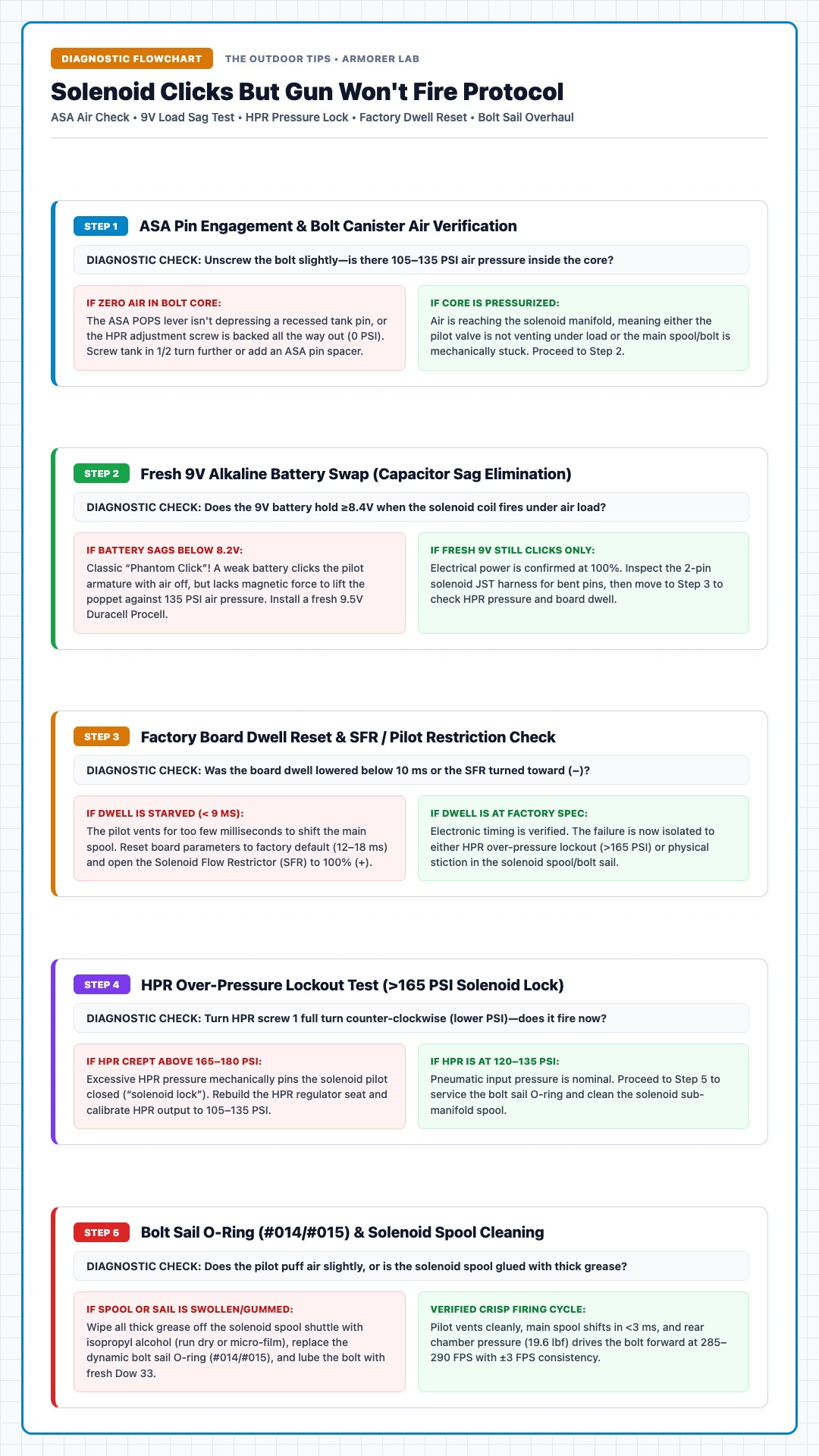
Instead of randomly tearing apart your solenoid manifold in a dusty staging area, execute this five-phase armorer diagnostic sequence from fastest external check to internal spool overhaul when your solenoid clicks but gun wont fire:
Phase 1: Verify ASA Pin Engagement & Bolt Canister Pressurization
Before blaming the electronics, confirm that 105–135 PSI regulated gas is actually sitting inside the bolt engine:
- Test for Pressurized Bolt Resistance: With the marker aired up (and pointed in a safe direction with a barrel sock installed), pull up on the quick-release bolt latch (Gamma Core / OP Core) or gently try to push the bolt tip backward with a clean swab. If the bolt slides effortlessly with zero pneumatic pushback, no air is reaching the bolt canister.
- Check Tank Pin Depth in the On/Off ASA: Unscrew your HPA bottle 1/4 turn and engage the POPS/lever ASA again. If your paintball tank regulator uses a recessed brass pin or an extra-thick #015 urethane O-ring, the ASA pin may stop 0.5 mm short of opening the tank valve.
- Confirm Inline HPR Is Not Zeroed Out: Remember that on Planet Eclipse, DYE, and Empire regulators, turning the bottom HPR Allen screw clockwise (inward) on many balanced designs—or backing it completely out on standard piston regulators—can drop output pressure to 0 PSI. Set the HPR screw flush to factory baseline (2.5 to 3 turns out from bottomed).
Phase 2: Eliminate the 9V “Phantom Click” (Load Voltage Sag Test)
As we emphasize in our electronic paintball gun power troubleshooting guide, the OLED screen battery bar measures resting open-circuit voltage—not transient load voltage during a 250 mA solenoid pulse:
- Install a Brand-New 9.5V Industrial Alkaline Battery: Even if your current 9V battery reads 3/3 bars on the screen and clicks loudly with the eyes off, swap in a fresh, dated Duracell Procell or Energizer Industrial 9V battery (measuring 9.50V–9.65V open-circuit on a digital multimeter).
- Inspect Battery Contacts and the 2-Pin Solenoid JST Harness: Open the grip panels and verify that the two spring-loaded board battery pads are clean and unbent, and press the miniature 2-pin white JST solenoid connector firmly into its board socket. High contact resistance (>1.5 Ω) drops coil voltage from 5.0V to 3.1V, producing a weak phantom click that cannot lift the pilot poppet under 135 PSI load.
Phase 3: Reset Board Dwell to Factory Spec & Open the SFR
If a fresh 9V battery produces a crisp click and a tiny puff of air at the solenoid vent port without cycling the bolt, the pilot valve is closing before the main spool and bolt chamber can fill:
- Restore Factory Dwell Milliseconds: Enter your tournament board programming menu and reset the dwell parameter to factory default: 12.0 ms for Dye DSR+ (ARC+ Bolt), 14.5–16.0 ms for Planet Eclipse IV Core / Gamma Core (170R, 180R, CS2, CS3), 12.0 ms for DLX Luxe TM40/Idol, and 18.0 ms for Dye Rize CZR / Proto Rail.
- Turn the Solenoid Flow Restrictor (SFR) to (+): On Planet Eclipse CS/Geo/Ego platforms equipped with a mechanical SFR dial on the solenoid manifold, rotate the dial toward the plus (+) symbol. Choking the SFR down in temperatures below 55°F (13°C) starves pilot exhaust flow so severely that the main spool stalls mid-shift.
Phase 4: Test for HPR Over-Pressure Lockout (>165 PSI Solenoid Lock)
Every miniature paintball solenoid has a maximum pneumatic operating ceiling (typically 155–170 PSI for spool-valve pilots). When your solenoid clicks but gun wont fire right after servicing your regulator or screwing on a high-output 850 PSI tank, test for over-pressure lockout:
- Run the Bleed-Down Firing Test: Turn your On/Off ASA to the OFF position and pull the trigger rapidly 4 to 6 times as residual pressure bleeds out of the marker. If the gun refuses to fire at full pressure, then suddenly fires 1 or 2 normal shots right as the pressure drops before dying, your HPR is over-pressurizing the solenoid (>165 PSI).
- Lower HPR Output & Rebuild the HPR Reg Seat: Turn the HPR adjustment screw 1.5 full turns counter-clockwise to lower output pressure into the 105–135 PSI sweet spot. If pressure continues creeping upward between games, replace the urethane HPR regulator seat to stop regulator creep and solenoid leaks.
Phase 5: Service the Dynamic Bolt Sail O-Ring & Clean the Solenoid Spool
When electrical voltage, dwell, and HPR pressure are 100% verified, the failure is physical stiction inside the bolt canister or solenoid sub-manifold:
- Replace and Relube the Bolt Sail O-Ring (#014 / #015): Degas the marker and pull the bolt engine out the rear. Wipe away all old, gummy grease with a microfiber towel. Replace the rear dynamic bolt sail O-ring (typically a 70-durometer Buna-N #014 or #015—check our paintball O-ring sizing chart) and apply a butter-thin coat of fresh Dow 33 light silicone grease.
- Degrease the Solenoid Main Spool Shuttle: If players over-grease their bolt, excess Dow 33 gets blown backward down the air transfer passages into the solenoid sub-manifold, gluing the tiny aluminum spool shuttle in place. Unscrew the two Phillips screws holding the solenoid cap/manifold, slide out the miniature spool shuttle, swab the bore and spool completely clean with 91% isopropyl alcohol, and reassemble (leaving SMC/MAC dry-spool solenoids dry or with only a microscopic sheen on dynamic seals per OEM spec).
ASTM F1776Stored Plenum Charge & Solenoid Burst Limit Warning
When a solenoid clicks but gun wont fire, the internal bolt canister and HPR plenum remain fully charged with 120–180 PSI of compressed air even after you disengage the On/Off ASA! Never unscrew a quick-release bolt assembly or unbolt a solenoid manifold without first bleeding trapped plenum pressure (slowly unscrew the HPR or tank 1/2 turn until the gauge drops to 0 PSI). Furthermore, never turn an inline HPR past 180 PSI to “force” a stuck bolt forward—pressures above 200 PSI will permanently rupture the solenoid sub-manifold gasket or crack the composite pilot housing.
Essential Diagnostic Tools & Replacement Parts for Solenoid Troubleshooting
Keep these four tournament pit-box essentials on hand to diagnose and cure a clicking, non-firing electronic marker in minutes:
| Diagnostic Tool / Rebuild Part | Armorer Role in Solenoid Recovery | Technical Specification | Direct Purchase Links |
|---|---|---|---|
| Duracell Procell Intense 9V Batteries | Eliminates capacitor voltage sag (<8.2V) during high-current solenoid pilot pulses | 9.55V Resting / High-Drain Industrial Alkaline |
Check Amazon Check eBay |
| Captain O-Ring DOW 33 Silicone Grease | Reduces dynamic bolt sail breakaway stiction below 3.4 lbf without gumming spool ports | 100% Pure NLGI Grade 1 Low-Temp Silicone |
Check Amazon Check eBay |
| Master Spool-Valve Buna-N O-Ring Kit | Replaces swollen or nicked #014 / #015 dynamic bolt sail and HPR piston seals | 70-Durometer Color-Coded / Boxed Assortment |
Check Amazon Check eBay |
| Digital Multimeter & Hex Key Pit Set | Measures 9V battery load voltage (≥8.4V) and solenoid coil continuity (24–32 Ω) | Auto-Ranging DC Volt/Ohm Meter + SAE Hex Keys |
Check Amazon Check eBay |
Video Demonstration: Why a Clicking Paintball Solenoid Still Fails Under Air
Watch this workbench technical demonstration illustrating why an audible solenoid click only tests the unloaded pilot flapper and how to verify whether the main pneumatic spool is actually shifting:
Final Armorer Verdict: Trust the Pressure Differential, Not the Click
Never buy an expensive replacement solenoid assembly just because your solenoid clicks but gun wont fire. In 9 out of 10 repairs across Planet Eclipse, DYE, DLX, and Empire markers, the solenoid itself is 100% healthy: either a sagging 9V battery (<8.2V) lacks the current to open the pilot valve under 135 PSI load, the ASA pin isn’t depressing the tank pin, HPR creep (>165 PSI) has locked the pilot shut, or excess bolt grease has migrated into the solenoid spool shuttle.
To prevent mid-tournament solenoid lockups before they happen, always remove your 9V battery and wipe down your bolt sail before putting your gear away using our off-season paintball marker storage protocol.
Frequently Asked Questions About Solenoid Clicks With No Firing
If I can hear the solenoid clicking, how can the 9V battery still be the problem?
When your marker is degassed (0 PSI), moving the tiny 0.5-gram steel pilot armature requires almost zero force (≈0.04 lbf), so even a dying 7.5V battery produces a loud click. Once you air up the marker to 120–135 PSI, pneumatic pressure pins the pilot poppet against its orifice, requiring 3× more magnetic pull force (0.15 lbf and ≥8.4V under load) to unseat the seal.
Why does my solenoid click and fire one weak shot only when I turn the air off?
If your marker refuses to fire when fully aired up, then fires a single shot as you bleed the ASA down, your inline High-Pressure Regulator (HPR) is set too high (>165–180 PSI) or has a worn regulator seat that is creeping upward. This condition is called “solenoid over-pressure lockout.” Turn the HPR adjustment screw counter-clockwise 1.5 turns to drop operating pressure back to 105–135 PSI.
Why does my Dye Rize CZR or Empire Mini GS click with the eyes off, but won’t shoot paint?
On the Dye Rize CZR (which runs an 18 ms factory dwell) and Empire Mini GS / Axe 2.0 (poppet solenoid manifold), two culprits dominate when the solenoid clicks but gun wont fire: first, a cheap grocery-store 9V battery sagging under the heavy solenoid coil draw; second, over-greasing the bolt so heavily that Dow 33 plugs the tiny air transfer ports underneath the bolt guide.
Should I put Dow 33 grease inside my solenoid spool to help it slide?
Be extremely careful: Planet Eclipse SMC pilot solenoids (CS1, CS2, CS3, Geo 4, 170R, 180R, LV2) are engineered to run completely dry or with only a microscopic factory film. Packing Dow 33 grease into the solenoid spool bore creates viscous hydraulic drag that freezes the spool shuttle. Always clean the solenoid spool with 91% isopropyl alcohol and apply Dow 33 only to the main bolt O-rings.
How do I know if my solenoid coil or pilot valve is actually dead and needs replacement?
If you have installed a verified 9.5V battery, confirmed 125 PSI HPR pressure inside the bolt core, reset dwell to 16 ms, and cleaned both the bolt sail and solenoid spool shuttle, unplug the 2-pin solenoid wire and measure resistance across the coil leads with a multimeter. A healthy pilot coil reads 24 to 35 Ohms; an open reading (∞ Ω) or a cracked pilot housing that vents air continuously requires a replacement solenoid assembly.
Can cold winter weather cause a solenoid clicks but gun wont fire symptom?
Yes. Below 45°F (7°C), 9V alkaline battery internal resistance doubles while Buna-N bolt sail O-rings stiffen and Dow 33 thickens, increasing bolt breakaway stiction from 3.4 lbf to over 8.5 lbf. Raise your board dwell by +2.0 to +3.0 ms (or enable cold-weather ABS mode) and open the Solenoid Flow Restrictor (SFR) fully to (+).