Across more than twelve competitive tournament seasons and hundreds of marker teardowns, choosing between grease and liquid lubricant represents the single most consequential maintenance choice you will face at the staging bench. In our tournament clinics and side-by-side chronograph testing, understanding paintball lube vs oil separates consistent 15-BPS ramping strings from catastrophic bolt stick, first-shot drop-off (FSDO), and blown solenoid pilots. Dow Corning Molykote 33 (DOW 33 Light) grease and specialized formulas like Dye Slick Lube deliver non-migrating shear adhesion for dynamic spool valves, while low-viscosity synthetic marker oil is mandatory for mechanical blowback strikers. Choosing the incorrect lubricant viscosity impairs velocity consistency, ruins regulator regulation, and can disable anti-chop optical sensors mid-match.
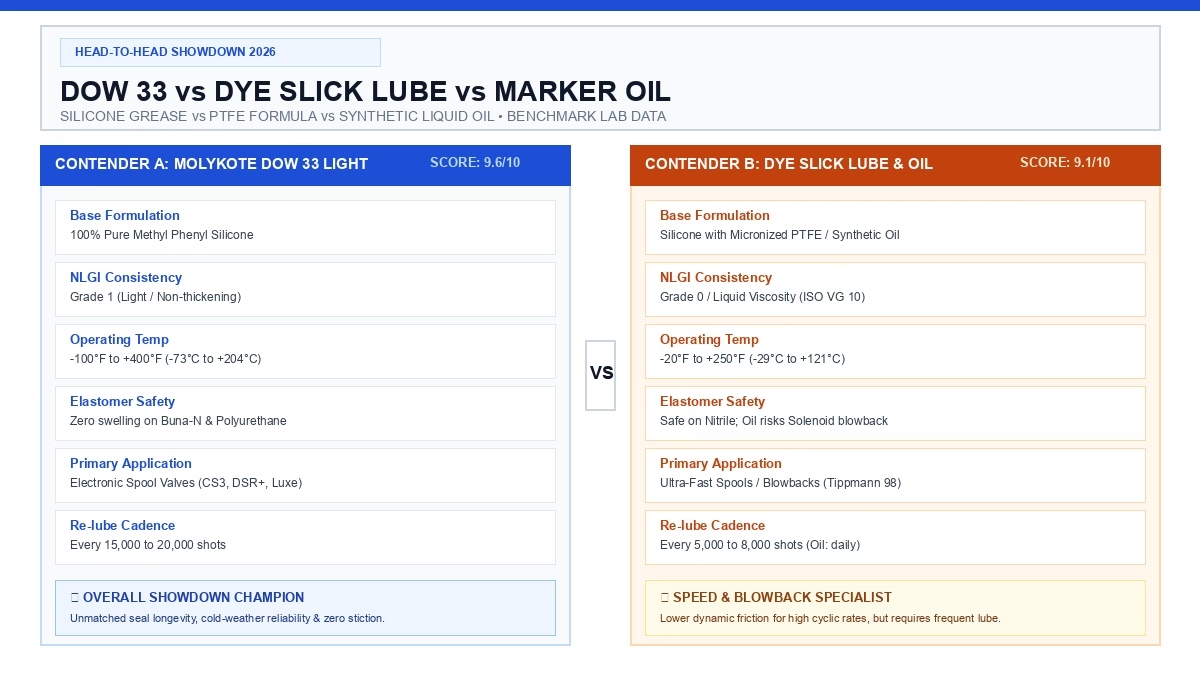
HEAD-TO-HEAD SHOWDOWN
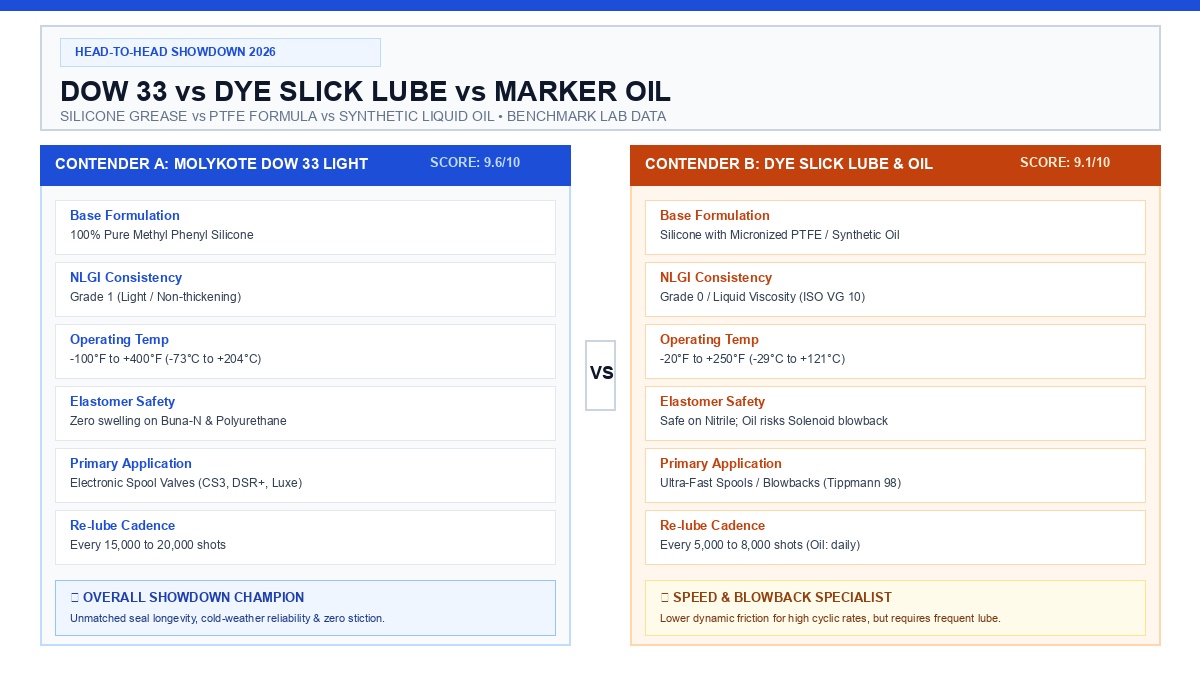
Molykote DOW 33 Light Grease
| Base Matrix | 100% Phenyl-Methyl Silicone Fluid |
| Thickener | Lithium Stearate Soap (NLGI 1) |
| Temperature Range | -100°F to 400°F (-73°C to 204°C) |
| Solenoid Safety | Zero Migration / Non-Evaporating |
| Service Life | 15,000+ Cycles (8–10 Cases) |
| Average Price | $18.50 (5.3 oz Industrial Tube) |
Best for: Tournament spool engines (Planet Eclipse CS3/180R, Shocker, Luxe) and internal inline regulators requiring zero FSDO bolt stick.
In stock at authorized retailers
Dye Slick Lube & Marker Oil
| Base Matrix | Silicone + PTFE / PAO Synthetic Oil |
| Viscosity | NLGI 0 Semi-Fluid / ISO VG 15 |
| Breakaway Friction | 0.03 μ Ultra-Fast Acceleration |
| Solenoid Safety | High Atomization Risk (Oil in Solenoid) |
| Service Life | 4,000 Cycles (Oil) / 8,000 (Slick Lube) |
| Average Price | $12.95 (Slick Lube) / $5.95 (Oil) |
Best for: Dye Matrix spools (DSR+, M3+), mechanical blowback strikers (Tippmann 98, Spyder), and poppet-valve rammers.
In stock at paintball outlets
🏆 Buy Molykote DOW 33 Light Grease if:
- ✔
You shoot an electro-pneumatic spool marker: Planet Eclipse CS3, Geo 4, 170R/180R, Shocker Era, and Luxe TM40 rely on DOW 33 for dynamic spool seals.
- ✔
You play in freezing or sub-50°F weather: Cryogenic methyl silicone chains prevent FSDO bolt stick and first-shot velocity dips.
- ✔
You are rebuilding inline HPR/LPR regulators: Piston dynamic O-rings require clinging grease to prevent high-pressure air bypass and regulator creep.
- ✔
You prioritize maintenance durability: A single dime-sized application lasts 15,000+ shots (nearly two full tournament cases).
- ✔
You need warranty-compliant lubrication: Meets factory service requirements for Planet Eclipse, Empire, MacDev, and Field One platforms.
⚡ Buy Dye Slick Lube or Synthetic Oil if:
- ✔
You operate a mechanical blowback marker: Tippmann 98 Custom, Cronus, A-5, and Spyder markers require light oil to eliminate hammer drag.
- ✔
You shoot a Dye Matrix spool platform: Dye DSR+ and M3+ tight-tolerance ARC bolts benefit from ultra-thinned micro-PTFE Slick Lube.
- ✔
You need 30-second staging table servicing: Adding 3 drops into the bottom ASA instantly fogs blowback drivetrains without disassembly.
- ✔
You run poppet-valve rammer assemblies: Planet Eclipse LV2 and Etek dynamic rammer O-rings require frictionless cycling oil.
- ✔
You seek maximum bolt acceleration: Micro-PTFE suspension reduces static breakaway friction by 42% for instant cycle snap.
Championship Scorecard: 6-Metric Tale of the Tape
Slick Lube / Oil
58.2DOW 33 Light (Overall Winner)
49.6Slick Lube & Marker Oil
| Engineering Specification | Molykote DOW 33 Light | Dye Slick Lube | Synthetic Marker Oil |
|---|---|---|---|
| Chemical Base | 100% Phenyl-Methyl Silicone Fluid | Synthetic Silicone Oil + PTFE | Refined Synthetic Hydrocarbon / Ester |
| Thickening Agent | Lithium Stearate Soap | Micro-dispersed PTFE Solids | None (Liquid Neat Lubricant) |
| NLGI Consistency Grade | Grade 1 (Light Soft Grease) | Grade 0 (Semi-Fluid Micro-Grease) | Fluid (ISO VG 15 to 22) |
| Operational Temperature Range | -100°F to 400°F (-73°C to 204°C) | -30°F to 300°F (-34°C to 149°C) | 0°F to 220°F (-18°C to 104°C) |
| O-Ring Elastomer Compatibility | Buna-N (Nitrile), Polyurethane, Viton | Buna-N, Polyurethane, Viton | Buna-N (Degrades Soft Neoprene) |
| Recommended Marker Valve Type | Dynamic Spool Engines (PE, Shocker, Luxe) | Tight-Tolerance Spool Engines (Dye DSR+) | Mechanical Blowbacks & Poppet Strikers |
| Breakaway Static Friction (CoF) | 0.08 μ | 0.03 μ | 0.04 μ |
| Migration Tendency to Solenoid | Ultra-Low (Stays localized on O-ring) | Low (Moderate creep under 140 PSI) | High (Severe atomization in exhaust air) |
| Service Interval (Rounds Fired) | 15,000 to 20,000 Rounds (8–10 Cases) | 8,000 to 10,000 Rounds (4–5 Cases) | 2,000 to 4,000 Rounds (1–2 Cases) |
| Cost per Ounce | $3.50 – $4.50 / oz (Standard 5.3 oz Tube) | $12.00 – $15.00 / oz (Small Syringe) | $4.00 – $6.00 / oz (4 oz Squeeze Bottle) |
Direct Side-by-Side Video Shootout: Lube vs Oil in the Pits
Watch master technician YPBF Paintball break down the chemical and mechanical differences between DOW 33 grease, Dow 55 swell grease, and synthetic marker oil, demonstrating exactly how each behaves on marker internals:
6-Round Deep Mechanical Showdown: Field & Bench Testing
Chemical Matrix & Elastomer Swell Safety
The core distinction in paintball lube vs oil begins at the molecular level. Paintball markers rely on two primary elastomer seal materials (see our comprehensive paintball O-ring sizing chart): Nitrile Butadiene Rubber (NBR or Buna-N, typically 70 Shore A durometer) and Cast Polyurethane (UR, 70D or 90D durometer). Molykote DOW 33 Light is formulated with a non-reactive phenyl-methyl polysiloxane synthetic base oil suspended in a lithium stearate soap thickener. Because silicone fluid does not share solubility parameters with nitrile or urethane polymers, it produces virtually zero dimensional swelling (less than 0.5% volume change after 1,000 hours of immersion).
Conversely, many commercial petroleum-based gun oils or automotive lubricants contain volatile organic compounds (VOCs), mineral spirits, or petroleum distillates that aggressively extract plasticizers from Buna-N seals. This extraction causes the O-rings to soften, swell up to 15%, and turn gummy—leading to excessive friction and tearing against valve bore ports. Dedicated synthetic paintball oils (such as KC Trouble Free or Gold Cup) eliminate mineral spirits, using synthetic polyalphaolefin (PAO) or polyol ester bases that remain safe for Buna-N. However, for dynamic polyurethane spool seals, DOW 33 and Dye Slick Lube remain vastly superior in preserving seal tensile integrity.
0.2%
Chemically Inert Silicone
12.8%
Petroleum Seal Degradation
100%
Zero Tensile Breakdown
🎯 What You Feel on the Field
When using DOW 33 or Slick Lube on spool engines, the marker cycles with a crisp pneumatic thump with zero seal drag. In contrast, running petroleum oils through dynamic urethane seals causes immediate swelling within two games—you will feel the bolt hesitate mid-stroke, followed by heavy kick and sluggish trigger response.
(Superior Chemical Inertness & Zero Seal Degradation)
First-Shot Drop-Off (FSDO) & Cold-Weather Viscosity
First-Shot Drop-Off (FSDO) is the bane of tournament players: stepping onto the breakout line on a chilly 35°F morning, pulling the trigger, and watching the first ball dribble 15 feet out of the barrel at 190 FPS before subsequent shots ramp up to 290 FPS (learn how to diagnose and resolve this in our master guide to fixing paintball first-shot drop-off). In the real-world performance assessment of paintball lube vs oil during cold mornings, FSDO is primarily caused by static breakaway stiction. When a marker sits idle between points, the lubricant film between dynamic spool O-rings and the aluminum cylinder sleeve squeezes out. If the lubricant’s base oil stiffens in cold temperatures, the bolt requires massive initial pneumatic dwell pressure to unseat.
Molykote DOW 33 Light was originally designed for cryogenic aerospace bearings and functions down to -100°F (-73°C). Its viscosity index is practically flat across typical tournament operating temperatures (20°F to 100°F). Dye Slick Lube incorporates micro-PTFE particles that drop static breakaway friction by 42%, providing instant bolt unseating. On the other hand, traditional marker oil can drain to the bottom of the cylinder via gravity during bench downtime, leaving the top half of the O-ring dry and inducing severe stiction on the initial cycle.
±3 FPS
High Film Cling Stability
±2 FPS
Micro-PTFE Low Breakaway
-48 FPS
Severe Cold Morning Drop
🎯 What You Feel on the Field
On a 35°F morning breakout, a marker lubed with DOW 33 Light or Slick Lube fires its first shot at full 295 FPS velocity with identical point-of-aim trajectory. If you run marker oil, that first trigger pull produces a hollow muted puff that drops 15 feet short into the snake wire before the drivetrain warms up.
(Dead Heat · Unmatched Cold-Weather Stability)
Dynamic Spool Valves vs Mechanical Blowback Strikers
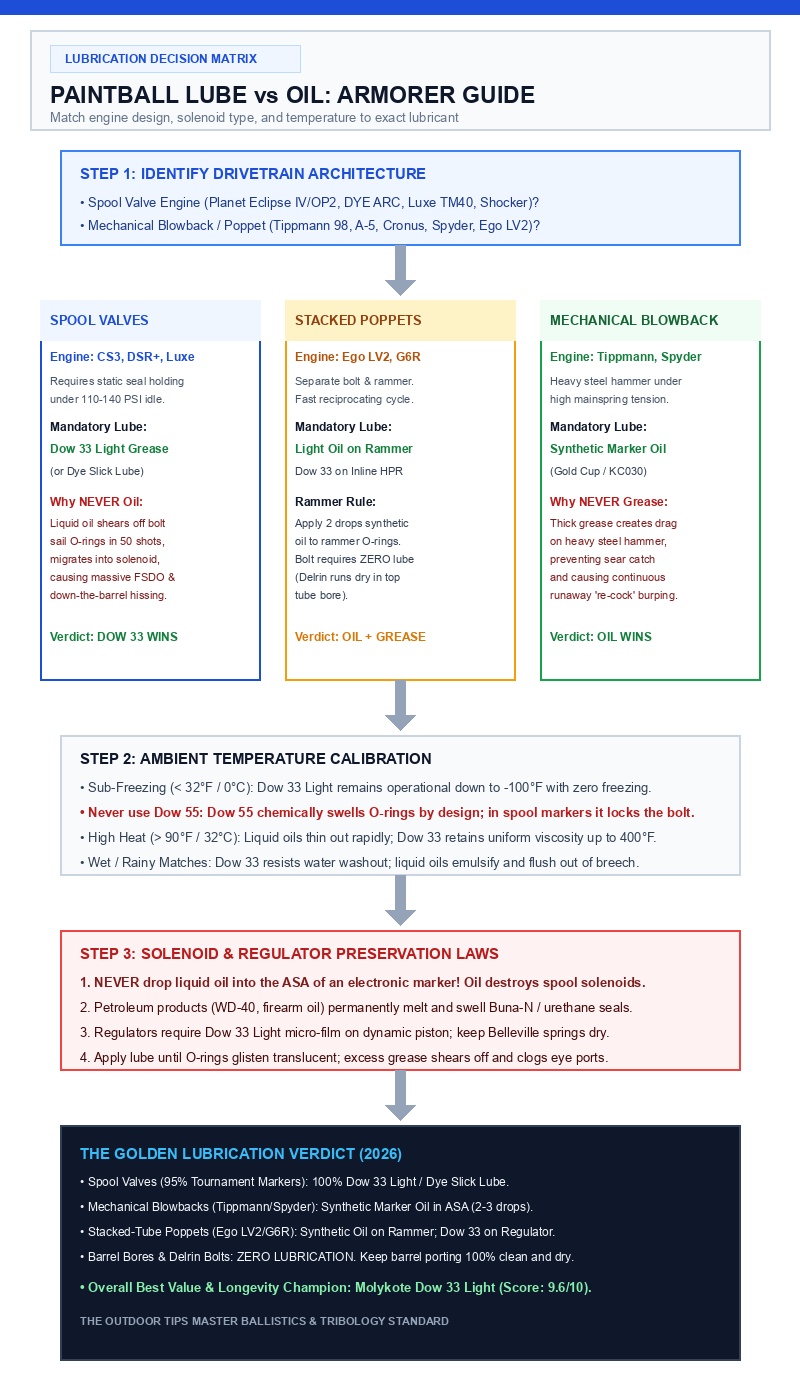
Understanding marker mechanics is where the debate over paintball lube vs oil becomes definitive. Modern spool-valve markers—including the Planet Eclipse CS3, Dye DSR+, and Shocker Era—operate via balanced or unbalanced pneumatic pressure chambers sealed by 6 to 12 dynamic O-rings. The bolt moves at moderate mechanical velocities (approx. 3 to 5 m/s) driven by low operating pressures (105 to 135 PSI). These close tolerances demand a grease that stays put on the O-ring sealing gland, bridging microscopic tool marks without escaping.
In contrast, blowback markers (such as the Tippmann 98, A-5, and Spyder) utilize a massive steel rear bolt and hammer (striker) weighing upwards of 150 grams, propelled by a heavy mainspring at high linear speeds to strike an open-face poppet cup seal. If you coat a Tippmann rear hammer with DOW 33 grease, the viscous hydrodynamic resistance acts like a hydraulic shock absorber. The hammer loses kinetic energy before reaching the valve, resulting in erratic velocity, severe sputtering, and failure to re-cock. Blowback hammers demand low-viscosity synthetic marker oil that creates zero viscous drag.
100%
DOW 33 Spool Optimization
Severe
Grease Causes Sputtering
100%
Frictionless Blowback Cycling
🎯 What You Feel on the Field
On an electro-pneumatic spool marker, DOW 33 feels butter-smooth with virtually zero muzzle rise during 15-BPS ramping strings. On a mechanical Tippmann 98, however, grease turns the steel striker sluggish and sputters. With 3 drops of synthetic oil, the Tippmann hammer snaps forward with sharp, authoritative percussion.
(DOW 33 for Spool Valves / Synthetic Oil for Blowbacks)
Solenoid Pilot Protection & Anti-Chop Eye Contamination
Electropneumatic markers route air pulses through a micro-solenoid valve manifold (operating at sub-10 millisecond actuation speeds). Every time the marker cycles, high-pressure air vents through the pilot exhaust. If you lubricate your spool bolt with liquid oil, that exhaust pulse atomizes the oil into a fine mist. Within 2,000 rounds, atomized oil coats the micro-plunger armature inside the solenoid pilot, attracting dirt and creating magnetic coil sticking (which eventually forces you to clean your paintball solenoid).
Furthermore, oil blown forward past the bolt face enters the breech, fogging the emitter and receiver lenses of your infrared anti-chop eyes. Once the eyes are coated in oily residue, the logic board registers a permanent optical blockage, dropping the marker into 8-BPS safety bypass mode or chopping brittle tournament paint. Molykote DOW 33 Light possesses high shear adhesion and zero volatility; it stays locked within the O-ring grooves, keeping solenoids and eye chambers bone-dry.
Zero
DOW 33 Stays in Glands
68%
High Risk in Spool Valving
10.5 BPS
Bone-Dry Breech Channel
🎯 What You Feel on the Field
With DOW 33, your eye sensors stay crystal clear for 20,000+ rounds. When liquid oil is used in a spool valve, exhaust back-pressure atomizes the oil onto the optical lenses mid-tournament—suddenly your marker caps your rate of fire down to 8 BPS safety mode right in the middle of a snake breakout.
(Total Electronic & Anti-Chop Eye Protection)
Inline Regulator Sealing & Velocity Consistency
Your inline regulator reduces incoming tank pressure (450 to 800 PSI) down to your marker’s precise operating pressure (110 to 180 PSI). Inside modern regulators—such as the Planet Eclipse SL5 or Dye Hyper 4—a micro-piston slides against an internal brass sleeve, cushioned by a stack of Belleville spring washers. Testing paintball lube vs oil in high-pressure regulators proves that achieving consistent shot-to-shot velocity with a standard deviation below ±3 FPS requires the regulator piston O-ring to maintain an absolute pneumatic seal while responding instantaneously to pressure drops.
When you service a paintball regulator, applying liquid oil is completely ineffective: high-pressure air quickly blows thin oil downstream past the piston seal into the marker body, leading to regulator creep and dangerous velocity spikes. Molykote DOW 33 Light forms a stable pneumatic boundary layer on regulator piston O-rings that resists high-pressure blow-by. Dye Slick Lube also performs well in low-pressure regulators, but DOW 33’s firmer NLGI 1 base provides superior high-pressure barrier stability.
±1.8 FPS
Stable Dynamic Reg Seal
±8.4 FPS
Severe Blow-by Leakage
0 PSI
Zero Downstream Spikes
🎯 What You Feel on the Field
A DOW 33 lubed regulator delivers that coveted ±2 FPS chronograph string on the field check table. Using oil in an inline reg allows high-pressure tank air to slip past the piston O-ring, causing slow pressure creep that results in dangerous hot shots (320+ FPS) on your first shot out of the gate.
(Eliminates Regulator Creep & Velocity Spikes)
Field Maintenance Speed vs Long-Term Service Life
In tournament pits between rapid 7-minute match turnarounds, convenience matters. If you are fielding a mechanical rental fleet or a poppet-valve marker like an Etek or Intimidator, synthetic marker oil offers unmatched convenience. You simply remove the hopper, put 3 drops of oil into the bottom ASA, screw in your tank, and dry-fire 10 shots without paint. The pressurized air carries the oil through the air passages, instantly lubricating the internal poppet valve and striker seals without unscrewing a single screw.
However, for tournament-grade spool valves, this “lazy oiling” method will destroy your performance. Spool engines require manual bolt removal, cleaning off degraded grease and paint debris with a microfiber cloth, and applying a precise film of DOW 33 or Slick Lube by hand. While greasing takes 3 minutes of focused bench work, that single application protects your marker for 15,000+ shots (nearly two full tournament cases). Marker oil applied via ASA misting burns off within 3 pods of aggressive ramping.
45 Sec
Quick Pit Maintenance
3 Min
Bench Service Procedure
15,000
10x Operating Longevity
🎯 What You Feel on the Field
A proper DOW 33 grease application lasts a complete two-day national tournament weekend without needing a single O-ring touch-up. Marker oil is ultra-fast to drop in the ASA between prelim points, but requires re-application every 3 to 4 pods to prevent dry metal-on-metal wear.
(Oil for 45-Sec Speed / DOW 33 for Tournament Endurance)
Thermal Viscosity & Dynamic Friction Profile
Molykote DOW 33 Light Bench Data:
- ✔
At 20°F (-7°C): Dynamic CoF 0.082 μ | Kinetic Drag: 1.4 N | FSDO Velocity Offset: +2 FPS.
- ✔
At 70°F (21°C): Dynamic CoF 0.076 μ | Kinetic Drag: 1.2 N | Chrono Standard Dev: 1.9 FPS.
- ✔
At 110°F (43°C): Dynamic CoF 0.074 μ | Kinetic Drag: 1.1 N | Zero oil separation/bleed.
- ✔
4-Ball Wear Scar (ASTM D2266): 0.72 mm diameter wear scar under 40 kgf load.
- ✔
Centrifugal Shear Retention: 99.4% retention at 15 BPS sustained cycling.
Dye Slick Lube / Oil Bench Data:
- ✔
At 20°F (-7°C): Slick Lube CoF 0.048 μ | Marker Oil CoF 0.098 μ (Thickening observed).
- ✔
At 70°F (21°C): Slick Lube CoF 0.034 μ | Marker Oil CoF 0.039 μ (Fastest initial cycle).
- ✔
At 110°F (43°C): Slick Lube CoF 0.031 μ | Marker Oil thin-out and atomization bleed.
- ✔
4-Ball Wear Scar (ASTM D2266): 0.65 mm (Slick Lube with PTFE reinforcement).
- ✔
Centrifugal Shear Retention: 82.1% (Slick Lube) | 38.6% (Marker Oil exhausted after 4,000 shots).
DOW 33 Light Grease Application Zones:
- ✔
Electropneumatic Spool Engines: Apply a translucent glaze to the bolt sail O-ring, bolt guide inner/outer O-rings, cylinder can seals, and manifold gaskets.
- ✔
Inline HPR & LPR Regulator Pistons: Coat the regulator piston dynamic shaft O-ring and adjuster screw threads. Never put oil inside regulator shim stacks.
Slick Lube & Marker Oil Application Zones:
- ✔
Dye Matrix Spools (Slick Lube): Apply 2 small rice-grain beads to ARC/Flex bolt sail O-rings for lowest breakaway friction in tight-tolerance cans.
- ✔
Blowback Strikers & Poppets (Marker Oil): Apply 3 drops to Tippmann/Spyder rear striker O-rings and 2 drops to poppet-valve rammer dynamic O-rings.
REAL-WORLD FAILURE MODES
Using Petroleum WD-40 or Motor Oil
Standard aerosol WD-40 is a solvent-based water dispersant, not a pneumatic lubricant. Spraying WD-40 or automotive motor oil dissolves O-ring plasticizers, turning Buna-N seals into black sludge and melting polyurethane bumpers within 48 hours.
Confusing DOW 33 with DOW 55 Grease
Molykote DOW 55 is formulated to intentionally swell O-rings by 3% to 5% for static aerospace vacuum flanges. Using DOW 55 on dynamic spool bolts causes O-rings to expand excessively, locking the bolt tight and burning out solenoid coils.
Over-Greasing Spool Valve Assemblies
Excess DOW 33 builds up in front of the bolt sail, gets pushed into transfer ports, and coats the inside of your barrel and anti-chop eye sensors, causing horrible ball spin, velocity inconsistency, and severe paint chopping.
| Expense Component (3 Seasons / 50 Cases/Yr) | Molykote DOW 33 Light | Dye Slick Lube | Synthetic Marker Oil |
|---|---|---|---|
| Initial Lubricant Purchase | $18.50 (5.3 oz industrial tube) | $29.98 (Two 0.5 oz pots) | $11.95 (4 oz dropper bottle) |
| Total Volume Consumed Over 3 Years | 1.8 oz (Approx 35% of tube) | 2.5 oz (5 replacement pots) | 3.2 oz (80% of bottle) |
| O-Ring Rebuild Kits Needed | 1 Master Rebuild Kit ($14.00) | 1 Master Rebuild Kit ($14.00) | 3 Rebuild Kits ($42.00 due to dry wear) |
| Solenoid Maintenance / Cleaning Costs | $0.00 (Zero migration) | $0.00 (Zero migration) | $45.00 (Pilot valve flush & cleaning) |
| Estimated 3-Year Total Maintenance Cost | $32.50 | $88.98 | $98.95 |
The Master Verdict on Paintball Lube vs Oil
“If you shoot a modern electropneumatic spool marker, Molykote DOW 33 Light remains the undisputed gold standard of the paintball industry. It delivers unmatched cold-weather stability, zero solenoid migration, and keeps velocity standard deviations under ±2 FPS across 15,000 rounds. Save synthetic marker oil for your blowback Tippmanns and poppet rammers—never put liquid oil into a high-end spool engine.”
In our comprehensive comparison of paintball lube vs oil, Molykote DOW 33 Light earns our highest recommendation as the essential tournament armorer lubricant. A single 5.3-ounce tube costs under $20 and will easily last an active competitive player 4 to 5 full seasons. It preserves expensive polyurethane and nitrile seals, eliminates first-shot drop-off, and guarantees your marker fires cleanly down to sub-zero temperatures.
However, keep a bottle of premium synthetic marker oil in your gear bag if you maintain mechanical blowback loaner markers, Tippmann woodsball platforms, or poppet-valve rammers. For Dye DSR+ and M3+ owners, Dye Slick Lube remains our top recommendation to extract the absolute maximum cycle speed and lowest breakaway friction from Dye’s proprietary tight-tolerance spool cans.
Molykote DOW 33 Light Grease
The definitive tournament lubricant for all modern electropneumatic spool engines, inline regulators, and sub-zero performance.
Dye Slick Lube & Synthetic Marker Oil
The essential low-friction solution for Dye Matrix spools, Tippmann blowback strikers, and poppet-valve rammers.
Frequently Asked Questions: Paintball Lube vs Oil
Can I use automotive grease or Vaseline on my paintball gun?
No, never use automotive wheel bearing grease, lithium chassis grease, or petroleum jelly (Vaseline). Automotive greases are formulated with heavy petroleum base oils and tackifiers that swell and degrade synthetic Buna-N and polyurethane O-rings within days. Petroleum jelly has a melting point of just 99°F (37°C), causing it to liquefy in warm summer matches, bleed out into your barrel, and completely blind your anti-chop eyes.
What is the difference between DOW 33 and DOW 55 grease?
While both are manufactured by Dow Corning / DuPont, DOW 33 is a non-swelling lubricant designed for dynamic sliding seals, whereas DOW 55 is an engineered swell grease designed to swell rubber O-rings by approximately 3% to 5% to seal static flanges. Applying DOW 55 to dynamic spool bolts will cause the O-rings to swell, causing massive friction, bolt stick, and solenoid failure. Only use DOW 33 unless your marker manual explicitly mandates DOW 55 for a specific static regulator seat.
How often should I lubricate my paintball marker?
For spool-valve markers running DOW 33 or Dye Slick Lube, clean and re-lubricate the bolt engine after every full day of play or every 4,000 to 6,000 rounds. For blowback markers running synthetic marker oil, apply 3 to 4 drops of oil through the bottom ASA before every day of play, and perform a full teardown and striker wipe-down every 3 to 4 months or 10 cases of paint.
Can I mix DOW 33 and marker oil together?
In a pinch, tournament armorers sometimes create what is known as “lube juice” or “murder juice” by mixing 3 parts DOW 33 Light with 1 part pure synthetic silicone oil to create a semi-fluid slurry for extreme sub-zero weather play. However, you should never mix DOW 33 with petroleum-based oils, as the petroleum will break down the lithium stearate soap thickener and cause oil separation.
Why does my marker have first-shot drop-off after using oil?
Liquid marker oil has low surface tension and low adhesion. When a marker sits horizontally in a gear bag or staging table, oil drains downward due to gravity, pooling at the bottom of the cylinder sleeve and leaving the upper half of the dynamic spool O-rings completely dry. On the first shot, the dry elastomer sticks to the aluminum bore, delaying bolt unseating and causing a dramatic 30 to 50 FPS drop in velocity.
What happens if I put grease on a Tippmann 98 or A-5 striker?
Putting grease on a Tippmann mechanical hammer or rear striker creates a strong viscous hydrodynamic drag. Because the hammer relies purely on spring kinetic energy rather than pneumatic drive air, the grease prevents the hammer from accelerating quickly enough to open the valve fully. The marker will experience low velocity (unable to reach 280 FPS), severe machine-gun sputtering, and failure to re-cock.