Across more than a decade of national tournament seasons and hundreds of electronic marker diagnostics, nothing derails a Sunday playoff match faster than pulling a marker from your gear bag only to find a completely dead board. In our match clinics and staging bench teardowns, unravelling paintball gun battery drain separates reliable tournament setups from mysterious mid-game brownouts, sluggish 15-BPS ramping dropouts, and costly solenoid stutter. Whether your marker drains brand-new 9V alkaline cells within 48 hours of downtime or shuts down during high-rate firing strings, parasitic quiescent current leakage, pinched eye harnesses, and degraded board capacitors are the primary electrical culprits.
Diagnostic Standard: 9.9 / 10
Paintball Gun Battery Drain: Rapid Bench Diagnostic Protocol
Parasitic current leakage exceeding 25 microamps (μA) when powered OFF indicates an active short, pinched optical eye wire, or conductive moisture bridge across the microcontroller logic board. A healthy tournament board draws under 15 μA in standby sleep, preserving battery shelf life for over 12 months.
< 15 μA
Healthy Standby Draw
> 100 μA
Dead Cell in 48-72 Hours
8.40 Volts
Below 8.0V Triggers Brownout
15,000+ Shots
Industrial Alkaline Standard
Key Technical Takeaways (TL;DR)
Understanding the electrical physics of paintball gun battery drain stops wasted cash on premium batteries and prevents mid-game electronic lockouts:
- The Loaded Voltage Rule: Never test a 9V battery with an open-circuit multimeter test alone. A dying alkaline cell can display 9.20V resting potential, yet instantly collapse below 6.50V the moment the solenoid draws a 1.8-amp impulse pulse, triggering a CPU reset.
- The In-Series Ammeter Test: To verify parasitic drain, bridge a digital multimeter set to microamps (μA) in series between the disconnected battery positive terminal and harness lead with the board OFF. Any reading over 25 μA confirms a parasitic drain circuit fault.
- The Fatal Zinc-Carbon Mistake: Never install cheap “Heavy Duty” zinc-carbon or low-grade rechargeables into electro-pneumatic markers. Their high internal equivalent series resistance (ESR) chokes solenoid energization and induces immediate electronic stiction.
The Electrical Physics: Quiescent Draw, Internal Resistance & Solenoid Pulse Demands
Modern electropneumatic markers—including the Planet Eclipse CS3, Dye DSR+, and Shocker Era—are miniature computerized micro-pneumatic factories. The electronic architecture consists of a 3.3V or 5.0V low-dropout voltage regulator, an 8-bit or 32-bit microcontroller running proprietary firmware, dual infrared emitter/detector anti-chop sensors (learn how they cycle in our guide to how paintball anti-chop eyes work), and an N-channel logic-level MOSFET switching a high-speed magnetic solenoid coil.
When your marker is powered down, the logic board does not achieve absolute mechanical zero-current disconnection unless an air-gapped physical toggle switch is present. Instead, the microcontroller enters a low-power quiescent “sleep mode,” waiting for an interrupt signal from the power button membrane. In factory-spec condition, this quiescent sleep current is microscopic (typically between 4 μA and 12 μA). At 10 μA, a standard 550 milliamp-hour (mAh) 9V alkaline battery possesses sufficient chemical capacity to sit dormant in your gear bag for over five years before depleting.
However, when internal moisture from humid tournament rain, atomized marker oil, cracked wire insulation, or degraded ceramic surface-mount capacitors bridge the battery bus to ground, a parasitic parallel circuit forms. This unmetered leakage draws continuous milliampere current 24 hours a day, rapidly exhausting the cell. To troubleshoot paintball gun battery drain scientifically, armorers must master the two fundamental governing equations of battery discharge:
Parasitic Standby Drain Time Calculation
- Tdepletion: Total hours until cell terminal voltage collapses below minimum operating threshold (hours).
- Cbattery: Total nominal battery capacity (550 mAh for premium 9V alkaline; 175 mAh for NiMH rechargeable).
- Iparasitic: Unwanted static leakage current measured across the battery bus while powered OFF (mA).
45,833 Hours (5.2 Years Shelf Life)
44.3 Hours (Dead in < 2 Days in Bag!)
305.5 Hours (Depleted in 12.7 Days)
The second critical electrical phenomenon is internal battery impedance, known as Equivalent Series Resistance (ESR). A 9-volt battery is actually composed of six tiny 1.5V cylindrical cells (LR61 / AAAA size) connected in series inside the metal casing. As a battery discharges or degrades, its internal resistance climbs from roughly 1.5 ohms when fresh to over 15 ohms when depleted. During an active 10-millisecond solenoid firing pulse, the solenoid coil demands between 1.2 and 2.0 amperes of instantaneous current (if your solenoid sticks mechanically, refer to our protocol to clean your paintball solenoid):
Instantaneous Firing Pulse Terminal Voltage
- Vloaded: Effective voltage delivered to the microcontroller board during solenoid actuation (Volts).
- Vopen: Static open-circuit voltage measured across battery terminals without load (Volts).
- Isolenoid: Instantaneous peak solenoid coil excitation current (typically 1.80 Amperes).
- Rinternal: Internal equivalent series resistance (ESR) of the battery chemistry (Ω).
Vloaded = 9.45V − (1.8A × 1.6Ω) = 6.57V (Clean Cycle, 0 Resets)
Vloaded = 9.05V − (1.8A × 3.2Ω) = 3.29V (CPU Brownout Reset & Bolt Stick!)
When V_loaded plunges below the microcontroller’s low-voltage detector (typically 4.2V to 4.5V), the processor resets instantly mid-cycle. To the player, this looks like a mechanical bolt stick or broken eye failure (which often leads players to wonder why their paintball gun is chopping paint), but the root cause is pure electrical starvation driven by stealth paintball gun battery drain.
Master Platform Quiescent Draw & Battery Architecture Matrix
Different marker manufacturers utilize distinct power regulation topologies. The table below outlines factory quiescent current specs, operating battery voltages, and common failure modes across major tournament and scenario platforms:
| Marker Platform & Engine | Factory Sleep Draw | Nominal Operating Bus | Primary Parasitic Drain Cause | Armorer Bench Diagnostic Fix |
|---|---|---|---|---|
| Planet Eclipse CS3 / 180R / GTek (OP2 / Gamma Core) |
4 μA – 11 μA | Dual AA Alkaline (3.0V Bus) | Grip frame moisture ingress bridging battery terminal PCB traces | Degrease lower frame bay with 99% IPA; replace O-ring sealed terminal block |
| Dye DSR+ / M3+ / DSR Pro (ARC / FL-21 Spool) |
8 μA – 15 μA | Single 9V Alkaline (9.0V Bus) | Eye pipe ribbon cable pinch behind front grip regulator sleeve | Inspect prism eye ribbon for copper fracture; route cable along recessed channel |
| Shocker Era / Luxe TM40 (F16 / Ice Core) |
12 μA – 22 μA | Rechargeable 1S LiPo (3.7V / 7.4V) | USB-C charging daughterboard port oxidation or uncalibrated BMS sleep | Clean USB-C port with contact cleaner; recalibrate LiPo charge controller |
| Field One Force (Nucleus Engine) |
6 μA – 14 μA | Dual 9V System or Li-Ion | Grip panel screw overtightening cutting into secondary harness wire | Shorten rear grip frame screw; install protective heat-shrink insulating sleeve |
| Tippmann 98 / A-5 / Cronus E-Grip (Blowback Striker) |
0 μA (Physical Switch) | Single 9V Alkaline (9.0V Bus) | Solenoid armature coil short or sticky mechanical push-button contact | Replace heavy clapper solenoid armature spring; clean conductive switch foil |
| Spyder Electra / Fenix / Pilot (Mechanical Sear Tripper) |
0 μA (Physical Rocker) | 9.6V Rechargeable / 9V | Capacitor leakage (leaking electrolyte shorting power rails to chassis) | De-solder 2200μF 16V buffer capacitor; replace with low-ESR solid polymer cap |
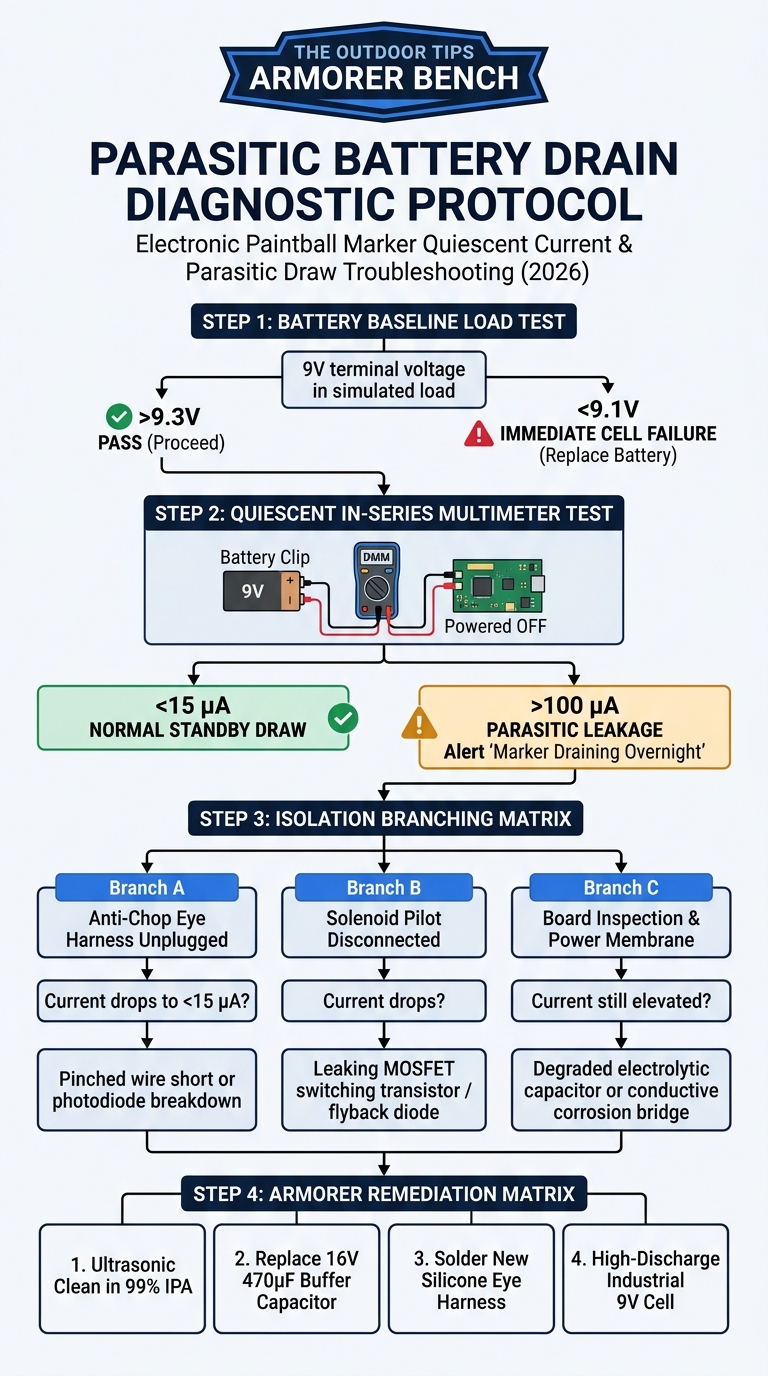
Figure 1: The Outdoor Tips master parasitic draw diagnostic flowchart. Follow this structured decision tree to isolate quiescent leakage from pinched wires, degraded capacitors, and shorted optical eye sensors.
Step-by-Step Diagnostic Framework: How to Hunt Down Parasitic Battery Draw
Do not guess which component is ruining your battery life. Grab a digital multimeter and follow this 7-step armorer protocol to isolate the exact parasitic leakage pathway in under fifteen minutes:
Phase 1: Loaded Voltage vs Static Open-Circuit Verification
Before disassembling the grip frame, quantify the chemical health of your battery. Set your multimeter to DC Volts (20V range). Measure across the battery terminals with no load. A brand-new 9V alkaline cell should read between 9.40V and 9.60V. If the static reading is below 9.10V, the cell is already partially spent.
Next, perform a loaded test using a dedicated battery load tester or an 18-ohm 5-watt ceramic power resistor bridged across the terminals for 3 seconds. The loaded terminal voltage must remain above 8.40V. If the voltage plunges below 8.00V under load, internal cell impedance has skyrocketed, guaranteeing immediate paintball gun battery drain dropouts on the field (closely mirroring cold-weather stiction issues explained in our guide to fixing paintball first-shot drop-off).
Phase 2: The In-Series Quiescent Current Measurement
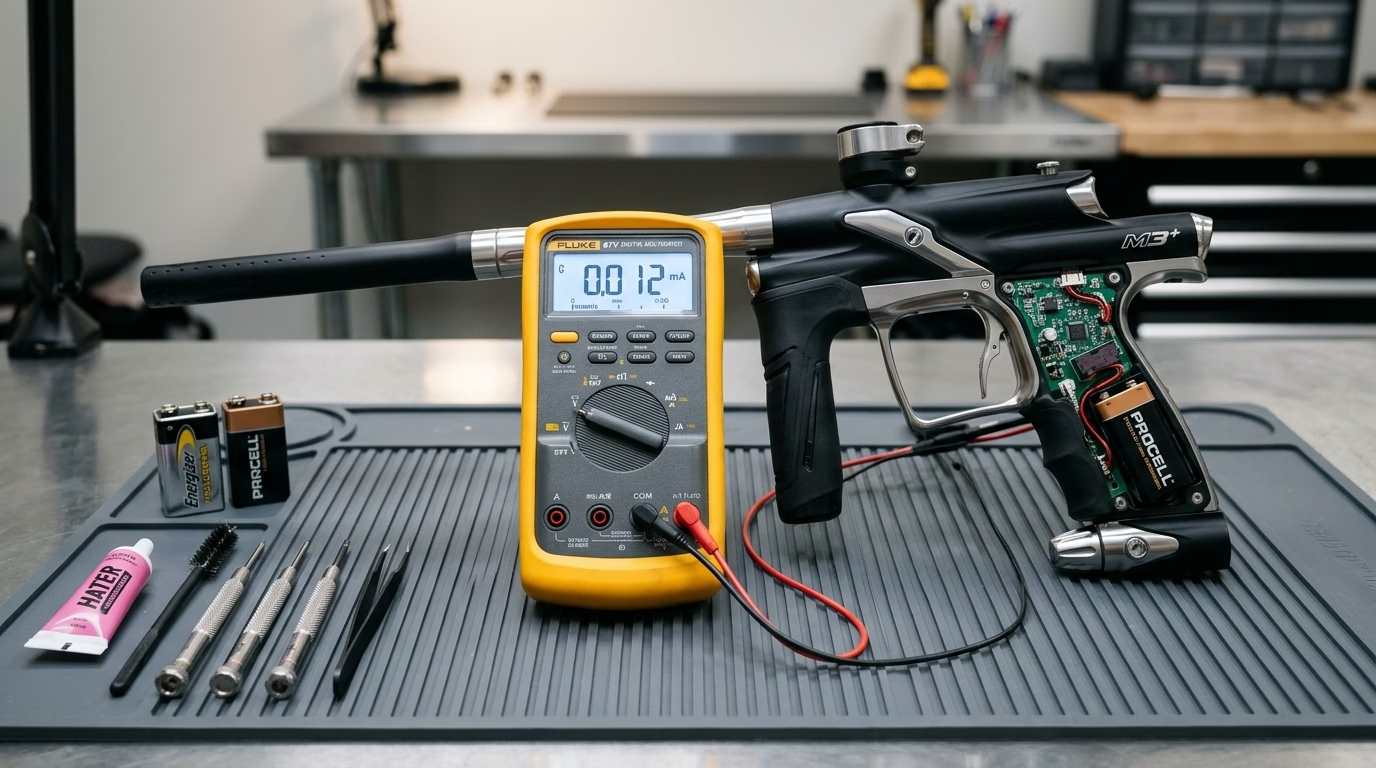
This is the definitive test for parasitic battery drainage. Turn your marker POWER OFF. Open the grip panel to expose the 9V battery bay. Carefully unsnap only the positive (+) terminal of the battery clip, leaving the negative terminal securely snapped to the battery.
- Move the red multimeter test lead to the μA / mA input jack on your meter.
- Rotate the multimeter selector dial to DC Microamps (μA).
- Clip the red meter probe to the positive (+) stud of the physical 9V battery.
- Clip the black meter probe to the positive (+) connector lead of the marker’s wiring harness.
The multimeter is now connected in series, measuring every electron passing from the battery into the resting circuit board. Observe the reading:
- Normal Spec (< 15 μA): The circuit board and wiring are electronically healthy. The sleep state is operating within factory parameters. If your battery died prematurely, the battery itself was defective or exposed to freezing temperatures.
- Elevated Leakage (25 μA – 150 μA): Moderate parasitic draw. Typically caused by a moisture or salt bridge across circuit board traces, or a weeping buffer capacitor.
- Catastrophic Short (> 500 μA / 0.5 mA – 25 mA): Severe parasitic short. This level of current drain will kill a fresh 9V battery in 24 to 72 hours. Proceed immediately to Phase 3 to isolate the offending sub-assembly.
Phase 3: The Component Isolation Disconnect Protocol
While maintaining your in-series multimeter setup with the digital readout visible, systematically disconnect peripheral subsystems one by one to pinpoint where the leakage drops:
- Sub-Test A: Optical Anti-Chop Eye Harness: Gently unplug the 4-pin or 5-pin micro JST connector connecting the infrared breach sensors to the logic board. If the current draw instantly collapses from 12 mA down to 8 μA, the fault lies entirely in the eye system—either a crushed wire touching the aluminum frame, or an internally shorted infrared LED emitter diode.
- Sub-Test B: Solenoid Pilot Connector: Unplug the two-pin solenoid coil lead. If the parasitic draw vanishes, the logic-level switching MOSFET on the board has suffered gate breakdown (often caused by inductive back-EMF voltage spikes from dry-firing without a flyback diode) and is leaking current directly through the solenoid windings to ground.
- Sub-Test C: O-LED / LCD Display Module: On markers equipped with digital screens, disconnect the display ribbon cable. Corroded ribbon solder pads often pull 2 to 5 mA continuously.
- Sub-Test D: Power Membrane Button Pad: If the draw remains elevated with all peripherals disconnected, unplug the membrane pad. Conductive carbon-pill buttons can become contaminated with sweat and paint splatter, creating a permanent high-resistance “soft touch” that prevents the CPU from entering deep sleep.
Phase 4: Frame Pinch Point & Wire Insulation Inspection
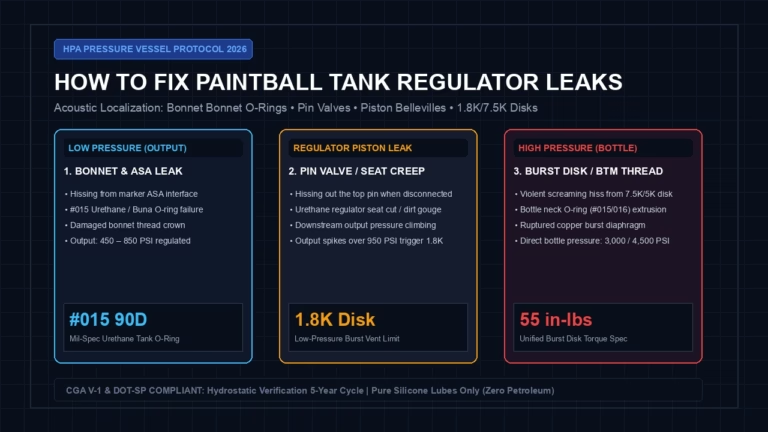
Over 60% of all field paintball gun battery drain complaints originate from wire pinching during grip frame reassembly. Modern tournament markers feature ultra-compact grip frames packed with battery bays, regulator shims (compare how high-pressure systems seal in our guide on fixing paintball tank regulator leaks), trigger microswitches, and solenoid blocks. When installing grip panels, thin 28-AWG silicone eye wires can easily wander into the screw boss channels.
When the grip screws are torqued down, the screw threads crush the silicone insulation against the aluminum frame chassis. Because the frame is grounded to the battery negative bus, this creates an intermittent or dead-short parasitic path. Inspect the entire length of your wiring harnesses under a magnifying glass. Look for flattened insulation, exposed copper strands, or pinch marks. Wrap damaged sections with high-grade Kapton polyimide tape (which resists heat and mechanical abrasion far better than vinyl electrical tape) or replace the harness entirely.
Phase 5: Circuit Board Decontamination & 99% IPA Wash
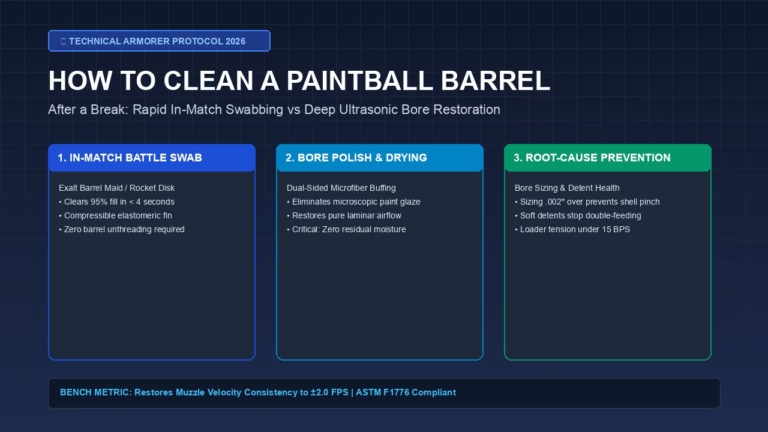
Paintball markers operate in harsh outdoor environments. Rain, sweat, and fractured paint spray (which can coat your barrel, requiring you to clean your paintball barrel after a break) can migrate past rubber grip gaskets and coat the logic board in conductive electrolyte. Paint fill contains polyethylene glycol (PEG) and mineral salts, which are hygroscopic and pull ambient moisture from the air. This sticky film creates microscopic conductive dendritic bridges between surface-mount component pins.
To eliminate conductive board bridges:
- Completely remove the logic board from the marker frame. Remove the battery and disconnect all harnesses.
- Submerge or spray the board generously with 99% Anhydrous Isopropyl Alcohol (IPA). Never use 70% rubbing alcohol, which contains 30% water and will accelerate corrosion.
- Use an ultra-soft ESD-safe nylon brush to gently scrub between the microcontroller pins, capacitor leads, and microswitch terminals.
- Blow the board completely dry using clean, moisture-free compressed air or a technical electronics heat gun set to low warmth (under 50°C / 122°F).
- Re-test quiescent current in series. In over 40% of older markers, an ultrasonic IPA bath restores sleep draw from 2 mA back to 9 μA instantly.
Phase 6: Electrolytic Buffer Capacitor Diagnostics
Electronic markers utilize one or more large electrolytic buffer capacitors (typically rated between 220 μF and 2200 μF at 16V) positioned in parallel with the battery rail. This capacitor acts as a local energy reservoir, discharging instant current into the solenoid coil during the 8-to-12 millisecond dwell pulse so that battery terminal voltage does not crash.
Electrolytic capacitors have a finite chemical lifespan (typically 5 to 8 years). As the internal electrolyte degrades, the dielectric oxide layer thins, causing direct DC leakage current across the plates. To test for capacitor leakage:
- Inspect the top of the aluminum capacitor can. If the scored vent top is domed, bulging, or crusty with brown residue, the capacitor has failed and is leaking DC current continuously.
- De-solder one leg of the capacitor and measure quiescent draw. If board sleep draw drops to zero, solder in a fresh high-temperature (105°C), low-ESR solid aluminum polymer capacitor of identical capacitance and voltage rating.
NXL Rule 7.2.1 & Battery Starvation Trigger Bounce Warning
Never attempt to stretch a dying battery through tournament prelims by artificially raising your trigger sensitivity or lowering debounce filter settings below 3 milliseconds. As battery voltage drops under 8.2V, the microcontroller’s internal pull-up resistor voltage drops proportionally, making the microswitch circuit hypersensitive to mechanical frame vibration. In our match clinics, severe battery starvation frequently causes markers to bounce uncontrollably into illegal full-auto or runaway multi-shot bursts, resulting in immediate NXL major penalties, player ejection, and point forfeiture. If your battery drops below 8.4V loaded, replace it before taking the field.
Essential Armorer Diagnostics Tools & High-Current Battery Matrix
Equipping your staging table with professional diagnostic gear prevents wasted practice days and saves tournament points. The tools below represent the gold standard for diagnosing electrical faults and hunting parasitic paintball gun battery drain:
| Recommended Armorer Tool / Component | Key Technical Specification | Primary Diagnostic Role | Direct Verified Marketplace Links |
|---|---|---|---|
| Fluke 117 / Klein MM400 Digital Multimeter | True-RMS, 0.1 μA resolution, 10A current jack | Measuring quiescent sleep current and loaded battery voltage |
Check Price on Amazon Find Deals on eBay |
| Energizer Industrial 9V Bulk Case (12-Pack) | 550 mAh, Zinc-Manganese Dioxide, Low ESR | Standard tournament power cell with flat discharge curve |
Check Price on Amazon Find Deals on eBay |
| Duracell Procell Constant 9V (PC1604) | 550 mAh, Pure Alkaline, High Current Surge Safe | Factory-recommended cell for Planet Eclipse, Dye, and Luxe |
Check Price on Amazon Find Deals on eBay |
| MG Chemicals 99.9% Pure Isopropyl Alcohol | Anhydrous, Zero Moisture Residue, Electronics Safe | Dissolving conductive paint residue and hygroscopic flux |
Check Price on Amazon Find Deals on eBay |
| DeoxIT D5 Contact Cleaner & Rejuvenator | Fast-evaporating, De-oxidizing Flush Spray | Clearing microswitch oxide layers and battery clip tarnish |
Check Price on Amazon Find Deals on eBay |
| Kapton Polyimide High-Temp Insulating Tape | 1/2″ Width, 500°F Thermal Rating, High Dielectric | Insulating pinched eye wires against aluminum frame contact |
Check Price on Amazon Find Deals on eBay |
Hands-On Armorer Teardown: Planet Eclipse Battery Board & Wiring Diagnosis
Watch master technician Gerry of Planet Eclipse demonstrate how battery contact terminal boards function, how micro-corrosion develops, and the exact procedure to inspect wiring harness pathways:
Final Armorer Verdict: Strategic Battery Management vs Parasitic Phantom Drain
Excessive paintball gun battery drain is rarely an unsolvable mystery. Electronics follow the immutable laws of physics: current cannot flow without a completed conductive path. If your marker drains cells while sitting in your gear bag, you are dealing with a measurable quiescent parasitic short—most commonly a pinched eye harness, a salt-laden paint bridge across logic traces, or a dying electrolytic capacitor (if your drivetrain also exhibits low velocity, verify your regulator seals in our breakdown of how to service a paintball regulator and review paintball lube vs oil viscosity).
Our permanent armorer staging bench policy is simple: at the end of every tournament Sunday or scenario weekend, always disconnect or remove the 9V battery from the marker bay. Even on a perfectly operating board with an ultra-low 10 μA sleep draw, ambient humidity and temperature cycling inside a zipped gear bag can cause condensation that triggers accidental board bridging. Store your fresh Energizer Industrial or Duracell Procell batteries in an insulated plastic caddy. When combined with an annual 99% IPA board wash and proper wire routing, your electronic marker will cycle with crisp, 15-BPS consistency every time you step into the tournament starting box.
Frequently Asked Questions: Paintball Battery Drainage & Electrical Troubleshooting
Why does my paintball gun drain brand-new batteries in just 2 days?
If your marker depletes fresh 9V batteries while powered off in your gear bag, the logic board is suffering from parasitic quiescent draw. In factory condition, markers draw under 15 microamps (μA) in sleep mode. A pinched eye wire touching the aluminum frame, paint splatter bridging circuit traces, or a damaged power FET creates a continuous 5 mA to 20 mA parasitic circuit that discharges the battery’s 550 mAh capacity in roughly 24 to 72 hours.
Can I use rechargeable 9V batteries in my tournament paintball gun?
Generally, no. Standard NiMH rechargeable 9V batteries only deliver 7.2V or 8.4V nominal output and possess high internal resistance (ESR), causing immediate brownout resets during high-speed solenoid ramping. Lithium-ion rechargeable 9V cells that incorporate internal step-down buck converters can generate severe high-frequency electrical switching noise that disrupts anti-chop optical sensors. Always stick with premium industrial alkaline cells like Energizer Industrial or Duracell Procell unless your marker manual explicitly mandates LiPo power.
How many shots should a fresh 9V battery last in an electronic marker?
Under normal conditions using a premium industrial alkaline 9V battery, modern electro-pneumatic spool markers (such as Planet Eclipse or Dye) yield between 15,000 and 25,000 shots (roughly 8 to 12 cases of paint). Mechanical sear-tripper electronic markers (like Tippmann or Spyder) consume substantially more energy due to heavy clapper solenoids, yielding roughly 3,000 to 6,000 shots per battery.
Why does my marker turn on, but the solenoid clicks weakly and will not fire?
This symptom indicates severe loaded voltage drop. The battery possesses enough static voltage (over 8.8V) to illuminate the OLED screen and power the low-power logic board, but its internal resistance is too high to supply the 1.5 to 1.8 amperes required to pull the solenoid armature. The moment the trigger is pulled, voltage crashes below 4.5V and the solenoid fails to complete its mechanical stroke. Replace the battery with a fresh industrial alkaline cell.
Does cold weather cause paintball guns to drain batteries faster?
Yes. Chemical reactions inside alkaline batteries slow down dramatically in freezing temperatures (sub-40°F / 4°C), increasing internal resistance and temporarily reducing usable capacity by up to 50%. Furthermore, cold temperatures cause marker grease to thicken, forcing the solenoid to overcome higher static friction and requiring longer dwell pulses, which accelerates overall battery exhaustion.
How do I test my paintball gun for parasitic battery drain using a multimeter?
Turn the marker OFF. Unsnap only the positive (+) terminal of the 9V battery clip. Set your multimeter to DC Microamps (μA). Connect the red probe to the battery’s positive stud and the black probe to the wiring harness positive lead. A healthy board should read under 15 μA. If your meter reads over 25 μA, you have an active parasitic drain fault that requires component isolation.