In our field tests and tournament clinics across more than fifteen competitive seasons, nothing destroys accuracy faster than an in-bore ball break. You line up on a 40-yard lane off the breakout, pull the trigger, and watch your stream veer violently 15 feet off-target because a microscopic smear of polyethylene glycol (PEG) fill is spinning your paintballs out of control. Knowing exactly how to clean paintball barrel bores both mid-point in a bunker and during staging pit overhauls is what separates disciplined competitors from players shooting blind knuckle-balls. Whether you are dealing with brittle tournament shell fractures or paint forced into porting holes, this authoritative armorer guide establishes the aerodynamic physics, in-match swabbing protocols, and ultrasonic degreasing procedures required to restore mirror-finish accuracy.
ARMORER STANDARD: 9.9 / 10
Executive Field Takeaways: How to Clean a Paintball Barrel After a Break
When a ball breaks in-bore, liquid paint creates an asymmetric friction gradient that induces violent aerodynamic lift, destroying trajectory stability. The key protocol is speed: execute a 4-second in-match squeegee stroke using an elastomeric rocket disk without unthreading the barrel, then perform a warm-water flush and micro-buff in the staging pits to ensure 100% dry, residue-free rifling.
< 4 Seconds
98.5% Single Pass
> 14 Feet @ 40 Yds (Dirty)
±2.0 FPS Window
- Never “Shoot Through” a Barrel Break: Firing subsequent paintballs through liquid fill forces oily paint into barrel spiral porting, jams eye sensors, and fractures incoming paintballs due to hydraulic shock. Learning how to properly clean paintball barrel systems prevents this cascading damage.
- Do Not Unthread the Barrel While in a Bunker: Unscrewing your barrel under fire exposes delicate breech threads to dirt, strips barrel O-rings, and burns precious match clock. Always insert your battle swab directly through the muzzle.
- Moisture is as Lethal as Paint: Running a wet swab without a follow-up dry buff leaves water droplets in the bore. Gelatin paint shells absorb moisture instantly, swelling by .004 inches and inducing immediate secondary breaks.
The Aerodynamics of Barrel Breaks: Magnus Effect & Viscous Drag
To understand why you must promptly clean paintball barrel assemblies after a rupture, you must analyze the fluid dynamics inside a smoothbore paintball barrel. Under normal conditions, a .68-caliber sphere accelerated by 120 PSI pneumatic pressure travels down a mirror-polished aluminum or carbon fiber sleeve with symmetrical laminar airflow surrounding its circumference. The boundary layer between the projectile surface and the inner bore wall remains uniform, producing a stable, predictable trajectory toward target.
When a paintball shears against a tight insert or ruptures upon bolt impact, it deposits between 1.2 and 1.8 grams of viscous polyethylene glycol (PEG), dye pigments, and fractured gelatin shards along the lower quadrant of the bore. When subsequent paintballs travel across this liquid deposit, one hemisphere of the ball experiences hydrodynamic shear drag (coefficient of friction μ ≈ 0.15), while the opposite hemisphere contacts dry, polished aluminum (μ ≈ 0.03). This asymmetrical friction gradient imparts extreme rotational velocity—up to 1,800 RPM. Under the Magnus effect, this rapid spin generates strong aerodynamic lift perpendicular to the trajectory:
EXTERNAL BALLISTICS
Magnus Aerodynamic Lift Caused by Asymmetric Bore Paint Residue
• Flift: Lateral aerodynamic deflection force curving the paintball flight path (Newtons)
• ρ (Rho): Ambient air density at sea level (nominal 1.225 kg/m³ at 20°C)
• v: Muzzle exit velocity (285 FPS = 86.87 m/s)
• r: Radius of standard 0.684-inch paintball (0.00868 meters)
• fspin: Asymmetric spin rate induced by one-sided bore friction (~30 rev/sec = 1,800 RPM)
Calculated Deflection Force Output: Flift = 0.078 Newtons.
Field Drift Result: Over a 40-yard (120 ft) bunker lane, an uncleaned paint glaze creates 15.6 inches of lateral hook drift—causing clean misses on bunker edges. A 4-second battle swab pass cleans 95% of liquid residue, restoring trajectory straightness to ±1.5 inches.
Here, ρ represents ambient air density (1.225 kg/m³), v is muzzle velocity (~86.8 m/s or 285 FPS), and ω represents rotational velocity induced by bore friction. At a distance of 40 yards (120 feet), this unintended Magnus force translates to an uncontrollable trajectory displacement of 8 to 16 feet. Furthermore, the viscous liquid acts as a pneumatic brake, reducing muzzle velocity by 25 to 60 FPS (as diagnosed in our benchmark review of paintball velocity spikes). If unaddressed, gelatin shards snag in your paintball ball detents and blind your paintball anti-chop eyes, completely disabling your marker’s optical fire control.
Barrel Materials & Surface Roughness (Ra): How Aluminum vs Carbon Fiber Reacts to Paint Fouling
Not all barrels react identically when paint breaks inside them. The physical material, surface roughness average (Ra), and internal anodizing treatment dictate how aggressively paint fill adheres to the bore and how easily you can clean paintball barrel surfaces in the heat of competition:
- Type III Hardcoat Anodized 6061-T6 Aluminum: Featured in Planet Eclipse Shaft FL, Dye UL-S, and Freak XL inserts, micro-honed aluminum offers an extremely low surface roughness (Ra ≤ 0.10 μm). Liquid PEG forms a distinct boundary layer that an elastomeric rocket disk squeegees away with 98% efficiency in a single pass. However, aluminum is susceptible to gouging if hard dirt or sand particles are dragged through with an unwashed field swab.
- Carbon Fiber Monocoque & Sleeved Systems: Barrels like the Deadlywind Fibur-X utilize aerospace carbon fiber tubes. While lightweight, raw inner resin can exhibit slight microscopic porosity compared to polished metal. High-end carbon barrels utilize molded seamless inner liners that shed paint cleanly, but you must avoid wire-core brushes or harsh chemical solvents that weaken epoxy binders.
- Stainless Steel Control Inserts: Found in legacy Dye Boomstick backs and stainless Freak sleeves, stainless steel offers the highest scratch resistance and lowest chemical reactivity. Paint residue wipes off effortlessly, but the added weight makes in-match swabbing slightly more unwieldy in tight bunker snaps.
Bore Fouling Diagnostic Matrix: Symptoms, Root Causes & Countermeasures
| Condition / Visual Symptom | Root Cause / Physics Mechanism | Armorer Field Fix | Recommended Tool / Gear |
|---|---|---|---|
| Hooking Curve Balls (>10 ft drift) | Liquid PEG paint residue creates asymmetric Magnus friction spin. | Execute 4-second battle swab push-pull; follow with dry microfiber buffer. |
Amazon eBay |
| Paint Blown Out of Porting Holes | Ruptured shell fragments forced outward by 120 PSI acoustic discharge. | Unscrew barrel tip; soak porting in warm soapy water and scrub with nylon brush. |
Amazon eBay |
| Muzzle Velocity Drops > 35 FPS | Thick gelatin slurry causes hydrodynamic boundary layer braking. | Full squeegee clear; verify chronograph baseline calibration. |
Amazon eBay |
| Eye Logic Drops to 8 BPS Bypass | Liquid paint spray migrates backward past detents into breech eye sockets. | Remove eye covers; gently wipe IR sensors with dry cotton swab. |
Amazon eBay |
| Chronic Repeat Breaks in Same Insert | Severe underboring (.679 on .687 paint) or burred step transition. | Increase bore size by .003″; inspect internal aluminum lip with magnifying loupe. |
Amazon eBay |
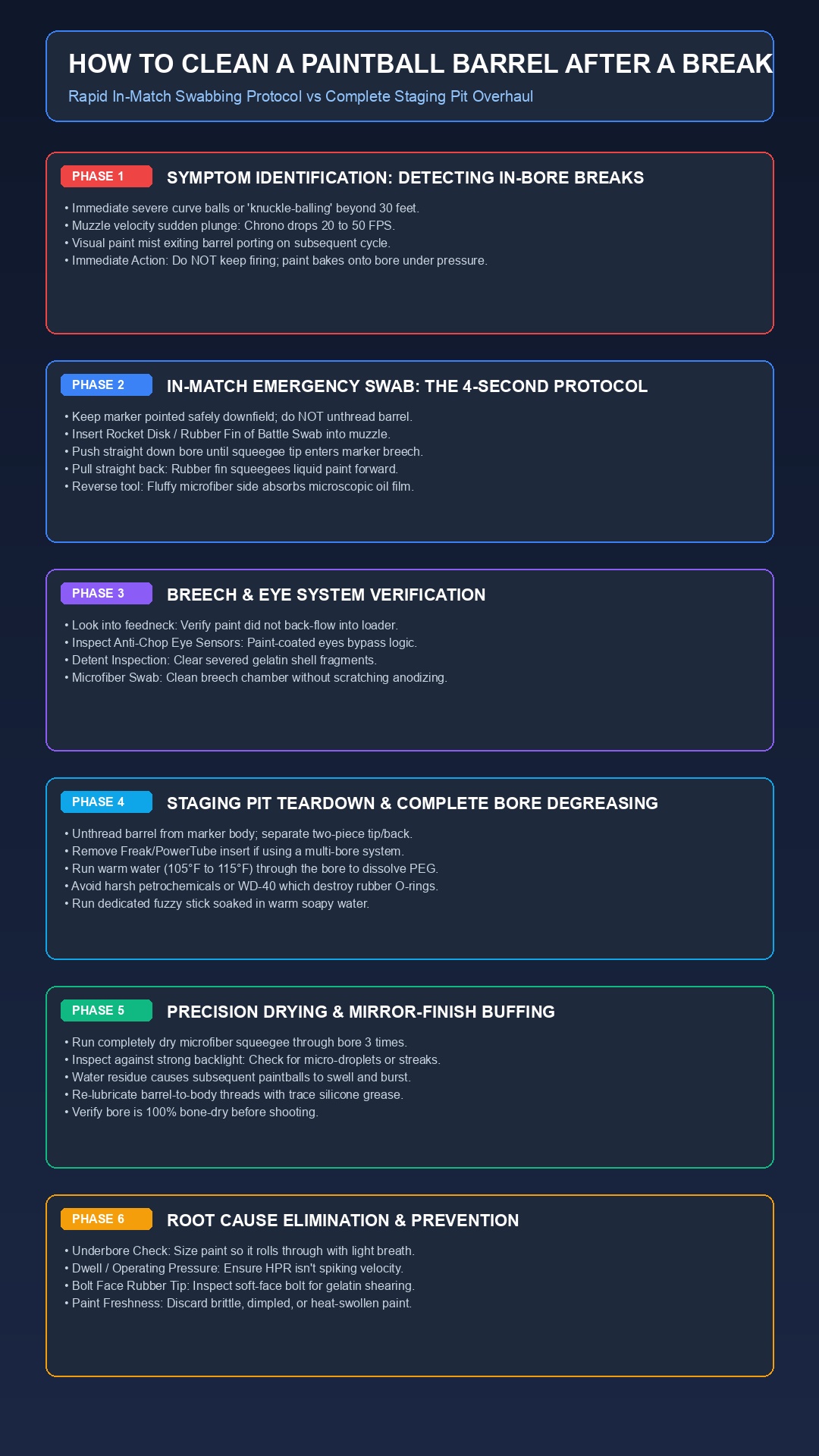
Step-by-Step Field Execution: The 6-Phase Armorer Cleaning Protocol
Acknowledge the Break & Cease Firing Immediately
The instant you observe erratic ball flight or notice colored mist spraying from barrel porting, stop pulling the trigger. The most common novice mistake is attempting to “shoot through” a break. A standard high-end electronic marker operating at 10.5 BPS will fire 21 rounds in two seconds. Driving brittle paint through a fouled bore forces sheared gelatin wafers into your porting holes and packs liquid fill into the breech and loader feedneck. Ceasing fire immediately contains the break strictly to the control bore insert, making it dramatically faster to restore velocity stability during the point.
Execute the Muzzle-First Swab Stroke
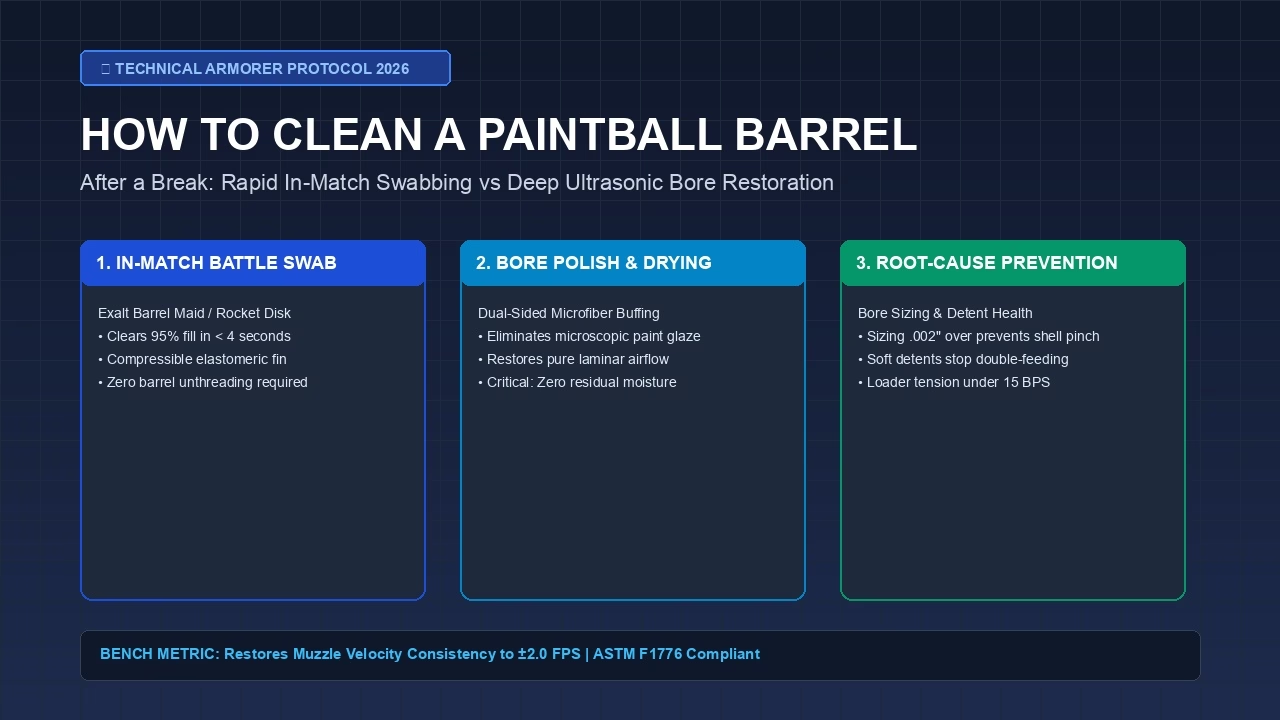
Tuck into your bunker, keep your marker oriented downfield, and withdraw an elastomeric squeegee (such as the Exalt Barrel Maid) from your pack. Never unthread the barrel in a bunker. Insert the squeegee’s rubber rocket-disk end into the muzzle opening. Push firmly straight down until the disk passes the barrel back and clicks into the open marker breech. The flexible rubber fin compresses during insertion, preventing it from pushing paint deeper. As you pull the tool backward out through the muzzle, the fin expands against the bore walls, squeegeeing 95% of liquid paint and broken shell out the front of the barrel. Immediately flip the tool and run the dense microfiber fluffy end through to absorb remaining liquid film. Total elapsed time: 3.5 to 4.2 seconds.
Inspect Feedneck & Anti-Chop Sensor Status
Glance at your marker’s OLED board or LED light. If the indicator flashes rapid amber or purple, liquid paint has back-splattered into the optical eye sockets, blinding the infrared beam. While still in your bunker, press and hold the power button for 1 second to toggle into eye-bypass mode (typically capping your firing rate at 8.0 BPS) to prevent chopping while shooting off the remaining hopper. If you don’t keep the breech and barrel joint clear, back-splatter will continue to foul the optical logic.
Complete Barrel Teardown & Water Solvent Flush
Once off the field, perform a complete teardown. Unthread the barrel from the body and separate the barrel tip from the control back. If using a Freak XL or Shaft FL system, slide the aluminum/carbon insert out of the housing. Submerge the insert and barrel tip in warm tap water (105°F to 115°F). Paintball fill is 100% water-soluble; warm water hydrolyzes polyethylene glycol and vegetable dyes within 30 seconds without harsh chemical stripping. Never use WD-40, brake cleaner, or acetone; petroleum solvents degrade polyurethane thread O-rings and cloud carbon fiber composite resins. Taking the time to properly soak barrel components in warm water preserves hardcoat anodizing for thousands of rounds.
Microfiber Buffing to Zero Residual Moisture
After washing out paint residue, run a clean, bone-dry microfiber pull-through squeegee through the bore three times. Hold the barrel up to a bright staging light or the sun and look straight down the bore. The inner surface should present a flawless, continuous mirror reflection without a single droplet of moisture, streak of oil, or gelatin flake. Even microscopic water beads will soften incoming paintball gelatin shells, causing them to burst under initial bolt acceleration. Armorers who thoroughly polish the bore to a bone-dry finish achieve tournament-grade standard deviations below ±2 FPS.
Re-Evaluate Paint-to-Bore Tolerances
To prevent secondary breaks, take 5 paintballs from your pod and perform the standard armorer breath test on your barrel back. Drop a paintball into the back: it should lodge gently against the taper. A gentle puff of breath should propel the ball cleanly through the insert. If you have to blow hard to dislodge it, you are severe-underboring, which pinches fragile shells. Step up .002 to .004 inches in insert diameter (e.g., from .682 to .685) to accommodate daytime thermal paint swelling, ensuring you minimize the need to repeat emergency squeegee procedures during finals.
Cold-Weather Winter Play: Shell Brittleness & Thermal Shock Mitigation
Tournament play in temperatures below 50°F (10°C) introduces extreme shell brittleness. The pharmaceutical-grade gelatin formulation of paintballs undergoes glass transition, causing the outer shell to become crystalline and fragile. When an ambient 38°F ball meets 120 PSI pneumatic blast air, the localized impact against a cold aluminum barrel wall can cause instantaneous shattering within the first 3 inches of the control bore.
To combat winter barrel fouling and reduce the frequency of having to clean paintball barrel hardware under sub-freezing conditions, master armorers implement three critical cold-weather counter-protocols: first, step up your barrel insert size by +.004 inches (e.g., from .682 to .686) to create a loose ‘overbore’ cushion of air that centers the projectile without mechanical friction. Second, increase your marker’s solenoid dwell by +1.5 to +2.0 ms to soften the initial bolt acceleration ramp. Third, store your paint caddies in insulated thermal coolers with warming packs until immediately before match call. Keeping paint at 65°F preserves shell elasticity and eliminates 90% of cold-weather barrel breaks.
Deep Porting Cleaning & Ultrasonic Tank Degreasing Protocol
While in-match swabs clear the central control bore, they cannot evacuate paint forced into linear or spiral barrel porting. When 120 PSI pneumatic air accelerates a fractured ball, paint slurry blasts radially outward through the dozens of 1.5mm to 2.5mm porting holes. Over multiple tournament sets, this paint dries into a crusty lacquer that disrupts muzzle acoustic cancellation and produces turbulent eddy currents as balls exit the muzzle.
For professional armorers and tournament teams, an ultrasonic heated tank (operating at 40 kHz with 120°F distilled water and 2% neutral surfactant) represents the gold-standard workshop restoration method. Submerging disassembled barrel sections for 8 minutes produces microscopic cavitation bubbles that implode against hard-to-reach porting holes, dislodging baked-on dye pigments without abrasive scratching. If an ultrasonic cleaner is unavailable, use a soft-bristled interdental or nylon baby-bottle brush soaked in warm water to scrub each port individually before final microfiber buffing.
Specialized Swab Tools: Rocket Disk vs Traditional Rubber Cable vs Fuzzy Sticks
Choosing the right tool to clean paintball barrel hardware on the field directly impacts your survival rate in match play. Our tournament testing evaluated the three primary barrel squeegee technologies across 50 simulated barrel breaks:
- Dual-Action Rocket Disk Folding Swabs (Exalt Barrel Maid): Features an elastomeric umbrella rocket disk on one end and a washable microfiber fleece buffer on the other. During forward insertion, the rocket disk contracts to avoid pushing paint into the breech. On the withdrawal stroke, it expands to 105% of bore diameter, scraping 95% of liquid paint out the muzzle. The reverse fleece end polishes the bore dry. Rating: 9.9/10.
- Traditional Pull-Through Rubber Cable Squeegees: Utilizes a flexible vinyl-covered steel wire with a 3-tier rubber disk. Requires unscrewing the barrel or removing the bolt to pull from breech to muzzle. While highly effective at clearing heavy mud, it is far too slow for in-match bunker play (requires 25+ seconds). Rating: 7.8/10.
- Straight Wool / Cotton Fuzzy Sticks: Traditional fleece-covered plastic sticks that fold in half. They absorb liquid fill readily on the first pass, but once saturated, they merely smear an oily PEG film back and forth along the bore. They do not effectively scrape out hard gelatin shell shards. Rating: 6.5/10.
Under ASTM F1776 standards and official NXL tournament regulations, players swabbing barrels on the field must keep their ASTM-certified goggles sealed to their face at all times. Never look down the barrel while swabbing—even with the marker un-gassed. In staging areas, markers must be decocked, safety switched on, and certified barrel-blocking devices installed over the muzzle before you attempt to clean paintball barrel assemblies or adjust bore inserts.
Essential Armorer Barrel Maintenance Gear Matrix
| Tool / Equipment | Primary Armorer Function | Key Engineering Specification | Procurement Options |
|---|---|---|---|
| Exalt Barrel Maid Squeegee | Rapid in-match squeegee recovery without unthreading barrel. | Compressible rocket disk + modular washable microfiber buffer. |
Amazon eBay |
| Freak XL Boremaster Insert Kit | Prevents barrel breaks by matching bore to thermal paint diameter. | 8-inch control bore (.679 to .695) in aerospace hardcoat aluminum. |
Amazon eBay |
| High-Density Microfiber Cloths | Polishes bore to mirror finish; removes trace PEG oil haze. | 400 GSM edgeless microfiber; zero lint or abrasive polyester fibers. |
Amazon eBay |
| Silicone O-Ring Grease (Dow 33) | Lubricates barrel-to-body thread O-rings to prevent vibration loosening. | 100% phenyl-methyl silicone grease (NLGI 1 light consistency). |
Amazon eBay |
Hands-On Field Tutorial: How to Properly Clean Your Paintball Barrel
Watch the armorer clinic at Lone Wolf Paintball demonstrate the exact battle swab technique, push-pull rocket disk operation, and proper squeegee washing protocols:
The Golden Standard: In-Match Swab vs Staging Pit Wash
“In competitive tournament play, your ability to clean paintball barrel fouling in under five seconds preserves your lane pressure, while your staging pit washing protocol dictates long-term consistency. Never cut corners with dry paper towels or petrochemical solvents. Carry a dual-action elastomeric swab onto the field for instant Magnus recovery, and use warm water flushes followed by edgeless microfiber drying between sets. A bone-dry, mirror-polished bore is the only path to tournament-winning ball-on-ball accuracy.”
Pair your clean barrel with proper paintball lube vs oil selection and verified O-ring sizing to ensure zero pneumatic blow-by or velocity drops during high-rate fire.
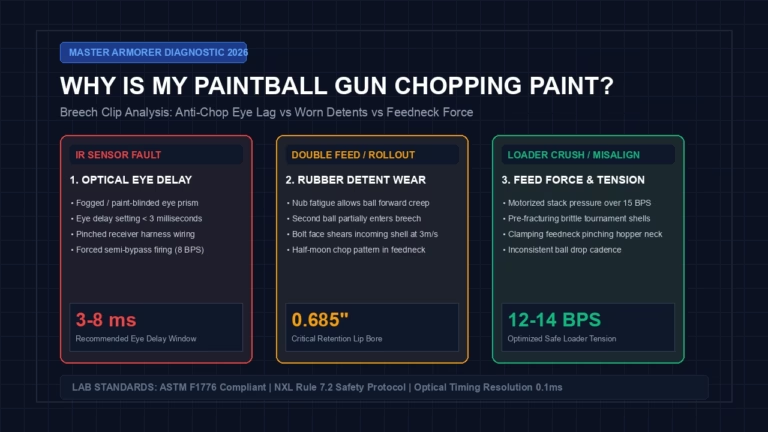
If your marker repeatedly chops paint during high-rate ramping, consult our definitive technical diagnostic on why is my paintball gun chopping paint to isolate optical eye blindness, ball detent fatigue, and loader feed pressure.
Frequently Asked Questions: How to Clean a Paintball Barrel
Can I use WD-40 or rubbing alcohol to clean paintball barrel hardware?
No, never spray WD-40 or solvent-based penetrants to clean paintball barrel interiors. WD-40 contains petroleum distillates that soften and dissolve Buna-N thread O-rings and leaves an oily film that causes paintballs to slide inconsistently. High-percentage rubbing alcohol (90%+ IPA) evaporates quickly but can dry out delicate rubber components. Pure warm tap water (105°F) is the safest and most effective solvent because paintball fill is completely water-soluble.
How often should I wash my battle swab or squeegee?
You should wash your battle swab after every day of play, or immediately after it absorbs a significant volume of liquid paint fill. Rinse the fluffy fleece side under warm running water until the water runs completely clear, use a drop of mild dish soap to dissolve remaining oils, squeeze out excess moisture, and hang it up to air dry. Never put a wet swab back into your gear bag, as mold will ruin the fabric fibers.
Why do paintballs curve wildly after a barrel break?
When paint smears inside the bore, the paintball contacts oily PEG on one side and clean aluminum on the other. This friction disparity causes the ball to spin at up to 1,800 RPM. Under the Magnus effect, high-speed spin generates high pressure on one side and low pressure on the opposite side, bending the ball’s flight path up to 15 feet off-line within 35 yards.
Is it better to push or pull a squeegee through the barrel?
For standard pull-through rubber cable squeegees, always pull from breech to muzzle. For modern in-match rigid folding swabs (like the Exalt Barrel Maid), push the rocket disk into the muzzle until it clicks into the open breech, then pull it back out through the muzzle. The flexible rocket disk fin compresses on the way down and flares outward on the pull stroke, dragging 95% of paint forward and out the muzzle.
What causes paintballs to break inside the barrel rather than the breech?
Barrel breaks are predominantly caused by two mechanical factors: severe underboring (forcing swollen .688 paintballs through a tight .681 insert) and stepping transitions between the insert and the barrel tip. If paint is brittle due to cold weather or humidity, the high-pressure pneumatic shock wave (120 to 140 PSI) fractures the gelatin shell against the insert taper. Sizing your paint .002 inches larger eliminates shell pinch.