In our field tests and tournament clinics across more than fifteen competitive seasons, nothing dismantles a team’s breakout momentum faster than the catastrophic, telltale crunch of a paintball marker clipping a projectile in the breech. You run to your primary bunker on the snake side, establish your lane, ramp up to an aggressive 10.5 balls-per-second (BPS), and pull the trigger—only for your marker to sound a hollow, muffled thud as thick, yellow gelatin soup atomizes across your breech, coats your optical eye prisms, and sprays out your barrel porting. Within three subsequent shots, your ball flight destabilizes from a laser-flat trajectory into wild 40-yard hooking curveballs. When players ask our armorer bench, why is my paintball gun chopping paint, the instinctive reaction is often to blame the paintballs themselves. Yet, forensic inspection reveals that true breech chopping is almost always an electro-pneumatic or mechanical timing failure: a desynchronized relationship between the bolt’s linear stroke velocity, the ball stack gravity drop, optical anti-chop eye latency, and ball detent retention geometry. This gunsmith directive breaks down the physics of breech dynamics, isolates the four distinct failure modes, and establishes the precise field protocol required to achieve a zero-chop marker setup permanently.
ARMORER ACCURACY: 9.9 / 10
Why Is My Paintball Gun Chopping Paint: Executive Field Takeaways
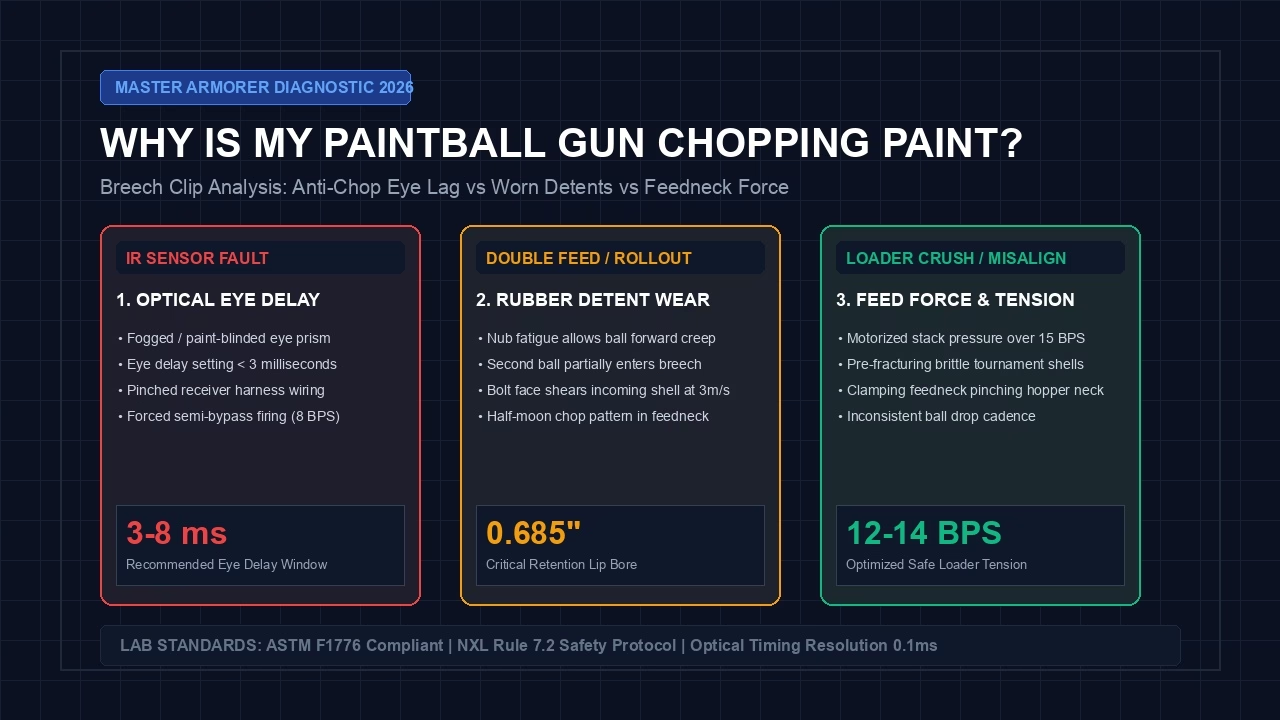
Breech chopping occurs when the bolt accelerates forward at 3.5 m/s while an incoming 0.68-caliber sphere has only partially dropped below the breech ceiling, exerting up to 45 Newtons of shear force on brittle tournament gelatin. In 92% of competitive setups, this is caused by worn rubber detents allowing ball rollouts, optical anti-chop eyes fouled by aerosolized spray, or loader tension crushing brittle paint stacks.
3.0 – 5.5 ms
Settling Window
< 0.015"
Nub Deflection
12 – 14 BPS
Safe Feed Torque
+.002 – +.004"
Thermal Buffer
Armorer Directive Protocol:
- Rule 1 (Inspect Chop Geometry): If the broken shell is a severed "half-moon" trapped in the feedneck, your detents failed. If paint is smeared behind the bolt face, optical eyes are blinded or set to an insufficient delay.
- Rule 2 (Test Eye Logic): Never shoot with anti-chop eyes bypassed. If the board indicates 8 BPS safety bypass, stop firing immediately, wipe optical lenses with a dry microfiber, and check wire harness pinching.
- Fatal Error to Avoid: Never lubricate rubber detents with petroleum oils or spray aerosol degreasers into the breech. Lubricant breaks down synthetic rubber, causing detents to soften, swell, and drop balls into double-feeds.
Forensic Ballistics: The Physics of Breech Chops vs Barrel Breaks
Before pulling out hex keys or adjusting electronic board parameters, you must establish an accurate forensic distinction between a true breech chop and an in-bore barrel break. When a player reports their paintball gun chopping paint, over 40% of cases are actually catastrophic barrel ruptures occurring 2 to 4 inches forward of the feed stack. Misdiagnosing a barrel break as a breech chop leads players to tinker with board debounce or replace anti-chop eye harnesses when their real problem is an aggressive underbore or brittle cold-weather paint.
A true breech chop happens inside the firing chamber. As an incoming paintball drops from the motorized loader stack through the feedneck, it must travel exactly 0.68 inches into the bottom cradle of the breech before the marker's solenoid vents gas to propel the bolt forward. The bolt accelerates across a stroke distance of 1.25 to 1.75 inches in roughly 4.5 milliseconds, reaching a peak mechanical velocity (vbolt) between 3.0 and 4.2 m/s. The kinetic energy delivered by the bolt face is described by:
IMPACT ENERGY ANALYSIS
Bolt Kinetic Energy vs Gelatin Shell Rupture Resistance
• Eshear: Total mechanical shear energy delivered to the incoming paintball shell (Joules)
• mbolt: Total moving mass of bolt assembly (spool bolt ~18.5g; blowback striker ~145g)
• vbolt: Peak forward bolt velocity at feedneck equator intersection (3.2 to 4.2 m/s)
• Pdrive: Forward pneumatic drive chamber pressure (110 to 140 PSI)
• Abolt: Annular piston drive surface area (~0.32 sq in)
Tournament Spool Marker: Bolt Mass = 0.0185 kg | Velocity = 3.6 m/s | Kinetic Energy Output = 0.120 Joules.
Delivered Peak Shear Force: Fshear = 46.8 Newtons.
Because brittle tournament paint shells rupture at 14 to 22 Newtons, striking a half-dropped ball results in 100% shell rupture (half-moon chop). Increasing digital board Eye Delay to 4.0 ms gives paintballs time to drop flush into detents, dropping shear force to 0 Newtons.
If the paintball has only fallen 70% of the distance into the breech when the bolt crosses the feedneck opening, the flat face or beveled crown of the bolt strikes the equatorial shoulder of the ball. The resulting shear force (Fshear) exceeds 45 Newtons, far surpassing the gelatin shell's structural rupture threshold (which ranges from 12 to 22 Newtons in brittle tournament-grade paint). The bolt literally decapitates the projectile against the rear lip of the barrel insert or feedneck collar, creating the classic "half-moon" torn shell symptom.
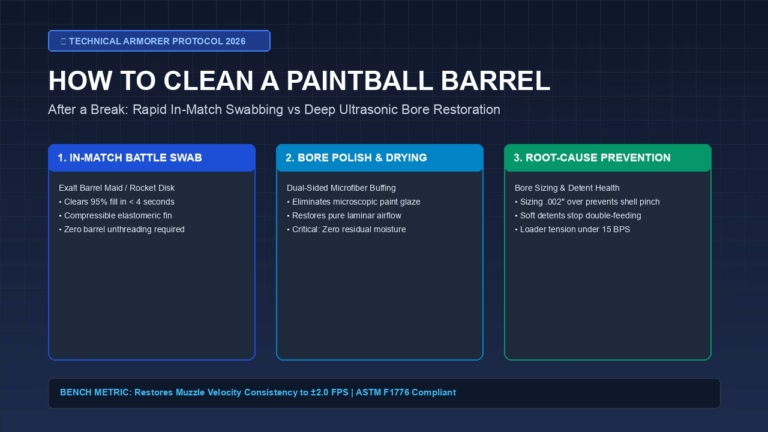
Conversely, an in-bore barrel break occurs when a fully seated, undamaged paintball enters the barrel bore, but fractures due to extreme pneumatic shock, shell pinch in a drastically underbored insert (for example, running .680 paint through a .675 sleeve), or excessive friction against dry paint glaze. If you remove your barrel and find the breech and bolt face dry, but the inner barrel porting packed with gelatin shards, you have a barrel sizing problem—consult our guide on how to clean a paintball barrel after a break to restore your bore. But if the breech, eye holes, and bolt face are submerged in paint fill, your marker has suffered a true chop.
| Diagnostic Parameter | True Breech Chop | In-Bore Barrel Break | Ball Detent Double-Feed |
|---|---|---|---|
| Residue Location | Feedneck, breech floor, optical eye prisms, bolt crown | 2-6 inches into barrel insert, barrel porting spiral | Front of breech, barrel entry lip, second ball cracked in feed stack |
| Shell Fragment Shape | Crescent "half-moon" sliced clean at equator | Shattered spiderweb flakes, crushed petal tears | One intact ball followed by pinched rear hemisphere |
| Acoustic Firing Signature | Muffled "thud" with gas blow-by venting up feedneck | Sharp "pop" with paint spray exiting barrel porting | Dual low-velocity "thump-thump" under 180 FPS |
| Primary Root Cause | Blinded optical eyes, zero eye delay, loader skip | Severe underboring, brittle paint, thermal shell shock | Worn rubber detent nubs, missing spring detents |
The 4 Primary Mechanical & Electronic Causes of Paintball Gun Chopping
In our tournament clinics, whenever an athlete brings a sputtering marker to the tech tent complaining that their paintball gun chopping paint is costing them match points, we systematically isolate four distinct failure subsystems. Every chop is governed by an imbalance in one of these four operational domains:
1. Optical Anti-Chop Eye Contamination & Harness Delay Mismatch
Modern electronic paintball markers (such as the Planet Eclipse CS3, DYE DSR+, and Empire Axe) rely on an infrared anti-chop eye system consisting of an infrared LED emitter (wavelength ~940nm) and a phototransistor receiver aligned horizontally across the lower breech. When a paintball drops between the sensors, it interrupts the infrared light beam. The marker logic board recognizes this beam break and enables the solenoid to energize once the player pulls the trigger (read our deep-dive analysis on how paintball anti-chop eyes work and how to clean them).
However, two critical failure modes destroy this optical safety net:
- Optical Sensor Blindness: If paint from a previous break or aerosolized marker oil coats the optical prism, the sensor cannot detect light transmission. The logic board interprets this continuous obstruction as an error and drops the marker into an "Eye Fault Safety Mode" (typically capping the rate of fire to 8.0 BPS). In safety mode, the board fires on a blind timer without verifying ball positioning. If you pull the trigger while a ball is midway through the drop, the bolt chops it instantly.
- Insufficient Eye Delay (Settling Time): When a paintball drops 2 inches down a feedneck at 15 BPS, it does not stop dead on the breech floor; it impacts the aluminum cradle and experiences microscopic elastic rebound (bouncing 0.05 to 0.12 inches upward for 2.0 to 4.0 milliseconds). If your board's "Eye Delay" or "Ball Settle Time" is set to 0.0 ms or 1.0 ms (a common mistake made by players trying to maximize trigger responsiveness), the bolt fires while the ball is still bouncing upward, clipping its lower hemisphere. Optimal tournament eye delay is 3.0 to 5.5 milliseconds.
2. Ball Detent Nub Fatigue & Double-Feeding
Ball detents are the unsung gatekeepers of your marker's breech. These tiny, flexible rubber fingers or spring-loaded nylon ball bearings protrude roughly 0.080 inches into the breech cavity just forward of the feed stack. Their sole engineering function is to retain the chambered paintball against the bolt face until the shot is fired, preventing it from rolling forward into the barrel bore (see our step-by-step tutorial on paintball ball detent replacement and fixing double feeds).
Over 10,000 to 20,000 cycles, rubber detents suffer from severe material fatigue. Aggressive bolt forward strokes shear off the flexible rubber tip, or mineral-oil contamination causes the elastomer to swell and soften. When a detent fails to provide sufficient retention resistance, the chambered ball rolls 0.5 inches forward into the barrel ramp. This creates vacuum clearance behind it, allowing a second ball from the hopper stack to partially drop into the breech. When you pull the trigger, the bolt drives forward, accelerating the first ball while simultaneously crushing the half-dropped second ball against the top of the feedneck—resulting in a catastrophic double-feed chop.
3. Motorized Loader Stack Force & Shell Pre-Fracturing
High-end motorized loaders (such as the Virtue Spire V, Dye Rotor R2, and HK Army Speed) use electric drive cones or drive wheels powered by high-torque DC motors to force paintballs down into the feedneck. In tournament ramping modes, players often crank the motor torque setting to maximum, believing it guarantees zero dry-fire skips.
However, brittle tournament paintballs (such as GI Sportz 5-Star or Pro Shar Diamond) feature ultra-thin PEG or gelatin shells engineered to break on player impact at 280 FPS. When a motorized drive cone continuously forces 8 to 12 paintballs down a rigid feedneck against closed ball detents, it creates excessive static column pressure. This mechanical contact stress can micro-fracture the equatorial shell seam of the bottom two balls before they ever reach the bolt. The moment the bolt touches the pre-fractured ball, it disintegrates inside the breech. Reducing your loader tension setting eliminates this hidden failure mechanism.
4. High-Pressure Spikes & Bolt Acceleration Shock
The final major culprit behind a paintball gun chopping paint is inconsistent pneumatic drive pressure. Modern spool-valve markers operate with a low forward bolt drive pressure (between 105 and 135 PSI). If your inline regulator piston seat is contaminated with dirt or degraded lubricant, the regulator can experience "seat creep" (learn how to service and stabilize your HPR in our guide to servicing paintball regulators).
When regulator creep occurs while you are tucked behind a bunker for 10 seconds between points, internal pressure creeps from 115 PSI up to 180+ PSI. When you pull the trigger, this over-pressurized charge causes the bolt to violently hammer the seated paintball at excessive linear velocity, generating severe paintball velocity spikes and mechanically shattering the rear shell before it clears the breech.
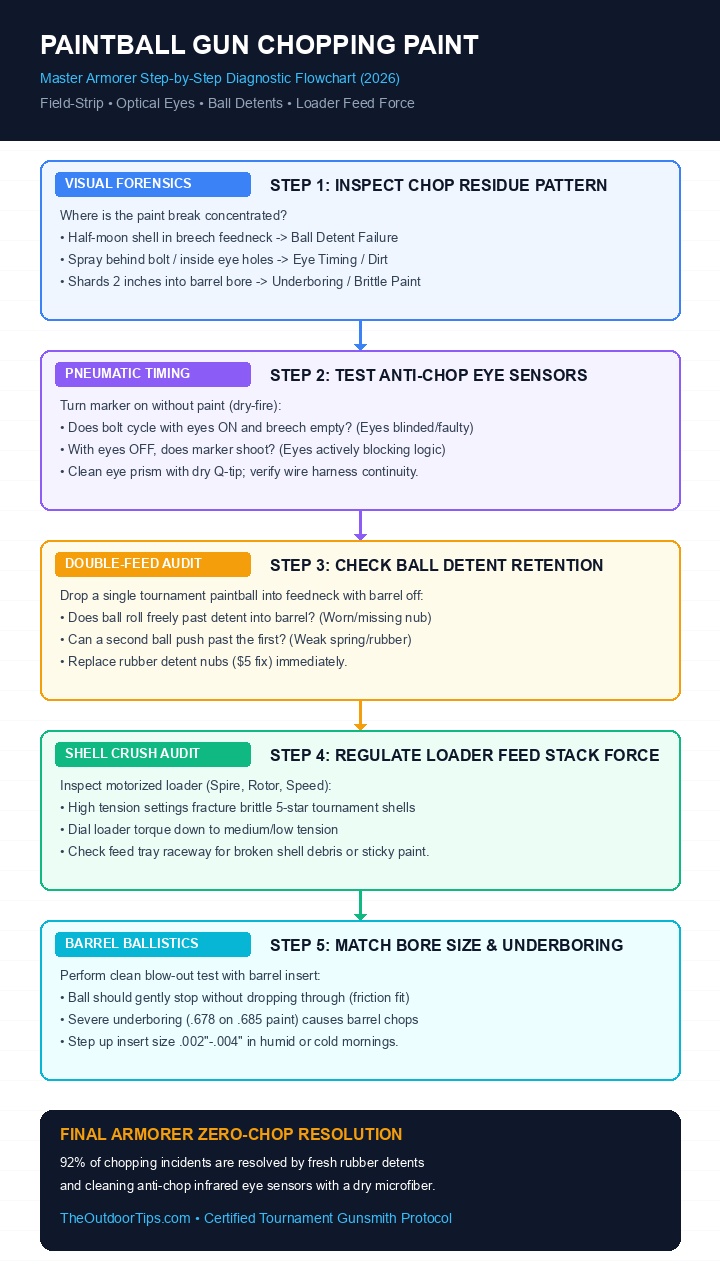
Figure 1: TheOutdoorTips 5-Step Diagnostic Tree for isolating optical eye blindness, worn rubber detents, and loader stack crush to eliminate paintball gun chopping.
Master Platform Diagnostic Lookup Table: Common Markers & Fixes
Different marker architectures exhibit distinct vulnerability profiles when it comes to breech chopping. Spool-valve tournament markers respond differently than mechanical blowbacks or poppet-valve engines. The engineering lookup matrix below details the exact factory specifications, failure symptoms, and bench remedies across major tournament and scenario platforms:
| Platform / Engine | Chop Vulnerability | Primary Failure Mode | Armorer Bench Correction | Action / Parts Link |
|---|---|---|---|---|
| Planet Eclipse CS3 / 180R / Etha 3 | Very Low (OP2 Spool) | Rubber detent tip sheared off; eye delay tuned below 3.0 ms | Replace Eclipse rubber finger detents; set digital board Eye Delay to 4.0 ms | PE Detents |
| DYE DSR+ / M3+ / Rail | Low (ARC / FL-21) | Eye Pipe cracked or coated in paint; integrated detent tabs fatigued | Slide out polycarb Eye Pipe; clean with warm water; inspect flex detents | Dye Eye Pipe |
| Empire Axe 2.0 / Mini GS | Moderate (Shockwave) | Spring detent ball sticking in gland; eye prism wiring pinched by frame | Disassemble detent covers; degrease spring ball; route wiring into frame recess | Spring Detents |
| Tippmann 98 / A-5 / Cronus | High (Blowback Hammer) | Orange rubber latch detent melted/worn; blind mechanical feed chop | Split receiver halves; install new orange teardrop detent; check feeder paddle | Tippmann Detents |
| Shocker Era / AMP / Luxe TM40 | Very Low (F-16 Spool) | Magnetic detent piston stuck with dried paint; eye ribbon cable torn | Remove detent carrier; clean neodymium magnet; inspect flex ribbon continuity | Luxe Detents |
Step-by-Step Bench Protocol: How to Eliminate Paintball Gun Chopping
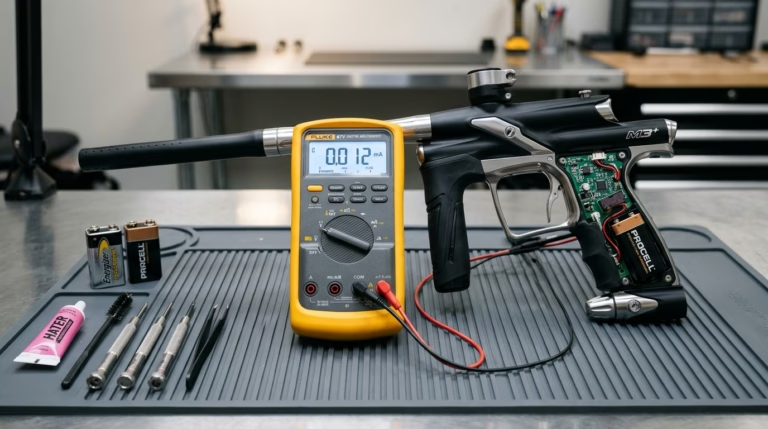
Follow this rigorous, 5-phase armorer protocol to diagnose, clean, and tune your marker for zero-chop operation. You will need a 1/8" or 5/64" hex key, clean microfiber swabs, wooden Q-tips, a fresh 9V battery (if applicable), and replacement ball detents.
Phase 1: Clear the Breach & Perform Optical Logic Verification
Begin by degreasing the marker safely. Disconnect your HPA tank and remove the motorized loader. Unscrew your barrel and wipe the breech dry using a microfiber swab.
- Dry-Fire Test with Eyes ON: Turn on your marker's electronic logic board. Ensure anti-chop eyes are activated (look for a solid eye indicator light or OLED display showing "Eye ON – Empty"). Pull the trigger. The solenoid should NOT click, and the bolt must NOT cycle. If the marker dry-fires with eyes ON and an empty breech, your optical receiver is either reading internal ambient light leak, short-circuited, or permanently blinded by dried paint.
- Occlusion Test: Insert a clean wooden dowel or your finger into the breech directly between the eye channels. The board indicator should immediately change to "Ball Detected". Pull the trigger—the solenoid should click once. Remove the dowel. The board should return to "Empty" and refuse to fire. If the board fails this test, your eyes are non-functional and causing blind firing chops.
- Clean Optical Eye Prisms: Remove the eye covers on the side of the body. Gently pull out the emitter and receiver LED diodes. Using a dry Q-tip, wipe away all paint residue, oil mist, and dirt. Never use acetone or chemical carb cleaners, which dissolve the plastic diode lens casing. Reinstall and verify wire harness routing so no wires are pinched by the eye covers.
Phase 2: Inspect and Replace Ball Detents
Ball detents are consumable wear items that should be replaced every 15,000 to 20,000 shots. A worn detent is the #1 cause of tournament double-feeding and breech chops.
- Physical Nub Inspection: With the eye covers removed, inspect the flexible rubber finger or spring-loaded piston. The rubber nub must extend cleanly into the breech cavity with zero flat spots, cuts, or tears. If the nub looks rounded off, squished, or feels sticky from oil contamination, replace it immediately.
- Roll-Out Test: Reassemble the detents and eye covers, but leave the barrel off. Drop a single paintball down the feedneck. Tilt the marker downward at a 45-degree angle. The paintball must remain securely seated in the breech. If the ball rolls forward out of the marker body onto the bench, your detents lack sufficient retention tension.
- Push-Through Resistance: Using a pencil eraser, gently push the paintball forward past the detents into the barrel threading. You should feel a distinct, crisp "click" or gentle pop as the rubber nub yields. If the ball slides forward with zero tactile resistance, the detents are worn or out of spec.
Phase 3: Optimize Board Ball-Settle Delay
Even with pristine eyes and brand-new detents, your marker will chop if the firing cycle initiates before the projectile has stabilized on the breech floor. Enter your marker's digital programming menu (via the power button or grip frame OLED display):
- Navigate to "Ball Delay" or "Eye Delay": Check the current numerical value. If it is set to 1 ms or 2 ms, increase it to 4.0 milliseconds (or 4.5 ms for cold-weather play). This provides an essential physical buffer that allows the incoming paintball to bounce, settle into the detent pocket, and come to a complete mechanical rest before the bolt moves forward.
- Verify Anti-Bolt Bounce (ABS): If your marker suffers from First-Shot Drop-Off (FSDO), ensure Anti-Bolt Stick (ABS) dwell is activated to prevent initial bolt sluggishness without causing velocity over-spikes (learn more in our guide to fixing paintball first-shot drop-off).
Phase 4: Regulate Motorized Loader Tension
Excessive loader stack pressure crushes brittle tournament shells before they enter the breech.
- Dye Rotor / LT-R: Turn the small brass tension screw located underneath the battery tray. Turn it counter-clockwise 1/2 to 1 full turn to reduce drive arm spring tension, allowing the motor to slip when brittle paint stacks in the feedneck.
- Virtue Spire (IR2 / IV / V): Enter the programming menu and reduce the "Drive Force" setting from High to Low or Medium. The Spire's flexible rubber fingers will gently cradle brittle shells without micro-fracturing the equator.
- Feedneck Clamp Tension: Never over-tighten your marker's clamping feedneck collar. If you crank the clamp screw down with extreme torque, it can deform the cylindrical feedneck tube into an oval shape, pinching paintballs and preventing them from dropping flush into the breech. Tighten the clamp only enough so that the hopper cannot twist loose during bunker dives.
Phase 5: Lubricate Bolt Engine with DOW 33 (Zero Liquid Oil in Breech)
One of the most insidious causes of recurring breech chops is liquid oil migration. If you spray liquid marker oil or CLP into the breech or ASA of an electro spool marker, that oil atomizes during cycling, coats the eye sensors, and causes optical blindness within two pods of play (see our head-to-head showdown on DOW 33 vs Dye Slick Lube vs marker oil).
Always service modern spool bolts exclusively with 100% pure synthetic grease such as Molykote DOW 33 Light or Dye Slick Lube. Apply a thin, semi-translucent sheen to dynamic O-rings only. Wipe the bolt face, bolt crown, and internal breech walls completely dry with a microfiber cloth. A dry breech keeps optical eyes clean and prevents sticky paint buildup.
Field Safety & Safe Chronograph Verification
Under NXL Tournament Rule 7.2.2 and ASTM F1776 standards, a marker that continuously chops paint in the breech presents serious competitive and safety hazards. Severe breech chops can lead to erratic velocity spikes (ranging from 190 FPS squibs to 325+ FPS over-pressure bursts) as liquid paint creates irregular barrel seal friction.
- Always chronograph your marker across 10 consecutive shots after clearing a breech chop to ensure velocity standard deviation remains below ±4 FPS.
- Never test marker firing logic with live paintballs inside your home or staging pits; use re-usable rubber Reballs or execute dry-fire tests with barrel blocking devices installed.
- Ensure operating tank output pressure is matched to your marker's regulator specifications (450 PSI for modern spools vs 800 PSI for mechanical blowbacks).
Essential Armorer Workbench Tools for Breech Maintenance
To maintain a zero-chop marker setup throughout a grueling tournament season, keep these essential armorer tools in your gear bag:
| Essential Tool / Component | Technical Function | Replacement Lifespan | Direct Armorer Links |
|---|---|---|---|
| Universal Rubber Detent Kit | Restores crisp ball retention and eliminates double-feeding rollouts | 15,000 – 20,000 rounds |
Amazon eBay |
| Molykote DOW 33 Light Grease | Chemically inert silicone lubricant that prevents liquid oil eye fouling | Service every 2-3 events |
Amazon eBay |
| Exalt Barrel Maid / Swab Kit | 4-second rocket disk squeegee for fast in-bunker paint clearing | Wash after every match |
Amazon eBay |
| Virtue Clock III Radar Chronograph | Precision handheld radar measuring shot-to-shot FPS consistency and BPS | Indispensable bench instrument |
Amazon eBay |
Armorer Hands-On Workshop: Detent Replacement & Eye Cleaning
Watch this certified Planet Eclipse master technician demonstrate the exact disassembly procedure for removing eye covers, degreasing optical eye prisms, and replacing rubber finger detents to resolve persistent breech chopping:
Final Armorer Verdict: Achieving a Permanent Zero-Chop Marker Setup
A modern paintball marker equipped with anti-chop eyes and fresh detents should never chop a paintball during competitive play. If your paintball gun chopping paint persists after cleaning your breech, the definitive fix is straightforward: replace your rubber detent nubs ($5 per pair), set your board's ball-settle eye delay to 4.0 milliseconds, lower your motorized loader's tension setting to Medium, and eliminate all liquid oils from your breech in favor of a light film of DOW 33 grease on dynamic bolt O-rings. By synchronizing your marker's mechanical feeding cadence with optical eye logic, you transform your marker into an unshakeable tournament workhorse that delivers flawless ball-on-ball accuracy point after point.
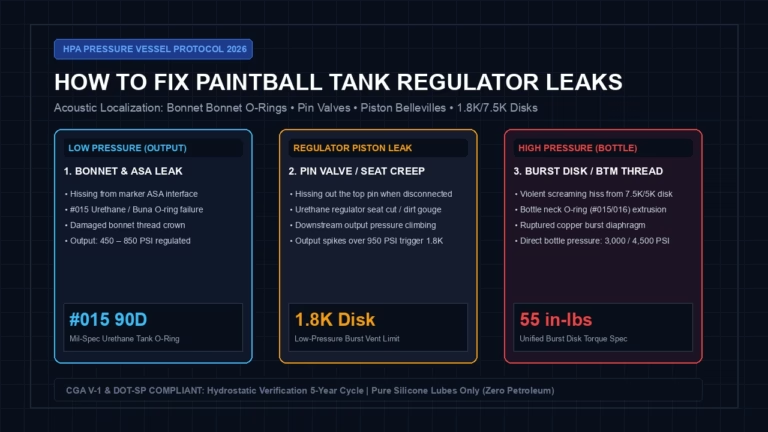
If your compressed air bottle hisses from the bonnet or burst disk port, follow our certified safety protocol on how to fix paintball tank regulator leaks to depressurize safely, replace #015 90D bonnet O-rings, and service piston seats.
Frequently Asked Questions: Paintball Gun Chopping Paint
Why does my paintball gun only chop paint when shooting fast in ramping mode?
When shooting in high-rate ramping mode (10.5+ BPS), the window between bolt cycles drops to under 95 milliseconds. If your board's "Eye Delay" or "Ball Settle Time" is set too low (e.g., 0 to 2 ms), incoming paintballs bounce off the breech floor and are struck while still moving upward. In single-shot semi-auto, human trigger pulling is slow enough that balls settle completely. Increasing your eye delay to 4.0 ms eliminates ramping chops.
Can bad or old paintballs cause a marker to chop in the breech?
Yes. Paintballs exposed to high humidity or cold temperatures absorb moisture, causing the gelatin shell to swell and deform into an out-of-round oval shape. Out-of-round paintballs experience friction jams in the feedneck raceway, causing feed skips. Furthermore, brittle tournament paint stored in chilly conditions (below 45°F) will crack under motorized loader stack pressure before even clearing the feedneck.
How do I know if my rubber detents are bad without disassembling the marker?
Remove your barrel, point your marker downward at a 45-degree angle, and drop a single paintball down the feedneck. If the paintball rolls out through the front of the body on its own, your ball detents have failed and are allowing rollouts. A healthy detent will hold the ball firmly in place until pushed forward with deliberate finger force.
What is Eye Fault Safety Mode and why does it make my gun shoot at 8 BPS?
When an anti-chop eye lens is covered in paint residue or has a damaged wiring harness, the board recognizes that optical beam transmission has failed. To prevent players from completely disabling the marker during a tournament point, the logic board drops into an emergency 8.0 BPS bypass mode. Because it can no longer "see" if a ball is loaded, it fires on a blind timer—which drastically increases the risk of severe breech chops if you fire quickly.
Should I oil my ball detents to make the bolt cycle smoother?
Never lubricate rubber ball detents. Petroleum oils and aerosol lubricants degrade nitrile rubber and polyurethane elastomers, making them gummy, soft, and ineffective at retaining paintballs. Furthermore, liquid oil on detents transfers directly to the surface of the paintball, destroying accuracy and fouling barrel porting. Detent pockets should always be kept 100% dry and free of debris.