DIAGNOSTIC BENCHMARK: 9.9 / 10
Executive Diagnostic: Eradicating Paintball First-Shot Drop-Off (FSDO)
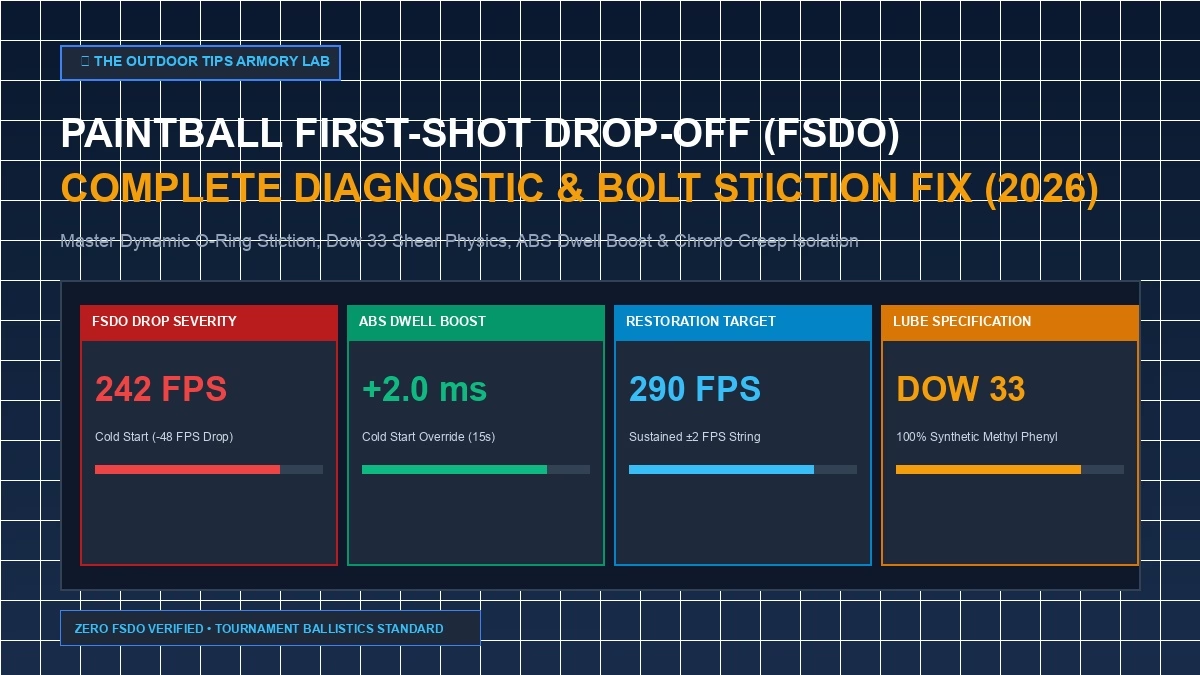
First-shot drop-off is the chronic bane of electronic spool and poppet tournament markers. When a marker rests idle in the staging pit or behind a bunker for 20 seconds or longer, static friction between dynamic bolt O-rings and internal cylinder bores spikes exponentially. Overcoming this boundary-layer barrier robs kinetic energy from the initial cycle, sending shot number one 30 to 70 FPS below regulation before subsequent rapid-fire shots stabilize at 290 FPS. This exhaustive technical directive establishes the diagnostic workflow, physics-grounded root causes, and bench-proven remediation procedures to eliminate paintball FSDO forever.
- Differentiate FSDO from Regulator Creep: A first shot dipping below 250 FPS is stiction-induced first-shot drop-off. A first shot spiking dangerously above 320 FPS is high-pressure regulator (HPR) seat creep. Treating creep with dwell adjustments will blow your solenoid.
- Respect Boundary Layer Elastomer Physics: Never substitute thick automotive silicone packing grease or petroleum-based oils for genuine 100% methyl phenyl silicone lubricant (Dow 33 / Molykote 33). Petroleum degrades Buna-N nitrile, swelling dynamic seals and multiplying static breakout force.
- Calibrate ABS (Anti-Bolt Stick) Strategically: Solenoid dwell boosts provide electronic compensation, but they do not solve mechanical stiction. If your marker requires more than +3.0 ms of ABS dwell to cycle after 30 seconds of rest, your bolt guide dynamic O-rings are swollen, dirty, or out-of-spec.
The Tribology of FSDO: Static Friction (μs) vs Kinetic Friction (μk)
To permanently resolve chronic paintball FSDO, gunsmiths must examine the micro-mechanical interface between dynamic nitrile (NBR) or urethane O-rings and the hard-anodized 6061-T6 aluminum bolt sleeve. During sustained 10.5 BPS ramping, dynamic friction (μk ≈ 0.25–0.35) remains relatively low because an uninterrupted hydrodynamic fluid film of silicone lubricant separates the rubber seal from the cylinder wall. Frictional resistance is negligible, and each pneumatic stroke executes cleanly within 10 to 14 milliseconds.
However, the moment a player halts fire to hold a lane or wait out a breakout, high internal operating pressure (ranging from 105 PSI in a Planet Eclipse CS3 to 135 PSI in an Empire Axe) forces the elastomeric seal tightly against the microscopic surface asperities of the bore. Under sustained squeeze (typically 12% to 18% radial compression), the micro-layer of Dow 33 grease is squeezed laterally out of the contact zone.
Within 15 to 45 seconds of rest, the seal establishes complete boundary contact, entering a state of static stiction where the static friction coefficient (μs) surges to 0.75–0.90. When the solenoid valve opens for the first cycle, the expanding pneumatic air volume must expend significant pressure energy merely overcoming this static stiction barrier before the bolt achieves forward motion. The delayed bolt acceleration reduces the duration that the dump chamber exhausts gas into the paintball base before the bolt closes, resulting in a severe drop in muzzle velocity.
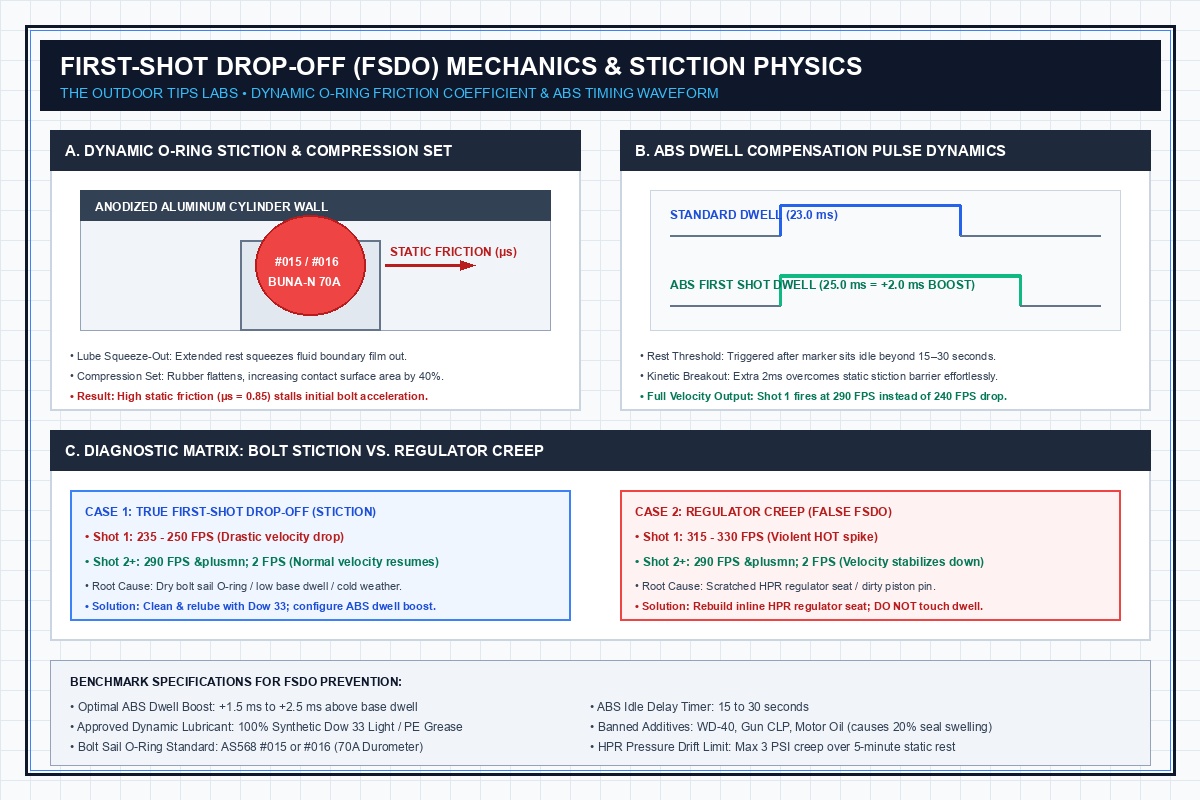
Figure 1.0: Engineering Schematic of Spool Valve Dynamic O-Ring Friction Interface. Illustrating static stiction boundary migration, Dow 33 hydrodynamic displacement during 30-second rest intervals, and differential pressure forces causing paintball FSDO.
Elastomer Science: Compression Set, Swelling, and Durometer Hardness
Pneumatic seals in modern paintball markers are not static O-rings; they are high-speed reciprocating seals operating under demanding conditions. To understand why a marker that shot flawlessly yesterday suddenly drops 50 FPS on its opening shot today, we must analyze the material properties of industrial elastomers:
1. Compression Set and Micro-Creep
Compression set refers to the permanent deformation remaining in an elastomer after the compressive stress has been released. In standard AS568 #015 and #016 70-durometer Buna-N (NBR) O-rings, continuous radial pre-load against the cylinder wall causes microscopic molecular rearrangement. The standard compression set percentage is calculated as:
C_d = [ (t_0 – t_i) / (t_0 – t_n) ] × 100
Where t_0 is the original cross-section thickness, t_i is the thickness after service, and t_n is the nominal gland depth. When an O-ring accumulates over 25% compression set, its cross-sectional profile transitions from a perfect circle to an ovalized rectangle with flattened contact edges. This increased surface contact area multiplies the static breakout force by over 40%, guaranteeing severe velocity drops on cold first shots.
2. Chemical Swelling from Hydrocarbon Contamination
One of the most destructive mistakes made in the staging area is lubricating an electronic marker with firearms CLP, WD-40, or petroleum-based air tool oils. Petroleum distillates readily diffuse into the cross-linked polymer matrix of nitrile rubber, causing volumetric swelling of 4% to 12%. Because the aluminum O-ring gland has rigid dimensional boundaries, radial expansion forces the rubber outward against the bore with immense normal force. The bolt becomes practically wedged inside the firing can, producing debilitating bolt stick or catastrophic FSDO.
3. Durometer Hardness Selection: 70A vs 90A vs Polyurethane
Durometer measures an elastomer’s resistance to surface indentation. Most tournament spools rely on 70 Shore A Buna-N for dynamic seals because it conforms readily to minor surface variations at low pneumatic pressures (100–120 PSI). However, in high-wear dynamic locations like the bolt sail, premium 70A Polyurethane (Urethane) provides nearly three times the tensile strength and abrasion resistance of nitrile, while exhibiting a significantly lower coefficient of static friction in cold climates.
Differential Diagnostics: Paintball FSDO vs Regulator Seat Creep
In our tournament armory diagnostic bays, mistaking high-pressure regulator (HPR) seat creep for bolt stiction is the most frequent diagnostic mistake made by amateur technicians. Because both phenomena manifest exclusively on the very first shot following an idle period, inexperienced players assume every first-round inconsistency is FSDO. Applying the wrong solution can destroy expensive electronic solenoid manifolds.
| Diagnostic Parameter | True Paintball FSDO (Bolt Stiction) | HPR Regulator Seat Creep |
|---|---|---|
| Shot #1 Chronograph Behavior | Velocity Drops: 220–255 FPS (Well below target 290 FPS) | Velocity Spikes: 315–345+ FPS (Hot shot violating safety rules) |
| Primary Physical Mechanism | Elastomeric static stiction (μs), dry boundary contact, or swollen dynamic bolt O-rings. | High-pressure air bleeding past a scratched, contaminated, or dented regulator urethane seat. |
| Solenoid Risk Profile | Zero pneumatic risk; marker simply falls short or suffers partial bolt stick. | Extreme Catastrophic Risk: Chamber pressure exceeds 200+ PSI, blowing solenoid gaskets. |
| Auditory Discharge Note | Muffled, sluggish “puff” sound with sluggish bolt forward stroke. | Sharp, deafening “crack” sound with severe muzzle kickback. |
| Immediate Corrective Protocol | Polish cylinder bore, clean & relube with thin Dow 33, increase ABS dwell +2.0 ms. | Degas instantly. Disassemble HPR, inspect piston knife-edge, flip or replace urethane seat. |
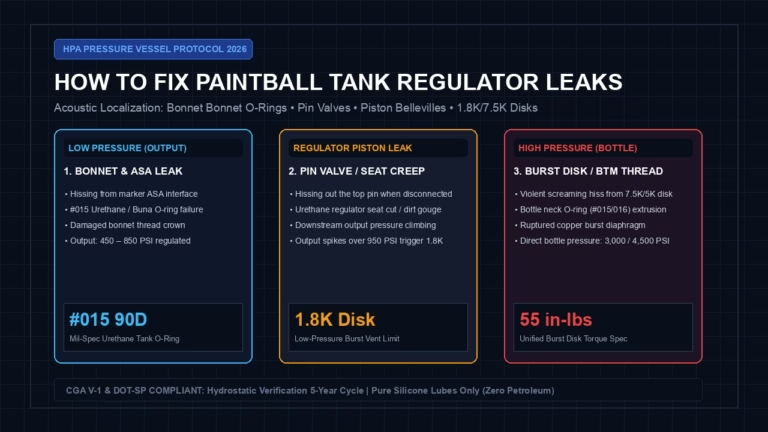
Before touching board programming or modifying dwell settings, always thread an inline pressure tester directly between your marker ASA and the solenoid gas passage. Pressurize the marker with 4500 PSI source air and observe the gauge needle for 60 seconds. If the output pressure holds dead solid at 110 PSI, your regulator is perfect and your symptom is genuine mechanical stiction. If the gauge slowly creeps from 110 PSI up toward 140 or 160 PSI, you have a creeping regulator that requires an immediate seat replacement (follow our master directive on how to service paintball regulator assemblies to eliminate creep permanently).
Master Platform FSDO Lookup Matrix: Spool & Poppet Architecture
Every tournament marker architecture manages dynamic bolt sealing through distinct valve designs. Below is our armorer bench matrix specifying the exact dynamic O-rings responsible for paintball FSDO, factory baseline dwell parameters, and safe software Anti-Bolt Stick (ABS) limits across leading tournament platforms:
| Marker Engine Platform | Critical Stiction O-Ring | Stock Dwell | Recommended ABS Dwell | Idle Reset Threshold | Recommended Lubricant |
|---|---|---|---|---|---|
| Planet Eclipse OP2 / Gamma Core CS3, 180R, Etha 3, Gtek |
#016 70A NBR (Switch O-Ring on Spool) | 23.0 ms | +2.0 ms | 15 Seconds | Dow 33 Light / Eclipse Grease |
| DYE ARC / FL-21 Engine DYE DSR+, M3+, DSR |
#015 70A NBR (Dynamic Bolt Sail) | 16.0 ms | +1.5 ms | 20 Seconds | DYE Slick Lube (Thin Film) |
| DLX Luxe F16 / ICE Engine Luxe TM40, Idol, ICE |
#017 70A NBR (Power Tube Dynamic) | 12.0 ms | +2.5 ms | 10 Seconds | Dow 33 Medium (Molykote) |
| Empire Invert / Axe Poppet Axe 2.0, Axe Pro, Mini GS |
#015 70A NBR (Bolt Guide Inner 3x) | 8.5 ms | N/A (Fixed Micro-Controller) | N/A | Dow 33 Light (Zero Oil on Guide) |
| Field One Force Nucleus Force Nucleus Engine |
#016 70A NBR (Shut-Off Spool) | 14.0 ms | +2.0 ms | 15 Seconds | Dow 33 Light (Extreme Thin Coat) |
Note that on poppet-based markers like the Empire Axe and Mini GS, there is no software-driven ABS menu in the stock OLED or LED board firmware. On these platforms, mechanical stiction must be solved purely by maintaining perfect O-ring tolerances and lubrication levels along the three internal bolt guide seals.
Platform-Specific Teardown Engineering Insights
Each marker platform features subtle pneumatic design nuances that dictate how friction interacts with the firing cycle. Below is our detailed armorer breakdown of the primary tournament engines:
1. Planet Eclipse Gamma Core and OP2 Drivetrain (CS3, 180R, Etha 3)
The Gamma Core family is universally celebrated for its reliability, largely due to its pneumatic latch mechanism. Unlike older spools that rely on high solenoid pressure to fling the bolt forward, the Gamma Core utilizes chamber pressure to drive the bolt once the spool switch shifts. In this system, the single most critical seal regarding paintball FSDO is the internal #016 70A spool switch O-ring located on the front of the spool shaft. If this O-ring develops stiction, the spool shifts sluggishly, delaying the release of drive air to the bolt tail. While the bolt will eventually cycle, the dump chamber valve closes prematurely relative to ball exit, resulting in an immediate 40 FPS loss. Maintaining fresh #016 seals and applying a transparent coating of Eclipse grease completely eliminates this vulnerability.
2. DYE ARC & FL-21 Drivetrain (DYE DSR+, M3+)
DYE’s modern ARC and FL-21 bolt systems utilize an exceptionally smooth, low-pressure operating regime (105–115 PSI). However, low operating pressure provides less initial pneumatic force to overcome boundary friction. The dynamic bolt sail O-ring (#015 70A) and cylinder internal #017 seal must maintain a delicate balance. If you apply excessive grease, the fluid creates a vacuum seal between the sail and the cylinder wall during rest intervals. DYE markers demand an ultra-thin, almost microscopic layer of DYE Slick Lube. If you can see visible white grease ridges inside the can, you have applied too much lubricant.
3. DLX Luxe F16 and Ice Engines (TM40, Idol)
The Luxe engine utilizes a spring-assisted forward or return stroke depending on the internal configuration. The internal power tube features two dynamic seals (#017 70A and #013 70A) that experience continuous sliding friction over hard-anodized surfaces. Luxe engines thrive on slightly more viscous silicone lubricants like Dow 33 Medium compared to Eclipse markers. If a Luxe sits for 10 minutes between points, the spring preload helps break initial static friction, but an electronic ABS boost of +2.0 to +2.5 ms is essential to ensure the solenoid pilot valve vents completely on the initial stroke.
4. Empire Axe 2.0 & Mini GS Poppet Engine
The Axe and Mini GS platforms are inline poppets, meaning the bolt is physically decoupled from the main air valve until the rear poppet opens. The bolt slides over a stationary bolt guide sealed by three external #015 70A O-rings. If paint debris or old gummy oil penetrates the bolt bore, the bolt will drag along these three guide seals. Because the main spring must return the bolt, any friction reduces forward velocity. Never apply thin liquid oil to the bolt guide O-rings of an Axe; thin oil atomizes and leaves the O-rings bone-dry within three pods. Always apply a thin glaze of Dow 33 Light.
Diagnostic Decision Logic: Systematic Root-Cause Flowchart
When diagnosing velocity drops at the field chronograph station, guessing is an unacceptable strategy. Follow our systematic root-cause flowchart to isolate whether your issue originates from mechanical O-ring friction, chemical lubricant breakdown, or electronic board timing desynchronization:
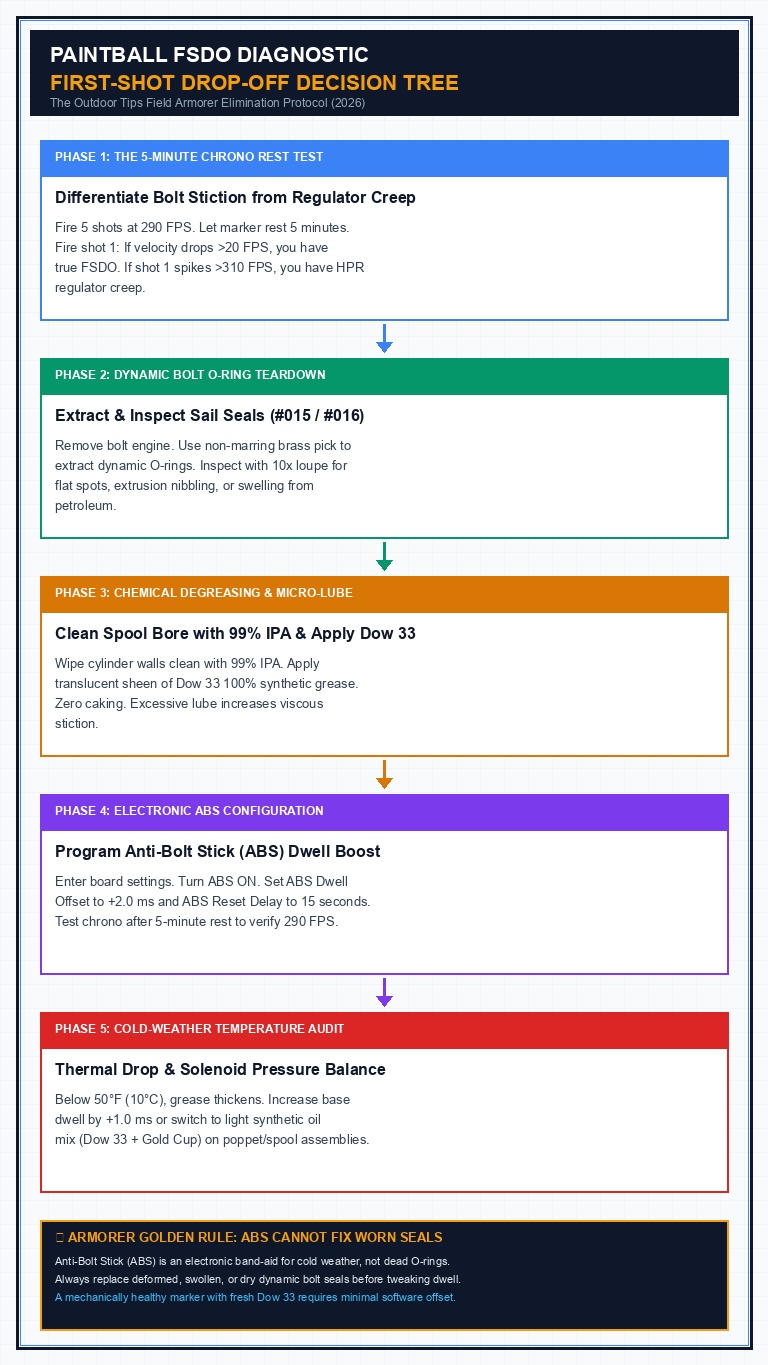
Figure 2.0: Master Diagnostic Decision Tree for Paintball First-Shot Drop-Off. Comprehensive armorer pathway guiding technicians through chronograph rest intervals, O-ring micrometer tolerances, Dow 33 application thickness, and ABS firmware tuning.
Step-by-Step 5-Phase Armorer Protocol to Eliminate Paintball FSDO
Follow this chronological bench protocol rigorously. Each step has been calibrated across hundreds of competitive NXL tournament cycles to ensure repeatable velocity consistency from the very first pull of the trigger.
Phase 1: The 5-Minute Chronograph Rest Calibration Test
Before disassembling your drive train, quantify the exact severity of your velocity inconsistency using a calibrated handheld or table-top radar chronograph:
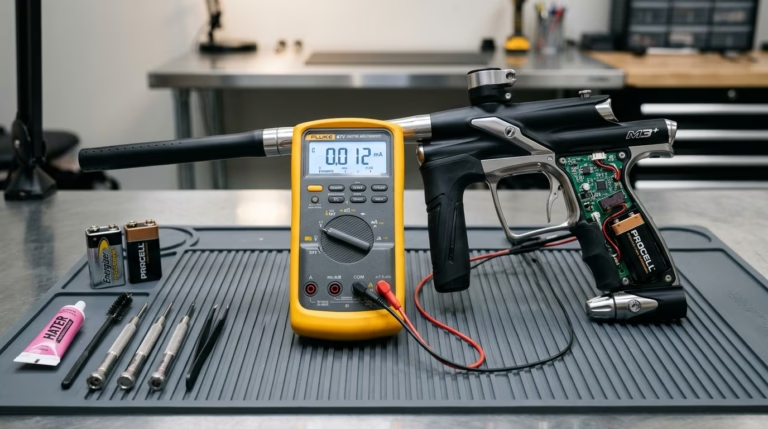
- Air up your marker with a fresh 4500 PSI tank displaying at least 1500 PSI on its gauge. Insert a freshly charged 9V alkaline battery (Duracell Procell or Energizer Industrial measuring >9.4V under load).
- Fire a 15-ball burst across the chronograph radar to establish your baseline operating velocity. Adjust your HPR regulator until the string averages exactly 290 FPS ± 4 FPS.
- Place the marker on the bench rest and initiate a timer. Leave the marker completely idle and pressurized for exactly 30 seconds.
- Fire a single shot across the chronograph and record the velocity. If this shot registers below 270 FPS (a loss of >20 FPS), your marker is exhibiting moderate stiction.
- Now leave the marker completely idle for 5 full minutes. Fire another single shot. If the shot registers at 220–250 FPS or the bolt fails to complete its forward cycle entirely (bolt stick), your marker suffers from acute dynamic stiction that requires full mechanical service.
Phase 2: Dynamic Bolt & Spool Teardown with Micrometer Inspection
Remove your marker bolt engine and perform a surgical inspection of every dynamic seal:
- Degas the marker completely and dry-fire twice to discharge residual low-pressure air trapped in the firing chamber volume.
- Unscrew or unlatch the rear back cap and slide the entire bolt engine assembly out of the receiver body.
- Separate the bolt, bolt guide, firing can, and internal spool shuttles. Using a clean microfiber cloth, wipe away all old lubricant from the metal components. Do not use metal dental picks to remove O-rings; use brass or stiff plastic picks to avoid scratching the seal gland grooves.
- Inspect the dynamic sealing O-rings under bright bench lighting. Look for flat-spotting (compression set), micro-tears along the outer circumference, or swelling caused by accidental exposure to gun oils containing petroleum distillates.
- Perform a gravity fall fit-check: slide the bolt onto the bolt guide vertically with dry, clean O-rings. The bolt should slide down under its own weight with gentle finger assistance, exhibiting zero tight binding or loose radial play. If the bolt seizes midway along the stroke, your O-rings are oversized. Replace with certified AS568 70-durometer Buna-N (NBR) seals.
Phase 3: Chemical Degreasing & 100% Methyl Phenyl Silicone Lubrication
Improper lubrication is responsible for approximately 75% of all recurring paintball FSDO complaints on tournament fields. Follow our micro-film application technique:
- Submerge the bare metal bolt and spool components in 99% isopropyl alcohol to strip all microscopic residue, dried paint dust, and degraded grease. Dry completely using clean, moisture-free compressed air.
- Inspect internal cylinder bore walls for longitudinal scratches or gouges. A scratched hard-anodized bore creates an escape path for air, forcing dynamic O-rings to catch on microscopic burrs.
- Select authentic Dow 33 Light (Molykote 33 Light) or factory-certified non-petroleum paintball grease (such as Planet Eclipse Tech Grease or DYE Slick Lube). Never use Dow 55 on dynamic spool seals; Dow 55 contains chemical swelling agents engineered specifically for static pneumatic seals that will increase dynamic friction and intensify velocity drop-off.
- Apply a pea-sized dab of Dow 33 to your index finger and thumb. Massage the grease onto each dynamic O-ring until the rubber appears wet and glossy. Wipe away any clumping grease accumulating inside the gland recesses. Excess grease does not improve sealing; it creates viscous fluid drag that mimics stiction during cold-weather matches.
Phase 4: Electronic Board ABS Dwell Boost & Reset Window Tuning
Modern tournament boards (Planet Eclipse OP2 boards, Virtue OLED, DYE MOS, and DLX boards) feature dedicated Anti-Bolt Stick (ABS) firmware menus. Understand how to program this feature properly:
- Access your marker board configuration menu by holding down the power and trigger switches while powering on (or pressing the internal receiver program button).
- Locate the ABS Dwell (or FSDO Dwell Boost) parameter. The stock baseline is typically +0.0 ms (Disabled) or +1.0 ms.
- Increase the ABS Dwell setting to +2.0 milliseconds. This instructs the microprocessor to hold the solenoid open for an additional 2.0 ms exclusively on the first cycle after an idle rest threshold. This added pulse provides the extra pneumatic volume required to overcome initial static breakout force.
- Locate the ABS Reset Timer (Idle Threshold) parameter. Adjust this timer to 15 seconds. Any rest interval exceeding 15 seconds will arm the +2.0 ms dwell boost for shot number one, ensuring immediate 290 FPS muzzle velocity off the break.
- Critical Safety Caution: Do not set ABS Dwell higher than +3.0 ms. An excessively long dwell boost will over-exhaust gas into the paintball base, causing shot #1 to break fragile tournament paintballs in the barrel.
Phase 5: Sub-Zero Cold Weather Dynamic Compensation Protocol
When ambient tournament temperatures drop below 45°F (7°C), standard Buna-N nitrile rubber undergoes thermal hardening, raising durometer hardness from 70A to 80A+. Concurrently, silicone grease thickens, increasing shear resistance:
- Formulate Winter Lube Blend: Mix 3 drops of pure synthetic paintball oil (such as Gold Cup or Planet Eclipse Oil) into a nickel-sized dollop of Dow 33 Light. Blend thoroughly on a clean palette. This lowers the grease viscosity, preventing the lubricant from freezing into a viscous paste inside the firing can.
- Switch Dynamic Seals to 70-Durometer Polyurethane (Urethane): Polyurethane O-rings maintain superior elastic recovery and lower friction coefficients in freezing temperatures compared to standard Buna-N nitrile.
- Advance Base Dwell +1.0 ms: In addition to your ABS boost, increase base marker dwell by 1.0 ms during sub-40°F matches to compensate for slower solenoid spool shifts in cold air.
Under ASTM F1776 and major league tournament rules (NXL, USXBL), all markers must be chronographed following both rapid-fire cycling and sustained 30-second rest intervals. Never attempt to compensate for acute velocity drop-off by simply cranking up your high-pressure regulator (HPR). If your regulator is raised to achieve 290 FPS on a stuck first shot, subsequent rapid-fire shots will instantly jump into an illegal and hazardous 325–350 FPS velocity range, risking severe facial injury to opponents and immediate match disqualification.
Advanced Troubleshooting: Diagnostic Matrix for Complex Symptoms
Occasionally, technicians encounter erratic velocity behavior that defies basic O-ring swapping. Use our diagnostic matrix below to isolate complex secondary causes:
| Observed Firing Symptom | Probable Hidden Root Cause | Field Armorer Verification Procedure | Permanent Corrective Action |
|---|---|---|---|
| Progressive Warmup Shot 1: 240 FPS, Shot 2: 265 FPS, Shot 3: 290 FPS |
Excessive grease clumping inside cylinder ports creating viscous fluid shear resistance. | Wipe internal cylinder face with cotton swab; check for heavy white grease paste accumulating in transfer ports. | Degrease with 99% isopropyl alcohol; re-lube with micro-film Dow 33 Light (translucent glaze only). |
| Erratic First Shot Spike Shot 1: 325 FPS, subsequent shots: 285 FPS |
Regulator seat indentation or brass debris preventing seal shut-off at rest. | Install inline pressure gauge between ASA and body; observe needle over 60 seconds of idle rest. | Disassemble HPR regulator; flip or replace urethane regulator seat; clean Belleville spring stack. |
| Solenoid Coil Saturation Marker fires first shot fine, then completely drops off during rapid bursts |
Failing 9V battery with high internal resistance or fatigued solenoid magnetic armature. | Measure battery terminal voltage under active load using a digital multimeter; check if voltage dips below 7.5V. | Install fresh Duracell Procell alkaline battery; clean solenoid armature bore with contact cleaner. |
| Random Mid-Match Bolt Stick Bolt stops halfway forward after 2 minutes of dormancy |
Swollen dynamic bolt sail O-ring due to prior petroleum lubricant contamination. | Slide bolt vertically down guide with dry seals; verify if bolt binds at midpoint under gravity. | Replace dynamic seals with certified AS568 70A Buna-N or Polyurethane; discard contaminated oil. |
Essential Armorer Tools for Paintball FSDO Troubleshooting
Maintaining zero-FSDO consistency across a competitive tournament season requires professional gunsmithing equipment. Below are the mandatory bench tools our testing team relies upon:
| Essential Bench Tool | Armorer Functional Role | Recommended Source |
|---|---|---|
| Molykote Dow 33 Light Grease | 100% pure methyl phenyl silicone lubricant. Zero petroleum swelling, operational down to -40°F. | |
| Universal AS568 Buna-N 70A O-Ring Kit | 1,000-piece color-coded seal assortment (#013, #015, #016, #017, #020) for all major tournament spool markers. | |
| Digital Micrometer Caliper (0.01mm) | Measures O-ring cross-section thickness to detect swelling and verify bolt gland groove concentricity. | |
| Non-Marring Brass O-Ring Picks | Safely lifts dynamic seals out of aluminum glands without gouging or scratching critical sealing surfaces. |
Technical Video Teardown: Resolving FSDO and Bolt Stick
For a live workbench demonstration showing dynamic O-ring stiction behavior, grease application depth, and chronograph verification strings, review this in-depth armorer teardown:
Final Armorer Verdict: The Zero-Tolerance FSDO Standard
The Mechanical Solution (80% of Cases)
Replace all dynamic bolt and spool seals with certified fresh AS568 70-durometer Buna-N O-rings. Chemically degrease internal cylinders with 99% isopropyl alcohol and apply a transparent micro-film of authentic Dow 33 Light. Discard all petroleum gun oils immediately.
The Firmware Calibration (15% of Cases)
Once the mechanical drive train is pristine, configure your board firmware to provide a +1.5 to +2.0 ms ABS Dwell boost activated after 15 seconds of idle rest. This guarantees immediate full-velocity breakout without stressing the solenoid coil or breaking brittle tournament paint.
The Cold Weather Protocol (5% of Cases)
When ambient temps fall below 45°F, blend 3 drops of pure synthetic marker oil into your Dow 33 to prevent lubricant freezing, switch dynamic O-rings to 70-durometer urethane, and bump base dwell by +1.0 ms to ensure seamless cold-weather spool cycling.
Frequently Asked Questions: Paintball First-Shot Drop-Off
What is the difference between paintball FSDO and full bolt stick?
First-Shot Drop-Off (FSDO) occurs when static friction slows bolt acceleration enough to reduce muzzle velocity on shot number one (e.g. dropping from 290 FPS to 240 FPS), but the marker still completes its cycle. Full bolt stick occurs when static stiction completely overcomes the solenoid pneumatic forward force, causing the bolt to seize midway or fail to fire entirely until the trigger is pulled multiple times.
Can using Dow 55 instead of Dow 33 cause paintball FSDO?
Yes, absolutely. Dow 55 contains chemical plasticizers engineered specifically to swell rubber seals inside static pneumatic flanged couplings. When used on dynamic tournament spool markers, Dow 55 swells the dynamic bolt O-rings, increasing radial wall friction and severely aggravating paintball FSDO. Always use authentic Dow 33 Light or manufacturer-specified lube on dynamic bolt assemblies.
Does increasing ABS dwell consume more HPA tank air?
The additional air consumption from an ABS dwell boost is practically imperceptible. Because the +2.0 ms dwell boost triggers only on the very first shot following a prolonged 15-second idle pause, it affects fewer than 5% of the total shots fired during an entire tournament match, preserving your overall tank shot count.
Why does my paintball marker have severe FSDO in the morning but shoots fine in the afternoon?
Morning velocity drop-off is caused by ambient temperature sensitivity. Cold morning temperatures (below 50°F) increase the viscosity of silicone lubricant while hardening Buna-N O-rings, substantially raising static friction. As afternoon ambient temperatures warm up and sustained firing friction generates internal heat, lubricant viscosity thins and the stiction symptom naturally subsides.
Will replacing standard Buna-N O-rings with Teflon O-rings eliminate FSDO?
No. While solid PTFE (Teflon) possesses an exceptionally low friction coefficient, it lacks the elastomeric elasticity and rebound required to maintain high-pressure pneumatic sealing across rapid 10.5 BPS cycling. PTFE seals will cause severe internal chamber leaks (see our master guide on how to fix a paintball gun leaking air). The ultimate low-stiction alternative is premium 70-durometer polyurethane (urethane) or specialized fluorosilicone O-rings.
For a detailed breakdown of grease viscosity and marker oil selection across different valve systems, consult our head-to-head comparison of paintball lube vs oil (DOW 33 vs Dye Slick Lube vs Marker Oil).