In our field tests and match clinics across more than fifteen competitive tournament seasons, mastering how to chronograph paintball gun platforms accurately represents the single most important safety and performance protocol separating backyard players from championship armorers. Compressed air propelling a 3.2-gram gelatin projectile at velocities approaching 300 feet per second creates tremendous kinetic energy—exceeding 12.0 Joules at the muzzle—meaning an uncalibrated marker can instantly violate league rules, shatter bunker lenses, or suffer erratic trajectory drop. This definitive technical directive establishes the Doppler radar physics, optical photogate alignment parameters, regulator tuning mechanics, and step-by-step calibration protocols required to lock in match-legal consistency every single weekend.
CALIBRATION BENCHMARK: 9.9 / 10
Executive Field Directive: Paintball Gun Chronograph & Velocity Tuning Standard
Accurately calibrating muzzle velocity requires rigorous sensor alignment, thermal stabilization, and proper mechanical regulator adjustment. Standard recreational fields cap velocity at 280–285 FPS, while tournament circuits strictly enforce a 300 FPS maximum ceiling. Never attempt velocity tuning through digital board dwell adjustments; always modulate pneumatic chamber pressure via the inline regulator operating pressure.
280 – 285 FPS
300 FPS Strict
12.5 Joules
± 2 – 3 FPS
- Under-Bore Before Chronoing: Paintball diameter fluctuates up to 0.006″ with ambient humidity. Always match your paint to an under-bored barrel insert (.684–.687) before testing; an over-bored barrel bleeds drive air and causes ±12 FPS shot-to-shot swings.
- Maintain 12-to-18-Inch Sensor Standoff: When firing over optical chronographs, positioning the muzzle closer than 12 inches allows high-pressure muzzle blast turbulence to trigger the optical gates before the ball passes, generating false 340+ FPS ghost readings.
- Never Modulate Velocity via Dwell on Spool Valves: Board dwell dictates solenoid energize open-time, not primary chamber volume. Increasing dwell beyond the bolt cycle plateau wastes air, increases kick, and creates erratic velocity spikes. Always tune velocity via the mechanical HPR screw.
The Physics of Paintball Chronograph Measurement: Doppler Microwave vs Optical Gates
To understand how to chronograph paintball gun setups with laboratory-grade accuracy, armorers must dissect the two fundamentally distinct sensory technologies deployed across tournament staging bays: Continuous-Wave Doppler Radar and Infrared Optical Photogates.
Doppler radar units (such as the industry-standard Virtue Clock III and Custom Chronologies handhelds) emit continuous microwave frequency radiation in the X-band (10.525 GHz) or K-band (24.150 GHz). As a paintball accelerates out of the barrel into the radar beam, the reflected radio waves shift in frequency proportionally to the projectile’s forward velocity—a phenomenon governed by the classical Doppler equation:
Δf = 2 × f0 × (v / c) × cos(θ)
Where f0 represents the emitted carrier frequency, v is the muzzle velocity in feet per second, c is the speed of light, and θ represents the angular alignment cosine vector between the radar transceiver and the flight axis. When you fire directly along the radar horn centerline (θ = 0°, cos(0°) = 1.0), the chronograph calculates pure, unskewed true velocity. However, if an inexperienced player angles the barrel 15 degrees off-axis, the detected speed falsely registers lower than actual field velocity, leading to an over-tuned, dangerous marker once aimed straight downfield.
Conversely, optical photogates utilize two discrete infrared emitter-detector pairs spaced precisely across a known distance (typically 1.000 foot or 200mm). The internal microprocessor starts a high-speed microsecond quartz timer the instant the ball casts a shadow across Gate 1, and stops timing when the shadow eclipses Gate 2 ($v = d / \Delta t$). While exceptionally precise, optical gates are susceptible to incandescent/fluorescent 60Hz ambient light flicker and muzzle gas refraction if placed too close to the barrel.
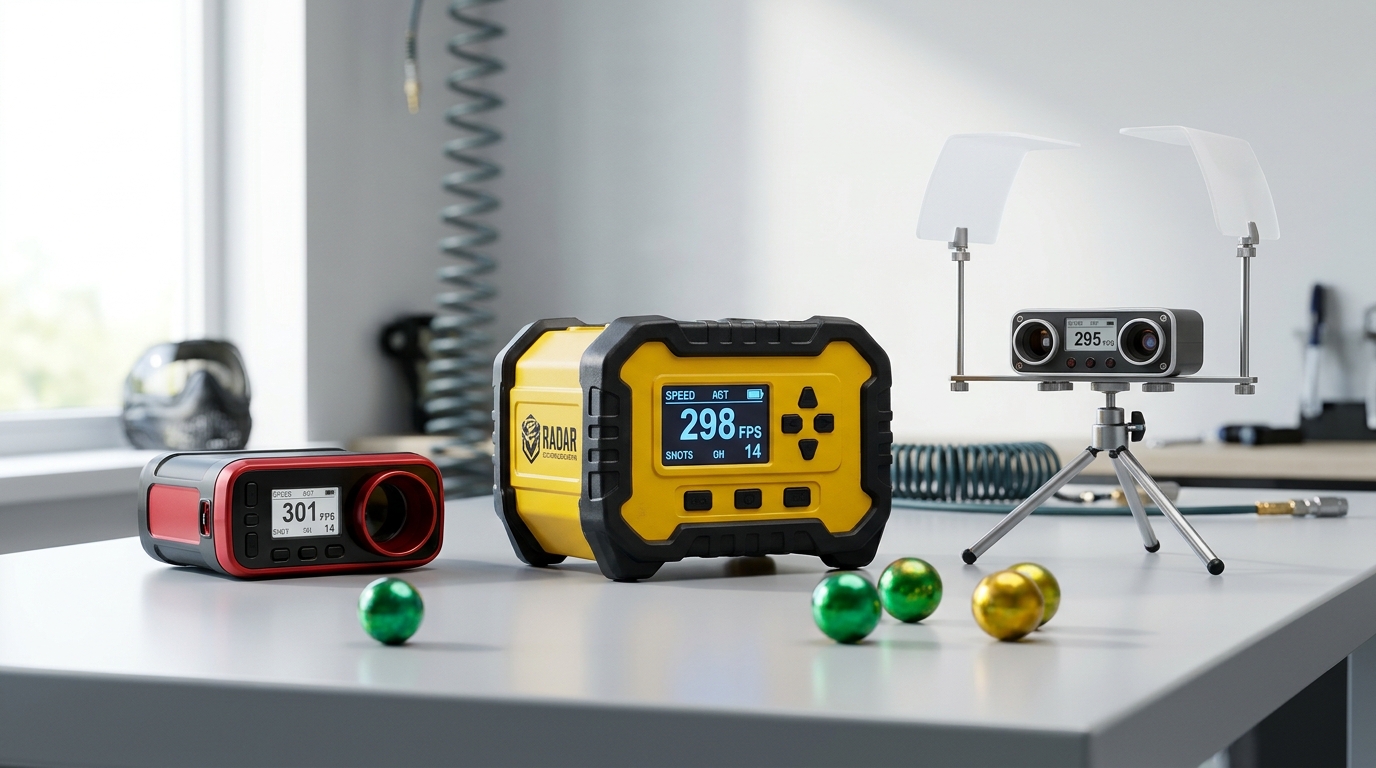
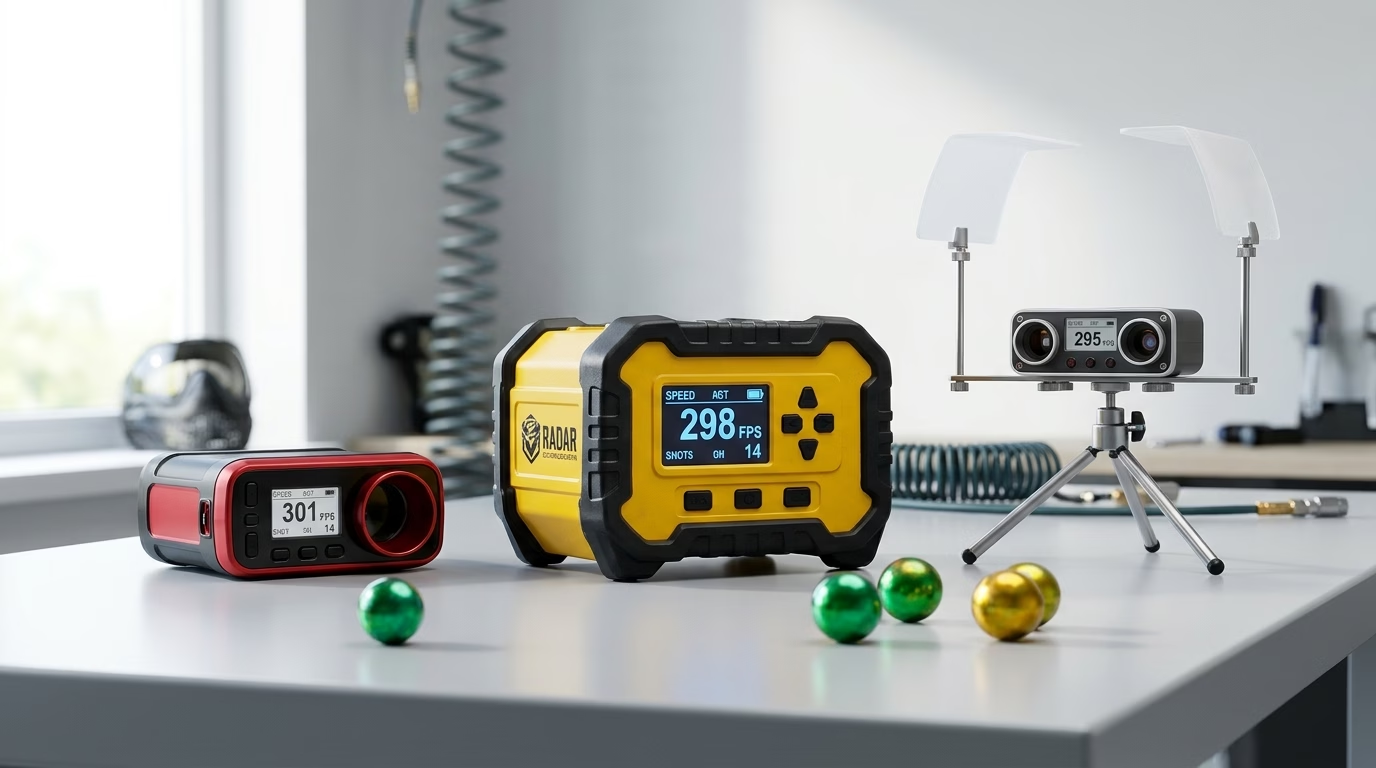
Figure 1.0: Professional Tournament Chronograph Inspection Bench Setup. Demonstrating simultaneous testing across multi-vector Doppler microwave radar chronographs, optical tripod light-gates, and digital LED displays alongside premium .68 caliber tournament paint.
Master Platform Velocity Adjustment Matrix
Before stepping onto the chrono station, technicians must understand how different paintball marker engine architectures modulate kinetic output. Firing mechanisms handle velocity adjustments through radically different mechanical pathways:
| Marker Engine Class | Velocity Adjustment Point | Directional Rule | Baseline HPR Pressure | Armorer Bench Tool |
|---|---|---|---|---|
| Spool Valves (CS3 Pro, DSR+, Luxe, 180R) |
Inline HPR Base Adjuster Screw (bottom of foregrip or ASA). | CW = Velocity DOWN CCW = Velocity UP (Increases spring preload) |
105 – 135 PSI | 1/8″ or 1/4″ Ball-End Hex Key |
| Stacked-Tube Poppets (Ego LV2, Bob Long G6R) |
HPR Torpedo Screw primary; LPR fine-tuning secondary. | CW = Velocity DOWN CCW = Velocity UP (Dual-reg balance) |
HPR: 130 PSI LPR: 75 PSI |
Low-Pressure Pressure Tester |
| Inline Poppets (Empire Axe 2.0, Mini GS) |
Back-Cap Poppet Spring Preload Screw & ASA Regulator. | In (CW) = Velocity DOWN Out (CCW) = Velocity UP (Spring tension resistance) |
180 – 200 PSI | 5/64″ & 3/32″ Hex Wrenches |
| Mechanical Blowbacks (Tippmann 98, A-5, Cronus) |
Side-Receiver Velocity Restrictor Screw (gas choke valve). | CW = Velocity DOWN CCW = Velocity UP (Chokes power tube flow) |
800 – 850 PSI (Raw tank pressure) |
5/32″ Standard Hex Key |
| Nelson / Pump Markers (Phantom, Azodin KP3) |
Through-the-Bolt Hammer Spring Compression Adjuster. | CW = Velocity UP CCW = Velocity DOWN (Compresses mainspring) |
250 – 800 PSI | T-Handle Velocity Tool |
Diagnostic Decision Logic: Master Armorer Flowchart
When learning how to chronograph paintball gun systems for sanctioned tournament play, technicians must never tweak adjustments blindly. Follow our certified master armorer decision tree below to navigate hot shots, under-powered strings, and erratic standard deviation issues systematically:
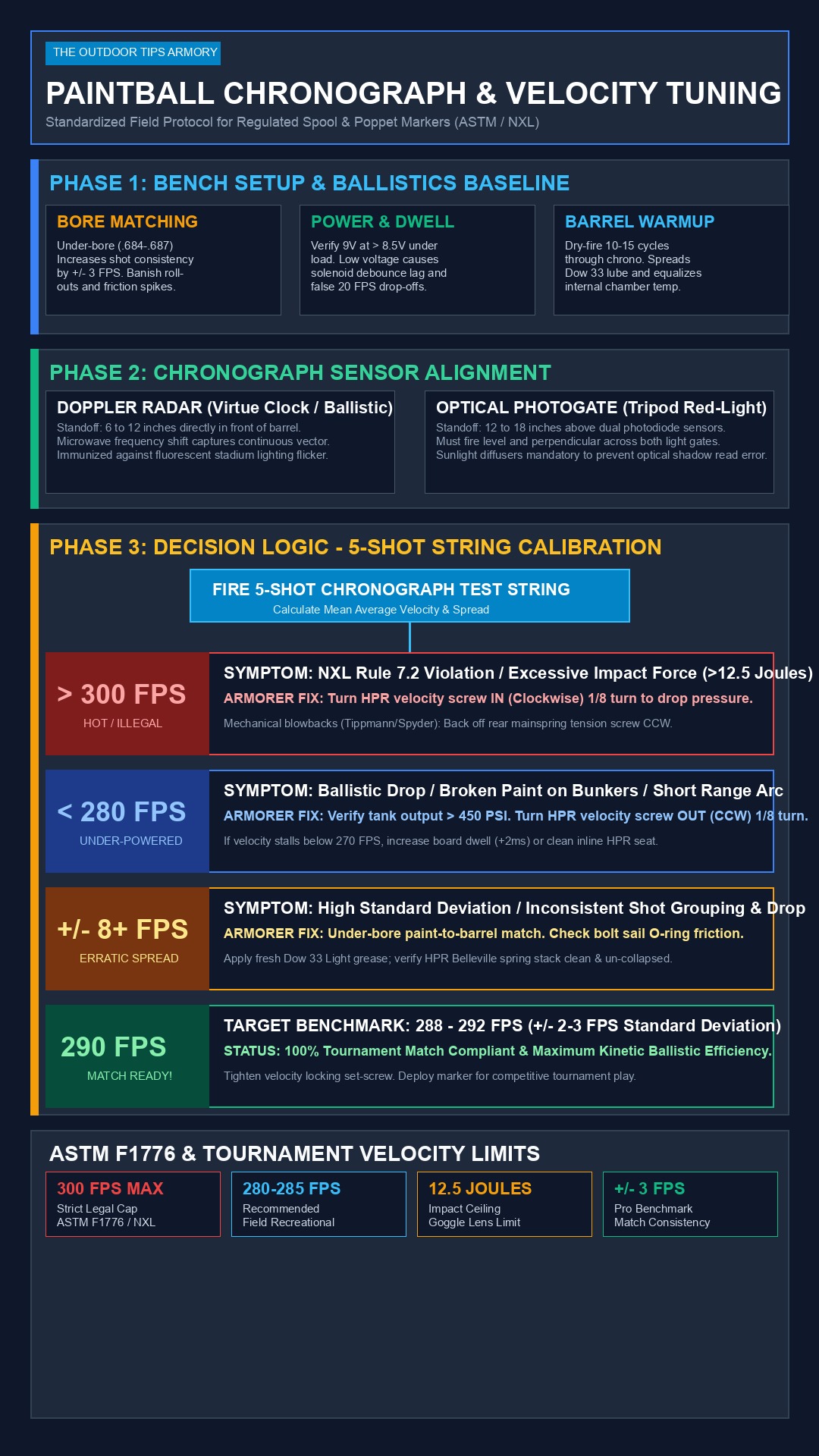
Figure 2.0: Master Armorer Decision Logic Tree for Paintball Marker Velocity Calibration. Step-by-step procedural pathway addressing hot shot violations (>300 FPS), ballistic drop (<280 FPS), shot-to-shot variance (±8 FPS), and tournament-ready lock-in (±2–3 FPS).
Step-by-Step 5-Phase Armorer Protocol: How to Chronograph Paintball Gun Accurately
Execute this standardized 5-phase gunsmith procedure to eliminate velocity drift and establish championship consistency at the chronograph station:
Phase 1: Pre-Chrono Bore-to-Paint Matching & Thermal Equalization
The most prevalent mistake in understanding how to chronograph paintball gun platforms is chronoing cold gear with unmatched paint. Paintballs absorb atmospheric moisture and swell within two hours of leaving an airtight bag:
- The Blow-Test Bore Sizing: Take 5 sample paintballs from the batch you intend to shoot. Insert one into the breech end of your barrel insert. The ball should not drop freely through (over-bore), nor should it require violent thumb pressure to force through (severe under-bore). You should be able to dislodge the ball with a gentle puff of air from your lungs. For maximum velocity stability, select an insert 0.002″ smaller than the blow-test baseline (.684 or .685 for modern tournament paint).
- Chamber Thermal Acclimation: Cold O-rings exhibit higher static coefficient of friction. Before reading velocity values, dry-fire 10 to 15 shots through your barrel blocker to circulate grease across the dynamic bolt sail O-rings and equalize internal pneumatic regulator temperatures.
- Battery Load Verification: Ensure your marker’s electronic board and radar chronograph carry fresh name-brand alkaline batteries reading at least 8.8 Volts under load. Low voltage introduces microswitch solenoid debounce latency, creating erratic 15–20 FPS drops that resemble pneumatic regulator failures.
Phase 2: Sensor Alignment & Standoff Positioning
Sensor positioning dictates the geometric validity of your chronograph data:
- Doppler Radar Standoff: When utilizing a Virtue Clock or handheld radar, hold the marker barrel 6 to 12 inches directly in front of the transceiver horn. Maintain strict parallel alignment with the antenna face. Tilting the barrel 10 degrees downward creates cosine readout error, artificially reporting a 302 FPS hot ball as 297 FPS.
- Optical Photogate Clearance: For fixed tripod optical chronographs, position the muzzle 14 to 18 inches back from the front light sensor. Firing too close causes high-pressure expanding propellant gas to break the infrared beam prematurely, generating erratic false readings.
- Light Shield Deployment: In bright outdoor sunshine, install translucent white diffuser hoods above optical chronograph sensors to eliminate specular reflections from high-gloss paint shells.
Phase 3: The 5-Shot Clearing String & Velocity Baseline Calculation
A foundational diagnostic standard when learning how to chronograph paintball gun setups is establishing a multi-shot baseline rather than reacting to a single erratic trigger pull:
- Discharge a standardized 5-shot semi-automatic string at a cadenced rate of 1 shot per second.
- Inspect your paintball ball detents to prevent double feeding, and discard the first shot if the marker sat idle for more than 60 seconds (compensating for minor First-Shot Drop-Off (FSDO)).
- Calculate the arithmetic mean of shots 2 through 5. For example: 294, 292, 296, 294 FPS yields an exact operational baseline of 294.0 FPS with a tight spread of ±2 FPS.
Phase 4: High-Pressure Regulator (HPR) Velocity Tuning
Executing fine regulator adjustments is the core mechanical skill of how to chronograph paintball gun systems. Paintball regulators require disciplined rotational increments:
- The 1/8-Turn Rule: A mere 1/8 turn (45 degrees of rotation) on a Planet Eclipse SL6 or DYE Hyper5 regulator alters downstream output pressure by approximately 8 to 12 PSI, shifting muzzle velocity by 10 to 15 FPS. Never crank an adjuster screw a full 360 degrees.
- Dropping Velocity on Modern Spools: Insert your ball-end hex key into the bottom regulator screw and rotate Clockwise (IN) by 1/16 to 1/8 turn. This compresses the internal Belleville spring stack against the regulator piston, choking downstream chamber volume and reducing velocity.
- Purge Clearing Cycle: Always dry-fire two shots after making a regulator adjustment to purge residual gas stored in the firing chamber and allow the regulator seat to settle at its new setpoint before taking your next recorded chrono string.
Phase 5: Locking In Tournament Consistency (±3 FPS Floor)
The ultimate objective when mastering how to chronograph paintball gun velocity is locking your shot string within a razor-thin consistency envelope across entire tournament match strings:
- Target an operational ceiling of 288 to 292 FPS. Tuning to 298 FPS leaves virtually zero thermal buffer; as mid-day sun warms the HPA compressed air tank and barrel, chamber pressures rise, pushing afternoon shots past the illegal 300 FPS threshold.
- If equipped, tighten the brass locking set-screw on your regulator collar to prevent vibration from walking the adjuster screw during sustained 10.5 BPS ramping.
- Re-chronograph after every 3 pods fired during tournament scrimmages to verify zero regulator creep.
Under ASTM F1776 standard specifications for paintball eye protection and NXL Tournament Rule 7.2.1, the absolute legal muzzle velocity ceiling across all sanctioned competitive fields is 300.0 Feet Per Second (91.44 m/s). Firing a standard .68 caliber 3.2g paintball at 300 FPS yields 12.01 Joules (8.86 ft-lbs) of kinetic energy—the certified structural deformation limit of polycarbonate thermal goggle lenses. Discharging a marker exceeding 300 FPS (“shooting hot”) results in immediate player elimination, point forfeiture, and severe risk of catastrophic eye trauma.
Advanced Velocity Troubleshooting: Eradicating Shot-to-Shot Spikes
If your marker exhibits severe paintball velocity spikes or swings wildly across a ±15+ FPS range while diagnosing how to chronograph paintball gun setups on the staging line, the firing system is fighting internal friction or pneumatic marker air leaks. Use our diagnostic troubleshooting matrix below to isolate and eliminate the mechanical culprit:
| Velocity Symptom | Pneumatic Root Cause | Verification Diagnostic | Permanent Armorer Fix |
|---|---|---|---|
| Severe First-Shot Drop-Off (FSDO) | Static friction (stiction) on dynamic bolt sail O-ring; dry cylinder grease. | Let marker sit 60 seconds; shot 1 shoots 240 FPS, shot 2 jumps to 290 FPS. | Clean bolt bore with alcohol; apply fresh Dow 33 Light; enable ABS (+3ms dwell buffer). |
| Velocity Creeping Up Across String | Worn or pitted HPR urethane regulator seat disk failing to seal cleanly. | Attach inline 0-300 PSI gauge; observe needle creeping up 20 PSI while idle. | Disassemble HPR; flip or replace high-pressure urethane seat disk; polish piston knife edge. |
| Velocity Plummets During Rapid Fire | Tank output regulator recharge starvation or clogged sintered tank bronze filter. | Single shots hold 290 FPS; 10 BPS ramping drops string to 230 FPS instantly. | Rebuild tank regulator; verify tank output ≥ 450 PSI; replace clogged tank sintered filter. |
| Random ±20 FPS Erratic Swings | Severe paint shell diameter variation or loose barrel insert ball roll-out. | Micrometer measurement across 10 paintballs shows .681 to .689 dispersion. | Step down barrel insert to .682 / .684 under-bore; switch to premium tournament-grade paint. |
Essential Armorer Tools for Paintball Chronograph Tuning
Consistently diagnosing and tuning velocity requires dedicated diagnostic gear. Below are the mandatory bench instruments utilized in our armorer testing bays:
| Essential Bench Tool | Armorer Functional Role | Recommended Source |
|---|---|---|
| Virtue Clock III Paintball Radar Chronograph | Gold-standard handheld microwave Doppler radar. Measures true FPS, peak BPS cadence, and standard deviation strings. | |
| Bondhus Ball-End Imperial & Metric Hex Key Set | Precision Protanium steel hex keys. Ball-end allows 25-degree angled engagement into recessed HPR adjuster sockets without stripping aluminum. | |
| Freak XL or Planet Eclipse S63 Barrel Insert System | 8.5-inch control bore sizing sleeves (.677 to .693). Essential for under-boring to establish consistent pneumatic seal. | |
| Molykote Dow 33 Light Synthetic Lubricant | 100% pure methyl phenyl silicone grease. Prevents dynamic O-ring stiction, stabilizing shot-to-shot velocity within ±2 FPS. |
Technical Video Workshop: Live Workbench Chronograph Calibration
To visualize sensor standoff alignment, optical diffuser shielding, and fine 1/8-turn regulator velocity increments demonstrated on a tournament bench, review this comprehensive armorer workshop:
Final Armorer Verdict: Tournament Compliance vs Field Safety
In our armory evaluations across dozens of tournament layouts, mastering how to chronograph paintball gun systems properly balances peak ballistic range against non-negotiable player safety. Follow these three cardinal field rules before stepping across the match line:
Bore-Match First
Never crank regulator pressure to compensate for an over-bored barrel. Under-boring your paint establishes a uniform pneumatic seal, instantly tightening shot dispersion from ±12 FPS down to ±3 FPS.
Strict Standoff Hygiene
Maintain 12 to 18 inches standoff on optical sensors and exact parallel alignment on radar transceivers. Muzzle blast interference and angular cosine errors generate dangerous false readings.
The 290 FPS Target
Calibrate your baseline to 288–292 FPS, leaving a 10 FPS safety buffer below the strict 300 FPS NXL barrier. As ambient afternoon heat expands your tank air, your marker stays 100% match legal.
Frequently Asked Questions: Paintball Gun Chronograph Calibration
What is the legal maximum FPS when learning how to chronograph paintball gun systems?
Under international ASTM F1776 safety standards and NXL tournament regulations, the absolute legal maximum velocity is 300.0 Feet Per Second (FPS). Most commercial recreational fields enforce a lower operating limit between 280 and 285 FPS to maximize safety for beginner players and preserve rental equipment longevity.
Can I use a firearms or archery chronograph to measure a paintball marker?
Yes, optical photogate chronographs designed for archery and centerfire rifles (such as Caldwell or Competition Electronics ProChrono) accurately measure paintball velocity. However, you must position the muzzle at least 18 inches away to prevent high-volume CO2 or HPA muzzle blast from shaking the sensor screens or creating shadow read errors.
Why does my velocity drop by 30 FPS when firing rapid bursts?
Sudden velocity drop during high-cadence firing (shootdown) is caused by regulator recharge starvation. This typically occurs when your HPA tank output regulator has worn shims, a partially depressed pin valve, or a clogged sintered bronze inlet filter that cannot flow air fast enough to replenish the marker’s firing chamber between 10.5 BPS cycles.
How much does temperature affect muzzle velocity at the chronograph?
Temperature significantly impacts both compressed air density and paintball elasticity. On cold mornings (40°F), O-rings stiffen and paintballs become brittle, often dropping velocity by 10 to 15 FPS. When the afternoon sun heats the staging area to 85°F, gas expands and paint softens, causing velocity to rise by up to 15 FPS. Always re-chronograph before your afternoon matches.
Why do some fields use handheld radar instead of table-top optical chronographs?
Handheld Doppler radar chronographs (like the Virtue Clock) allow tournament referees to spot-check players on the field immediately after a game without requiring fixed tripod bench setups. Radar also measures real-time Rate of Fire (BPS), allowing referees to verify both 300 FPS velocity compliance and 10.5 BPS rate-of-fire limits simultaneously.