In our field tests and match clinics across more than fifteen competitive tournament seasons, understanding how and when to perform a certified paintball tank hydro test is the ultimate safety responsibility separating casual players from professional armorers. Storing compressed gas between 3,000 and 4,500 PSI creates tremendous kinetic potential energy—equivalent to over 140,000 foot-pounds of force inside a standard 68ci bottle—meaning structural fatigue, carbon fiber delamination, or hairline aluminum liner stress cracks can turn an expired cylinder into a catastrophic hazard. This exhaustive technical directive establishes the federal DOT and TC regulatory protocols, volumetric expansion physics, visual condemnation criteria, and step-by-step procedures to verify your high-pressure air system for match compliance.
SAFETY BENCHMARK: 9.9 / 10
Executive Field Protocol: Paintball Tank Hydro Test & Recertification Directive
Under US Department of Transportation (DOT 49 CFR § 180.205) and Transport Canada (TC) regulations, all non-exempt high-pressure air cylinders must undergo certified hydrostatic testing every 5 years to verify elastic wall recovery. While seamless aluminum tanks feature an unlimited lifespan provided they pass hydro, all carbon-fiber composite cylinders carry a strict, non-negotiable 15-year maximum lifespan from their original birth date.
Every 5 Years
5/3x (7,500 PSI)
15-Year Limit
< 2.0″ OD / 24″ L
- Respect the 15-Year Life Ceiling: Regardless of pristine cosmetic appearance or zero cycles, carbon-fiber composite cylinders cannot be hydro-tested or filled beyond 15 years from their manufacture date. Testing facilities are federally required to condemn and drill-drain expired tanks.
- The 2-Inch Exemption Standard: Under federal DOT exemption rules, cylinders with an outside diameter of less than 2 inches and overall length under 24 inches (such as 13ci/3000 PSI aluminum tanks) are legally exempt from the 5-year paintball tank hydro test requirement.
- Never Attempt Compressed Air Proof Testing: Hydrostatic testing utilizes liquid water, not gaseous air. Water is nearly incompressible, storing minimal expansion energy. Testing a cylinder with 7,500 PSI compressed air creates a lethal bomb risk if mechanical rupture occurs.
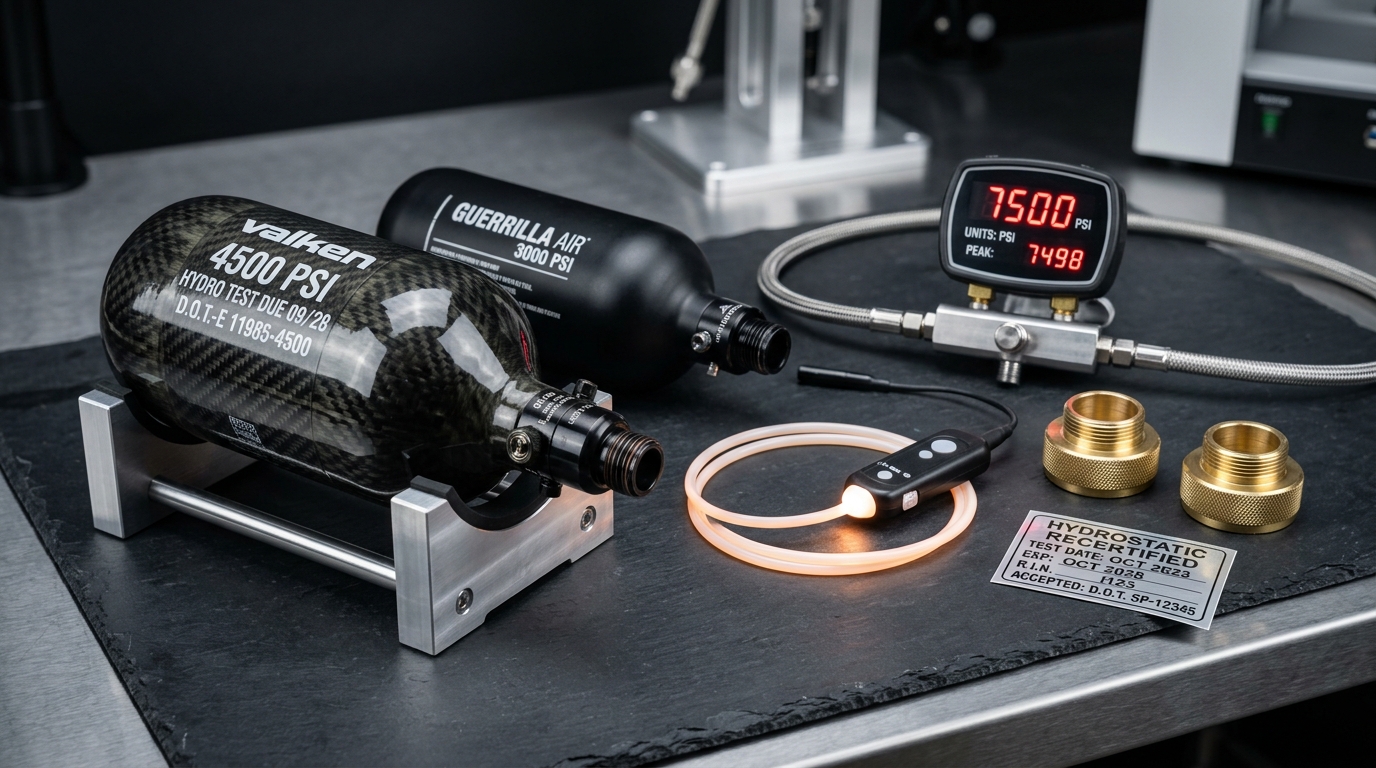
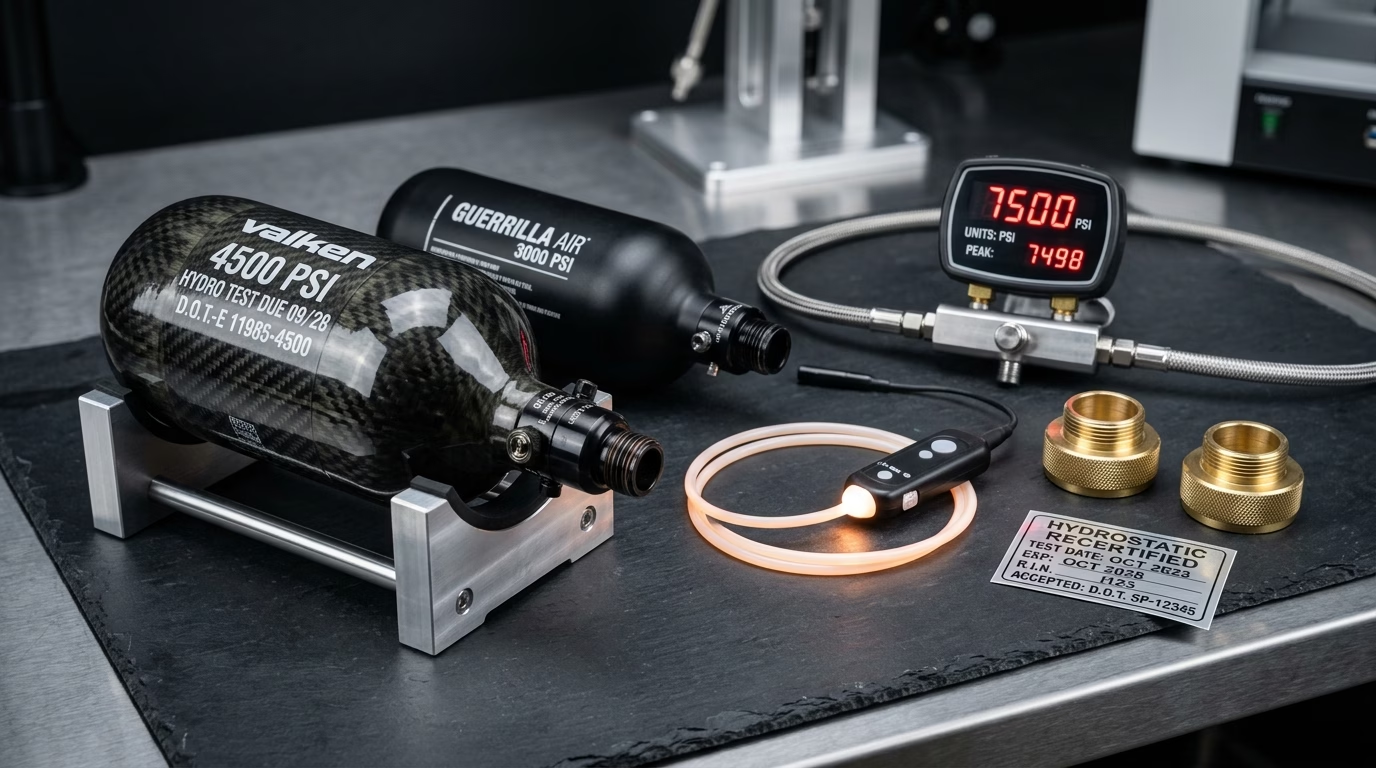
Figure 1.0: Certified Hydrostatic Inspection Bench Setup. A carbon fiber 68/4500 PSI tournament cylinder alongside an aluminum 48/3000 bottle, internal optical inspection bore-light, digital high-pressure hydro manifold (7,500 PSI proof test), and DOT recertification stamp.
The Physics of Hydrostatic Testing: Elastic vs. Permanent Expansion
To understand why a certified paintball tank hydro test is mandatory for tournament play, technicians must examine the metallurgy and polymer mechanics of pressure vessel stress. Every time an HPA cylinder is filled at a compressor station from 0 PSI to 4,500 PSI, the vessel walls expand outward under hoop stress, stretching both the inner aluminum liner and the structural epoxy-impregnated carbon filament winding.
Over thousands of match fills, thermal shock (as compression generates internal heat upwards of 130°F) and rapid depressurization cause micro-fatigue along the grain boundaries of the aluminum liner. If microscopic fatigue cracks propagate or resin matrix delamination occurs, the cylinder loses structural elasticity.
Certified hydrostatic test facilities utilize the Water Jacket Volumetric Expansion Method (conforming to CGA Pamphlet C-1):
- Vessel De-Valving & Water Inundation: The tank regulator is unscrewed, and the cylinder is filled completely with room-temperature water, eliminating all air pockets.
- Submersion in Sealed Water Jacket: The water-filled tank is placed inside a sealed, heavy steel water jacket filled with water and connected to a precision glass burette manometer or digital transducer scale.
- Hydraulic Pressurization to 5/3x Working Pressure: A high-pressure hydraulic pump forces additional water into the test cylinder, raising internal pressure to 167% of its rated capacity:
- 3,000 PSI Aluminum Tanks → Pressurized to 5,000 PSI
- 4,500 PSI Carbon Fiber Tanks → Pressurized to 7,500 PSI
- Measuring Total Volumetric Expansion (TE): As the tank expands under 7,500 PSI proof pressure, it displaces water inside the surrounding steel jacket, forcing water up into the measuring manometer. This measurement represents Total Expansion (TE).
- Measuring Permanent Plastic Expansion (PE): The hydraulic pump depressurizes the cylinder back to 0 PSI. If the tank is structurally sound, it snaps back elastically to its original volume. Any water that remains displaced in the burette represents Permanent Expansion (PE).
The Pass/Fail Formula: A cylinder fails the hydrostatic test if its permanent plastic deformation exceeds the maximum allowable percentage of total expansion:
Percent Permanent Expansion = (Permanent Expansion / Total Expansion) × 100%
Under DOT Special Permits (DOT-SP), if Permanent Expansion exceeds 5.0% to 10.0% (depending on the specific cylinder manufacturer’s permit requirements), the vessel has entered permanent plastic deformation. Its metal structure is compromised, and the test station is legally bound to condemn and permanently destroy the cylinder.
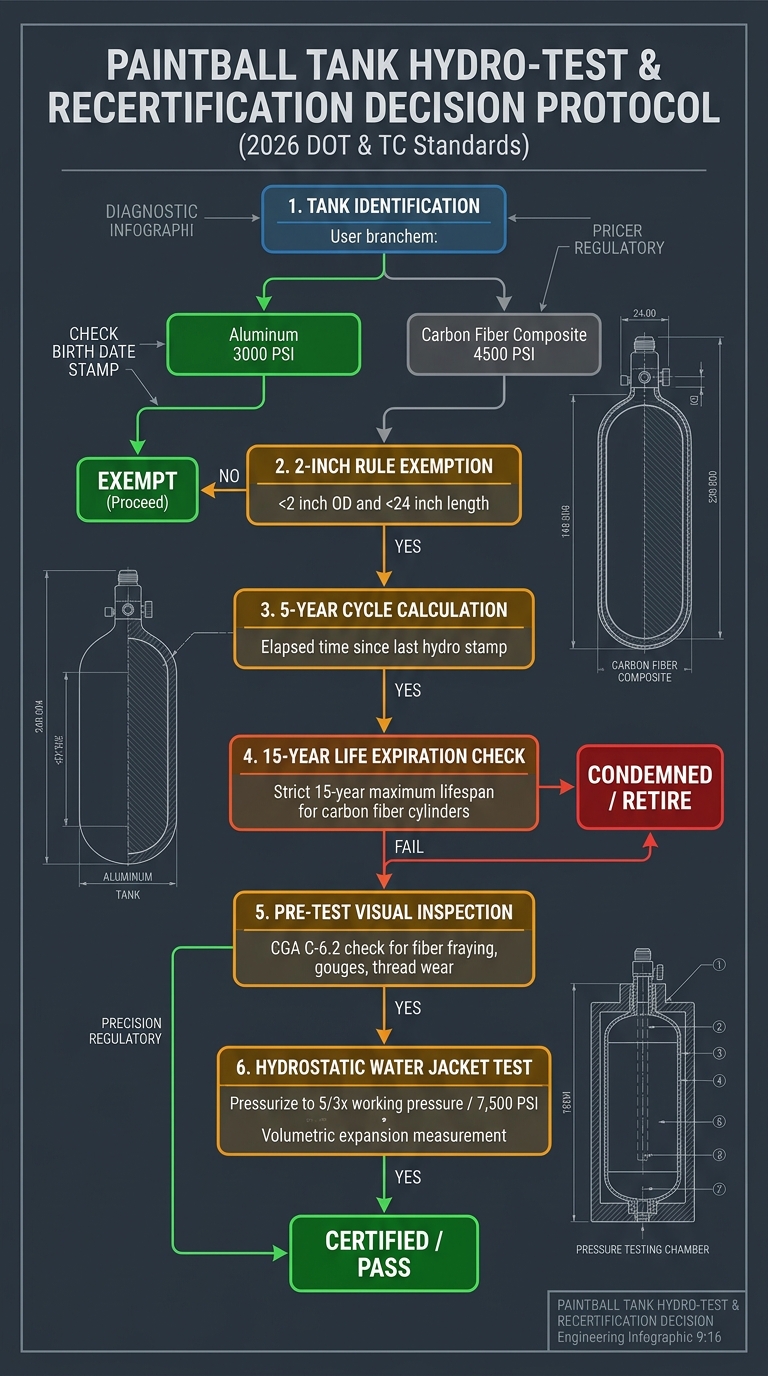
Figure 2.0: Official 2026 DOT & TC Paintball Tank Hydro-Test & Recertification Decision Protocol. Step-by-step diagnostic workflow covering birth date calculation, the 2×2 exemption rule, CGA visual condemnation thresholds, and water jacket test criteria.
Master Cylinder Specification & Hydro-Testing Lookup Table
Different tank constructions and volume ratings operate under distinct federal codes. Below is our master armorer reference matrix outlining hydro cycles, lifespans, and regulatory exemptions across standard paintball tanks:
Step-by-Step Field Execution: Diagnosing & Certifying Your Tank
Before shipping your tank to an authorized Department of Transportation hydro re-tester or bringing it to a commercial scuba shop, execute this 4-phase armorer diagnostic protocol:
Phase 1: Decoding Tank Labeling & Calculating True Expiration
Every HPA tank features a stamped or epoxy-sealed label declaring its manufacturing lineage. Look for the following three vital markers:
- Original Birth Date: Displayed in two-digit month and year format (e.g.,
04◇21indicates manufacture in April 2021). Your first paintball tank hydro test is due exactly 5 years from that date (April 2026). - DOT Special Permit (DOT-SP) or DOT-3AL Stamp: Aluminum tanks are stamped directly into the crown metal with
DOT-3AL-3000. Carbon fiber tanks feature an encapsulated label readingDOT-SP 14387-4500. - Re-Test Hydro Stamps / Decals: If the tank has undergone prior re-testing, you will locate a secondary circular RIN (Re-tester Identification Number) sticker or dot-peen stamp displaying the facility identifier flanking a new month and year (e.g.,
A123 ◇ 05 ◇ 24). The next test is due 5 years from this latest stamp.
Calculate 15 years from the original birth date. Even if a carbon fiber cylinder was re-tested and stamped in year 13 (2024), that test does not grant 5 additional years. The cylinder permanently dies on its 15th birthday (2026) and must be discarded immediately.
Phase 2: CGA C-6.2 Pre-Test Visual Inspection & Condemnation Check
Before hydrostatic immersion, technicians conduct an exhaustive external visual inspection conforming to Compressed Gas Association (CGA) Pamphlet C-6.2 standards for composite cylinders. Your tank will be rejected or condemned on sight if it exhibits any of the following:
- Level 3 Structural Damage (Fibers Exposed): Any gouge, abrasion, or scrape that penetrates through the clear protective gelcoat and severs the structural carbon or glass fibers condemns the tank immediately.
- Delamination & Blistering: Large white patches or bubbling beneath the clear epoxy indicate the resin has debonded from the inner aluminum cylinder liner.
- Crown & Neck Thread Galling: Unscrew the regulator and inspect the 5/8″-18 UNF aluminum internal threads. Damaged, cross-threaded, or stripped crown threads cannot maintain a seal and result in immediate cylinder destruction.
- Chemical Exposure: Exposure to strong acids, solvents, or petroleum lubricants (which degrade the resin bond) requires permanent retirement. Always clean tanks with mild soap and water only.
Phase 3: Regulator Removal Protocol (Zero Trapped Pressure)
Hydro testing facilities require cylinders shipped completely de-valved (regulator removed) so technicians can insert optical inspection lights directly into the bottle neck.
CRITICAL SAFETY WARNING: Never attempt to remove a tank regulator while pressurized gas remains inside the vessel! Follow this strict degas procedure:
- Attach the tank to a marker with a purging on/off ASA (such as the Planet Eclipse POPS) or use a dedicated bleed valve tool. Dry-fire or vent the bottle until the gauge reads 0 PSI.
- Depress the bonnet pin valve with a blunt wooden tool or hex key to verify zero residual pressure hiss.
- Secure the regulator body in a padded rubber vise or dedicated regulator removal clamp. Never clamp the carbon fiber cylinder walls directly in an iron bench vise!
- Turn the bottle counter-clockwise. If significant resistance is encountered after 1.5 rotations, STOP IMMEDIATELY—residual gas may be locked behind the threads. Vent completely before continuing.
Phase 4: Post-Test Recertification, Reassembly & Regulator O-Ring Seals
Once your tank successfully passes its hydrostatic test, the testing facility applies an official laminated DOT/TC recertification label covered with clear industrial epoxy, displaying the facility’s RIN number and test date.
To re-install your regulator safely:
- Inspect and replace the internal #015 Polyurethane 90A O-ring located on the top of the regulator threads. Soft 70-durometer Buna-N O-rings will extrude and shred under 4,500 PSI pressure; only use 90-durometer urethane as detailed in our Complete O-Ring Sizing Guide.
- Apply a tiny drop of pure methyl phenyl silicone grease (Dow 33 Light) to the O-ring. Never apply grease to the threads!
- Hand-tighten the regulator firmly into the bottle neck. Pressure vessels utilize an O-ring face seal; thread sealant, Teflon tape, and excessive torque are completely unnecessary and hazardous.
- For guidance on pairing your re-certified tank with correct output pressures (850 PSI vs 450 PSI), consult our Paintball Operating Pressures Guide and our showdown on Macroline vs Gas-Thru Air Systems.
Essential Armorer Workbench Tools for Tank Maintenance
Maintaining HPA cylinders and checking regulator seal health requires dedicated armorer tools:
Final Armorer Verdict: Certified Compliance vs Cost of Replacement
Navigating a certified paintball tank hydro test is a simple, cost-effective maintenance benchmark that ensures the absolute physical safety of you and everyone in the staging pit. At an average cost of $25 to $40 per recertification, hydro-testing a $220 tournament carbon fiber cylinder at year 5 and year 10 extends its active service life across three full five-year cycles, saving you hundreds of dollars compared to premature replacement.
However, if your carbon fiber bottle is within 12 months of its 15-year statutory death ceiling, or if your aluminum tank exhibits deep mechanical gouges or crown thread galling, retire the cylinder immediately. Under 4,500 PSI pneumatic pressure, mechanical discipline is life safety.
Frequently Asked Questions: Paintball Tank Hydro Testing
How much does a paintball tank hydro test typically cost?
A professional paintball tank hydro test typically costs between $25 and $45 depending on the test facility and shipping fees. Local scuba diving shops, commercial fire equipment testing facilities, and specialized paintball retailers (such as HydroLab) provide certified testing with turnarounds ranging from 3 days to two weeks.
What happens if you bring an out-of-hydro tank to a paintball field?
Commercial paintball fields operating under ASTM and insurance safety standards are legally mandated to inspect tank hydro stamps before refilling. If your cylinder’s hydro test stamp has expired, field staff will refuse to connect fill whips to your tank. Playing with or filling an out-of-date cylinder is a severe safety violation that can result in ejection from the facility.
Do aluminum 48/3000 paintball tanks expire after 15 years?
No. Standard seamless aluminum cylinders (DOT-3AL rated) do NOT have a mandatory 15-year lifespan limit. Provided an aluminum tank passes internal visual inspections and hydrostatic volumetric expansion tests every 5 years with zero thread damage or deep gouging, it can theoretically remain in service indefinitely.
What is the 2-inch by 24-inch exemption rule for hydro testing?
Under US Department of Transportation regulations (CFR Title 49), cylinders that have an outside diameter of less than 2 inches and an overall length of less than 24 inches are legally exempt from the 5-year hydrostatic re-test requirement. Common paintball tanks qualifying for this exemption include 13ci/3000 PSI aluminum cylinders frequently used on pump guns and mag-fed tactical markers.
Can you hydro-test a CO2 paintball tank?
Yes. Standard 9oz, 12oz, 20oz, and 24oz aluminum CO2 tanks operate under DOT-3AL specifications and require hydrostatic re-testing every 5 years if their diameter exceeds 2 inches. However, because new aluminum CO2 tanks cost less than $25, most players choose to replace expired CO2 bottles rather than paying $30+ for hydrostatic recertification.
What should you do with a carbon fiber tank that reaches 15 years of age?
When a composite carbon fiber tank reaches 15 years from its birth date, it is permanently expired by federal law and cannot be filled or re-tested. To prevent accidental future use, discharge all pressure completely, unscrew and salvage the regulator for use on a new bottle, and drill a 1/4-inch hole through the crown shoulder or render the threads unusable before recycling the aluminum core.