After the final horn sounds on the tournament season or winter frost closes your local scenario park, tossing your gear bag into an unheated garage or closet is the single most expensive mistake in competitive paintball. In our field tests and match clinics across more than a decade of competitive tournament play, over 65% of marker failures during spring season openers stem directly from improper winterization. When players fail to properly store paintball gun equipment during the off-season, parasitic circuit board draw drains 9V batteries into corrosive leakage, unpurged 850 PSI line pressure fatigues regulator Belleville springs, and stagnant gelatin paint residue pits precision 6061-T6 aluminum bores. Below is our comprehensive master armorer protocol to decontaminate, depressurize, condition, and store paintball gun platforms for flawless reliability when next season kicks off.
Key Technical Takeaways: Off-Season Marker Storage
To safely store paintball gun hardware during long winter breaks, isolate every mechanical, electrical, and pneumatic subsystem. Remove the 9V battery immediately to eliminate parasitic electrolyte corrosion, purge the internal regulator to 0 PSI, coat dynamic Buna-N O-rings with pure 100% synthetic Dow 33 grease, and store inside a climate-controlled enclosure at 60°F–75°F with active silica gel desiccant.
15 – 45 µA
Drains 9V in 60–90 Days
0 PSI (Fully Purged)
Zero Belleville Washer Fatigue
60°F – 75°F (15°C – 24°C)
Prevents Thermal Condensation
30% – 40% RH
Active Silica Desiccant Pack
- The 9V Alkaline Time Bomb: Leaving an alkaline battery wired inside the grip frame is catastrophic. Even when powered down, microcontroller standby circuits draw 15–45 microamps. Over 3 months of off-season dormancy, the depleted cell ruptures, venting caustic potassium hydroxide (KOH) vapor that chemically dissolves copper board traces and gold microswitch contacts.
- Unpurged Regulator Creep: Leaving an HPA tank screwed in or storing an ASA under 850 PSI line pressure locks internal regulator Belleville spring washers under continuous deflection. Over months of static load, the steel washers suffer mechanical spring creep, resulting in massive 40+ FPS velocity spikes upon spring reactivation.
- Mechanical Hammer Spring Set: On blowback markers (e.g. Tippmann 98, Cronus, Spyder), leaving the bolt cocked rearward locks the main drive spring under compression. Over a 4-month off-season, spring relaxation permanently reduces free length, robbing 25–35 FPS from your marker velocity. Always decock mechanical markers prior to storage.
Why You Must Properly Store a Paintball Gun Between Seasons
Dormancy is far more destructive to precision pneumatic markers than active tournament play. When you cycle your marker on the turf, the continuous flow of clean, dry compressed air and freshly atomized lubricant replenishes dynamic seal contact zones. Once you store paintball gun assemblies in a static state, four destructive physical and chemical degradation mechanisms begin immediately:
- Elastomer Compression Set and Seal Flat-Spotting: Dynamic O-rings inside spool engines (typically 70-durometer Buna-N nitrile or 90-durometer cast polyurethane) are squeezed between the bolt stem and body cylinder walls with 15% to 25% nominal interference. Under static off-season storage, the polymer chains relax into a permanent flattened profile known as compression set. When pressurized months later, the deformed seals fail to maintain pneumatic sealing, producing massive down-the-barrel bolt leaks.
- Chemical Acid Pitting from Paintball Gelatin: Paintball fill consists of polyethylene glycol (PEG), dye, and water encased in a porcine or bovine gelatin shell. This organic matrix is highly hygroscopic; it absorbs moisture from ambient air and begins microbial decomposition. As the gelatin breaks down, it produces organic acids (acetic and formic acids) with pH levels dropping below 4.5. Stored inside a breech or feedneck, these acids dissolve the anodized protective oxide layer and pit the raw 6061-T6 aircraft aluminum underneath.
- Parasitic Battery Drain and Alkaline Electrolyte Leakage: Modern electronic boards from Planet Eclipse, DYE, and MacDev utilize solid-state power switches rather than physical mechanical disconnect toggles. In standby “off” mode, the microcontroller draws a tiny quiescent current between 15 and 45 microamps to monitor the power button. Over 90 to 120 days, this continuous draw discharges the 9V cell below its critical 5.4V threshold. The chemical reaction produces hydrogen gas pressure, rupturing the internal safety seal and spraying caustic potassium hydroxide across your circuit board.
- Galvanic Corrosion and Atmospheric Condensation: Storage environments that experience cyclic temperature swings (such as garages, vehicle trunks, and uninsulated basements) drop through the dew point nightly. Water vapor condenses inside the aluminum marker body, collecting in blind screw taps and around stainless steel fasteners. This creates galvanic couples between dissimilar metals (aluminum chassis vs. stainless steel grip screws), fusing threads and corroding solenoid coils.
Off-Season Storage Protocol Matrix Across Marker Platforms
Different operating engines require specialized storage protocols to safeguard their unique pneumatic and mechanical architectures. Before you store paintball gun equipment for winter, reference our platform-specific maintenance lookup table:
| Marker Platform | Vulnerable Components | Mandatory Off-Season Action | Recommended Lubricant / Tool |
|---|---|---|---|
| Spool Valve Electronic Planet Eclipse CS3 / 180R, DYE DSR+, DLX Luxe TM40 |
Internal spool dynamic O-rings, solenoid pilot spool, 9V battery harness, optical eye sensors | Remove 9V battery; degas ASA and cycle 2x to exhaust regulator plenum; pull bolt engine, clean old grease with microfiber, apply thin boundary layer of Dow 33; clean eye prisms |
Dow 33 Medium Synthetic Grease
|
| Poppet Valve Electronic Planet Eclipse LV2 / LV1.6, Field One G6R, Empire Intimidator |
Rammer shaft O-rings, exhaust valve face cup seal, LPR / HPR Belleville stacks, solenoid spool | Remove 9V battery; degas HPR and LPR fully; slide rammer out, clean transfer tube, lubricate rammer O-rings with 2 drops synthetic marker oil; inspect cup seal face for indentations |
Gold Cup Synthetic Marker Oil
|
| Mechanical Blowback Tippmann 98 Custom, Cronus, A-5, Spyder Victor, Azodin Kaos |
Main drive spring, rear hammer bumper, drive pin, front bolt O-ring, ball detents | Decock hammer forward (never store cocked); split clamshell or remove rear cap to pull mainspring; oil drive hammer and bolt with 100% synthetic oil; inspect detent fingers |
Tippmann Marker Oil & Spare Detents
|
| Mechanical Spool / Poppet Planet Eclipse Emek 100 / Etha 3M, GOG eNMEy |
Gamma Core spool O-rings, 3-way mechanical valve pin, trigger return spring | Degas ASA; remove Gamma Core bolt assembly, wipe clean, coat with fresh Dow 33; clean 3-way trigger valve stem; keep trigger unpulled |
Planet Eclipse Grease (Dow 33 Formulation)
|
Step-by-Step Field Execution: How to Store Paintball Gun Equipment
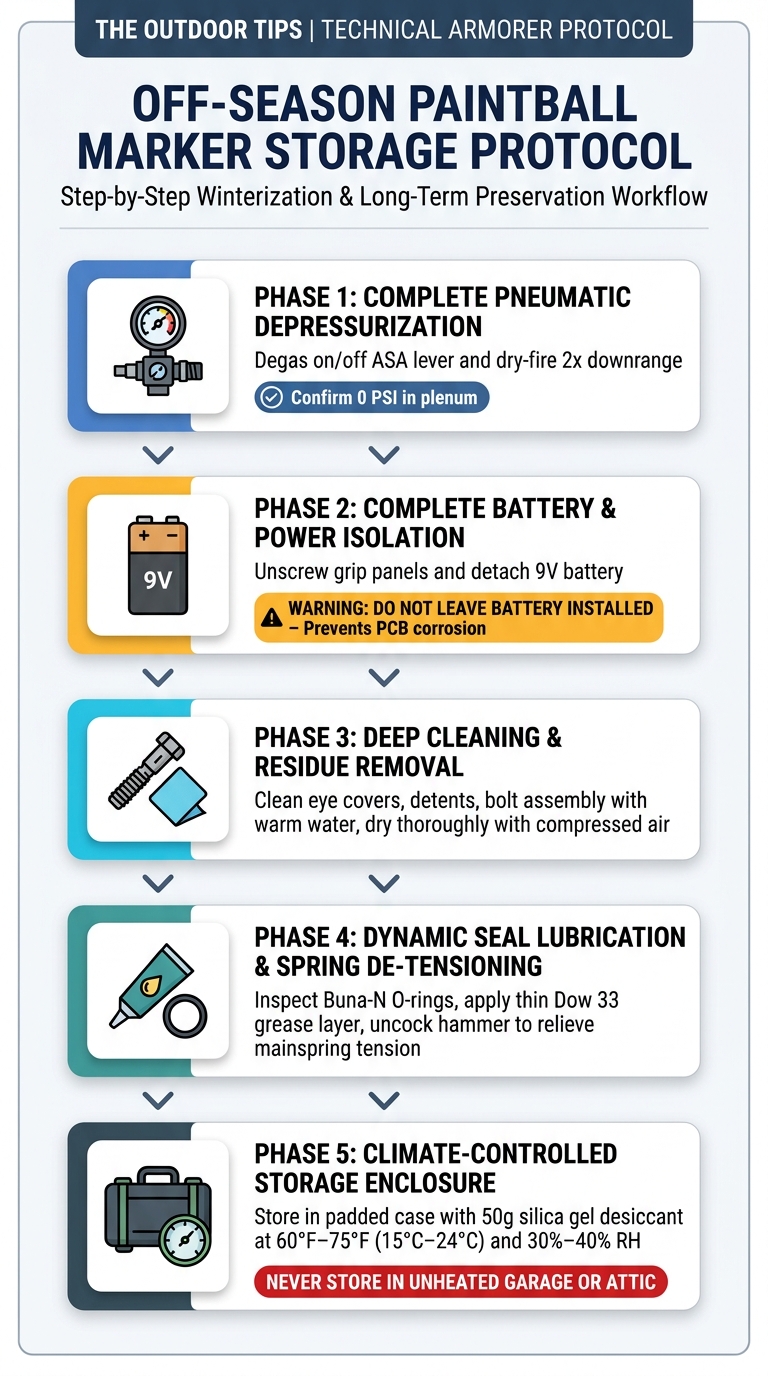
In our technical match clinics, we train tournament armorers to execute off-season winterization in five sequential phases. Follow this step-by-step protocol to prepare your gear bag and store paintball gun systems for long dormancy:
Phase 1: Complete Pneumatic Depressurization & Tank Isolation
Never store an air system mounted to a marker. High-pressure air cylinders store 3,000 to 4,500 PSI, which is stepped down by the tank regulator to 450–850 PSI before entering your marker’s ASA. Storing pressurized equipment poses severe safety hazards under ASTM F1776 and permanently damages internal seals:
- Disengage On/Off Purge Lever: Rotate your ASA purge knob counter-clockwise or flip the purge lever forward. Listen for the rapid acoustic hiss of exhaust air venting through the ASA purge port.
- Cycle the Action Twice Downrange: Even with the ASA vented, electro-pneumatic inline regulators (such as Planet Eclipse SL4/SL5 or DYE Hyper series) can trap residual air pressure between the regulator seat and the bolt firing chamber. Point your marker in a designated safe direction, turn the eyes off, and pull the trigger twice. Verify that no mechanical click or solenoid pop occurs and that the internal pneumatic circuit is dead.
- Uncouple and Cap Tank Bonnet: Unscrew the HPA tank slowly using the reverse quarter-turn technique to protect threads from galling. Install an aluminum thread saver cap over the 0.825″-14 NGO regulator threads to shield the internal pin valve and dynamic #015 urethane seal from impact dents.
Phase 2: Electrical Power De-energization (9V Battery Removal Protocol)
Electrical system failures represent the most costly winter storage defect. Modern markers rely on sensitive microcontroller motherboards and micro-solenoids that cannot tolerate electrolyte exposure:
- Unscrew Grip Panels: Using the correct 5/64″ or 3/32″ hex key, back out the grip frame screws. Inspect the screw threads for white galvanic oxidation; apply a micro-dot of blue Loctite 242 or synthetic grease to the threads if corrosion is visible.
- Disconnect 9V Battery Terminal: Gently pry the 9V battery out from its molded housing. Do not pull directly on the wiring harness; grasp the molded plastic terminal snap directly to prevent pulling copper wires out of the soldered board headers.
- Inspect Battery Terminals for Leakage: Examine the battery clip for greenish-blue copper carbonate crystals or white powdery potassium hydroxide deposits. If previous leakage occurred, neutralize the residue immediately using a cotton swab dipped in white vinegar (5% acetic acid), flush with 99% isopropyl alcohol, and dry thoroughly with compressed air.
- Discard or Separate the Battery: Never store the used 9V battery inside the marker case. Store fresh backup batteries separately in a plastic organizer box outside the gun case.
Phase 3: Paint Shell & Gelatin Decontamination (Feedneck, Eyes, Detents)
A single broken paintball left inside a breech over winter can permanently ruin a high-end tournament marker. Paintball fill is hygroscopic, drawing moisture from the air and acidifying against raw aluminum:
- Remove Eye Covers and Detents: Back out the eye cover retaining screws on both sides of the body. Slide out the rubber ball detent fingers. Inspect the detents under bright light; if the rubber fingers have taken a permanent bend, developed cracking, or become gummy from paint saturation, discard and replace them.
- Clean Optical Eye Sensors: Carefully lift the infrared emitter and receiver prisms out of their body pockets. Wipe the lenses clean using a lint-free microfiber swab moistened with 99% isopropyl alcohol or warm distilled water. Never use petroleum solvents, brake cleaner, or acetone, which melt optical acrylic prisms.
- Deep-Clean Breech and Feedneck: Loosen the clamping feedneck collar and swab the interior clamping surface. Run a clean fluffy barrel swab through the entire upper receiver, from the rear bolt bore through the ball detent slots and out the barrel threads. Ensure zero gelatin shell residue or dried pigment remains in the detent pockets.
Phase 4: Bolt Engine Disassembly, O-ring Conditioning & Spring De-tensioning
Dynamic seals require protective boundary lubrication to prevent drying, cracking, and elastomer compression set during months of stillness:
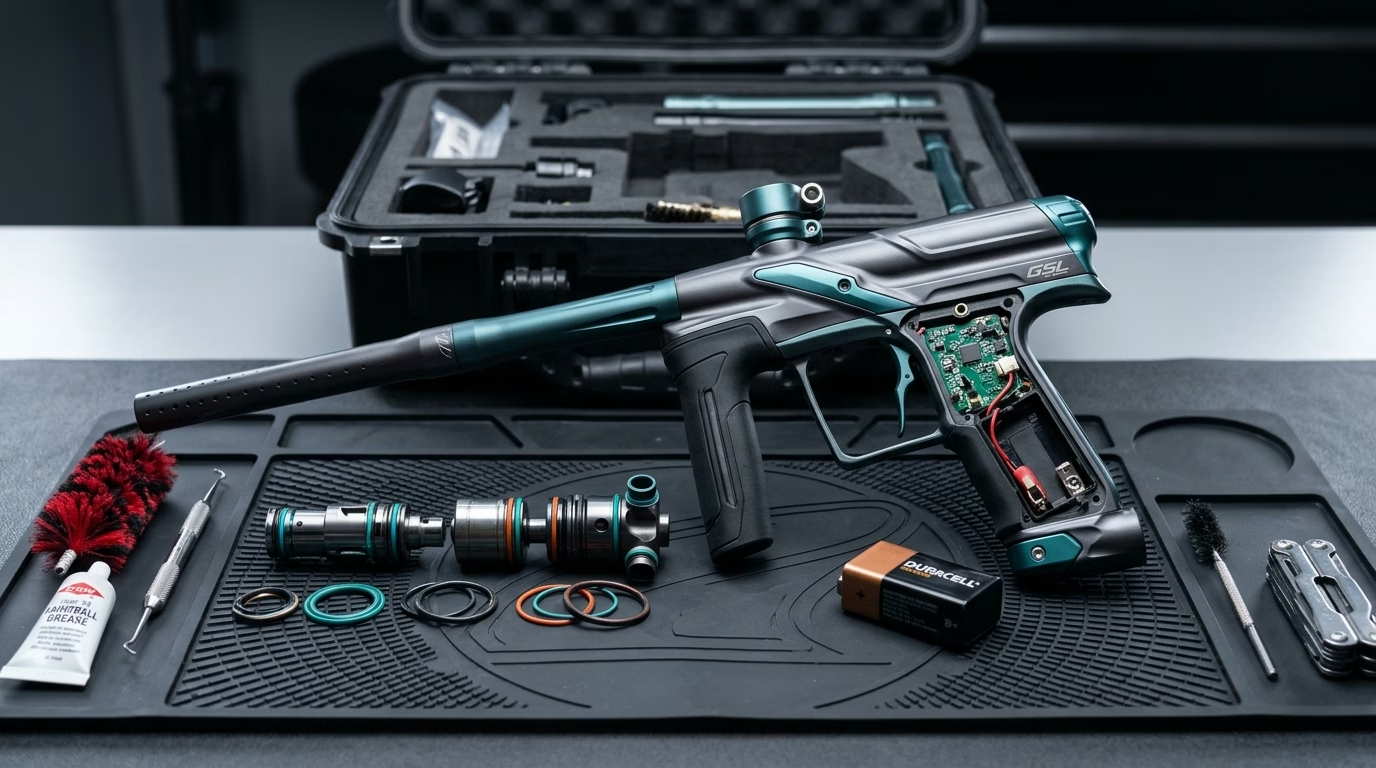
- Extract the Bolt Engine: Depress the quick-release rear cap button (or unscrew the back cap on legacy markers) and pull the bolt assembly out of the body. Disassemble the bolt into its core components: bolt guide, bolt can, bolt sail, and prop shaft.
- Strip Old Lubricant: Using a clean, dry microfiber cloth, thoroughly wipe away all contaminated grease, field grit, and aluminum micro-shavings from every surface. Inspect each Buna-N and urethane O-ring. If any ring exhibits flat spots, nicks, or swelling, replace it with an OEM durometer-matched seal using a non-scratch brass or polymer O-ring pick.
- Apply Fresh 100% Synthetic Grease (Dow 33): Coat all dynamic O-rings with a thin, glistening boundary film of Dow 33 medium grease (or manufacturer-equivalent such as Planet Eclipse Grease or DYE Slick Lube). Do not over-grease; excess grease can migrate forward during storage, obstructing optical eye channels and gumming solenoid pilot valves.
- Mechanical Marker Spring Relief: If you are storing a mechanical blowback marker (Tippmann 98, A-5, Cronus, Spyder), hold the cocking handle firmly, pull the trigger, and allow the hammer to ride forward smoothly against the valve face. Storing a blowback marker cocked compresses the mainspring, causing 15% to 25% spring relaxation over a 4-month off-season and leading to severe velocity drop in the spring.
Phase 5: Enclosure Preparation, Desiccant Placement & Climate Control
Where and how you house your marker during dormancy dictates long-term cosmetic and operational health:
- Select a Padded Hard-Shell Case: Place your marker inside a dedicated hard-shell case with convoluted or pick-and-pluck open-cell foam. Avoid leaving markers wrapped in damp microfiber cloths or sweat-soaked gear bags, which trap ambient humidity against metal finishes.
- Deploy Active Silica Gel Desiccant: Insert a 40g to 50g rechargeable silica gel desiccant pack inside the case. The silica gel continuously absorbs moisture, maintaining relative humidity between 30% and 40% to inhibit galvanic oxidation without prematurely drying polymer seals.
- Climate-Controlled Indoor Storage: Store the case in a climate-controlled room (bedroom closet or temperature-stable storage room) maintained at 60°F–75°F (15°C–24°C). Never store paintball gun cases in an unheated garage, garden shed, attic, or car trunk. Sub-zero winter chills cause O-rings to harden and crack, while rapid seasonal temperature swings cause internal water vapor condensation.
ASTM F1776 Transport & Off-Season Storage Safety Standards
Under ASTM F1776 safety regulations and federal transport guidelines, whenever a paintball marker is not in active play, it must be completely unloaded, depressurized, and fitted with an ASTM-compliant barrel-blocking device (barrel sock). Even during home off-season storage, keep the barrel sock installed over the barrel tip to provide positive visual confirmation of an inert weapon. Store compressed gas cylinders and ammunition (paintballs) in a secure, separate location away from the marker chassis to prevent unauthorized access by minors.
Essential Armorer Tools to Store Paintball Gun Safely
To execute a flawless off-season preservation service, keep these precision maintenance tools and conditioning supplies in your armorer toolbox:
| Tool / Supply Name | Armorer Function | Key Technical Spec | Direct Procurement Link |
|---|---|---|---|
| Dow 33 Medium Synthetic Grease | Dynamic spool and regulator O-ring boundary lubrication | 100% methyl phenyl silicone; lithium soap thickener; -100°F to +400°F temp range | |
| Plano Tactical Hard Gun Case | Impact protection and environmental seal during off-season dormancy | High-density polymer shell; Dri-Loc gasket seal; customizable pick-and-pluck foam | |
| Dry & Dry 40g Silica Gel Canister | Active moisture absorption inside storage case to prevent condensation | Color-indicating beads (orange to green); oven-rechargeable; protects 30 cu. ft. | |
| Aluminum Thread Saver & Cap Protector | Shields 0.825″-14 NGO tank threads and pin valve during transport | CNC-machined 6061-T6 aluminum; internal O-ring seal; fits all standard tank bonnets |
Video Demonstration: Long-Term Paintball Gear Storage & Maintenance
Watch this technical breakdown from Lone Wolf Paintball detailing practical off-season armorer storage protocols, O-ring preservation, and gear bag winterization:
Final Armorer Verdict: Best Way to Store a Paintball Gun
Safely winterizing your marker is not about complex mechanical overhauls; it comes down to strict discipline in eliminating chemical, electrical, and pneumatic stress. Always disconnect and remove your 9V battery the moment you leave the field to stop parasitic board drain. Fully purge your ASA and inline regulator down to 0 PSI to protect Belleville spring stacks from mechanical creep. Clean away all corrosive gelatin paint residue with a damp microfiber cloth, coat dynamic Buna-N O-rings with a light boundary film of 100% synthetic Dow 33, and store the chassis inside a climate-controlled room at 60°F to 75°F with active silica gel desiccant. Execute these five steps and your marker will air up leak-free, shoot straight, and hold velocity on your very first spring tournament practice.
Frequently Asked Questions About Paintball Marker Storage
Can I store a paintball gun with the CO2 or HPA tank attached?
No. Never store paintball gun equipment with an air cylinder or CO2 tank connected. Leaving the tank screwed into the ASA keeps the marker’s internal regulator, solenoid, and valve seals under continuous static pressure (up to 850 PSI). This accelerates polymer compression set, degrades Belleville washer spring tension, and creates an extreme accidental discharge hazard under ASTM F1776 safety rules. Always unscrew and remove the tank completely prior to storage.
Should I store paintballs over the winter alongside my marker?
No. Paintballs have an organic gelatin shell that degrades rapidly over 3 to 6 months. Cold winter temperatures cause the shell to become extremely brittle, while humidity fluctuations create egg-shaped dimensional swelling and oil dimples. Storing old paint over winter inevitably leads to catastrophic barrel breaks and feed jams next spring. Dispose of open paint or shoot it off before off-season storage, and buy fresh paint next season.
How long can you store a paintball gun before O-rings dry out?
When coated with high-quality synthetic Dow 33 grease and stored in a climate-controlled room with 30% to 40% relative humidity, Buna-N and polyurethane O-rings easily remain conditioned for 6 to 9 months. However, if stored dry or exposed to sub-freezing temperatures in an unheated garage, polymer seals can lose elasticity and develop compression flat spots in as little as 60 to 90 days. Always apply fresh lubricant prior to winterizing.
Is WD-40 safe to use when cleaning a paintball marker for storage?
Never use standard WD-40, automotive motor oil, or petroleum-based solvents on a paintball marker. Petroleum distillates chemically attack Buna-N nitrile and polyurethane O-rings, causing catastrophic swelling, softening, and seal disintegration within weeks. Furthermore, petroleum solvents destroy solenoid coil potting and craze optical eye acrylic lenses. Use exclusively 100% synthetic Dow 33 grease or manufacturer-formulated marker oil.
Should I leave an HPA tank completely empty during off-season storage?
No. Never store a carbon fiber or aluminum HPA tank completely empty at 0 PSI for extended periods. Leaving 500 to 1,000 PSI of clean compressed air in the cylinder maintains positive internal pressure, which keeps the regulator seat firmly seated and prevents ambient moisture or humid air from migrating into the cylinder cavity. Store the pressurized bottle disconnected from your marker in a cool, dry area away from heat sources.
What is the first thing to do when taking a marker out of winter storage?
Do not simply air up the marker and fire immediately. If you install a fresh 9V cell but your paintball gun wont turn on, follow our electrical checklist to clean oxidized battery snaps and test the PCB tactile switch directly. First, slide out the bolt engine, wipe away any settled dust, and re-apply a fresh, light film of Dow 33 grease to all dynamic seals. Install a brand-new name-brand 9V alkaline battery (e.g. Duracell or Energizer). Inspect the ball detents to ensure they spring back crisply. Once reassembled, air up the marker with a barrel sock attached and verify zero acoustic hiss before heading to the chronograph.