You step onto a winter layout with temperatures hovering near 32°F (0°C), break out to the snake corner, pull the trigger on your first lane, and your marker produces a feeble puff of air or refuses to cycle entirely. After two seconds of frantic tapping, the bolt finally breaks free, but your opening stream falls thirty yards short of the bunker tape. In our field tests and match clinics across hundreds of sub-freezing tournament points, low-temperature cycling failure is rarely an electronic malfunction: it is classic paintball bolt stick driven by cold-temperature static friction, thickened grease, and contracting elastomer seals. Below is our comprehensive armorer diagnostic protocol, thermodynamic physics breakdown, platform-specific tuning matrix, and cold-weather field solutions.
Key Technical Takeaways (TL;DR)
Winter paintball bolt stick occurs when ambient cold and Joule-Thomson gas expansion drop internal engine temperatures below freezing, causing standard grease to congeal and static O-ring friction to exceed forward solenoid thrust. Eliminate the condition by stripping thick grease, applying a micro-thin sheen of Dow 33 Light (rated to -100°F), raising board dwell by +1.5 to +2.5 ms, and enabling Anti-Bolt Stick (ABS) with a +3.0 to +5.0 ms first-shot pulse offset.
< 45°F (7°C)
NLGI Grease Thickening Point
+3.0 to +5.0 ms
First-Shot Kinetic Boost
70A Urethane / NBR
Avoid Hardened 90A Buna
9.1V Fresh Alkaline
Prevents Cold Load Voltage Sag
- The Light Sheen Rule: In cold weather, over-greasing is fatal; apply only a microscopic, glossy sheen of Dow 33 Light so that dynamic O-rings glide without dragging through congealed grease dams.
- Anti-Bolt Stick (ABS) Activation: Always program an ABS dwell offset of +3.0 to +5.0 ms with an ABS reset timer of 5 to 10 seconds to ensure the first shot after crawling or waiting breaks free instantly.
- Fatal Error to Avoid: Never spray penetrating solvents (WD-40 or PB Blaster) or mix heavy petroleum gear oils into your bolt engine; petroleum eats rubber seals and triggers catastrophic solenoid failure (see our guide on paintball solenoid gasket replacement).
The Thermodynamic Physics of Cold-Weather Bolt Seizure
To understand why an electronic tournament marker that shoots flawless ±2 FPS chrono strings in July suddenly chokes in December, we must examine the thermodynamics of expanding compressed air (and learn how to clear a stuck paintball in barrel if bolt stick causes a squib) and elastomer contact mechanics.
When you fire an electronic marker, compressed air stored at 850 PSI in your tank drops across your in-line regulator down to 110–140 PSI, and then decompresses to atmospheric pressure (14.7 PSI) inside the breech within a 12-millisecond pulse. Under the Joule-Thomson effect, when a real gas expands rapidly through a restriction without performing external work, its temperature plummets:
• ΔT_cooling = Temperature drop of compressed gas across regulator and bolt firing vents
• μ_JT = Joule-Thomson coefficient for compressed air/nitrogen (≈ 0.024 °F per PSI pressure differential)
• ΔP = Pressure differential between tank regulator output and bolt chamber (approx. 740 PSI)
If the ambient staging air is 35°F (1.7°C), internal Joule-Thomson expansion chills the bolt assembly down to an icy 17.2°F (-8.2°C) during sustained 10.5 BPS tournament ramping! This localized deep freeze triggers three severe mechanical bottlenecks that create stubborn cold-weather bolt seizure:
1. Static Friction (Stiction) vs. Kinetic Friction
Friction between an elastomer O-ring and an anodized aluminum bore is divided into static friction (μ_s) and kinetic friction (μ_k). When a marker sits idle between points for 30 to 60 seconds, the compressed rubber settles into the microscopic surface roughness (asperities) of the aluminum cylinder wall. Under cold conditions, static breakaway friction μ_s spikes to more than triple its normal value. If the forward pneumatic drive force generated by the solenoid pulse cannot overcome this initial stiction threshold within the programmed dwell window, the bolt simply remains motionless.
2. Lubricant Rheology and Grease Thickening
Most commercial paintball lubricants are formulated with synthetic polyalphaolefin (PAO) or silicone base oils thickened with lithium stearate or PTFE fluoropolymers. As temperature drops, oil viscosity increases exponentially following the Arrhenius relationship. Medium-weight greases (NLGI Grade 2) transform from smooth fluids into stiff, gummy pastes. Instead of lubricating, congealed grease acts as a mechanical glue, dragging on dynamic O-rings and causing severe paintball bolt stick and extreme first-shot drop-off (FSDO).
3. O-Ring Thermal Contraction and Durometer Hardening
Nitrile butadiene rubber (NBR / Buna-N) has a thermal expansion coefficient (α ≈ 200 × 10⁻⁶ / K) roughly ten times higher than aluminum (α ≈ 23 × 10⁻⁶ / K). In sub-freezing temperatures, the O-ring contracts radially tighter against its inner gland while losing elasticity. Furthermore, as NBR approaches its glass transition temperature (-22°F / -30°C), its Shore A hardness climbs from a pliable 70A up to a rigid 85A durometer. The stiffened rubber cannot deform smoothly over port bevels, drastically compounding mechanical drag.
4. Alkaline Battery Voltage Collapse Under Load
Standard 9V alkaline batteries rely on chemical reactions between zinc and manganese dioxide. At 32°F, chemical reaction velocity slows by nearly 50%, causing internal battery impedance to double. When the electronic circuit board pulses the high-draw solenoid coil, the battery suffers massive voltage sag—plummeting from 9.2V resting down to 7.2V under load. The weakened electromagnetic field produces a sluggish solenoid plunger stroke that fails to deliver full pilot volume, leaving the bolt frozen forward or stuck rearward.
Master Platform Cold-Weather Tuning & Diagnosis Matrix
Different electropneumatic spool engines react differently to sub-45°F temperatures. Use our certified armorer lookup matrix below to match your marker’s engine with the correct cold-weather settings:
Cold Weather Diagnostic Decision Tree
When your marker fails to cycle properly in winter staging conditions, follow our structured diagnostic flowchart before touching board electronics or stripping regulators:
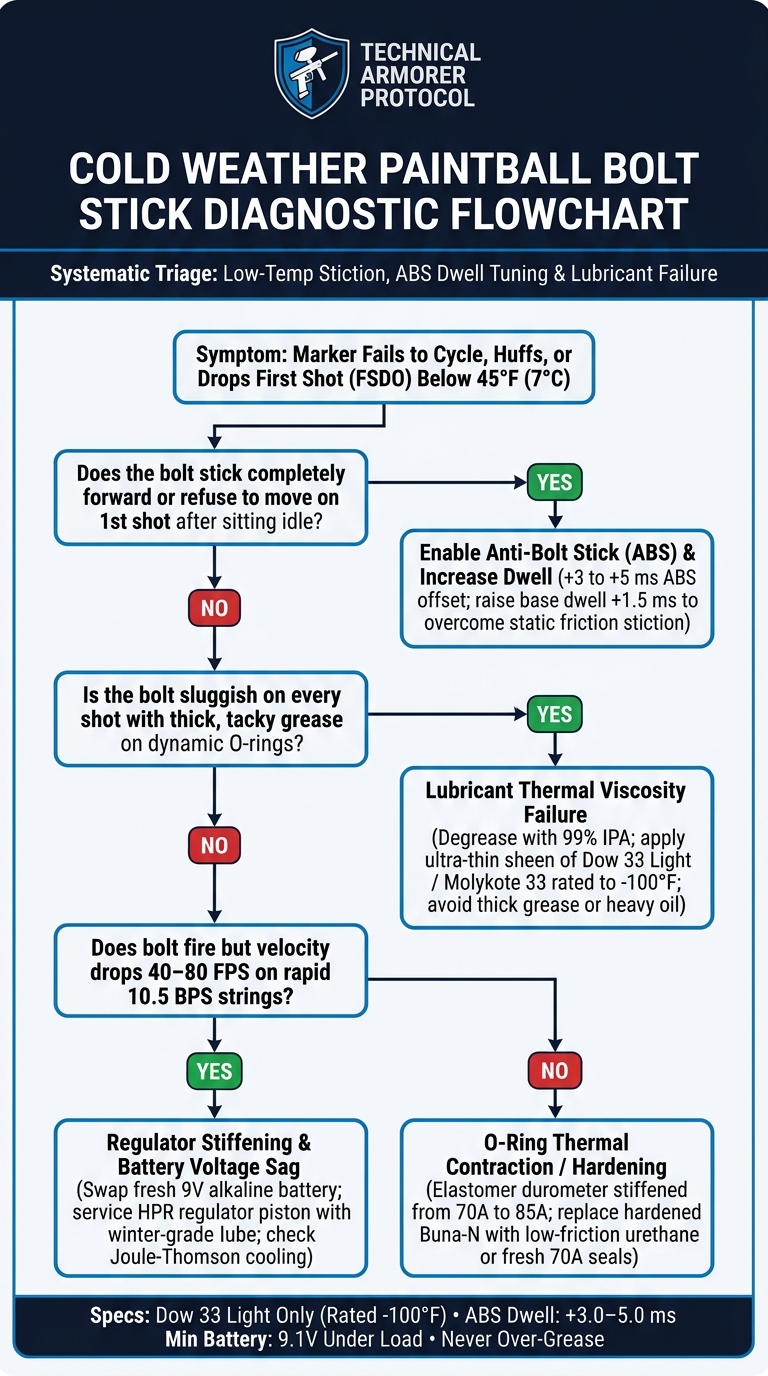
Figure 1: Field armorer decision tree for diagnosing and curing cold-weather paintball bolt stick, stiction, and low-temperature cycling failures.
5-Phase Armorer Protocol to Eliminate Cold-Weather Bolt Stick
Eliminating paintball bolt stick in freezing conditions requires systematic workshop preparation. Follow our 5-phase protocol before stepping onto cold staging grounds:
Phase 1: Complete Degreasing and Solvent Cleaning
Never layer winter lubricant over old summer grease. Old grease traps dust, broken paint gelatin, and moisture that freezes into ice crystals:
- Degas Marker Completely: Remove your HPA bottle or purge the on/off ASA lever downrange. Dry fire twice to dump residual dump-chamber air.
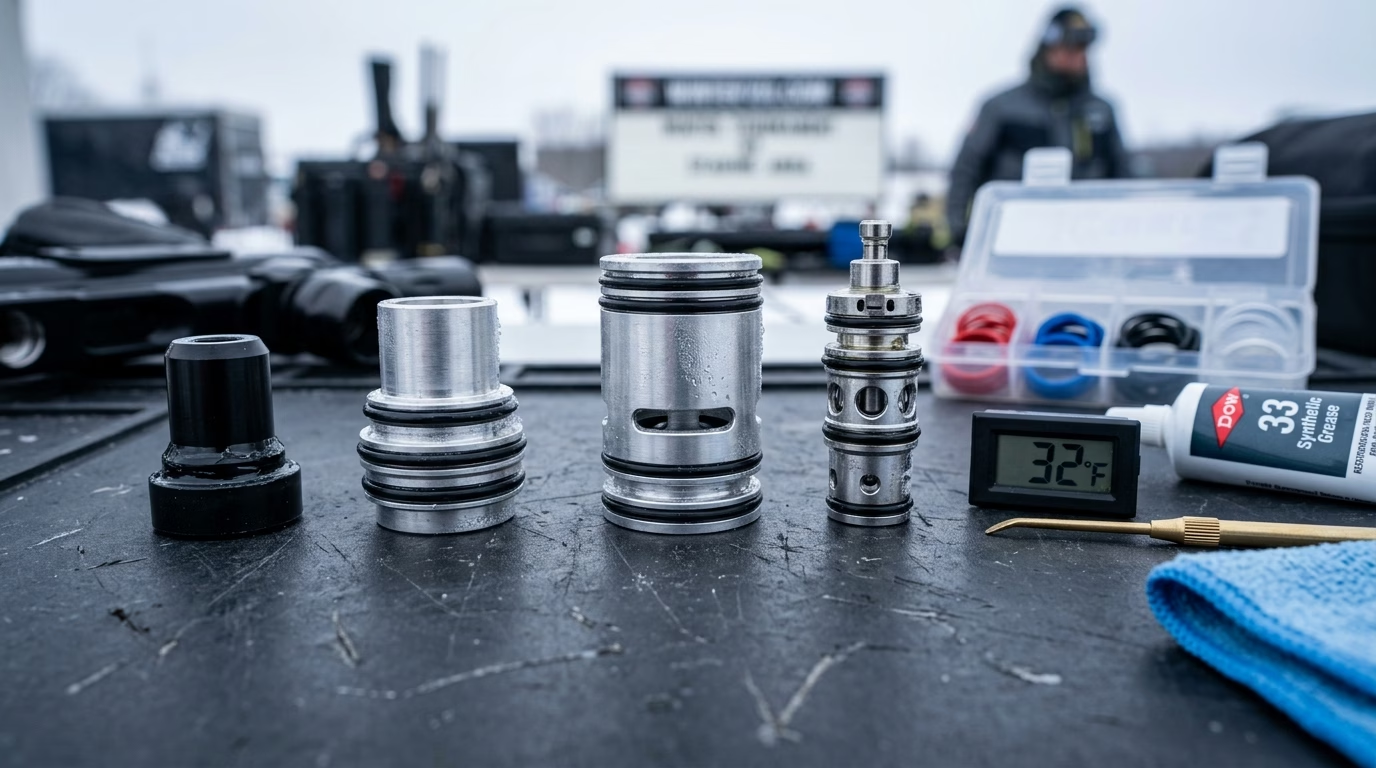
- Extract the Bolt Engine: Pull the tool-less rear back cap or loosen the body retention bolt, and slide the complete bolt core out of the marker body.
- Solvent Wipe All Components: Saturate a clean microfiber towel with 99% isopropyl alcohol (IPA). Thoroughly wipe down the bolt, bolt sleeve/can, manifold guide, and internal cylinder bore until no cloudy grease film remains.
- Degrease Internal Solenoid Manifold: If your marker has experienced persistent hissing, inspect the manifold interface (reference our armorer protocol on how to fix paintball marker leaks).
Phase 2: Cold-Weather O-Ring Selection & Sizing Inspection
O-ring fitment is the frontline defense against cold stiction:
- Inspect Dynamic Seals for Swelling: Using a non-marring brass pick, roll off dynamic bolt sail O-rings (typically #014, #015, or #016). Check our paintball O-ring sizing chart to ensure exact manufacturer dimensions.
- Swap to 70-Durometer Urethane: In sub-40°F weather, standard 70A Buna-N hardens significantly. Installing clear polyurethane (urethane) 70A dynamic seals provides superior abrasion resistance and maintains flexibility at sub-freezing temperatures without cold-brittleness.
- Conduct the “Gravity Drop” Fitment Test: Slide the stripped bolt through the cylinder can without lubricant. The bolt should glide effortlessly through the can under its own weight with zero binding. If it requires finger pressure to force through dry, the dynamic O-ring is oversized and will inevitably create severe bolt stiction in the cold.
Phase 3: The Micro-Thin Winter Lubrication Technique
In cold weather, less lubricant equals more reliability:
- Select Dow 33 (Molykote 33 Light): Only use authentic Dow 33 Light or manufacturer-approved synthetic lubricants (such as Planet Eclipse grease). Molykote 33 Light is engineered with a methyl silicone base oil and lithium soap thickener rated for continuous operation from -100°F to 400°F (-73°C to 204°C). Review our detailed comparison of Dow 33 vs Slick Lube vs marker oil.
- Apply a Glossy Sheen Only: Place a small pea-sized dot of Dow 33 on your index finger. Work the grease into your fingertips, then gently massage a microscopic film over each dynamic O-ring. The rubber should appear glossy and wet to the eye, but there should be zero visible grease ridges or clumps.
- Hybrid Winter Blend (Spool Markers): For stubborn spool markers in sub-freezing temperatures, armorers mix two drops of high-grade synthetic marker oil (such as Gold Cup) into a dab of Dow 33. This “winter blend” thins the grease base oil, drastically slashing breakaway stiction without evaporating.
Phase 4: Electronic Board Tuning (Dwell & ABS Optimization)
Electronic compensations overcome the remaining static friction gap:
- Raise Base Dwell by +1.5 to +2.5 ms: Cold air decompressing through your solenoid flows with slightly higher density and drag. Increasing base dwell gives the solenoid coil sufficient time to hold the pilot valve fully open, ensuring full forward pneumatic drive force reaches the bolt (consult our guide on how to tune dwell and debounce, plus our armorer guide to stop paintball trigger bounce).
- Enable Anti-Bolt Stick (ABS / FSDO Boost): Turn ABS ON in your board menu. Set the ABS dwell boost to +3.0 to +5.0 ms. When the marker sits idle for more than the ABS reset threshold (set to 5–10 seconds), the board delivers an extra burst of dwell energy on the first trigger pull, kicking the bolt free with zero hesitation.
- Install a Fresh 9V Name-Brand Alkaline Battery: Replace your battery with a fresh industrial Duracell Procell or Energizer. Ensure resting open-circuit voltage tests at 9.3V or higher. Cold-weakened rechargeable batteries or cheap carbon-zinc cells collapse under load and mimic severe bolt stick.
Phase 5: Staging Bench Chronograph Calibration
Final tuning must be conducted in the actual cold playing environment:
- Acclimate Marker to Ambient Temp: Let your marker sit in the cold staging area for 15 minutes before setting chronograph speed. Chronoing a warm gun straight out of a heated car will result in velocity spikes or severe velocity drops once the aluminum freezes on field.
- Dry-Fire Warmup String: Gas up your marker and fire 15 to 20 dry-fire shots into a safe barrel blocking device. This cycles the fresh grease evenly across the bolt can raceways.
- Chrono to 280–290 FPS: Shoot a 10-shot string over a certified radar chronograph. Cold brittle paintballs break easily in the breech, so setting speed 10–15 FPS below the standard 300 FPS tournament ceiling preserves paintball shell integrity. Check our step-by-step instructions on how to chronograph a paintball gun accurately.
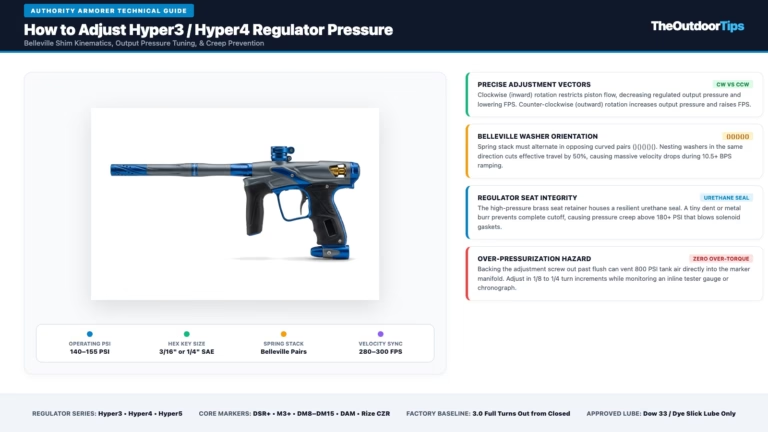
In cold weather, regulator seats stiffen. If an in-line regulator experiences dynamic creep between points, the first shot can spike dramatically over the 300 FPS ASTM safety limit, reaching 330+ FPS and endangering players on the field. Always re-chronograph your marker after sitting idle in the cold, and inspect our tutorial on paintball velocity spike troubleshooting if chrono spreads exceed ±10 FPS.
Essential Armorer Workbench Gear for Winter Maintenance
To eliminate paintball bolt stick, maintain precision regulator regulation, and protect electronic solenoids in winter weather, equip your armorer bag with these certified tools:
Dow 33 (Molykote 33 Light) Synthetic Grease
The ultimate winter marker lubricant. Rated to -100°F (-73°C), it maintains fluid boundary lubrication on dynamic spool seals without freezing or congealing.
Polyurethane (Urethane) 70A O-Ring Kit
Low-friction, wear-resistant clear urethane seals that resist sub-freezing thermal shrinkage and durometer stiffening better than standard black Buna-N rubber.
Duracell Procell Constant 9V Batteries (10-Pack)
Industrial-grade high-current 9V alkaline cells designed to maintain 9.2V+ operating output under heavy solenoid pulse draw in cold outdoor conditions.
Brass Non-Marring O-Ring Pick Set
Precision curved brass picks that extract delicate dynamic bolt seals without scratching cold, brittle anodized aluminum bolt sleeves.
Video Walkthrough: Diagnosing and Fixing Paintball Bolt Stick
Watch this practical technical demonstration showing the exact procedure for diagnosing, cleaning, and resolving bolt stick and FSDO on tournament markers:
Final Armorer Verdict: Reliable Cold-Weather Tournament Performance
Cold temperatures need not ground your tournament season. When retiring your marker for the winter, follow our complete diagnostic protocol on how to store a paintball gun during off-season to prevent static seal stiction and spring fatigue. Eliminating paintball bolt stick comes down to disciplined armorer prep: strip old congealed lubricant completely, apply an ultra-thin glossy film of Dow 33 Light (or a 50/50 winter oil blend), raise dwell by +1.5 to +2.0 ms, and program an Anti-Bolt Stick offset of +3.0 to +5.0 ms. Always pair these mechanical adjustments with fresh industrial 9V batteries and temperature-acclimated chronograph tuning. When prepared correctly, modern tournament spool engines cycle with absolute consistency down to sub-freezing temperatures.
Frequently Asked Questions
What is the difference between paintball bolt stick and First-Shot Drop-Off (FSDO)?
Bolt stick and FSDO are two degrees of the same physical problem: static friction (stiction). When a marker experiences paintball bolt stick, static friction completely prevents the bolt from cycling forward, causing a muffled puff of air or total lockup. FSDO occurs when the bolt manages to cycle, but static friction slows bolt acceleration down so much that forward gas transfer is delayed, causing the first shot to drop 30 to 80 FPS below your chronograph baseline.
Can I use marker oil instead of grease on a spool-valve bolt in cold weather?
Pure liquid marker oil has very low static friction in the cold, but in spool-valve markers, high-velocity compressed air easily blows light oil off the dynamic O-rings within 200 shots, leaving seals dry and unlubricated. The best armorer solution is a “winter blend”: apply a micro-thin sheen of Dow 33 Light grease, or blend a 50/50 mix of Dow 33 and synthetic marker oil on dynamic seals. Mechanical blowback markers (like Tippmanns) should always run 100% pure marker oil.
Why does Anti-Bolt Stick (ABS) cure cold-weather cycling issues?
Anti-Bolt Stick (ABS) is a digital circuit board feature designed specifically to overcome initial stiction. When the marker sits idle for a designated number of seconds, the board automatically increases the solenoid dwell on the first shot by +3 to +5 milliseconds. This extra pulse duration provides sufficient pneumatic pressure and time to break the cold O-ring stiction free, ensuring full velocity on the first shot.
Why does my paintball gun work inside but fail outside in the cold?
At room temperature (70°F / 21°C), grease remains fluid, O-rings are soft and pliable (70A durometer), and 9V batteries deliver full voltage under load. Once brought outside into 35°F weather, the aluminum body contracts, NBR O-rings shrink and harden to 85A durometer, grease thickens, and Joule-Thomson gas expansion drops internal temperatures an additional 15°F. These compounding factors tip the marker into immediate bolt seizure.
Should I raise my in-line regulator pressure to fix bolt stick?
No! Cranking in-line regulator pressure (HPR) to overcome cold bolt stick is dangerous and can blow out solenoid pilot gaskets or breach ASTM velocity limits once the marker warms up. The proper fix is always to clean the bolt, reduce lubricant film thickness, swap to winter-grade grease, and increase electronic dwell and ABS compensation.
Do urethane O-rings really perform better than Buna-N in cold weather?
Yes. Polyurethane (clear/amber urethane) maintains lower surface friction and higher elasticity in sub-freezing temperatures compared to standard black Buna-N (nitrile). Urethane seals resist compression set and do not harden as drastically when chilled, making them the preferred armorer choice for high-speed dynamic spool sails in winter tournament play.