You step up to the tournament chronograph table, the field referee slaps the back of your marker’s air tank with an open palm, and your marker fires two unauthorized bursts without a finger touching the shoe. Experiencing paintball trigger bounce is one of the quickest ways to receive a major penalty, a game forfeiture, or an outright match suspension under National Xball League (NXL) Rule 6.1. In our field tests and match clinics across more than a decade of competitive tournament play, an over-tuned hair trigger with zero post-travel or an improperly configured board debounce filter causes uncontrollable mechanical runaway. When a high-cadence marker cycles at 10.5 balls per second, the kinetic recoil vibrations traveling through the 6061-T6 aluminum frame trip sensitive microswitch leaves repeatedly. Below is our definitive armorer protocol to diagnose physical versus electronic bounce, calibrate mechanical travel stops, tune return tension, and dial in software debounce filters for 100% legal compliance.
Key Technical Takeaways (TL;DR)
To definitively eliminate paintball trigger bounce, distinguish between physical trigger momentum and electronic switch contact chatter. Increase your board software debounce setting from 2–3ms to 5–8ms, dial in at least 1.5mm to 2.0mm of combined trigger travel, and strengthen magnetic or spring return force so the trigger blade snaps forward with decisive mechanical authority.
1 Shot Per Pull
Zero Secondary Recoil Discharges
5 – 8 Milliseconds
Filters 99% Switch Chatter
1.5 – 2.0 mm
Prevents Kinetic Vibration Trips
0.050″ / 1/16″ Allen
Precision Ball-End Hex Key
- The Hair-Trigger Myth: Chasing a zero-travel “mouse click” trigger inevitably causes physical bounce. When the post-travel stop screw terminates the pull the exact microsecond the switch activates, marker recoil slams the trigger back over the activation threshold.
- The Palm Tap Test: Air up your marker with paint in the hopper, point downrange, and firmly strike the back of the HPA cylinder with your open palm. If the marker fires a single round without finger contact, your trigger assembly is physically illegal.
- Opto Sensor Vulnerability: If your marker utilizes an infrared optical trigger sensor (e.g. Planet Eclipse or MacDev), sunlight leaking through translucent grip covers or paint dust coating the emitter prism will trigger ghost cycles. (If your paintball gun wont turn on after servicing optical sensors, check that pinched eye wires have not shorted the 5V power rail).
Physics of Trigger Bounce: Mechanical Inertia vs. Contact Chatter
To systematically troubleshoot and eliminate paintball trigger bounce, armorers evaluate two independent physical and electrical mechanisms operating inside the grip frame:
Related Armorer Bench Guide: Upgrading to an aftermarket blade or deuce trigger on a Gtek 180R, Etha 3, or CS3? Check our How to Install Aftermarket Trigger on Planet Eclipse (2026) Step-by-Step Guide for exact 5-point SAE grub screw geometry and microswitch lever-arm calibration.
- Mechanical Inertia (F = m × a): Modern CNC-machined aluminum triggers possess physical mass (mmm). When the marker cycles, the rearward recoil impulse of the bolt and solenoid creates frame acceleration (mam). If the return magnet or spring tension is adjusted too light, the trigger blade remains stationary while the frame moves rearward around it. The microswitch collides with the trigger stop, creating an involuntary shot. As the shot discharges, the forward rebound throws the trigger forward and back again, causing full-auto runaway.
- Microswitch Contact Chatter: Subminiature snap-action switches rely on a thin beryllium-copper leaf spring. When struck by the trigger actuator screw, the metal contacts do not make clean instantaneous contact; they physically bounce against each other for 1 to 4 milliseconds before establishing steady electrical conductivity. If the electronic board processor lacks adequate filtering, each bounce pulse registers as an independent trigger pull.
- Optical Sensor Ambient Glare: In opto-electronic trigger systems, a spade blade breaks an infrared light beam. When grip panels develop hairline gaps or transparent windows, bright ambient sunlight (50,000+ lux on outdoor turf) scatters inside the frame cavity, partially illuminating the receiver phototransistor. Micro-vibrations from bolt cycling modulate this light beam, producing rapid false cycles.
Under official NXL and tournament rules (capped at 10.5 balls per second), the minimum time between consecutive legal shots is approximately 95.2 milliseconds (1000 ms / 10.5 BPS = 95.2 ms). Configuring your digital signal processor (DSP) debounce setting to 6 milliseconds filters out 100% of contact chatter without introducing perceptible trigger lag to your fingers.
Diagnostic Lookup Table: Trigger Bounce Symptoms & Armorer Remedies
Cross-reference your marker’s firing symptoms with our certified armorer lookup matrix below to apply the correct mechanical or electronic countermeasure:
Step-by-Step Diagnostic Flowchart
When you diagnose why your marker exhibits paintball trigger bounce, consult our structured armorer decision tree below to isolate mechanical recoil bounce from electrical chatter:
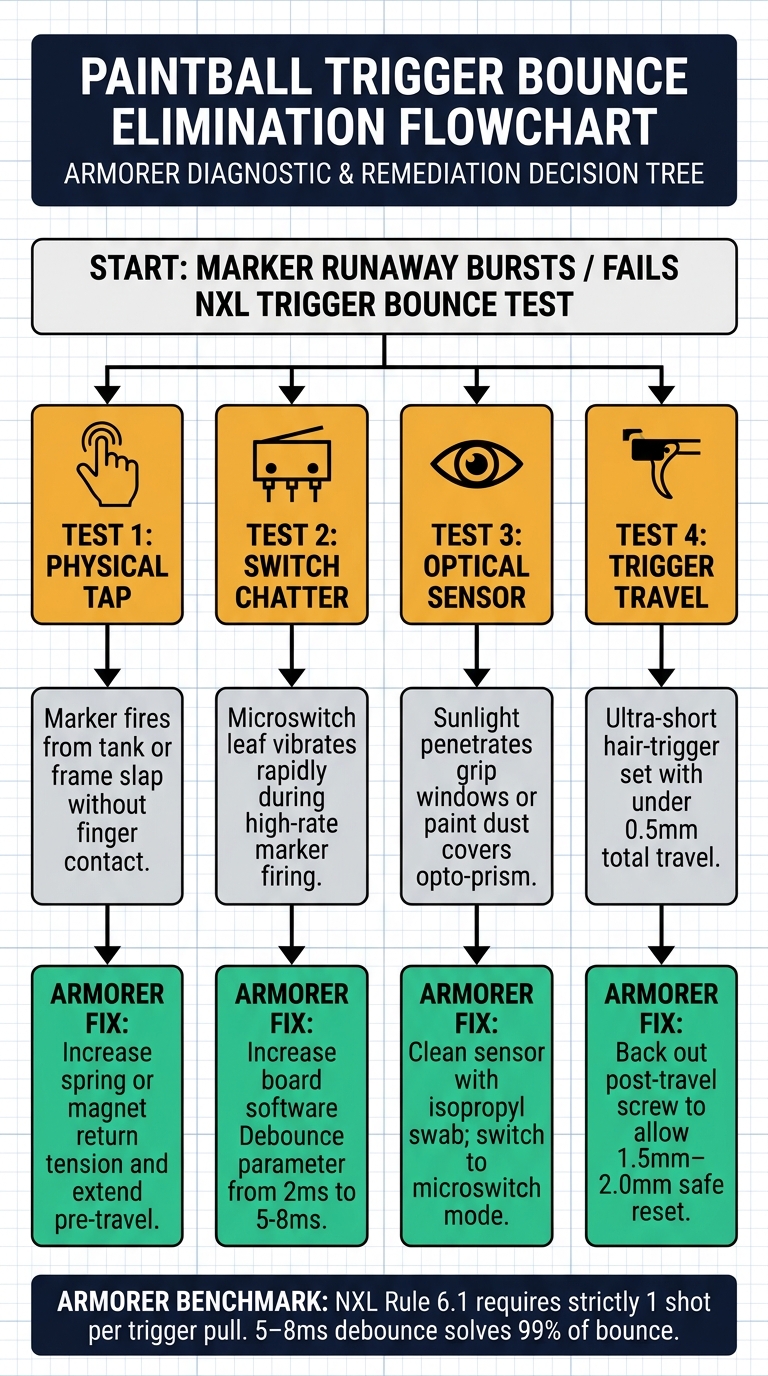
Figure 1: Certified armorer decision tree for diagnosing physical tap bounce, microswitch contact chatter, optical sensor glare, and mechanical travel stops.
5-Step Armorer Protocol: Eliminating Trigger Bounce
Follow our field-proven 5-phase protocol to eliminate paintball trigger bounce and pass referee inspection on the tournament chronograph layout:
Phase 1: The Referee Palm-Strike Tap Test
Before adjusting any screws, conduct the standard NXL referee field audit. With your marker fully aired up and eyes turned off (or hopper loaded with reballs), hold the marker in a firing stance with your finger completely outside the trigger guard. Using the heel of your non-dominant hand, strike the rear of the HPA tank firmly. Repeat with a strike to the side of the regulator and grip frame.
If the solenoid clicks or cycles a single shot, you have confirmed physical paintball trigger bounce driven by trigger inertia. Proceed immediately to Phase 2 and Phase 3.
Phase 2: Mechanical Pre-Travel & Post-Travel Calibration
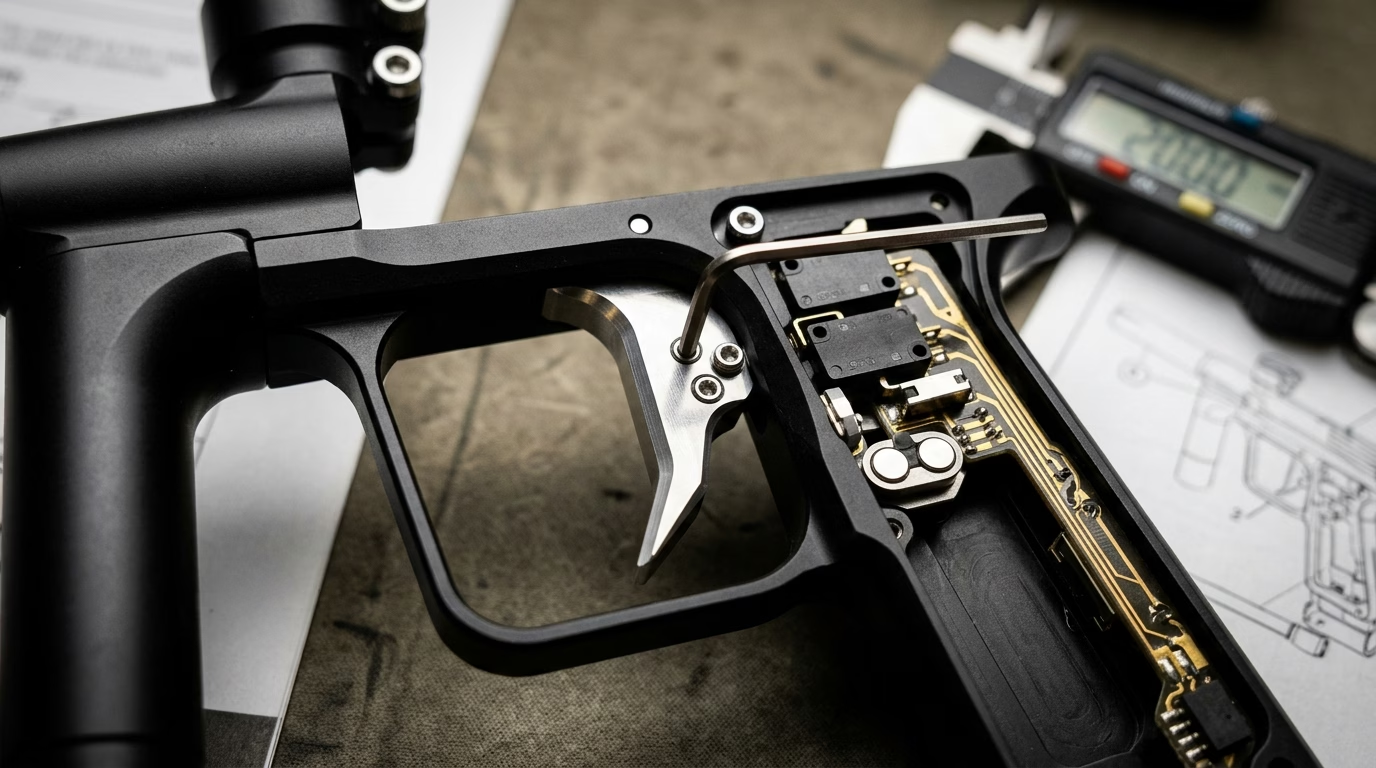
Most modern tournament triggers (Planet Eclipse CS3, Dye DSR+, Luxe TM40, Field One Force, Empire Axe) feature three distinct adjustment screws accessible via a 0.050″ or 1/16″ Allen key:
- Top Screw (Pre-Travel): Controls how far forward the trigger rests. Adjust this so the trigger does not rest on the microswitch leaf. There must be at least 0.5mm of “dead play” before the switch begins to compress.
- Middle Screw (Activation Point): Determines when the microswitch clicks. Adjust this screw so the switch trips cleanly at roughly 50% to 60% of total rearward travel.
- Bottom Screw (Post-Travel): Sets the rear stop point. Critical Rule: Never set post-travel to stop the trigger immediately upon microswitch activation. Turn this screw counter-clockwise to allow at least 0.5mm to 1.0mm of “over-travel” past the click. This cushion absorbs recoil momentum and prevents the switch from bouncing open.
Phase 3: Trigger Return Force Optimization
Light triggers feel effortless on the workbench, but without adequate return force, they flutter violently during live 280 FPS firing strings. Locate the return tension adjustment screw (which compresses a mechanical coil spring or adjusts the proximity of opposing neodymium magnets):
Rotate the tension screw clockwise until the trigger snaps forward crisply when released. A reliable tournament trigger requires approximately 40 to 60 grams of pull force. If the trigger feels mushy or takes more than 10 milliseconds to reset forward, install a stiffer spring or add an auxiliary return magnet.
Phase 4: Electronic Board Debounce Configuration
If your marker passes the physical palm-strike test but continues to double-fire during rapid semi-automatic strings, the issue is electronic switch chatter rather than mechanical movement:
Access your circuit board’s programming menu (consult your specific marker manual, such as Eclipse Gtek/CS series or Dye MOSair). Navigate to the Debounce (DB) setting. Factory default is typically 3 to 5 milliseconds. If you experience paintball trigger bounce, increase debounce by 2 increments (up to 7 or 8 milliseconds). This commands the microcontroller to ignore contact flutter pulses occurring within 8ms of the initial trigger pull, guaranteeing exactly 1 shot per physical cycle.
Phase 5: Optical Sensor Glare Mitigation
If your marker operates on optical trigger sensing (infrared transmitter and receiver LEDs) and exhibits intermittent ghost firing outdoors:
- Remove the grip panels and inspect the optical sensor tunnel. Clean any wet paint or dust off the infrared lenses using a cotton swab dipped in 99% isopropyl alcohol.
- If you use clear, translucent, or custom windowed grips, apply a strip of opaque black electrical tape inside the grip shell to completely shield the sensor cavity from direct solar UV radiation.
- Alternatively, change the board’s trigger sensor configuration from “OPTO” to “SWITCH” mode to utilize the tactile mechanical microswitch.
Essential Armorer Tools for Trigger Tuning & Debounce Setup
To eliminate paintball trigger bounce and calibrate tournament-legal trigger geometry, keep these precision tools on your workbench:
Bondhus Precision SAE Ball-End Hex Key Set
Includes 0.050″, 1/16″, and 5/64″ ball-end hex keys for adjusting tiny trigger stop screws, activation points, and magnet tension without stripping set screws.
Exalt Universal Magnetic Trigger Return Kit
High-strength neodymium repelling magnets that replace mushy coil springs, providing sharp, immediate trigger reset that completely eliminates inertia bounce.
Subminiature 25g Paintball Microswitch
Ultra-crisp 25-gram tactile leaf microswitch for replacing worn, mushy, or bouncing stock switches on electronic boards (Planet Eclipse, Dye, Empire).
Violent Series Scythe Aluminum Trigger Kit
Lightweight aircraft aluminum trigger blade featuring dual precision bearings and independent pre-travel, post-travel, and activation set screws to stop trigger bounce.
Video Walkthrough: Testing & Eliminating Trigger Bounce
Watch this practical technical demonstration showing the exact procedure for conducting a referee palm-strike bounce test and adjusting board debounce to eliminate illegal firing:
Final Armorer Verdict: Tournament Legal Trigger Compliance
A hair trigger that produces paintball trigger bounce is an amateur liability on a competitive field. True speed comes from an ergonomic blade shape and a positive, snappy reset rather than an unguided micro-pull. Dial in at least 1.5mm of total trigger travel with adequate post-travel cushion, configure your board debounce to 5–8ms, and ensure your marker withstands aggressive tank strikes without firing. You will pass referee chronographs every Sunday while maintaining maximum 10.5 BPS ramping consistency.
Frequently Asked Questions
What is paintball trigger bounce?
Trigger bounce occurs when a paintball marker discharges multiple shots from a single physical trigger pull, or fires involuntarily when the marker is tapped or shaken. It is caused by mechanical inertia vibrating the trigger blade against the switch or electrical contact chatter registering as multiple trigger activations.
Is trigger bounce illegal in NXL tournament play?
Yes. NXL Rule 6.1 strictly mandates that a marker must fire no more than one shot per distinct pull and release of the trigger. Referees perform palm-strike bounce tests on the chronograph line. If a marker discharges from a slap or double-taps on release, it is deemed illegal, resulting in point penalties or game forfeiture.
What is debounce on a paintball marker?
Debounce is a digital software filter inside the marker’s circuit board microcontroller. It defines the minimum duration (in milliseconds) a switch must remain closed or open before registering a subsequent shot, preventing electrical contact vibration from triggering false rounds.
What debounce setting should I use?
For modern electropneumatic markers, a debounce setting between 5 and 8 milliseconds provides the optimal balance of crisp response and complete bounce elimination. Settings below 3ms frequently allow contact chatter, while settings above 15ms can begin to limit human semi-automatic walk speeds.
How does post-travel affect trigger bounce?
Post-travel is the distance the trigger continues moving backward after the microswitch has clicked. If post-travel is zero, the trigger stops dead against the switch housing, causing kinetic recoil energy to bounce the trigger blade forward over the reset point. Allowing 0.5mm to 1.0mm of post-travel cushions the stop and eliminates rebound.
Why is my optical trigger bouncing in bright sunlight?
Optical trigger systems use infrared sensors. When translucent grip panels or loose grip gaps let direct sunlight flood into the grip cavity, high-lux solar rays scatter across the phototransistor. Marker cycling vibrations modulate this light, tripping false optical signals. Taping internal grip seams or switching to microswitch mode cures the issue.