NXL Regulation • Center & Back Line Protocol
Rapid Field Diagnostic: Center & Back Player Suppression Dynamics
Operating effectively as a dedicated back player paintball specialist demands supreme spatial awareness, pneumatic trigger control, and unyielding lane discipline. While front attackers capture highlight reels with explosive diving slides, the back gunner dictates game tempo by establishing 120-degree suppression cones, denying opposing wire advances, and orchestrating live field communication. Over 80% of tournament points are decided by the volume and accuracy of back-line paint that pins opposing shooters behind their bunkers.
In our tournament armorer clinics and competitive coaching sessions, the back player serves as the anchor and quarterback of the five-man squad. Rather than chasing frantic individual gunfights, a master back gunner reads the entire grid, tracking opposing body counts and feeding real-time positional calls to forward attackers while dumping relentless 10.5 BPS streams into priority choke points. To master the exact vocal terminology and G-code relays required for this role, study our coaching breakdown of paintball communication and 10 critical callouts.
To master coordinated team strategies, align your back-line suppression with our comprehensive guides on breakout lane shooting paintball drills, discover how frontline attackers advance by studying speedball snake player fundamentals, analyze sideline wire aggression in our breakdown of dorito side paintball strategy, and tune your electronic marker’s microswitch travel using our manual on how to install aftermarket trigger on Planet Eclipse.
⚡ Pro Gunfighting Progression: Once your lanes and callouts are locked in, train sub-240ms bunker exits and off-hand accuracy with our paintball snap shooting 50-ball daily drill guide.
1. The Geometry of Suppression: Zone Coverage & Fire Cones
The primary objective of a back player paintball gunner is not necessarily hunting direct eliminations, but establishing territory control through mathematical ballistics. Under NXL regulations, tournament fields span 120 by 150 feet. From the home back center bunker, a shooter commands a sweeping 120-degree visual arc encompassing both the snake wire and dorito wire.
At a velocity of 300 FPS (91.4 m/s), paintballs require roughly 400 to 450 milliseconds to traverse the 115-to-130-foot distance to opposing mid-field bunkers. By delivering sustained 10.5 BPS ramping fire—placing a paintball into the target airspace every 95.2 milliseconds—a dedicated back player paintball forms an impassable ballistic curtain. Any opposing attacker attempting to step out or advance across that lane absorbs multiple breaks within 200 milliseconds of exposure.
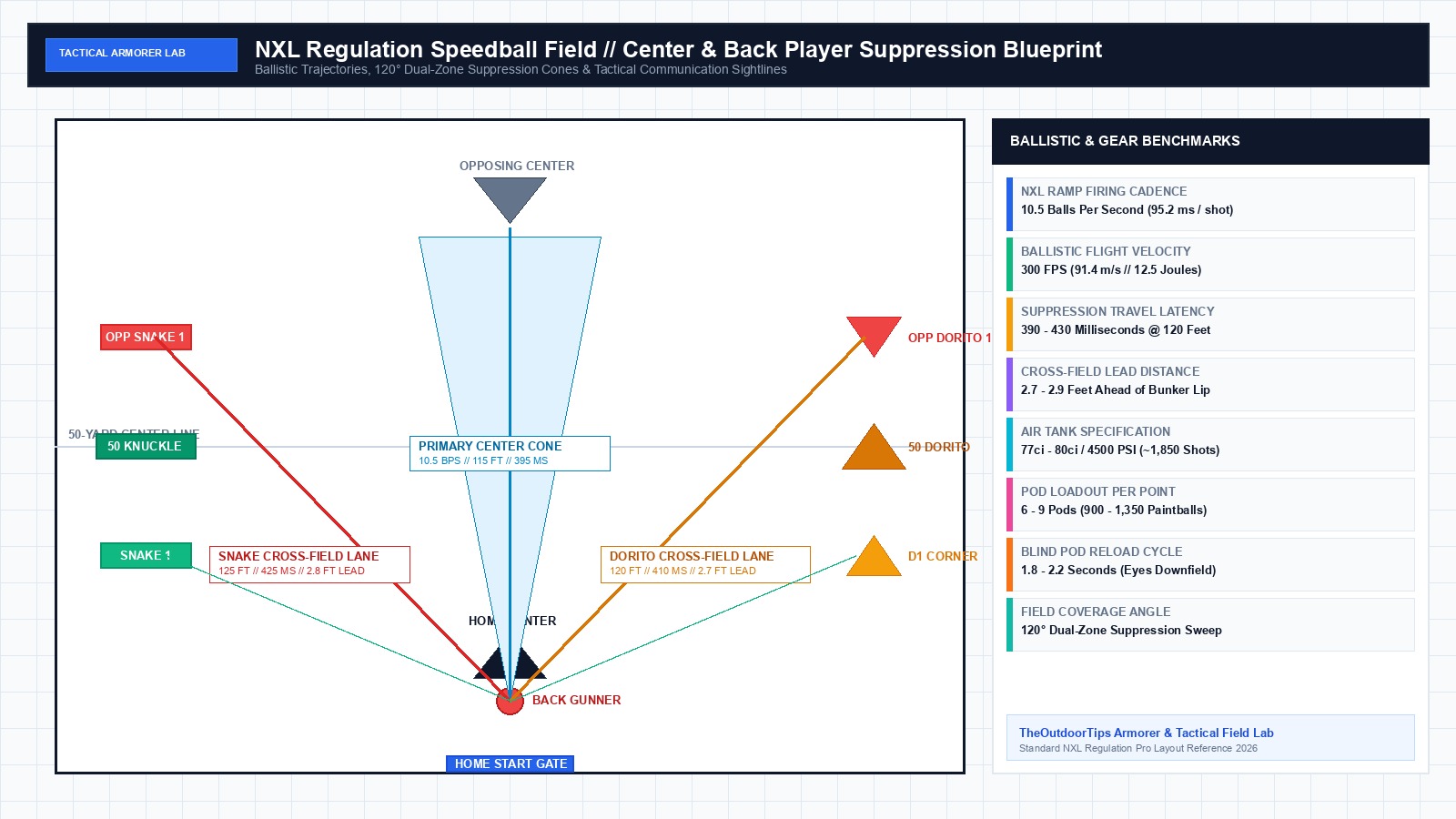
To guarantee that your marker sustains continuous high-BPS firing without air starvation or velocity fluctuations, verify your tank regulator output pressure with our guide on how to service paintball regulator and inspect your ASA bonnet using our Planet Eclipse POPS ASA service manual.
2. Master Tactical Matrix: Back Player Scenarios & Mechanical Adjustments
Operating from the back line requires instantaneous adaptation to fluid match conditions. The matrix below outlines primary in-game scenarios encountered during back player paintball execution, detailing underlying field mechanics, armorer adjustments, and tactical counter-measures.
| Field Scenario | Underlying Cause / Dynamics | Tactical Counter & Field Adjustment | Essential Gear Solution |
|---|---|---|---|
| Opposing Snake 1 Penetration | Opposing front runner successfully slides into low knuckle undetected off the break. | Shift suppression barrel from tape lane to inside knuckle seam. Lock crawl transit gaps and call ‘Snake 1’ to front line. | High-capacity 280-round loader with uninterrupted feed drive. |
| Severe Paint Starvation Mid-Point | Exhausting 6 pods within the first 60 seconds of high-BPS sustained laning. | Transition from continuous ramping streams to disciplined 5-ball burst taps. Signal back insert for reserve pod share. | 5+8 strapless tournament harness pack with 165-round pods. |
| Velocity Drop-Off Under Fire | HPA tank output pressure drops below marker operating pressure (115 PSI) due to thermal freeze. | Field-swap to warm 77ci 4500 PSI tank. Service tank regulator Belleville spring stack and clean piston seat. | Ultra-high-flow adjustable 4500 PSI carbon fiber air system. |
| Friendly Wire Player Eliminated | Front attacker shot out, leaving Dorito or Snake wire completely unmonitored. | Assume dual-role responsibility immediately. Shift body posture to anchor the abandoned wire tape before opponents wrap. | Thermal anti-fog goggle with 270-degree peripheral vision. |
| Hopper Jamming During Heavy Ramping | Swollen or misshapen paintballs binding against loader tension drive cone. | Engage manual unjam button or invert marker sharply behind bunker. Inspect ball shell brittleness at staging tent. | Anti-jam infrared electronic loader with spring ramp floor. |
3. Armorer Workbench: Essential Gear for the Back Line
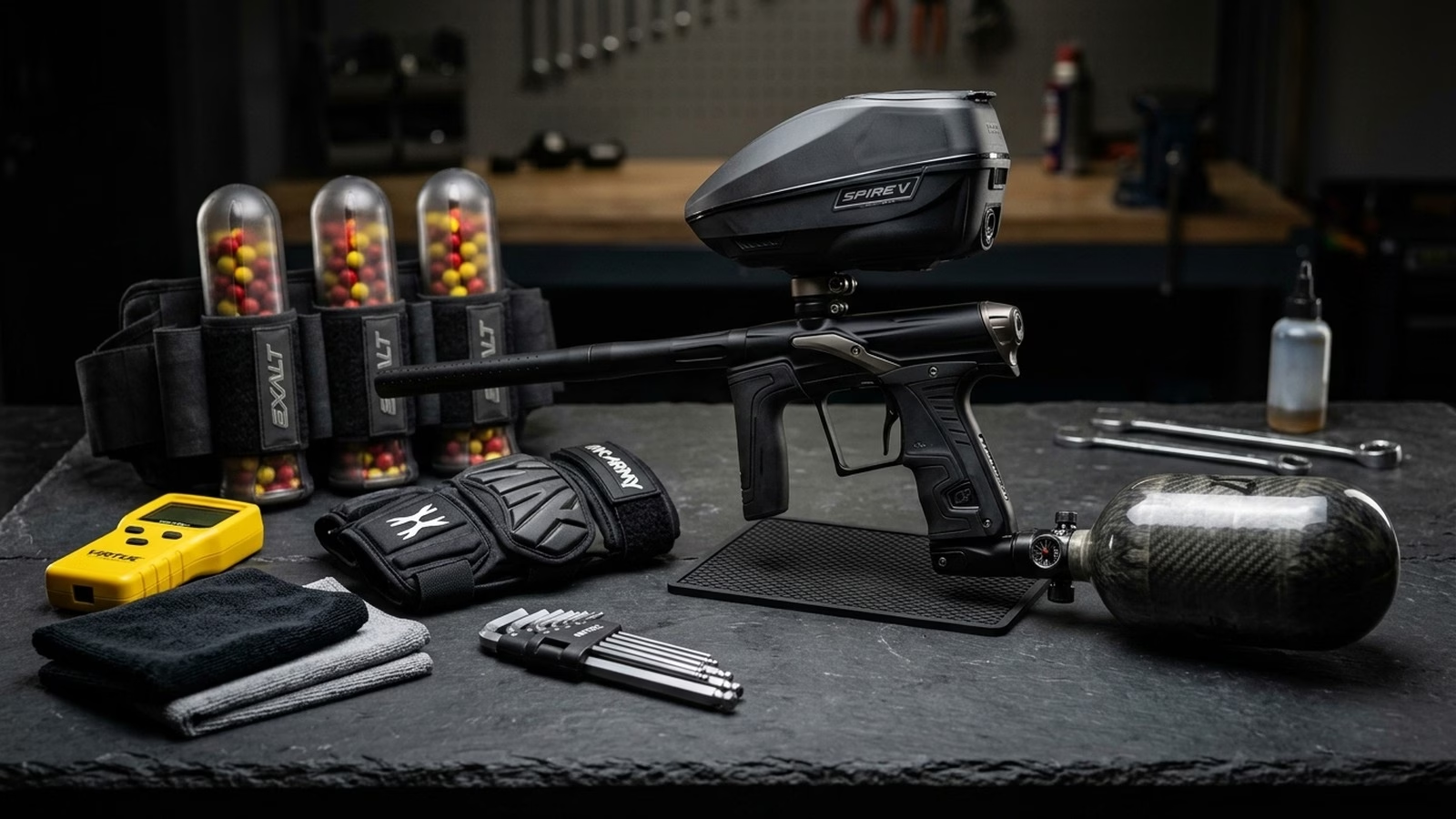
Sustaining unbroken suppression requires battle-tested gear engineered for massive paint capacities and zero pneumatic fatigue. A standard recreational setup cannot survive dumping 1,200 paintballs per point. When training as a back player paintball, your loadout must balance massive air reserves with lightning-fast pod reload accessibility.
- High-Capacity Carbon Fiber Tank (77ci to 80ci / 4500 PSI): Provides the 1,800+ shot capacity required to hold long 10.5 BPS suppression lanes without running out of air before the final point buzzer.
- Tournament 5+8 Strapless Pod Harness: Allows rapid, one-handed blind pod draws from the lower back while maintaining eyes and marker barrel locked downfield.
- High-Cap Electronic Loader (260 – 280 Capacity): Minimizes reloading frequency and ensures tension-controlled force-feeding up to 20+ BPS to eliminate dry fires during ramping.
- Anti-Fog Dual-Pane Thermal Goggle System: Essential for continuous field scanning, wide 270-degree peripheral awareness, and crystal-clear communication projection.
High-Capacity Strapless Tournament Pod Pack (5+8 Harness)
Essential for back-line gunners carrying 1,000+ rounds per point. Strapless tension sleeves ensure 1.5-second blind reloads under heavy incoming fire.
Carbon Fiber 77ci / 4500 PSI Ultralight Air Tank System
Delivers the high shot count required for prolonged suppression fire without suffering pressure drop-off during rapid 10.5 BPS ramping strings.
4. Step-by-Step Tactical Protocol: Executing Back-Line Dominance
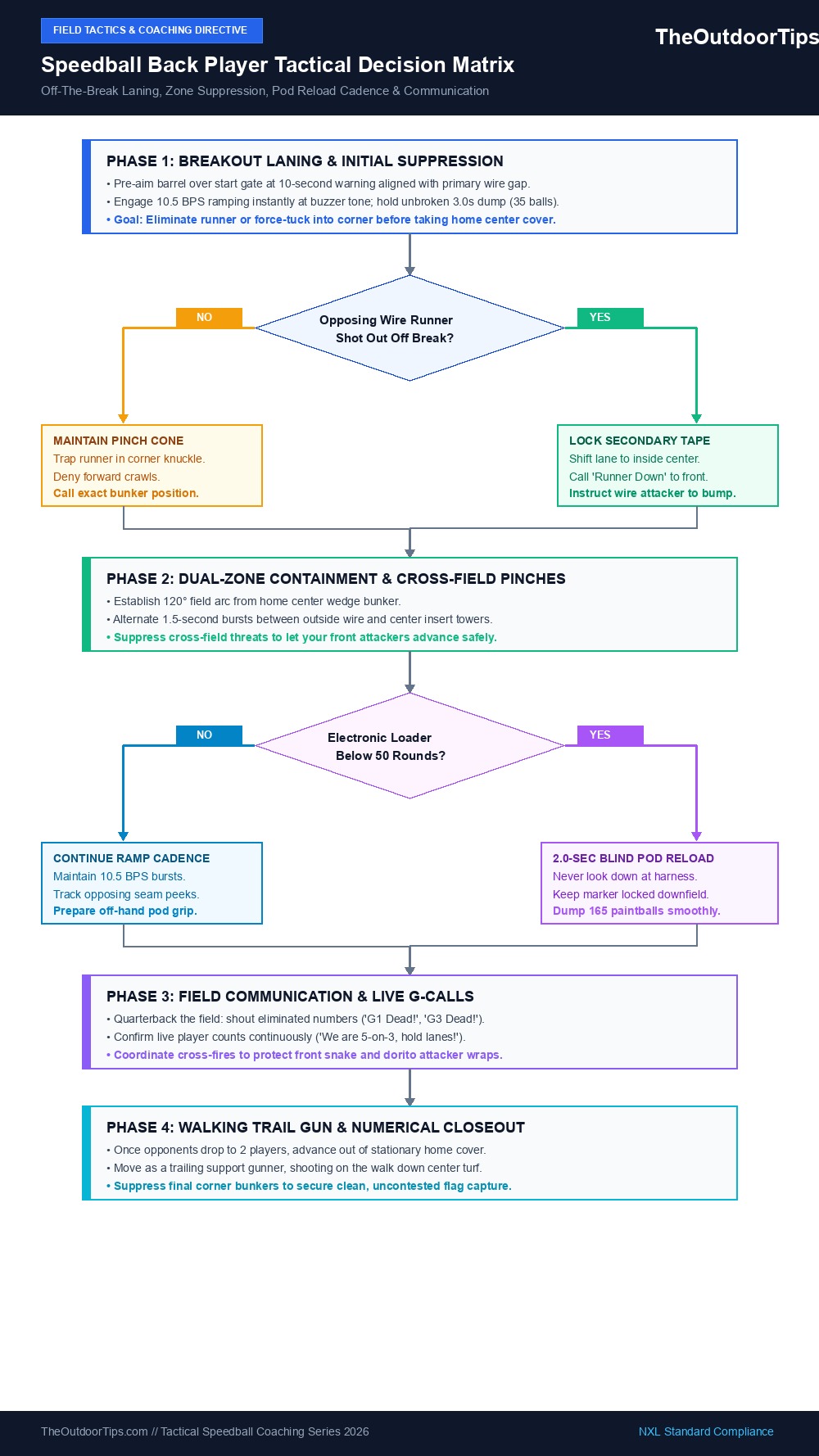
Mastering the position of a back player paintball requires rigorous athletic repetition and strict sequence adherence. Follow this five-phase armorer protocol during tournament play to control the field from the opening buzzer to the final point flag hang.
Pre-Aim Stabilization & Breakout Lane Dump
At the 10-second warning, lock your marker barrel over the start gate lip directly aligned with the opposing primary wire gap. At the buzzer tone, trigger 3 rapid semi pulls to engage 10.5 BPS ramping instantly. Deliver a continuous 3.0-second, 35-ball stream across the 2.8-foot lead window to eliminate or force-tuck the opposing front runner before taking your primary bunker position.
Establishing the 120-Degree Dual-Zone Suppression Arc
Drop into a stable low-kneel or standing tuck behind the home giant bunker. Alternate your gun barrel in rhythmic 1.5-second bursts between the opposing wire tape and the center wedge bunker. This dual-zone suppression rhythm prevents opposing front players from poking their heads out to scan while simultaneously isolating their center insert gunners.
Executing the 2.0-Second Blind Pod Reload
Never drop your eyes down to look at your harness. When your loader drops below 50 balls, tuck your elbow behind bunker cover, reach back with your off-hand, pop the pod latch, and dump 165 paintballs smoothly into the speed feed in under 2.2 seconds. Keep your marker pointed downfield and maintain visual tracking of opposing bunker seams throughout the reload cycle.
Quarterbacking Field Communication & Live G-Calls
As a back gunner, your voice is as lethal as your marker. Broadcast clear, loud vocal calls: shout opposing eliminated player numbers (‘G1 Dead!’, ‘G2 Dead!’), confirm live body counts (‘We are 5-on-3!’), and instruct your front attackers when to advance (‘Snake wrap is clear, bump to Snake 2!’). Relay calls across the entire width of the grid continuously.
The Walking Trail Gun & Closing Field Advance
When opposing numbers drop to 2 or 1, break from stationary bunker cover. Advance downfield as a trailing gunner behind your surviving front players. Keep your marker rolling on 10.5 BPS ramping, suppressing the final remaining corner bunkers from 50 yards out to ensure clean, uncontested flag possession.
5. Video Walkthrough: Back Player Field Mechanics & Laning Drills
Watch this comprehensive match clinic demonstration showcasing professional back player paintball mechanics, including smooth blind pod loading, rhythmic barrel switching, and vocal communication coordination:
6. Four Fatal Mistakes That Compromise Back Players
Even seasoned tournament competitors frequently make critical errors that cost their team matches. Avoid these four common back-line traps:
Looking down during a reload blinds you for 2 full seconds. Opposing attackers will read your lowered barrel and execute a sprint into secondary bunkers. Practice blind pod draws until your hands find harness tabs automatically.
Staring solely down the snake lane allows opposing dorito players to advance unopposed. A premier back player paintball maintains active head movement, alternating suppression streams between primary and secondary threats every few seconds.
A back player who shoots without shouting is only performing half their job. Front attackers cannot see the wider field while tucked in crawls. Constant loud voice calls prevent team blind spots and coordinate simultaneous team cross-fires.
Standing 3 feet behind the home bunker makes you vulnerable to oblique cross-field paintballs. Stay tightly tucked against the inflatable seams, using subtle body shifts to open firing angles without exposing elbows or hoppers.
7. Final Coach Verdict: The Decisive Backbone of the Speedball Grid
The Architectural Anchor of Tournament Success
Excelling as a back player paintball gunner is the ultimate expression of team leadership on a speedball field. Front players win individual gunfights, but disciplined back players win tournaments. By mastering the 120-degree suppression cone, executing sub-2-second blind pod reloads, and broadcasting continuous real-time field intelligence, you provide the structural foundation that allows your attackers to play fearlessly.
Equip your gear bag with an ultra-reliable 77ci air system, drill your off-hand pod reloads until they become second nature, and command the field like a veteran field general.
8. Frequently Asked Questions (FAQ)
What is the primary responsibility of a back player paintball specialist?
The primary responsibility is to control field geometry through high-volume zone suppression fire, protect front attackers as they bump downfield, deny opposing wire advances, and communicate live body counts and opponent bunker locations to the entire team.
How many pods of paint should a back player carry per point?
In competitive NXL tournament play, a back player typically wears a 4+7 or 5+8 harness carrying 6 to 9 pods (approximately 900 to 1,350 paintballs) in addition to a full 200-to-280-round electronic loader, ensuring adequate paint to sustain prolonged 10.5 BPS suppression lanes.
What size HPA tank is best suited for back players?
A 77ci or 80ci / 4500 PSI carbon fiber tank is strongly recommended. These larger cylinders deliver 1,700 to 2,000+ shots on efficient modern spool-valve markers, preventing tank pressure from dropping below marker operating thresholds during heavy suppression strings.
How fast should a tournament back player be able to reload a pod?
A competitive back player should execute a complete blind pod reload in under 2.2 seconds. This means drawing the pod with the non-trigger hand, dumping the paint, and discarding the empty pod while keeping the marker pointed downfield and eyes focused on opposing bunker seams.
When should a back player transition from stationary shooting to moving forward?
A back player transitions forward once the team achieves a decisive numerical advantage (such as 5-on-3 or 4-on-2) or when both opposing wire attackers have been eliminated. Moving forward as a trailing gunner closes the field and locks remaining defenders into their final bunkers.
X-Ball & M500 Breakout Rules: Review start-box barrel-touch compliance and the M500 2-pod limit in our NXL Tournament Rules Explained Guide.
Breakout Deceleration Drills: Protect your wrists and eliminate barrel core-sampling when sliding off the break with our Speedball Sliding & Diving Biomechanics Guide.
Breakout Reload Mastery: Replenish your loader without breaking full forward sprint momentum or dropping off your shooting lane in our Field Guide on How to Reload Paintball Pod on the Run.