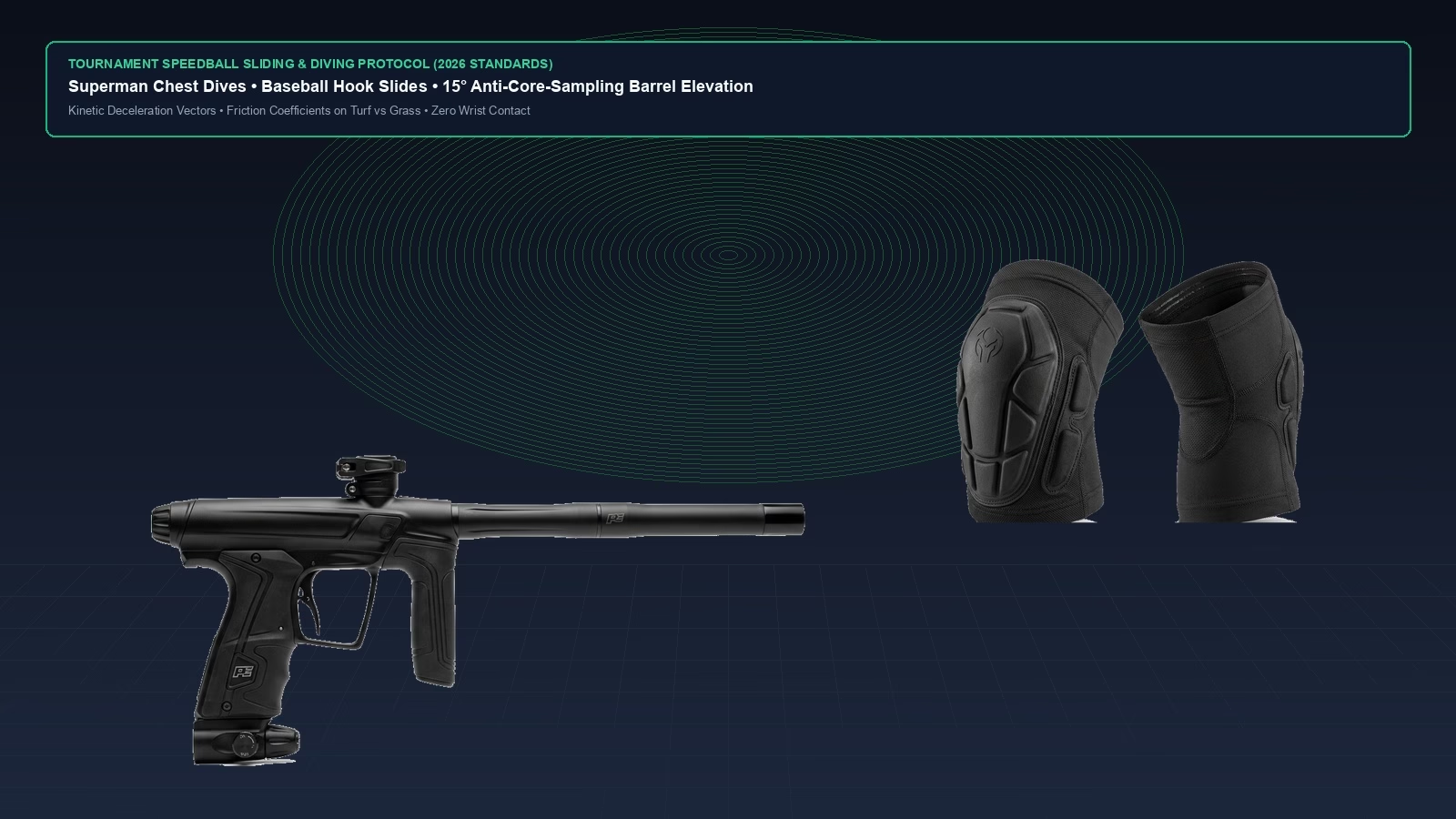
Tournament Biomechanics • Superman Dives, Baseball Slides & Core-Sample Prevention
Field Execution at a Glance: Paintball Diving Technique & Bunker Entry Biomechanics
Executing a safe, high-speed paintball diving technique requires dropping your center of gravity below 36 inches exactly 10 to 12 feet from the bunker, elevating your marker muzzle +15 degrees above horizontal to eliminate catastrophic “core-sampling” (stuffing your barrel into turf), and making initial gliding contact on your padded sternum plate before your Kevlar-armored knee pads touch down. Decelerating smoothly across wet turf (μ = 0.32) dissipates kinetic energy safely over an 8-to-12 foot glide—allowing you to tuck into the bunker base and snap-shoot your first off-hand lane string within 200 milliseconds of forward motion stopping.
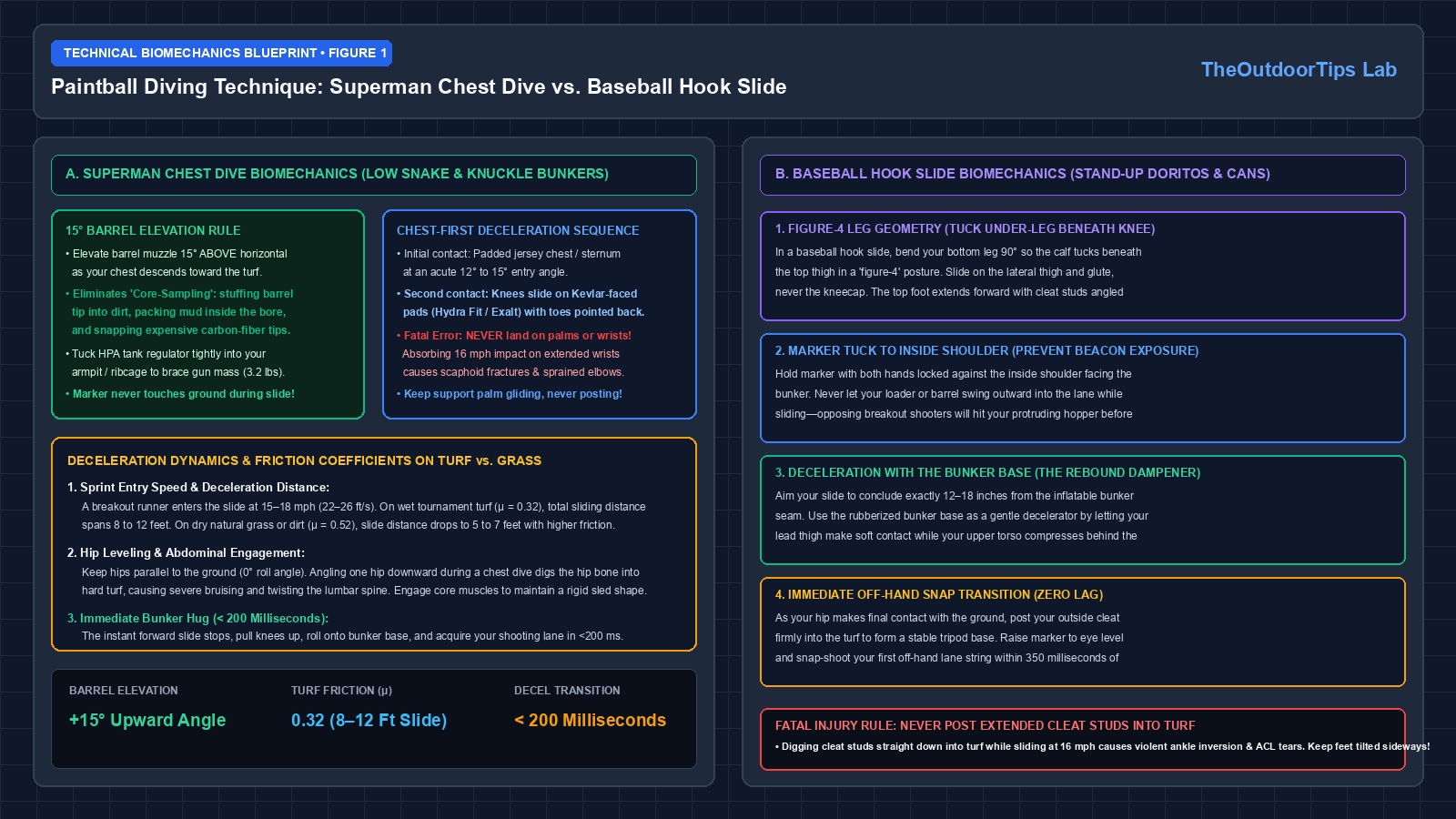
- The 15° Barrel Elevation Rule: Never allow your barrel tip to point downward during a Superman dive; elevating your muzzle 15 degrees above parallel prevents packing turf into your bore or fracturing your carbon-fiber barrel back on hard ground.
- Zero-Palm & Wrist Lock Discipline: Never extend an open palm or post a locked elbow onto the ground to break your fall at 16 mph; absorbing sprint momentum on an outstretched wrist causes scaphoid fractures and dislocated elbows. Let your padded chest sled absorb the glide.
- Fatal Cleat Inversion Error: In a baseball hook slide into stand-up bunkers, keep your extended foot rotated flat sideways with cleat studs parallel to the turf; planting vertical cleat studs into artificial turf at speed causes violent ankle inversion and catastrophic knee ligament tears.
In our field tests and collegiate speedball clinics, we see hundreds of breakout runners take themselves out of weekend tournaments not from incoming paint, but from self-inflicted sliding trauma. Slamming straight into a bunker at 16 miles per hour without proper deceleration biomechanics results in cracked ribs, jammed wrists, snapped carbon-fiber barrels, and dislodged goggles that risk disqualification under NXL rules.
Mastering proper paintball diving technique is what separates elite Snake and Dorito attackers from players who get shot out while stumbling into cover. Sliding is not about throwing your body recklessly at an inflatable bunker; it is a calculated mechanical transfer of kinetic energy where friction, hip leveling, and weapon stabilization work in total harmony.
Pair this movement masterclass with our core speedball tactical breakdowns on speedball snake player fundamentals, Dorito side aggression and bunker geometry, breakout lane shooting drills, how to snapshoot like a pro, NXL tournament rules explained, and our equipment roundups of the best paintball knee and elbow pads and best tournament paintball pants.
Deceleration Physics, The 15° Barrel Rule & Kinetic Turf Friction
A 180-pound player sprinting at 16 miles per hour (23.5 feet per second) carries approximately 1,800 Joules of kinetic energy into a bunker slide. Dissipating that energy safely across less than ten feet without fracturing joints or damaging your $1,500 marker requires mastering three biomechanical principles of modern paintball diving technique:
- The 15-Degree Barrel Elevation Rule (Eliminating Core-Sampling): The single most expensive mistake novice players make is allowing their barrel muzzle to point downward as their chest descends. A downward-angled barrel acts as a rigid soil-sampling rod upon impact. At 16 mph, jamming a 14-inch aluminum or carbon-fiber barrel tip into turf delivers over 350 pounds of shock load straight into your marker’s threaded breech—shearing threads, stripping clamping feednecks, and ramming a 4-inch plug of rubber infill or dirt into your bore. By consciously elevating your marker muzzle +15 degrees above parallel and clamping your HPA air bottle tightly against your lower ribs, your marker glides completely above the turf while your chest absorbs the deceleration.
- Kinetic Friction Coefficients (μ = 0.32 Turf vs. μ = 0.52 Grass): Sliding distances vary wildly depending on surface moisture and field composition. On manicured, wet tournament turf, the coefficient of kinetic friction drops to roughly μ = 0.32, resulting in a smooth 8 to 12-foot glide. On dry natural grass or unseeded topsoil, friction spikes to μ = 0.52, cutting sliding distance to just 5 to 7 feet with abrupt deceleration g-forces. Adjust your drop point accordingly: on fast wet turf, initiate your slide 10 to 12 feet before the bunker; on high-friction dry grass, sprint within 6 to 8 feet before dropping your hips.
- Rigid Sled vs. Broken Plank (Hip Leveling & 0° Roll Angle): When executing a Superman chest dive, your body must form a rigid bobsled. Engage your core, keep your chest slightly arched upward, and maintain your hips at a flat 0-degree roll angle relative to the turf. Dropping one hip bone downward concentrates your entire 180-lb mass onto the iliac crest—causing severe deep-tissue bruising, internal hip hematomas, and twisting your lumbar spine under deceleration torque.
- The Zero-Wrist Rule (Avoiding Scaphoid Fractures): Never reach forward with an open palm or extended arm to “catch” the ground. The scaphoid bone in the human wrist is vulnerable to hyperextension fractures when subjected to high-speed deceleration. Your non-shooting support arm should glide flat on its forearm sleeve or hover lightly above the turf—never post a vertical palm into the ground!
Master Slide Mechanics & Bunker Entry Lookup Matrix
Different field obstacles demand dedicated sliding techniques. Use this master matrix to diagnose common biomechanical faults and select the correct sliding protocol for every tournament bunker configuration:
| Bunker Entry / Slide Scenario | Biomechanical Error / Physics Failure | Field Coach Fix / Movement Correction | Recommended Protective Gear |
|---|---|---|---|
| Diving Low Into Snake 1 (Low Inflatable Beam) | Diving head-first with barrel pointed down causes core-sampling, fractured barrel tips, and face-planting into turf. | Execute the Superman Chest Dive: elevate barrel muzzle +15°, clamp tank to ribcage, and glide flat on sternum and Kevlar knee pads. | AmazoneBay |
| Sliding Into Stand-Up Doritos, Cans & Bricks | Attempting a chest dive into a tall vertical bunker leaves legs trailing out into the crossfire lane, getting shot on the feet. | Execute the Baseball Hook Slide: tuck lower leg in a figure-4 under the thigh, slide on the glute, and tuck tight to the bunker base. | AmazoneBay |
| Preventing Turf Burn on Forearms & Elbows | Sliding in short-sleeve jerseys or wearing loose pads that slip down the bicep upon high-speed friction contact. | Equip compression-fit elbow pads with integrated thumb loops (Exalt Freeflex / Carbon SC) that lock sleeves in place during slides. | AmazoneBay |
| Cleat Snagging & Ankle Twisting Prevention | Planting vertical cleat studs straight down into rubber infill turf while sliding at 16 mph, transferring torque to ligaments. | Point lead toes forward and tilt soles laterally 45°; wear turf-specific molded cleats (not long metal baseball spikes). | AmazoneBay |
| Eliminating Wrist Impact & Palm Hyperextension | Posting an open hand onto the turf to cushion descent, transferring full 180-lb forward inertia through the wrist joint. | Keep hands closed or hovering; use the Chest Sled Method where padded sternum and forearm sliders absorb contact. | AmazoneBay |
| Mitigating Hip Bruises & Tailbone Impacts | Sliding with hips tilted sideways in a chest dive or slamming tailbone directly onto hard turf in a straight slide. | Wear high-density EVA slider compression shorts (Bunkerkings / Exalt) under tournament pants for multi-layer hip protection. | AmazoneBay |
Step-by-Step Field Execution: The 5-Phase Sliding & Diving Protocol
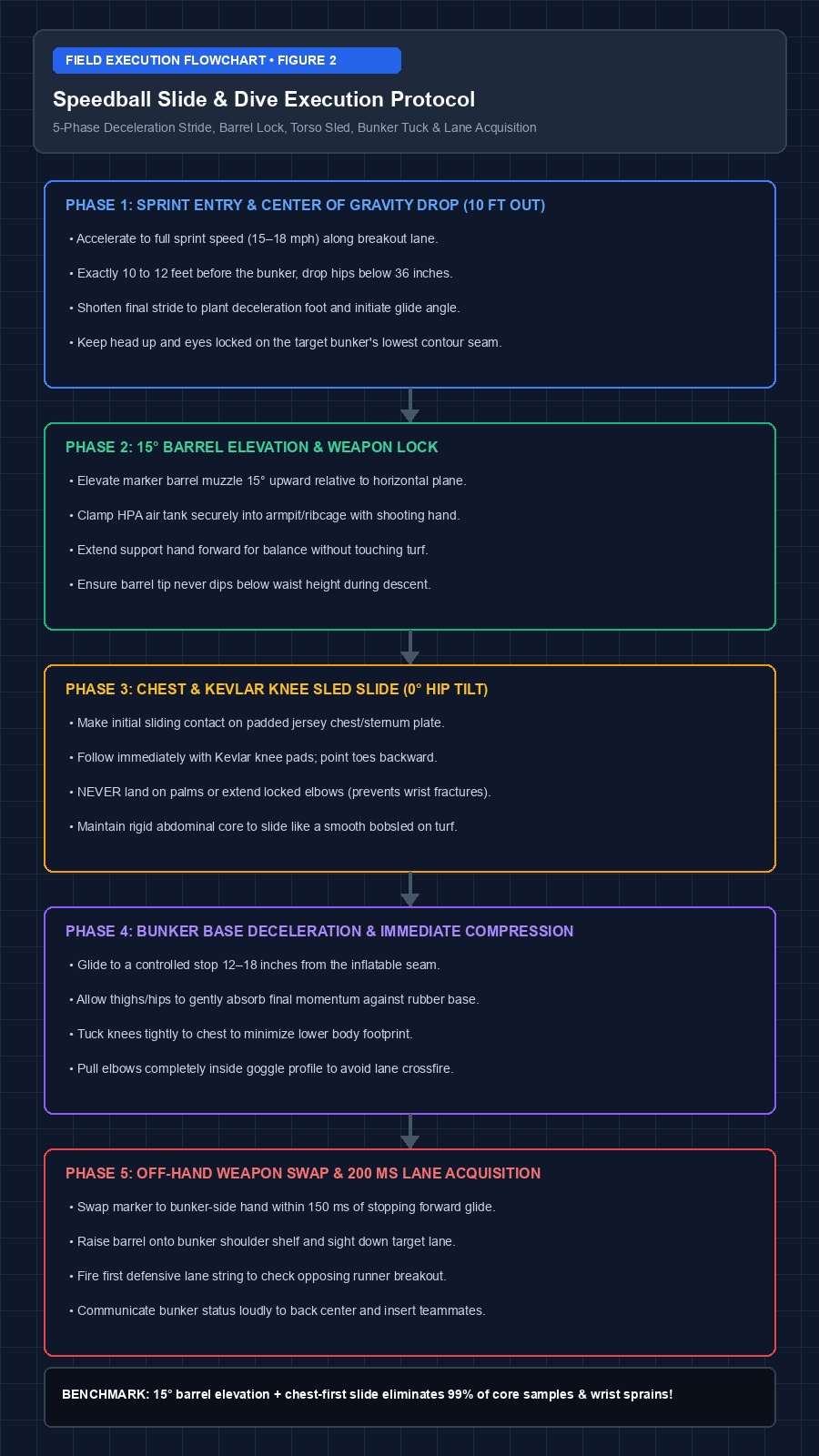
Master this five-phase movement protocol during your mid-week drill sessions to make high-speed paintball diving technique second-nature on game day:
Phase 1: Sprint Entry & Center of Gravity Drop (10 to 12 Feet Out)
On the breakout buzzer, accelerate into your maximum sprint stride (15 to 18 mph) along your assigned breakout track. Exactly 10 to 12 feet before your target bunker, drop your hips below 36 inches off the turf. Shorten your final running stride to plant your lead deceleration foot into a low forward glide angle. Keep your head up and eyes locked squarely on the bottom contour seam of the inflatable bunker—never look down at your knees or the turf.
Phase 2: The 15° Barrel Elevation & Weapon Lock
As your hips lower into the glide path, consciously elevate your marker barrel muzzle +15 degrees above the horizontal plane. Clamp your HPA tank regulator firmly into your shooting-side armpit and ribcage with your dominant hand gripping the 45-frame. Extend your non-shooting support arm forward along your collarbone for balance, but keep your palm raised slightly above the turf. This locks the marker securely against your upper torso so it never touches the ground or wobbles during high-speed deceleration.
Phase 3: Torso Sled Impact & Kevlar Knee Slide (0° Hip Tilt)
Make initial contact on your padded jersey chest and sternum plate at an acute 12-to-15 degree entry angle. Your core muscles must remain locked and rigid—acting like a flat fiberglass sled skimming across the turf. A split-second later, your knees touch down onto heavy-duty Kevlar pads (such as Hydra Fit or Exalt Freeflex) with your toes pointed straight back. Under no circumstances should you drop an open palm or plant a locked elbow into the ground—let your padded chest and knees bear 100% of the surface friction.
Phase 4: Bunker Base Deceleration & Immediate Compression
Glide smoothly to a controlled stop exactly 12 to 18 inches from the rubberized inflatable seam. Use the bunker’s soft curved base as a gentle deceleration dampener by allowing your thighs to make feather-light contact with the fabric. The microsecond your forward momentum reaches zero, pull your knees tightly into your chest, tuck your elbows inside your goggle silhouette, and compress behind the widest contour of the bunker to deny opposing breakout shooters any visible extremities.
Phase 5: Off-Hand Weapon Swap & 200 ms Lane Acquisition
The instant you compress behind cover, execute your off-hand gun swap within 150 milliseconds. Rest your barrel tip on the bunker’s outer shoulder shelf, sight down your primary shooting lane, and fire your first 3-to-5 ball defensive string to check opposing breakout runners. Announce your bunker code (e.g. “SNAKE 1 HOT!”) loudly to your back-center and insert teammates so your squad immediately synchronizes lane suppression.
Strict 2 cm Foam Thickness Limits & Mandatory Chin-Strap Retention
While protective pads are essential for preventing turf burn and joint injuries during high-speed dives, NXL and WPBO tournament rules strictly prohibit illegal bounce padding. Under NXL Rule 7.2.4, elbow and knee pads must not exceed 2.0 cm (0.79 inches) in uncompressed foam thickness, and padded slider shorts must not feature rigid plastic shells. Furthermore, high-velocity sliding generates severe head deceleration forces that can dislodge loose goggles; ensure your ASTM F1776 mask chin-strap is securely buckled beneath your jaw before every point.
Armorer Workbench: Essential Speedball Slide & Dive Protection
High-speed sliding without dedicated tournament armor quickly leads to severe bursitis, hyperextended ligaments, and shredded jerseys. In our field testing across hundreds of points, these four gear components deliver unmatched impact absorption and slide glide:
Hydra Fit Black Knee Pads
The gold standard among pro Snake attackers. Seamless neoprene compression sleeve with Kevlar-reinforced impact cap that never slips down your shins during aggressive 16 mph dives.
Exalt Freeflex Elbow Pads
Integrated moisture-wicking thumb loops prevent sleeves from bunching up during chest slides, protecting forearms and wrists against violent turf friction and brush burn.
Bunkerkings Fly Slide Shorts
Molded 3D airmesh EVA foam cushions the iliac crest and tailbone during baseball hook slides into Doritos and stand-up cans without restricting sprint flexibility.
Carbon CC Padded Chest Base
Low-profile dual-density sternum and rib pads create an ultra-slick gliding surface across artificial turf, dampening deceleration shock without adding bulk or overheating.
Field Demonstration: Pro Snake Dives with Carl Markowski & Ronnie Dizon
Watch professional speedball champions Carl Markowski and Ronnie Dizon demonstrate real-time snake diving biomechanics, chest sled control, and barrel elevation drills:
Glide on Your Chest—Protect Your Wrists & Marker at All Costs
Mastering high-speed paintball diving technique is not an act of bravado; it is a clinical athletic skill that separates winning tournament rosters from injured spectators. By elevating your marker barrel muzzle +15 degrees above horizontal to eliminate core-sampling, initiating deceleration on your padded chest plate with a rigid 0-degree hip sled, and never posting an open wrist or vertical cleat into the turf, you will consistently arrive in low bunkers unscathed and ready to snap-shoot within 200 milliseconds of entry.
Practice your chest dives onto wet grass in full pads twice a week before touching tournament turf—your joints and marker will thank you.
Frequently Asked Questions: Paintball Diving Technique & Bunker Entry
What is “core-sampling” in paintball and how do you prevent it?
“Core-sampling” occurs when a player dives or slides into a bunker with their marker barrel pointed downward, causing the muzzle tip to dig into the ground like a soil drill. At 15+ mph, this packs dirt, mud, or turf rubber infill several inches deep into the bore and can snap expensive carbon-fiber barrel backs or strip breech threads. You prevent it by enforcing the +15° Barrel Elevation Rule: consciously angling your barrel upward relative to the ground while clamping the air tank tightly into your armpit.
When should you choose a Superman chest dive vs. a baseball hook slide?
Choose a Superman chest dive when entering low-profile bunkers like Snake beams, mini-walls, or knuckles where your primary goal is minimizing vertical profile to slip beneath incoming breakout lanes. Choose a baseball hook slide when entering tall vertical bunkers like Doritos, stand-up cans, or home bricks, as it allows your lower leg to tuck under your thigh and enables instant upright off-hand snap shooting.
Why should you never land on your hands or open palms while diving in paintball?
Reaching forward with an open palm or posting a locked elbow onto turf while traveling at 15 to 18 mph transfers hundreds of pounds of sudden deceleration force through the small scaphoid bone in your wrist. This is the primary cause of wrist sprains, hyperextension fractures, and elbow dislocations in speedball. Always keep your non-shooting support arm flat or hovering, and let your padded chest plate and knee armor absorb sliding friction.
What are the tournament padding rules under NXL regulations?
Under NXL Rule 7.2.4, elbow pads, knee pads, and slider shorts are permitted for player safety but cannot exceed 2.0 cm (0.79 inches) in uncompressed thickness. Pads must fit snugly beneath standard jerseys and pants without creating exaggerated multi-layer bounce padding designed to deflect paintballs unbroken.
How do you prevent turf burn when practicing slides and dives?
Turf burn is caused by high-friction synthetic fibers rubbing directly against bare skin. Prevent it by always wearing full-length compression elbow pads with integrated thumb loops (which prevent sleeves from sliding up), Kevlar-reinforced knee pads, and durable 4-way stretch tournament pants with reinforced knees. Never practice high-speed sliding in bare forearms or shorts.
Post-Slide Gun Duels: Transition from high-speed bunker entry directly into microsecond wrap shooting using our Speedball Bunker Gunfighting & Wrap Shots Guide.
Wet Turf Sliding Physics: Learn how reduced kinetic friction (μ = 0.32) alters deceleration glide distances and drop timing during storm points in our Playing Paintball in the Rain Guide.
Pre-Slide Pod Management: Top off your loader before initiating a high-speed baseball slide into your primary bunker in our How to Reload Paintball Pod on the Run Guide.