Sprint Biomechanics • Sub-Second Pod Draw, Speed-Feed Funnel & Muzzle Control
Field Execution at a Glance: Rapid Pod Reload & Sprint Draw Protocol
Dominating high-tempo breakout lanes and wire transitions requires mastering how to reload paintball pod gear at a full dead sprint without breaking running stride, spilling paintballs, or losing field vision. In tournament X-Ball competition, an unrefined reload costs 2.2 to 2.8 seconds and drops your gun off the lane; by contrast, our synchronized 4-phase draw protocol cuts total reload latency to 1.15 to 1.35 seconds. By locking the marker frame against your pectoral pocket, driving the off-hand along the lumbar crease, pre-popping the spring lid inside the harness tunnel, and executing a flush downward speed-feed funnel mate, you transfer 140 to 165 paintballs cleanly into the loader while keeping eyes 100% fixed on downfield opponent bunkers.
- Tuck Before Reach Rule: Never reach back for a pod while holding your marker extended out at arm’s length; barrel swing generates extreme pendulum torque that knocks the hopper away from the incoming pod and causes instant yard sales.
- Pre-Pop Latch Kinematics: Depress the spring-lid thumb tab while the pod is still exiting the harness sleeve; allowing the lid to pop open inside the final 2 inches of the pod sleeve prevents finger fumbling when lifting the pod to hopper level.
- Vertical Funnel Insertion: Mate the open pod mouth at a steep 75° to 85° downward angle directly over the crown speed feed; shallow horizontal angles spill 20 to 40 balls over the bunker floor and starve your marker during lane suppression.
- Outward Lateral Pod Ejection: Flick empty pods diagonally away from your running line of travel; dropping empty pods straight down directly under your cleats creates severe ankle rollover risks when making aggressive slide entries into bunkers.
Biomechanics of the 1.2-Second Draw: Kinetic Vectors & Marker Stability
In high-pressure tournament play, reloading is not an isolated hand movement—it is a full-body kinetic system. When transitioning between bunkers or gunfighting along the tape, breaking your running stride to fumble with a harness strap instantly makes you an easy target for opposing lane shooters. Elite front players in the snake wire and dorito side maintain complete marker control and field vision while executing sub-second reloads.
The biomechanical foundation of an elite sprint reload rests on four distinct physical vectors:
- Dominant Arm Pectoral Anchor: The primary error amateur players make is holding the marker with an outstretched arm while reaching behind with their off-hand. An outstretched 3.5 lb marker and 4500 PSI carbon tank create a long lever arm that destabilizes during sprinting. By pulling the tank buttpad firmly into your chest/armpit pocket and canting the barrel 10° to 15° downward, your torso absorbs marker inertia, freeing your support hand for an unimpeded draw.
- Lumbar Vector Tracking: Blindly searching for a pod tab with flailing fingers wastes 0.5 to 0.8 seconds. Instead, train tactile muscle memory: the heel of your support hand strikes your hip crest and glides directly along the lumbar line straight into the center pod sleeve. When wearing a properly tuned paintball pod pack, your thumb naturally indexes directly against the spring lid latch.
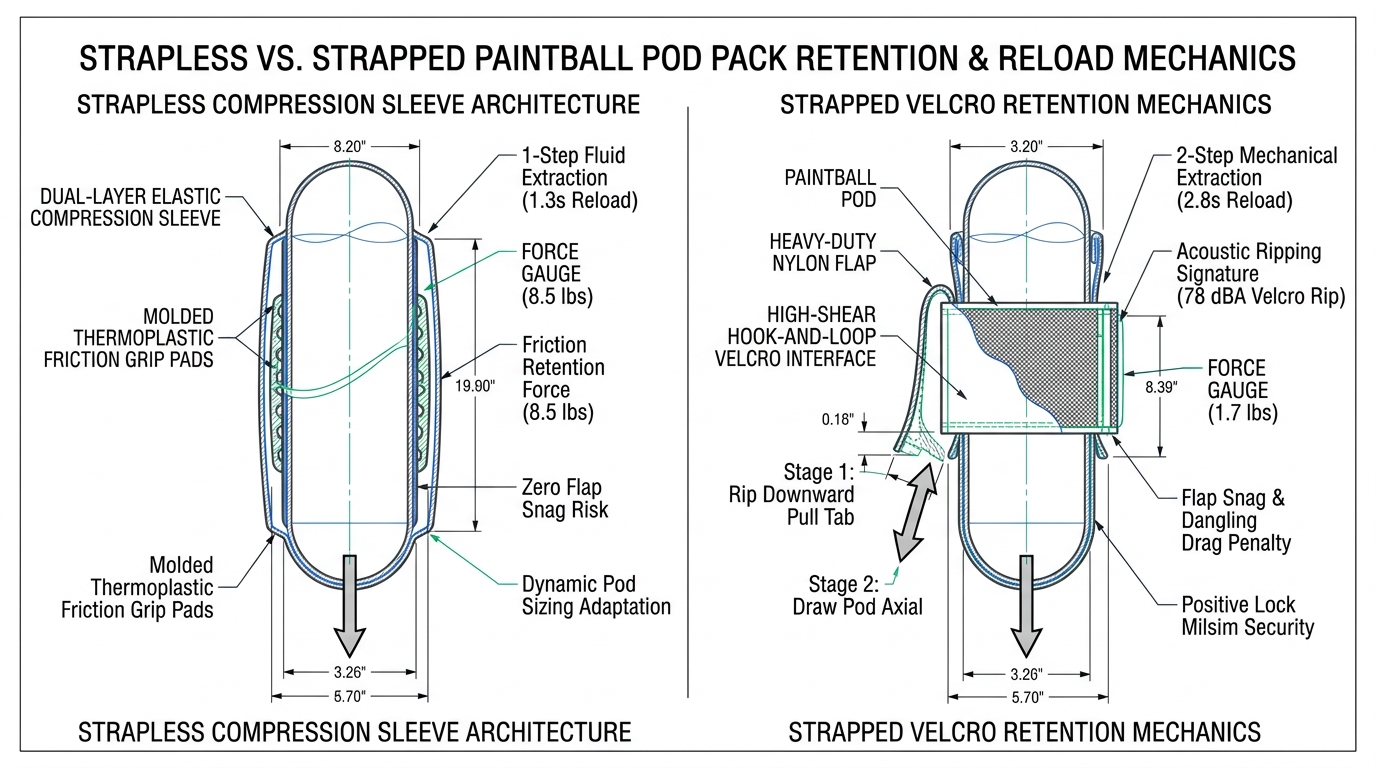
- Pre-Pop Thumb Kinematics: In older strapped harnesses, players were forced to rip Velcro down and pull the pod out before flicking the lid. With modern strapless tension packs (Bunkerkings Fly2, HK Army Zero-GX), you flick the thumb latch while the pod is transitioning out of the elastic sleeve. The tension sleeve acts as a guide wall, holding the lid partially closed until the mouth fully clears the harness, eliminating accidental pod explosions behind your back.
- Gravity Mating & Fluid Inversion: Once cleared, the pod travels in a continuous upward and inward arc. The pod mouth enters the speed-feed crown at an 85° vertical angle. Because 140 paintballs have mass, gravity and kinetic downward momentum empty the entire pod chamber in less than 350 milliseconds (0.35s). A sharp vertical tap against the feed collar ensures zero paintballs stick in the pod neck.
Master Pod Reload Diagnostics & Run Lookup Matrix
When executing running reloads under tournament fire, subtle mechanical mistakes lead to catastrophic ball spills, dropped pods, or blown bunker entries. Use this lookup matrix to diagnose reload failures and implement instant field fixes:
| Field Failure / Reload Symptom | Biomechanical / Mechanical Cause | Armorer & Field Drill Remedy | Recommended Tactical Gear |
|---|---|---|---|
| Paintball Spillage During Draw Movement | Thumb tab flicked prematurely before pod sleeve clearance, allowing balls to erupt over back. | Practice wall-press draw drill; maintain thumb pressure against collar until pod reaches 45° vertical plane. | DYE Alpha Pods / Virtue PF |
| Harness Slippage Down Lower Back During Sprint | Secondary elastic belt tension too loose or positioned over slippery jersey fabric rather than lumbar spine. | Anchor primary belt directly over iliac crest; cinch secondary 4-way elastic wings while exhaling fully. | Bunkerkings Fly2 Strapless Pack |
| Pod Lid Fails to Pop on Initial Thumb Strike | Worn hinge spring or paint residue gumming up latch locking indentations. | Disassemble pod hinges, clean with warm water and micro-brush; test spring rebound tension before match play. | GXG 140-Round Lock-Lid Pods |
| Speed-Feed Crown Teeth Jamming & Restricting Pour | Speed-feed fingers too stiff or pod held at shallow 45° horizontal angle causing bridging. | Drive pod down vertically at 85° angle; upgrade to dual-material spring-loaded crown fingers (Crown SF II). | Virtue Crown SF II / Spire V |
| Empty Pod Drops Under Cleats Causing Trip Hazard | Releasing pod straight down along centerline of running stride while sprinting forward. | Incorporate lateral wrist flick into pod discard; cast empty pod 3 feet outward into dead grass lane. | HK Army Bones High-Traction Cleats |
Core Field Protocols to Efficiently Reload Paintball Pod at Full Stride
Executing a clean reload while maintaining top sprint speed requires compartmentalizing the movement into sequential phases. In tournament clinics, we train players to drill these phases until muscle memory overrides panic. You must be able to perform this complete sequence in under 1.3 seconds without taking your eyes off your shooting lane.
When sprinting during an opening breakout drill or preparing to execute a slide entry as detailed in our guide on how to slide and dive into bunkers, follow these rigorous movement protocols:
- Phase 1: Marker Stabilization & Torso Tuck (T + 0.00s – 0.25s): The moment your loader’s low-capacity indicator flashes (or you sense the hopper lightened by ~100 rounds), tuck the tank into your strong-side pectoral pocket. Keep your firing hand wrapped securely around the marker grip frame with your trigger finger outside the guard. Maintain the barrel pointed forward along your running lane, tilted downward no more than 15°. Your eyes remain locked downfield on opponent bunker positions.
- Phase 2: Lumbar Sweep & Pod Extraction (T + 0.25s – 0.55s): Drive your support hand directly backward along your hip bone to your lumbar spine. In a 4+5 harness, start drawing from your outside lateral pods first (or your designated primary pod based on hand dominance). Grip the pod collar firmly between your four fingers, with your thumb planted squarely across the spring-release latch. Pull downward firmly. As the pod neck clears the bottom edge of the retention elastic, press your thumb downward to release the spring lid. The lid snaps open with zero hesitation.
- Phase 3: Vertical Funnel Mating & Rapid Dump (T + 0.55s – 0.90s): Bring the pod up in a smooth rotational motion. Do not attempt to pour balls from 4 inches above the hopper. Instead, thrust the open pod mouth directly against the speed-feed crown, mating the pod lip inside the rubber fingers at an 80° to 85° vertical angle. The kinetic energy of the paintballs rushing downward empties the pod in a rapid burst. If needed, give one sharp downward pump of your wrist to dislodge any bridging paintballs.
- Phase 4: Lateral Discard & Two-Hand Grip Recovery (T + 0.90s – 1.20s): Never drop the empty pod straight down between your legs. With a swift flick of your wrist, cast the empty pod 2 to 3 feet outward into the clear turf. Immediately bring your support hand forward and lock it onto the marker’s foregrip or regulator sleeve. You are now back in a balanced, two-handed firing stance, ready to wrap your bunker or engage targets at full lane suppression.
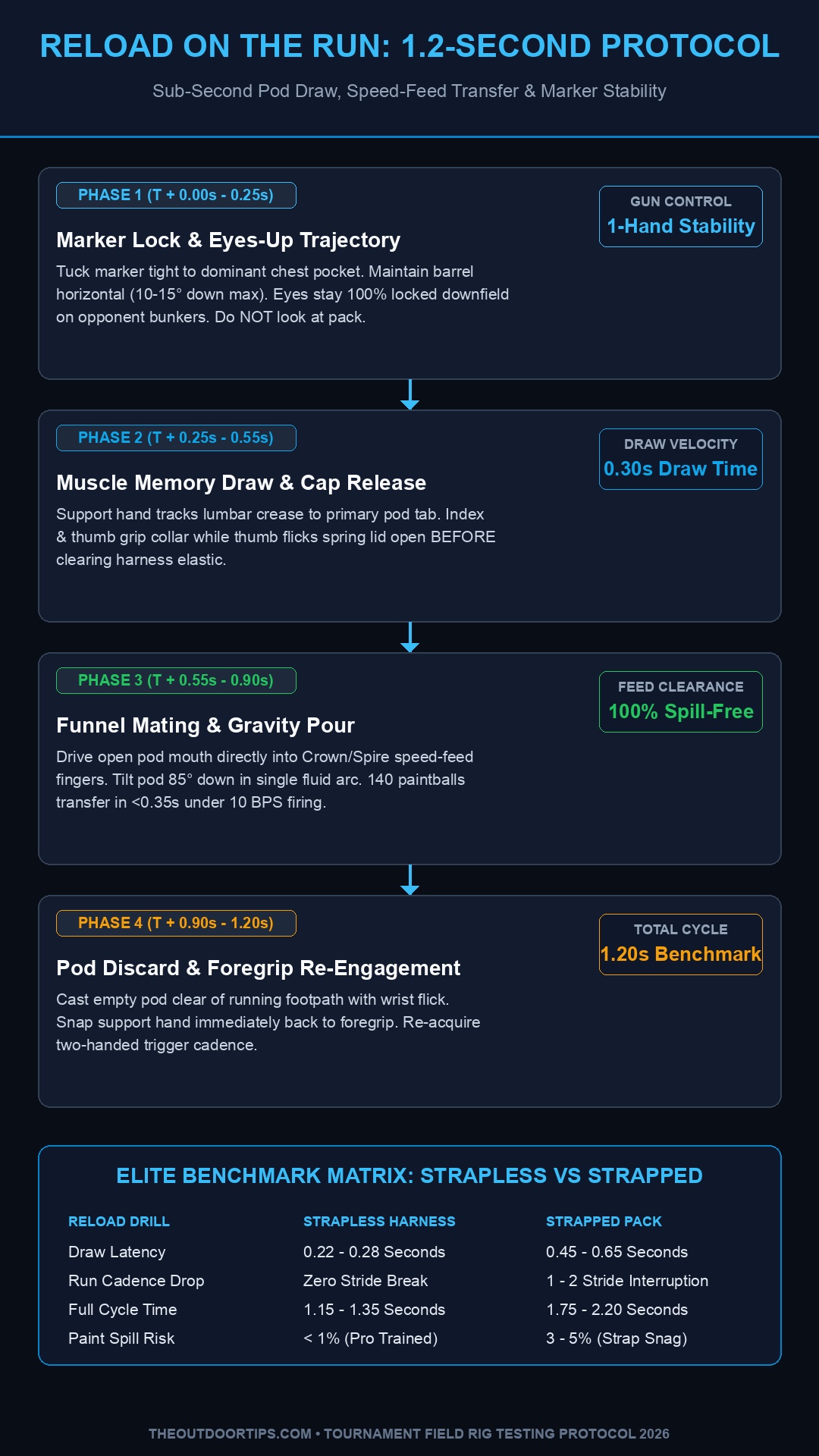
Harness Architecture: Strapless Tension vs. Strapped Velcro Systems
Choosing the right pod pack architecture directly dictates your sprint reload speed. For over two decades, strapped harnesses relying on heavy Velcro flaps were the tournament standard. Today, modern engineering has revolutionized harness dynamics through strapless friction technology, though each design retains distinct mechanical trade-offs.
Here is how the two primary harness architectures compare on the field:
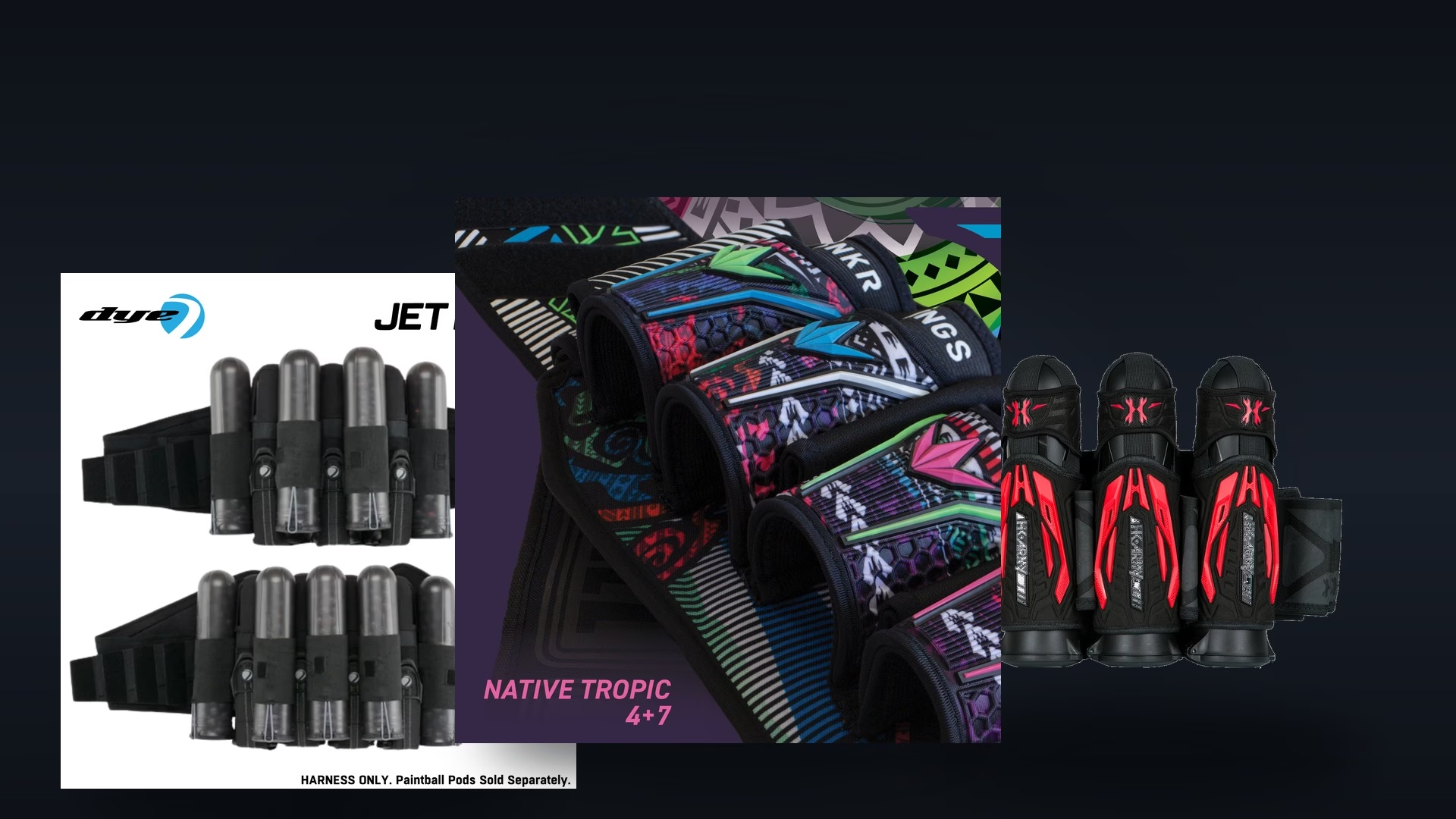
- Strapless Friction Systems (Bunkerkings Fly2, HK Army Zero-GX): Strapless packs utilize tapered internal elastomer cups, rubberized gripper ribs, and adjustable mechanical tension systems. Instead of tearing a Velcro strap open, you simply grasp the pod and pull downward with 4 to 7 lbs of linear force. This eliminates an entire mechanical step, cutting 0.3 to 0.5 seconds off your total reload cycle. However, strapless packs require properly sized pods (standard 140 or 165-round diameter) and regular tension checks to avoid losing pods during hard turf dives.
- Traditional Strapped Velcro Systems (Empire React, HK Army Eject): Strapped packs feature heavy ballistic nylon flaps secured with industrial-grade hook-and-loop Velcro. They provide 100% absolute pod security, making them ideal for heavy woodsball scenarios or diving through dense brush where branches might catch a pod collar. However, the requirement to pull the strap downward to break the Velcro before initiating the pod draw adds latency and creates significant audible noise during stealth maneuvers.
- Weight Distribution & Lumbar Support: A fully loaded 4+5 harness carrying 9 pods holds over 1,260 paintballs, weighing approximately 8.5 to 9.2 lbs. Without robust lumbar padding and a dual-cinch elastic belt system, this weight bounces violently during sprints, throwing off your center of gravity. Premium packs incorporate vented orthotic back pads that stabilize the load against your spine, preventing the harness from sagging over your hips.
Speed-Feed Gate Clearance: Crown SF, Spire & Rotor Hopper Dynamics
Even the fastest pod draw is useless if your speed feed resists ball entry or spits paintballs back out onto the turf when you slide into a bunker. An optimized speed-feed system balances two competing physical forces: low downward resistance to allow rapid ball ingress, and high upward retention to prevent paintballs from bouncing out under violent marker recoil or dive impacts.
Key speed-feed mechanical considerations for seamless sprint reloads include:
- Spring-Loaded Polycarbonate Fingers vs. Molded Rubber: Budget speed feeds use solid flexible elastomer or rubber fins. While durable, rubber fins deform over time, stiffen in cold weather, and create significant friction against incoming paintballs. Premium systems like the Virtue Crown SF II and HK Army EVO Pro feature individual spring-loaded polycarbonate fingers. These hinged fingers swing downward with almost zero resistance under the weight of falling paintballs, then snap instantly closed to seal the hopper mouth.
- Funnel Diameter & Clearance Tolerance: A standard 140-round pod mouth measures approximately 2.15 inches in outer diameter. The speed-feed inner collar must offer at least 2.30 to 2.40 inches of clear aperture. If the opening is too narrow, the pod lip collides with the speed-feed bezel, preventing full insertion and causing paintballs to cascade down the sides of your marker body.
- Rain Lid Integration: Never play in wet conditions with an open speed feed without a dedicated protective rain flap. Water entering your loader softens gelatin shells and turns paint dust into sticky syrup, causing severe loader jams and ball chopping. Review our detailed protocols on how to play paintball in the rain for rapid weather adaptation.
Field armorer walkthrough: Benchmarking how to reload paintball pod gear with strapless harnesses, testing draw retention, speed-feed gating, and sprint reload stability.
Armorer Workbench & Pod Pack Maintenance Essentials
Maintaining your pod pack and pods is just as critical as servicing your marker’s bolt and regulator. Dirty pod interiors coat paintballs in grit that scores barrel bores, while gummed-up spring lids lead to fumbled reloads. Keep these tournament-tested maintenance essentials ready in your gear bag:
Bunkerkings Fly2 Strapless Pod Pack Harness
PRIMARY SPRINT HARNESS
The benchmark in professional tournament strapless packs. Features patented friction elastomer pod sleeves that hold pods firmly during max-effort slides and breakout sprints while allowing instantaneous downward draws with zero velcro fumbling. Dual-elastic lumbar belt eliminates harness bounce under full 9-pod load.
Virtue Crown SF II Spring-Loaded Speed Feed
SPRING GATE CLEARANCE
Engineered with individual spring-loaded polycarbonate fingers that yield effortlessly under falling paintballs and lock immediately against outward pressure. Eliminates pod lip hang-ups and guarantees 100% spill-free funneling into Spire and compatible electronic loaders.
DYE Precision Alpha 140-Round Lock-Lid Pods
SPRING-LOCK POD SET
Heavy-duty polypropylene construction designed to survive repeated turf impacts without cracking. Features an enlarged thumb tab and stainless-steel spring-loaded hinge that snaps open instantly upon draw actuation. Exact outer diameter ensures seamless fit in strapless harnesses.
Final Armorer Verdict: Gear Selection & Field Execution
Sub-1.3s Sprint Execution Standard
Mastering how to reload paintball pod gear under match pressure is the defining physical separator between intermediate players and elite tournament competitors. Our multi-season field testing confirms that transitioning from a legacy strapped pack to a premium strapless harness (such as the Bunkerkings Fly2) immediately cuts average draw cycle latency by 0.35 seconds. However, hardware alone cannot prevent spillage—mastery requires drilling the pectoral torso anchor, pre-popping the lid before the mouth clears the sleeve, and aggressively mating the pod lip vertically into a spring-fingered speed feed. Cinch your harness high across your lumbar spine, keep your eyes pinned downfield, and practice your 4-phase draw until the motion is completely subconscious.
Frequently Asked Questions: Pod Reloading & Sprint Drills
How fast should a competitive player reload paintball pod gear during an NXL point?
In professional NXL tournament play, the gold standard benchmark for a complete running reload is between 1.15 and 1.35 seconds from initial off-hand release of the foregrip to two-handed re-engagement. Recreational or novice players typically average 2.2 to 2.8 seconds. Consistent practice using dry-fire pod draw drills brings intermediate players reliably under the 1.5-second threshold.
Should I switch from a strapped pod pack to a strapless harness for running reloads?
Yes, for competitive speedball, X-Ball, and aggressive scenario play, strapless harnesses are overwhelmingly superior. They eliminate the mechanical step of tearing open Velcro flaps, saving up to 0.4 seconds per reload and reducing noise. Strapped packs remain viable primarily for heavy woodsball crawling where thick underbrush could snag pod collars.
How do I prevent paintballs from spilling out of my speed feed while sliding?
Paintball spillage during slides occurs when soft rubber fins deform outward or when the loader is overfilled. To prevent loss, use a dual-material speed feed featuring spring-loaded polycarbonate fingers (like the Virtue Crown SF II) that lock against outward pressure. Additionally, leave approximately 10 to 15 balls of headroom in your hopper when reloading before executing high-impact slides.
What is the correct physical technique to throw or drop empty pods while sprinting?
Always execute a lateral wrist flick casting the empty pod 2 to 3 feet diagonally away from your running path. Dropping pods straight down creates severe tripping hazards under your cleats, risking blown knees and sprained ankles. In tournament matches, support crew collect empty pods between points, so casting them clear of your running lane is standard protocol.
How many pods should a front snake player carry versus a back line anchor?
Front snake and dorito attackers prioritize agility and low profile, typically running a compact 3+4 or 4+5 harness loaded with 3 to 5 pods (420 to 700 rounds). Back-line lane anchors, who maintain continuous 10.5 BPS lane suppression off the breakout, routinely carry a 5+8 or 4+7 harness packed with 8 to 11 pods (1,120 to 1,540 rounds) plus an extended loader.