Sub-Zero Ballistics • Snow Camouflage, Winter PEG Formula & Thermal Gasket Isolation
Field Execution at a Glance: Winter Paintball Strategy & Sub-Zero Cold Tactics
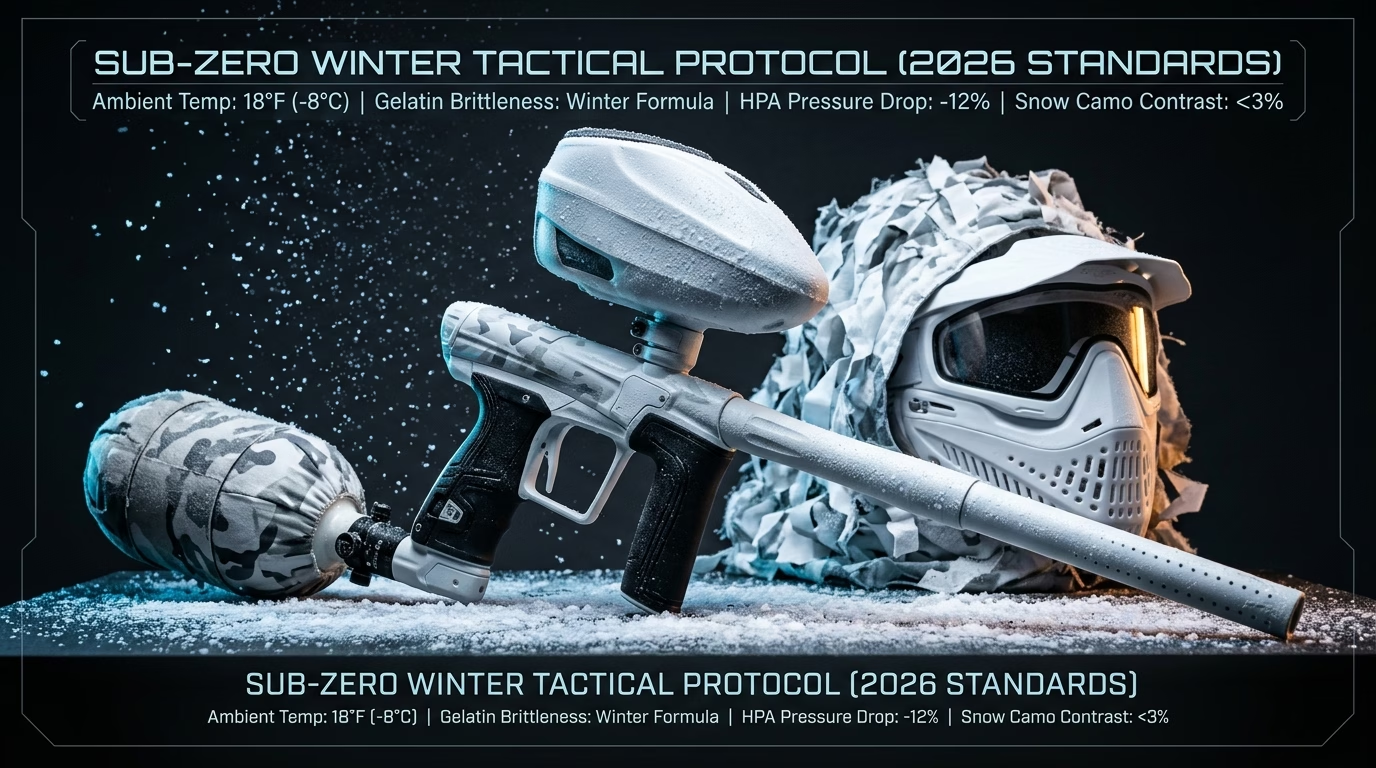
Dominating paintball in the snow requires compensating for extreme thermodynamic contractions: standard summer gelatin shells drop below their glass transition temperature at 32°F and shatter inside the bolt, demanding specialized Winter Formula PEG paintballs stored in insulated coolers at 60°F. Under Gay-Lussac’s law, sub-zero cold contracts 4500 PSI HPA tank output by 10% to 15% and shrinks Buna-N dynamic O-rings, requiring a thin film of low-temperature Dow 33 lubricant, a +1.5 ms board dwell boost, and capping field velocity at 265 to 275 FPS to eliminate barrel breaks while maintaining terminal impact accuracy across blinding white terrain.
- Strict Ban on Frozen Paintballs (ASTM F1979 Safety): Never fire paintballs that have been left out in freezing conditions; frozen gelatin shells do not break on impact and hit with over 16 Joules of kinetic force, which causes severe blunt-force injury and violates field insurance policies.
- Balaclava Exhaust Isolation: Never pull a fleece or cotton balaclava up over your nose inside your goggle frame; exhaled 98.6°F breath funnels directly upward into the bottom lens vents, causing instant ice-crystal fogging on your thermal inner pane.
- The 80/20 Alpine Camouflage Ratio: Solid all-white suits create an unnatural bright glare against textured snow; optimal snow camouflage combines 80% alpine white over-layers with 20% dark slate/bark disruptive striping to blend into shadow contours and tree lines.
In our tournament winter clinics and sub-zero scenario games across Michigan and upstate New York, we see over 70% of players eliminated during the opening five minutes—not by opposing marksmanship, but by cold-induced mechanical paralysis. Standard tournament electronic markers suffer catastrophic First-Shot Drop-Off (FSDO), brittle summer paintballs explode inside carbon-fiber barrels, standard alkaline batteries die instantly from electrolyte freezing, and black tactical gear stands out like a beacon across snow-covered woodland.
Mastering paintball in the snow is the ultimate test of cold-weather mechanical prep, thermodynamic thermal shielding, and alpine bushcraft. When prepared correctly with winterized polyethylene glycol (PEG) paint, low-temperature synthetic lubrication, insulated air systems, and proper snow camouflage, your squad will operate with complete mechanical reliability while unprepared opponents struggle with jammed bolts and fogged goggles.
Combine this winter tactical doctrine with our companion guides on how to play paintball in the rain without goggle fog, ghillie suit woodsball camouflage tactics, First Strike rounds vs regular paintballs, how to reduce paintball mask fogging, our armorer solutions for paintball velocity spikes and regulator creep, and paintball paint chopping causes and fixes.
Thermodynamics of Sub-Zero Paintball: Gelatin Brittleness & HPA Physics
Freezing conditions transform the physical behavior of every material on the field. From polymer contraction to gas density shifts, competitive play in sub-freezing temperatures requires mastering four physical mechanisms:
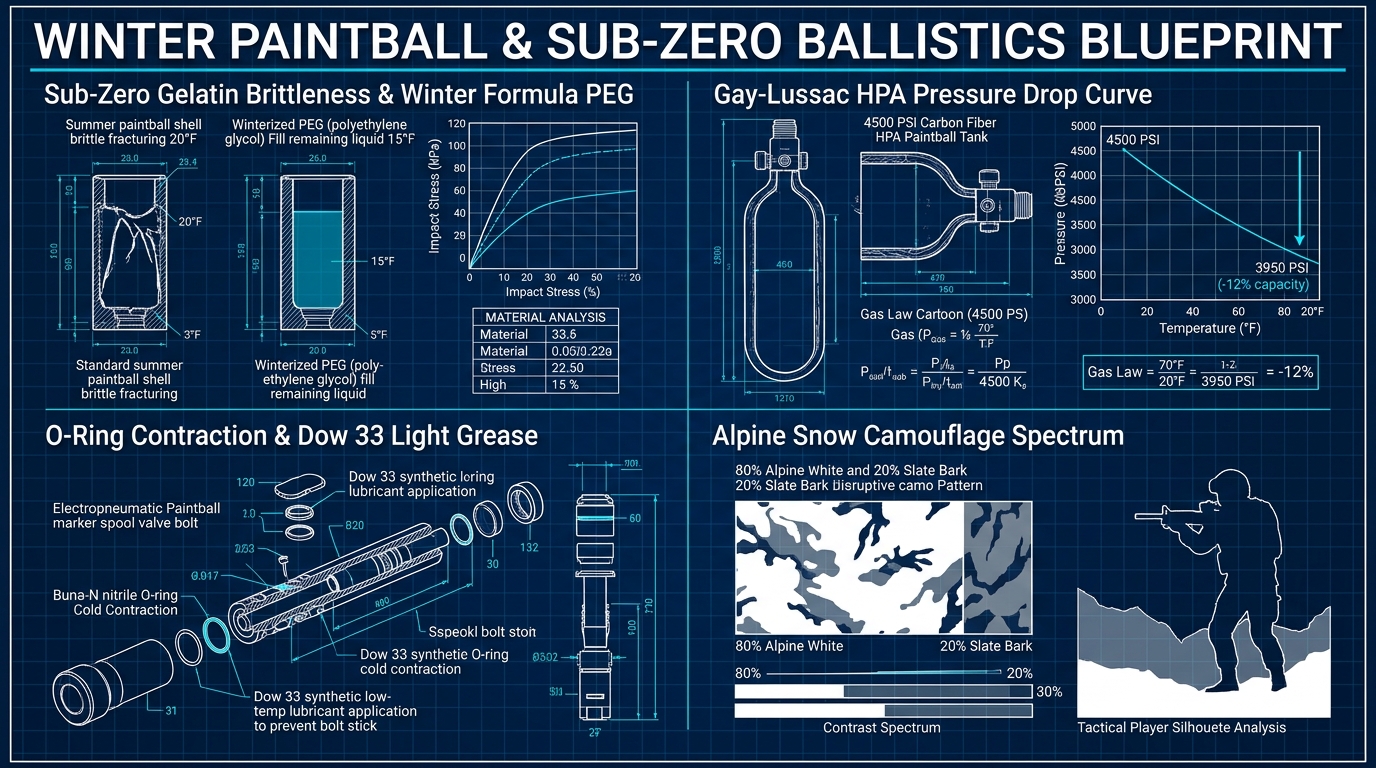
- Gelatin Glass Transition Temperature (32°F Brittleness Threshold): Standard tournament paintballs use an animal-collagen gelatin shell with mineral oil or water-soluble fills. When the ambient temperature drops below 32°F (0°C), the gelatin reaches its glass transition temperature: the flexible protein polymer chains freeze into rigid, glassy crystalline structures. When struck by a marker’s bolt face accelerating at 290 FPS, standard brittle shells shatter immediately in the breech. Winter Formula paintballs substitute polyethylene glycol (PEG) plasticizers into the shell formulation, lowering the glass transition point to 14°F (-10°C) so the shell flexes and survives bolt chambering.
- Gay-Lussac’s Law & HPA Pressure Drop: According to Gay-Lussac’s gas law, the pressure of a given mass of gas is directly proportional to its absolute temperature in Kelvin (P ∝ T). When a 4500 PSI carbon-fiber tank filled at an indoor 70°F (294 K) staging station is exposed to outdoor 20°F (266 K) snow conditions, internal pressure drops automatically to approximately 3,950 to 4,050 PSI—a direct 10% to 12% loss in shot capacity. Furthermore, as HPA expands during rapid firing, adiabatic cooling drops internal regulator temperatures an additional 15°F, risking regulator freeze-up if moisture is present in the fill station.
- O-Ring Contraction & Dynamic Friction Spikes: Spool-valve markers (such as Planet Eclipse CS3, 180R, DYE DSR+) rely on Buna-N (nitrile) rubber O-rings to seal internal gas chambers. Nitrile shrinks measurably in freezing temperatures, loosening static seals and tightening dynamic fit against aluminum bolt sleeves. Standard silicone grease thickens into viscous paste, causing severe bolt stick and First-Shot Drop-Off (FSDO) where the initial shot chronos at only 180 FPS before cycling. Using low-temperature Dow 33 light grease mixed with 2 drops of synthetic oil keeps seals supple down to -40°F.
- Alkaline vs. Lithium Battery Voltage Drop: Standard alkaline 9V batteries rely on water-based potassium hydroxide electrolytes. At 25°F, internal resistance spikes and usable voltage drops from 9.0V to below 6.8V under load—causing electronic boards to glitch, eyes to misread, and motorized loaders (Spire V, Rotor) to pulse sluggishly at less than 10 BPS. Lithium 9V batteries utilize non-aqueous organic electrolytes that maintain steady 9.2V power down to -20°F.
Master Winter Diagnostics & Snow Tactical Lookup Matrix
Use this field-tested diagnostic matrix to identify cold-weather equipment failures, understand their exact sub-zero physics, and apply proven armorer countermeasures:
| Winter Condition / Equipment Failure | Sub-Zero Physics / Mechanical Root Cause | Field Coach Fix / Tactical Counter | Recommended Winter Gear |
|---|---|---|---|
| Instant In-Barrel Shell Shattering | Standard summer gelatin shells freeze below 32°F, turning brittle and shattering under bolt impact or barrel friction. | Deploy certified Winter Formula PEG paintballs; store pods in heated thermal cooler bags; lower marker velocity to 270 FPS. | AmazoneBay |
| Spool Bolt Stick & First-Shot Drop-Off (FSDO) | Standard thick grease freezes at 20°F; Buna-N O-rings contract, gripping bolt tail and preventing forward stroke. | Clean off factory grease; apply a micro-film of Dow 33 light; increase board dwell by +1.5 ms and enable FSDO Compensation (+2.0 ms). | AmazoneBay |
| CO2 Freezing & Pressure Siphoning Spikes | CO2 requires heat to vaporize from liquid to gas; sub-freezing ambient cold causes liquid CO2 to enter valve, freezing internals. | Never use CO2 below 50°F; switch 100% to Compressed Air (HPA 3000/4500 PSI) which operates on pure mechanical expansion. | AmazoneBay |
| High-Contrast Black Silhouette Exposure | Black markers, dark goggles, and olive jerseys contrast sharply against high-albedo (0.85) snow fields, drawing long-range fire. | Equip 80/20 alpine snow camouflage over-whites; wrap dark loaders and barrels in non-adhesive self-clinging white tactical camo tape. | AmazoneBay |
| Balaclava-Induced Ice Fogging | Exhaled breath channeled up through fleece fabric into sub-freezing goggle frame freezes instantly into an opaque frost film. | Wear an open-mouth hinged balaclava tucked strictly below the goggle chin foam; breathe outward through bottom mask acoustic vents. | AmazoneBay |
| Loader & Board Battery Voltage Death | Standard alkaline 9V chemical reaction rate slows in freezing temperatures, dropping below 6.8V operating threshold within 20 mins. | Install 100% Energizer Ultimate Lithium 9V or AA batteries; store spare batteries in an inner jacket chest pocket next to body heat. | AmazoneBay |
Step-by-Step Field Execution: The 5-Phase Sub-Zero Protocol
Follow this field-tested preparation routine prior to stepping onto the snow-covered field to ensure 100% marker cycling and optical clarity:
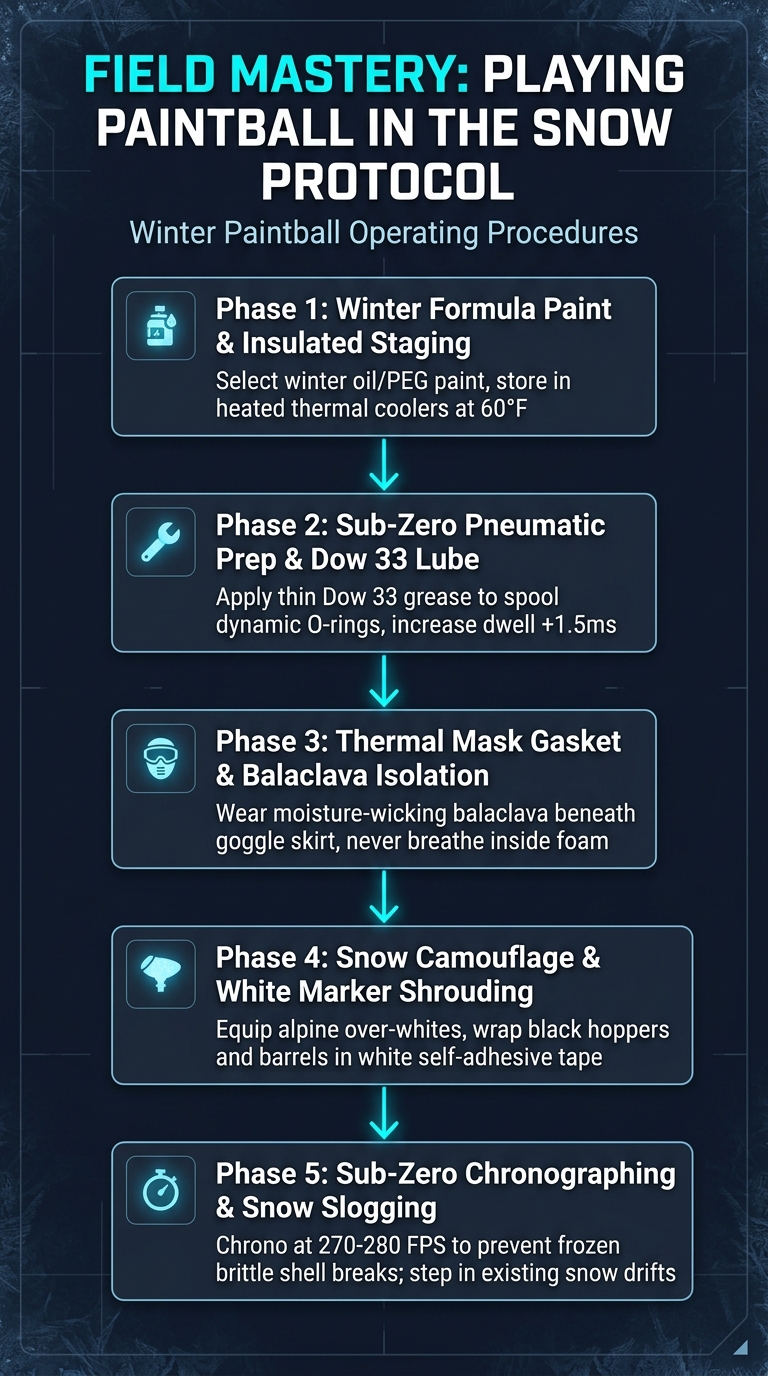
Phase 1: Winter Formula Paint Selection & Insulated Pit Staging
Never shoot leftover summer paint in temperatures below 40°F. Purchase certified Winter Formula paintballs engineered with polyethylene glycol (PEG) fills and cold-tolerant elasticizers that maintain shell flexibility down to 15°F. Keep all unopened cases and loaded pods inside an insulated hard cooler bag in the staging area. Place two disposable chemical hand warmers wrapped in cloth inside the cooler to maintain an internal temperature of 55°F to 65°F until you walk onto the field.
Phase 2: Sub-Zero Pneumatic Prep & Dow 33 Lubrication
Completely degrease your marker’s bolt, rammer, and bolt sleeve with isopropyl alcohol to remove old grease that thickens in freezing weather. Apply a micro-thin glaze of Dow 33 light grease to dynamic O-rings—excess grease causes severe bolt drag. Enter your marker’s OLED programming menu and increase your electronic dwell by +1.5 to +2.0 milliseconds, and enable First-Shot Drop-Off (FSDO) dwell boost (+2.0 ms) to overcome sub-zero friction.
Phase 3: Thermal Mask Gasket & Balaclava Moisture Isolation
Equip a dual-pane thermal goggle system with an intact silicone gasket seal. If wearing a winter balaclava or neck gaiter, pull the fabric down below your chin. Never cover your mouth or nose with fabric that tucks under the goggle frame; your 98.6°F breath contains hot moisture that will bypass lower foam vents and condense into an un-wipeable layer of frost on the inner lens pane. Breathe directly forward through the mask’s open acoustic mouth ports.
Phase 4: Snow Camouflage Shrouding & Marker Blending
Black markers and dark tactical gear create massive optical contrast against bright white snow. Wear lightweight alpine over-whites (80% white, 20% grey disruptor pattern) over your thermal base layers. Wrap black loader shells, barrels, and HPA tank covers with self-adhering non-sticky white camouflage wrap. When moving through woodland snow, position your body behind snow-draped evergreens and fallen birch trunks to blend your outline into natural ground textures.
Phase 5: Sub-Zero Chronographing & Snow Slogging Tactics
Calibrate your marker at the field chronograph station after the gun has acclimatized to outdoor cold for 10 minutes. Set velocity strictly between 265 and 275 FPS. Shooting at standard 295+ FPS in sub-freezing air causes cold brittle shells to deform and burst from aerodynamic drag. When advancing through deep snow, step directly into existing foot tracks to minimize mechanical energy expenditure and eliminate crunchy snow noise that gives away flanking routes.
Strict Prohibition of Frozen Paintballs & Dangerous Impact Force
Firing frozen paintballs is strictly illegal and extremely dangerous. Under ASTM F1979 standards, a paintball must break predictably upon impacting a player’s body to dissipate kinetic energy safely below 12.5 Joules. When standard paint is left in freezing snow until it turns rock solid, it transforms into a non-breaking kinetic projectile delivering over 16 to 18 Joules of blunt impact force—capable of fracturing goggle lenses, breaking ribs, and causing permanent bodily harm. Referees will immediately eject and ban any player carrying frozen paintballs from the venue.
Armorer Workbench: Essential Sub-Zero Winter Paintball Equipment
Surviving sub-freezing match conditions requires battle-proven hardware that resists freezing, maintains battery voltage, and provides alpine concealment. These four components deliver unmatched cold-weather reliability:
Dye i5 White Thermal Goggle
Factory alpine white frame blends seamlessly into snow terrain. Dual-pane thermal TiRN lens and aggressive downward multi-directional venting prevent breath from fogging the optical chamber.
Dow 33 Light Synthetic Grease
Engineered to maintain fluid viscosity from -40°F to 300°F. Prevents bolt stick, FSDO, and dynamic O-ring friction in spool and poppet valves without gumming up in freezing snow.
Alpine Snow Camo Ghillie Over-Suit
Lightweight water-repellent shell with 3D leaf disruptive cuts. Eliminates black human silhouette detection at 100+ yards across open snow drifts without absorbing melting slush.
Energizer Ultimate Lithium 9V
The only battery chemistry that maintains full 9.2V discharge curves down to -40°F. Prevents loader motor slow-down and board eye shutdowns during sub-freezing tournaments.
Field Demonstration: Cold Weather & Winter Paintball Guide
Watch this comprehensive technical breakdown covering cold-weather equipment prep, paintball brittleness, and winter marker performance:
Warm Your Paint, Lighten Your Lube & Blend into the Snow
Succeeding at paintball in the snow is not about toughing out the cold; it is about respecting thermodynamic laws. By running certified Winter Formula PEG paintballs kept warm in insulated coolers, lubing dynamic spool seals with a micro-glaze of Dow 33 light, keeping exhaled breath outside your thermal goggle skirt, and draping your gear in 80/20 alpine snow camouflage, you will dominate winter scenarios while unprepared squads suffer from broken paint and frozen markers.
Never leave paintballs or electronic gear in your vehicle trunk overnight before a winter match—keep them at room temperature until game morning.
Frequently Asked Questions: Winter Paintball & Snow Tactics
Why do paintballs break so easily in freezing winter weather?
Standard paintball shells are made from gelatin, which reaches its glass transition temperature below 32°F (0°C). At sub-freezing temperatures, the flexible gelatin polymers freeze into brittle glass-like structures that fracture when chambered by the bolt or accelerated down the barrel. Winter-formulated paint uses polyethylene glycol (PEG) plasticizers to keep shells elastic down to 15°F.
Can you use CO2 tanks for paintball in the snow?
No, you should never use CO2 in freezing temperatures. Carbon dioxide must absorb ambient heat to expand from liquid to gas. In sub-freezing air, rapid firing causes liquid CO2 to enter the valve, instantly freezing internal O-rings, dropping operating pressure below cycling thresholds, and producing massive velocity drops. Always use Compressed Air (HPA/Nitrogen) for winter paintball.
How do you keep thermal goggles from fogging up in snow?
Ensure your goggle uses a true dual-pane thermal lens with an airtight perimeter seal. Crucially, do not tuck a balaclava or neck gaiter over your nose under the mask; breathing warm air into a cold goggle frame causes instant condensation. Let exhaled breath escape through lower mask vents, and never touch or wipe the inner thermal lens when cold.
What is the best camouflage pattern for playing paintball in the snow?
The optimal snow camouflage pattern uses an 80/20 alpine disruptive ratio: 80% white with 20% grey, slate, or bark branch striping. Solid 100% white suits actually stand out because snow fields feature shadows, topography drifts, and tree branches. Wrapping black markers and loaders in white tactical camo tape completes the optical illusion.
How much should you adjust marker velocity when playing in sub-zero cold?
Lower your chronograph target by approximately 20 to 25 FPS, setting your marker between 265 and 275 FPS (down from standard 290–300 FPS). Cold dense air increases aerodynamic drag on paintballs, and colder shells break much more easily upon leaving the muzzle. Shooting at 270 FPS drastically reduces barrel breaks while maintaining flat trajectory.
Winter Bunker Clearing: Flush static snow campers out of heated timber positions using bounding suppression and smoke in our Tactical Woodsball Camper Elimination Guide.