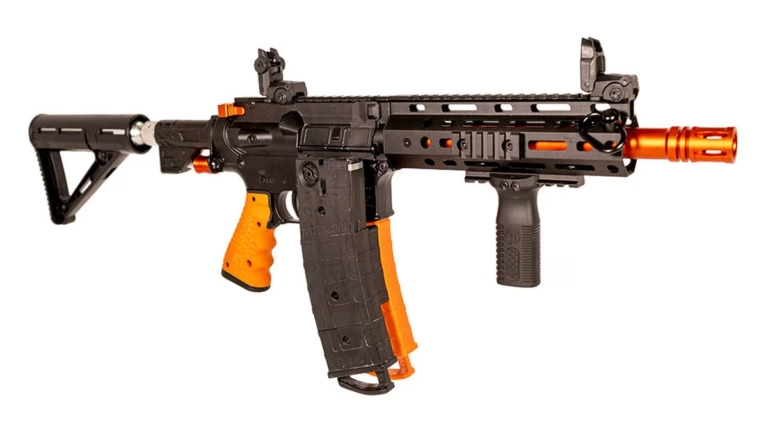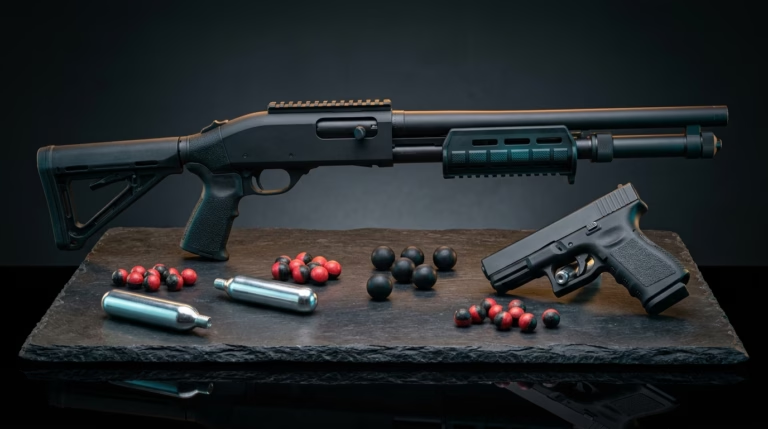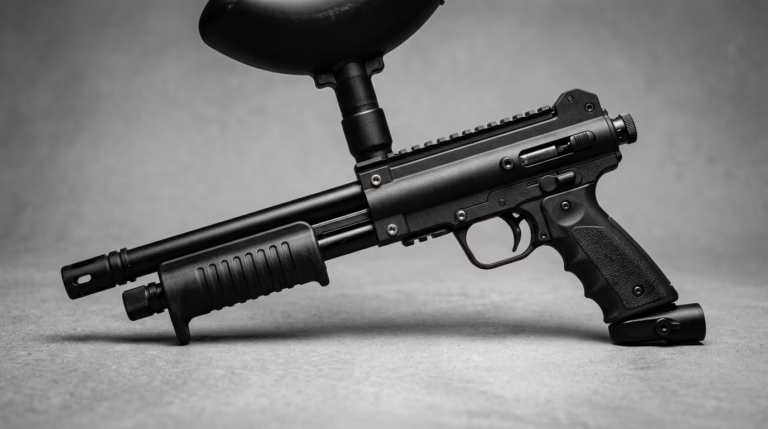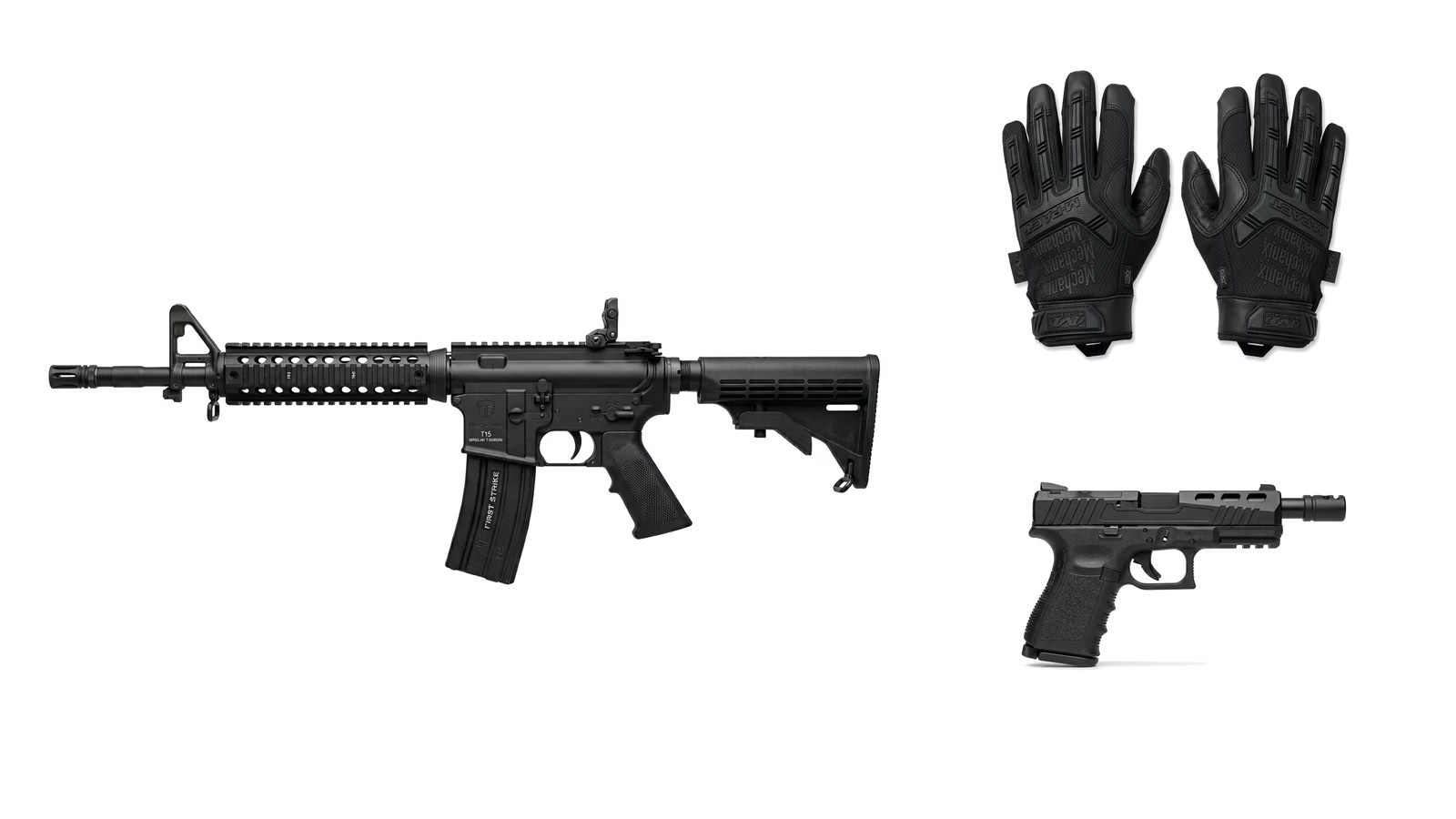
Woodsball Sniper & Recon Operations • 30/70 Bushcraft & Thermal Venting
Field Execution at a Glance: Paintball Ghillie Suit & Bushcraft Mechanics
Deploying an effective paintball ghillie suit requires replacing heavy 5-pound synthetic burlap blankets with a 1.1-pound laser-cut 3D leaf viper hood blended at a strict 30/70 synthetic-to-natural flora ratio. By disrupting the human head-and-shoulder “V-notch” outline, cutting a 6×4-inch thermal exhaust window over your goggle vents, and stalking in dappled canopy shadows at 6 to 12 inches per second, a reconnaissance sniper reduces visual detection range from 120 feet down to under 22 feet—delivering 285 FPS (~11.0 Joules) First Strike or roundball eliminations before the opposing squad registers muzzle sound.
- The 30/70 Bushcraft Rule & Chest Slick Modification: Keep 100% of your chest and stomach free of dangling jute so you can low-crawl over brambles and draw 20-round MagFed magazines cleanly; weave 70% fresh local ferns, oak twigs, and grass into your dorsal hood and shoulder loops.
- Thermal Goggle Venting & Scenario Bounce Compliance: Heavy burlap traps 98.6°F exhaled moisture and causes illegal paintball bounces at 285 FPS. Use single-layer 3D leaf mesh and cut an open exhaust port above your mask brow so warm breath escapes upward without fogging your lens.
- Fatal Field Error to Avoid: Never wear an un-vegetated “out-of-the-bag” synthetic ghillie suit directly in front of a dark tree trunk or skyline yourself on a ridge crest—uniform synthetic color blobs and glossy goggle lenses trigger human peripheral vision in under 350 milliseconds.
In our field tests and scenario coaching clinics, we watch recreational woodsball players buy a $70 synthetic burlap suit online, pull it straight out of the plastic bag, and get eliminated within 90 seconds of the opening horn. Instead of disappearing into the forest, they turn into a steaming, 5-pound monochrome hay-bale that snags on every blackberry thorn, fogs their thermal goggle lens solid before the first firefight, and contrasts starkly against native oak and fern undergrowth at 100+ feet.
Building and operating a tournament- and scenario-legal paintball ghillie suit is an exact science of optical silhouette disruption, thermodynamic moisture management, and terrain-matched bushcraft. Whether you are hunting high-value commanders with one of the best paintball sniper rifles or running forward recon ahead of your squad’s woodsball ambush and pincer formations, pair this concealment protocol with our testing of First Strike rounds vs regular paintballs, our deep dive into the First Strike Scout bolt-action marker, and our guide on how to reduce paintball mask fogging.
1. The Optical Physics of Woodland Detection: Visual Cortex Recognition, UV Glint & Thermal Fogging
To understand why a stock paintball ghillie suit fails in real woodland environments, you have to examine how the human visual cortex processes threats through forest clutter—and how paintball safety equipment fights against concealment:
- The Head-and-Shoulders “V-Notch” Recognition Reflex: The human brain is hardwired to detect two visual signatures in nature: bilateral symmetry—specifically the omega-shaped curve of a human head sitting atop horizontal shoulders—and sudden linear motion. Even if you wear woodland camouflage clothing, an exposed helmet/mask curve and distinct neck indentation allow an opposing player scanning a tree line at 110 feet to lock onto your silhouette in 280 to 350 milliseconds. A properly rigged viper hood or ghillie cape bridges the gap from the crown of your mask directly out to the tip of your deltoids, erasing the neck V-notch completely.
- Specular Glint from Polycarbonate Lenses & Carbon-Fiber Tanks: Nothing in a natural forest has the perfectly smooth, curved optical geometry of a polycarbonate goggle lens, an anodized aluminum barrel, or a gloss-coated 68/4500 carbon-fiber HPA tank. When sunlight filters through the tree canopy, an unshaded mirror or clear goggle lens produces a specular flash visible across 200+ feet of dense timber. Shading the lens beneath a 2.5-inch forward hood brim and wrapping the marker barrel in 3D leaf scrim eliminates 95% of optical glint.
- Thermodynamic Heat Trap & The 285 FPS Bounce Penalty: Crawling through forest deadfall generates 400 to 600 Watts of metabolic heat. A traditional military-style burlap jute suit weighs 4.5 to 6.0 pounds dry, absorbs up to 3 pounds of muddy water in wet grass, elevates core skin temperature by +4.5°F, and blocks convective airflow over your goggle frame. Worse yet, thick bundles of jute act like a shock absorber when struck by a 3.2-gram paintball traveling at 285 FPS (~11.0 Joules) or 190 FPS at 80 feet—resulting in illegal “padding” penalties from scenario referees. Modern woodsball operators use ultra-lightweight 1.1-pound laser-cut 3D polyester/nylon leaf mesh, which breathes freely and allows brittle gelatin shells to fracture legally on impact.
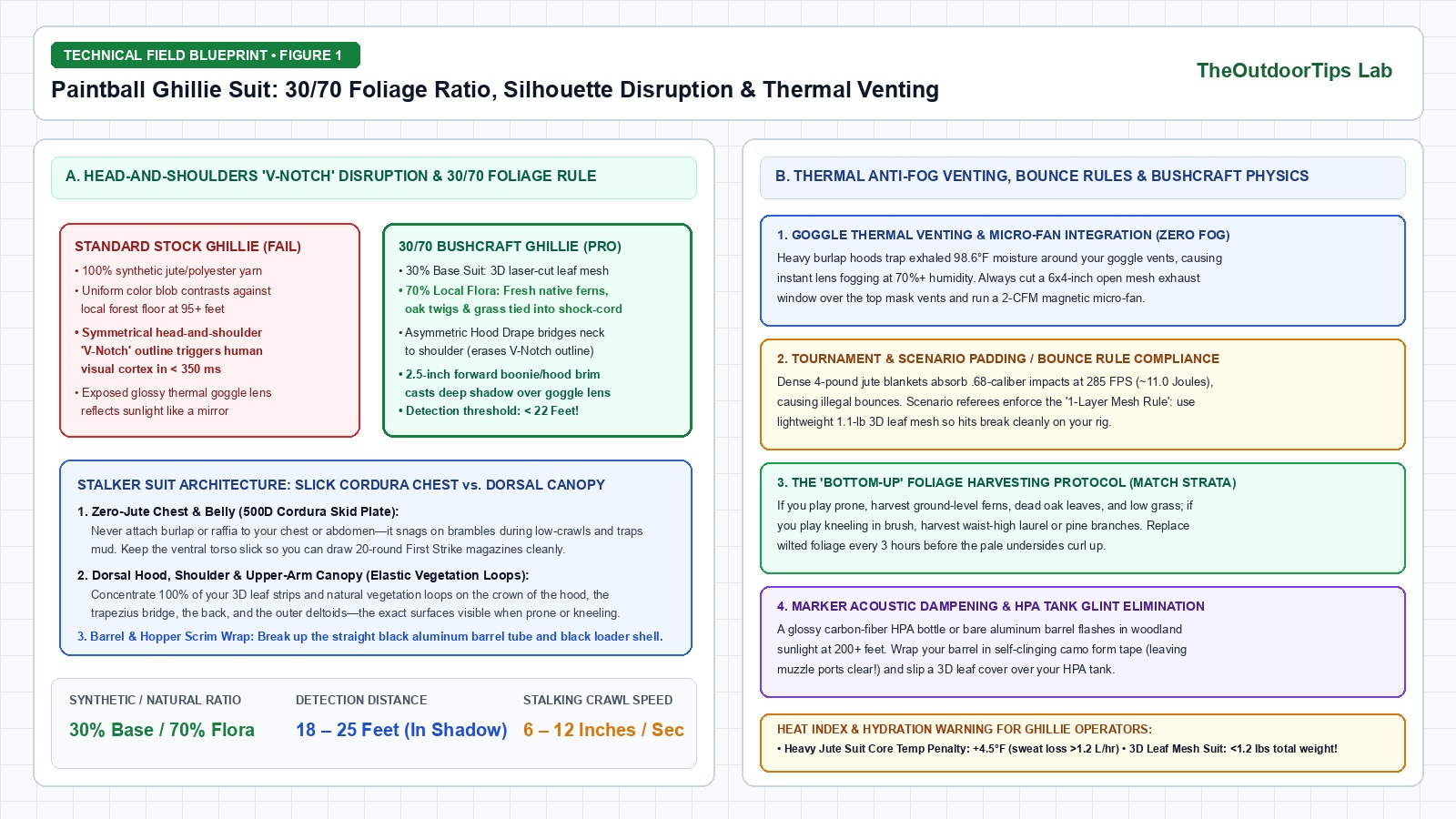
2. Master Paintball Ghillie Suit & Camouflage Architecture Lookup Matrix
Use our field-tested diagnostic matrix below to compare the six most common woodland camouflage configurations, solve field failures (fogging, snagging, and referee bounce penalties), and equip the right scenario gear:
| Condition / Camo Configuration | Root Cause / Optical & Thermal Physics | Armorer Fix / Bushcraft Protocol | Recommended Tool / Gear Link |
|---|---|---|---|
| 1. Laser-Cut 3D Leaf Viper Hood / Half-Cape (0.65 lbs) | Disrupts the critical head, neck V-notch, and shoulder silhouette (85% of visual detections) while leaving the chest and legs unencumbered for sprinting and reloads. | Weave 70% local ferns and twigs into the dorsal shock-cord grid; pair with a Planet Eclipse EMF100 or First Strike T15 DMR. | AmazoneBay |
| 2. 2-Piece 3D Leaf Mesh Suit (1.15 lbs Breathable) | Laser-cut ripstop nylon leaves flutter naturally in light wind currents, shed water, and allow 285 FPS (~11.0 Joules) paintballs to fracture legally without bounce penalties. | Trim all 3D leaves off the front chest rig zone so magazines draw cleanly; wear over breathable paintball pants and knee pads. | AmazoneBay |
| 3. Custom Stalker Suit (500D Cordura Chest + Jute Back) | Combines a slick 500D Cordura skid-plate belly for silent prone crawling with dense dorsal raffia/jute and elastic loops across the back and shoulders. | Spray dorsal jute with matte UV-killer earth-brown/olive dye; mud-wash and dry before weaving native ground-stratum grass for 180-foot FSR sniping. | AmazoneBay |
| 4. Marker Barrel, Scope & Hopper 3D Scrim Wrap | Eliminates the straight geometric line and specular sunlight flash of a 14-inch black aluminum barrel, rifle scope objective lens, or loader shell. | Wrap self-clinging camo form tape behind the barrel ports (never cover muzzle venting!) and fit an anti-reflection killflash honeycomb on your optic. | AmazoneBay |
| 5. Thermal Mask Anti-Glint Hood & Micro-Fan Setup | Heavy hood fabric draped over upper goggle vents traps 98.6°F exhaled humidity, causing thermal lens fogging in 70%+ forest relative humidity. | Cut a 6×4-inch exhaust window over the top mask vents and mount a 2-CFM magnetic micro-fan on a JT Proflex X or Empire EVS. | AmazoneBay |
| 6. Heavy Full-Body Burlap Jute Suit (4.8 – 6.2 lbs) | Absorbs 3+ lbs of water, snags thorns, elevates core skin temperature by +4.5°F, and draws referee elimination penalties for illegal bounce padding. | If you already own one, strip 60% of the heavy synthetic yarn and convert the upper jacket into an open-front dorsal shoulder cape. | AmazoneBay |
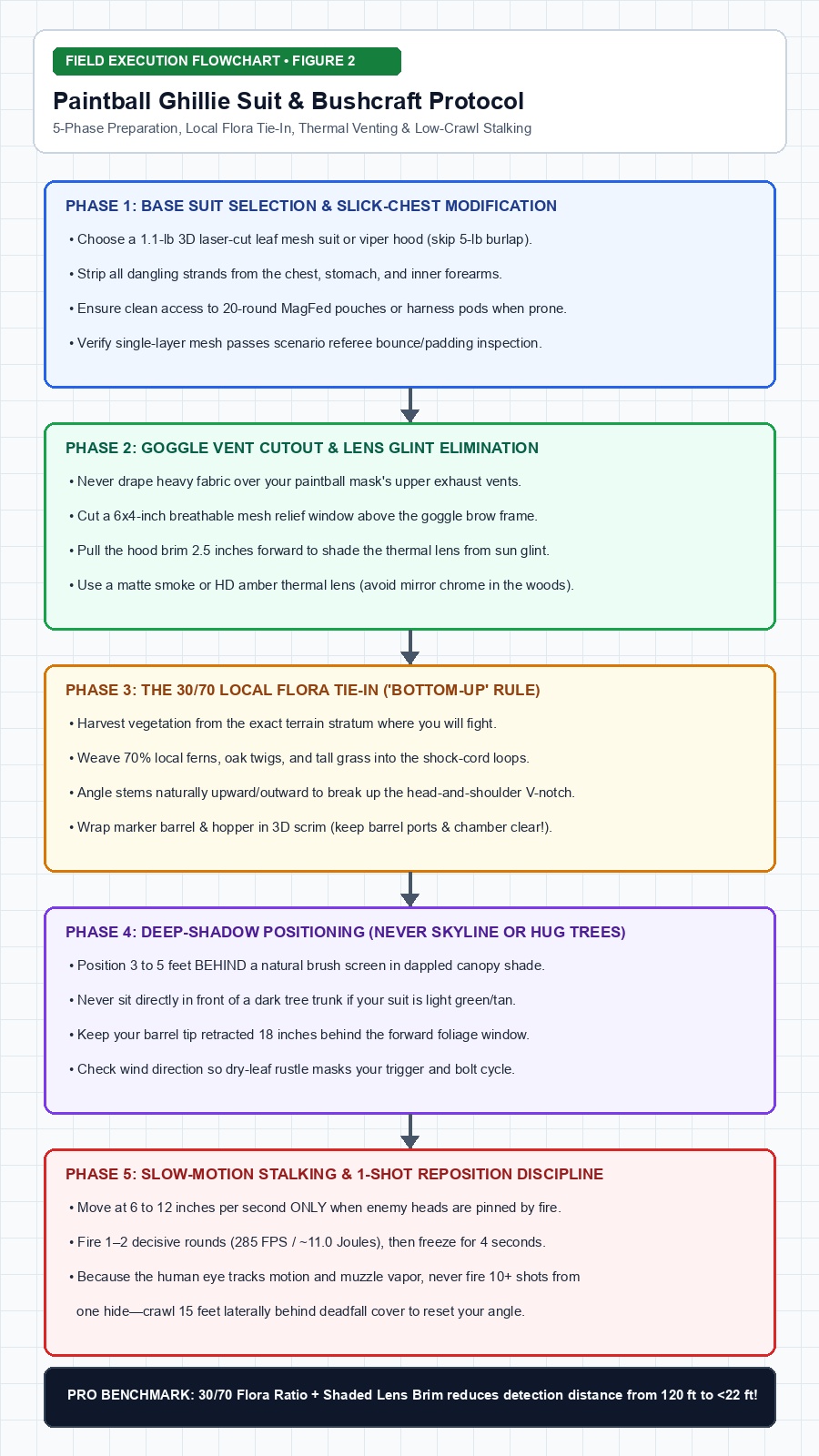
3. Step-by-Step Bushcraft & Paintball Ghillie Suit Execution Protocol
Follow this five-phase field preparation and bushcraft protocol before stepping onto the scenario field. Every step is engineered to maximize optical blending while preserving goggle visibility and reloading speed:
Phase 1: Base Suit Selection & The “Slick-Chest” Crawl Modification
Start with a lightweight 1.1-pound 3D laser-cut leaf mesh suit or a tactical viper hood rather than a heavy burlap blanket. Lay the jacket flat on your workbench and remove every hanging strip of synthetic material from the sternum, ribcage, stomach, and inner forearms. If you play prone sniper roles, stitch a panel of matte olive or coyote 500D Cordura over the belly and elbows, and wear low-profile knee and elbow pads underneath. A slick front torso allows you to slide silently over pine needles and roots without dragging a pound of twigs under your chest, while giving your hands unobstructed access to chest-mounted 20-round First Strike magazines.
Phase 2: Thermal Goggle Exhaust Cutout & Lens Glint Shading
Drape your ghillie hood over your thermal paintball mask while wearing it in front of a mirror. Locate the upper brow exhaust vents on your goggle frame and use sharp trauma shears to cut a 6×4-inch open mesh exhaust window directly above those vents so your 98.6°F exhaled breath rises straight out of the hood instead of rebounding onto your lens. Next, wire a stiff piece of paracord or flexible plastic into the leading edge of the hood so it projects 2.5 inches forward past your brow. This awning casts a permanent shadow across your polycarbonate lens, eliminating sunlight glint even when scanning open firebreaks. Always run a matte smoke, HD amber, or clear thermal lens—never a mirror-chrome lens in woodland terrain.
Phase 3: The 30/70 Local Flora Tie-In (“Bottom-Up” Harvesting Rule)
An out-of-the-bag paintball ghillie suit should only provide 30% of your total camouflage; the remaining 70% must come from live vegetation harvested from the exact field sector where you plan to fight. Stitch a grid of 1/8-inch matte shock-cord or paracord loops across the crown of the hood, the back of the shoulders, and the outer upper arms at 4-inch intervals. Follow the military sniper “Bottom-Up” harvesting rule: if you plan to shoot prone, harvest ground-level bracken ferns, dead oak leaves, and low grass; if you plan to shoot kneeling inside brush lines, harvest waist-high laurel, pine twigs, or palmetto fronds. Tuck the stems into the elastic loops oriented in their natural growth direction. Because cut foliage wilts and curls within 2 to 3 hours—exposing pale, light-reflecting leaf undersides that shine like beacons—refresh your natural tie-ins between scenario missions.
Phase 4: Marker Barrel Scrim, Hopper Breakup & Acoustic Dampening
Even a flawless ghillie hood fails if you wave a glossy black 16-inch barrel and black hopper across a green background. Wrap your barrel back and handguard in self-clinging matte camo form tape, and tie short 3-inch strips of 3D leaf mesh along the top rail and scope body—taking strict care never to obstruct your barrel’s muzzle porting or chamber breach. If you run a hopper-fed mechanical gun from our best woodsball paintball guns roundup, slip a 3D leaf cover over the loader shell and line the inside floor of your pod harness or hopper with a 1mm adhesive neoprene dot to silence the 62 dB rattle of paintballs shifting when you crawl. Wear dark tactical paintball gloves so pale bare hands never flash when actuating your trigger or bolt.
Phase 5: Deep-Shadow Positioning, Slow-Motion Stalking & 1-Shot Discipline
In the field, a paintball ghillie suit is not an invisibility cloak—it is a background matcher. Never sit directly in front of a dark tree trunk if your suit is dressed in bright green ferns (you will contrast like a neon sign against dark bark), and never position on a ridge crest where open sky shows behind your shoulders. Instead, settle 3 to 5 feet behind a natural brush screen inside dappled canopy shadow, keeping your muzzle tip retracted 18 inches back from the forward “keyhole” shooting window. When stalking into range, move at 6 to 12 inches per second only when wind gusts rustle the canopy or when friendly gunfire masks your movement. Fire 1 to 2 decisive shots at 285 FPS (~11.0 Joules), hold completely still for 4 seconds so opposing players scanning toward the acoustic pop look right past your outline, and then low-crawl 15 feet laterally behind deadfall cover before engaging again.
Goggle Foam Seal Integrity, The “1-Layer Mesh” Bounce Rule & Poison Ivy Identification
Never tuck ghillie netting, burlap strands, or sniper veils underneath the foam facial seal of your ASTM F1776-22 paintball mask—breaking the foam seal creates an eye-injury gap for paintball shell fragments and forces warm breath upward across the inner thermal lens. Furthermore, major scenario events (ION, SuperGame, Legends) strictly prohibit multi-layer quilted burlap that absorbs 285 FPS impacts without shell fracture; stick to single-layer 3D leaf mesh over standard paintball clothing to pass referee pinch-checks. Finally, positively identify every plant before tying it into your hood so you never weave three-leaf poison ivy (Toxicodendron radicans) around your face and neck.
4. Armorer Workbench: Essential Woodsball Ghillie & Recon Sniper Loadout
Equipping a stealth woodsball loadout requires breathable 3D leaf disruption, a quiet mechanical or MagFed marker platform, and active thermal lens ventilation:
Tactical 3D Leaf Viper Hood & Ripstop Mesh Suit
Weighing under 1.15 pounds total, a laser-cut 3D leaf viper hood or two-piece mesh suit breaks up your head-and-shoulder V-notch without absorbing mud or triggering scenario referee bounce penalties.
First Strike T15 DMR / Planet Eclipse EMF100 + Camo Tape
Pairing a MagFed First Strike T15 or upgraded Planet Eclipse EMF100 with First Strike Rounds and self-clinging barrel camo tape delivers 180-foot one-ball eliminations at 86 dB.
Olive Thermal Mask + 2-CFM Magnetic Anti-Fog Micro-Fan
Combining a high-airflow JT Proflex Thermal or V-Force Grill 2.0 with a magnetic goggle fan and Mechanix Covert gloves guarantees zero fogging in humid timber.
5. Field Demonstration: Ghillie Suit Bushcraft & Woodsball Camouflage in Action
Watch this field breakdown demonstrating how natural vegetation tie-ins, shadow discipline, and low-profile movement allow a woodsball sniper to remain completely undetected within 25 feet of opposing players:
3D Leaf Viper Hood vs. Full Jute Suit: Why Bushcraft Beats Heavy Burlap
In 95% of woodsball and scenario games, a lightweight 3D leaf viper hood or two-piece laser-cut leaf mesh suit vastly outperforms a heavy military-style burlap jute suit. A viper hood weighs less than 11 ounces, keeps your chest rig and pod pack 100% accessible, vents goggle heat rapidly, and never draws illegal padding penalties from scenario referees—while still disrupting the critical head-and-shoulders V-notch that gives players away.
Remember that buying a paintball ghillie suit only gives you a 30% foundation. The players who pull off 20-foot ambushes are the ones who spend 10 minutes before the game weaving 70% fresh local ferns, oak twigs, and grass into their dorsal shock-cord loops, shading their goggle lens beneath a 2.5-inch brim, and anchoring 3 to 5 feet behind brush screens in deep canopy shadow.
6. Frequently Asked Questions: Paintball Ghillie Suit & Bushcraft
1. Are ghillie suits legal in woodsball and scenario paintball tournaments?
Yes, a paintball ghillie suit is legal at almost all recreational woodsball fields and major scenario games (such as ION, SuperGame, and Legends), provided it does not violate the field’s “excessive padding / bounce” rule. Heavy multi-layer burlap suits that absorb 285 FPS (~11.0 Joules) paintball impacts without breaking the shell are frequently penalized by referees, where even a bounce on loose jute counts as an elimination. Using a single-layer 1.1-pound 3D leaf mesh suit or viper hood ensures legal shell breaks and 100% rule compliance.
2. How do I stop my paintball mask from fogging under a ghillie hood?
First, always wear a true dual-pane thermal lens mask (like the JT Proflex or Empire EVS). Second, never let heavy ghillie fabric drape directly over the upper brow exhaust vents of your goggle frame; use scissors to cut a 6×4-inch breathable mesh relief window in the hood directly above your mask’s top vents so 98.6°F exhaled moisture escapes straight upward. In high-humidity summer woodsball (70%+ RH), clip a 2-CFM magnetic micro-fan onto your upper goggle vents to force active air exchange.
3. What is the 30/70 rule for a paintball ghillie suit?
The 30/70 bushcraft rule states that your synthetic base suit should only represent 30% of your camouflage, while 70% must consist of live natural foliage (ferns, leafy twigs, and grass) harvested directly from the field you are playing on. Synthetic dyes rarely match the exact chlorophyll and soil tones of a local forest, and uniform synthetic texture stands out at 90+ feet. Weaving 70% native vegetation into your hood and shoulder shock-cord loops matches local color, texture, and wind movement perfectly.
4. Should I buy a full-body ghillie suit or a viper hood for paintball?
For almost every woodsball and MagFed player, a viper hood (half-cape) or 3D leaf mesh jacket is far superior to a heavy full-body burlap suit. A viper hood disrupts your head, neck V-notch, shoulders, and arms—which account for 85% of visual detections behind cover—while leaving your chest rig accessible for fast reloads and your legs free to sprint between bunkers without snagging brambles or overheating.
5. Does wearing a ghillie suit make paintball hits hurt less?
A lightweight 3D leaf mesh suit adds virtually zero thickness, so a .68-caliber paintball impacting at 285 FPS feels identical to a hit on a standard paintball jersey. While a thick 5-pound burlap suit softens impacts slightly, it traps intense body heat (+4.5°F skin temperature penalty) and often draws referee penalties for illegal padding. If you want impact protection underneath a breathable 3D leaf suit, wear moisture-wicking paintball elbow/knee pads and a thin chest protector.
Scenario Recon & TOC Integration: Learn how ghillie recon snipers plug into a 4-channel GMRS command net in our Scenario Paintball Command & Big-Game Strategy Guide.
Night Bushcraft & Vision Discipline: Learn how to protect your eyes’ 25-minute rhodopsin dark adaptation curve and avoid optical backscatter in our Night Paintball Tactics & Illumination Guide.