Scenario & MagFed Operations • 90° L-Ambush & Bounding Overwatch
Field Execution at a Glance: Woodsball Ambush & Pincer Mechanics
Executing decisive woodsball tactics requires replacing chaotic frontal tree-to-tree stalemates with geometric 90-degree L-shaped ambushes and Hammer-and-Anvil pincer envelopments. Because a standard .68-caliber roundball fired at 285 FPS (~11.0 Joules) loses over 48% of its velocity past 125 feet and deflects off 2-millimeter twigs, elite scenario squads use a stationary Base-of-Fire (“The Anvil”) at 110 to 130 feet to generate 92 dB of acoustic suppression while a flanking wing (“The Hammer”) closes to 65 to 85 feet at an 88-degree perpendicular angle—wiping out the opposing squad in under 12 seconds with 265-millisecond side-profile shots.
- Roundball vs. FSR Kill Windows: Restrict standard .68-caliber roundball ambush kill zones to 65–115 feet to maintain >155 FPS shell-breaking impact velocity; deploy fin-stabilized First Strike Rounds (FSR) for 180–240 foot overwatch lanes.
- Acoustic Footstep Masking: Walking on dry forest leaves generates 58 to 68 dB of crunching noise audible 110 feet away; always time your flanking movement with 92 dB suppressive bursts from your Base-of-Fire element.
- Fatal Field Error to Avoid: Never fire on the solitary enemy lead scout (which blows your concealed ambush early) and never arrange a 180-degree linear crossfire where your own squad wings shoot into each other across the trail.
In our field tests and scenario coaching clinics, we see recreational woodsball squads lose 80% of their engagements before a single paintball breaks—not because of inferior markers, but because they fight in a static, single-file line along obvious forest trails. When ten players bunch up behind the same fallen log at 150 feet and lob paintballs through dense underbrush, virtually every shot either shatters on intervening 2-millimeter twigs or slows below 135 FPS and bounces harmlessly off loose woodland camo.
Mastering high-percentage woodsball tactics transforms natural terrain, canopy shadows, and acoustic masking into force multipliers. Whether you run a hopper-fed mechanical spool platform or a magazine-fed carbine, align this tactical playbook with our foundational comparisons of speedball vs woodsball paintball guns, our ballistic analysis of First Strike rounds vs regular paintballs, our head-to-head review of Planet Eclipse EMF100 vs First Strike T15, our mechanical breakdown of Emek 100 vs Etha 3M, and our close-quarters paintball snap shooting 50-ball daily drill.
1. Woodland Ballistics: Foliage Deflection, Energy Decay & Acoustic Masking
Every effective decision in woodsball tactics is governed by external ballistics and forest acoustics. On an open speedball turf grid, nothing obstructs the flight path between two inflatable bunkers. In a wooded environment, three physical phenomena dictate how you must position your squad:
- Velocity Decay & The 115-Foot Roundball Threshold: A 3.2-gram .68-caliber roundball chronographed at 285 FPS (~11.0 Joules of muzzle energy, driven by a 450–800 PSI HPA tank into a 135 PSI spool or poppet valve) decelerates rapidly due to atmospheric drag. At 75 feet, impact velocity is roughly 188 FPS (310 ms flight time); by 130 feet, velocity drops below 140 FPS (620 ms flight time), where gelatin shells fail to fracture on padded chest rigs or baggy camouflage fatigues over 40% of the time. Unless you are firing back-spun shots with a Tippmann 98 Flatline barrel or fin-stabilized First Strike Rounds (which retain 185+ FPS out to 210 feet), your ambush kill zone must pull opponents within 65 to 115 feet.
- The “Keyhole” Brush Window Principle: Because a paintball weighs only 3.2 grams, grazing a 1.5-millimeter fern stem or pine twig imparts enough lateral impulse to deflect the trajectory by 8 to 15 degrees (missing a man-sized target by 6 feet at 50 yards) or rupture the brittle shell immediately. Standing pressed against a bush blinds your sightlines and causes self-breaks. Instead, step back 20 to 30 inches behind a hardwood trunk or brush screen and thread your muzzle through a clean 6-inch “keyhole” gap. Looking through a small gap from 24 inches back gives you a wide downrange field of view while keeping 92% of your body concealed in deep shadow.
- Decibel Masking in Forest Canopy: In quiet timber with 42 dB ambient background noise, boots stepping on dry oak leaves or snapping twigs generate 58 to 68 dB—easily heard by stationary defenders 100 to 120 feet away. However, two markers firing suppressive bursts at 8 to 10.5 BPS generate 90 to 94 dB of low-frequency muzzle report and paint impact clutter. Coordinating your flankers to sprint only while your Base-of-Fire element is actively shooting masks 100% of their footstep noise.
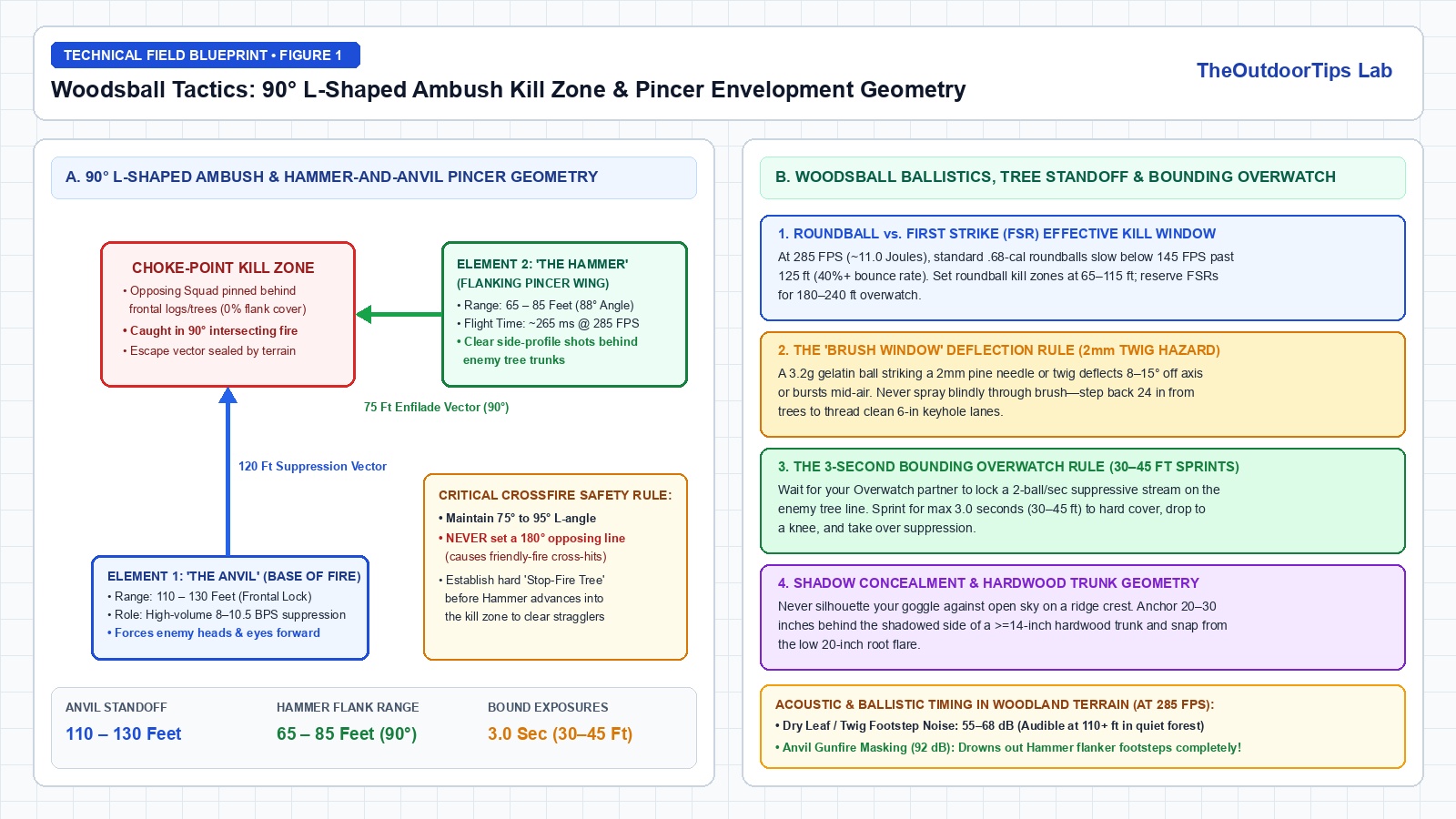
2. Core Formations: The 90° L-Shaped Ambush & Hammer-and-Anvil Pincer
A tree trunk is only one-dimensional cover: a 16-inch oak tree completely blocks paintballs arriving from 12 o’clock, but offers zero protection against paintballs arriving from 3 o’clock or 9 o’clock. Every formation in modern woodsball tactics is designed to manufacture that 90-degree perpendicular angle.
A. The 90-Degree L-Shaped Ambush (Defensive Choke-Point Trap)
When defending a bridge, creek crossing, village road, or ridge trail, split your 4-to-6-player squad into two perpendicular legs forming the letter “L” around a natural terrain funnel:
- The Short Leg (The Anvil / Frontal Stopper @ 110–130 Feet): Position two heavy-volume shooters directly down the axis of the trail behind solid hardwood cover or a log barricade. Their job is to initiate the ambush first, fixing the enemy squad’s attention forward and forcing them to dive behind the trailside trees facing 12 o’clock.
- The Long Leg (The Flanking Kill Wing @ 65–85 Feet): Position two to three disciplined marksmen concealed in low brush or elevation parallel to the trail at an 85-to-95-degree angle. Because the enemy squad has just taken cover against the Anvil’s 12 o’clock fire, their backs and shoulders are 100% exposed to the Long Leg from 70 feet away (~265 ms paintball flight time).
- The Point-Scout Discipline Rule: Experienced woodsball teams send a solitary point scout 40 feet ahead of the main body to draw premature fire. Your squad leader must enforce strict trigger discipline—let the lead scout pass through the center of the kill box unharmed, and trigger the ambush only when 60% or more of the main squad enters the 75-foot enfilade zone.
B. The Hammer-and-Anvil Pincer (Offensive Envelopment)
When attacking an entrenched enemy bunker complex or hilltop fort, never charge straight up the center. Instead, deploy a dynamic Pincer Movement: your Center/Base-of-Fire element (“The Anvil”) engages from 115 to 130 feet with sustained suppressive paint and smoke grenades to lock the defenders’ barrels forward, while one or two fast-moving flanking wings (“The Hammers”) use dead-space gullies, creek beds, or thick boundary brush to wrap around the left and right tape lines simultaneously. Coordinate the final pincer collapse using standardized paintball field communication callouts or FRS/GMRS throat-mic radio checks so both wings strike within 3 seconds of each other.
3. Master Tactical Matrix: Woodland Scenarios, Physics & Field Counters
Reference the diagnostic matrix below to solve the six most common woodland combat breakdowns, understand the underlying ballistic or acoustic failure, and equip the right scenario gear.
| Condition / Scenario | Root Cause / Physics Mechanism | Armorer Fix / Tactical Counter | Recommended Tool / Gear Link |
|---|---|---|---|
| 1. Paintballs Bouncing Off Opponents at 130+ Feet | Aerodynamic drag (Cd ≈ 0.47) slows .68-caliber roundballs from 285 FPS to < 140 FPS (< 3.0 Joules) past 125 ft; soft woodland fabric absorbs impact energy without shell fracture. | Pull L-ambush kill zones inward to 65–110 ft for roundball, or load fin-stabilized First Strike Rounds (FSR) in a magfed platform for 200-foot overwatch accuracy. | AmazoneBay |
| 2. Flanking Wing Spotted by Acoustics Before Reaching 90° | Flankers sprinting across dry leaf litter generate 62–68 dB of crunching noise plus 75 dB of plastic paintball pod rattle inside half-empty harnesses during quiet lulls. | Move only during 92 dB Anvil firing bursts, roll heel-to-toe along damp soil/moss, and switch to spring-fed magazines or strapped tactical pod pouches to eliminate rattle. | AmazoneBay |
| 3. Thermal Goggle Fogging in Humid Forest Canopy | 85%+ woodland relative humidity combined with heavy respiratory heat during uphill flanking sprints saturates single-pane lenses or worn foam seals. | Equip an ASTM F1776 dual-pane thermal lens mask (V-Force Grill 2.0 / JT Proflex) paired with a micro-fan or anti-fog spray so vision never fails inside the ambush zone. | AmazoneBay |
| 4. Squad Pinned Down by Entrenched Heavy MG Bunker | Opposing defender has clear 100-foot sightlines over open ground with zero natural dead-space gullies for an unmasked flanking approach. | Deploy a cold-burning pull-ring tactical smoke grenade 25 feet in front of the enemy bunker (blinding their wide field of view, not yours) to screen a 3-second pincer bound. | AmazoneBay |
| 5. Shots Breaking in Foreground Brush (“Self-Chopping”) | Shooter is pressing barrel into leafy branches or using brittle tournament-grade shell paint (0.5mm shell wall) that ruptures on minor foliage contact. | Step back 24 inches from cover to shoot through clean 6-inch keyhole windows and load thicker, resilient woodsball-grade paint (Valken Graffiti / GI 3-Star). | AmazoneBay |
| 6. Loss of Contact Between Anvil & Hammer Wings | Dense timber and ridge topography attenuate unamplified human shouts by 35+ dB over 180-foot flanking separations, causing mistimed pincer attacks. | Equip 2-watt FRS/GMRS two-way radios with low-profile acoustic tube earpieces and PTT (Push-To-Talk) finger switches taped to the foregrip. | AmazoneBay |
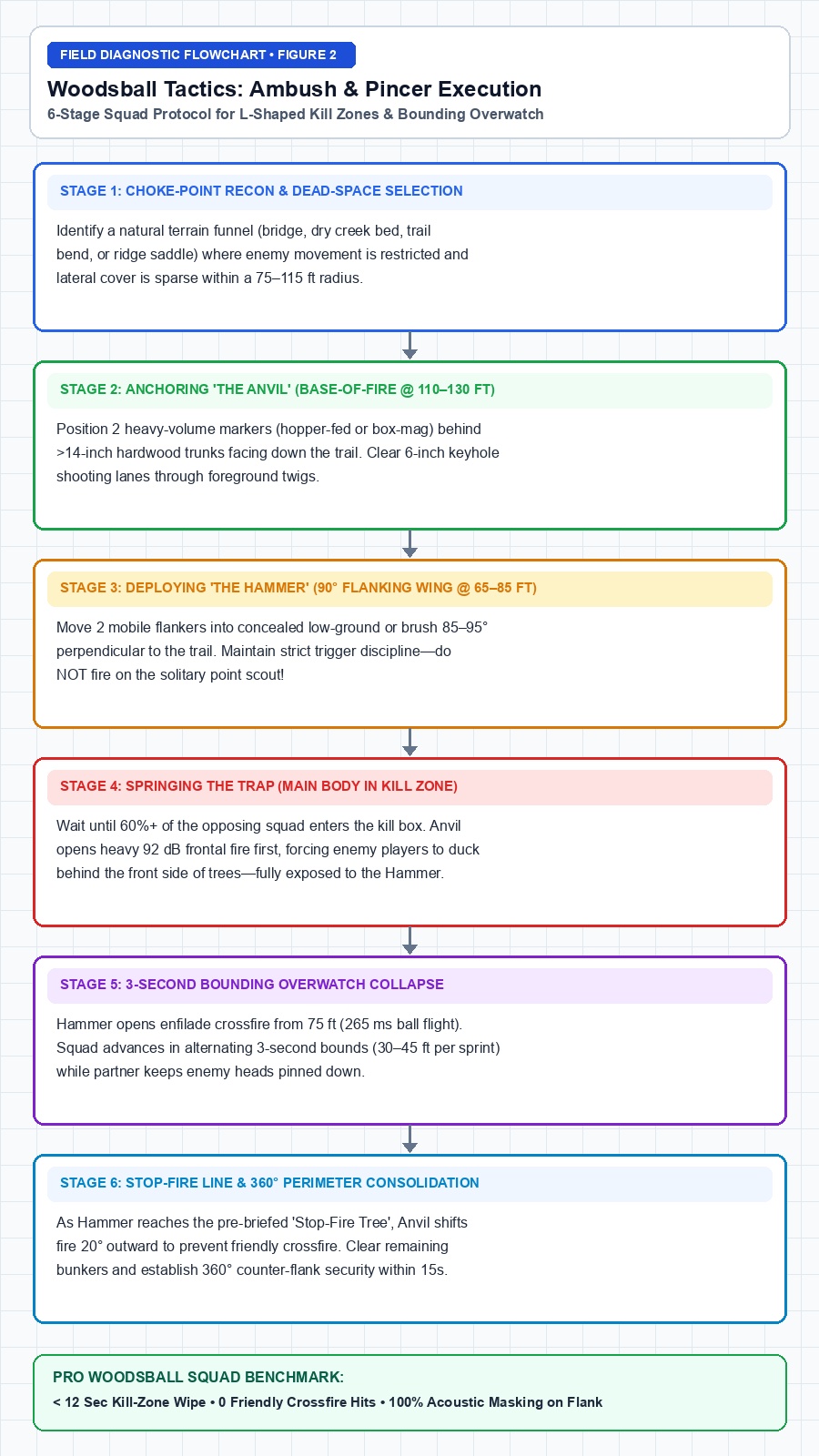
4. Step-by-Step Field Execution: Setting & Springing a Woodsball Ambush
Whether you are commanding a 4-player fireteam in a weekend rec-woods match or a 12-player tactical unit in a 24-hour scenario event, execute this 6-step protocol to turn every trail encounter into a one-sided wipe.
Phase 1: Choke-Point Recon & Dead-Space Selection
Never set an ambush in uniform, flat timber where an enemy squad can spread out 150 feet wide. Push 60 seconds ahead of the main engagement zone and locate a natural terrain funnel—a wooden footbridge, a breach in a brush wall, a dry creek crossing, or a narrow saddle between two steep gullies. The ideal kill zone stretches 50 to 70 feet long with sparse cover inside the funnel and dense, shadowed hardwood cover along one flank.
Phase 2: Anchoring “The Anvil” (Base-of-Fire Element @ 110–130 Feet)
Assign your two highest-capacity markers (such as a Planet Eclipse Etha 3M / Emek with a 200-round loader or a box-fed support gunner) to the Base-of-Fire position looking straight down the length of the funnel from 110 to 130 feet away. Have each shooter step back 24 inches into the root shadow of a 14-inch+ hardwood tree, snap from the low 20-inch root flare (never standing upright at 60 inches where defenders scan first), and identify two clean 6-inch keyhole lanes through the brush.
Phase 3: Deploying “The Hammer” (Flanking Pincer Wing @ 65–85 Feet)
Send two fast, low-profile flankers (ideally running compact magfed carbines or lightweight mechanical markers with zero pod rattle) 80 to 100 feet off the trail to form an 85-to-95-degree L-angle overlooking the center of the kill box from 65 to 85 feet away. Before concealing themselves in low ferns or behind a ridge lip, the Hammer and Anvil leaders must agree on a visual “Apex Trigger Landmark” (e.g., a dead white birch tree in the center of the trail) and a “Stop-Fire Boundary Tree” so the two elements never shoot into each other.
Phase 4: Trigger Discipline & The 2-Stage Ambush Initiation
- Let the Point Scout Pass: As the opposing point man walks cautiously into the funnel, every finger stays off the trigger and every barrel stays motionless in the shadows (human peripheral vision detects barrel movement 5x faster than stationary camouflage shapes).
- Anvil Fires First (0.0 – 2.5 Seconds): The moment the main enemy body reaches the Apex Trigger Landmark, the Anvil opens heavy 92 dB suppressive fire down the trail. Instinctively, the entire opposing squad dives behind the trailside trees facing the Anvil.
- Hammer Sweeps the Exposed Flank (2.5 – 10.0 Seconds): Two seconds after the Anvil pins the enemy’s eyes forward, the Hammer erupts from the 90-degree flank at 70 feet. Because the opposing players are crouched with their backs and side ribs completely exposed to the Hammer’s sightline, the flanking wing eliminates the entire pocket from back-to-front in seconds.
Phase 5: 3-Second Bounding Overwatch Collapse & 360° Consolidation
If one or two surviving defenders retreat into deeper cover, transition immediately into Alternating Bounding Overwatch (“Leapfrogging”). Player A shouts “COVERING!” and fires a steady 2-ball-per-second stream directly at the defender’s tree edge while Player B shouts “MOVING!” and sprints for a maximum of 3.0 seconds (30 to 45 feet) to the next hard cover trunk. Why 3 seconds? Because it takes a pinned defender roughly 1.5 seconds to realize the runner is moving and 1.5 seconds to snap out, acquire the runner through timber, and lead a 285 FPS shot. By diving behind cover before 3.0 seconds elapse, Player B is untouchable. Once the position is cleared, immediately establish a 360-degree security perimeter within 15 seconds to defeat enemy reinforcements responding to the gunfire.
Minimum Engagement Distances (MED), Surrender Rules & Crossfire Geometry
When executing close-range stealth flanks in woodsball tactics, strictly observe field Minimum Engagement Distance (MED) rules—typically 15 to 20 feet for standard 280–290 FPS roundball and 30 to 50 feet for markers chronographed with First Strike Rounds (FSR). When a stealth flank brings you within 15 feet of an unsuspecting opponent’s back, offer a clear vocal “Surrender or Bunkered!” call or aim a single shot at the lower pod pack or boot rather than the neck or head. Never position two friendly pincer wings at a 180-degree opposing angle across a narrow trail; always maintain an 80-to-95-degree L-geometry so missed shots travel safely into uninhabited forest backdrop.
5. Armorer Workbench: Essential Woodsball Ambush & Overwatch Gear
Equipping your squad with anti-fog thermal optics, rattle-free magazine/pod harnesses, and reliable mechanical or magfed markers ensures your ambush never fails due to equipment noise or fogged lenses. For deeper maintenance on anti-fog optics, review our technical guide on how to reduce paintball mask fogging.
Planet Eclipse EMF100 / Etha 3M Gamma Core Platform
Powered by the 135 PSI Gamma Core spool drivetrain for whisper-quiet acoustic signature in timber, zero battery dependency, and instant compatibility with both roundball and First Strike Rounds.
V-Force Grill 2.0 / JT Proflex Thermal Woodsball Goggle
Low-profile, non-glare matte visor geometry with dual-pane thermal lenses and high-ventilation mouth skirts that prevent fogging in 90% woodland humidity while projecting clear squad calls.
Midland GXT1000VP4 GMRS Tactical Radio & PTT Headset
Waterproof 50-channel GMRS radio kit with whisper-sensitive throat/lapel microphones that synchronize your Anvil Base-of-Fire and 90-degree Hammer flankers across dense forest ridges.
Maddog / Condor MOLLE Tactical Chest Rig & Remote Coil
Transfers your 68/4500 HPA bottle to a rear hydration pouch via a 3000+ PSI coiled remote line, shaving 2.2 pounds off your marker for tireless flanking sprints and low-crawl ambushes.
6. Field Demonstration: Woodsball Flanking, Camouflage & Squad Ambush Video
Watch the live woodland tactical demonstration below to see how experienced scenario players use tree-shadow standoff, keyhole brush windows, and synchronized base-of-fire suppression to execute 90-degree flank eliminations.
Angles Beat Volume: Why a 4-Player Pincer Outguns a 15-Player Trail Mob
In every scenario event and woodland tournament we referee, the squad that wins the forest is never the one burning cases of paint at 160 feet down the center of the main trail. By enforcing disciplined woodsball tactics—splitting your unit into a 120-foot Anvil Base-of-Fire and a 75-foot 90-degree Hammer Flanking Wing, stepping back 24 inches into tree shadows to thread clean keyhole lanes, and advancing in strictly timed 3.0-second bounding overwatch sprints—a coordinated 4-player fireteam can systematically dismantle opposing groups three times their size.
Before your next scenario mission, brief your squad on your Apex Trigger Landmark, Stop-Fire Boundary Tree, and radio callsigns at the staging table.
7. Frequently Asked Questions: Woodsball Tactics & Ambush Mastery
1. What is the ideal engagement distance for a roundball woodsball ambush?
For standard .68-caliber roundballs chronographed at 280 to 290 FPS (~11.0 Joules), set your ambush kill zone between 65 and 115 feet. Beyond 125 feet, aerodynamic drag drops roundball impact velocity below 145 FPS, causing over 40% of hits to bounce off loose woodland camouflage or tactical vests without breaking.
2. Why do we use a 90-degree L-shaped ambush instead of setting up on both sides of a trail?
Setting up friendly shooters directly across from each other at a 180-degree angle across a trail creates a lethal friendly-fire crossfire hazard where missed paintballs hit your own teammates. A 90-degree L-shaped ambush places the Anvil Base-of-Fire down the trail axis (12 o’clock) and the Hammer Flanking Wing at 3 o’clock or 9 o’clock, creating intersecting fire into the kill zone while all missed shots travel safely into empty forest.
3. How does the 3-second bounding overwatch rule work in woodsball tactics?
During a bounding overwatch advance, your stationary partner suppresses the enemy tree line at 2+ balls per second while you sprint from cover to cover for a maximum of 3.0 seconds (30 to 45 feet). Because it takes a pinned opponent roughly 1.5 seconds to spot a runner in timber and another 1.5 seconds to emerge, aim, and lead a 285 FPS paintball, diving behind hard cover under 3 seconds prevents you from being shot in transition.
4. How do I shoot through thick forest brush without my paintballs breaking early?
Never press your barrel into leafy branches and spray blindly—even a 2-millimeter twig will deflect or shatter a 3.2-gram paintball. Instead, step back 20 to 30 inches behind your tree or brush screen, locate a clean 6-inch “keyhole window” through the foliage, and thread single shots or tight 2-ball bursts using resilient woodsball-grade paint.
5. How can a flanking player move silently across dry leaves in the woods?
Dry leaves crunch at 58 to 68 dB, which carries over 100 feet in quiet timber. Instead of trying to tip-toe slowly during silent lulls, coordinate with your Base-of-Fire (“Anvil”) gunners to fire sustained 92 dB bursts—moving aggressively during their gunfire completely masks your footsteps. Additionally, step onto damp moss, exposed roots, or rocks whenever possible and secure half-empty pods so they never rattle.
Recon & Concealment Companion: Equip your forward ambush scouts with our Paintball Ghillie Suit Camouflage & Bushcraft Guide to reduce visual detection distance below 22 feet.
Big-Game Command Companion: Scaling these squad formations up to a 500-player 24-hour event? Read our Scenario Paintball Command: Leading Big Games Guide for 50/30/20 force allocation and 10-minute respawn wave synchronization.
Playing Solo Without a Squad? Learn how to use the 80% rental center cluster as a natural anvil and execute back-to-front wide-tape sweeps in our One-Man Army Walk-On Paintball Tips Guide.
Operating After Dark? Master low-light strobe ambushes and 395 nm UV tracer stream discipline in our Night Paintball Games: Tracer Units & Flashlight Tactics Guide.