24-Hour Big-Game & Scenario Operations • TOC Command, Respawn Math & QRF
Field Execution at a Glance: Scenario Paintball Command & Big-Game Mechanics
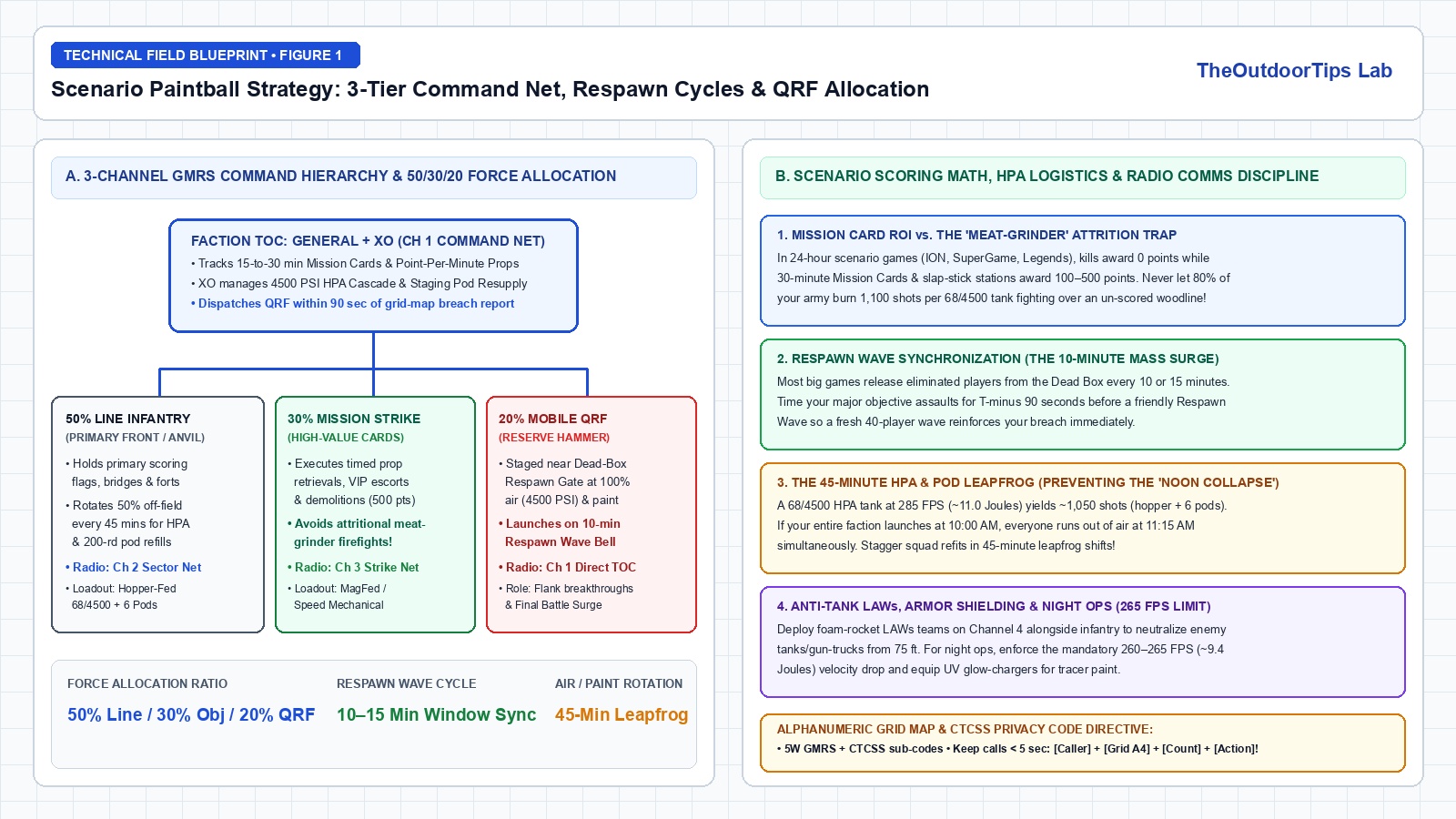
Winning a 200-to-2,000-player big game with high-percentage scenario paintball strategy requires treating your faction as a logistical engine rather than a mob: split your roster into a strict 50/30/20 task architecture (50% Line Infantry, 30% Objective Strike Teams, 20% Mobile Quick Reaction Force), synchronize major bunker breaches 90 seconds before the 10-minute Dead-Box Respawn Wave bell, and enforce a 45-minute HPA/pod leapfrog rotation so your 68/4500 tanks (~1,050 shots at 285 FPS / ~11.0 Joules) never run dry simultaneously.
- Mission Card ROI vs. The “Meat-Grinder” Trap: Individual eliminations award 0 points in scenario rulebooks, whereas 30-minute timed Mission Cards and slap-stick flag stations award 100 to 500 points. Never allow your objective strike units to burn air fighting over an un-scored center woodline.
- Preventing the “11:30 AM Faction Collapse”: When an entire faction walks onto the field at the 10:00 AM horn with a 68/4500 tank (~1,050 shots), 70% of the army runs out of air and paint between 11:00 and 11:30 AM. Stagger squad refits in 45-minute leapfrog shifts so the front line never collapses.
- Fatal Command Error to Avoid: Never put every squad on a single FRS/GMRS radio channel (which creates continuous crosstalk static during firefights) and never leadfrom the front bunker with a marker in your hands instead of managing the Tactical Operations Center (TOC) map board.
In our field tests, scenario command clinics, and 24-hour big-game refereeing across events like Invasion of Normandy (ION), SuperGame, and Legends, we see the exact same strategic collapse every season: one General treats a 500-player scenario game like a giant team deathmatch, sends 90% of their roster into a deafening center-field firefight over a worthless ridge, and loses on the scoreboard by 4,500 points to an opponent that quietly completed 88% of its timed Mission Cards and controlled the slap-stick timers.
Mastering big-game scenario paintball strategy is an exercise in command-and-control communications, respawn-wave mathematics, and high-pressure air (HPA) logistics. Whether you have been appointed Faction General, Executive Officer (XO), or Squad Leader for your local team, integrate this command manual with our tactical playbooks on woodsball ambush and pincer formations, paintball ghillie suit camouflage and bushcraft, paintball field communication callouts, and our equipment guides to the best woodsball paintball guns and best carbon-fiber HPA paintball tanks.
1. The Mathematics of Scenario Scoring: Mission ROI, Respawn Waves & Air Decay
Unlike a 5-on-5 NXL speedball point where eliminating all five opponents wins the game, a 24-hour big game is governed by continuous respawn loops, point-per-minute territory clocks, and pneumatic air depletion. Every decision in scenario paintball strategy rests on three mathematical realities:
- Point-Per-Minute Slap-Sticks vs. Timed Mission Cards: In standard scenario scoring, shooting an opposing player only removes them from the sector for 10 to 15 minutes (their walk to the Dead Box and insertion wave)—it adds zero points to your faction score. Conversely, flipping a central electronic slap-stick box awards 2 to 5 points per minute (120 to 300 points per hour), and completing a 30-minute Field Producer Mission Card (such as escorting a pilot, recovering a nuclear prop crate, or raising a flag at Grid C4 at 2:15 PM) awards 250 to 500 points instantly. Therefore, trading 30 eliminations in an un-scored swamp while missing a 400-point prop extraction is a catastrophic strategic loss.
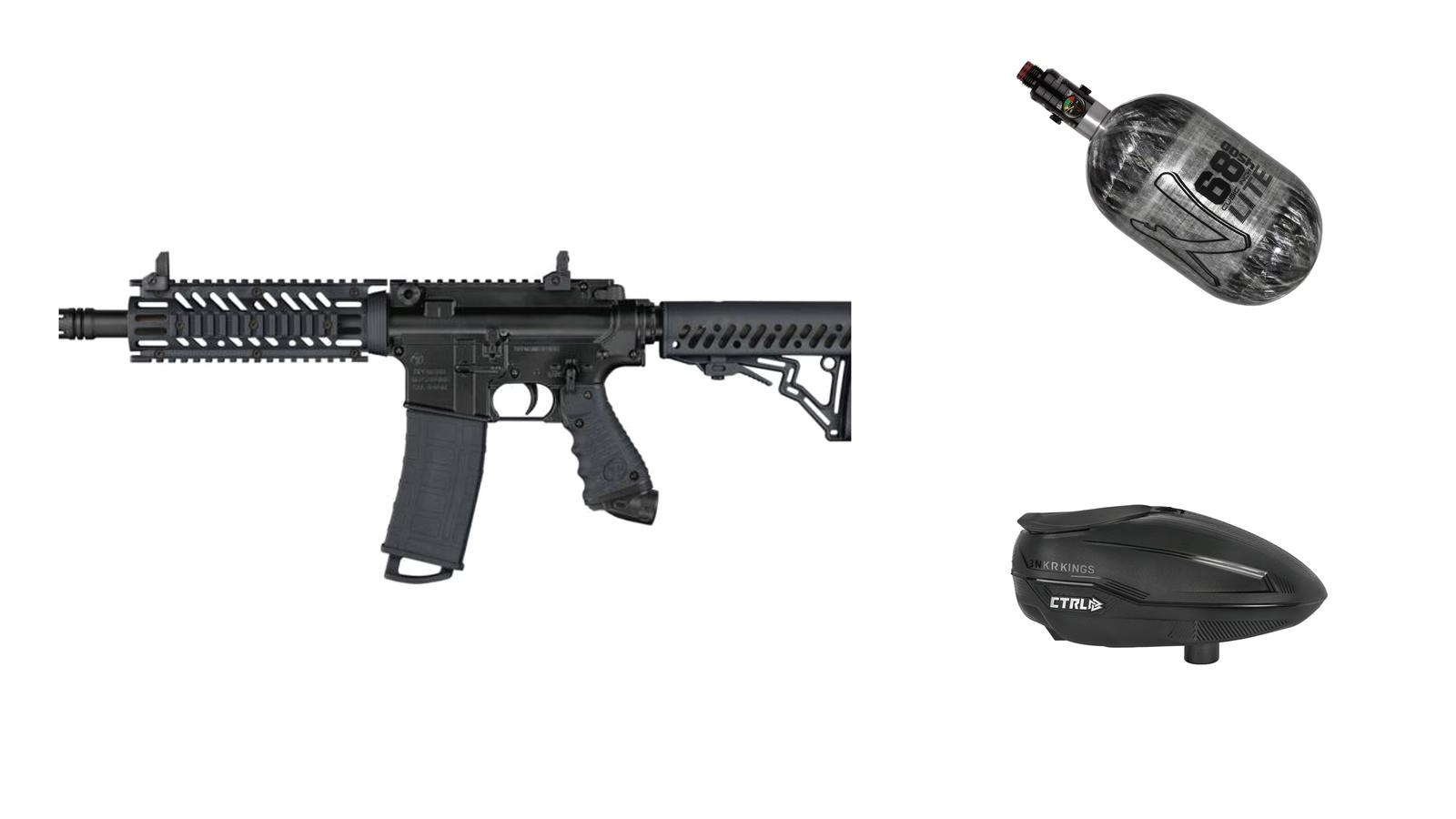
- The 68/4500 HPA Depletion Clock (“The 11:30 AM Collapse”): A modern spool or mechanical woodsball marker (such as a Planet Eclipse EMF100 or Etha 3M operating at 135 PSI with a 68ci / 4500 PSI carbon-fiber tank) yields roughly 1,000 to 1,150 shots at 285 FPS (~11.0 Joules)—enough to shoot a 200-round loader plus 4 to 5 pods. In an active firefight, an average scenario player expends 18 to 22 paintballs per minute, exhausting their entire air and paint load in 45 to 60 minutes. When an unorganized General sends 100% of their army onto the field at the 10:00 AM opening horn, 75% of the faction runs dry and walks off to the staging area simultaneously between 11:00 and 11:30 AM, gifting the entire map to the enemy for 40 minutes.
- Respawn Wave Pulse Physics: Big-game referees release eliminated players from the Insertion / Dead Box on a strict 10-minute or 15-minute bell cycle (e.g., on the :00, :10, :20, :30, :40, and :50 of every hour). Launching an attack on an enemy fort 2 minutes after an enemy respawn wave releases means you are charging headfirst into 45 freshly re-inserted defenders. Launching that exact same attack 90 seconds before your own friendly respawn bell means enemy defenders you eliminate are locked in the Dead Box for a full cycle while your own insertion wave surges into the breach behind you.
2. Master Scenario Paintball Strategy & Diagnostic Lookup Matrix
Use our field-tested command matrix below to diagnose the six most common scenario army breakdowns, understand the underlying logistical or tactical mechanism, and equip the right command gear:
| Condition / Scenario Breakdown | Root Cause / Logistical Mechanism | Commander Fix / Tactical Counter | Recommended Tool / Gear Link |
|---|---|---|---|
| 1. Radio Net Jammed by Continuous Crosstalk Static | Putting 15+ squads on one FRS/GMRS channel causes simultaneous PTT key-ups (heterodyne interference) and drowns out urgent TOC mission dispatches. | Split comms into a 4-Channel GMRS architecture (Ch 1 Command, Ch 2 Line, Ch 3 Strike, Ch 4 Armor/QRF) with CTCSS privacy tones and 5-second call limits. | AmazoneBay |
| 2. “11:30 AM Faction Collapse” (Empty Front Line) | 100% of the faction deployed at 10:00 AM; after 60 minutes of shooting (~1,050 balls per 68/4500 HPA tank), the entire army walks off to refill air at once. | Enforce a 45-minute Leapfrog Rotation and stage a mobile pod/microfiber resupply bin at the forward Respawn Gate so players reload without leaving the field. | AmazoneBay |
| 3. Timed 30-Minute Mission Cards Expiring Unfinished | General tries to pull squads out of active firefights to run errands; pinned squads cannot disengage or locate obscure prop coordinates in time. | Dedicate 30% of your roster to fast MagFed/Mechanical Strike Teams (EMF100 / TMC) whose sole job is executing timed Mission Cards via Grid Map routes. | AmazoneBay |
| 4. Enemy Armor / Gun-Trucks Rolling Through Front Line | Scenario tanks and UTV armor are immune to .68-caliber paintballs; infantry panics and retreats when a mobile bunker pushes down a road. | Pair every sector with a 2-man Anti-Tank (AT) LAWs rocket team on Channel 4; strip the enemy tank’s infantry screen with paint, then land a 75-ft foam rocket hit. | AmazoneBay |
| 5. Friendly-Fire Chaos & Blindness During Night Ops | Players wear dark daytime smoke lenses after sunset, cannot identify friendly arm-tape colors in timber, and fire over the 265 FPS night safety cap. | Swap to Clear or HD Amber thermal lenses at dusk, chrono down to 260–265 FPS (~9.4 Joules), use UV glow-charged tracer paint, and enforce verbal Challenge/Password codes. | AmazoneBay |
| 6. Losing the “Final Battle” Double-Point Slap-Sticks | Army burns all remaining paint 40 minutes before the final horn and gets overrun during the last 15 minutes when slap-stick multipliers double. | Order a mandatory faction-wide 4500 PSI air top-off 30 minutes before Final Battle, then launch your 20% QRF at T-minus 12 minutes to flip and hold the scoring boxes. | AmazoneBay |
3. Step-by-Step Field Execution: Commanding a 24-Hour Scenario Army
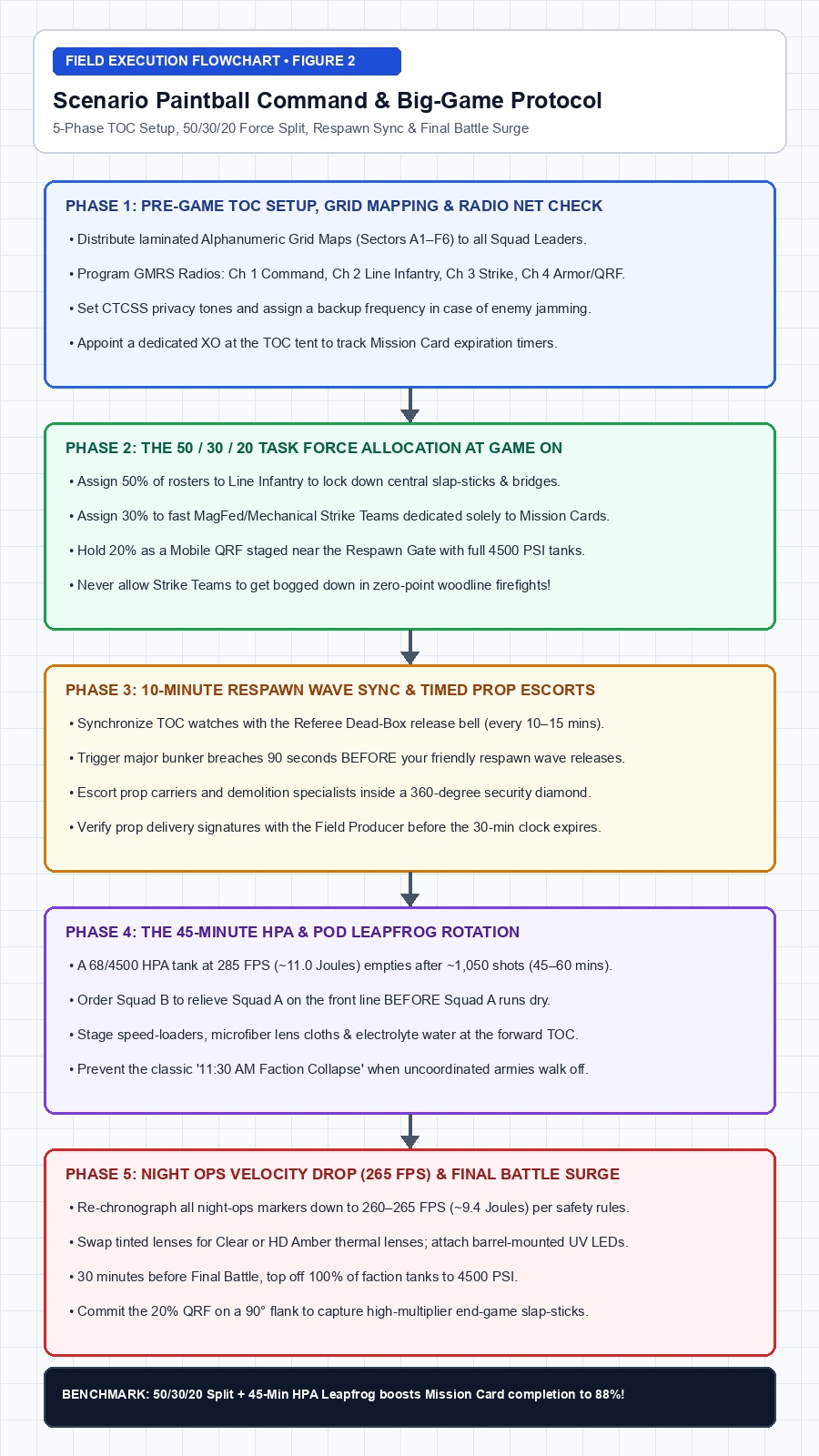
Whether you are leading a 150-player woodsball faction or commanding a 1,000-player D-Day landing, execute this five-phase command protocol to control the map and dominate the scoreboard:
Phase 1: Pre-Game TOC Setup, Alphanumeric Grid Mapping & 4-Channel GMRS Net
Two hours before Game On, establish a dedicated Tactical Operations Center (TOC) tent right outside the primary insertion gate. Never let your General wander into the woods alone without a map board; appoint a calm Executive Officer (XO) who remains inside the TOC 100% of the time with a master dry-erase Alphanumeric Grid Map (dividing the field into Sectors A1 through F6) and a countdown timer for every active Mission Card. Issue laminated pocket grid maps to every Squad Leader and program all 5-Watt GMRS radios into four segregated nets with CTCSS privacy sub-codes: Channel 1 (TOC Command & QRF), Channel 2 (Line Infantry Sectors), Channel 3 (Objective Strike Teams), and Channel 4 (Armor / Anti-Tank LAWs). Enforce a strict 5-second radio transmission rule: “[Caller] to TOC — 15 enemy pushing Bridge at Grid C3 — requesting QRF flank.”
Phase 2: The 50 / 30 / 20 Force Allocation Rule at Game On
Divide every registered team on your roster into three specialized task forces before the opening horn sounds:
- 50% Line Infantry (“The Anvil”): Heavy hopper-fed squads tasked with holding the main road intersections, fort walls, and central point-per-minute slap-stick boxes. Their job is territorial control and fixing the enemy main body in place.
- 30% Objective Strike Teams (“The Scalpel”): Fast, disciplined 4-to-8-player squads running MagFed carbines (with First Strike Rounds) or lightweight mechanical guns. These units are strictly forbidden from joining static center-field firefights; they slip around the boundary tape lines to complete timed 300-to-500-point Field Producer Mission Cards, VIP escorts, and prop retrievals.
- 20% Mobile Quick Reaction Force (“The Reserve Hammer”): An elite, high-mobility unit staged right at the forward Respawn Gate with topped-off 4500 PSI tanks and full pod packs. Whenever a Line Infantry leader reports a breach on Channel 1—or when a high-value supply drop lands—the TOC dispatches the QRF within 90 seconds to hit the enemy flank at a 90-degree angle.
Phase 3: 10-Minute Respawn Wave Synchronization & Prop Escort Diamonds
Synchronize the TOC master clock with the Head Referee’s Dead-Box insertion whistle (typically every 10 or 15 minutes). When planning a major assault on a fortified castle or village slap-stick, order your attacking squads to stage in concealed cover and initiate their breach at T-minus 90 seconds before your friendly Respawn Wave releases. Every defender your first wave trades with is locked in the enemy Dead Box for 10+ minutes, while 30 to 50 freshly respawned friendly players pour out of your insertion gate 90 seconds later to cement the capture. When escorting an unarmed VIP or heavy prop crate back to the TOC, surround the carrier in a 4-player 360-degree security diamond (Point Scout 35 feet ahead, Left/Right Flank Guards 25 feet wide, Rear Guard 25 feet behind) so a solitary ghillie sniper cannot shoot the prop carrier.
Phase 4: The 45-Minute HPA & Pod Leapfrog Rotation
To eliminate the dreaded 11:30 AM Faction Collapse in scenario paintball strategy, stagger your Line Infantry into Shift A and Shift B. At the 40-minute mark of continuous play—before Shift A’s 68/4500 tanks drop below 800 PSI or their paintball pods run dry—order Shift B forward to physically bump Shift A off the bunker line. Shift A then rotates back to the staging area for air, paint, hydration, and thermal goggle lens cleaning, returning 25 minutes later to relieve Shift B. Even better, station two non-playing support crew members at the insertion gate with a 1,000-ball pod hauler caddy and dry microfiber towels so eliminated players can reload during their 10-minute respawn wait without walking all the way back to their cars.
Phase 5: Night Operations (265 FPS Cap) & The Final Battle Surge
Thirty minutes before sunset, order all night-operations squads to the chronograph station to dial marker velocity down to the mandatory scenario night cap of 260 to 265 FPS (~9.4 Joules), swap dark smoke lenses for Clear or HD Amber dual-pane thermal lenses, and establish a faction-wide verbal Challenge & Password (e.g., Challenge: “Thunder” / Response: “Flash”) to prevent friendly fire in dark timber. On Sunday afternoon, 35 minutes before the Final Battle horn—when slap-stick point multipliers frequently double—order a mandatory faction-wide 4500 PSI air top-off. Ignore cosmetic center-of-bridge ego fights during the last 12 minutes; instead, launch your entire 20% QRF and 30% Strike Force on a synchronized 90-degree flank to flip and lock down the highest-scoring slap-stick boxes until the final whistle blows.
Anti-Tank LAWs Rocket Rules, Vehicle Standoff Distances & Night Velocity Caps
When operating around motorized scenario tanks, gun-trucks, or ATVs, strictly maintain the mandatory 15-to-25-foot vehicle safety perimeter—never crawl underneath, climb onto, or place props in the path of a moving vehicle. Anti-Tank (AT) operators firing 2-inch foam Nerf/Valken rockets from compressed-air LAWs launchers must chronograph below 170 to 200 FPS, never fire at individual infantry players, and only engage armored vehicles beyond the 50-to-75-foot minimum engagement distance (aiming at the lower hull, never into open driver viewports). For night games, strictly enforce the 260–265 FPS velocity reduction and never shine high-lumen tactical strobes directly into a referee’s eyes.
4. Armorer Workbench: Essential Scenario Command & Big-Game Gear
Equipping a scenario command staff and strike unit requires long-range GMRS radio communications, high-capacity 4500 PSI carbon-fiber air systems, and hands-free grid map navigation:
Midland GXT1000VP4 5W GMRS Radio + Acoustic PTT Headset
50-channel waterproof GMRS radio system with 142 CTCSS/DCS privacy codes and covert acoustic-tube earpieces that link your TOC General, Line Infantry, and QRF across 200-acre wooded maps.
Ninja Lite 68/4500 or 77/4500 Carbon-Fiber HPA Tank + Remote
Delivers 1,050 to 1,250 regulated shots per fill at 285 FPS (~11.0 Joules), preventing mid-mission air outs during 60-minute deep-woods pushes when paired with a coiled 3000+ PSI remote line.
Tactical Forearm Wrist-Coach Map Case & Pod Hauler Caddy
Keeps your laminated Alphanumeric Grid Map, radio channel matrix, and Mission Card timers strapped right to your non-gun forearm while staging 1,000-round pod haulers at the Respawn Gate.
5. Field Demonstration: Big-Game Scenario Paintball Command & Tactics Video
Watch this big-game scenario tactical breakdown illustrating how coordinated squad communication, objective tasking, and respawn surge timing turn the tide in massive woodland battles:
Logistics & Mission Cards Win Big Games—Not Center-Field Firefights
Every winning General we have worked with over two decades of 24-hour scenario paintball shares the same discipline: they never get hypnotized by the noise of the center woodline. By structuring your faction around a proven scenario paintball strategy—allocating 50% Line Infantry, 30% dedicated Mission Card Strike Teams, and a 20% Mobile QRF at the Respawn Gate, running a 4-channel GMRS radio hierarchy with an XO anchoring the TOC map board, and staggering 45-minute HPA/pod rotations—your army will outscore larger factions by thousands of points before the Final Battle horn even sounds.
Print and laminate your Alphanumeric Grid Maps and radio channel matrix before Friday check-in so every Squad Leader hits the ground synchronized at Game On.
6. Frequently Asked Questions: Scenario Paintball Strategy & Big-Game Command
1. How are points actually scored in a 24-hour scenario paintball game?
In almost all major big games, individual player eliminations award 0 points. Points are earned through two primary mechanisms: holding electronic Point-Per-Minute (PPM) slap-stick boxes or flag stations (typically awarding 2 to 5 points per minute controlled) and completing timed Field Producer Mission Cards (escorting VIPs, retrieving prop crates, or demolishing enemy structures for 100 to 500 points each).
2. What is the 50/30/20 rule in scenario paintball strategy?
The 50/30/20 force allocation rule divides a scenario faction into three distinct roles: 50% Line Infantry to hold primary bridges, forts, and slap-stick timers; 30% Objective Strike Teams dedicated exclusively to running timed high-value Mission Cards without getting bogged down in attritional firefights; and a 20% Mobile Quick Reaction Force (QRF) staged near the Respawn Gate to reinforce breaches or counter-flank enemy pushes within 90 seconds.
3. How do you prevent your scenario army from running out of air and paint at the same time?
A standard 68/4500 HPA tank at 285 FPS (~11.0 Joules) provides ~1,050 shots, which lasts 45 to 60 minutes of active combat. To prevent the entire faction from walking off the field simultaneously at 11:15 AM, command staff must enforce a 45-minute Leapfrog Rotation—sending fresh Squad B forward to relieve Squad A on the bunker line before Squad A runs dry—and stage bulk pod haulers right at the Respawn Gate.
4. How should a Scenario General set up team radio communications?
Never put an entire army on a single channel. Program 5-Watt GMRS radios into a 4-Channel Command Net with CTCSS privacy tones: Channel 1 for TOC Command & QRF Leaders, Channel 2 for Line Infantry Squad Leaders, Channel 3 for Objective Strike Teams, and Channel 4 for Armor & Anti-Tank LAWs units. Pair the radio net with a laminated Alphanumeric Grid Map (Sectors A1–F6) so every call takes under 5 seconds.
5. What equipment changes are required for scenario night operations?
For night operations in a 24-hour big game, players must re-chronograph their markers down to the mandatory night velocity cap of 260 to 265 FPS (~9.4 Joules), swap tinted daytime goggle lenses for Clear or HD Amber thermal lenses, use UV-charged glow tracer paintballs or red-lens administrative lights for map reading, and use verbal Challenge/Password callouts before engaging silhouettes in dark timber.
Weekend Rec-Ball Leadership: Scaling down from 200-player scenario command to Saturday walk-on games? Read our How to Play Paintball as a One-Man Army in Rec Ball Guide.