NXL Regulation • Voice Protocol & Callout Standards
Rapid Field Diagnostic: Speedball Vocal Systems & Callout Relays
Mastering structured paintball communication is the single greatest competitive multiplier in modern tournament play. While raw athleticism and gun skills dictate individual duels, vocal relays connect five isolated players behind inflatable bunkers into a unified, predatory machine. Over 75% of unexpected eliminations trace back not to lost gunfights, but to communication dropouts where players fail to call out opposing bunker wraps, live body counts, or crawling wire transitions.
In our tournament armorer clinics and competitive coaching sessions, players often obsess over marker rate-of-fire and barrel bore matching while completely neglecting tactical paintball communication mechanics. Yet on a regulation 120-by-150-foot NXL grid where multiple markers are firing 10.5 BPS ramping streams simultaneously, ambient sound pressure levels routinely exceed 95 decibels. Cutting through that sonic barrage requires diaphragm projection, acoustic mask alignment, and universally understood tactical vocabulary.
To master coordinated team strategies, align your voice protocols with our tactical manuals on back player paintball tactics, explore opening lane suppression in our breakdown of breakout lane shooting paintball drills, discover low-crawl wire advances in our guide to speedball snake player fundamentals, and analyze sideline aggression with our manual on dorito side paintball strategy.
⚡ Pro Gunfighting Progression: Once your lanes and callouts are locked in, train sub-240ms bunker exits and off-hand accuracy with our paintball snap shooting 50-ball daily drill guide.
1. The Acoustic Physics: Decibels, Sound Latency & Mask Venting
Understanding effective paintball communication begins with atmospheric acoustics. Sound travels through sea-level air at approximately 1,125 feet per second (343 meters per second). On a tournament field, a vocal shout from the back-center bunker requires roughly 100 to 135 milliseconds to reach a front player stationed at Snake 1 or Dorito 1—virtually instantaneous compared to the 420-millisecond flight time of an incoming 300 FPS paintball.
However, sound obeys the inverse-square law: acoustic energy dissipates rapidly over distance. A player shouting at 90 dB at the mouth drops to under 65 dB at 120 feet away. When combined with the continuous roar of electronic markers and the acoustic muffling of rigid goggle ear cups, soft voices become completely inaudible. Premier teams overcome this physical limitation by utilizing flexible, micro-perforated lower mask skirts (such as the JT Proflex) and anchoring their speech in short, high-contrast phonetic syllables.
To ensure your vision matches your vocal clarity on the grid, inspect your goggle thermal dual-pane assembly using our armorer walkthrough on how to change paintball lens, and calibrate your electronic marker trigger using our manual on how to install aftermarket trigger on Planet Eclipse.
2. Master Tactical Matrix: The 10 Critical Callouts Decoded
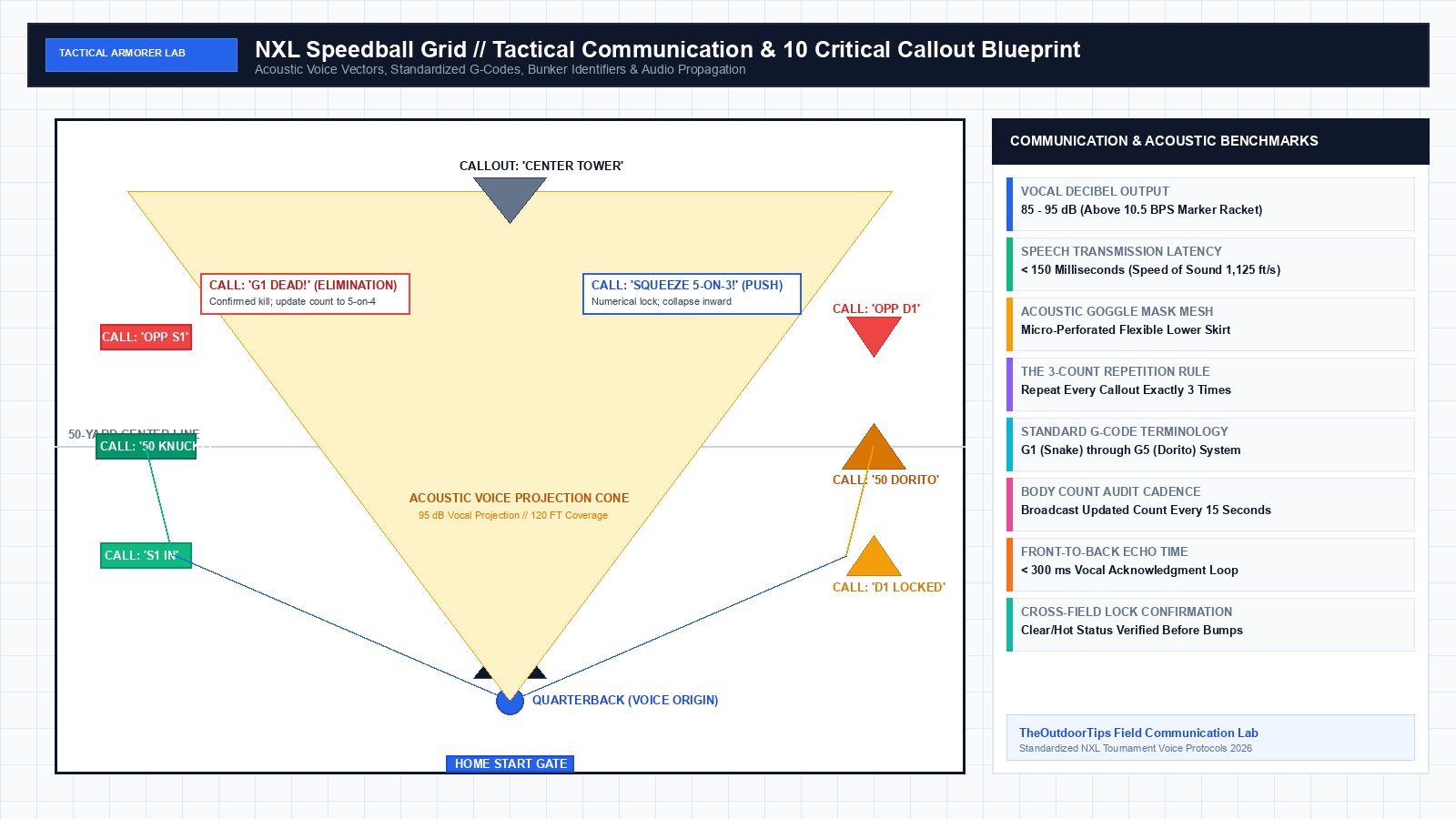
Tournament speedball uses a standardized shorthand system that replaces lengthy sentences with crisp, single-breath commands. The matrix below defines the 10 essential callouts every competitive paintball communication system must utilize, detailing the underlying field scenario, acoustic syntax, and tactical response.
| Callout Code | Tactical Field Scenario | Acoustic Syntax & Rule | Immediate Team Tactical Response |
|---|---|---|---|
| 1. “G1 DEAD!” | Opposing Snake 1 wire runner is hit and walks off the field. | Shout 3 times loudly: “G1 DEAD! G1 DEAD! G1 DEAD!” | Friendly snake player immediately advances past the 50; back gun shifts lane to center insert. |
| 2. “G5 DEAD!” | Opposing Dorito 1 wire attacker is eliminated off the break. | Shout 3 times: “G5 DEAD! G5 DEAD! G5 DEAD!” | Friendly D-side attacker sprints to 50 King Dorito; initiates elevated cross-field suppression. |
| 3. “SNAKE CRAWLING!” | Opposing snake player is actively belly-crawling between beam knuckles. | Call out specific destination: “SNAKE CRAWLING TO 2!” | Back-center and insert drop continuous 10.5 BPS paint onto the upcoming knuckle seam before runner arrives. |
| 4. “DORITO WRAPPING!” | Opponent steps around the outside flat base of a pyramid to shoot down the tape. | Shout: “D2 WRAPPING TAPE! WATCH TAPE!” | Front D-player tucks tight against inside seam; friendly back gun snaps out to eliminate exposed flank. |
| 5. “CENTER LOCKED!” | Opposing center giant or wedge bunker is suppressing your team’s forward routes. | Shout: “CENTER LOOKING SNAKE! CENTER LOCKED!” | Snake players freeze transitions; Dorito players capitalize on unmonitored lane to pinch center gunner. |
| 6. “5-ON-3! (LIVE COUNT)” | Periodic numerical body audit confirming current live player ratios on both sides. | Broadcast ratio every 15s: “WE ARE 5-ON-3! 5-ON-3!” | Eliminates passive hesitation; team mentally prepares to coordinate the closing field squeeze. |
| 7. “TAPE IS CLEAR!” | Back player confirms no opposing guns are monitoring the outside boundary line. | Shout directly to wire runner: “TAPE CLEAR! BUMP BUMP!” | Front attacker sprints into secondary bunker without looking back, confident the transit lane is safe. |
| 8. “RELOADING! (HOLD LANE)” | Back gunner drops off the lane for 2 seconds to execute a pod dump. | Shout: “RELOADING BACK! PICK UP MY LANE!” | Adjacent insert player immediately mirrors the suppression stream so opponents cannot slip through. |
| 9. “SQUEEZE!” | Team possesses overwhelming numbers (e.g., 5-on-2 or 4-on-1) and must finish the point. | Command shouted repeatedly: “SQUEEZE! SQUEEZE! SQUEEZE!” | All active players collapse inward, moving in unison with barrels rolling to eliminate remaining defenders. |
| 10. “PULLING FLAG!” | Designated runner enters opposing start base to hit the buzzer or grab the flag. | Shout: “I’M PULLING FLAG! CEASE FIRE!” | Teammates redirect barrels away from opposing base to prevent accidental friendly fire hits. |
3. Armorer Workbench: Essential Gear for Acoustic Voice Projection
Vocal performance on the speedball grid is heavily governed by equipment ergonomics. Rigid plastic masks act as acoustic mufflers, trapping your voice inside the goggle cavity where it echoes in your own ears while traveling less than 40 feet across the field. Upgrading to gear engineered specifically for acoustic clarity elevates team paintball communication instantly.
- Flexible Acoustic Goggle Mask (JT Proflex / Push Unite): Features a soft, rubberized lower skirt with wide micro-perforations directly in front of the mouth and ears. Allows unobstructed sound transmission up to 95 dB while maintaining full ASTM F1776 eye and face impact certification.
- Tactical Dry-Erase Field Playbook & Clipboard: Essential for pre-match staging, establishing standardized bunker numbers (G1-G5), and aligning your five-man roster on breakout voice calls before stepping onto the turf.
- Electronic Timer & Tournament Whistle: Essential coaching tools for drilling the 3-Count Echo Rule and measuring vocal response latencies during team practice scrimmages.
JT Proflex Tournament Goggle System (Acoustic Vent Skirt)
The gold standard in voice projection. Soft rubber lower mask eliminates speech echo, allowing calls to carry 120+ feet across high-BPS tournament gunfire.
Speedball Tactical Dry-Erase Coaching Board & Grid Matrix
Standardized field diagram board for assigning bunker codes, coordinating breakout cross-fires, and mapping team communication relays prior to tournament matches.
4. Step-by-Step Tactical Protocol: Executing the 4-Phase Vocal System
Deploying a high-performance paintball communication network requires systematic athletic discipline. Follow this four-phase coaching protocol during tournament matches to maintain total battlefield situational awareness.
Pre-Point Code Alignment & Diaphragm Projection
Before the 10-second buzzer, confirm the team’s bunker callout sheet at the pit staging table. Confirm whether the squad is using standard G-numbers (G1-G5) or custom team phonetic codes. Inhale deeply from the lower belly rather than the chest so your voice projects with 90+ dB power directly through the acoustic vents of your goggle skirt.
The Breakout Callout & Live Runner Confirmation
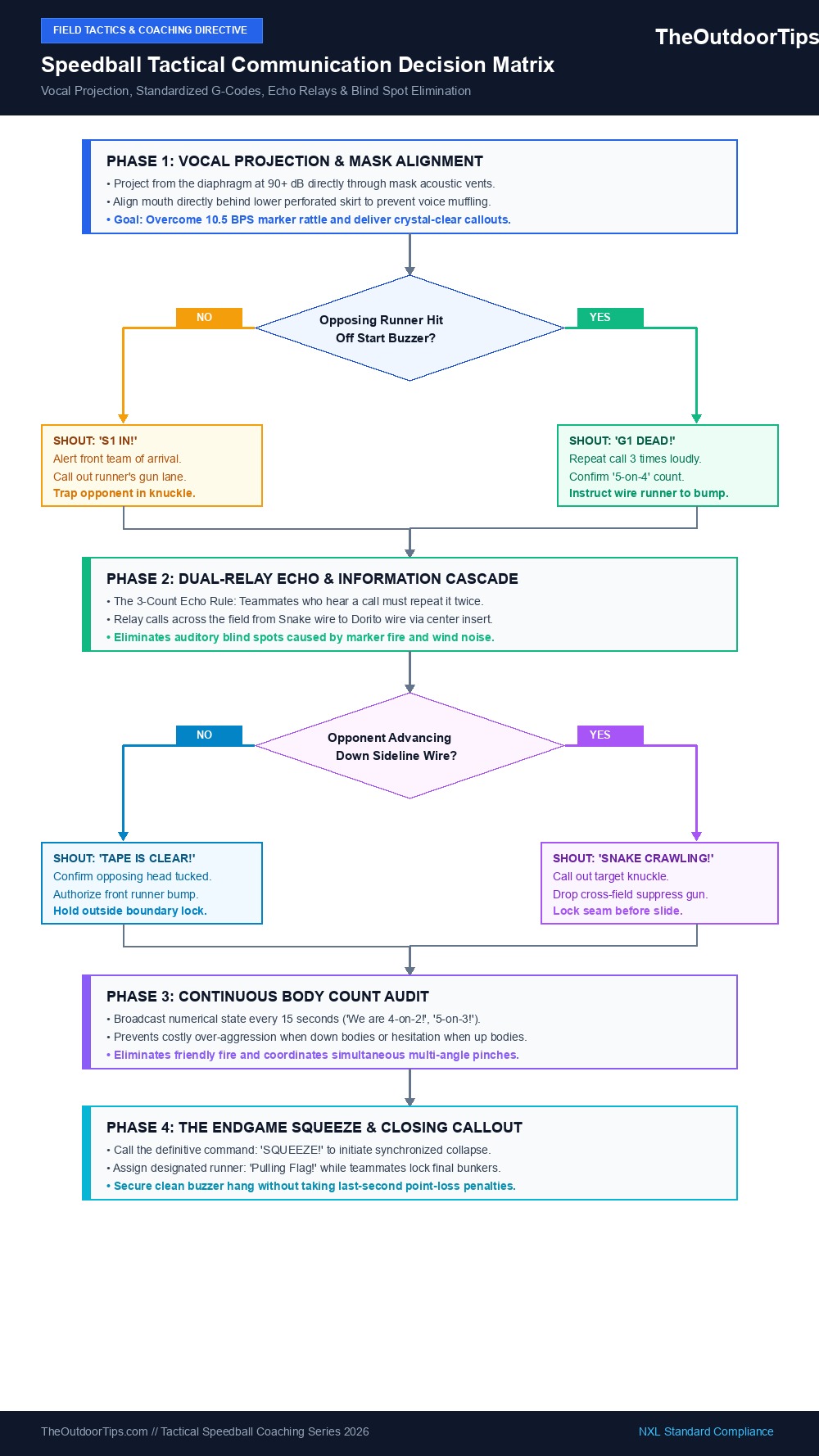
As the start horn sounds and initial 3.0-second breakout lanes finish, the back gunners must immediately broadcast opposing arrivals. If the opposing runner is eliminated in the open, scream: ‘G1 DEAD!’. If they successfully dive into bunker cover, scream: ‘S1 IN! S1 IN!’. Never assume teammates saw what you saw.
The 3-Count Echo Rule & Cross-Field Information Cascade
Every callout must be repeated three consecutive times by the originating player, and immediately echoed twice by the nearest teammate. Because players tucked in snake crawls cannot hear calls originating from the opposite Dorito sideline, the center insert player acts as an audio relay bridge, re-broadcasting calls across the width of the grid.
Continuous Body Audits & The Endgame Squeeze
Every 15 seconds, the back quarterback shouts the live ratio: ‘We are 4-on-2!’. When the opposing squad drops to one or two remaining defenders, command the final tactical phase: ‘SQUEEZE!’. This triggers all active guns to collapse forward simultaneously, closing firing angles and securing the point flag hang cleanly.
5. Video Walkthrough: Team Communication Drills & Echo Relays
Watch this professional tournament clinic demonstration showcasing live field communication drills, diaphragm voice projection, and the 3-Count Echo Rule under match conditions:
6. Four Fatal Communication Mistakes That Lose Tournament Points
Even elite divisional squads regularly surrender points due to fundamental voice breakdowns. In our tournament analysis, these four errors appear most frequently:
A player who shoots 1,000 rounds without uttering a word leaves their teammates operating in the dark. Your eyes see field gaps that your crawling teammates cannot see. Constant talking is as mandatory as pulling the trigger.
Muttering a callout once under your breath guarantees nobody heard you over 95 dB marker ramping. Enforce the 3-Count Rule: shout every piece of critical tactical data three distinct times with maximum vocal volume.
Yelling ‘He’s over there by the blue thing!’ forces teammates to guess. Use exact standardized nomenclature: ‘Dorito 2!’, ‘Snake Knuckle 3!’, or ‘Center Tower!’. Precision eliminates lethal hesitation.
Assuming your opposite wire teammate heard a callout across 120 feet of active cross-fire leads to disastrous flanks. The center insert gunner must immediately echo calls to bridge the acoustic gap between sidelines.
7. Final Coach Verdict: The Decisive Value of the Connected Grid
The Ultimate Competitive Multiplier
An elite paintball communication network transforms good individual paintball players into an unbeatable tournament team. When all five players communicate relentlessly—shouting G-numbers, echoing calls across the center, and auditing body ratios every 15 seconds—the field shrinks, opponents become trapped in their bunkers, and your front attackers can advance with absolute confidence.
Equip your squad with acoustic-vented goggle systems, drill the 10 Critical Callouts during every scrimmage, and let your voices dominate the tournament grid.
8. Frequently Asked Questions (FAQ)
Why is paintball communication more critical than individual shooting skills?
Because speedball fields feature multiple blind spots. A player tucked in a snake crawl cannot see what is happening on the opposite Dorito wire. Relaying live information coordinates simultaneous multi-angle cross-fires that eliminate opponents far more reliably than isolated 1-on-1 gun battles.
What does the term ‘G-Code’ or ‘G-Number’ mean in tournament paintball?
The ‘G’ system numbers opposing field positions from left to right (traditionally G1 on the snake wire through G5 on the dorito wire). Calling ‘G1 Dead!’ instantly communicates to all teammates that the opposing snake attacker has been eliminated, without needing lengthy explanations.
How does goggle mask choice impact voice projection on the field?
Rigid plastic masks muffle sound and cause vocal echo inside the mask, reducing voice projection by up to 20 dB. Masks with flexible, perforated lower skirts (like the JT Proflex) allow acoustic energy to escape freely, ensuring callouts carry 120+ feet across gunfire.
What is the 3-Count Echo Rule in tournament paintball communication systems?
The 3-Count Rule dictates that the player making a callout must repeat it three consecutive times (e.g., ‘D1 Dead! D1 Dead! D1 Dead!’), and any teammate who hears the call must echo it back twice. This guarantees auditory reception over 95 dB marker noise.
How frequently should a team audit the live player body count?
A tournament team should audit and announce the live player ratio every 10 to 15 seconds, or immediately following any elimination. Broadcasting ‘We are 4-on-3!’ prevents over-aggressive mistakes and lets players know when to push or hold lanes.
24-Hour Scenario Radio Comms: Commanding a multi-squad woodsball faction? Explore our Scenario Paintball Command Strategy Guide for 4-channel GMRS TOC nets and Alphanumeric Grid Map callouts.
Sliding into Stand-Up Bunkers: Learn the baseball hook slide technique to enter tall Doritos and snap-shoot within 200 ms in our Paintball Diving Technique & Bunker Sliding Guide.
Tight Bunker Gunfighting: Master the 12-degree torso cant and eliminate elbow flaring during stand-up Dorito duels in our Paintball Wrap Shooting & Bunker Gunfighting Guide.
Dorito Sprint Reloads: Execute 1.2-second sub-second reloads while charging between pyramid bunkers in our Paintball Pod Reload on the Run Drills Guide.