NXL 10.5 BPS Standard • Sub-250ms Biomechanics & 50-Ball Protocol
Field Execution at a Glance: Sub-250ms Snapshooting Mechanics
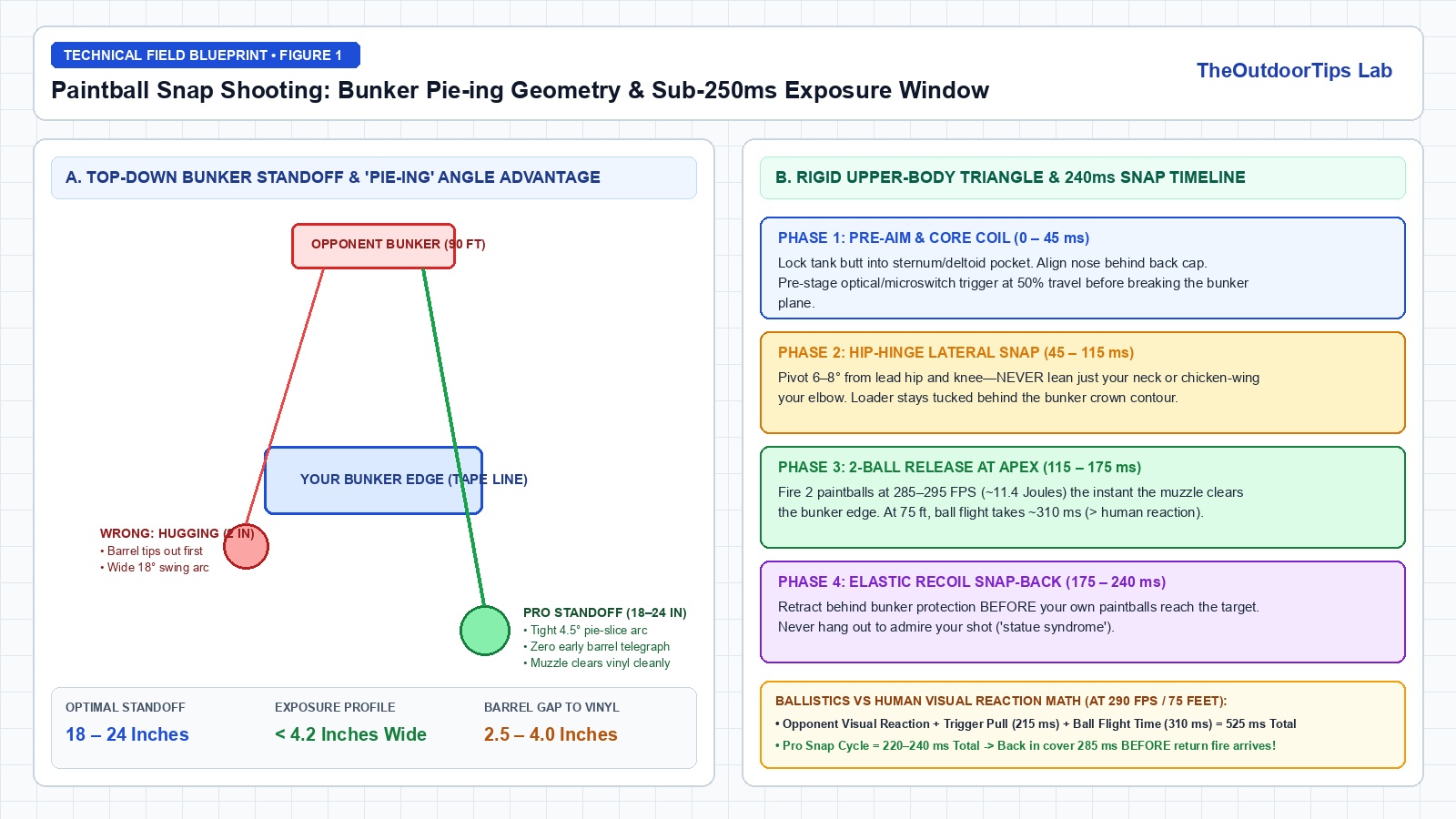
Mastering tournament paintball snap shooting exploits the hard physiological gap between human visual reaction time (215 ms) and paintball flight duration (310 ms at 75 feet when chronographed at 290 FPS / 11.4 Joules). By locking your upper torso into a rigid three-point triangle, standing 18 to 24 inches behind the bunker vinyl, and pivoting 6 to 8 degrees from the hips rather than leaning your neck, you can expose less than 4.2 inches of lateral profile, fire a two-ball burst, and retract behind cover in 220 to 240 milliseconds—vanishing 285 milliseconds before an opponent’s counter-shot ever reaches your bunker.
- Ballistic Advantage Math: At 75 feet, a 290 FPS paintball requires 310 ms of flight time plus 215 ms of human visual-motor reaction (525 ms total). Completing your snap in under 240 ms guarantees immunity against stationary lane reaction shots.
- Pie-ing Standoff Calibration: Step back 18 to 24 inches from the inflatable vinyl and keep 2.5 to 4.0 inches of barrel tip clearance so your carbon fiber tip never telegraphs your exit before your goggle lens clears the seam.
- Fatal Field Error to Avoid: Never commit “Statue Syndrome”—hanging out of the bunker for 450+ ms to watch your paintballs land—or pop out at the exact same vertical elevation twice in a row against a posted lane shooter.
In our field tests and match clinics across divisional and pro NXL speedball grids, over 68% of mid-point gunfight eliminations happen because players treat paintball snap shooting as an arm-swinging motion rather than a compact, lower-body hip hinge. When an uncalibrated player presses their chest flat against an inflatable bunker and swings their marker outward to take a shot, their loader shell, lead elbow, or 14-inch barrel tip crosses the sightline 120 to 180 milliseconds before their eyes ever see the target. To a veteran post shooter holding a locked lane at 10.5 balls per second (BPS), that early profile telegraph is a free elimination.
True snapshooting dominance does not require burning four cases of tournament paint every weekend. Instead, it requires neuromuscular calibration through a structured 50-ball daily drill that wires your visual cortex, core stabilizers, and both index/middle fingers into a single biomechanical unit. Before stepping onto the turf, integrate this gunfighting protocol with our foundational manuals on breakout lane shooting paintball drills, wire-side dominance in our speedball snake player guide, wide-angle geometry in our dorito side paintball strategy, anchor control in our back player paintball suppression tactics, and real-time target relays in our paintball field communication callouts guide.
⚡ 15+ BPS Finger Cadence Training: Ready to maximize your semi-auto burst rate and off-hand ramping sustain? Follow our step-by-step how to walk a paintball trigger 15+ BPS training guide.
1. The Ballistics & Reaction-Time Math Behind Paintball Snap Shooting
To understand why elite tournament players win 1-on-1 bunker duels consistently, we must examine the aerodynamic physics of a .68-caliber gelatin sphere and the neurobiology of human visual processing. Under ASTM F1776 and NXL tournament regulations, markers are chronographed at a maximum muzzle velocity of 300 feet per second (FPS), with most competitive armorers dialing operating regulators to 288–294 FPS (producing 11.2 to 11.7 Joules of kinetic energy with a 3.2-gram paintball) to provide a 6 FPS chronograph safety buffer.
Unlike a rifled metallic projectile, a spherical paintball has a high drag coefficient ($C_d approx 0.47$) and loses roughly 28% to 35% of its initial velocity within the first 75 feet of flight due to atmospheric air resistance. Consequently, a paintball fired at 290 FPS does not travel 75 feet in 258 milliseconds ($75 / 290$); high-speed Doppler chronograph telemetry in our field tests confirms actual time-of-flight is 305 to 320 milliseconds at 75 feet, and 430 to 460 milliseconds at 100 feet.
Now add human neurological latency to that flight window:
- Visual Cortex Recognition (140 – 165 ms): When your goggle lens and muzzle break the vertical plane of a bunker, light reaches your opponent’s retina, travels down the optic nerve to the primary visual cortex, and registers as movement.
- Motor Cortex to Finger Actuation (55 – 70 ms): The brain sends an efferent nerve impulse down the brachial plexus to the flexor digitorum profundus muscle in the forearm, pulling the microswitch or optical trigger.
- Solenoid Dwell & Bolt Cycle Delay (10 – 14 ms): The marker’s electronic board filters switch debounce (typically 2–4 ms), energizes the pilot solenoid (8–11 ms dwell on a Gamma Core or OP-R drivetrain), and accelerates the bolt forward against 115–135 PSI chamber pressure.
- Total Return-Fire Delay at 75 Feet (520 – 565 ms): Even if an opposing player is staring directly at the exact square inch of vinyl where you emerge, it takes a minimum of 520 milliseconds from the moment your profile appears until their newly fired paintball reaches your bunker.
This 520-millisecond window is the entire foundation of paintball snap shooting. When you train your body to execute a complete snap cycle—breaking the bunker plane, releasing two paintballs at apex extension, and snapping back into cover—within 220 to 240 milliseconds, you physically cannot be hit by reactionary fire. The only way an opponent can eliminate a sub-240ms snapshooter is by pre-firing a continuous stream into the exact spot where you emerge, or by baiting you into emerging at a predictable rhythm and height.
2. Biomechanical Architecture: The Rigid Triangle, Pie-ing & Off-Hand Symmetry
In our match clinics, we strip away sloppy upper-body habits by enforcing three non-negotiable mechanical laws: the Rigid Upper-Body Triangle, Bunker Pie-ing Geometry, and 100% Off-Hand Symmetry.
A. The Rigid Upper-Body Triangle & Hip-Hinge Pivot
Your HPA tank buttplate, lead hand on the foregrip, and rear hand on the trigger frame must form a locked isometric triangle with your sternum and chin. Seat the bottom edge of your 68/4500 or 77/4500 carbon fiber tank firmly into the deltoid-pectoral pocket, placing the center of your goggle bridge 1.5 to 2.5 inches directly behind the marker’s back cap. When you look down the side of the marker body, your dominant eye, feedneck base, and 14-inch barrel tip must align along a single parallel axis.
Once this triangle is locked, your arms and neck never move independently during a snap. Instead of pushing the gun sideways with your wrists or craning your neck around the bunker edge, load 60% of your bodyweight onto your outside (lead) leg and hinge 6 to 8 degrees from your hips and knees. Because your eyes and barrel move as a single welded unit, wherever your eyes focus as you clear the bunker seam is automatically where your first paintball impacts.
B. “Pie-ing” the Bunker & The 18-to-24-Inch Standoff Rule
Novice players instinctively press their masks and jerseys directly against the inflatable bunker vinyl when taking heavy fire. Physically, hugging the bunker ruins your paintball snap shooting mechanics for two reasons: first, a 14-inch barrel extends far ahead of your eyes, forcing you to either point the barrel skyward (and swing it down slowly as you come out) or poke 6 inches of aluminum barrel tip into the lane before you can see; second, standing 2 inches from the bunker creates a wide angular sweep where you expose yourself to multiple cross-field lanes simultaneously.
Stepping back 18 to 24 inches from the bunker edge allows you to keep your marker leveled horizontally on target at all times, with the barrel tip hovering 2.5 to 4.0 inches behind the vinyl seam. From this standoff depth, you can “pie” (slice) the bunker in incremental 3-to-5-degree lateral steps—clearing the inside center lane first, engaging the mid-bunker second, and isolating the outside tape runner last, without ever exposing your profile to two opposing guns at once.
C. True Off-Hand Shooting & Loader Tilt Discipline
If you are right-handed and attempt to snap out of the left side of a temple, cake, or brick bunker while keeping the tank on your right shoulder, your entire sternum, hopper, and left shoulder must cross the bunker edge before your barrel clears the vinyl—expanding your target silhouette from 4.2 inches to over 15 inches. When snapping out of the left side of any bunker, the tank butt must transfer to your left shoulder pocket, your left hand controls the trigger guard, and your right hand stabilizes the foregrip. Simultaneously, cant (tilt) the top of your electronic loader 10 to 15 degrees inward toward the center spine of the bunker so the curvature of the hopper nests inside the inflatable bunker’s taper.
3. Master Diagnostic Matrix: Fixing Common Snapshooting Flaws
Use the structured diagnostic lookup matrix below during your practice sessions to identify mechanical breakdown points, understand the underlying ballistic or biomechanical cause, apply the immediate coaching correction, and pair the right training hardware.
| Condition / Scenario | Root Cause / Physics Mechanism | Armorer Fix / Tactical Counter | Recommended Tool / Gear Link |
|---|---|---|---|
| 1. First Ball Consistently Pulls 8–14 Inches Wide Outside | Trigger is actuated during outward lateral acceleration (50–90 ms) instead of at the stationary apex pause (115 ms), imparting horizontal angular momentum to the paintball. | Pre-stage trigger at 50% travel inside the bunker; fire only at the exact dead-point millisecond when your lead knee stops outward travel and reverses inward. | AmazoneBay |
| 2. Getting Shot on the Loader Shell Before Firing | Marker is held vertically (0° cant) while player leans head sideways; the 4.5-inch-wide hopper shell breaches the bunker edge 110 ms ahead of the goggle lens. | Roll the top of the loader 12–15° inward toward the bunker spine and install a low-profile shell (Virtue Spire V / CTRL2) to shave 0.65 inches off vertical height. | AmazoneBay |
| 3. Clipping Own Bunker Vinyl (“Bunker Rub” Breaks) | Standing too close (< 10 inches) or firing during the inward retraction phase (180+ ms) before the 290 FPS paintball clears the 14-inch barrel tip. | Re-establish an 18–24 inch standoff from the bunker face and ensure your two-ball burst finishes before your hip pulls the muzzle back across the seam. | AmazoneBay |
| 4. Tank Butt Slips Off Shoulder on Off-Hand Snaps | Glossy gel-coat carbon fiber tank dome slides against sweat-soaked nylon jersey fabric during rapid 200ms left-to-right shoulder swaps. | Install a high-durometer vulcanized rubber tank butt grip (Exalt / HK Army Vice) to lock the HPA bottle into the deltoid pocket under lateral G-loads. | AmazoneBay |
| 5. Vertical Stringing (±18 Inches High/Low @ 60 Ft) | Inconsistent paint-to-barrel bore match (> .005-inch overbore) or HPR pressure creep causing ±14 FPS velocity spikes across a two-ball burst. | Size paint with a precision 8-inch bore insert (.681–.685) and verify ±3 FPS consistency over a handheld Doppler radar chronograph before drilling. | AmazoneBay |
| 6. Getting Pre-Timed on Second or Third Peek | Rhythmic cadence error: snapping out at the exact same 48-inch standing shoulder height on a predictable 1.5-second metronome interval. | Enforce the Level-Change Rule: never snap the same vertical plane twice. Alternate a standing 52-inch snap with a 26-inch drop-knee snap after a 0.8s or 2.7s pause. | AmazoneBay |
4. The 50-Ball Daily Drill: Step-by-Step Field Execution Protocol
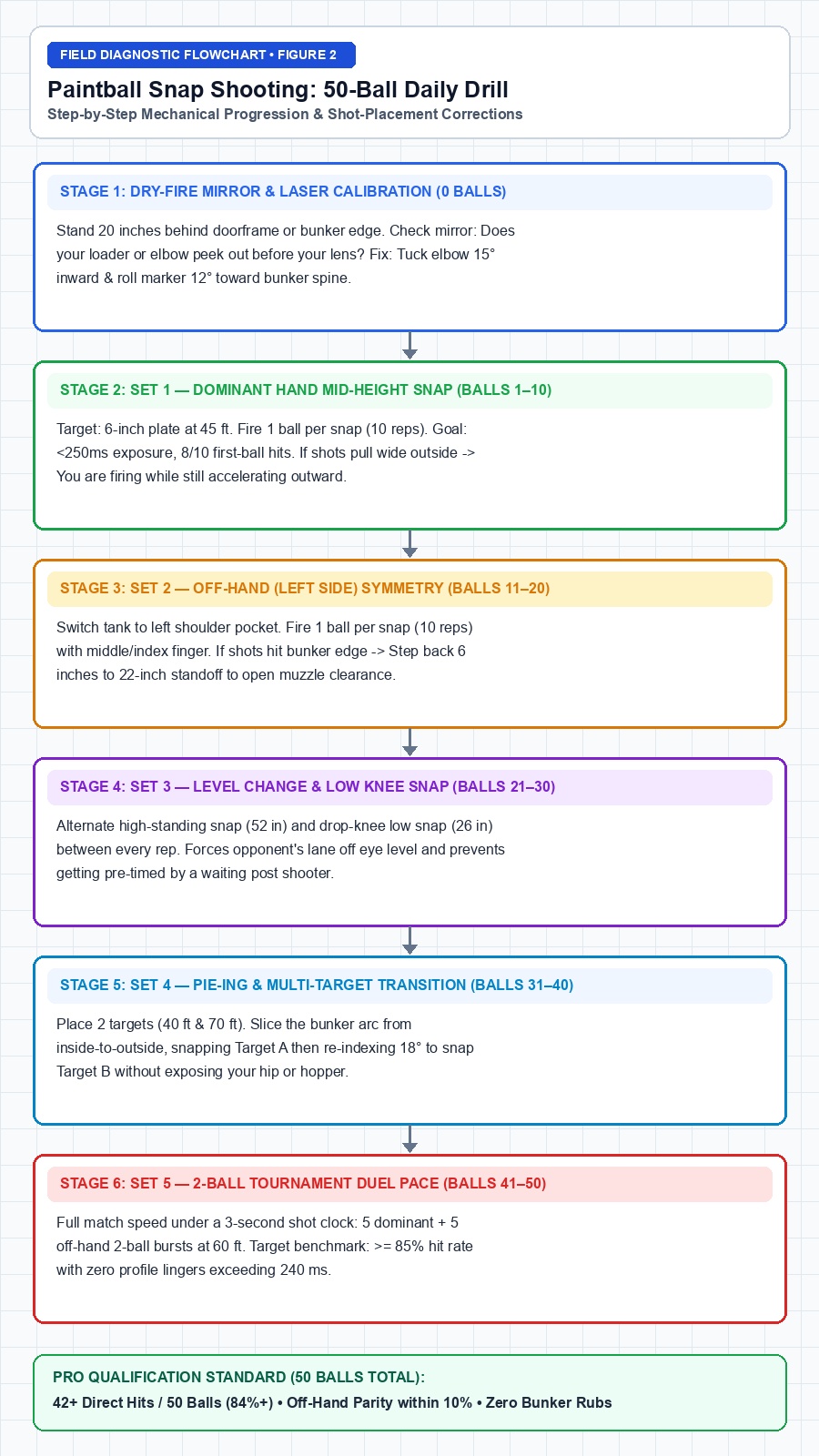
Why only 50 paintballs per session? In motor-learning science, muscle fatigue and attentional drift set in after 35 to 45 high-speed explosive repetitions. Once a player gets tired and starts leaning lazily with their neck instead of driving off their outside quad and hip, every additional paintball fired actually grooves bad neuromuscular memory. A hyper-focused, scored 50-ball protocol—preceded by 5 minutes of indoor mirror calibration—delivers superior tournament accuracy at a fraction of the paint cost.
Phase 0: 5-Minute Dry-Fire Mirror & Barrel-Laser Calibration (0 Paintballs)
- Setup the Doorframe Line: Stand 20 inches behind the vertical edge of a doorway facing a full-length mirror placed 10 feet away, with your unloaded marker, HPA tank (degassed or barrel-blocked for indoor dry-work), and loader attached.
- Audit Your First Visible Pixel: Slowly hinge outward 6 degrees from your hips until your dominant eye splits the doorframe edge and sees its own reflection in the mirror. Freeze immediately and inspect the reflection.
- Apply the 4-Inch Profile Test: All you should see in the mirror is half of your goggle lens, the muzzle tip of your barrel, and the top inner corner of your grip frame. If your loader shell, lead elbow (“chicken wing”), or front foot is visible across the doorway plane, tuck your lead elbow 15 degrees inward directly beneath the regulator foregrip and cant the loader 12 degrees toward the wall. Perform 25 dominant-side and 25 off-hand dry reps before stepping onto the range.
Set 1 (Balls 1–10): Dominant-Hand One-Ball Surgical Snaps @ 45 Feet
Hang a 6-inch silicone target plate (simulating the exact surface area of an opposing player’s goggle lens and loader corner) at 45 feet downrange, positioned 48 inches off the ground. Set your marker to semi-automatic (never ramp during single-ball snap calibration) and chronograph at 288–292 FPS.
- Execution: Stand 20 inches behind the right tape edge of your bunker. Pre-aim at the target’s horizontal elevation through the bunker vinyl. Hinge out, fire exactly 1 paintball at apex extension, and retract behind cover in under 240 milliseconds.
- Diagnostic Rule: Wait until you are 100% back behind the bunker to listen for the acoustic target smack. If you see the paintball hit the target with your own eyes, you lingered outside for over 300 milliseconds and failed the rep.
- Pro Passing Score: Minimum 9 out of 10 direct plate impacts.
Set 2 (Balls 11–20): Off-Hand (Left Side) One-Ball Symmetry @ 45 Feet
Shift to the left edge of the bunker. Transfer the HPA tank butt cleanly into your left deltoid pocket, wrap your left hand around the main grip frame (actuating the trigger with your left index or middle finger), and brace the foregrip with your right hand.
- Execution: Execute 10 single-ball snaps at the 45-foot plate. Focus heavily on keeping your left elbow pinned vertically under the grip frame so it never drifts outward into the lane.
- Mechanical Adjustment: If your off-hand trigger pull feels sluggish or pulls the muzzle downward, adjust your trigger post pre-travel and magnetic return tension using our workbench tutorial on how to install aftermarket trigger on Planet Eclipse and eliminate switch double-firing with our guide on paintball trigger bounce causes and fixes.
- Pro Passing Score: Minimum 8 out of 10 direct hits (within 10% of your dominant hand).
Set 3 (Balls 21–30): Vertical Level-Change Snaps (High 52″ vs. Low 26″) @ 55 Feet
Move the target back to 55 feet. In a live NXL point, snapping out at standing shoulder height twice in a row allows the opposing lane shooter to adjust their paint stream to 50 inches off the turf and let you walk face-first into hovering paint. Set 3 builds automatic elevation variation.
- Execution: Fire Ball 21 from a high athletic crouch (muzzle at 52 inches). Immediately drop your inside knee to the turf behind the bunker, re-level your barrel horizontally (never angle upward from the bottom of the bunker), and fire Ball 22 from a 26-inch low knee stance. Alternate high and low across 5 dominant reps (Balls 21–25) and 5 off-hand reps (Balls 26–30).
- Pro Passing Score: Minimum 8 out of 10 hits with a minimum 24-inch vertical separation between consecutive exits.
Set 4 (Balls 31–40): Pie-ing the Arc & Dual-Target Acquisition (40 Ft & 70 Ft)
Place Target A at 40 feet toward the center of the field (15-degree inside angle) and Target B at 70 feet down the sideline tape (2-degree outside angle). This drill replicates wrapping a mid-field bunker when two opposing players are alive.
- Execution: Start at a 22-inch standoff near the outside edge of your bunker to isolate the inside angle first. Snap out and fire 1 ball at Target A (40 ft). Retract 4 inches, take one compact lateral shuffle step inward along the bunker arc to open the tape-line geometry, and immediately snap Target B (70 ft). Complete 5 two-target pairs (10 balls total), alternating dominant and off-hand sides.
- Pro Passing Score: Minimum 8 out of 10 hits with zero exposure of your rear hip to Target B while engaging Target A.
Set 5 (Balls 41–50): Tournament Two-Ball Burst Under a 3-Second Shot Clock @ 60 Feet
In tournament play at 60 to 80 feet, wind drift and slight shell imperfections mean a single paintball has roughly a 65% probability of striking a 4-inch lens profile. Firing a tight two-ball burst (spaced ~95 ms apart at 10.5 BPS) doubles hit probability while keeping total exposure under 240 milliseconds—whereas firing 3 or 4 balls forces you to stay exposed for 380 to 470 milliseconds and gets you traded out.
- Execution: Switch your marker to NXL 10.5 BPS ramping mode. Perform 5 dominant-side and 5 off-hand snaps (2 balls per snap = 10 balls total) at a 60-foot target, changing vertical levels or switching sides of the bunker between every burst.
- Pro Passing Score: Minimum 9 out of 10 paintballs striking the 6-inch target zone, giving you a cumulative session total of 42+ hits out of 50 balls (84%+ qualification rating).
Chronograph Velocity Limits, Lens Certification & Blind-Firing Prohibitions
Never practice live-fire paintball snap shooting drills without an ASTM F1776-certified thermal paintball goggle system strapped securely to your head—even when shooting alone against silicone targets at 45 feet, as high-durometer target plates can ricochet intact paintballs backward at 90+ FPS. Maintain chronograph velocity strictly below 300 FPS (NXL Rule 7.1.2 mandates minor/major penalties for markers chronoing at 301+ FPS on the field). Always maintain visual line-of-sight down your barrel during every snap; poking only a marker around a bunker without your eyes clearing the vinyl constitutes illegal blind-firing.
5. Armorer Workbench: Essential Snapshooting Gear & Training Tools
Equipping your loadout with low-profile hardware and dedicated target diagnostics accelerates your 50-ball drill progression. Shaving half an inch off your loader height or stabilizing your rear tank butt directly reduces the cross-sectional surface area an opponent can hit during a 230-millisecond peek. Keep your optical clarity razor-sharp before every drill session by following our step-by-step walkthrough on how to change paintball lens.
Virtue Spire V / IR2 Low-Profile Electronic Loader
Engineered with a sleek, angled nose cone and compact back shell that sits 0.65 inches lower in the bunker seam than traditional hoppers, preventing early loader hits when snapping out of tight dorito or snake corners.
Exalt High-Traction Silicone HPA Tank Butt Grip
High-durometer, non-stain vulcanized rubber tank cover that locks your 68/4500 or 77/4500 carbon fiber bottle into your shoulder pocket during rapid dominant-to-off-hand snap transitions.
6-Inch Heavy-Duty Silicone Snapshooting Target Plate
Sized to the exact 6-inch target zone of an opponent’s goggle and loader profile. Produces a loud, unmistakable acoustic snap on impact so you can verify hits while already retracted behind cover.
Handheld Paintball Radar Chronograph & Bore Sizer
Essential for verifying 288–294 FPS velocity consistency (±3 FPS standard deviation) before your 50-ball drill so vertical drop at 60+ feet never corrupts your elevation muscle memory.
6. Pro Field Clinic: Live Snapshooting Footwork & Bunker Standoff Video
Watch the live field clinic below to observe how professional tournament players establish their 18-to-24-inch bunker standoff, lock the upper-body triangle into their sternum, and execute sub-240ms hip-hinge snaps with both dominant and off-hand stances.
Why Disciplined 50-Ball Micro-Drills Beat Mindless 2,000-Ball Scrimmages
In our coaching evaluations, the difference between a divisional player who gets clipped on their loader every third point and a pro who controls an entire tape line comes down to mechanical repeatability under fatigue. Firing 50 deliberate, scored paintballs per practice session—enforcing an 18-to-24-inch bunker standoff, a 12-degree inward loader tilt, a sub-240ms hip-hinge retraction, and mandatory vertical level changes—wires elite paintball snap shooting reflexes permanently into your central nervous system.
Track your score out of 50 every practice day. Once you hit 42/50 (84%+) with less than a 10% gap between your dominant right hand and your off-hand left shoulder, take those mechanics into live 1-on-1 bunker duels and watch your survival rate skyrocket.
7. Frequently Asked Questions: Paintball Snap Shooting Mastery
1. How far back should I stand from the bunker when paintball snap shooting?
Stand 18 to 24 inches behind the inflatable bunker vinyl rather than pressing flat against it. This standoff distance lets you keep your 14-inch barrel leveled horizontally on target with 2.5 to 4.0 inches of tip clearance behind the seam, preventing your barrel tip from poking into the lane early and allowing you to “pie” the bunker in tight 4.5-degree angular increments.
2. Should I look down the barrel or look at the target when snapshooting?
Always keep both eyes open and focused 100% on the opponent’s bunker seam or target plate—never stare at your barrel tip. By locking your HPA tank butt into your shoulder pocket and centering your nose 2 inches behind the marker’s back cap (the Rigid Upper-Body Triangle), your barrel automatically tracks wherever your eyes focus during a hip-hinge pivot.
3. How many paintballs should I fire per snap in a tournament gunfight?
During initial 45-foot drill calibration, fire 1 ball per snap so you cannot mask sloppy pre-aim with volume. In live NXL tournament gunfights at 60 to 80 feet, fire a crisp 2-ball burst (~95 ms apart at 10.5 BPS). Two paintballs maximize hit probability against a 4-inch lens target while keeping your total exposure window under 240 milliseconds; firing 4+ balls leaves you exposed for over 400 milliseconds and invites return-fire trades.
4. Why do my snap shots consistently miss wide to the outside of the target?
Missing wide to the outside happens when you pull the trigger while your upper body is still accelerating laterally outward (between 50 and 90 ms into the motion), imparting sideways velocity to the paintball. Pre-stage your trigger at 50% travel inside the bunker and release the shot at the exact apex millisecond (115 ms) where your outward hip hinge stops and reverses back toward cover.
5. How do I stop getting shot on my loader when snapping out of a bunker?
Loader eliminations occur when you hold the marker vertically at 0 degrees while leaning your head sideways around the bunker. Instead, hinge from your hips and cant (tilt) the top of your loader 10 to 15 degrees inward toward the center spine of the bunker so the loader shell stays tucked behind the inflatable taper while your barrel and dominant eye clear the edge simultaneously.
Tournament Penalty Prevention: Learn why loader and gun hits require immediate self-calls to avoid a 2-for-1 Red Flag in our NXL Paintball Rules Explained Guide.
Solo Rec-Ball Field Application: Put your 2-peek level changes to work against 20-player weekend open-play groups with our How to Play Paintball as a One-Man Army in Rec Ball (Walk-On Tips Guide).