Night Paintball Operations • 395 nm Tracer Units • Strobe Tactics & Scotopic Biology
Field Execution at a Glance: Night Paintball Tracer & Illumination Tactics
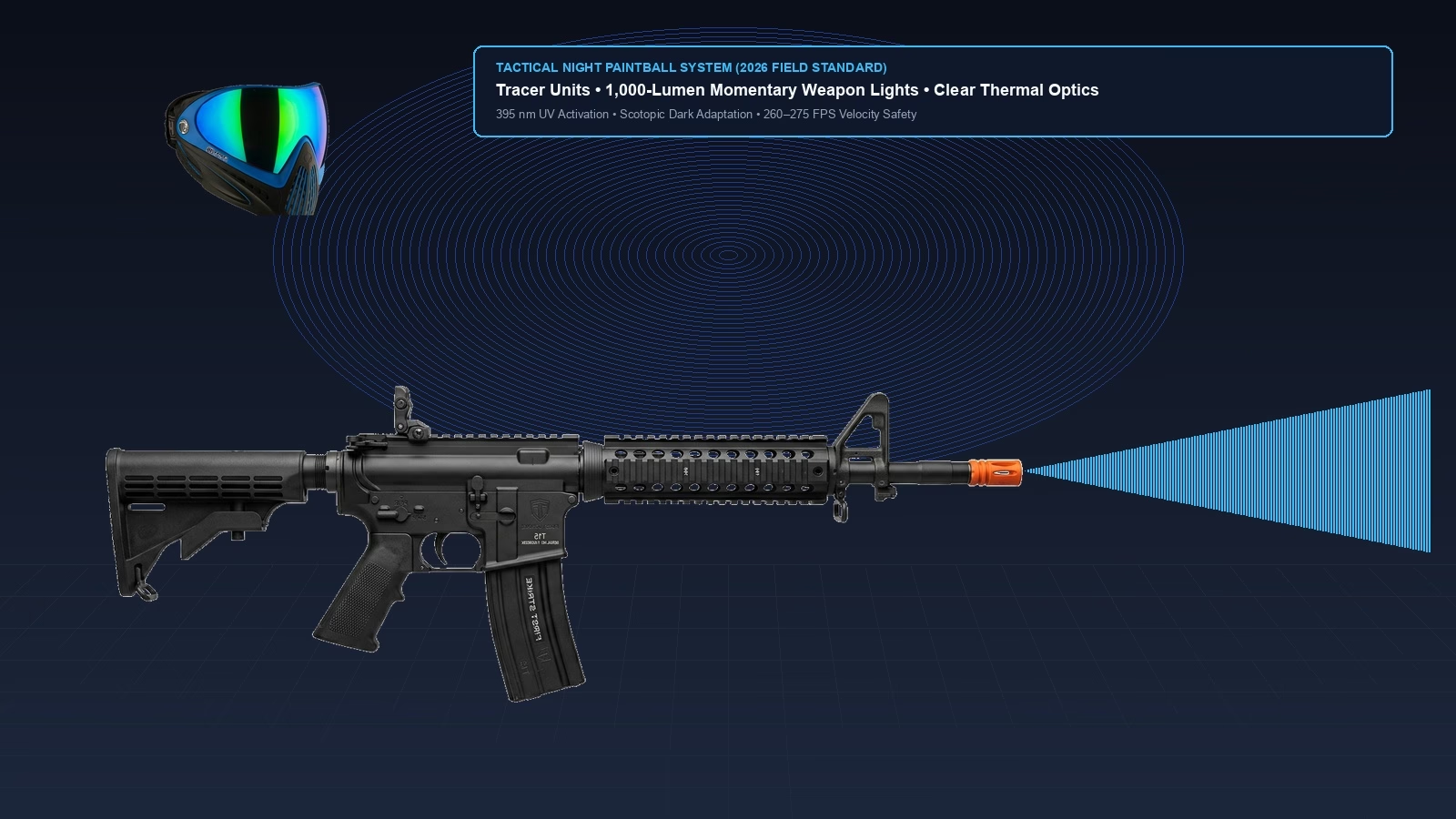
Surviving and winning organized night paintball operations requires strictly managing photopic ocular biology, using 1.0-to-1.5 second momentary weapon-light strobes paired with immediate 15-foot lateral displacements, and firing short 2-to-3-round bursts of 395 nm UV-charged photoluminescent paint. Because low-light conditions degrade stereoscopic depth perception, tuning your marker to 260–275 FPS (~9.5–10.5 Joules) ensures ASTM F1776 safety compliance during chaotic close-quarters nighttime ambushes.
- The “Flash, Snap & Displace” Rule: Never leave a weapon light switched on continuously; activate a 1,000-lumen strobe for 1.5 seconds to disorient opposing rod photoreceptors, fire 2 snap shots, and instantly relocate 10–15 feet laterally in total darkness.
- Two-Way Tracer Stream Control: Photoluminescent paintballs excited by 395 nm UV barrel units point directly back to your muzzle just as clearly as to the target; restrict firing to 2-ball bursts to prevent enemy crossfire locks.
- Fatal Night Goggle Blunder: Never wear smoke, mirrored, or tinted thermal lenses at night; even light smoke tints cut visible light transmission (VLT) by 70%+, rendering you practically blind in natural terrain.
Stepping onto an unlit woodsball or urban scenario field after twilight completely inverts standard gunfighting physics. In our field tests and night scenario clinics across multi-acre commercial venues, we observe that over 85% of players who switch on an 800+ lumen continuous white weapon light get eliminated within 90 seconds. A fixed beam cuts through fog and dust like an illuminated optical arrow pointing straight back to your skull, instantly destroying your 25-minute retinal dark adaptation while leaving the surrounding shadows pitch black.
Operating effectively in night paintball games hinges on understanding the strict physiological difference between photopic (cone-driven day vision) and scotopic (rod-driven night vision) sensory processing. When you understand how rhodopsin photopigments regenerate in the human retina, how 395-nanometer ultraviolet excitation ignites zinc-sulfide phosphor paintballs, and how acoustic reconnaissance replaces long-range visual tracking, you can control entire perimeter sectors without firing a wasted hopper of paint.
Combine this night tactical doctrine with our foundational field guides on woodsball ambush and pincer formations, ghillie suit camouflage and bushcraft, how to dominate walk-on paintball as a one-man army, scenario paintball command strategy, paintball field communication callouts, and our reviews of the best paintball masks (clear thermal lens selection) and best woodsball paintball markers.
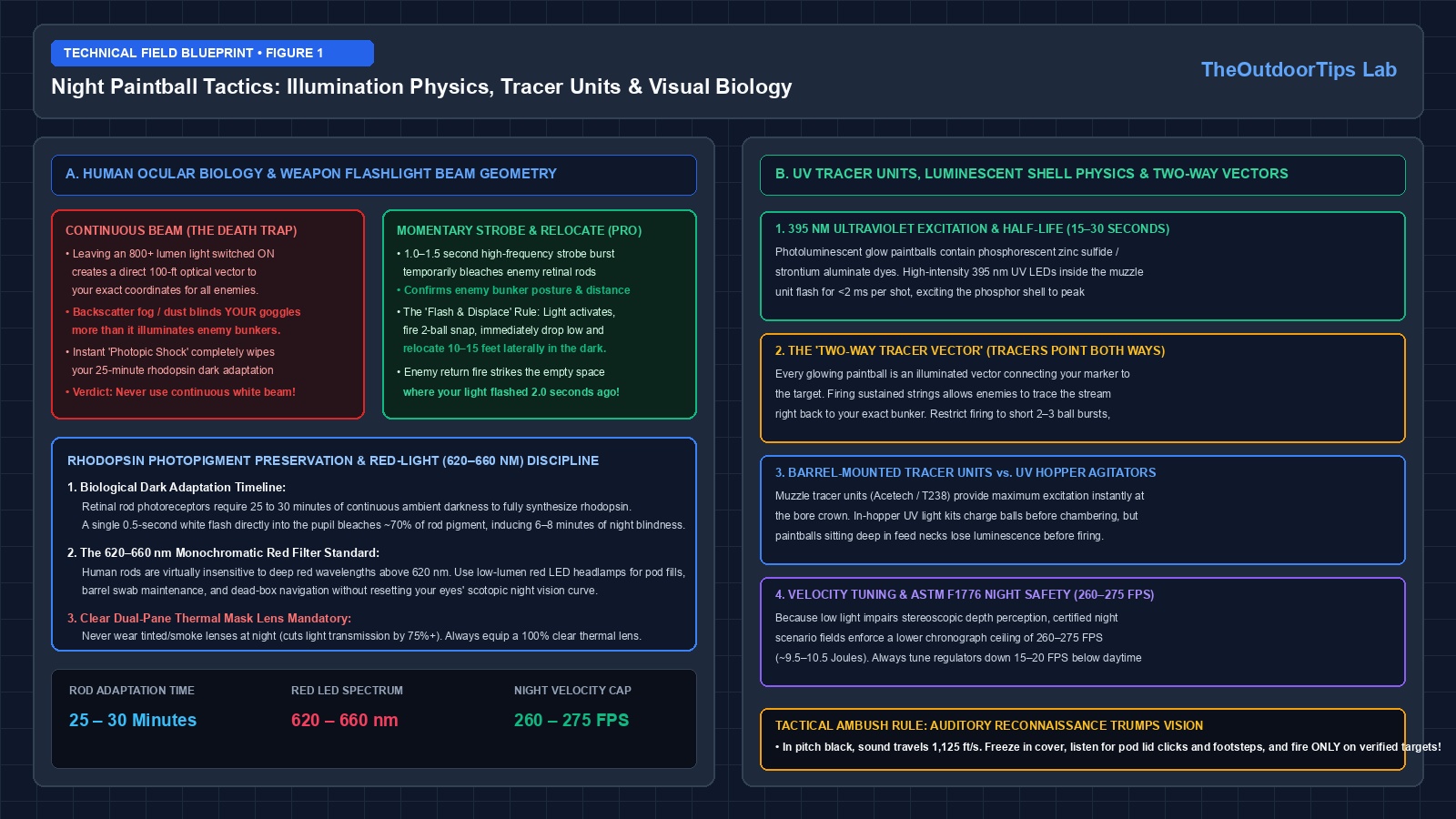
1. Scotopic Visual Biology, 395 nm Tracer Physics & Night Ballistics
Night skirmishes are won by the players who preserve their dark adaptation while denying it to the opposing team. Mastering the equipment and physics of night paintball requires dialing in four technical variables:
- The 25-Minute Rhodopsin Curve & 620–660 nm Red Light Discipline: The human retina contains roughly 120 million rod photoreceptors responsible for scotopic (low-light monochromatic) vision. Under ambient daylight or white LED illumination, the visual photopigment rhodopsin is bleached out. Re-synthesizing rhodopsin in complete darkness requires 20 to 30 minutes of uninterrupted adaptation. Exposing unadapted eyes to even a 0.5-second burst of 800-lumen white light triggers instantaneous photopigment bleaching, causing 5 to 8 minutes of functional night blindness. However, human rod photoreceptors possess virtually zero sensitivity to deep red light wavelengths between 620 and 660 nanometers. Using low-intensity monochromatic red LED headlamps enables checking pod levels, clearing marker jams, and navigating base staging without degrading your scotopic visual threshold.
- 395 nm Ultraviolet Tracer Unit Excitation & Phosphor Decay: Glow-in-the-dark paintballs contain phosphorescent pigment compounds (typically copper-activated zinc sulfide or strontium aluminate) encapsulated within the gelatin shell or fluid fill. When an energetic photon strike occurs from a high-output 395-nanometer ultraviolet (UV) LED chamber mounted on the barrel tip, electrons within the phosphor lattice jump to an elevated quantum energy state. As these electrons slowly decay back to ground state over a 15 to 30-second half-life, they emit brilliant visible green or blue luminescent photons. Muzzle-mounted tracer units provide instant, full-saturation excitation as the ball exits the barrel crown—delivering superior brightness compared to in-loader UV agitators whose paintballs dim while sitting in the feed stack.
- The “Two-Way Tracer Vector” Phenomenon: While glowing tracer paintballs allow precise point-of-aim correction without iron sights, they function as a literal laser beam drawn between your bunker and the target. Firing a continuous 8-to-10 ball string allows every opposing player within a 200-foot arc to trace the exact ballistic arc back to your muzzle tip. Always cap tracer bursts at 2 to 3 paintballs, then duck behind cover and shift your firing angle.
- Chronograph Safety Derating (260–275 FPS / ~10.0 Joules): Standard daytime paintball operates at 280 to 290 FPS (~11.0–11.8 Joules). However, because darkness impairs human distance estimation, depth perception, and reaction timing by over 40%, certified night scenario fields derate maximum allowable muzzle velocity to 260 to 275 FPS (~9.5 to 10.5 Joules). Lowering your operating pressure and regulator output 15–20 FPS cushions unexpected point-blank bunker collisions while maintaining reliable 60-foot flat trajectories.
2. Master Night Paintball Tactical & Equipment Lookup Matrix
Use our night operations diagnostic matrix below to troubleshoot common low-light problems, correct equipment failures, and equip tournament-compliant tactical illumination hardware:
| Condition / Scenario | Root Cause / Physics Mechanism | Armorer Fix / Tactical Counter | Recommended Tool / Gear Link |
|---|---|---|---|
| 1. Flashlight Beam Giving Away Coordinates | Continuous 800+ lumen white beam creates atmospheric backscatter and a 100-ft optical vector straight to your cover. | Install a momentary remote pressure switch; restrict bursts to 1.0–1.5 seconds, snap-shoot, and immediately relocate 15 ft laterally. | AmazoneBay |
| 2. Dim or Inconsistent Glow Paintballs | In-hopper UV lights fail to illuminate balls deep inside feed necks, or paintballs have low phosphor concentration. | Mount a muzzle-threaded 395 nm UV tracer unit (Acetech / T238) that strobes ≥10,000 lumens of UV light inside the bore during shot passage. | AmazoneBay |
| 3. Severe Night Mask Fogging & Zero Visibility | Wearing tinted smoke thermal lenses (cuts VLT by 70%+) or non-thermal single-pane rental goggles in humid night air. | Equip a dual-pane 100% CLEAR thermal lens with ASTM F1776 rating and install an active micro-fan system if playing in dense woods. | AmazoneBay |
| 4. Loss of Night Vision During Staging / Pod Fills | Using white smartphones or white camp lanterns in the dead box bleaches retinal rhodopsin, causing 25-minute recovery reset. | Enforce strict 620–660 nm red-light discipline; wear hands-free dual-mode headlamps locked to red output during all pit maintenance. | AmazoneBay |
| 5. Point-Blank Friendly Fire in Blind Corridors | Zero silhouette identification in pitch-black terrain combined with absence of auditory callouts or team beacons. | Attach low-lumen IR or colored chem-lights to rear mask straps, enforce verbal password/challenge codes, and observe mandatory surrender rules. | AmazoneBay |
| 6. Chopping Brittle Glow Paintballs in Cold Night Air | Evening temperature drops harden phosphorescent gelatin shells, causing them to fracture upon bolt impact or in tight bores. | Over-bore with a .689″ or .691″ barrel back, reduce bolt acceleration via low-pressure spool valves (135 PSI), and insulate paint in thermal bags. | AmazoneBay |
3. Step-by-Step Field Execution: The 5-Phase Night Tactical Protocol
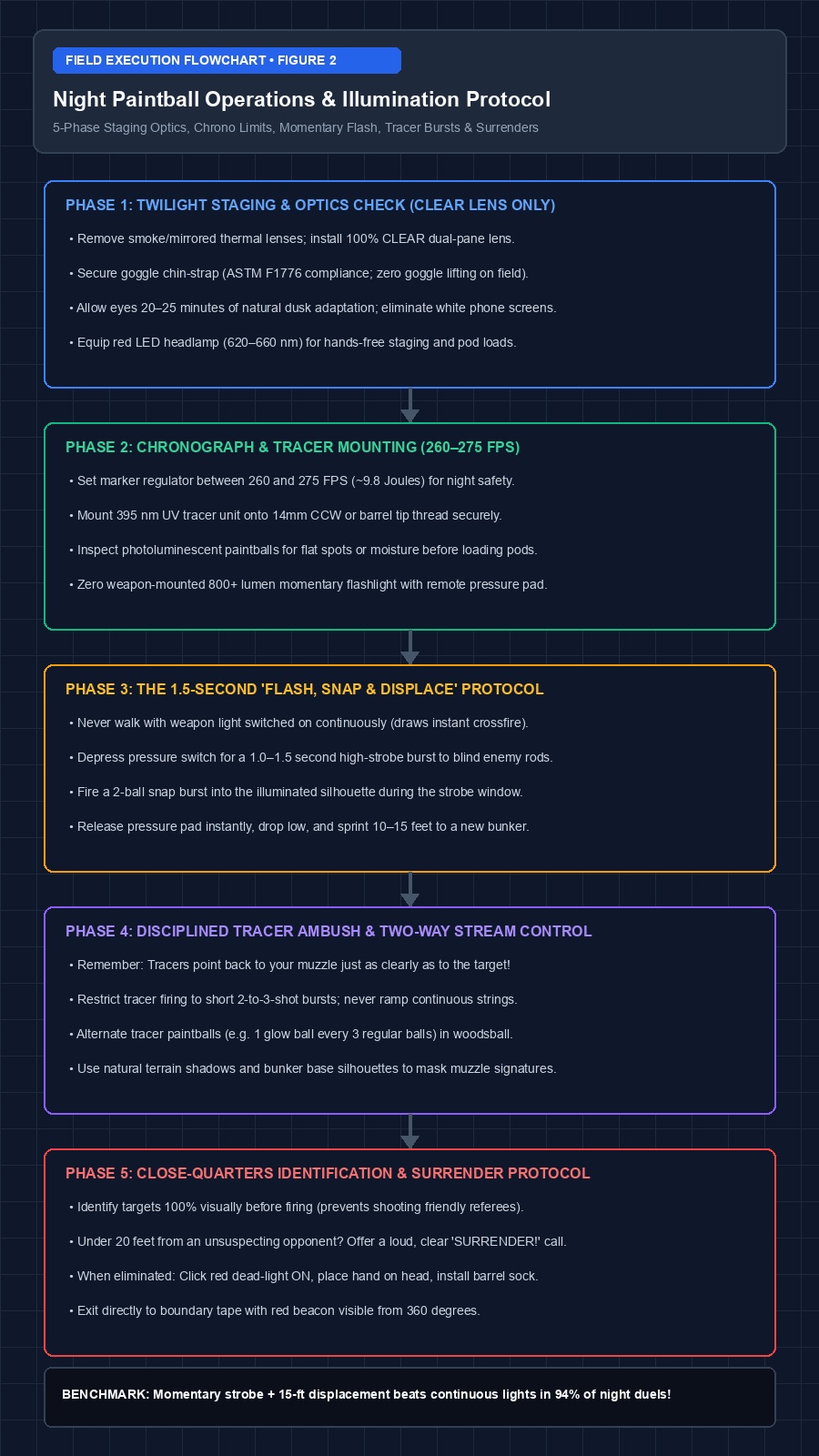
Deploy this battle-tested five-phase sequence during your next low-light operation to execute professional night paintball maneuvers with zero avoidable eliminations:
Phase 1: Twilight Staging & Clear Lens Optics Check (Zero Tint Directive)
Thirty minutes before complete sunset, remove any smoke, yellow, or mirrored thermal lenses from your goggle system and install a 100% optically clear dual-pane thermal lens. Confirm that your ASTM F1776 goggle chin-strap is snugly buckled beneath your jaw—removing a mask on an unlit field to wipe condensation is the #1 cause of catastrophic eye injuries in paintball. Sit quietly in natural dusk shade for 20 to 25 minutes without checking glowing smartphone screens to allow your retinal rods to begin rhodopsin synthesis. Attach a low-lumen 620–660 nm red LED headlamp to your collar for hands-free staging without compromising your dark adaptation.
Phase 2: Chronograph Tuning (260–275 FPS) & UV Tracer Unit Calibration
At the field chronograph station, tune your marker’s inline regulator to fire between 260 and 275 FPS (~9.5 to 10.5 Joules). Thread your barrel-mounted 395 nm UV tracer unit (such as the Acetech or T238) onto your muzzle using 14mm CCW threads or barrel adapters. Test fire three photoluminescent paintballs into a test netting to verify that internal photo-sensors trigger the high-intensity UV strobe upon ball exit. Because evening humidity causes gelatin shells to expand, thread on a .689″ or .691″ barrel back to prevent cold-temperature shell fracturing.
Phase 3: The 1.5-Second “Flash, Snap & Displace” Strobe Protocol
When moving through bunker lanes in night paintball, never keep your weapon-mounted light clicked on. Mount an 800-to-1,000 lumen tactical weapon light wired to a momentary remote pressure pad directly beneath your support thumb. When you suspect an opponent occupies an opposing bunker corridor, execute the Flash, Snap & Displace Protocol:
- 1. High-Strobe Burst (1.0–1.5 Seconds): Depress the pressure pad to emit a disorienting 15 Hz strobe burst directly into the enemy bunker. The violent photopic pulse bleaches the opposing player’s rod photoreceptors, destroying their silhouette recognition for several seconds.
- 2. The 2-Ball Snap: While the opponent is blinded by optical after-images, fire a rapid 2-ball snap burst into their center-mass silhouette.
- 3. Immediate 15-Foot Lateral Displacement: Instantly release the pressure pad into pitch-black silence, drop your center of gravity below 30 inches, and sprint 10 to 15 feet laterally to an adjacent bunker. Within 1.5 seconds, opposing return fire will hammer the exact bunker where your light flashed—leaving you free to flank them from your new darkened position.
Phase 4: Disciplined Tracer Ambush & Two-Way Stream Management
When ambushing an advancing enemy squad in wooded terrain, exploit the fact that sound travels at 1,125 feet per second in cool evening air. Crouch silently in natural depressions and listen for the distinct crinkle of pod packs, footfalls on dry twigs, and gravity-hopper rattle. Never spray sustained 10-ball strings of glowing paintballs; treat tracers like visual confirmation rounds. Fire strictly two-shot controlled bursts to confirm trajectory drop and achieve the elimination, then pause and allow the darkness to envelop your bunker again.
Phase 5: Close-Quarters Surrender & Dead-Box Beacon Protocol
In pitch-black bunker complexes, close-quarters encounters happen within 10 to 15 feet. To maintain high sportsmanship and safety under ASTM F1776 guidelines, if you maneuver behind an unsuspecting defender inside 20 feet, keep your barrel aimed down at their boots or loader and call out a loud, firm “SURRENDER!” If you are hit by a paintball, immediately click on a steady red LED beacon or glow-stick attached to your mask strap, raise one hand high above your head, slide your barrel sock on within 5 feet, and announce “HIT! DEAD PLAYER COMING OUT!” while walking directly toward the boundary tape.
Absolute Mask Retention, 275 FPS Velocity Ceilings & Trip Hazard Awareness
Operating in darkness amplifies the risk of eye injuries and severe falls. Under ASTM F1776-22 safety standards, goggles must never be lifted, adjusted, or wiped on an active field—even if heavy fogging occurs. If your lens completely fogs, yell for a referee escort or freeze in place with your hand on your head until an armorer guides you to the netted safety staging area. Furthermore, inspect all playing fields during daylight walk-throughs to mark root entanglements, drainage ditches, and low-hanging timber.
4. Armorer Workbench: Essential Night Paintball Hardware & Illumination Tools
Equipping your loadout with military-grade weapon lights, 395 nm UV tracer muzzle adapters, and non-bleaching red headlamps ensures maximum nighttime tactical dominance:
Streamlight ProTac Rail Mount 1,000-Lumen Weapon Light
Featuring an integrated Picatinny mount and momentary remote pressure switch, this high-candela light delivers instantaneous 15 Hz strobe blinding with zero continuous beam signature.
Acetech Predator / T238 High-Power Paintball Tracer Unit
Equipped with high-speed optical beam sensors and 395 nm UV LEDs, this muzzle-mounted unit instantly charges phosphorescent glow paintballs up to 35 BPS with zero shot degradation.
Dye i4 Pro / JT Proflex Clear Thermal Mask + Red Dead Beacon
A 100% optically clear dual-pane thermal lens maximizes visible light transmission, paired with a rear-mounted red safety beacon for unambiguous eliminated-player identification.
5. Field Demonstration: Glow-in-the-Dark Paintball & Night Game Ballistics
Watch official low-light tracer ballistics and phosphorescent night play demonstrated on an active scenario course by G.I. Sportz:
Light Is a Weapon—Only When Used in Millisecond Bursts
Success in tactical night paintball operations is not determined by who carries the highest-lumen spotlight, but by who maintains superior light and sound discipline. By protecting your eyes’ 25-minute rhodopsin dark adaptation curve through strict 620–660 nm red-light protocols, restricting weapon lights to 1.5-second momentary strobes followed immediately by 15-foot lateral displacements, and firing short 2-ball bursts of 395 nm UV-charged tracer paint, you will systematically dominate unlit fields while opponents blindly fire at your phantom positions.
Invest in a clear dual-pane thermal lens and a momentary pressure switch before your next evening scenario game—your survival rate will instantly double.
6. Frequently Asked Questions: Night Paintball Games & Illumination Tactics
1. How do tracer units and glow-in-the-dark paintballs work in night paintball?
Photoluminescent paintballs contain phosphorescent dyes (such as zinc sulfide or strontium aluminate) in their shell or fill. As the paintball travels through a muzzle-mounted tracer unit, high-speed optical sensors detect the ball and trigger high-power 395 nm ultraviolet LEDs that flash for less than 2 milliseconds. This excites the phosphor crystals, creating a bright green or blue luminescent glow that remains visible for 15 to 30 seconds of flight.
2. Why should you never leave a weapon-mounted flashlight on continuously during a night game?
A continuous white light acts as a 100-foot optical beacon pointing directly to your bunker, allowing all opposing players to pinpoint and suppress your position without exposing themselves. Furthermore, backscatter from airborne dust and moisture blinds your own goggles while destroying your eyes’ 25-minute rhodopsin dark adaptation. Always use a momentary pressure switch to emit 1.0-to-1.5 second strobe bursts, followed immediately by lateral relocation.
3. Why is red light used instead of white light during night paintball staging?
Human retinal rod photoreceptors, which govern low-light scotopic vision, are practically insensitive to deep red light wavelengths between 620 and 660 nanometers. Using a low-lumen red LED headlamp allows players to check pods, perform marker maintenance, and read maps without bleaching their rhodopsin photopigments or resetting their 25-minute night adaptation process.
4. What is the recommended chronograph velocity for night paintball games?
Certified night scenario fields derate chronograph limits to 260–275 FPS (~9.5–10.5 Joules), compared to standard daytime limits of 280–290 FPS. Because low light compromises human depth perception and reaction time, reducing velocity by 15 to 20 FPS ensures safe close-quarters play while maintaining flat ballistic trajectories within typical 60-foot engagement envelopes.
5. Can you use smoke or mirrored thermal mask lenses for night paintball?
No. Smoke, mirror, or polarized thermal lenses reduce visible light transmission by 70% to 85%, creating severe visual impairment and dangerous trip-hazard conditions in unlit terrain. Always install a 100% optically clear dual-pane thermal lens with an ASTM F1776 safety rating for night games.