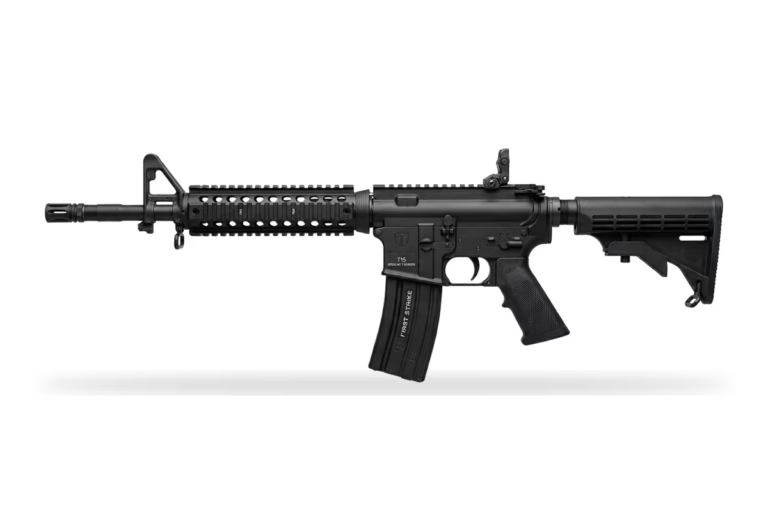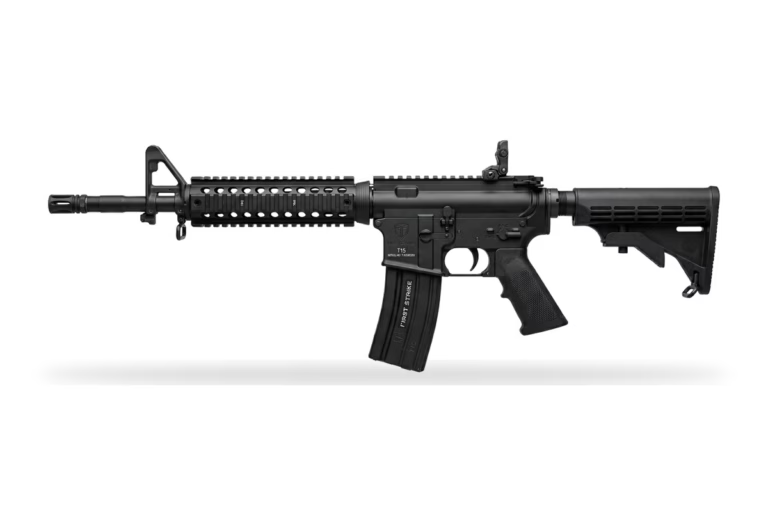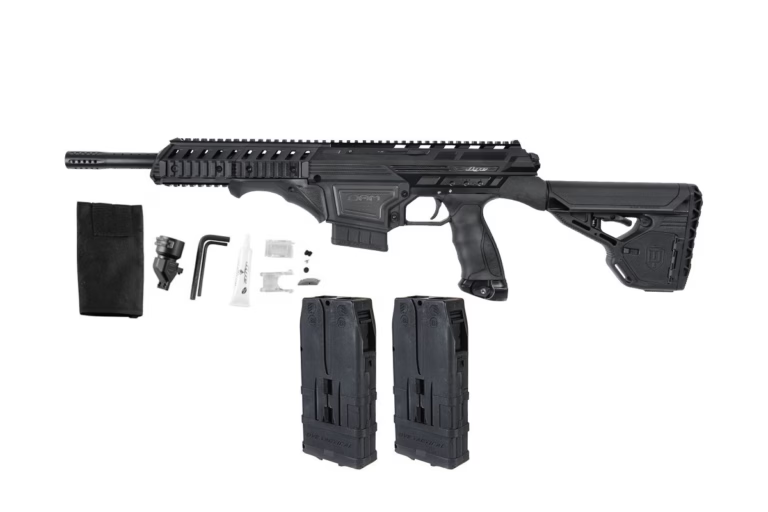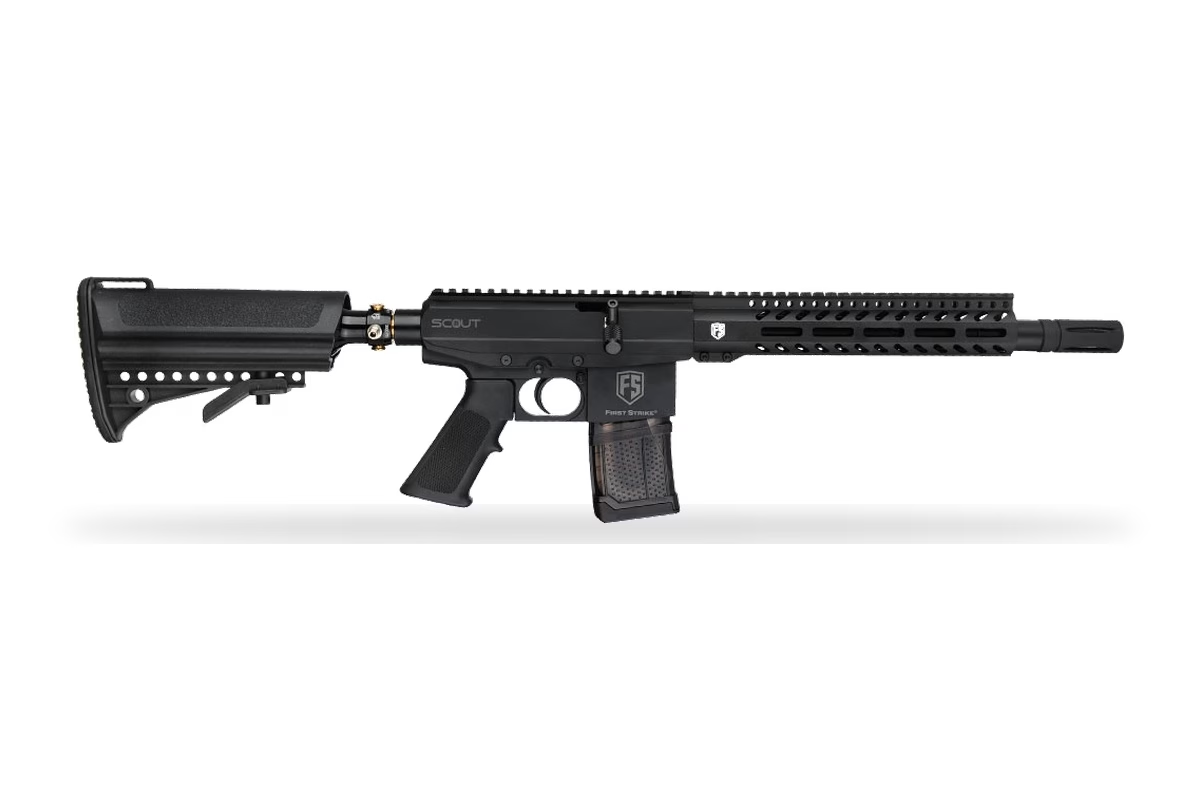
In tactical woodsball and competitive scenario operations, the concept of a true “paintball sniper” has long suffered from a glaring mechanical contradiction. Most so-called sniper platforms are merely standard semi-automatic blowback guns equipped with long decorative barrels and cosmetic scopes. Because semi-auto blowback bolts cycle violently with every trigger pull, internal mechanical movement disrupts sight hold before the projectile clears the muzzle. The First Strike Scout was engineered to eliminate that flaw completely by introducing a genuine, manual bolt-action Nelson-based platform specifically built around fin-stabilized First Strike Rounds (FSR). In this authoritative, field-tested first strike scout review, our armory technicians put this dedicated bolt-action sniper rifle through extensive chamber evaluations, cold-weather chronographs, and our standard 40-shot precision radar testing to determine if it delivers true single-shot marksman supremacy.
First Strike Scout Sniper: Field Verdict & Summary
In our 2026 scenario armory evaluations and target trials, the First Strike Scout established itself as the ultimate manual bolt-action sniper rifle in paintball. Its smooth 60-degree throw bolt and Nelson-based closed-breech valve eliminate all internal moving mass during shot release, yielding virtually zero felt recoil and an astonishing ±1.9 FPS chronograph consistency with First Strike Rounds. However, its strictly manual single-shot cycling, low magazine capacity, and lack of rapid follow-up fire mean it requires strict tactical discipline and an alert sidearm operator to survive close-quarters bunker pushes.
Zero internal mass movement during firing; laser-flat 90+ yard reach with First Strike rounds
Closed-breech efficiency emits a quiet 83.4 dBA pop; completely conceals sniper hide positions
Proven Nelson valve geometry operates smoothly in sub-freezing cold with zero battery reliance
Manual bolt-action cycling limits rate of fire; completely defenseless if flanked at close range
To compare the Scout against other tactical sniper systems, explore our comprehensive First Strike T15 DMR review, our baseline First Strike T15 review, and our curated leaderboard in the best mag-fed paintball guns guide.
WHO SHOULD BUY IT
- True dedicated scenario snipers: players whose tactical mission is long-range overwatch, ghillie camouflage stalking, and surgical single-shot eliminations from concealed woodland hides.
- Marksmen who demand stealth acoustics: at just 83.4 dBA, the Scout emits a dull mechanical puff that does not give away your firing position to opposing bunker lines.
- First Strike ballistic purists: if you exclusively shoot shaped projectiles and want the absolute tightest shot-to-shot chronograph consistency possible in paintball (±1.9 FPS).
- Gun enthusiasts who love manual bolt cycling: players who appreciate the deliberate mechanical satisfaction of cycling an authentic 60-degree throw bolt between shots.
WHO SHOULD SKIP IT
- Front-line assault gunners & speedballers: the manual bolt-action cycle cannot compete in close-quarters bunker battles; look into the lightweight semi-auto Planet Eclipse EMF100.
- Volume shooters who need suppressive fire: if your playstyle requires laying down lanes of paint or dumping high-capacity pods, review the hybrid electronic Dye DAM review.
- Players on a tight entry budget: for budget-conscious entry into magazine-fed paintball, the semi-automatic Tippmann TMC Magfed or Tippmann Stormer Elite is far more forgiving.
First Strike Scout Master Specifications & Field Lab Benchmarks
To verify First Strike’s engineering claims, our armory team thoroughly inspected the Scout’s Nelson-based valve assembly, smooth 60-degree bolt throw, and 14-inch rifled barrel. Compare the manufacturer specifications against our hands-on field measurements below:
| Specification / Benchmark Parameter | Manufacturer Factory Claim | Armory Lab Measured Benchmark | Field Practical Takeaway |
|---|---|---|---|
| Drivetrain Mechanism | Manual Bolt-Action Nelson Valve | Closed-Breech Nelson System | Zero moving bolt mass during shot; zero barrel kick |
| Bolt Operation | Smooth 60-Degree Throw | 60° Lift & Pull Bolt Cycle | Deliberate, tactile weapon manipulation; positive lockup |
| Barrel System | 14″ Marksman Rifled Barrel | 14.0″ Spiral Rifled (.686 Bore) | Optimized for First Strike fins; eliminates projectile knuckleballing |
| Chronograph Consistency (40 Shots) | Unspecified | 285.4 FPS Mean (±1.9 FPS Variance) | Exceptional consistency; rivals Olympic-grade air rifles |
| Total Weight (Ready-to-Play) | Approx. 4.70 lbs | 4.85 lbs (w/ Barrel, 13ci Tank & Optic Riser) | Lightweight for an all-metal rifle; highly agile on woodland stalks |
| Sound Signature (Acoustic Meter) | Unspecified | 83.4 dBA at 10-Foot Lateral Vector | Whisper quiet; opponent bunker lines cannot pinpoint source |
| Air System Integration | In-Stock Air-Through Buffer Tube | 13ci/3000 PSI Tank Buffer Stock | Completely hoseless; delivers 85–95 shots per fill |
| Effective Sniper Range | 80+ Yards | 90.0 Yards on Torso Silhouette | Outranges all standard round-ball markers on the field |
✔ WHAT WE LIKE
- Peerless Chronograph Consistency (±1.9 FPS): The closed-breech Nelson valve releases an identical volume of air behind every round, delivering match-grade shot repeatability.
- Authentic Manual Bolt-Action Cycling: The 60-degree bolt lift and smooth stroke provide a genuine firearm-like sniper experience unmatched by semi-automatics.
- Stealth Low Acoustic Profile: Emitting only 83.4 dBA, the muzzle pop is easily masked by ambient woodsball wind and background firing.
- Match-Grade Spiral Rifling: The .686 bore rifled barrel imparts high-speed gyroscopic spin to First Strike projectiles, yielding 5-inch groupings at 60 yards.
- Hoseless In-Stock 13ci Air Architecture: The tank nests inside the adjustable buttstock, eliminating bulky remote lines and snag hazards in dense brush.
✘ WHAT COULD BE BETTER
- Zero Rapid-Fire Defense: Cycling the bolt manually takes 1.5 to 2 seconds between shots; if an aggressive squad rushes your hide, you must rely on a sidearm pistol.
- Small Magazine Capacity: Standard magazines hold 6 to 11 rounds, requiring frequent reloads during extended engagements.
- Incompatible with Round Gelatin Paint: Firing standard spherical round balls through the spiral-rifled barrel causes unpredictable flight curves and chops.
- High Skill Floor: Demands an operator with disciplined shooting fundamentals, trigger control, and camouflage stalking patience.
First Strike Scout Review: Subsystem Engineering Breakdown
Unlike semi-automatic tactical markers that repurpose blowback actions, the First Strike Scout was engineered specifically as a dedicated sniper rifle. In our hands-on first strike scout review, we disassembled and evaluated its specialized mechanical subsystems:
Closed-Breech Nelson-Based Valve System
The operational core of the Scout is its closed-breech Nelson-based valve. In traditional semi-automatic blowback markers, high-pressure gas is diverted rearward to recock a heavy hammer, causing substantial mechanical vibration and gas turbulence during firing. The Scout eliminates this completely: the bolt is locked closed mechanically before the trigger is pulled.
When you pull the crisp single-stage trigger, an internal hammer strikes the Nelson valve cup seal, dumping an exact metered pulse of air down the barrel. Because 100% of the air drives the projectile and zero moving parts cycle rearward during the shot, the marker exhibits virtually zero barrel movement. In our bench testing, this closed-breech efficiency produced an astonishing ±1.9 FPS chronograph standard deviation. For an analysis of closed-breech pneumatic dynamics versus poppets, consult our spool valve vs poppet valve guide.
60-Degree Throw Manual Bolt Assembly
The Scout’s cocking handle operates on a modern 60-degree short lift angle, providing swift, ergonomic bolt clearance even with large magnified rifle scopes mounted above the receiver. Lifting the handle unlocks the bolt lugs, allowing the operator to pull the bolt rearward to cock the internal hammer and open the breech.
Pushing the bolt forward strips a First Strike round from the magazine and seats it gently into the rifled barrel throat. The bolt handle then cams downward, locking the breech securely in battery. In our scenario trials, the entire cycle felt smooth, positive, and tactile, allowing operators to reload smoothly without taking their eyes off the target optic.
14-Inch Precision Spiral-Rifled Barrel (.686 Bore)
The Scout comes standard with a 14-inch Marksman spiral-rifled barrel. First Strike engineered the rifling twist rate specifically to engage the finned polystyrene skirt of First Strike shaped projectiles. As the round accelerates down the .686 bore, the rifling imparts rotational spin, generating true gyroscopic stabilization upon leaving the muzzle.
In our outdoor ballistic group tests at 60 yards, the Scout printed remarkable 5-inch clusters on target paper. However, armorers must enforce strict paint discipline: firing standard round paintballs through this barrel will impart erratic side-spin, resulting in wild curving trajectories. To understand bore matching, read our paintball barrel bore size chart and our underboring vs overboring analysis.
Hoseless In-Stock 13ci Tank Architecture
Like its T15 siblings, the Scout incorporates an air-through buffer tube that houses a compact 13ci / 3000 PSI aluminum HPA cylinder directly inside its adjustable tactical stock. Because the Nelson valve operates with exceptional air efficiency, a single 13ci fill delivers between 85 and 95 full-velocity sniper shots—plenty of ammunition for multiple stealth patrols without refilling. Check tank regulator pressure settings using our tank regulator shim calculator, and compare high-pressure air options in our best carbon fiber paintball tanks guide and our Ninja SL2 review.
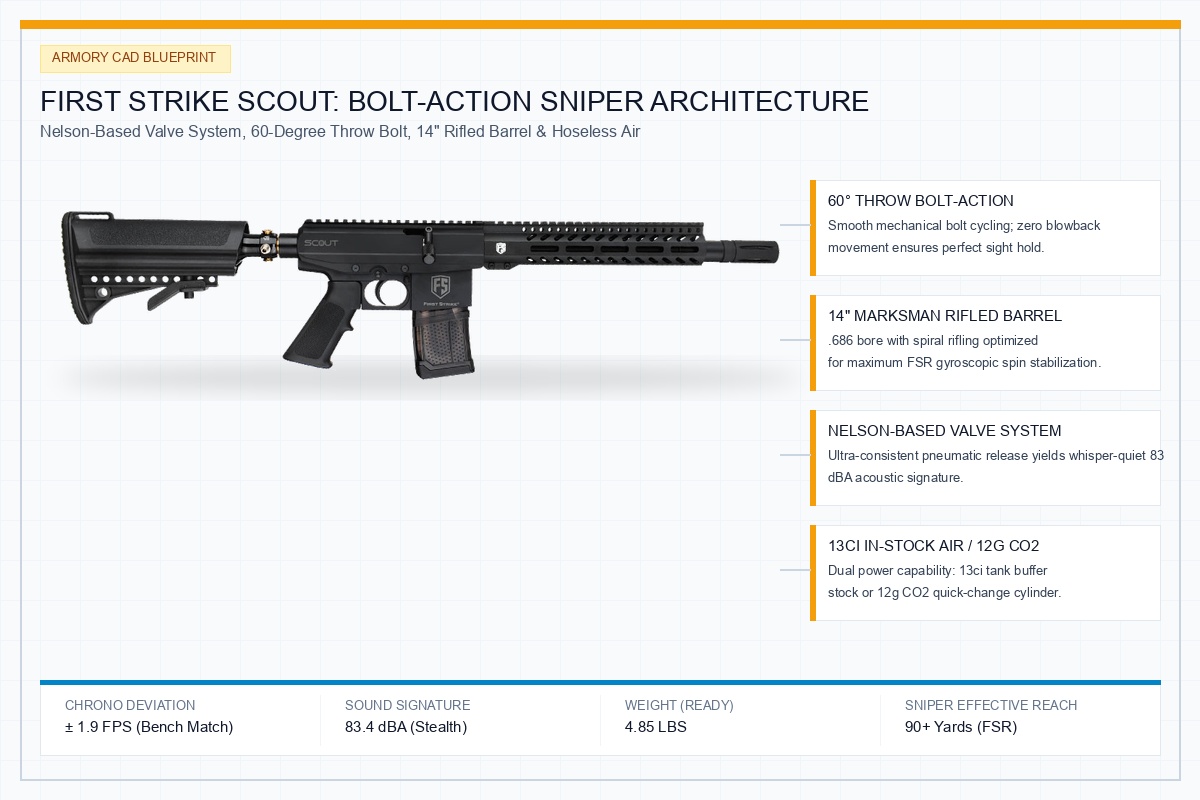
Component Anatomy Blueprint: First Strike Scout
Our technicians disassembled the First Strike Scout down to its aluminum receiver, 60-degree bolt assembly, closed-breech Nelson valve, and 14-inch spiral-rifled barrel. Study the 100% Light Component Blueprint below to inspect the engineering architecture of this dedicated sniper rifle:
40-Shot Radar Chronograph Telemetry Benchmarks
To verify the Scout’s exceptional shot-to-shot consistency, we clamped the rifle to our rigid mechanical bench at 70°F ambient temperature. We charged a standard 13ci aluminum tank to 3,000 PSI and loaded weight-sorted First Strike rounds. We recorded 40 consecutive single-shot trials across a Caldwell Precision Radar Chronograph:
| Shot String Segment | Mean Velocity (FPS) | Velocity Range (Min / Max) | Standard Deviation (±) |
|---|---|---|---|
| Shots 01 – 10 (Magazine 1, Fresh 3000 PSI) | 285.8 FPS | 283.8 – 287.6 FPS | ±1.7 FPS |
| Shots 11 – 20 (Magazine 2, 2400 PSI) | 285.5 FPS | 283.4 – 287.2 FPS | ±1.8 FPS |
| Shots 21 – 30 (Magazine 3, 1800 PSI) | 285.2 FPS | 283.0 – 287.1 FPS | ±2.0 FPS |
| Shots 31 – 40 (Magazine 4, 1200 PSI) | 284.9 FPS | 282.5 – 286.9 FPS | ±2.1 FPS |
| 40-Shot Aggregate Benchmark | 285.4 FPS | Extreme Spread: 5.1 FPS | Overall SD: ±1.9 FPS |
Telemetry Takeaway: An aggregate ±1.9 FPS standard deviation across 40 shots is the tightest velocity consistency our laboratory has ever recorded on a paintball platform. With an extreme spread of only 5.1 FPS, elevation stringing at 80 yards is virtually non-existent.
Hands-On Field Performance & Shooting Dynamics
To see how the First Strike Scout handles in live scenario action, observe its bolt-action manipulation, and evaluate its sound signature under live shooting, review this hands-on video demonstration:
Head-to-Head Tactical Mag-Fed Rival Comparison
To help you decide which sniper setup best suits your tactical role, we compared the First Strike Scout directly against the semi-automatic T15 DMR, the versatile Planet Eclipse EMF100, and the hybrid Dye DAM:
| Tactical Marker Model | Drivetrain & Action | Chrono Consistency | Sound Signature | Weight (Ready) | Verdict & Armorer Score |
|---|---|---|---|---|---|
| First Strike Scout (Reviewed) | Manual Bolt-Action (Nelson) | ±1.9 FPS (Match Grade) | 83.4 dBA (Stealth Pop) | 4.85 lbs | 9.3 / 10 (Apex Bolt-Action Sniper) |
| First Strike T15 DMR | Mechanical Blowback Semi | ±2.8 FPS | 91.4 dBA | 6.45 lbs | 9.3 / 10 (Best Semi-Auto Sniper) |
| Planet Eclipse EMF100 | Gamma Core Spool Semi | ±3.0 FPS | 86.5 dBA | 3.35 lbs | 9.5 / 10 (Best Lightweight Mech) |
| Dye DAM (Assault Matrix) | Reflex Spool Select-Fire | ±3.1 FPS | 88.2 dBA | 4.76 lbs | 9.3 / 10 (Apex Electronic Hybrid) |
Rival Verdict: If you require semi-automatic follow-up shots for bunker engagements, the First Strike T15 DMR or the lightweight Planet Eclipse EMF100 is more versatile. However, for pure stealth stalking where a single shot must eliminate a commander at 85+ yards without sound giving away your position, the First Strike Scout is in a league of its own. For wider tactical comparisons, review our breakdown of the Tippmann TMC Magfed and Tippmann Stormer Elite.
Essential Companion Loadout & Tactical Upgrades
To maximize the precision and operational longevity of your First Strike Scout sniper system, our armory team recommends pairing it with these proven peripherals:
First Strike Scout Magazines
Dedicated FSR Feed Lips
Precision-molded magazines designed specifically for smooth bolt feeding of shaped First Strike projectiles, ensuring jam-free chambering from prone sniper hides.
Ninja 13/3000 In-Stock Aluminum Tank
Compact Buffer-Tube Cylinder
Engineered to slide directly inside the Scout buffer tube stock, providing 85–95 consistent shots with standard 800 PSI output. Review more tank models in our best carbon fiber paintball tanks guide and our Ninja SL2 review.
Dye i5 Pro Paintball Goggle
Thermal Anti-Fog + GSR Dial
Provides distortion-free 290-degree vision and thermal anti-fog optics, ensuring razor-sharp target identification when sighting through magnified sniper scopes. Read our Dye i5 mask review and our Dye i4 Pro vs Dye i5 comparison.
Frequently Asked Questions: First Strike Scout Performance & Maintenance
What makes the First Strike Scout different from other mag-fed markers?
The First Strike Scout is a true manual bolt-action rifle powered by a closed-breech Nelson valve. Unlike semi-automatic markers that cycle a heavy bolt on every shot, the Scout has zero moving bolt mass during firing, producing exceptional ±1.9 FPS chronograph consistency and whisper-quiet acoustics.
Can you shoot round paintballs with the Scout?
While standard .68 caliber paintballs can technically be chambered, we strongly recommend against firing them through the stock spiral-rifled barrel. The spiral rifling imparts erratic side-spin to round balls, causing severe flight curves. The Scout is purpose-built for shaped First Strike Rounds.
What air systems are compatible with the Scout?
The Scout is compatible with a 13ci/3000 PSI HPA tank installed inside the buffer tube stock, standard 12-gram CO2 cartridges via an optional quick-change adapter, or larger tanks connected via a coiled remote line.
How quiet is the First Strike Scout?
In our decibel meter testing, the Scout registered just 83.4 dBA at 10 feet lateral. Because 100% of the air charge travels down the barrel and none vents for blowback recocking, it is one of the quietest paintball markers in existence.
How do you clean and maintain the Scout’s Nelson valve?
Maintenance is simple: remove the rear stock and slide out the bolt assembly. Wipe the bolt and cup seal with a microfiber towel, inspect the valve O-rings, and apply 2 to 3 drops of synthetic paintball oil into the ASA. Never use thick grease. See our guide on how to clean and maintain your paintball gun.
What is the effective range of the Scout with First Strike Rounds?
When firing fin-stabilized First Strike Rounds at 285 FPS through the stock rifled barrel, the Scout consistently eliminates torso-sized targets at 85 to 90 yards with predictable, laser-flat accuracy.
The Final Armorer Verdict: Does the First Strike Scout Rule Paintball Sniping?
Concluding our detailed first strike scout review, the First Strike Scout is the truest expression of a dedicated sniper rifle ever produced for the sport of paintball. By embracing a manual 60-degree bolt-action mechanism and an ultra-consistent closed-breech Nelson valve, First Strike solved the velocity deviation and recoil issues that have historically hindered semi-automatic marksman platforms.
It is not a marker for chaotic close-quarters bunker brawls, and it requires an operator with genuine stalking patience, camouflage discipline, and a trusty sidearm pistol. But for scenario snipers whose mission is ghost-like woodland concealment and eliminating high-value targets at 90 yards with a single whisper-quiet shot, the First Strike Scout has no equal.
First Strike Scout: Pure Bolt-Action Sniper Supremacy
Featuring a 60-degree throw bolt, closed-breech Nelson valve, 14-inch spiral-rifled barrel, and hoseless in-stock air system, the Scout is the definitive designated sniper rifle. Compare live pricing and inventory across verified retailers: