Wet-Weather Engineering • Anti-Fog Dual Panes, Porting Taping & Swell Control
Field Execution at a Glance: Playing Paintball in the Rain Without Gear Failure
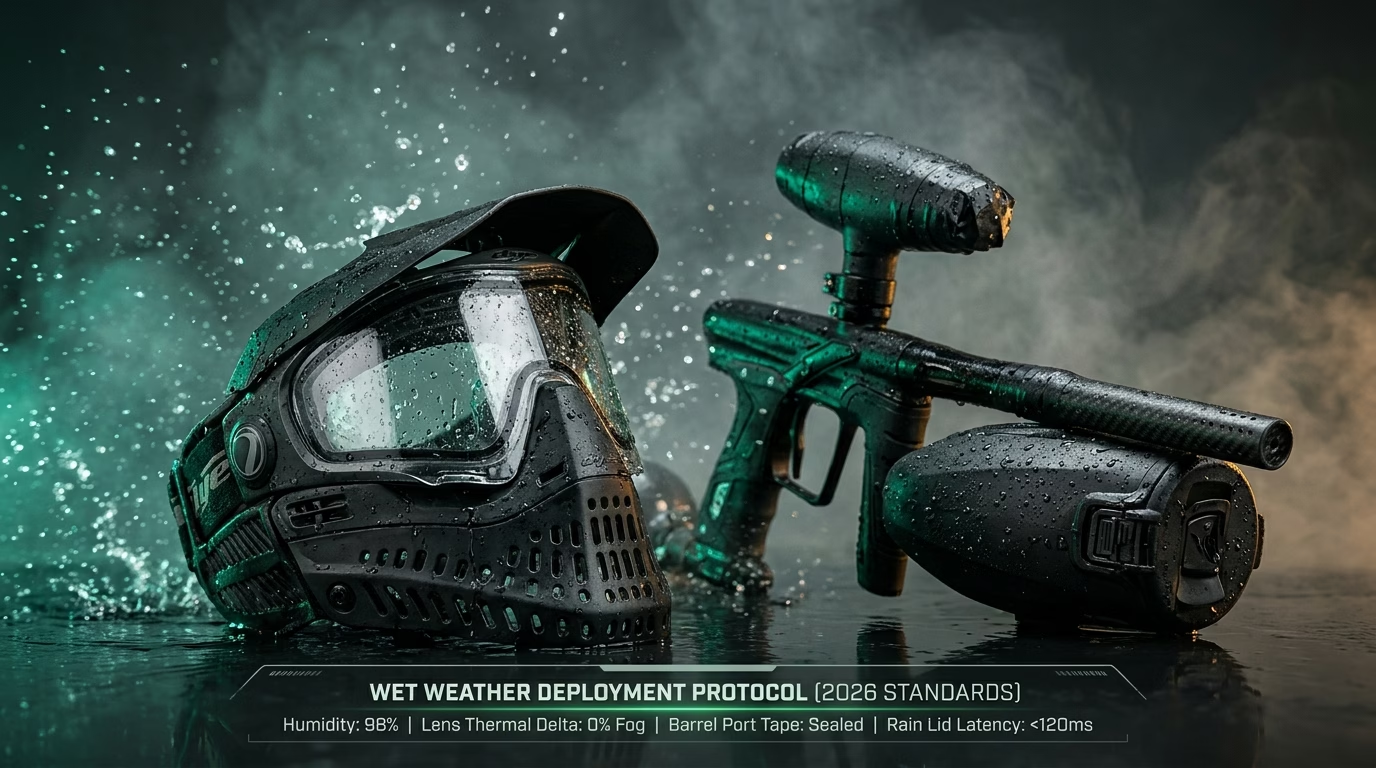
Surviving and winning when playing paintball in the rain requires treating moisture as an active mechanical adversary: you must seal your upper goggle vents with an extended brim visor to keep water out of your dual-pane thermal gasket, wrap the top 4 inches of your barrel porting with waterproof vinyl electrical tape to prevent bore hydroplaning, and replace high-speed crown feeds with a sealed rubber rain lid. In 95% relative humidity, gelatin shells expand up to +0.008 inches within 60 minutes, requiring a 1-size larger barrel insert (over-boring from .685 to .689) to eliminate catastrophic barrel breaks and maintain 290 FPS tournament velocity.
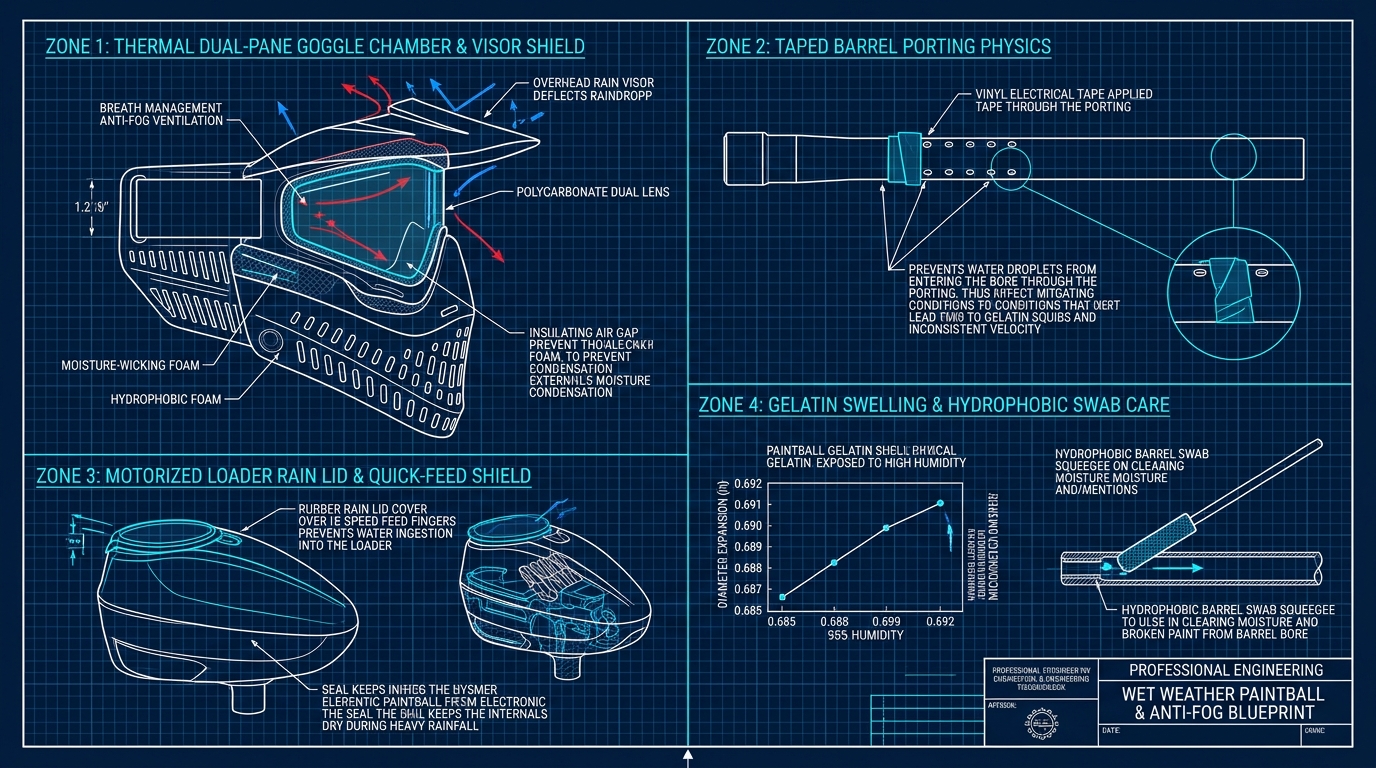
- The Fatal Brow Foam Water Trap: Never allow falling rain to saturate the open foam lining above your goggle frame; waterlogged brow foam drips onto the inner thermal lens, destroying the silicone perimeter seal and blinding you instantly.
- The 4-Inch Top Barrel Porting Wrap: Rainwater drops striking unsealed barrel porting seep inside the bore, creating a hydraulic fluid wedge that breaks paintball gelatin shells mid-barrel and sends unpredictable “curveballs” 15 feet off target.
- Speed-Feed Disaster Prevention: Operating an electronic loader with an open rubber speed-feed during heavy rain will fill your hopper with 2 to 3 ounces of standing water within a single 5-minute point, melting 200 paintballs into useless paint soup.
In our tournament referee clinics and rainy-day scenario trials, we see unprepared squads surrender entire matches not because the other team out-shot them, but because their gear drowned. Players charge onto a downpour-soaked speedball turf or muddy woodsball ravine, and within three minutes their single-pane rental masks fog completely white, their speed-fed loaders turn into water buckets, and their barrels spray paint soup from hydroplaning squibs.
Competing in paintball in the rain is not an exercise in misery; it is a masterclass in thermodynamic sealing, ballistics control, and wet-turf friction management. When you understand how water affects gelatin capsules, electronic solenoid seals, and optical dew points, rain becomes your biggest competitive advantage against opponents struggling to see three feet ahead.
Align this wet-weather survival guide with our comprehensive masterclasses on how to reduce paintball mask fogging, our head-to-head optical comparisons of thermal vs single lens paintball masks, Dye i5 vs Virtue VIO Ascend shootout, JT Proflex vs Dye i5 mask comparison, our armorer troubleshooting on paintball chopping causes and fixes, and our high-speed mechanics in how to slide & dive into bunkers without injury.
Thermodynamics of Goggle Fogging, Gelatin Swelling & Hydroplaning
When playing in wet weather, you are battling three distinct physical phenomena governed by atmospheric humidity, fluid dynamics, and thermodynamics. Understanding the exact science allows you to inoculate your gear before stepping onto the staging grid:
- Thermodynamic Dew Point Delta (The Anti-Fog Science): Goggle fogging occurs when warm, moisture-laden air from your breath and face (98.6°F with 100% relative humidity) contacts a cold polycarbonate lens cooled by ambient rain (45°F–60°F). The moisture condenses into micro-droplets on the lens surface. A true thermal dual-pane lens creates an insulating dead-air pocket between the outer polycarbonate shield and inner acetate pane, preventing the inner pane from reaching the dew point. However, if rain drips through your goggle’s top brow foam, water bridges the two panes or saturates the inner face, inducing instant flash condensation.
- Hygroscopic Gelatin Expansion (+0.005″ to +0.008″): Paintball shells are manufactured from animal collagen (gelatin), which is inherently hygroscopic—meaning it actively absorbs ambient moisture from the air. In a dry climate, tournament paint sizes consistently at .684 to .685 inches. In sustained 90%+ rain, the gelatin expands rapidly. Within 45 to 60 minutes, your paintballs will swell to .689 to .692 inches. If you run a tight .685 bore barrel insert, swollen paint will wedge tightly in the control bore, producing massive velocity drops, barrel breaks, and broken balls inside your breech.
- Barrel Porting Hydroplaning & Fluid Trajectory Rupture: Modern tournament barrels feature 30 to 80 precision-drilled porting holes designed to vent propellant gas gradually behind the ball to quiet the shot signature. In driving rain, water collects across the top ridge of the barrel and seeps through these porting holes directly into the bore. As a paintball travels down the barrel at 295 FPS (201 mph), it collides with standing water droplets, creating an asymmetric hydraulic fluid wedge. This causes the ball to hydroplane, scrub velocity, spin wildly off trajectory, or burst from hydraulic shock inside the barrel.
- Ground Friction Decay (μ = 0.18 Wet Clay vs. μ = 0.32 Wet Turf): On artificial tournament turf, rain lowers the coefficient of kinetic friction from μ = 0.45 down to μ = 0.32, creating smooth, fast slides. But on natural grass, rain turns the topsoil into slick clay with a friction coefficient as low as μ = 0.18. This doubles your deceleration glide distance and creates severe slipping hazards if your footwear lacks deep molded turf cleats.
Master Wet-Weather Diagnostics & Rain Rig Lookup Matrix
Use this field-tested diagnostic matrix to identify wet-weather failures, understand their exact moisture mechanics, and implement immediate field coach remedies:
| Wet-Weather Condition / Equipment Failure | Moisture Mechanism / Physical Root Cause | Field Coach Fix / Tactical Counter | Recommended Rain-Ready Gear |
|---|---|---|---|
| Instant Goggle Blindness & White-Out Fogging | Rain dripping into top brow vents saturates open-cell foam; exhaled warm breath cannot escape, condensing instantly on inner lens. | Install a rigid clip-on rain visor; apply a narrow strip of breathable electrical tape over top vents; install an active magnetic goggle fan. | AmazoneBay |
| Bore Squibs & Swollen Paint Jamming | Hygroscopic gelatin absorbs moisture, swelling from .685″ to .691″; balls wedge in under-bored control backs and fracture. | Over-bore by 1–2 insert sizes (e.g. switch from .685 to .689/.691); keep unopened paint bags sealed in airtight coolers with desiccant. | AmazoneBay |
| Wild Curveball Deflection & Barrel Chopping | Rainwater entering top barrel porting pools in the bore, causing the 200 mph paintball to hydroplane on an asymmetric water film. | Wrap top 4–6 inches of barrel porting with black 3M vinyl electrical tape (leave bottom ports open); swab bore after every single point. | AmazoneBay |
| Loader Paint Meltdown (Speed-Feed Inundation) | Open rubber finger speed-feeds allow rainwater to run straight into the loader raceway, softening gelatin into a gelatinous slurry. | Remove speed-feed; snap on a sealed spring-loaded solid rain lid; wrap pod necks with electrical tape and reload with marker pointed down. | AmazoneBay |
| Electronic Solenoid / OLED Board Water Damage | Water seeps between rubber grip frame seams and screw holes during heavy rain, corroding microswitch contacts and shorting 9V boards. | Apply thin coat of Dow 33 grease to grip panel rubber lip seals; ensure marker battery door gasket is seated; never submerge gun in puddles. | AmazoneBay |
| Uncontrolled Deceleration & Mud Slipping | Flat rubber sneakers lose all traction on wet turf/mud (μ < 0.20), causing groin pulls, knee hyperextensions, and sliding past cover. | Equip turf-specific cleats with aggressive molded studs (HK Shredder / Under Armour); drop hips 4 feet earlier to initiate slide safely. | AmazoneBay |
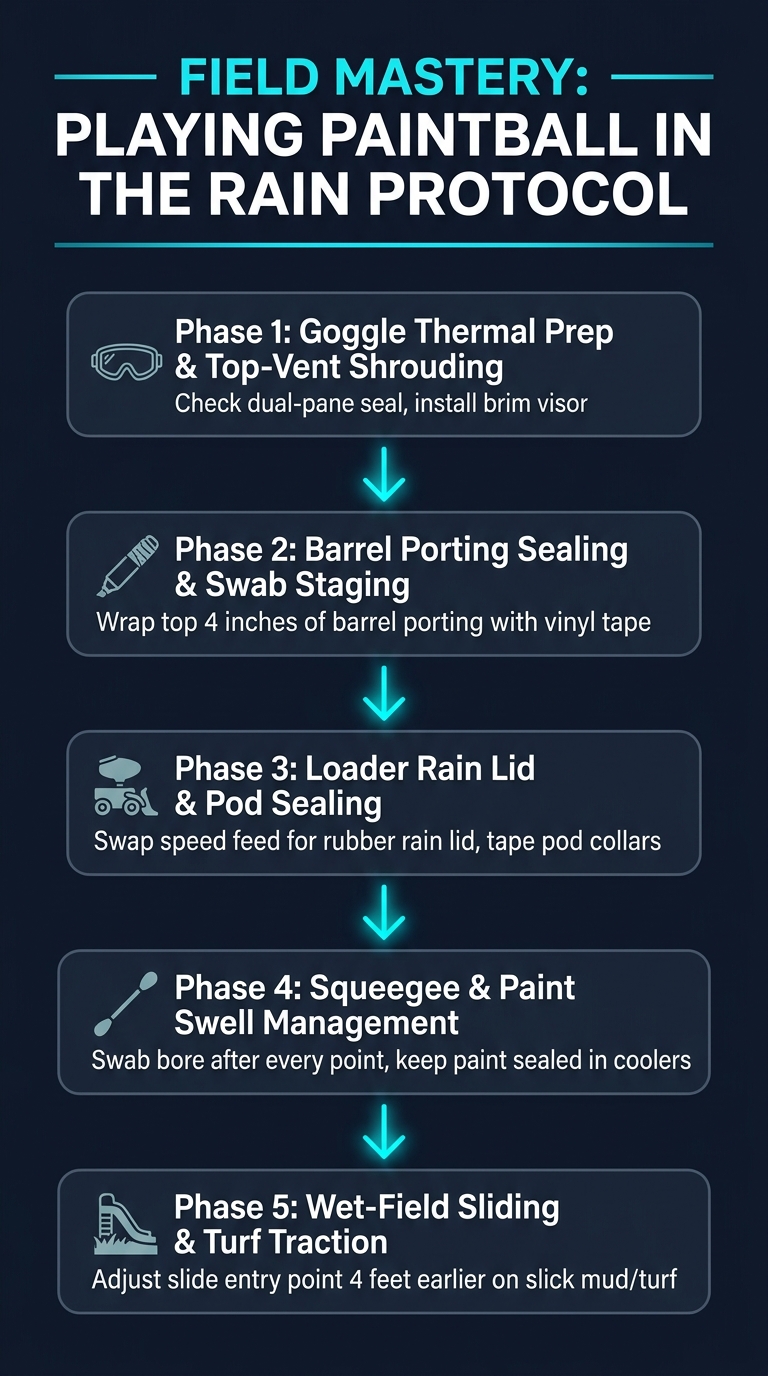
Step-by-Step Field Execution: The 5-Phase Wet Weather Protocol
Execute this rigorous staging protocol before the opening horn to keep your vision crystal clear and your marker shooting laser-straight through heavy rain:
Phase 1: Goggle Thermal Prep & Shrouded Rain Visor Installation
Inspect your mask’s dual-pane thermal lens under bright light. Ensure the thin perimeter silicone glue bead is 100% intact with zero moisture trapped between panes. Clip on your mask’s manufacturer rain visor (e.g. Dye i5 visor or Virtue stealth visor). For driving rain, place a 2-inch strip of electrical tape across the top brow vent foam—leaving the side and chin vents completely unobstructed so warm breath exhausts downward and outward without rising into your lens chamber.
Phase 2: Barrel Porting Sealing & Swab Staging
Take a roll of standard 3/4-inch black vinyl electrical tape and wrap the top 4 to 6 inches of your barrel tip porting. Cover only the top-facing rows of holes; leave the bottom and side ports open so excess propellant air still vents cleanly. The tape acts as an umbrella over the bore, preventing vertical raindrops from entering the barrel while running or bunker-tucking. Stage two dual-sided swab squeegees (such as the Exalt Barrel Maid) in your harness so you can swab your bore dry between points.
Phase 3: Loader Rain Lid & Pod Sealing Discipline
Never use a speed-feed in active rain. Unclip your speed-feed and install your loader’s solid, spring-loaded rain lid. In staging, wrap a 1-inch ring of electrical tape around the joint where your pod lids meet the plastic tube; this prevents water from seeping into your pods while they sit in your harness pack. When reloading on the field, angle your marker barrel downward 45 degrees, pop the rain lid, dump your pod with your body shielding the loader opening, and snap the lid shut within 2 seconds.
Phase 4: Hydrophobic Paint Storage & Bore Over-Boring
Keep all unopened cases and bags of tournament paint inside sealed, insulated hard coolers with silica desiccant packs in the staging pits. Never leave open bags on staging tables. Measure your paint on a barrel sizer every 45 minutes: as relative humidity approaches 98%, paint will swell from .685 to .689. Step up your barrel control bore by at least +0.004 inches (e.g. switch from a .685 back to a .689 or .693 insert) to give swollen gelatin extra clearance and eliminate barrel breaks.
Phase 5: Wet-Turf Sliding Biomechanics & Traction Control
Adjust your movement physics to the slick field surface. On wet turf or muddy natural fields, your glide distance increases by 4 to 6 feet due to reduced friction (μ = 0.32). Drop your center of gravity 4 feet earlier than normal when approaching an inflatable bunker. Keep your cleat studs angled laterally (45 degrees) to prevent vertical cleat snagging on soaked turf infill, and elevate your taped barrel muzzle +15 degrees to prevent scooping mud into your bore upon impact.
Strict Goggle Lens Cleaning Protocols & Wet Chrono Calibration
Never wipe the inner pane of your thermal goggle with a wet rag or jersey sleeve. The inner acetate lens is coated with a hydrophilic anti-fog chemical layer that softens when exposed to water; scrubbing a wet inner pane destroys the anti-fog coating and permanently ruins optical clarity. Only dab moisture gently with a dry, clean microfiber cloth. Furthermore, cold rainwater cools marker regulators and changes gas density: always re-chronograph your marker in wet staging pits to ensure velocity remains strictly between 280 and 300 FPS under NXL tournament rules.
Armorer Workbench: Essential Wet Weather & Rain Rig Equipment
Playing competitively in heavy rain requires dedicated wet-weather hardware designed to deflect precipitation and maintain airtight sealing. In our field testing across torrential storm matches, these four components are indispensable:
Dye i5 Thermal Goggle + Visor
The gold standard in optical clarity. Features TiRN dual-pane thermal optics, rapid-change lens locking, and clip-on rain visor to prevent precipitation from pooling in top ventilation foam.
Virtue Spire Solid Rain Lid
Replaces speed-feeds in seconds. Heavy-duty spring-loaded polycarbonate lid forms an airtight rubber lip seal, preventing rain from flooding your loader raceway and melting paintballs.
Exalt Barrel Maid Squeegee
Dual-action design features a rubber rocket disc that pushes water droplets out of the bore and an ultra-dense microfiber puff that polishes barrel walls dry in a single stroke.
HK Army Shredder Cleats
Engineered specifically for slick tournament turf and deep mud. 15 aggressive perimeter molded studs bite into wet topsoil, preventing slipping and ankle roll during breakout sprints.
Field Demonstration: Playing Paintball in the Rain Tutorial
Watch this technical walkthrough demonstrating essential rain preparation, goggle visor setup, barrel porting taping, and paint protection tips:
Seal Your Goggles & Barrel—Let the Other Team Drown
Playing paintball in the rain separates amateur players from disciplined competitors. By maintaining your thermal lens seal with a rigid visor, wrapping the top 4 inches of your barrel porting with vinyl electrical tape to eliminate bore hydroplaning, swapping to a solid loader rain lid, and over-boring by +0.004 inches to accommodate swollen gelatin, you will shoot clean, laser-straight ropes while blinded opponents wander helplessly out of their bunkers.
Pack a roll of 3M electrical tape, two fresh squeegees, and dry microfiber towels in your gear bag before every weekend event—because tournament champions play in any weather.
Frequently Asked Questions: Playing Paintball in the Rain
Can electronic paintball guns be used in heavy rain?
Yes, modern tournament electronic markers (such as Planet Eclipse CS3, 180R, DYE DSR+, and Shocker AMP) feature rubberized grip seals and water-resistant internal solenoid housings capable of handling standard rain. However, you should never submerge your marker in standing puddles, and you should apply a thin film of Dow 33 grease along grip panel rubber seams before playing in torrential downpours.
Why do paintballs curve wildly when shooting in the rain?
Paintballs curve in the rain because standing water droplets seep through top barrel porting and collect inside the bore. When a paintball travels through the barrel at 295 FPS, it hydroplanes across the asymmetric water film, inducing uneven Magnus spin that causes the projectile to hook or slice up to 15 feet off target. Wrapping the top 4 inches of your barrel porting with electrical tape prevents water entry and restores straight flight.
How do you dry a fogged thermal goggle lens between points?
Never wipe the inside pane with a wet cloth or shirt sleeve, as this rubs off the delicate hydrophilic chemical coating. Instead, use a completely dry microfiber cloth to dab (not scrub) moisture droplets off the inner pane. If the brow foam is soaking wet, press a dry paper towel or towel firmly into the foam to extract standing water before re-entering the field.
What barrel bore size should you use when it rains?
You should always over-bore by +0.004 to +0.006 inches in the rain. Gelatin shells absorb atmospheric humidity rapidly, expanding from .685 to .689+ within 60 minutes. Running a tight under-bore or exact match bore will cause swollen paintballs to pinch and shatter inside your barrel back.
How do you protect paintballs in the staging pits during a rainstorm?
Store unopened paintball bags inside insulated plastic coolers with snap-tight latches. Place several 50-gram silica gel desiccant packs inside the cooler to absorb residual ambient humidity. Never open a bag until you are actively loading pods, and immediately seal filled pods with a wrap of tape around the lid seam.
Sub-Zero Freezing Conditions: Learn how sub-freezing snow transforms gelatin brittleness and pneumatic HPA output compared to rain in our Paintball in the Snow Cold Tactics Guide.