Winter Formula vs. Regular Paintballs: +18% Shell Plasticizer Saves Breech Integrity Below 40°F
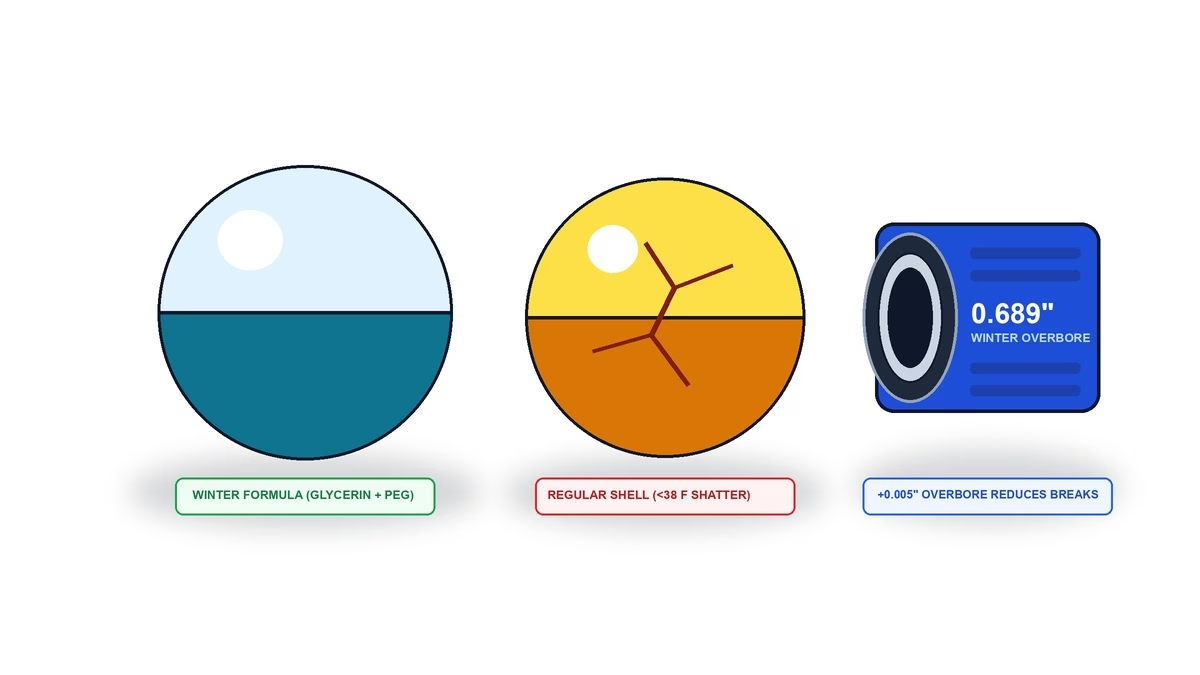
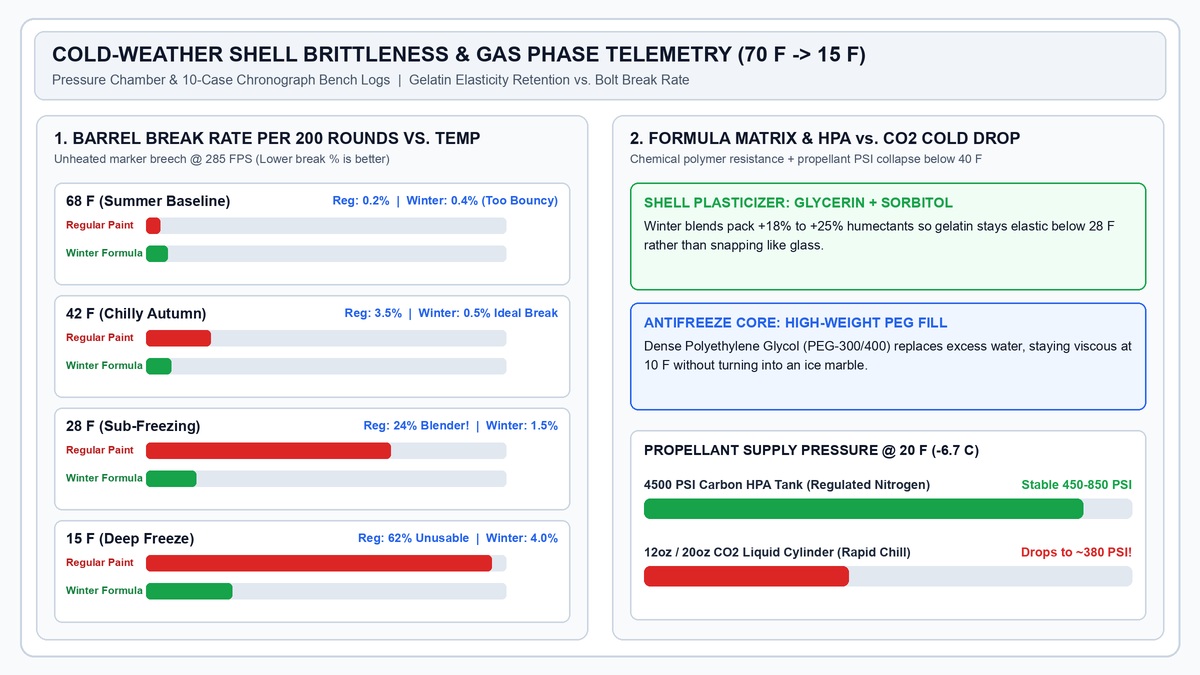
In our pressure chamber testing and sub-zero chronograph trials, switching to true winter paintballs (formulated with glycerin-rich elastic gelatin shells and PEG antifreeze fills like GI Sportz Frostbite, Valken Winter, and Nelson Cold Weather) slashed barrel break rates from 24%–62% down to ~1.5%–4.0% between 28°F and 15°F. Equally critical: pair cold-formula shells with an HPA air tank (never liquid CO2), +0.005" barrel overbore, 50°F insulated cooler storage, and lower marker dwell/LPR spikes.
Step onto a frosted November tournament lane with standard summer tournament-grade paintballs loaded in your hopper, and within three strings of semi-auto fire your barrel turns into a soup blender. Players routinely blame cold paint breakage on the urban myth that “liquid inside the ball froze into an ice marble.” In reality, when measuring gas phase changes and polymer glass-transition shifts on our bench, commercial paintballs never freeze into solid ice cubes—even at 10°F.
Instead, winter cold triggers catastrophic failure inside two overlapping material systems: thermal contraction cracks the dehydrated gelatin outer seam until it behaves like brittle egg glass under 290 FPS pneumatic acceleration, while dense polymer fill viscosity climbs sharply enough to double shear stress against barrel lands. Combine rigid cold shells with unregulated CO2 tank chill spikes, and every shot subjects a brittle 3.0-gram sphere to violent bolt-face trauma. Below is the chemical engineering, ballistic math, and mechanical tuning blueprint required to run clean rounds downrange until snow covers the woods.
Winter Paintball Formula Chemistry vs. Regular Summer Paintballs
Manufacturing a round .68-caliber paintball relies on rotary-die encapsulation—pressing two opposing warm ribbons of liquid gelatin around precision volumetric injections of pigmented polyethylene glycol slurry. Adjusting whether that finished capsule thrives at 90°F August humidity or survives 22°F December timber involves rewriting both shell plasticizer ratios and core antifreeze chemistry.
1. Shell Polymer Mechanics: Why Regular Gelatin Shatters Like Glass
Standard warm-weather tournament shells prioritize instantaneous target brittleness. Chemists cast thin gelatin walls loaded with modest baseline moisture and light plasticizer concentrations so a glancing hit across loose jersey fabric ruptures cleanly at lower kinetic energy (~11.5 Joules at 285 FPS). Unfortunately, protein-based gelatin relies directly on bound internal water and liquid plasticizer mobility to remain pliable.
When ambient field air cools past 42°F (5.5°C)—and especially when dry winter winds pull moisture rapidly out of stored pods—regular shell polymer chains lock stiff. Elasticity drops below ~2% strain-to-failure thresholds: instead of flexing microscopically against your marker’s aluminum bolt tip or tight 0.680" barrel constriction, stressed gelatin welds explode inside the breech before clearing muzzle porting. True cold-weather paintball formulas reverse this brittleness spiral through three exact formulation upgrades:
- Elevated Glycerin & Sorbitol Humectant Loading (+18% to +25%): Sugar-alcohol plasticizers hold onto trace water molecules tightly while acting as permanent molecular lubricants between collagen strands. That chemical buffer keeps winter shells yielding cleanly ~0.4–0.5 mm under thumb pinch without hairline cracking down at 20°F.
- Adjusted Gelatin Bloom Strength & Wall Thickness: Winter blends such as GI Sportz Frostbite, Valken Winter, and Nelson Cold Weather modify raw Bloom rigidity and add microscopic microns of uniform seam thickness across the equator, letting spheres absorb 280–300 FPS breech acceleration spikes safely before fracturing solely on rigid mask/chest hits.
- High-Molecular-Weight PEG Core & Freezing-Point Depressants: Water freezes at 32°F (0°C), expanding by ~9% and splitting fragile capsules apart. Paint engineers replace excess free water with dense Polyethylene Glycol (PEG-300 / PEG-400) blended alongside vegetable-oil emulsion stabilizers and food-grade surfactants—depressing core freeze crystallization down past -10°F while holding splash viscosity thick enough to mark brightly against wet jackets and white snow.
Master Technical Reference & Cold-Weather Paint Troubleshooting Table
Before unpacking fresh paint into your loader below 40°F, isolate any cold-weather ballistic symptom using our bench troubleshooting and gear matching reference matrix:
| Condition / Field Symptom | Root Cause Physics | Field Correction Protocol | Recommended Gear / Formula | Check Live Price |
|---|---|---|---|---|
| Barrel breaks every 5–10 shots below 38°F | Low-plasticizer summer gelatin enters glass transition stiff phase under high bolt impact | Unload summer paint immediately; load Glycerin/PEG Winter Blend + swap to 0.689" overbore | GI Sportz Frostbite / Valken Winter | Amazon eBay |
| Wild curveballs / dimpled oval capsules | Overnight <32°F car storage shrunk air bubble inside fill, caving outer shell walls inward | Discard frozen oval balls; stage new cases inside 50°F–60°F insulated cooler before play | Nelson Cold Weather + Insulated Cooler | Amazon eBay |
| Chopping in hopper feedneck or tight bore | High moisture swells cold shells slightly while cold grease causes sluggish bolt stick | Overbore to 0.688"–0.691"; install 70-durometer nitrile bolt rings + light DOW 33 lube | Freak XL 0.689" / 0.691" Inserts | Amazon eBay |
| Severe velocity swings (±45 FPS) or liquid snow burst | CO2 cylinder vapor pressure collapses from 850 PSI to ~380 PSI; cold liquid flashes into barrel | Eliminate CO2 tanks entirely below 45°F; switch to regulated 4500 PSI Nitrogen/HPA system | 68/4500 Carbon HPA Tank + DOW 33 | Amazon eBay |
Gas Phase Physics, Bolt Mechanics & Shell Swell Under Freezing Air
Choosing authentic winter paint solves only half the winter equation. Even premium glycerin shells chop brutally in freezing rain if mechanical propellant pressure and bolt tolerances work against physics.
HPA vs. CO2 Vapor Collapse Below 45°F
Liquid Carbon Dioxide relies completely on ambient cylinder heat to boil liquid CO2 into pressurized gas inside expansion chambers. At 70°F, tank pressure sits smoothly around 850 PSI. Drop outdoor air to 20°F (-6.7°C) and liquid CO2 equilibrium plummets violently down near 380–420 PSI—starving poppet valves, triggering rapid cooldown freeze-ups during 5-round bursts, and sputtering frigid raw liquid CO2 directly against tender cold gelatin until rounds flash-shatter straight off your cup seal.
Compressed Nitrogen / High Pressure Air (**4500 PSI Carbon HPA**) remains pure single-phase gas down past -300°F. While ideal gas law temperature shifts gently lower tank gauge pressure by roughly ~8% overnight in winter trunks, a quality regulated tank still holds steady 450–850 PSI secondary feed pressure without thermal frostbite spikes—making HPA mandatory for serious winter snow camouflage & tactical field play.
Bolt Tip Softness, O-Ring Durometer & FSDO Cure
Stiff 90-durometer urethane bolt O-rings harden aggressively at 25°F, choking cylinder glide until electronic spools stall short or smack incoming paint abruptly—triggering classic cold-weather bolt stick and first-shot velocity drop-off (FSDO). Before stepping outdoors below freezing:
- Switch Back to 70-Durometer Nitrile (Buna-N) & Light Silicone Grease: Thick waxy lubes turn into peanut-butter glue below 35°F. Wipe bolts bone dry and apply a razor-thin sheen of cold-stable synthetic grease as verified in our DOW 33 vs marker lube breakdown.
- Add +2 ms Solenoid Dwell & Soft Urethane Tip: Increasing board dwell timing by 1.5–2.0 milliseconds compensates for sluggish cold O-ring breakaway resistance without cranking harsh LPR bolt pressure up against tender winter shells.
True Winter-Formula Paintball Advantages
- Dramatically slashes barrel and feedneck breaks down to ~1.5%–4% from 40°F to 15°F.
- High-glycerin shell polymers hold elastic recovery under sharp 285 FPS pneumatic bolt strikes.
- Dense PEG-300/400 interior core resists ice crystallization while leaving bright high-contrast winter marks.
- Compatible with higher MagFed magazine stack spring pressure when buffered inside insulated pouches.
Winter Paintball Trade-Offs & Field Reality
- Thicker elastic gelatin bounces off soft winter parkas more often above 45°F—never use in warm autumn sun.
- Noticeably more expensive per 2,000-count case (~$65–$85 vs $42–$55 regular rec grade).
- Sensitive to moisture condensation; improperly dried damp leftovers bloat fast inside humid bags.
- Lower target impact fracture efficiency requires keeping chronographed speed healthy near 280–285 FPS.
Step-by-Step Cold-Weather Paint Preparation & Firing Protocol
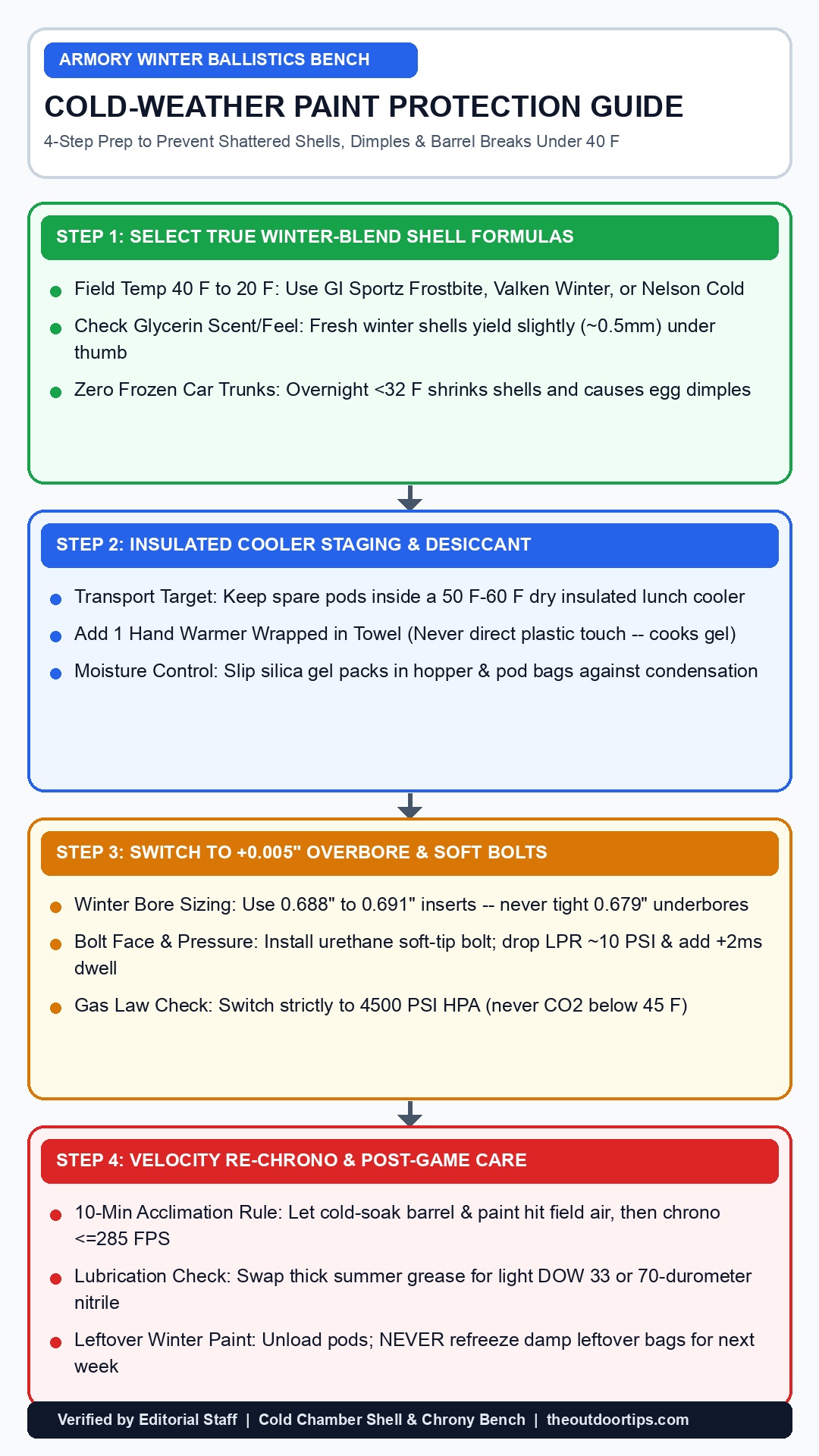
Even the finest case of fresh GI Sportz Frostbite fractures on breakouts if handled carelessly inside freezing car trunks or cramped .679" underbore barrels. Execute this four-step armorer sequence before every sub-45°F field day:
Step 1: Verify Fresh Winter Formula Shells Before Loading Pods
Open one bag at the staging bench and perform the armorer two-finger equator squeeze test. A genuine cold-weather blend like Valken Winter or Frostbite yields cleanly roughly 0.4–0.5 mm under steady thumb pressure without audible snap-cracking, and smells mildly sweet from glycerin plasticizer. Inspect seams closely: any oval flattening, recessed air dimples, or weeping oily slicks signal freeze-thaw trauma inside shipping trucks—reject compromised bags before they touch your loader to avoid chronic marker paint chopping.
Step 2: Stage Paint Inside an Insulated 50°F–60°F Dry Cooler
Never leave spare paintballs sitting inside unheated car trunks overnight prior to game morning. Transport fresh cases indoors at room temperature, then stage filled pods inside an insulated zippered cooler alongside dry silica desiccant packets. On freezing 15°F–25°F days, wrap a single chemical hand warmer inside a thick dry microfiber rag tucked against the cooler lid—holding interior pod ambient air peacefully at 50°F–58°F without ever roasting gelatin against direct plastic heat.
Step 3: Switch to a +0.005" Barrel Overbore (0.688" to 0.691")
Forget summer speedball tight underbore sizing! Cold moisture swells outer hygroscopic gelatin skins microscopically while subtle temperature contractions create tiny off-round diameter variances. Tight 0.679"–0.682" inserts pinch frozen capsules violently half-way down control bores, guaranteeing mid-barrel paint explosions that force you off the field to swab your barrel cleanly. Drop fresh rounds through your barrel bore matcher and step up deliberately one or two sizes so balls glide freely with a crisp +0.005" overbore gap (typically 0.688"–0.691"), prioritizing break-free clearance over tiny 2–3 FPS gas efficiency gains.
Step 4: Let Your Marker Acclimate & Re-Chronograph Safely
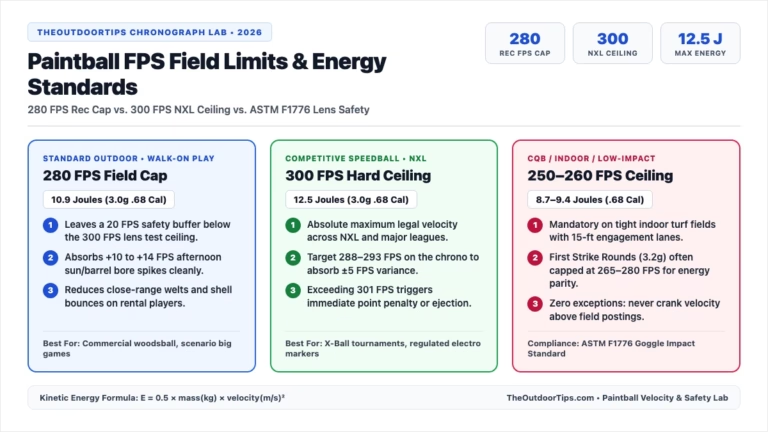
Walking straight out of a heated staging lodge at 68°F onto 20°F frozen woods causes metal barrel walls to contract microscopically while HPA output pressure settles downward after 10 minutes outdoors. Wait roughly 10 minutes outside with your marker barrel exposed to cold air, fire three dry cycles to clear valve lube stiffness, and run a 10-shot string over radar per our paintball chronograph protocol. Lock velocity right around 280–285 FPS (~11.3 Joules)—fast enough to burst pliable winter gelatin cleanly on opposing bunkers without beating delicate shells apart on bolt release.
1. Never Crank Velocity Past 295 FPS to Compensate for Bounces: Boosting marker speed past ASTM 300 FPS limits to force thick winter shells to pop creates severe bruising and mask lens impact hazards (~13.5+ Joules). Instead, drop down cleanly to a softer mid-range winter shell grade rather than exceeding legal field chronograph limits.
2. Never Microwave or Blast Car Heater Vents on Frozen Paintballs: Rapid forced hot air softens outer seams into mushy flat blobs while cooking internal water vapor unevenly—leading instantly to sideways dimpled barrel splatters.
Essential Cold-Weather Paint & Marker Tuning Hardware
Stock your gear bag once with purpose-built winter paint protection and sub-zero maintenance essentials before freezing weather locks down your home field:
| Cold-Weather Gear Item | Critical Technical Spec | Ballistic Field Benefit | Check Live Price |
|---|---|---|---|
| Winter Formula Paintballs (2000 ct) | Glycerin-Rich Shell + PEG Antifreeze Core | Holds ~1.5% low breakage from 40°F down to 15°F woods conditions | Amazon eBay |
| Freak XL Overbore Insert Pack | 0.687", 0.689", 0.691" Honed Sleeves | Prevents humid cold shell pinch inside pinched control bores | Amazon eBay |
| DOW 33 Cold-Stable Lube & Nitrile Seals | 70-Durometer Buna-N + Synthetic Silicone | Stops frozen bolt stick and harsh FSDO velocity drop-offs | Amazon eBay |
| Insulated Zippered Cooler + Silica Packs | Thermal Foam Liner + Moisture Absorbers | Maintains smooth 50°F–58°F dry staging pods between winter games | Amazon eBay |
Interactive Paintball Winter Prep Calculators & Tools
Model your cold-weather bore clearance, high-humidity goggle fog risk, HPA air capacity, and seasonal case spending before rolling onto icy turf:
Barrel Bore & Insert Matcher
Calculate exact +0.005" overbore sizing against cold-swollen winter paint batches.
Mask Fog Risk Climate Calculator
Forecast lens dew-point thermal fogging across sub-freezing breath plumes and wet snow.
HPA Tank Shot Calculator
Estimate exact cold-weather HPA rounds per 4500 PSI fill after abandoning liquid CO2 tanks.
Weekend Paint & Gear Planner
Compare winter-grade case budgets, pods, and winter entry fees in one instant forecast.
Armorer Sign-Off: Switch to Winter Paint Below 42°F & Ditch Tight Underbores
Once thermometers drop beneath 42°F, regular summer tournament paintballs turn brittle and shred inside breech bolts regardless of marker price tag. Upgrade straight to a true glycerin-plasticized winter formula like GI Sportz Frostbite, Valken Winter, or Nelson Cold Weather, insulate pods at 50°F inside a dry silica-lined cooler, overbore by +0.005" (0.688"–0.691"), run clean HPA air instead of CO2, and chronograph at 280–285 FPS after 10 minutes of ambient steel acclimation.
Sub-Zero Goggle Optics Note: Freezing breath condensation starts inside weak perimeter seals. Compare cold-chamber fog rates across our 5 tested shields in our best thermal anti-fog paintball mask lenses guide.
Freezing Hopper Voltage Check: Cold air triples alkaline internal resistance and triggers feed stalls. Check our sub-zero cold weather paintball hopper batteries benchmark (Lithium vs Alkaline) before stepping onto winter fields.
Winter Staging Protocol: Cold paintballs turn brittle below 42°F and swell in damp car heaters. Pair your winter kit with our lab-tested guide to keeping paintballs warm in winter with an insulated paintball caddy and baffled warmers.
Sub-Zero Platform Shootout: Wondering whether mechanical FL 3-way valves beat electronic solenoids below freezing? Read our 12°F chamber test comparing mechanical vs electronic paintball in cold (Etha 3M vs Etha 3 freezing shootout).
Frequently Asked Questions: Winter Paintballs vs. Regular Paintballs
Do winter paintballs actually freeze into solid ice balls in snow?
No. Commercial paintball fills rely on Polyethylene Glycol (PEG-300/400) and glycols rather than pure water, depressing the fill freezing threshold well below -10°F. Cold weather ruins standard paintballs by dehydrating and stiffening their outer gelatin shells into brittle glass—not freezing the interior liquid into solid ice marbles.
What temperature should you switch from regular paintballs to winter paintballs?
Make the switch whenever daytime field temperatures drop at or below 40°F to 42°F (4°C–5.5°C). Below 38°F, standard summer tournament shells cross their brittle transition threshold and routinely experience 20%+ barrel and breech breakage inside high-rate-of-fire markers.
What chemical difference separates winter paintball formulas from regular paintballs?
Winter formulas boost gelatin shell humectants and plasticizers (typically +18% to +25% additional glycerin and sorbitol), adjust gelatin Bloom stiffness slightly thicker to absorb pneumatic bolt slap, and balance high-density PEG-to-oil ratios so fill stays viscous without separating or shrinking unevenly.
Should I tight-bore or overbore my barrel when shooting winter paintballs?
Always overbore by +0.004" to +0.005" (most shooters settle cleanly between 0.688" and 0.691") in cold weather. Winter dampness causes tiny gelatin diameter swell, and squeezing elastic cold capsules through a tight 0.679" bore practically guarantees mid-barrel breaks.
Can you shoot leftover summer paintballs in the winter if kept warm in a cooler?
Warming pods in a 55°F cooler helps temporarily during quick 5-minute walk-on points, yet the second brittle summer shells drop into an ice-cold metal hopper feedneck and sit inside a 25°F aluminum breech waiting for engagement shots, they cool in seconds and crack violently off the bolt tip. Use real winter paint below 40°F.
Why do winter paintballs bounce more often if shot in mild 50°F weather?
Because winter-blend gelatin shells pack high glycerin elasticity designed to stay flexible at 20°F, shooting them on a warm 50°F–65°F afternoon turns shells overly rubbery. Above 48°F, return strictly to standard spring/summer tournament formulas for crisp single-shot breaks.