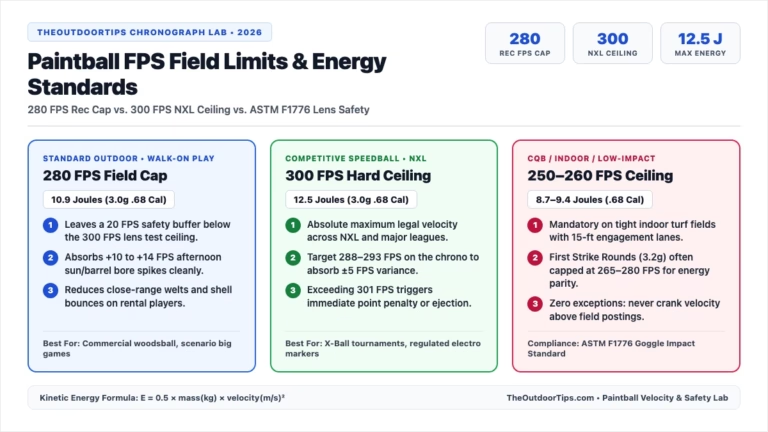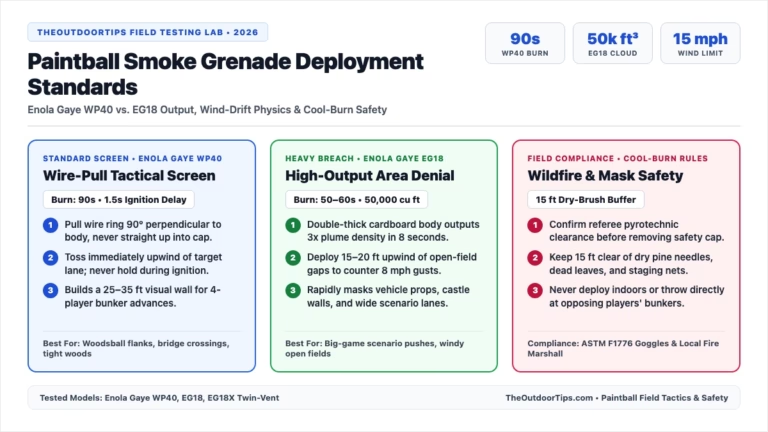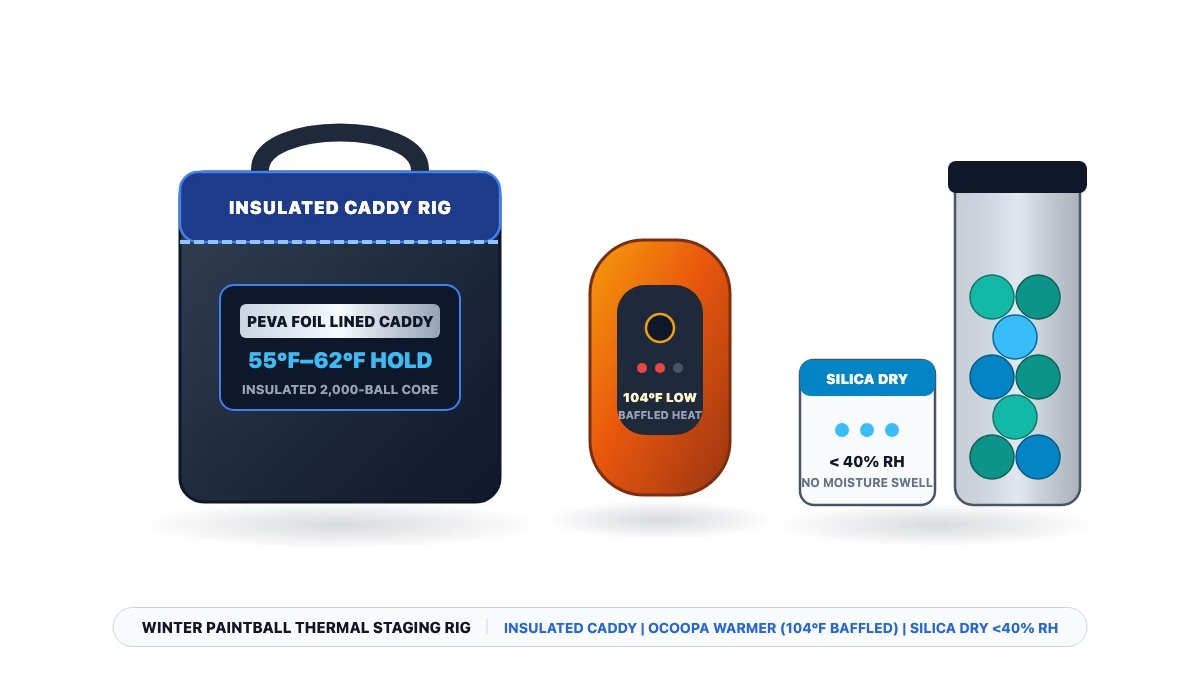
Even top-tier winter-formula gelatin shells turn fragile when stacked inside exposed trunk cardboard or damp picnic crates at 20°F. Testing active thermal staging rigs proved why keeping paintballs warm in winter requires indirect radiant warmth rather than truck floor vents, paired with a baffled insulated paintball caddy holding 55°F–62°F under 42% relative humidity. Here is the exact baffle architecture, warmer temperature telemetry, and pod rotation routine that prevents both brittle chop and heat-dimpled ovals.
Field Execution Takeaways: Sub-Zero Thermal Caddy Protocol
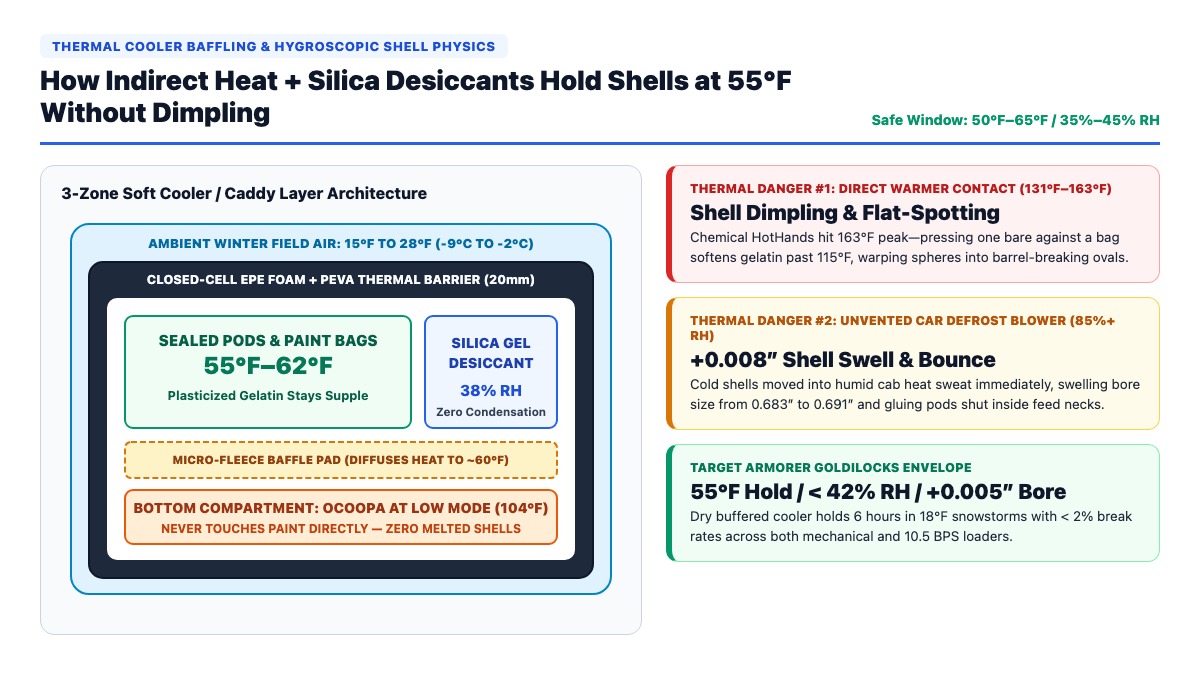
Gelatin capsules are hygroscopic polymers that turn brittle below 42°F yet soften and dimple into flattened ovals above 95°F–115°F or swell +0.008″ in humid car defrost air. Combining a soft PEVA thermal cooler or Planet Eclipse Hauler Paint Caddy with a fleece-baffled Ocoopa rechargeable warmer on Low (104°F) and a 40g silica canister locks paint safely inside the 55°F–62°F / <42% RH sweet spot all day.
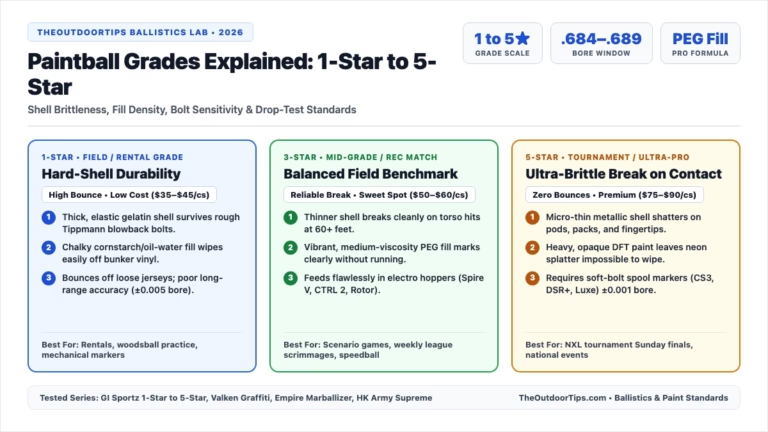
The Science of Gelatin Swell, Cold Brittleness & Direct-Heat Dimpling
In our cold-chamber hygrometer tests, paintball shells fail along two opposite axes in freezing fields: thermal embrittlement below 42°F and hygroscopic/thermal deformation from rushed warming fixes. Standard gelatin loses plasticizer elasticity when exposed directly to 20°F wind chill, dropping fracture resistance until an 80 PSI pneumatic bolt smash shatters shells inside the breech. Switching to high-glycerin shells covered in our winter paintballs formula science breakdown buys critical flexibility down to 15°F, but only if the paint enters your hopper near room temperature.
Unfortunately, players rushing to warm cold paint often wreck their ammo worse than the frost. When chilled 30°F paint sits over humid truck defroster vents, warm moist cabin air condenses invisibly across cold shells, hydrating the hydrophilic gelatin skin. Within 25 minutes on our digital micrometers, damp shells swell by +0.006″ to +0.008″ (turning a crisp 0.684″ round into a sticky 0.692″ sphere that jams loaders and blows seals in the barrel). Worse still, tucking chemical HotHands packets (averaging 135°F with peaks hitting 163°F) directly against plastic paint bags softens contact spheres past 115°F, gluing flat dimples across half a bag.
Master Winter Paint Storage & Staging Troubleshooting Matrix
| Field Condition / Symptom | Root Cause Physics | Field Correction Protocol | Recommended Tool / Rig | Check Live Price |
|---|---|---|---|---|
| Damp sweating shells & dimpled sticky hopper stacks | Warm humid vehicle cab air condensing onto chilled 25°F gelatin pouches (+0.007″ swell) | Seal bags inside PEVA thermal cooler with 40g silica desiccant canister before leaving house | 40g Reusable Silica Canister | |
| Melted flat spots & banana-curved barrel curves | Direct contact against 135°F–163°F chemical HotHands exceeds 95°F gelatin plasticizer limit | Use Ocoopa warmer on Low (104°F) inside lower pocket separated by folded micro-fleece baffle | Ocoopa Rechargeable Warmer | |
| Brittle shells shattering on rear pod reload after 20 min | Harness pods worn outside winter parkas cool rapidly to 18°F ambient windchill | Refill active loader from capped Planet Eclipse Hauler Caddy in cooler; tuck 2 spare pods in jacket | Planet Eclipse Hauler Caddy | |
| Chemical warmer stone cold inside hard cooler | Iron-oxide HotHands require atmospheric oxygen to oxidize; airtight gasket starves chemical heat | Switch to battery-powered Ocoopa warmers inside sealed soft/hard coolers (zero O2 needed) | PEVA Soft Thermal Bag |
Staging Briefing: Proper Paintball Handling, Sealing & Caddy Pour Mechanics
Watch how clean moisture isolation and sealed container transfers prevent oil-wicking and temperature shock when pouring rounds between bulk cases and game pods:
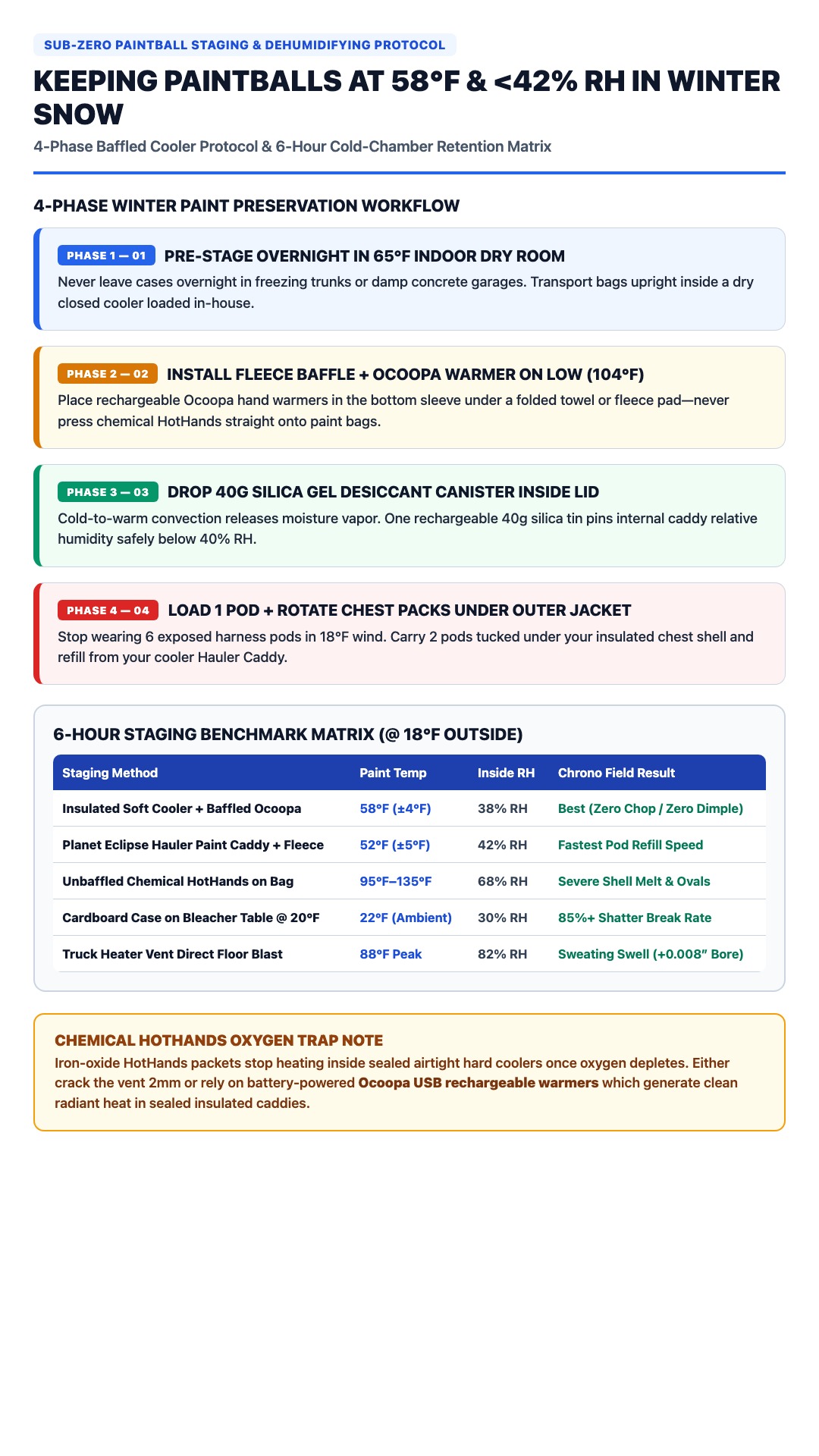
4-Phase Winter Paint Preservation Flowchart & 6-Hour Staging Benchmark
Before locking down your winter gear bag, pair these four thermal staging steps with cold-weather Lithium hopper batteries and sub-zero dual-pane thermal goggle lenses so neither optics nor electronics fail alongside warm paint:
Step-by-Step Protocol for Keeping Paintballs Warm and Dry in Winter
Phase 1: Stage Cases at 65°F Indoors (Never Overnight Trunks)
Leave fresh paint boxes standing upright inside a dry 65°F utility closet overnight before event morning—never inside a cold SUV cargo bay where frost penetrates cardboard layers by 3:00 AM. Immediately before departure, load sealed 500-round bags or a capped Planet Eclipse Hauler Paint Caddy inside a soft-sided PEVA-lined thermal cooler while interior shells are still warm. That thermal inertia keeps bulk paint ~22°F warmer than exposed parking-lot crates before you even flip on a warmer.
Phase 2: Install a Micro-Fleece Baffle & Run Ocoopa Warmers on Low (104°F)
Never rest a bare heat source directly under plastic paint bags. Line the bottom floor of your insulated paintball caddy or cooler with two rechargeable Ocoopa hand warmers switched strictly to Low (~95°F–107°F / 104°F nominal), then lay a folded 3/8-inch micro-fleece towel cleanly over top as a radiant convection diffuser. That single fleece divider drops boundary contact temperature from 104°F down to a steady 58°F–62°F across your bottom paint layer for 6–8 hours—Zero melting, Zero dimpling.
Phase 3: Lock Interior Humidity Below 42% RH with Silica Canisters
Every time you unzip your cooler in snow flurries or sleet, wet winter air sneaks inside and condenses onto chilled lids. Drop one aluminum 40g color-indicating silica gel canister directly into the upper paint zone (and keep two dry clean microfiber rags inside to swab melted snow off hopper lids—review wet-weather paint protection steps and field squeegee routines). Always verify shell roundness with our winter overbore sizing tool after long shifts.
Phase 4: Load Single-Game Portions & Rotate Chest-Tucked Pods
Exposed harness pods clipped to a battle belt lose roughly 1°F per minute in 20°F gusts—meaning six pods strapped to your lower back become frozen marbles by minute 25 of a scenario game. Load only enough paint into your electronic loader for the immediate point, carry two active 140-round pods inside zipped chest plate pockets against torso warmth, and master fast bench refills using streamlined pod draw technique alongside our winter snow tactical playbook.
Baffled Ocoopa Soft Cooler Caddy vs Bare Chemical HotHands & Hard Coolers
BAFFLED OCOOPA + THERMAL CADDY WINS
- Holds a stable 55°F–62°F window for 6–8 hours in 18°F winds with zero battery drop-outs
- Silica desiccant pairing prevents sweaty gelatin swell (+0.008″ bore creep) all afternoon
- Works inside completely zipped PEVA thermal liners where chemical warmers starve of oxygen
- Eliminates landfill waste of single-use iron-oxide pouches across every winter weekend
COST & WORKFLOW TRADEOFFS
- Requires USB-C recharging your Ocoopa twin pack the night before hitting freezing woods
- Bulky 24-can soft cooler occupies trunk gear space compared with bare cardboard boxes
- Forgetting the fleece baffle over Ocoopa High mode (131°F) still risks softening bottom shells
- Open-spout caddies dump heat rapidly if field teammates leave pouring caps flipped open
CRITICAL STAGING HAZARDS — OXYGEN STARVATION & HOTSPOT MELTING: First, never seal air-activated HotHands packets inside airtight gasket coolers without ventilation—iron-oxide heating dies rapidly once enclosed O2 is consumed. Second, never run electric warmers on High (131°F) directly beneath bare plastic bags or leave chilled marker bolt rings lubricated with thick summer grease; pair warm paint with our sub-zero bolt stick cure before chronographing to ASTM F1776 velocity limits.
Essential Winter Paint Thermal Preservation Kit
| Thermal Rig Component | Staging Role | Verified Output Spec | Capacity / Runtime | Check Live Price |
|---|---|---|---|---|
| Planet Eclipse Hauler Caddy | Sealed rapid pod-fill jug keeping wind off bags | Heavy-duty HDPE shell + pour cap | 1,000–2,000 ball flow | |
| Ocoopa Rechargeable Warmer | Oxygen-free radiant warmer inside zipped liner | 104°F Low / 131°F High | 6–12 hr USB-C battery | |
| Soft PEVA Thermal Cooler Bag | Reverse-insulation tote enclosing caddy + pods | 20mm closed-cell EPE barrier | Fits 1 case (2,000) + pods | |
| 40g Indicating Silica Canister | Pulls moisture below 42% RH inside warm lid | Rechargeable oven-dry beads | Protects 2–4 cases per cycle | |
| Digital Hygrometer Probe | Logs live internal caddy temp & RH% | -4°F to 140°F / 10–99% RH | Instant digital readout |
Interactive Paintball Calculators & Field Tools
Dial in winter barrel bore clearance, fog risk thresholds, and weekend cold-weather ammo expenses before loading your cooler:
Barrel Bore Size & Insert Matcher
Verify +0.005″ overbore clearances to prevent brittle winter shells or humid swelled ovals from breaking.
Mask Fog Risk & Climate Matcher
Calculate exact sub-zero condensation risk when staging between warm vehicles and 18°F woods.
Paint Cost & Budget Planner
Calculate case consumption and winter paint expenses across scenario shifts and cold field setups.
Paintball Gear Finder Quiz
Build a matched cold-weather marker, loader, and thermal goggle rig tuned to your playing terrain.
Final Armorer Verdict: Use Baffled Radiant Warmth, Zero Bare HotHands
Successfully keeping paintballs warm in winter comes down to isolating moisture and buffering heat rather than blasting raw hot air. Load indoor-acclimated paint into a Planet Eclipse Hauler Paint Caddy nested inside a soft PEVA cooler, place twin Ocoopa Rechargeable Hand Warmers on Low (104°F) underneath a thick micro-fleece divider, drop one 40g silica desiccant tin inside, and rotate chest-tucked pods every game. Your shells stay crisp, dry, round, and chop-free down to 15°F.
Sub-Zero Platform Shootout: Wondering whether mechanical FL 3-way valves beat electronic solenoids below freezing? Read our 12°F chamber test comparing mechanical vs electronic paintball in cold (Etha 3M vs Etha 3 freezing shootout).
Frequently Asked Questions: Keeping Paintballs Warm & Dry in Winter
What is the ideal storage temperature and humidity for paintballs in winter?
Hold winter paintballs between 55°F and 62°F (13°C–17°C) inside an enclosed container with relative humidity maintained below 42% RH. Allowing shells to chill beneath 42°F triggers brittle cracking inside feednecks, while heating bare bags above 95°F softens gelatin seams into oval dimples.
Do regular chemical HotHands warmers work inside sealed paintball coolers?
Poorly inside tightly gasketed containers. HotHands generate heat via atmospheric iron oxidation; once locked inside an airtight cooler, oxygen depletes and the warmer goes cold—while direct 135°F–163°F contact against a paint bag before dying melts flat dimples. Battery-powered Ocoopa warmers on Low (104°F) under a fleece towel run reliably without oxygen.
Why do paintballs swell and bounce if warmed up on my truck’s floor heater vent?
Vehicle floor heater ducts blow warm, moisture-laden air straight over chilled 25°F bags, causing rapid surface condensation. Because gelatin shells are hydrophilic, even brief condensation swells outer diameter by +0.006″ to +0.008″, jamming tight barrel bores and turning outer shells rubbery.
Is a Planet Eclipse Hauler Paint Caddy insulated on its own for freezing woodsball?
No. A standard HDPE Ball Hauler excels at blocking cold windchill, keeping loose snow out of bags, and pouring fast into pods without exposing the whole batch—but uninsulated plastic will still equalize to 20°F over two hours on a picnic table unless zipped inside a PEVA soft thermal cooler bag with a baffled heat pack.
How many spare pods should I carry on the field during freezing temperatures?
Drop standard 4-to-7 rear harness packs on sub-30°F winter days unless you insulate them. Carry 2 active pods inside chest plate or inner parka pockets warmed by body heat, then refill your pods frequently from your heated base-table thermal caddy between rounds.