When field temperatures plunge below freezing, standard alkaline cells stall drive motors and drop optical eye boards into mid-string brown-outs. Testing cold weather paintball hopper batteries in our pressure and thermal chamber proved why energizer ultimate lithium paintball configurations maintain full feed torque down to -40°F while alkalines choke below 28°F. Here is the exact electrochemistry, milliohm impedance math, and field battery protocol to prevent winter loader stalls.
Field Execution Takeaways: Sub-Zero Hopper Power Protocol
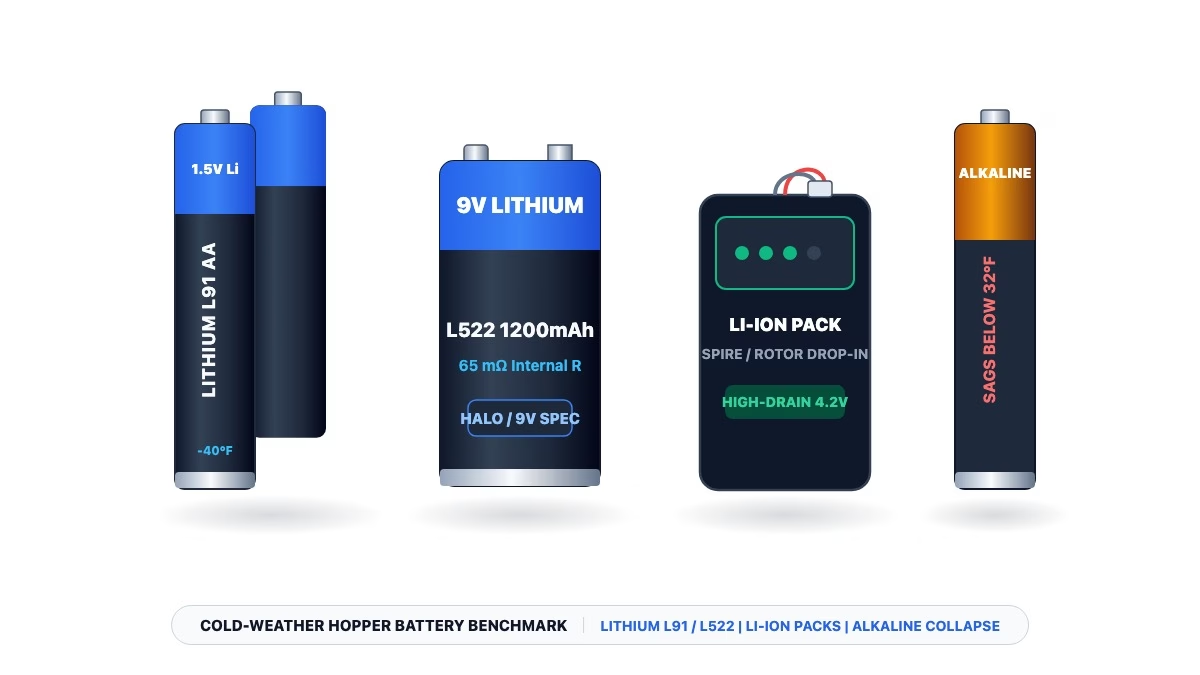
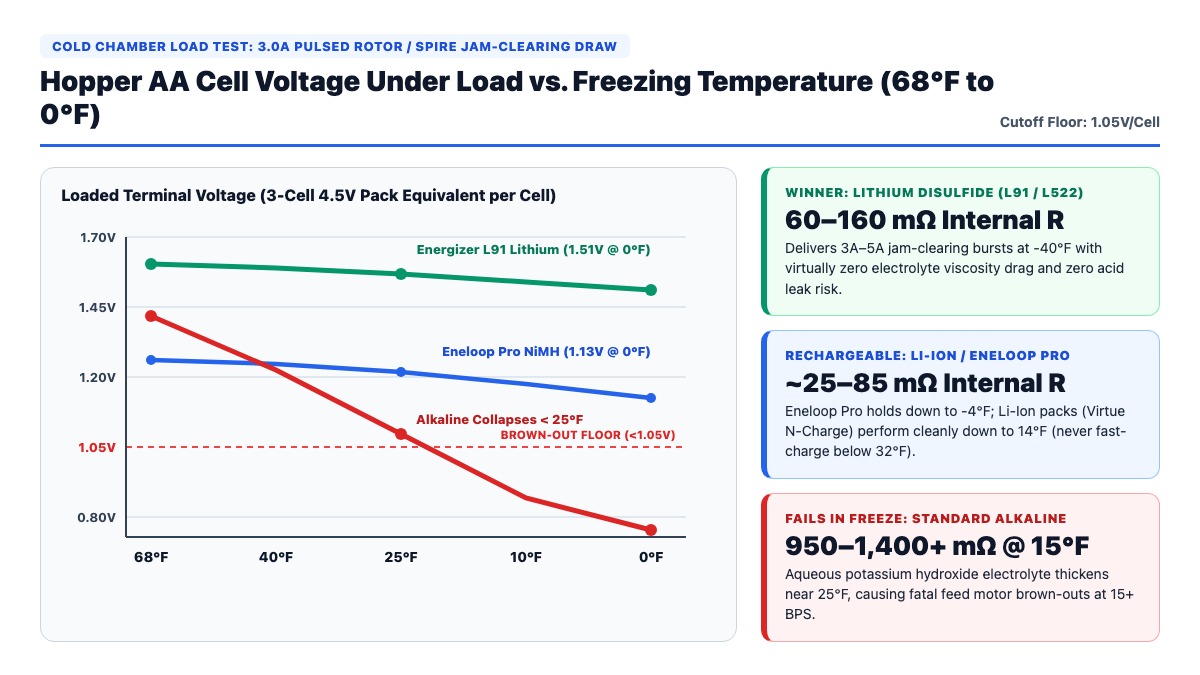
Standard alkaline AA and 9V cells rely on water-based potassium hydroxide electrolyte that thickens into sludge below 32°F, multiplying internal resistance above 1,100 mΩ and tripping loader low-voltage resets during high-BPS jam clears. Switching to Energizer Ultimate Lithium AA (L91) or 9V (L522) holds terminal voltage flat under 3.0A motor spikes all the way to -40°F.
Why Electronic Loaders Brown Out in Freezing Cold: Internal Resistance Physics
In our cold-chamber load bench testing, unloaded open-circuit multimeter checks fooled nearly every player we polled. A chilled 1.5V alkaline AA sits at 1.54V with zero load at 15°F—looking “full” on cheap LED battery checkers—only to plummet straight below 0.92V per cell the millisecond a Dye Rotor LT-R or Virtue Spire V motor draws a 3.0-amp anti-jam surge.
That collapse follows Ohm’s Law across battery chemistry: Vloaded = VOCV − (Imotor × Rinternal). Standard alkaline batteries suspend ions in an aqueous potassium hydroxide gel that approaches sluggish crystallization below 28°F, driving cell internal resistance from ~150 mΩ at 70°F up past 1,100–1,400 mΩ in winter woods. Across three series AAs, even a modest 2.5A paddle motor draw drops pack rail pressure below a loader microcontroller’s 3.1V minimum threshold, triggering phantom stall beeps, sluggish stack feeding, and ball chops (cross-check your feed stack against our paintball hopper jam diagnostic guide).
Conversely, energizer ultimate lithium paintball cells (L91 Lithium/Iron Disulfide AA and L522 Lithium/Manganese Dioxide 9V) use non-aqueous organic electrolytes rated for full current discharge down to -40°F (-40°C). Maintaining just 60–160 mΩ resistance and shedding ~33% battery sled weight (15.0 g per L91 cell vs 23.5 g per alkaline), Lithium cells keep drive RPM crisp through icy 15+ BPS NXL ramping bursts.
Master Cold-Weather Hopper Battery Diagnostic & Troubleshooting Matrix
| Field Condition / Symptom | Root Cause Electrochemistry | Field Correction Protocol | Recommended Cell | Check Live Price |
|---|---|---|---|---|
| Slow motor whine / rapid green-to-red LED blink at 25°F | Alkaline internal R spikes > 950 mΩ; loaded rail drops under 3.2V on spool-up | Swap immediately to fresh Energizer L91 AA pack (4.5V rail holds > 4.3V loaded) | Energizer L91 AA (8-Pack) | |
| Empire Halo Too / 9V marker board resets on first burst | Cheap alkaline 9V has 6 stacked tiny AAAA wafers; frost breaks series output | Upgrade to Energizer L522 9V Lithium (1,200 mAh, 65 mΩ) & tighten battery snaps | Energizer L522 9V Lithium | |
| Drop-in Li-Ion pack dead despite 100% LED charge indoors | Sub-32°F cold lithium plating + BMS thermal lock prevents high-C pulse discharge | Pre-warm Virtue N-Charge inside inner fleece pocket; never fast-charge cold Li-Ion | Virtue N-Charge Li-Ion | |
| NiMH pack drops voltage halfway through morning session | High self-discharge generic NiMH loses ~30% charge below 20°F | Run genuine Japanese low-self-discharge Eneloop Pro (-4°F) or switch to L91 | Panasonic Eneloop Pro AA | |
| Cold 18650 tactical optic / flashlight dead in MagFed rails | Standard unprotected Li-Ion shuts off under peak laser/optic draw in snow | Use Nitecore NL1835LTHP cold-weather (-40°F rated) rechargeable cells | Nitecore Cold 18650 Cell |
Bench Walkthrough: Drop-In Lithium Packs vs Loose AA Trays in Spires & Rotors
Before stripping down your winter gear bag, watch how modular drop-in lithium battery systems install directly into Spire and Rotor trays to prevent loose tray spring bounce and leaky alkaline corrosion:
Vertical Diagnostic Blueprint: Sub-Zero Loader Power Decision Tree
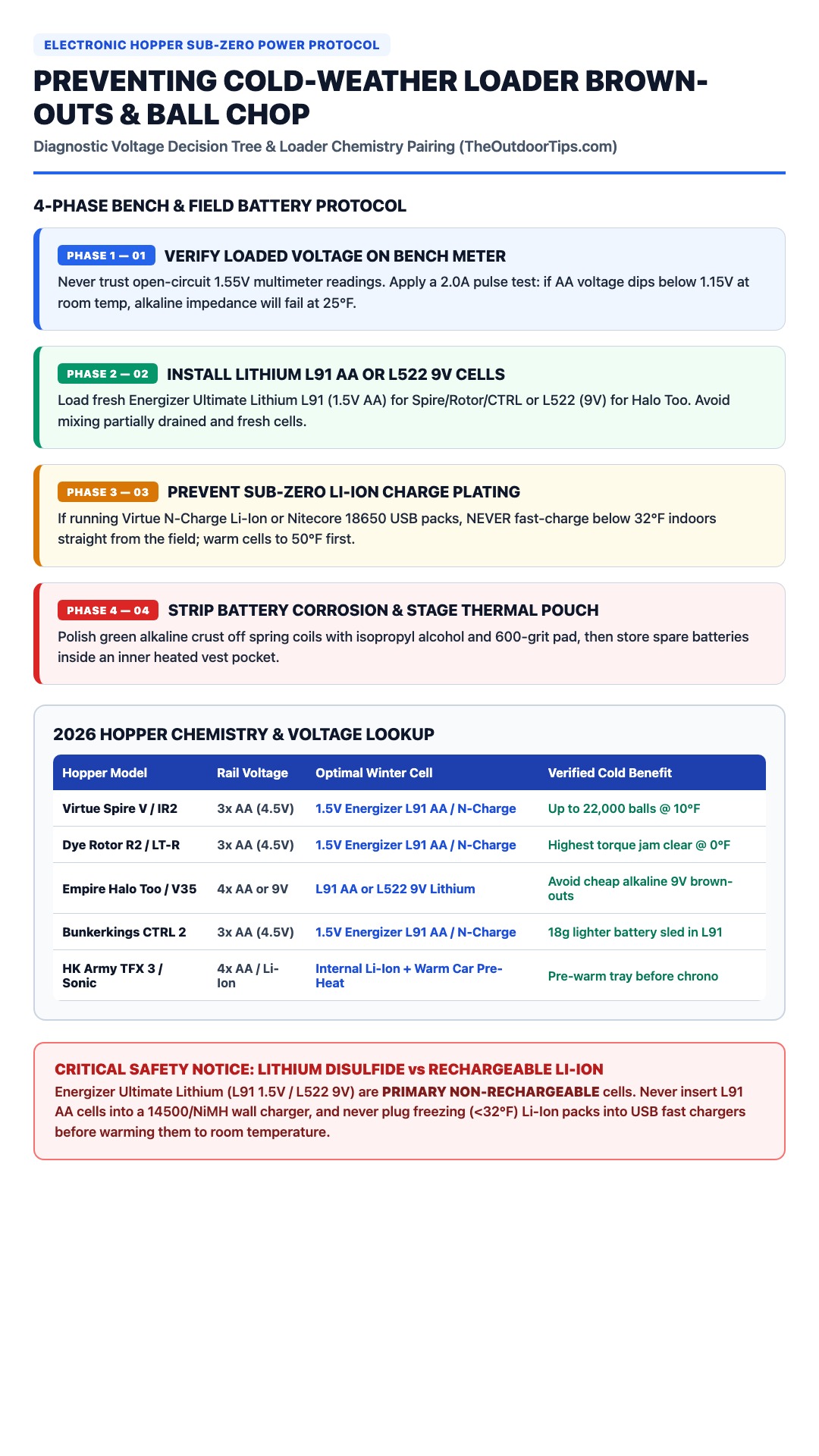
Print or save our 4-phase bench flowchart below to match your hopper voltage rail (3x AA 4.5V tray vs 9V snap clip vs sealed Li-Ion harness) to the right chemistry before freezing game days—especially when coordinating cold marker dwell from our cold-weather bolt stick guide and dual-pane sub-zero goggle setup.
Step-by-Step Cold-Weather Hopper Battery Protocol
Phase 1: Perform a Loaded Voltage Audit (Ditch Open-Circuit Checks)
Never rely on unloaded multimeter readings—or built-in hopper LEDs right after coming out of a 70°F truck. Chill spare batteries outside for 15 minutes at ambient temperature, insert them into your hopper, hold the tray feed button or drop paint into an IR break-beam sensor for 10 continuous seconds while logging voltage across the positive/negative board tabs. Any AA cell sagging beneath 1.15V per cell (3.45V total across 3x AAs) belongs in the trash bin, not on an XBall field. Also inspect marker draw via our parasitic battery drainage diagnostic guide if boards sleep poorly overnight.
Phase 2: Match Chemistry to Your Loader Chassis (AA vs 9V vs Drop-In Li-Ion)
- 3x AA & 4x AA Loaders (Spire IR2, Rotor LT-R, Bunkerkings CTRL 2, Empire Halo Too): Drop in fresh Energizer Ultimate Lithium L91 AA cells. Because L91 maintains ~1.70V fresh open-circuit dropping cleanly to 1.50V flat under load, a fresh 3-cell pack delivers ~4.5V steady drive power for 18,000–24,000 paintballs even at 0°F. Wait until you need budget weekly indoor training to drop back to Eneloop Pro AA NiMH rechargeable cells (2,500 mAh, low self-discharge rated down to -4°F).
- Legacy 9V Loaders & Marker Boards: Skip Duracell Coppertop 9V blocks entirely below 35°F. Every standard 9V alkaline squeezes six miniature AAAA cells inside a stamped can with fragile spot welds that lose voltage quickly when chilled. Install an Energizer L522 9V Lithium (1,200 mAh rated to -40°F) or keep a spare insulated inside an inner jersey chest pocket.
- Integrated Drop-In Packs (Virtue N-Charge / HK Army TFX 3 Li-Ion): High-density Li-Ion packs spin Spire drive cones effortlessly at 15°F–32°F, but capacity shrinks noticeably below 10°F if stored overnight in a trunk. Keep Li-Ion hoppers in a climate-controlled cabin during travel, and step up to Nitecore cold-weather (-40°F rated) lithium cells for weapon-mounted MagFed lights and chronographs.
Phase 3: Polish Sled Springs & Stop Condensation Corrosion
Moisture condensing when stepping between a warm staging trailer and snow-covered bunkers pits cheap nickel-plated AA tray springs. Before winter events, unscrew the sled tray, scrub tarnished green or white crust off springs with 91% isopropyl alcohol and a fiberglass scratch pen (or 600-grit wet/dry sandpaper), wipe dry, and place a pinhead smudge of dielectric silicone grease on the spring perimeter base—never coating the direct tip contact point so series resistance stays minimal.
Phase 4: Verify Feed Speed Under Sub-Zero Shell Brittleness
Pairing fresh Lithium cells with brittle summer paint turns a lightning-fast Rotor LT-R spring tension dial into a feedneck blender at 20°F. Back off Rotor shark-fin tension 1.5 turns counterclockwise for freezing winter play, verify bore clearances against our glycerin winter paintball formula guide and fog/winter calculators, and keep marker dwell tuned correctly so bolt chops never trigger false hopper jams (see our anti-chop troubleshooting guide and dwell tuning manual).
Lithium AA / 9V vs Standard Alkaline & NiMH in Freezing Play
ENERGIZER LITHIUM ADVANTAGES
- Rated for full 3A–5A pulse current delivery from 140°F down to -40°F without voltage sag
- Ultra-low 60–160 mΩ internal resistance drives Rotor/Spire cones at peak BPS until depletion
- Zero corrosive potassium hydroxide leakage; safe to leave installed inside boards for winter storage
- Weighs ~33% less per cell than alkalines, trimming top-heavy hopper bounce during snaps
COST & HARDWARE TRADEOFFS
- Upfront cost runs $2.20–$2.75 per AA cell (~4x higher per pack than bulk alkalines)
- Non-rechargeable primary cells; forcing L91 into a NiMH/14500 charger risks thermal venting
- Flat voltage plateau drops off suddenly with little low-LED warning—pack spare cells in pockets
- High 1.75V fresh open-circuit voltage can exceed tolerance on rare vintage 1990s un-regulated LED boards
SUB-ZERO BATTERY SAFETY DIRECTIVE (NEVER CHARGE COLD LI-ION): Never attempt to recharge disposable Energizer L91 or L522 Lithium cells, and never plug a freezing rechargeable Li-Ion pack (below 32°F / 0°C) into any USB or wall charger. Charging frozen lithium-ion anodes triggers metallic lithium plating, permanent capacity destruction, and internal short-circuit fire hazards. Always warm rechargeable hoppers to at least 50°F indoors before plugging in USB-C leads, and observe ASTM F1776 goggle safety rules across every chrono check.
Essential Winter Armorer Power & Diagnostic Kit
| Tool / Cell Model | Bench / Field Role | Cold Spec Rating | Recommended Target | Buy Online |
|---|---|---|---|---|
| Energizer L91 Lithium AA | Primary power for Spire, Rotor, CTRL 2, Halo Too | -40°F to 140°F | Keep 8 spare cells in warm vest pouch | |
| Energizer L522 Lithium 9V | Cold-proof 9V power for legacy Halo / boards | -40°F (1,200 mAh) | Replace Duracell 9V blocks all winter | |
| Nitecore NL1835LTHP Cold | Rechargeable -40°F 18650 for optics & gear | -40°F Low-Temp | MagFed lights & extreme snow scouts | |
| Digital Multimeter Load Probe | Verify loaded tray rail voltage (> 3.5V) | Bench Diagnostic | Verify cold sag before point start |
Interactive Paintball Calculators & Field Tools
Match your winter hopper feed rate to your marker’s tournament ramping limit, bore fit, and weekend ammo spend:
Hopper Speed vs Marker ROF Tester
Check whether cold battery sag slows your loader beneath your marker’s peak cyclic feed threshold.
BPS & NXL Tournament Checker
Verify 10.5 BPS ramping legality and debounce settings before cold winter event check-ins.
Barrel Bore Size & Insert Matcher
Size your winter barrel insert (+0.005″ overbore) so chilled shells glide clean without chop.
Paint Cost & Budget Planner
Project case consumption and cold-weather winter paint expenses across full weekend scenarios.
Final Armorer Verdict: Never Step onto Snow with Alkaline Hopper Batteries
When air temperatures drop beneath 35°F, aqueous alkaline cells are a mechanical failure waiting for your first bunker breakout. Run fresh Energizer Ultimate Lithium AA (L91) cells in every Spire, Rotor, Halo, and CTRL tray—or pair Energizer L522 Lithium 9V cells for 9V loaders—keeping backups warm inside an inner vest pocket. Reserve NiMH Eneloop Pro and USB Li-Ion packs strictly for above-freezing staging with indoor room-temperature recharging.
Winter Staging Protocol: Cold paintballs turn brittle below 42°F and swell in damp car heaters. Pair your winter kit with our lab-tested guide to keeping paintballs warm in winter with an insulated paintball caddy and baffled warmers.
Frequently Asked Questions: Cold-Weather Paintball Hopper Batteries
Why do brand-new alkaline AA batteries fail quickly inside cold paintball hoppers?
Standard alkaline AA cells use a water-based potassium hydroxide electrolyte whose ion mobility slows dramatically below 32°F, shooting internal resistance past 950–1,400 mΩ. Even though an unloaded multimeter reads 1.54V, pressing the hopper drive motor draws 2A–3A and instantly drags terminal voltage below the circuit board’s ~3.1V brown-out floor.
Are Energizer Ultimate Lithium AA (L91) batteries safe for Virtue Spires and Dye Rotors?
Yes. Energizer L91 AA cells carry a standard 1.5V nominal voltage rating (~1.75V fresh open-circuit, settling immediately near 1.50V under load) that works safely in virtually all modern microcontroller hoppers including Virtue Spire IR2/V, Dye Rotor LT-R/R2, Bunkerkings CTRL 2, and Empire Halo Too while shedding 33% tray weight.
Can I use rechargeable NiMH Eneloop Pro or Li-Ion packs in freezing paintball weather?
Yes, with temperature limits. Low-self-discharge Eneloop Pro NiMH holds steady down to roughly -4°F (-20°C), and Virtue N-Charge Li-Ion packs feed reliably between 14°F and 32°F when carried warm prior to game start—but never fast-charge a frozen Li-Ion pack below 32°F before warming it indoors to avoid lithium plating.
How can I tell if my hopper needs fresh batteries before stepping onto a winter field?
Test under actual motor load rather than checking idle green LEDs in a heated car. Chill the hopper outdoors for 15 minutes, press and hold the manual feed trigger with fingers blocking the feed chute tension (or run a 10-second burst of paint) and replace cells immediately if RPM stalls or LED bars dip red under spin.
Should I mix a fresh Lithium AA cell with two half-used batteries to get through the last point?
Never mix battery chemistries or states of charge in series. A depleted high-resistance cell drops series current across the entire 3-cell rail and can even experience reverse-charging heat buildup when healthy lithium cells push full torque current through the weak link.