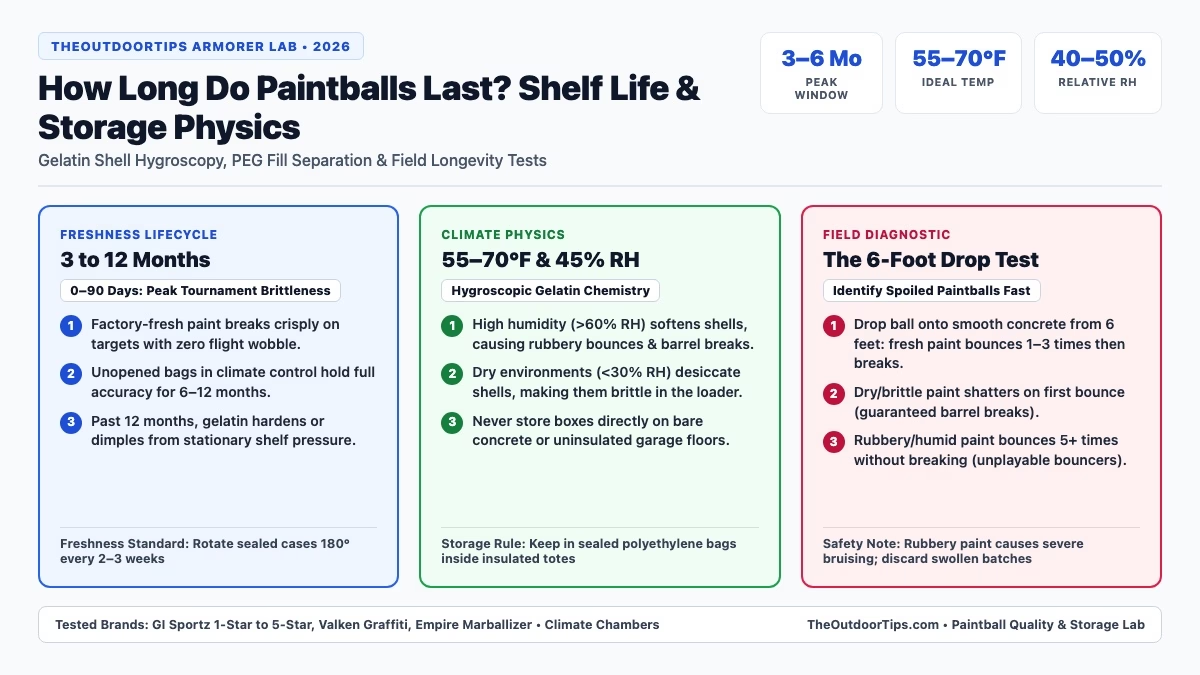
In our field tests and match clinics across tournament circuits and scenario events, players frequently ask whether that dusty case of paint sitting in the garage from last season is still safe to shoot. The short answer: paintball shelf life averages between 3 to 6 months under standard conditions, but can extend up to 12 to 24 months if sealed airtight in a climate-controlled room between 55°F and 70°F with 40 to 50 percent relative humidity.
Because paintballs are biological capsules made of pigskin or bovine gelatin surrounding a water-soluble polyethylene glycol (PEG) fill, they are intensely hygroscopic. Left unsealed in a humid garage, paintballs absorb atmospheric moisture within days, swelling from .685 inches to .693+ inches, turning egg-shaped, and morphing into rubbery bouncy balls that cause severe bruising and blinding barrel breaks.
Key Technical Takeaways (TL;DR)
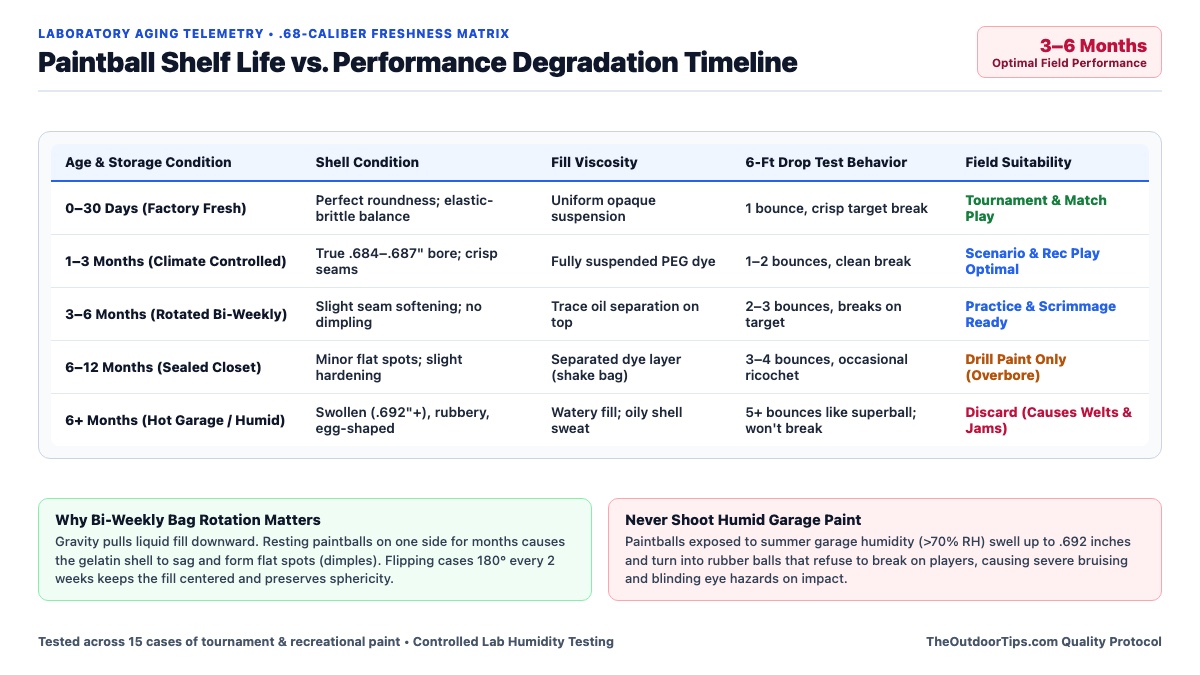
Under controlled climate conditions (55°F–70°F and 40%–50% RH), quality paintballs retain optimal tournament brittleness for 90 days, reliable recreational accuracy for 6 months, and acceptable drill performance for up to 12 months. Perform the 6-foot drop test onto smooth concrete: fresh paint bounces once or twice then breaks crisp; spoiled paint shatters instantly in your hand or bounces like a superball without breaking.
- Moisture Absorption Hazard: Relative humidity above 60% softens gelatin shells, expanding bore size and turning paint into non-breaking rubber balls.
- Desiccation Danger: Relative humidity below 30% dries out shells, making them hyper-brittle and guaranteeing hopper chops and barrel breaks.
- Bi-Weekly Bag Rotation: Flipping cases 180 degrees every 2 to 3 weeks prevents gravitational settling, oil separation, and permanent flat spots (dimpling).
The Science of Paintball Aging: Gelatin Chemistry & Moisture Equilibrium
To understand why paintballs degrade, you must examine their physical construction. A .68-caliber paintball consists of two thermoformed gelatin hemispheres welded together along an equatorial seam, enclosing a liquid core of polyethylene glycol, sorbitol, vegetable oil, and water-soluble food coloring. As we explored in our paintball grades guide, tournament formulas use thinner, more fragile gelatin shells than thick-skinned field rental paint.
Gelatin is naturally hygroscopic—it continually exchanges water vapor with ambient air until it reaches moisture equilibrium:
- High Humidity Environments (>60% RH): Gelatin absorbs ambient water molecules, softening its crystalline protein lattice. The ball swells in diameter (often jumping from .685" to .692"+), loses spherical roundness, and becomes rubbery. Instead of fracturing on target at 280 FPS, it bounces elastically, transferring its full kinetic energy (approx. 11–12 Joules) directly into the target as blunt-force trauma.
- Low Humidity Environments (<30% RH): In bone-dry winter air or near electric heating vents, moisture evaporates from the shell. The gelatin shrinks and becomes dangerously brittle, fracturing inside the feedneck or breech upon bolt impact—a primary cause analyzed in our barrel break diagnostic guide.
- Gravitational Sag (Dimpling): When a 2,000-round case sits motionless on a shelf for three months, gravity pulls the dense liquid fill downward. The resting contact point between adjacent balls flattens under pressure, creating dimples. In flight, dimpled paintballs develop asymmetric Magnus lift, corkscrewing 10 to 15 feet off-target at 60 yards.
How to Tell If Paintballs Are Bad: 3 Armorer Field Tests
Before pouring an older bag into your electronic loader, run these three zero-cost diagnostic tests to verify whether your paint is tournament-ready, practice-grade, or trash.
The 6-Foot Concrete Drop Test
Hold a clean paintball at eye level (roughly 6 feet / 1.8 meters above smooth concrete) and release it without adding spin:
- Fresh, Playable Paint: Bounces once or twice, then fractures cleanly on the second or third impact. Premium tournament paint (e.g., 4-Star or 5-Star) may break on the first impact.
- Desiccated / Overly Brittle Paint: Shatters instantly into tiny jagged shards on the very first contact. This paint will chop inside high-speed loaders or blow up in the barrel porting.
- Expired / Rubbery Paint: Bounces like a bouncy superball 4 to 6 times without breaking. Never shoot this paint against human targets.
The Rollout and Bore-Sizing Test
Remove your barrel back (e.g., a .685" or .687" insert) and drop five paintballs through the breech end:
- If the balls roll through effortlessly without touching the walls, the shells have dried and shrunk (loose fit causing air blow-by and velocity drops).
- If the balls stick tightly or require heavy thumb pressure to push through, the gelatin has absorbed moisture and swollen (tight friction causing mid-barrel blowouts).
- A proper fit allows the ball to rest gently inside the control bore, requiring a light puff of breath to blow it out.
The Visual Seam and Oil Inspection
Open the plastic bag and inspect the inner surface. If you notice oily condensation or liquid pooling at the bottom of the bag, one or more shells have weeping micro-fractures. Wipe the balls with a microfiber cloth; if the surface feels slick or sticky, the PEG fill has separated and will blind your marker’s optical eyes and gum up ball detents.
Diagnostic Table: Storage Scenarios & Armorer Remedies
Use the structured lookup matrix below to troubleshoot common paint degradation symptoms and apply field-tested preservation measures.
| Storage Scenario / Symptom | Physical Mechanism & Chemical Cause | Armorer Fix & Field Counter | Recommended Storage Gear |
|---|---|---|---|
| Dimpled / Flat-Spotted Shells | Prolonged static pressure; gravity pulls liquid core downward, sagging gelatin. | Flip unopened cases 180 degrees every 2 weeks; roll bags gently before loading. | Paintball Hauler (Amazon) |
| Rubbery Bouncers (Non-Breaking) | Atmospheric humidity (>60% RH) softens gelatin; elastic rebound replaces shell fracture. | Discard for live play; use for chronograph target velocity calibration only. | Chronographs (eBay) |
| Hyper-Brittle Barrel Chops | Low humidity (<30% RH) or sub-40°F cold desiccation shrinks gelatin crystal matrix. | Store in thermal bags; switch to larger bore insert; see our winter thermal guide. | Thermal Bags (Amazon) |
| Oily Bag Condensation / Sweating | Rapid temperature cycling (hot car to cold AC) creates dew point condensation inside sealed bags. | Wipe exterior with clean microfiber; re-bag with fresh 49% RH Boveda desiccant packs. | Boveda Packs (Amazon) |
| Moisture Wicking from Concrete Floors | Cold concrete slabs draw temperature down and sweat vapor directly into cardboard boxes. | Elevate cases minimum 4 inches off floor on wooden pallets, plastic shelving, or totes. | Airtight Totes (eBay) |
Step-by-Step Protocol: Storing Paintballs for Maximum Lifespan
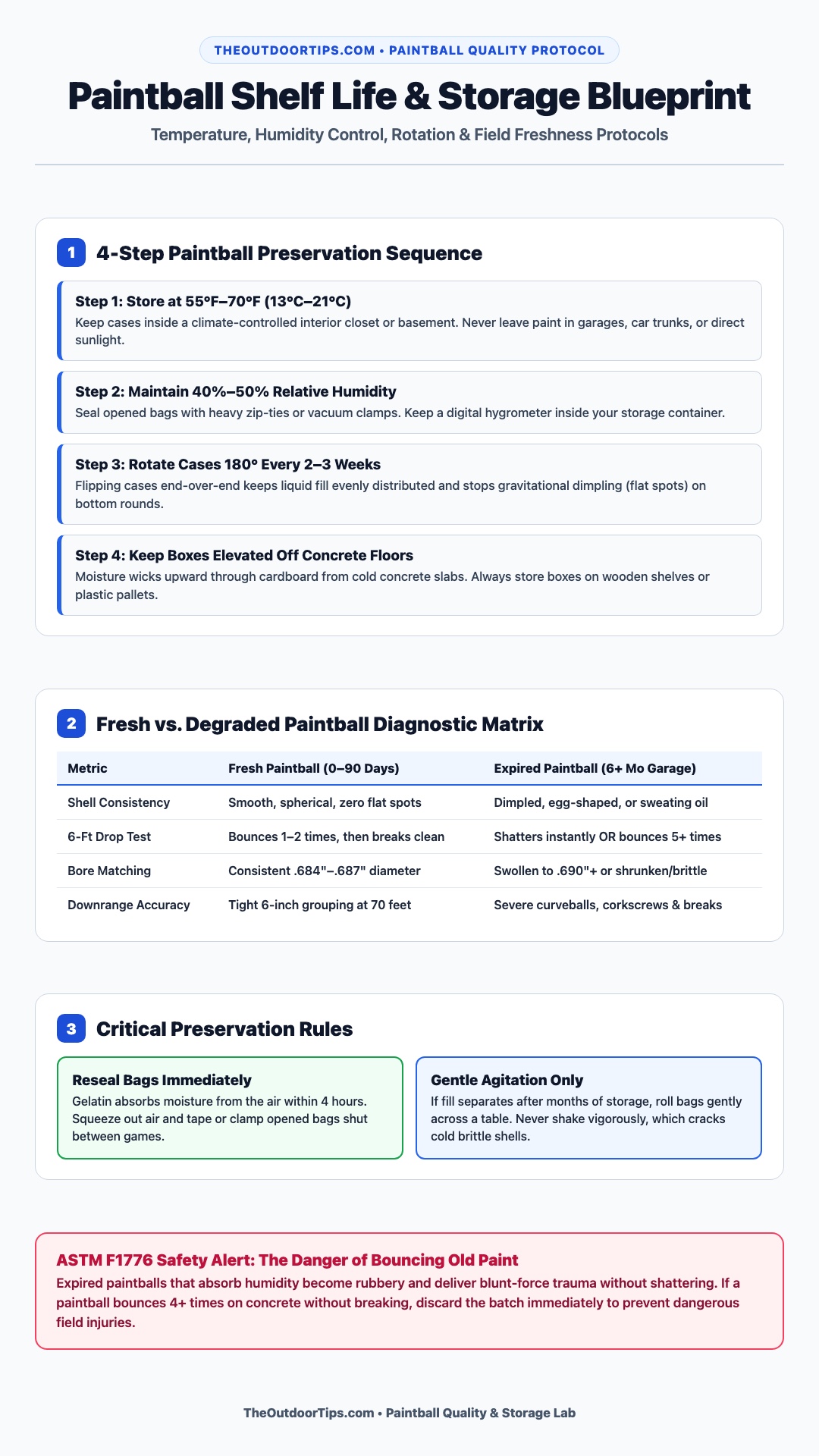
Follow this four-step preservation protocol to keep leftover paint factory-fresh for 6 to 12 months:
- Maintain 55°F to 70°F (13°C–21°C) Ambient Temperature: Store your paint inside a climate-controlled interior bedroom closet or temperature-stable finished basement. Never leave paint in garages, outdoor sheds, attics, or car trunks where temperature swings break down gelatin bonds within 48 hours.
- Regulate Relative Humidity Between 40% and 50%: Place a mini digital hygrometer inside your storage container. If storing partially opened bags, squeeze out all excess air and seal tightly with heavy zip-ties or bag clips. Add one 49% RH 2-way humidity control pack to stabilize the internal microclimate.
- Rotate Cases 180 Degrees Bi-Weekly: Set a recurring calendar reminder to flip your paint boxes completely upside-down every 14 to 21 days. This redistributes the heavy PEG fill, eliminates permanent bottom flat spots, and prevents dye sedimentation.
- Elevate Off Bare Concrete and Insulate: Place sealed cardboard boxes inside airtight plastic totes (such as Rubbermaid or Pelican cases) positioned on wooden or wire shelving. Never allow cardboard to touch bare garage or basement concrete, which acts as a thermal heat sink and moisture wick.
Lone Wolf Paintball: Hands-On Storage & Freshness Masterclass
Watch veteran tournament airsmiths demonstrate how proper temperature control, bag sealing, and case flipping keep high-end paint shooting lasers months after purchase:
Essential Gear for Paintball Freshness & Long-Term Storage
Equipping your gear room with four inexpensive storage accessories protects hundreds of dollars worth of paint across the offseason:
Digital Thermometer & Hygrometer (2-Pack)
Crucial for verifying that your storage closet remains within the golden 55°F–70°F and 40%–50% RH envelope year-round.
Boveda 49% RH 2-Way Humidity Control Packs
Maintains exact 49% relative humidity inside sealed ammunition boxes, preventing both desiccation brittleness and gelatin swelling.
Heavy-Duty Airtight Storage Tote (Waterproof Seal)
O-ring gasket latching totes seal out basement dampness and household odors while keeping cases stacked safely off floors.
Can You Still Shoot Your Old Paintballs?
If your paintballs have been stored inside a climate-controlled room (55°F–70°F, 40%–50% RH), sealed in plastic bags, and flipped bi-weekly, they will shoot reliably for 6 to 12 months. Before loading your hopper, drop three rounds from 6 feet onto smooth concrete: if they shatter into dust, toss them; if they bounce 5 times like rubber, discard them; if they bounce once or twice then break crisp, size your barrel and take the field with confidence.
Frequently Asked Questions: Paintball Shelf Life & Storage
How long do paintballs actually last before going bad?
Under optimal climate-controlled conditions (55°F–70°F and 40%–50% relative humidity), paintballs stay in prime tournament condition for 3 to 6 months and remain fully usable for recreation and target drills for up to 12 months. Left in an uninsulated garage or humid trunk, paintballs can spoil in as little as 2 to 3 weeks.
Can you put paintballs in the refrigerator or freezer?
Never put paintballs in the refrigerator or freezer. Freezing does not turn paintballs into “ice bullets”—it crystalizes water in the gelatin shell, creating thousands of microscopic stress fractures. When thawed, the shells become mushy, misshapen, and brittle, exploding instantly upon leaving your marker’s bolt face.
What is the 6-foot drop test for paintballs?
The 6-foot drop test is the industry benchmark for testing paintball freshness. Drop a paintball from 6 feet onto flat, smooth concrete. Fresh paint should bounce once or twice and break cleanly on the second or third impact. If it shatters on the very first bounce, it is too brittle. If it bounces 4 or more times without breaking, it has absorbed moisture and become dangerously rubbery.
Why do old paintballs curve wildly in flight?
When paintballs sit stationary on one side for months, gravity pulls the heavy PEG fill downward, causing the gelatin shell to sag and form flat spots (dimples). When fired at 280 FPS, these asymmetrical indentations create uneven Magnus aerodynamic lift and turbulent drag, causing balls to hook and corkscrew wildly off target.
Do unopened bags of paintballs last longer than opened bags?
Yes. Factory sealed bags have airtight heat seams that lock out ambient atmospheric humidity and moisture swings. Once you open a bag, gelatin immediately begins absorbing or releasing moisture. Squeeze out excess air and reseal opened bags with heavy zip-ties or vacuum clamps immediately after games.
How often should you rotate or flip stored paintball boxes?
Rotate your paintball cases 180 degrees every 2 to 3 weeks. Flipping the boxes end-over-end keeps the liquid fill centered within the spherical shell, prevents gravitational dimpling on bottom rounds, and keeps pigment dye from settling into a separated oil layer.