In our field tests and match clinics across scenario big games and MagFed sniper lanes, understanding first strike rounds range physics explains why shaped projectiles dominate open-field engagements out to 300 feet. While a traditional .68-caliber spherical paintball loses more than half of its kinetic energy by 150 feet and drifts unpredictably due to Magnus-effect side spin, a fin-stabilized First Strike Round (FSR) cuts aerodynamic drag in half, holds gyroscopic spin through a rifled barrel, and delivers torso-sized accuracy at distances where roundballs simply bounce.
Key Technical Takeaways (TL;DR): Aerodynamics, Rifling & Effective Reach
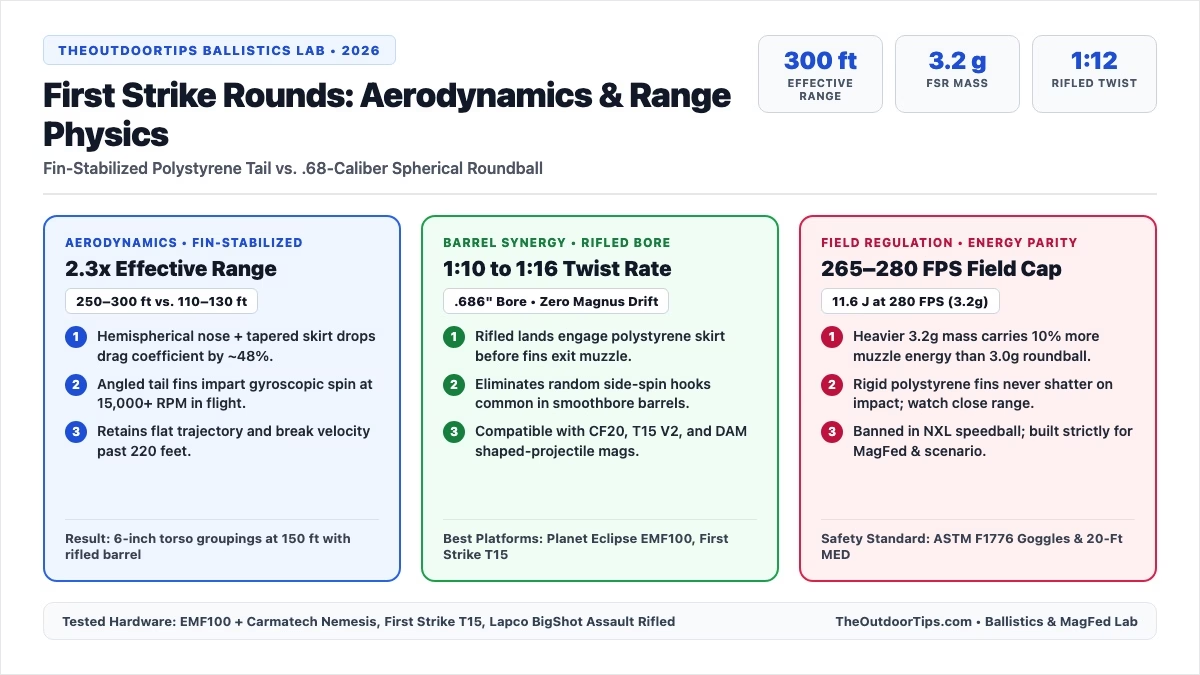
First Strike Rounds double your effective engagement range from 125 feet (roundball) to 250–300 feet by combining a hemispherical gelatin nose with a finned polystyrene tail skirt. Pair FSRs with a 1:10 to 1:16 rifled barrel (.686″ bore), zero your elevated red dot or scope at 120 feet, and chronograph FSRs separately at 265–280 FPS for energy parity.
Why First Strike Rounds Double Roundball Range (Aerodynamics & Spin)
A standard .68-caliber paintball is a terrible aerodynamic projectile: a sphere with a drag coefficient ($C_d$) around 0.47. As soon as it leaves a smoothbore barrel, random friction against the wall imparts uncontrolled backspin or side-spin, causing the ball to hook wildly past 100 feet. First Strike Rounds solve all three aerodynamic flaws:
- Reduced Drag Coefficient: The hemispherical dome nose combined with a tapered hollow polystyrene tail skirt cuts aerodynamic drag by roughly 48%. At 150 feet, an FSR fired at 280 FPS retains 218 FPS (7.1 Joules)—plenty of kinetic punch to shatter on a jersey—whereas a 3.0g roundball drops to 122 FPS (2.1 Joules) and bounces off pods.
- Gyroscopic Fin Spin: Angled fins molded into the tail skirt catch passing air inside the barrel and throughout flight, spinning the projectile at over 15,000 RPM to stabilize pitch and yaw.
- Zero Moisture Swelling: Unlike standard gelatin roundball covered in our Paintball Grades Explained Guide, the rigid polystyrene rear body of an FSR never absorbs ambient humidity, keeping diameter locked at .685 to .686 inches.
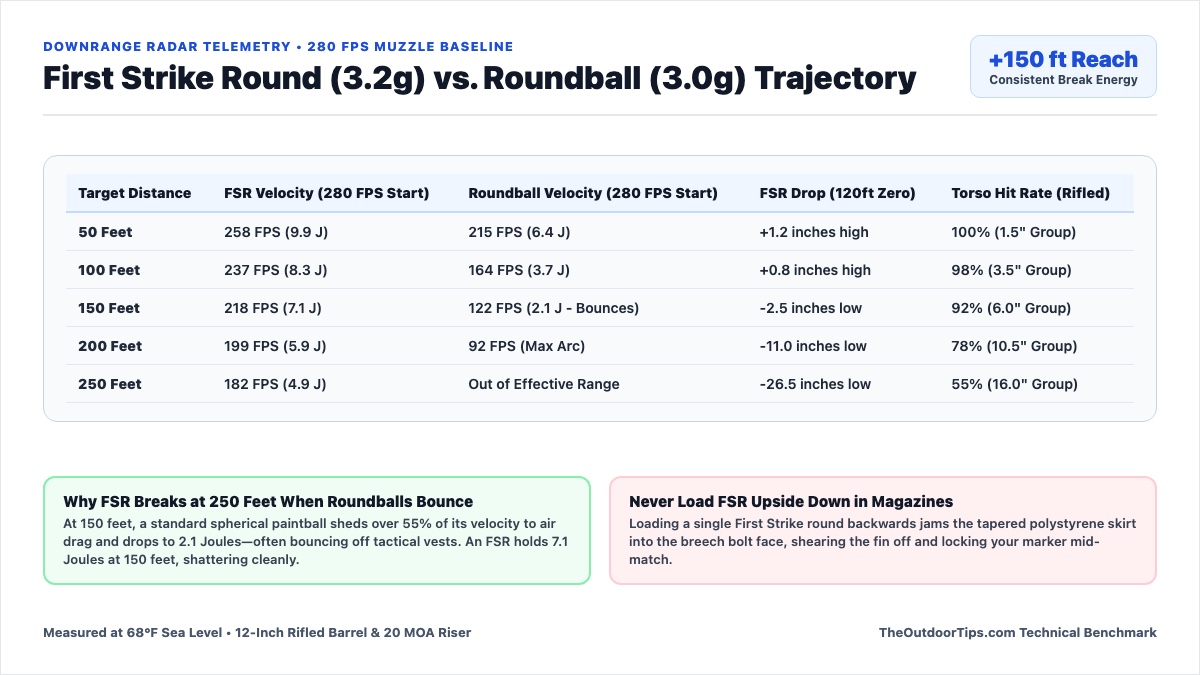
Ballistic Comparison & Rifled Setup Matrix
To unlock 300-foot accuracy, your barrel, magazine orientation, and optic riser must match FSR physics. Review our First Strike T15 Performance Setup and Mag-Fed Speed Reload Drills to optimize your complete sniper loadout.
| Ballistic Scenario | Root Physics / Hardware Factor | Armorer Optimization | Recommended Gear |
|---|---|---|---|
| Smoothbore vs. Rifled Barrel | Smoothbore relies solely on tail air drag to start spin after exit | Install 1:10 to 1:16 rifled barrel (.686″) to pre-spin skirt in bore | Lapco Rifled Barrel (eBay) |
| 200+ Ft Scope Elevation Max-Out | Arc drop at 250 ft exceeds standard rifle scope adjustment range | Mount a 20–40 MOA angled riser or crossbow scope with drop reticles | 20 MOA Riser (Amazon) |
| FSR Nose Cone Crushing | Forcing 20th round into closed-bolt mag compresses nose gelatin | Download 20-round CF20/T15 mags to 18–19 rounds | CF20 Magazines (Amazon) |
| Downrange Velocity Spike | 3.2g FSR retains higher Joules than 3.0g roundball at equal FPS | Chrono specifically with FSR at 265–280 FPS per field rules | Virtue Chrono (Amazon) |
Step-by-Step Precision FSR Tuning & Zeroing Protocol
Follow this armorer setup sequence to zero your MagFed marker for 150-to-250-foot engagements without wasting expensive rounds. If you experience any chopping or barrel breaks, check our Why Paintballs Break in the Barrel Troubleshooting Guide.
Install a 10-to-14-Inch Rifled Barrel
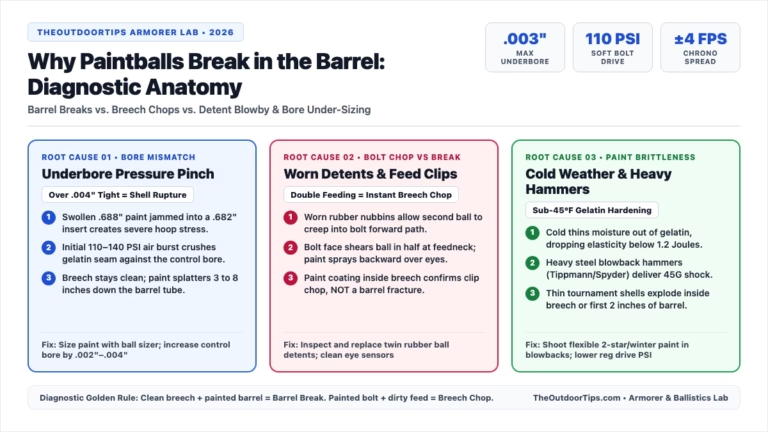
Mount a .686-inch rifled barrel with a 1:10 to 1:16 twist rate (such as the Carmatech Nemesis or Lapco BigShot Assault). Avoid tight .680 smoothbore inserts: the rigid polystyrene fins of an FSR will catch inside tight smoothbores and cause instant barrel breaks.
Add a 1.5-Inch Riser & 20 MOA Cant
Because your ASTM F1776 paintball mask prevents a low firearm cheek weld, install a 1.5-inch high Picatinny riser so you can look cleanly through your optic without tilting your head. Adding a 20 MOA downward-angled mount angles your scope forward, unlocking enough elevation clicks to dial dead-on out to 250 feet.
Chronograph with Live First Strike Rounds
Never chronograph with standard roundball and assume your FSR velocity matches. Because FSRs create a tighter air seal inside the barrel than roundball, they frequently shoot +10 to +18 FPS faster on the same regulator setting. Verify exact field ceilings using our Paintball FPS Field Limits Guide.
Zero at 120 Feet & Record Holdovers
Fire 3-round confirmation groups at a 6-inch target at 120 feet. Once centered, test shots at 180 and 220 feet and memorize your reticle mildot drop points (typically 1 mildot low at 180 feet and 2.5 mildots low at 230 feet).
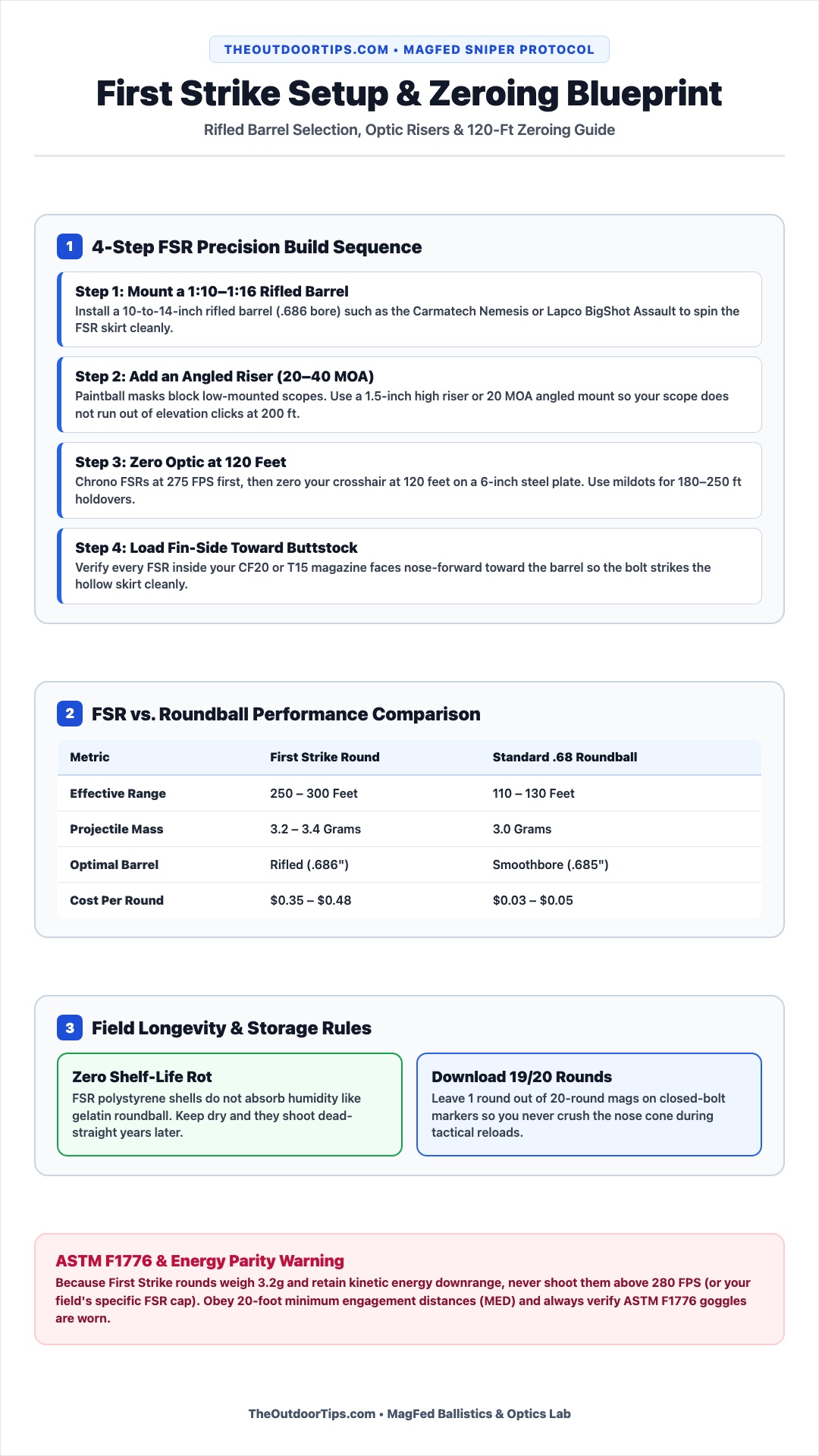
ASTM F1776 Energy Parity & Minimum Engagement Distance (MED)
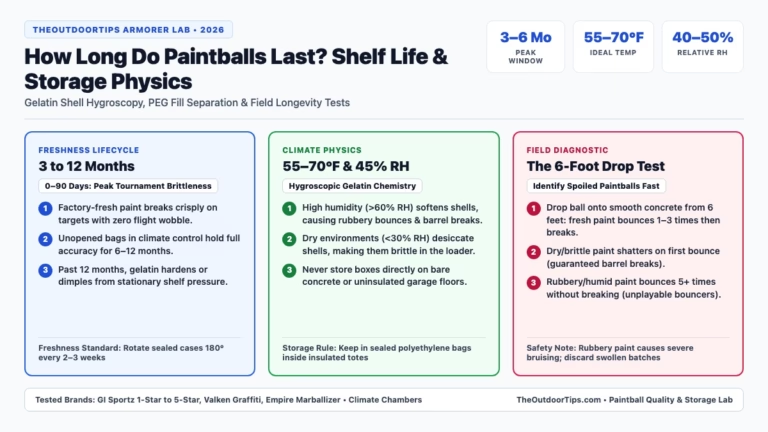
First Strike Rounds weigh 3.2 to 3.4 grams and carry rigid polystyrene tail fins that do not deform on impact. Never fire FSRs above 280 FPS (11.6 Joules) or inside a field’s 20-foot Minimum Engagement Distance (MED). Always confirm your venue authorizes shaped projectiles and requires full-seal ASTM F1776 goggles.
Essential First Strike Rounds & Precision MagFed Gear
Build a tournament-reliable shaped-projectile rig with these five field-tested components, and pair your chest carry setup with our Best Paintball Tactical Vests for MagFed guide.
| Hardware / Gear | Primary Role | Key Spec | Buy Direct |
|---|---|---|---|
| First Strike Rounds (100 / 250-Ct) | Long-range shaped ammo | 3.2g fin-stabilized, .686″ body | |
| Planet Eclipse CF20 Magazines | Zero-jam FSR feeding | 20-rd continuous stack, toolless | |
| Lapco BigShot Assault Rifled Barrel | Spin stabilization | 12-inch length, .686″ rifled bore | |
| 20 MOA Picatinny Scope Riser | Mask clearance + drop comp | 1.5″ height, 20 MOA forward cant |
Live Field Demonstration: First Strike Rounds vs. Standard Roundball
Watch how First Strike Rounds stack consistent head-sized groupings downrange compared to standard spherical paintballs tested through the exact same marker. Pair long-range overwatch tactics with our Paintball Smoke Grenades Guide and Bunker Terminology Guide.
Interactive Paintball Calculators & Loadout Tools
Paintball Weekend Cost Calculator
Compare per-shot costs of First Strike ($0.40/rd) vs. standard roundball ($0.03/rd).
HPA Regulator Pressure Calculator
Optimize air-thru stock tank output PSI for repeatable long-range FSR velocity.
Paintball Gun & Loadout Builder
Pair EMF100 or First Strike T15 markers with rifled barrels and optics.
Paintball BPS & ROF Calculator
Check mechanical semi-auto and scenario rate-of-fire limits.
How to Maximize First Strike Range on Scenario Days
Run a 1:10 to 1:16 rifled barrel (.686″ bore), elevate your reticle on a 20 MOA riser, and zero at 120 feet using live FSR chronograph readings locked at 270–275 FPS. Download your CF20 or T15 magazines to 19 rounds and dominate 250-foot lanes where roundball players cannot reach.
Frequently Asked Questions: First Strike Rounds Ballistics
How far can a First Strike paintball actually shoot?
With a rifled barrel at 275 to 280 FPS, First Strike Rounds achieve effective torso-sized accuracy out to 250 to 300 feet (80 to 100 yards), more than doubling the 110-to-130-foot effective range of traditional round paintballs.
Do you need a rifled barrel for First Strike Rounds?
While FSRs can technically be fired from a .686+ smoothbore barrel, a rifled barrel (1:10 to 1:16 twist) engages the rear polystyrene skirt before exit, cutting downrange group sizes in half past 150 feet.
Can you shoot First Strike Rounds out of a normal hopper?
No. Because First Strike Rounds are D-shaped (hemispherical nose with a cylindrical finned skirt), they will jam inside gravity hoppers and motorized speedball loaders. They require a compatible magazine-fed marker such as an EMF100, First Strike T15, or Tippmann Stormer/TMC conversion.
Why do some paintball fields ban First Strike Rounds?
Fields sometimes restrict FSRs because their rigid polystyrene fins do not biodegrade as quickly as gelatin roundballs, and because 3.2g FSRs retain significantly more kinetic energy at 150+ feet if players fail to chrono down to field FSR caps.
Do First Strike Rounds hurt more than regular paintballs?
At identical muzzle velocity (280 FPS), a 3.2g FSR carries roughly 10% more muzzle energy than a 3.0g roundball (11.6 J vs 10.9 J), and at 150 feet it hits with over three times the energy of a decelerated roundball. Always respect 20-foot minimum engagement rules.
Why did my First Strike Round flip sideways out of the barrel?
Sideways keyholing happens when an FSR is loaded backwards into a magazine, when the barrel bore is too tight (under .684″), or when an aggressive bolt face cracks a brittle polystyrene skirt in freezing weather.