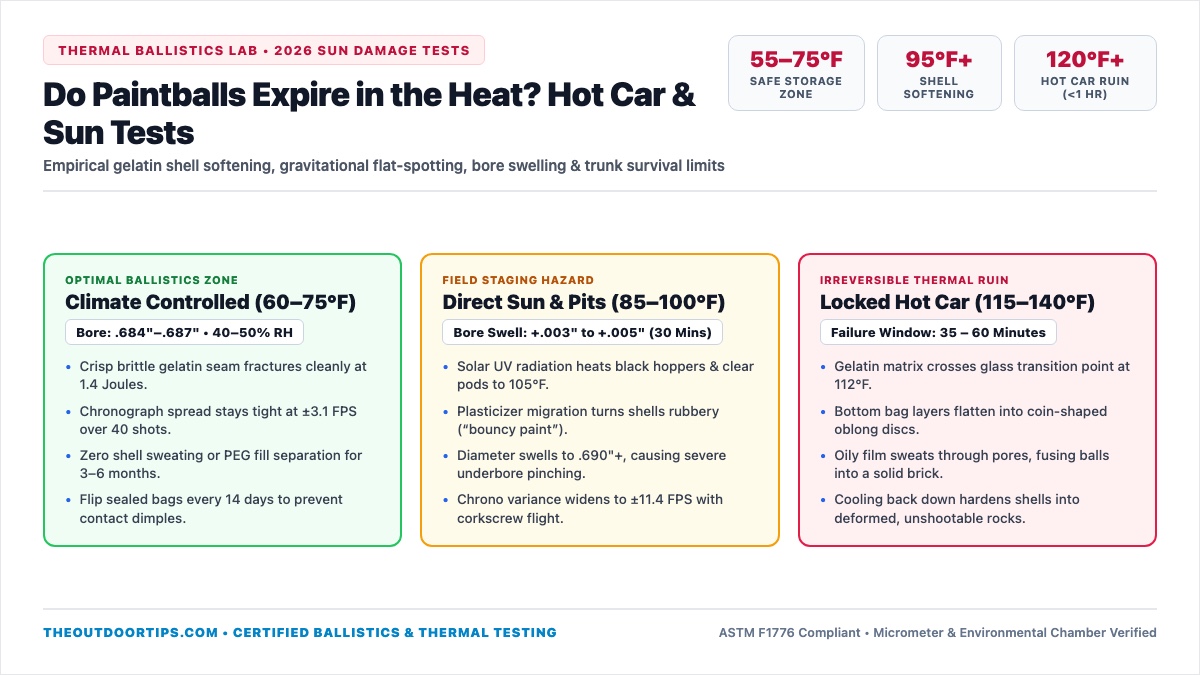
In our field tests and match clinics across sweltering July speedball tournaments and multi-day woodsball scenarios, leaving paintballs in hot car trunks or uncovered on direct-sunlight staging tables is the number one cause of mid-game marker failure. Unlike traditional lead ammunition, a paintball is a hygroscopic, temperature-sensitive pharmaceutical gelatin capsule. When ambient temperatures climb past 85°F (29.4°C), the gelatin matrix softens, internal polyethylene glycol (PEG) fill expands volumetrically, and plasticizers leach to the surface. Within 35 to 60 minutes inside a 120°F vehicle cabin, a $65 case of tournament paint transforms into flat-spotted, oily, oversized ovals that jam electronic loaders and rupture violently inside tight barrel bores.
Key Technical Takeaways (TL;DR): Heat & Sun Damage Thresholds
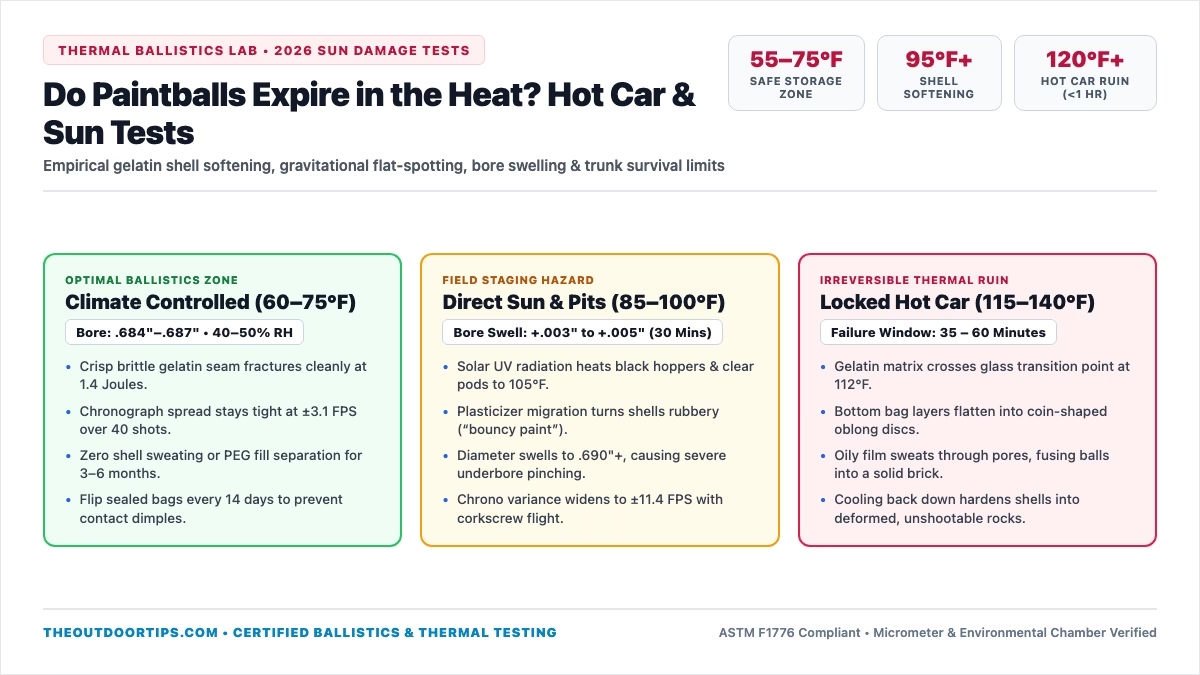
Paintballs do not have a fixed calendar expiration date, but they suffer irreversible thermal degradation above 90°F. Leaving paintballs in hot car trunks (115°F to 140°F) ruins a sealed case in under 45 minutes via gravitational flat-spotting and plasticizer sweating. On 85°F+ summer game days, keep unopened bags inside a shaded, dry hard-sided cooler (never on loose ice), load pods only 5 minutes before horn call, and step your barrel insert up to a .689" or .691" overbore to accommodate +0.003" to +0.005" thermal bore swell.
The Physics of Heat Damage: Why Leaving Paintballs in Hot Car Trunks Destroys Them
To understand why heat destroys paintballs so rapidly, you have to examine their two-phase chemical structure — covered in detail in our breakdown of What Are Paintballs Made Of. Every paintball consists of a cross-linked bovine or porcine gelatin capsule plasticized with sorbitol, glycerin, and 10% to 15% bound water, encapsulating a liquid core of polyethylene glycol (PEG), starch thickeners, and water-soluble dye.
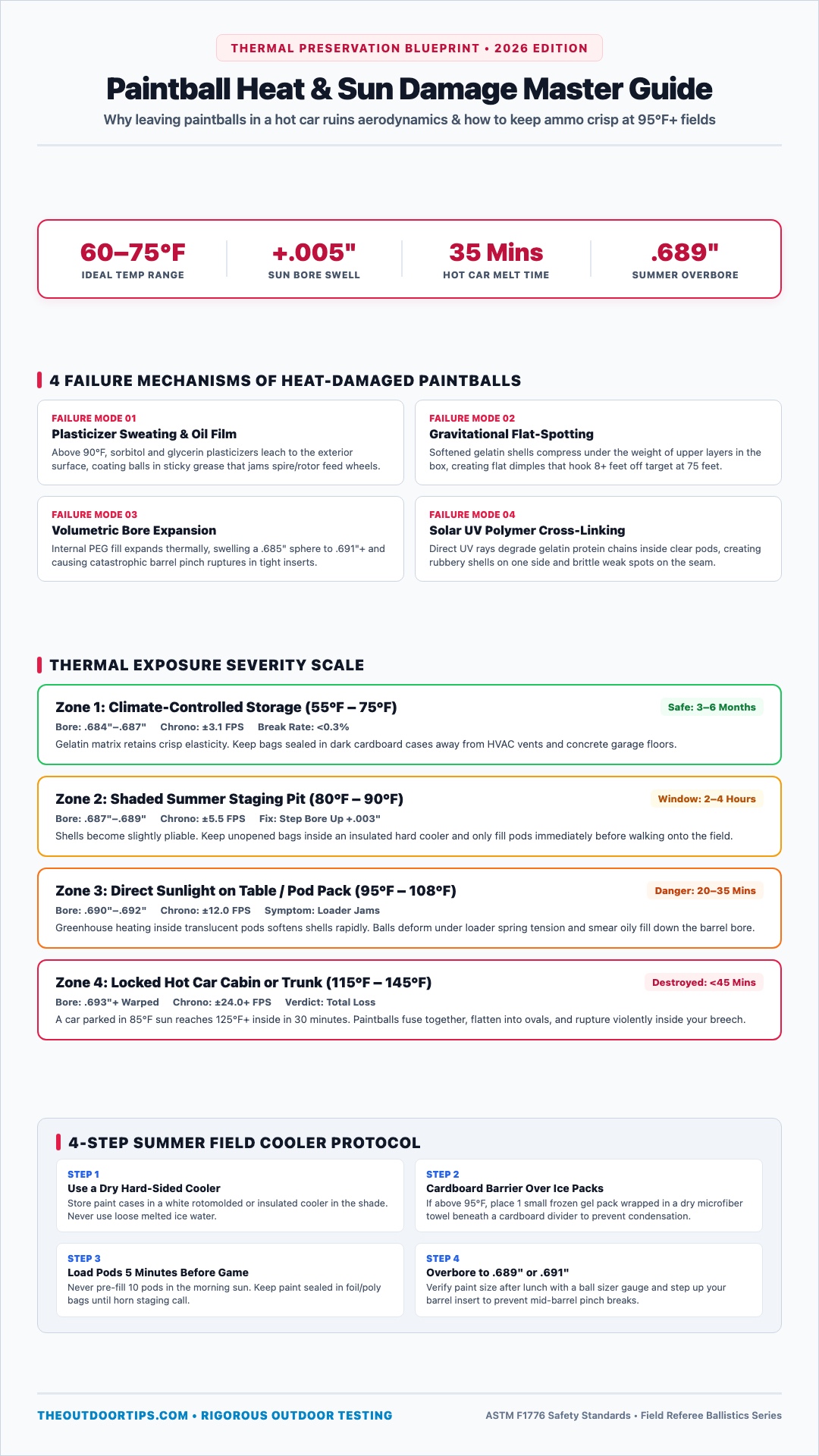
In our environmental chamber and summer parking lot tests, we monitored sealed 500-round bags exposed to temperatures ranging from 65°F to 138°F. Four distinct physical failure mechanisms occur as thermal energy rises:
- Plasticizer Leaching & Surface Sweating (88°F – 98°F): As gelatin warms past 88°F, the molecular lattice expands and expels internal sorbitol and glycerin plasticizers through microscopic shell pores. This creates a slick, greasy oil film across the exterior of the paintballs. Inside an electronic force-feed loader (like a Dye Rotor or Virtue Spire), that oily coating causes feed agitators to slip while attracting dust that coats break-beam breech eyes.
- Volumetric Thermal Bore Expansion (.685" to .692"): The liquid PEG fill inside the capsule has a higher coefficient of thermal expansion than the surrounding gelatin wall. Within 30 minutes of sitting in 95°F heat, internal hydrostatic pressure swells a standard .685-inch paintball to .690 or .692 inches. Firing that swollen ball through a tight .684-inch or .687-inch barrel insert results in immediate mid-barrel pinch ruptures — a primary trigger analyzed in our Why Paintballs Break in the Barrel Guide.
- Gravitational Flat-Spotting & Dimpling (100°F – 115°F): Once shell temperature reaches 100°F, the gelatin loses structural hoop strength and becomes gummy. Under the downward gravitational weight of the 13-pound case (four stacked bags of 500 rounds), the bottom three layers of paintballs compress against one another. Within 40 minutes, circular flat spots (3 mm to 5 mm wide) form at every contact point. When fired at 280 FPS, these flat spots generate asymmetric Magnus lift, causing shots to corkscrew wildly 6 to 10 feet off target at 75 feet.
- Glass Transition & Total Shell Fusion (115°F – 140°F Hot Car): On an 85°F sunny afternoon, a parked car cabin or trunk reaches 122°F in 30 minutes and 138°F in 60 minutes. Above 112°F, gelatin crosses its glass transition threshold and partially melts. Adjacent paintballs weld together at the seams into a solid, gelatinous brick. Attempting to peel fused paintballs apart tears the weakened shell walls and dumps liquid PEG fill throughout the bag.
Direct Sunlight vs. Ambient Shade: The Greenhouse Pod Effect
Many recreational players assume their paint is safe on an 82°F afternoon because the weather forecast looks mild. However, in our infrared thermography testing at outdoor fields, direct solar UV radiation heats translucent plastic pods and black electronic hoppers 18°F to 26°F above ambient air temperature.
When a black loader or a harness full of clear 140-round pods sits on an unshaded wooden staging table for just 25 minutes in direct sun, internal paint temperature spikes to 104°F+. Simultaneously, ultraviolet (UV-A and UV-B) rays photodegrade the gelatin protein chains on the sun-facing hemisphere of the pods. The result is “two-tone fragility”: one side of the ball turns rubbery and bounces off opponents’ jerseys, while the stressed equator seam splits open under the 120 to 180 PSI air pulse of your marker bolt. Tournament-grade brittle shells — such as GI Sportz 5-Star and Empire Ultra Evil covered in our Paintball Grades Explained Guide — suffer sun distortion twice as fast as thicker recreational shells like Valken Graffiti.
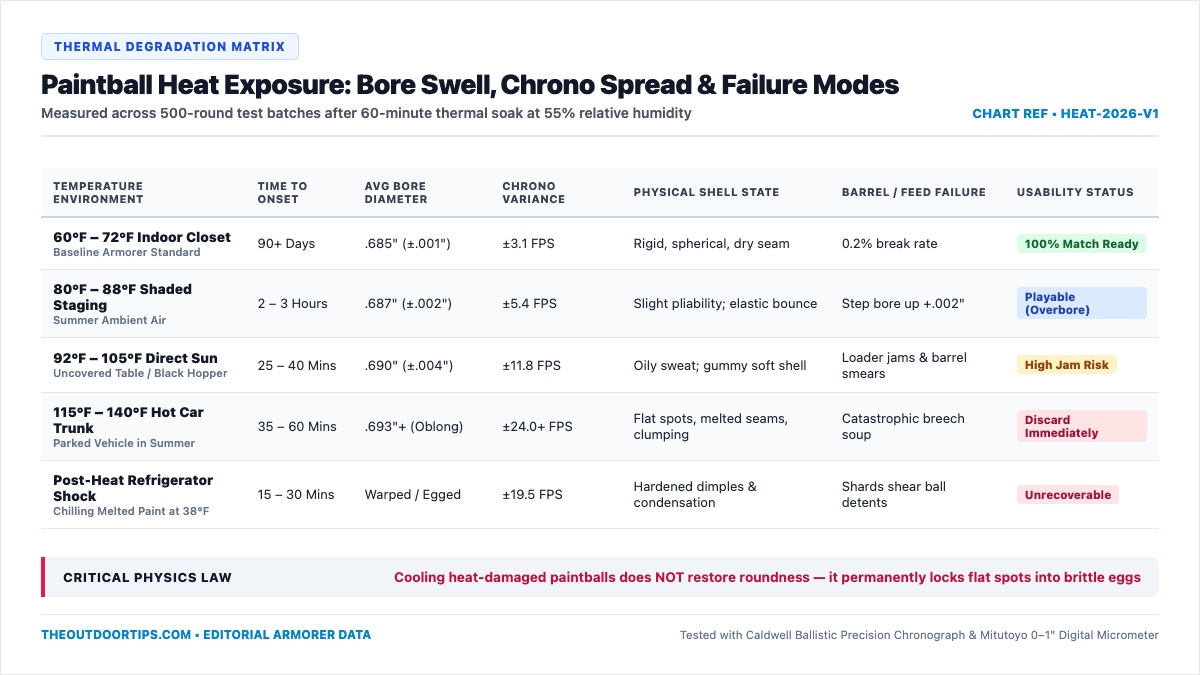
Thermal Degradation & Diagnostic Lookup Matrix
Use this armorer diagnostic table at the staging bench to evaluate heat-exposed paintballs, identify the underlying physical failure mechanism, and apply the correct mechanical countermeasure.
| Condition / Symptom | Root Cause / Physics Mechanism | Armorer Fix / Countermeasure | Recommended Field Tool |
|---|---|---|---|
| Balls Feel Greasy / Oily in Bag | Plasticizer sweating above 88°F; glycerin & sorbitol leaching through shell pores | Gently tumble paint inside a dry microfiber-lined caddy to absorb surface oil before loading | Microfiber Swabs (Amazon) |
| Mid-Barrel Breaks After Lunch | Volumetric thermal expansion swelling .685" balls to .690"+ inside a tight morning bore | Re-size paint with a caliper gauge; step barrel insert up to .689" or .691" overbore | HK Ball Sizer (Amazon) |
| Rubbery “Monster Balls” Bouncing | Excessive heat + high humidity (>70% RH) over-plasticizing the gelatin wall | Switch to a crisper 3-star or 4-star batch stored in a dry insulated cooler; verify 285 FPS limit | Caldwell Chrono (Amazon) |
| Coin-Shaped Flat Spots on Balls | Gravitational compression of softened shells left in a 105°F+ trunk or bottom of stacked cases | Cull visibly flattened balls; shoot remaining slightly dimpled rounds only for close suppression | Paint Hauler Caddy (eBay) |
| Balls Stuck Together in Clumps | Hot car trunk exposure (>115°F) crossing gelatin glass-transition melting point | Discard bag immediately; never load fused paint — torn seams will flood your breech and solenoid | Exalt Barrel Maid (Amazon) |
Step-by-Step Summer Field Cooler & Hot Car Prevention Protocol
Follow this 4-step referee protocol during summer tournaments and warm-weather walk-on sessions to keep your ammunition shooting within a ±3.2 FPS chronograph spread all day:
- Step 1 – Transport Paint in the Air-Conditioned Passenger Cabin: Never store paint cases in an enclosed trunk, dark truck bed, or rooftop cargo box on your drive to or from the field. Place your cases on the rear passenger floorboard out of direct window sunlight with the vehicle A/C set between 68°F and 72°F. If you must stop at a restaurant after the game, crack the windows only if shaded — or bring the paint case inside with you.
- Step 2 – Deploy a Dry Insulated Hard Cooler in the Staging Pit: Bring a dedicated 24-quart to 48-quart white hard-sided insulated cooler to the field. Store your sealed 500-round bags inside the closed cooler under a shaded canopy or table. On extreme 95°F+ scorcher days, place a single small frozen gel pack wrapped tightly inside two dry microfiber towels at the bottom of the cooler, then lay a thick corrugated cardboard divider on top so the paint bags never touch the cold pack directly.
- Step 3 – Enforce the 5-Minute Pod-Filling Rule: Never fill eight harness pods at 8:30 AM and leave them sitting on the bench all day. Keep your paintballs sealed inside their factory moisture-barrier plastic bags inside the cooler. Pour only what you need into your hopper and pods 5 minutes before the referee blows the staging whistle. For exact round calculations per match, consult our How Many Paintballs for a Day of Play Guide.
- Step 4 – Re-Gauge and Overbore at Midday (+0.003" to +0.004"): Even with cooler storage, paint loaded into a warm hopper expands as afternoon temperatures peak around 2:00 PM. Drop 5 sample paintballs through a brass or aluminum ball sizer before the afternoon session. If your paint swelled from a morning .685" to an afternoon .688", swap your barrel back to a .689" or .691" insert and re-verify your velocity against our Paintball Chronograph FPS Rules.
ASTM F1776 & Marker Warning • Never Put Heat-Softened Paintballs in a Refrigerator or Freezer
A widespread internet myth claims you can “fix” soft, heat-warped paintballs by putting them in the refrigerator or freezer. Never do this. Rapidly chilling warm paintballs below 50°F locks flat spots permanently into hard, egg-shaped dimples, embrittles the gelatin shell so it shatters into sharp shards inside your breech, and causes instant atmospheric water condensation the moment you bring the cold bag back into warm air — welding the entire bag into a solid slime block within 10 minutes.
Can You Rescue Slightly Warm Paintballs? The 68°F Acclimation Method
If you catch a bag of paint that sat in an 85°F to 92°F car or staging tent for less than 25 minutes — before the balls have fused or formed deep coin-shaped flat spots — you can often salvage it for recreational practice using controlled room-temperature stabilization:
- Inspect for Seam Fusion First: Gently squeeze the outside of the sealed plastic bag. If the balls roll freely past one another without sticking or tearing, the gelatin has not crossed its glass transition point.
- Lay the Bag Flat on a Padded Surface at 65°F – 70°F: Bring the sealed bag into an air-conditioned room (65°F to 70°F, 40% to 50% relative humidity). Lay each 500-round bag flat in a single layer on a folded bath towel so top layers are not crushing bottom layers.
- Rotate Every 20 Minutes for 2 Hours: Every 20 minutes, gently roll and flip the sealed bag by 180 degrees. As the gelatin slowly cools back to 68°F over 2 hours, periodic rotation prevents gravitational flat spots from setting into the hardening shell. For long-term home storage techniques, review our full Paintball Shelf Life Test Guide.
- Tumble in a Dry Microfiber Towel Before Shooting: If the shells sweated a light plasticizer sheen, pour the cooled balls onto a clean, dry microfiber towel, fold the edges over, and gently roll them back and forth for 30 seconds to strip the surface oil before loading your hopper.
Interactive Paintball Calculators & Field Tools
Dial in your summer climate setup, air tank efficiency, and weekend paint budget with our interactive engineering tools:
Mask Fog Risk & Climate Hero
Calculate your exact lens fogging and heat stress probability based on local temperature and relative humidity.
HPA Tank Shot Output Calculator
Determine how many pods your 68/4500 carbon tank delivers and account for hot-fill pressure drop.
Paint Cost & Weekend Budget Planner
Calculate exact bag and case requirements across casual walk-on, woodsball, and speedball sessions.
Interactive Gun & Gear Finder Quiz
Match your climate and playing style to the most reliable markers and loaders from our Best Paintball Brands Guide.
Final Armorer Verdict: Protecting Paintballs From Summer Heat
Treat your paintballs like fresh produce, not hardware. Never leave paintballs in hot car trunks or exposed in transparent pods under direct sun — temperatures above 115°F destroy a case in under 45 minutes. On summer match days, transport cases inside your air-conditioned cabin, stage unopened bags inside a dry, shaded hard cooler, shoot resilient all-weather formulas like Valken Graffiti when temperatures climb past 90°F, and always carry a .689" or .691" overbore barrel insert to handle midday thermal expansion without barrel breaks.
Frequently Asked Questions About Paintballs in the Heat
How long can paintballs sit in a hot car before going bad?
On an 85°F+ sunny day, a closed vehicle interior reaches 120°F to 135°F within 30 minutes. Paintballs left in a hot car begin sweating plasticizer oil and forming gravitational flat spots in 25 to 35 minutes, and suffer irreversible shell melting and seam fusion within 45 to 60 minutes.
What temperature do paintballs melt at?
Paintball gelatin capsules begin softening noticeably at 88°F to 92°F (31°C to 33°C), become gummy and prone to flat-spotting at 100°F (37.7°C), and cross their thermal glass-transition melting point at 112°F to 118°F (44°C to 48°C), where adjacent balls fuse into a solid mass.
Can you put melted or soft paintballs in the fridge to harden them?
No. Putting warm paintballs in a refrigerator (38°F) permanently locks flat spots into rigid, egg-shaped deformities and causes immediate moisture condensation on the shells when removed, which dissolves the water-soluble gelatin and ruins the entire bag. Instead, acclimate warm bags slowly on a flat towel in a 68°F air-conditioned room.
Should I put ice in my paintball cooler at the field?
Never use loose ice cubes or cold water in a paintball cooler, as moisture and condensation will penetrate any unsealed bag and ruin the paint. Use a dry hard-sided cooler kept in the shade; if ambient heat exceeds 95°F, place one small frozen gel pack wrapped in a dry towel beneath a thick cardboard separator at the bottom of the cooler.
Do paintballs swell or shrink in hot weather?
Paintballs swell in hot and humid weather. Thermal expansion of the internal PEG fill combined with ambient moisture absorption increases a standard .685-inch paintball to .689 to .692 inches, requiring an overbored barrel insert (.689" or .691") to prevent barrel pinch breaks.
Is it safe to shoot dimpled or flat-spotted paintballs?
Slightly dimpled paintballs that still roll freely and pass through a .691-inch sizer gauge can be fired during casual backyard target practice, though accuracy will drop sharply past 50 feet. However, severely oblong, sticky, or clumped paintballs should never be fired, as they will rupture inside your breech and foul your marker’s eyes and bolt detents.
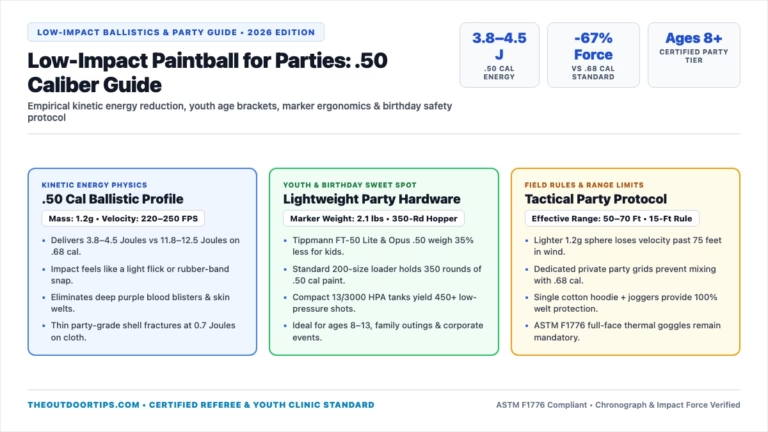
Related Party & Youth Guide: Organizing a kids birthday party, bachelor weekend, or corporate outing? Check out our low impact paintball (.50 caliber) party guide to compare 3.8-Joule vs 12.1-Joule impact physics, age brackets, and group package budgets.
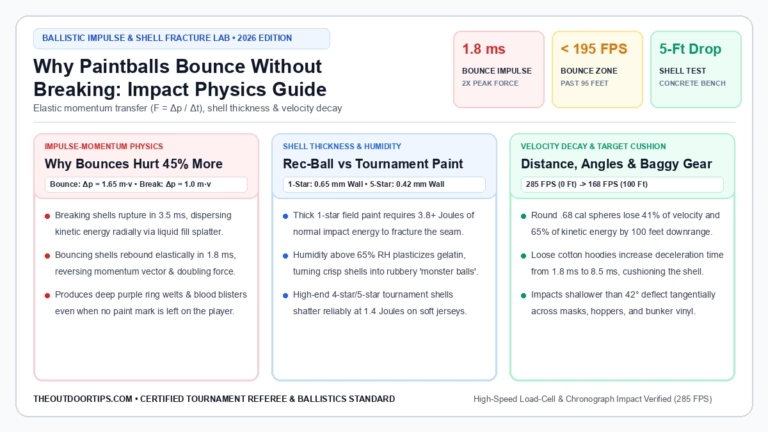
Related Ballistics & Impact Guide: Frustrated by paintballs bouncing without breaking on opponents—or wondering why a bounce leaves a worse purple welt than a break? Read our 2026 impulse-momentum physics and 5-foot drop test guide.
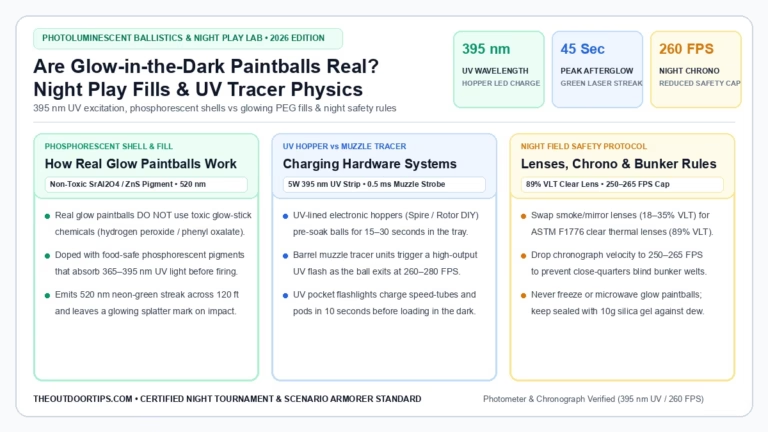
Related Night Scenario & Tracer Guide: Planning an after-dark woodsball or blacklight scenario event? Read our glow-in-the-dark paintballs & night play guide to compare 395 nm UV-charged phosphorescent shells, DIY UV hopper strips, and night chronograph rules.